FreeCryptoCurrency.Me

Free stocks and money too!

Category Archive : Crypto News

Frax founder says Fei Protocol situation reaches ‘new low for DeFi’

Sam Kazemian, founder of the stablecoin project Frax, expressed dismay at the way the sunsetting of the Fei Protocol and its hack redemption strategy is being handled.

The main issue appeared to be that it doesn’t plan to fully repay big protocols, including Frax, that were hurt by the hack.

In December, decentralized stablecoin project Fei Protocol merged with DeFi protocol Rari Protocol and became two connected protocols governed by a single group: Tribe DAO. In April the combined project suffered an $80 million hack. As The Block reported, Tribe DAO has now proposed a $157 million redemption package aimed at compensating victims  — one that would ultimately result in the dissolution of the DAO itself.

It’s the redemption package with which Kazemian takes issue. He argued on Twitter that the plan provides little to compensate affected protocols, including Frax and Olympus, as well as individuals who were hurt by the hack. He claims the protocol could instead redeem all of the stablecoins, repay all of the victims and have millions in value left over for Tribe’s governance holders. 

“An honorable, ethical, & respectable shutdown of a DAO is literally perfectly here. The money is there. The full repayment, the perfect peg redemption, & moral precedent is possible. I truly don’t understand how it’s possible to look at this, then decide “Na let’s take the rest,” he said.

He added, “This is truly one of the most mind boggling situations I’ve seen.”

In response to the redemption package proposal, Jack Longarzo, a core contributor to Rari Capital, acknowledged that while the package will reimburse most affected addresses, “a handful of the larger victims will only be partially reimbursed.”

Frax is a stablecoin project that is competitive with Fei, which Kazemian has openly criticized in the past. Still, the fates of the two projects have become more connected because of the hack.

After it happened, Kazemian said that Frax was one of Fei’s biggest supporters and users, acknowledging that Frax had been impacted by the hack. In today’s thread, he said that he had since tried to get in contact with the protocol’s founder, Joey Santoro, but to no avail.

© 2022 The Block Crypto, Inc. All Rights Reserved. This article is provided for informational purposes only. It is not offered or intended to be used as legal, tax, investment, financial, or other advice.

Go to Source
Author: Tim Copeland

Uniswap has blocked 253 crypto addresses related to stolen funds or sanctions

Decentralized exchange Uniswap has blocked 253 crypto addresses in its four months of working with blockchain analytics firm TRM Labs.

It was the first time Uniswap had revealed data on wallet blacklisting. 

The addresses were mostly blocked because of connections with stolen funds or transaction mixing services like Tornado Cash, which was recently sanctioned by the US Treasury. 

The data was published on GitHub by Uniswap software engineer Jordan Frankfurt, according to Yearn Finance core developer Banteg, who saved the data in a tweet thread and on GitHub. We reached out to Frankfurt and Uniswap for comment and will update this article should we hear back. 

There are three core things that make up Uniswap: code running on the blockchain that anyone can interact with, a front-end website that provides one way for users to interact with the code and a US-based company that develops the protocol and runs the front-end website. Blocking crypto addresses happens on the front-end level. 

Uniswap partnered with TRM Labs in April. When someone interacts with the Uniswap website, their address is sent to TRM Labs, which will assign it a risk level. It’s up to Uniswap to decide what risk levels it’s comfortable with. 

According to Frankfurt’s comments on GitHub, Uniswap initially blocked addresses that were indirectly related to sanctioned addresses, but has since scaled that back. Now it only blocks addresses that were sanctioned or have directly received hacked or stolen funds. 

TRM Labs checks the addresses for seven categories of illegal activity, according to a chart shared on GitHub. The main four that are commonly flagged are stolen funds, funds from a transaction mixer, sanctioned addresses and funds from a known scam. The remaining categories are child sexual abuse material, funds from known hacker groups and funds used for terrorist financing.  

Banteg noted that 30 of the addresses were associated with ENS names, which are human readable names used to make it easier to send crypto payments to those wallets. Banteg reckoned most of them were probably legitimate users.

© 2022 The Block Crypto, Inc. All Rights Reserved. This article is provided for informational purposes only. It is not offered or intended to be used as legal, tax, investment, financial, or other advice.

Go to Source
Author: Tim Copeland
BIT Mining seeks to reassure investors as NYSE threatens to delist

Bitcoin mining company BIT Mining, which is currently trading below $0.50 a share, said that investors shouldn’t be concerned with its current stock price, despite a warning from the New York Stock Exchange (NYSE) that the company is “not in compliance” with its listing standards. 

“It should not be concerning that our stock is currently trading at these levels,” Chairman Bo Yu said in a statement Friday. “Despite the tumultuous market conditions, rest assured that the current stock price will have no impact on our company’s normal business operations and our ability to create value for our investors in the future.”

Current market conditions have affected the industry in general in the past six months, reflecting “poorly on the stock prices and revenues for everyone in the sector,” Yu said.

The statement came on the heels of a notice from NYSE that BIT Mining’s shares could be delisted for trading below $1 for more than 30 days, a filing with the US Securities and Exchange Commission (SEC) shows.

The company was given six months to comply with those rules or “the NYSE will commence suspension and delisting procedures.” BIT Mining, in turn, told the NYSE that it intends “to cure the deficiency,” the company said in its filing with the SEC.

BIT mining’s stock fell below $1 on July 23, data from Yahoo Finance show. In the last six months, it has declined by about 85.8%. It was priced at $0.39 as of market close on Friday.

The company argued that the two rounds of funding it closed recently will help “maximize the value of our investments for the future of the company and continue our further expansion.” It raised $16 million from the sale of 16 million shares on June 30 and an additional $9.3 million on August 19. It also pointed toward its investments in research and development, including the “in-house development of a new generation of highly efficient” miners.

“These investments are in the future growth of our company and will yield the greatest returns in the medium to long term for our investors,” Yu told investors. 

BIT mining posted a net loss of $21 million in its second quarter on Friday. It reported an impairment charge related to cryptocurrencies of $4.9 million. Revenues were $195.5 million, down 34% from the previous quarter.

“Over the past quarter, we have focused on R&D and identifying synergies across our vertically integrated supply chain. Cryptocurrency price weakness and higher energy prices have had a significant impact on stock prices and revenues of companies in our sector, including BIT Mining,” BIT Mining CEO Xianfeng Yang said in advance of the company’s second-quarter earnings report.

The company recently announced the sale of its subsidiary Loto Interactive. It also acquired Bee Computing, a manufacturer of mining hardware. BIT Mining has four main business segments: self-mining, mining pool, data center operation and miner manufacturing.

“The company is pursuing its development strategy to focus on cryptocurrency mining operations globally,” it said in its second-quarter earnings. “Given our early-mover advantage in Ethereum mining, we are also making inroads into Proof-of-Stake (POS) operations by providing a series of services including governance and monitoring, node management and account systems.” 

© 2022 The Block Crypto, Inc. All Rights Reserved. This article is provided for informational purposes only. It is not offered or intended to be used as legal, tax, investment, financial, or other advice.

Go to Source
Author: Catarina Moura

Tribe DAO proposes a $157 million redemption for token holders, Rari hack victims

Tribe DAO is moving to close its doors and has outlined a multi-million dollar redemption plan that will see it distribute crypto assets to token holders as well as those impacted by the $80 million Rari hack earlier this year.

Tribe DAO — which acquired Rari in the largest DeFi merger of all time last year — proposed a roughly $157 million redemption plan to distribute remaining DAO-controlled assets to TRIBE holders and compensate victims of the Rari hack that occurred in April. Any approval would need to come during a future DAO vote by token holders.

On April 30, Rari Capital, a protocol that allowed users to create custom borrowing and lending markets for various assets, saw seven of its so-called fuse pools drained for approximately $80 million.

The redemption proposal would compensate hack victims from this incident with the teams’ 88.9 million unvested TRIBE tokens, which would distribute approximately $16 million dollars to victims.

The vesting period for the team’s tokens ends on July 1.

For TRIBE holders, the DAO-controlled assets total approximately $141 million and would be distributed in proportional allocations.

The motivation behind this move by Tribe DAO is a mixture of the current global macro environment, the Rari hack, and future regulatory risks, per the proposal.

“Any of the mounting technical, financial, and future regulatory risks could cause the project to be far worse off than it is now,” the proposal stated. 

The proposal is comprised of three components: consolidation (of DAO assets), fuse hack victim payment, and final redemption. Each component will have its own independent snapshot. “The purpose of the snapshots is to determine which parts of the proposal to include in the on-chain vote(s), and whether to adjust or change any pieces.” the proposer Fei Labs stated.

The first snapshot will be for the consolidation component and occur the week of August 22.

The proposal stated it could take one to two months after the snapshot before any developments are put up to an on-chain vote.

© 2022 The Block Crypto, Inc. All Rights Reserved. This article is provided for informational purposes only. It is not offered or intended to be used as legal, tax, investment, financial, or other advice.

Go to Source
Author: Mike Truppa

Bitcoin mining stock report: Friday, August 19

Most bitcoin mining stocks fell by double digits on Friday as bitcoin’s price dropped below $22,000.

The coin was trading at around $21,400 at market close, compared to$23,400 the day before.

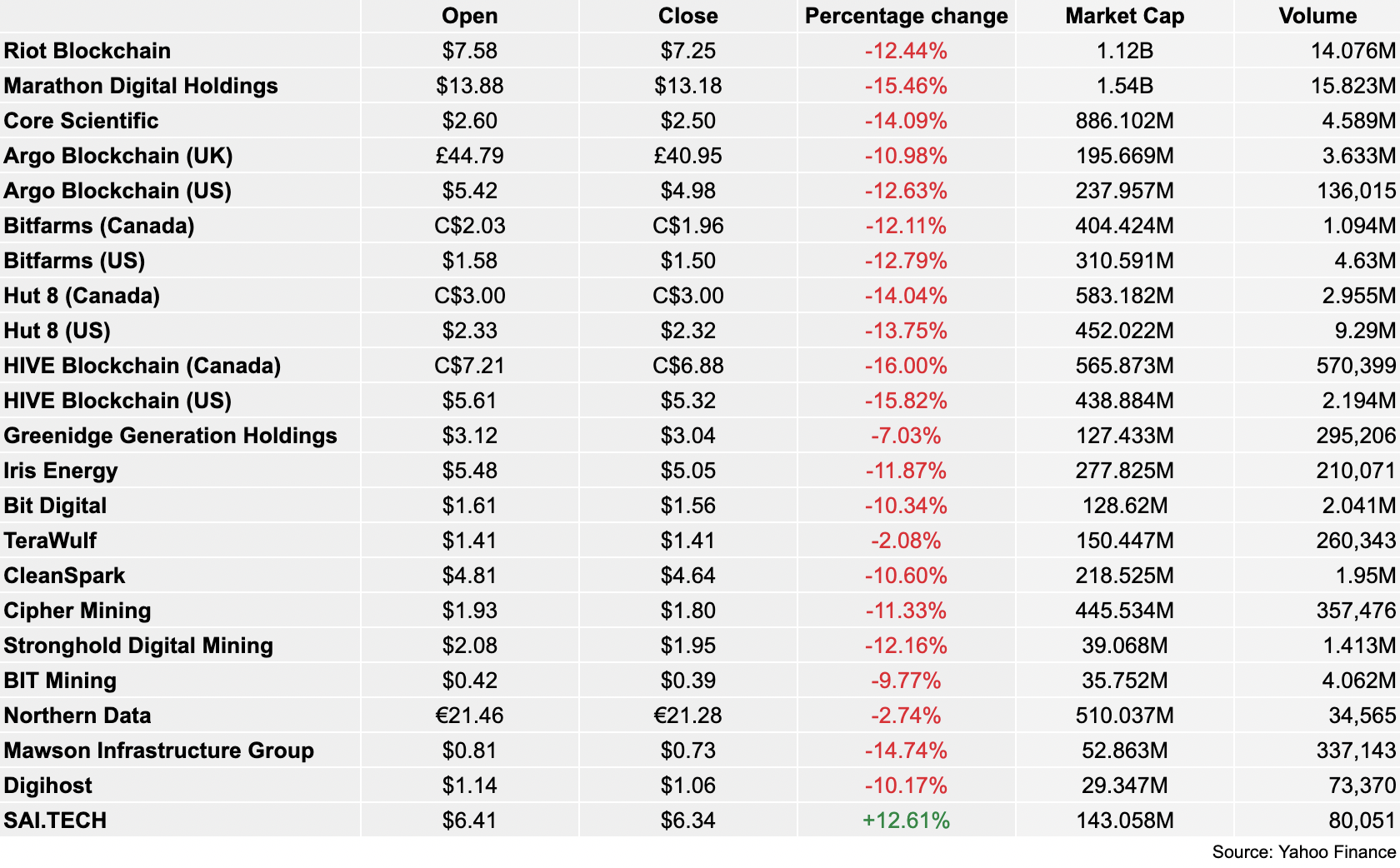
HIVE Blockchain’s stock was down by 16.00% on the Toronto Stock Exchange, followed by Marathon (-15.46%) Mawson Infrastructure Group (-14.74%), and Core Scientific (-14.09%). 

CleanSpark was down by 10.60%, after announcing that it closed on the acquisition of a site in Georgia initially reported last week.

Here’s how crypto mining companies performed on Friday, August 19:

An overview of how miners fared over the week of trading:

© 2022 The Block Crypto, Inc. All Rights Reserved. This article is provided for informational purposes only. It is not offered or intended to be used as legal, tax, investment, financial, or other advice.

Go to Source
Author: Catarina Moura

CFTC focuses on outreach as digital assets gain popularity among underserved groups

The US Commodity Futures Trading Commission (CFTC) sees a need to increase investor education and outreach as the market for digital assets grows and faces downturns, Commissioner Kristin Johnson said during a recent roundtable discussion.

“We must increase investor education and outreach to empower consumers and contemporaneously combat illicit activity and safeguard the integrity and stability of our financial markets,” Johnson said last week during an event focused on digital assets organized by the CFTC’s Office of Minority and Women Inclusion (OMWI) among others in the commission. 

The roundtable was the latest chance for policymakers to discuss cryptocurrencies through the lens of financial inclusion, focusing on topics such as investor protections for underserved groups and creating legislation to best serve those communities. Attendees also discussed the regulation, policy and innovation in the digital asset space. 

The roundtable also addressed the bipartisan Digital Commodities Consumer Protection Act of 2022 (DCCPA). If passed, the legislation would mandate, among other things, a CFTC study on how digital assets impact “diverse communities.” 

The CFTC commissioner’s prepared remarks also highlighted a June 1 report from the Federal Reserve Bank of Kansas City that “indicates that historically underserved groups have higher levels of participation in the crypto-investment community than the investment communities for traditional financial products.” 

“The CFTC must maintain high standards of enforcement and educational outreach to protect retail participants in the cryptocurrency market — a group that includes greater representation of younger and diverse investors,” Johnson’s prepared remarks said. 


© 2022 The Block Crypto, Inc. All Rights Reserved. This article is provided for informational purposes only. It is not offered or intended to be used as legal, tax, investment, financial, or other advice.

Go to Source
Author: Kristin Majcher

FDIC issues cease-and-desist letters to FTX US, other crypto firms over deposit insurance

This story is developing.

© 2022 The Block Crypto, Inc. All Rights Reserved. This article is provided for informational purposes only. It is not offered or intended to be used as legal, tax, investment, financial, or other advice.

Go to Source
Author: Michael McSweeney

Phygital NFTs: The Physical-Digital Nexus

Quick Take

  • “Phygital NFTs” enable a holistic product experience by blending physical and digital elements
  • Typically, the NFT is burned when its owner decides to redeem the corresponding physical product
  • Despite being prone to skeuomorphic use cases, phygital NFTs might provide promising benefits for particular industries

This research piece is available exclusively to
members of The Block Research.
You can continue reading
this Research content on The Block Research.

Go to Source
Author: Thomas Bialek

Latest Tether disclosures show $28.9 billion in US Treasury bills

Stablecoin issuer Tether on Friday published results of its latest quarterly assurance opinion, completed by public accounting firm BDO.

A quarterly assurance opinion is a method used by stablecoin issuers to assure the market that their coins are backed by real assets. It involves assessing and analyzing different operations, processes, and procedures.

The report reveals it holds $28.9 billion in US Treasury bills, $6.8 billion in money market funds, cash and bank deposits of $5.4 billion, reverse repurchase agreements of almost $3 billion and non-US Treasury bills of $397 million. 

It also shows a more than 58% decrease in Tether’s commercial paper holdings over the prior quarter from $20 billion to $8.5 billion.

“As previously announced, the exposure to commercial papers will be down to 200m by the end of August 2022 and to zero before the end of the year,” a post on Tether’s website says. “During the same period, Tether has increased its holdings of cash and bank deposits by 32%.”

“The utility of Tether continues to be supported by the transparency of its reserves and has been a leading source of stability allowing us to build a tool for the global economy,” said Paolo Ardoino, CTO of Tether, in a statement. “Our commitment to transparency and the community is a long-standing pillar in the underlying ethos of the company and aligns with our responsibility as a market leader.”

The report comes weeks after the stablecoin issuer said that it holds no Chinese commercial paper. 


© 2022 The Block Crypto, Inc. All Rights Reserved. This article is provided for informational purposes only. It is not offered or intended to be used as legal, tax, investment, financial, or other advice.

Go to Source
Author: Lucy Harley-McKeown

Self-custody solution Safeheron raises $7 million, partners with MetaMask

Safeheron, a self-custody solution for small-to-medium enterprises in the web3 space, announced it has closed a $7 million pre-Series A round. 

Co-leading the round is early-stage VC firm Yunqi Partners and hybrid venture and hedge fund Web3Vision, according to a news release on Friday. Other investors include M77 Ventures, PrimeBlock Ventures and Waterdrip Capital. 

Singapore-based Safeheron was founded in 2019 by Wade Wang, Max He and Bruce Wang. The founding team is a collective of technology industry heavyweights with Bruce having spent years working in the technical teams at Tencent and Alibaba and Wade played a founding role in the creation of Damai.com, China’s largest concert ticketing e-commerce platform.  

This technical know-how helped Safeheron create a solution that makes it easier for crypto native small-to-medium businesses to adopt institutional grade self-custody security.  

Self-custody means enabling users to have complete control of their digital assets. This is typically managed through crypto wallets which store the addresses of crypto assets on the blockchain and manage the sending and receiving of assets.

Safeheron leverages multi-party computation (MPC) and a trusted execution environment (TEE) to provide increased custody security, per the release. 

MPC enables multiple devices to validate a transaction removing the potential for a single point of failure, while TEE enables a safe area within the processor to execute code related to the transactions. 

Partnering with MetaMask

In addition to the new fundraise, software cryptocurrency wallet MetaMask is partnering with Safeheron to use its MPC technology to provide multi-factor authentication, according to the release.

MPC will first be integrated into the MetaMask Snaps system, which enables developers to expand the capabilities of MetaMask for their decentralized apps.

This means MetaMask users will now be able to use two or three verification devices to sign transactions, according to the release. The devices currently supported are the Keystone hardware wallet, MetaMask desktop extension and MetaMask mobile, per the release.

Raising a pre-Series A

Safeheron’s pre-Series A is an add-on to the existing seed funding, according to a spokesperson. To date, Safeheron’s total funding is $9 million. 

The funds will be used to continue enhancing the technology and infrastructure as well as expanding Safeheron’s presence internationally, said Bruce Wang, co-founder and CTO of Safeheron, in an interview with The Block. 

“Custody security providers often compete for enterprise clients, shunning SMEs with unaffordable solutions,” said Yu Chen, partner at Yunqi Partners, in the release. “So, we’re excited to back Safeheron, who’s making the safeguarding of crypto assets with enterprise-grade custody security solutions more accessible.” 

This fundraising round and partnership announcement comes as the crypto industry grapples with several security breaches related to wallets and private keys, such as the Harmony blockchain losing $100 million when a hacker took control of the multi-signature wallet linked to its Ethereum bridge. 


© 2022 The Block Crypto, Inc. All Rights Reserved. This article is provided for informational purposes only. It is not offered or intended to be used as legal, tax, investment, financial, or other advice.

Go to Source
Author: Kari McMahon


Follow by Email
Facebook20
Pinterest20
fb-share-icon
LinkedIn20
Share