FreeCryptoCurrency.Me

Free stocks and money too!

Category Archive : Crypto News

Bitcoin mining stock report: Monday, August 22

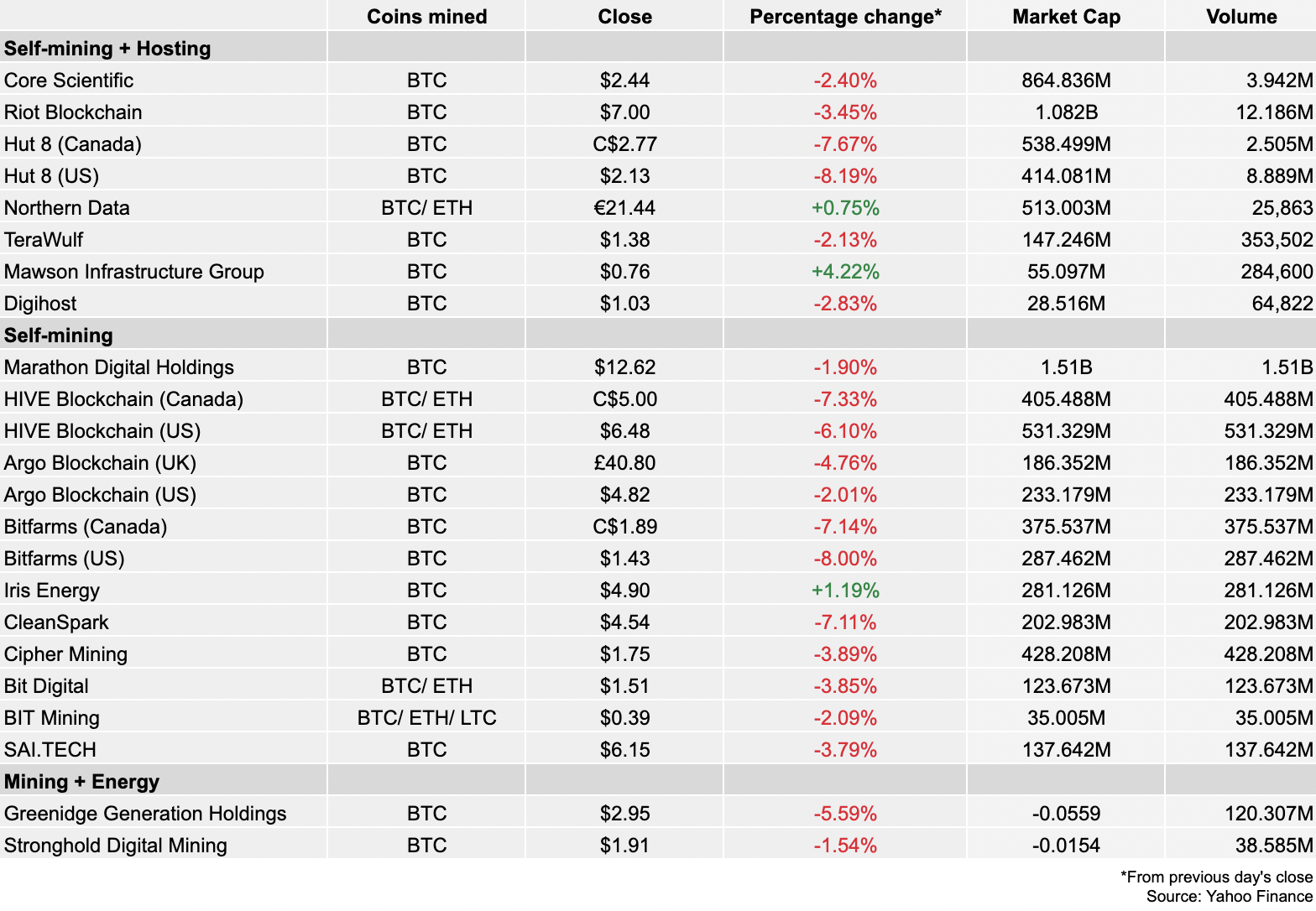
Bitcoin minings stocks were mostly down on Monday as the coin’s value remained close to $21,000.

Bitcoin was trading at $21,100 at market close, according to data from TradingView.

Hut 8 was down by 8.19% on Nasdaq, followed by Bitfarms (-8.00% on Nasdaq), HIVE Blockchain (-7.33% on Nasdaq) and CleanSpark (-7.11%).

Here’s how crypto mining companies performed on Monday, August 22:

© 2022 The Block Crypto, Inc. All Rights Reserved. This article is provided for informational purposes only. It is not offered or intended to be used as legal, tax, investment, financial, or other advice.

Go to Source
Author: Catarina Moura

Here’s how crypto-linked PACs are spending in the New York and Florida primaries 

Crypto-linked super political action committees (PACs) have poured $3.6 million into congressional races in New York and Florida, flexing some political muscle on both sides of the aisle ahead of Tuesday’s primary election.

Political leaders in New York and Florida are among the most outspoken in the nation about digital assets. The mayors of Miami and New York City have taken paychecks in cryptocurrency, for example.

Now, with Washington lawmakers pitching new rules to regulate the digital markets, cryptocurrency executives are boosting candidates for the House of Representatives in both states. Although crypto PACs are hardly the only outside groups spending serious cash to influence the primaries, their chosen candidates could become industry allies if elected this fall.

PACs come in various forms. Super PACs can raise unlimited amounts of money but cannot contribute to campaigns.

Here’s a roundup of where crypto-linked PACs are spending their cash ahead of primary day.

NY-01: Michelle Bond

Two crypto super PACs are wading into a Long Island congressional primary. Crypto Innovation PAC, an outside group funded by GMI PAC, has spent $411,000 to help Association for Digital Asset Markets CEO Michelle Bond in a three-way Republican primary. GMI PAC is funded by crypto industry executives including Bond’s boyfriend, FTX Digital Markets co-CEO Ryan Salame. Meanwhile, Crypto Freedom PAC reported spending $287,000 attacking Bond’s primary opponent, Nick LaLota. The outside group is linked to the Club for Growth, a major conservative group.

NY-03: Josh Lafazan 

Protect Our Future has spent more than a half-million dollars boosting Josh Lafazan’s Democratic primary bid. The PAC is focused on pandemic preparedness, not digital assets, but it is funded by FTX chief Sam Bankman-Fried. The group reported spending $511,000 to boost Lafazan, a member of the Nassau County Legislature.

Protect Our Future is a so-called hybrid PAC. Like a super PAC, it can make unlimited independent expenditures. But can also give limited amounts of money directly to campaigns and political committees. 

Lafazan has a lengthy crypto policy platform. He pledged to “proudly champion” the sweeping crypto bill released by Sens. Kirsten Gillibrand, D-N.Y., and Cynthia Lummis, R-Wyo., in June and has filed legislation to create a “Cryptocurrency Task Force” in the county legislature.

“Cryptocurrency is more prevalent now than before, and I believe that cryptocurrency is a positive force for good in the world not only as a new technology but as a tool for financial freedom,” Lafazan wrote on his campaign website.

NY-04: Laura Gillen

Bankman-Fried’s Protect our Future PAC is also playing in several other Democratic primaries on Tuesday. The group reported spending $251,000 on TV and digital ads boosting Democrat Laura Gillen. Gillen is the former town supervisor of Hempstead. 

NY-22: Francis Conole

Protect Our Future PAC’s third major race is in central New York, where Democrat Francis Conole is running in a crowded primary. The PAC has spent $510,000 promoting Conole, according to FEC filings. Conole is one of several candidates on the ballot Tuesday who accept cryptocurrency donations using the platform Engage Raise. 

FL-04: Aaron Bean

Florida Republican Aaron Bean has received a boost from another FTX executive in his primary contest. Salame, the FTX Digital Markets co-CEO, is backing Bean through his American Dream Federal Action PAC. The outside group is focused on broad issues like national security, rather than cryptocurrency. The group reported spending $450,000 on TV and digital ads and direct mail in the district, which includes parts of Jacksonville.

FL-10: Maxwell Alejandro Frost

Bankman-Fried’s Protect Our Future PAC is spending for a pair of Democrats in Florida primaries. The group has spent $963,000 in support of Maxwell Alejandro Frost, a 25-year-old activist running for an Orlando-based House seat. Bankman-Fried’s support has become an issue in the primary. Mysterious texts sent to voters accused Frost of being “fully in bed with conservative crypto-billionaire Sam Bankman-Fried,” the Orlando Sentinel reported. Bankman-Fried’s PAC typically supports Democrats, although Bankman-Fried has made some individual political contributions to Republicans.

FL-23: Jared Moskowitz

Protect Our Future has spent $262,000 to support former state Rep. Jared Moskowitz’s congressional bid. Moskowitz is one of six Democrats seeking a South Florida House seat. The PAC has purchased digital and TV ads.

© 2022 The Block Crypto, Inc. All Rights Reserved. This article is provided for informational purposes only. It is not offered or intended to be used as legal, tax, investment, financial, or other advice.

Go to Source
Author: Stephanie Murray

Telegram founder floats new auction marketplace

Telegram may launch a new marketplace to allow users to transfer usernames via “NFT-like smart-contracts,” founder Pavel Durov said in a message on the platform.

“Imagine how successful Telegram with its 700 million users could be if we put reserved @ usernames, group and channel links for auction,” Durov wrote on Monday. “In addition to millions of catchy t.me addresses like @storm or @royal, all four-letter usernames could be made available for sale.” 

TON jumped around 10% after Durov sent the message. The company did not immediately respond to a request for comment.

Durov is eyeing the TON blockchain, which he designed, to host decentralized sales, saying the Telegram team can “write bullet-proof smart contracts for TON.” He cited the success of a recent auction TON conducted for domain and wallet names, including wallet.ton which sold for 215,250 Toncoin (about $260,000) and casino.ton for about $244,000.

“Let’s see if we can add a little bit of Web 3.0 to Telegram in the coming weeks,” Durov said. 

In addition to t.me addresses like @storm or @royal, all four-letter usernames could be made available for sale, such as @bank, @club and @game, he said.

© 2022 The Block Crypto, Inc. All Rights Reserved. This article is provided for informational purposes only. It is not offered or intended to be used as legal, tax, investment, financial, or other advice.

Go to Source
Author: Stephanie Murray

NFT lender BendDAO begins vote to change protocol amid liquidity crisis

The BendDAO community is currently voting to make short-term changes to the non-fungible token (NFT) lending platform as the project tries to navigate a brewing liquidity crisis.

“We are sorry that we underestimated how illiquid NFTs could be in a bear market when setting the initial parameters […] After a comprehensive review and discussion, it’s time to make a proposal to help ETH depositors to build confidence,” the proposal stated.

BendDAO is an NFT lending platform. Lenders deposit ether (ETH) to earn interest and borrowers can obtain loans using their NFTs as collateral.

BendDAO supports seven major NFTs as collateral, including Bored Ape Yacht Club, Mutant Ape Yacht Club, CryptoPunks, Azuki and CloneX. Several borrowers have defaulted on their loans due to the rising interest rates for loans on the platform and the declining floor price value of their NFTs.

Lenders worried about the project’s health have withdrawn their funds from the platform. The NFTs put up as collateral for defaulted loans are now in danger of liquidation. Some items are already up for auction, but the demand is minimal.

There are a few reasons for the low demand. For one, BendDAO’s protocol mandates starting bids that are higher than the value of the debt and 95% of the floor price of the underlying NFT collateral. Secondly, liquidators in the auction must also lock up their ETH for 48 hours. Both parameters are not attractive to liquidators as the value of the debt can be higher than the floor price, making the deal unviable.

Today’s vote, which will end on Tuesday, is looking to change these parameters. The vote has called for a 5% reduction in the liquidation threshold on a weekly rolling basis. This change will begin with 85% on August 30 up until 70% on September 20.

This threshold refers to the spread between the floor price and the starting bid that liquidators can place when an NFT from a defaulted loan goes into auction. The vote also called for the auction lock-up period to be reduced from 48 hours to 4 hours.

Early voting figures are indicating support for the vote. BendDAO community members with 20 million veBEND tokens in total have voted in favor of the proposal and this amounts to 98% approval for the protocol changes.

BEND is the protocol’s native token and veBEND is the staked version of the token that gives voting rights to the holder. The vote will pass if those in support can amass up to 47 million veBEND tokens in the polls.

© 2022 The Block Crypto, Inc. All Rights Reserved. This article is provided for informational purposes only. It is not offered or intended to be used as legal, tax, investment, financial, or other advice.

Go to Source
Author: Osato Avan-Nomayo

Here’s how Rally is ‘democratizing’ ownership of a rare Noun NFT 

In a market that values rarity above all else, Nounders Noun NFTs stand out. So Rally decided to break one into pieces. 

Rally, a firm that creates fractional shares of valuable physical and digital assets, announced August 19 that it will sell Noun #160, a Nounders Noun non-fungible token (NFT). 

What makes a Nounders Noun so special? Unlike other projects which mint 10,000 items at once, the Nouns project says it will mint and auction off one NFT every day for forever.  

Anyone with enough money can buy a Noun, which often sell for around 80 ETH (about $150,000). Every 10th Noun goes directly to the 10 Nounders — the project founders — and is not available for public auction.  

It’s this rarity that made Rally interested in a Nounders Noun over a regular one, says Fitz Tepper, the vice president of operations at Rally. So the firm decided to acquire one. 

Nounders have occasionally sold these rare artifacts to friends, strategic partners and to cover the group’s expenses, says Punk 4156, one of the founding members of NounsDAO.  

“Fitz Tepper reached out at the end of March and proposed adding a Noun to the Rally platform and we thought it was an interesting idea,” Punk 4156 says. “We’re always looking for new ways to democratize Noun ownership.”

Breaking the token into pieces dramatically lowers the barrier of entry to ownership of one of these rare tokens. Buying a Noun could easily cost more than $100,000; through Rally, the price for one of the 13,000 shares on offer for Noun #160 starts at $15. 

Noun #160, an NFT previously reserved only for the 10 Nounders of NounsDAO, to be offered in fractionalized shares on August 19.

Fractional ownership over this Noun also gives holders the ability to vote in the Nouns governance process, which determines how to use the more than $50 million in its treasury.

Noun #160, an NFT previously reserved only for the 10 Nounders of NounsDAO, to be offered in fractionalized shares on August 19.  

But fractionalizing an NFT is not a straightforward process, and there are many details — including legal ones — that Rally had to work out behind the scenes to make this possible.  

From fractions to securities 

The impulse to break up valuable NFTs into cost-effective fractions emerged amid the market mania of 2021. Similar projects to Rally include Fractional.art, which allows users to purchase portions of popular NFTs such as CryptoPunks and items from Bored Ape Yacht Club.  

NFTs are generally not considered securities, but Rally has decided to avoid the question altogether. It went to great lengths to ensure all its NFT fractions are registered as securities with the United States Securities Exchange Commission (SEC).  

Rally does this through the Jumpstart Our Business Startups Act (JOBS) Act and a provision in that act called Regulation A+, or RegA+. The provision allows anyone to participate in private investments, not just accredited investors with a net worth of over $1 million or income of over $300,000. 

To create fractionalized shares of an asset as an SEC-registered security, Rally forms an LLC specifically for that asset. The LLCs of these assets are not subsidiary to Rally itself but another company Rally set up; Rally is the startup building a Robinhood-like app to track the LLCs’ securitized assets. s the the assets it has securitized assets.  

The SEC reviews every offering from these LLCs, such as asset information and risk disclosure, to ensure investors are protected. Once approved, Rally users then buy shares in the company that owns the asset.   

Rally expanded into digital assets in July of 2021. The platform first started with CryptoPunk #9670, one of 3,840 female Punks with rarer features of crazy hair (1 in 414) and nerd glasses (1 in 572). Rally then included Bored Apes, Azuki, Cool Cats and now it has a Noun on its roster. 

Voting matters 

“Our thesis for getting an asset on the platform is like always to get the best of the best, especially if it’s going to be seen as a long-term hold,” Tepper says, adding that this should not be read as investment advice. The Nounders Noun fits Rally’s preference for the rare, the same as a Bored Ape which has laser vision, Tepper says. 

Rally’s Noun comes with an a twist, though: holders get to participate in Nouns DAO’s decision making. So how does that work with fractional shares? 

Despite Nounders NFTs going specifically to Nounders, they still have the same voting power of other Nouns. One Noun equals one vote, Punk 4156 says. It’s up to Rally to figure out how that one vote will be split up among fractional holders. 

“We understand that Rally intends to build a mechanism for fractional owners to proxy vote their Noun, which is an exciting addition to the Nouns DAO governance model — and a stepping stone to wider awareness of the project and adoption of the Nouns DAO model,” Punk 4156 says. 

Rally is working on building a new voting mechanism for the fractionalized Nounders owners to participate in NounsDAO, says Tepper 

“Since the launch of the project, we’ve understood that most Nouns could eventually be owned and governed by more than one individual, says Punk 4156.

© 2022 The Block Crypto, Inc. All Rights Reserved. This article is provided for informational purposes only. It is not offered or intended to be used as legal, tax, investment, financial, or other advice.

Go to Source
Author: MK Manoylov

Former OpenSea employee accused of insider trading files motion to dismiss indictment

Lawyers for former OpenSea head of product Nathaniel Chastain filed a motion to dismiss an indictment against him, according to court documents.

Chastain was indicted by a grand jury on wire fraud and money laundering charges in June, after an insider trading scandal.

Chastain is accused of using confidential OpenSea business information to secretly purchase NFTs shortly before they were featured on the company’s homepage. After he bought the NFTs, Chastain allegedly sold them for a profit. He is also accused of conducting purchases using anonymous digital currency wallets and anonymous OpenSea accounts. The company acknowledged the incident in a blog post.

The defendant’s lawyers argue in the motion that NFTs are neither securities nor commodities, and wire fraud cases require trading in securities or commodities. The lawyers also claim that the government cannot prove whether the specific crypto transactions it cites qualify as financial transactions under money laundering rules. 

“The government has brought the instant prosecution using ill-founded applications of criminal law to set precedent in the digital asset space,” Chastain’s lawyers wrote in the motion to dismiss the indictment. 

© 2022 The Block Crypto, Inc. All Rights Reserved. This article is provided for informational purposes only. It is not offered or intended to be used as legal, tax, investment, financial, or other advice.

Go to Source
Author: Stephanie Murray

You’ve been punk’d: CryptoPunks takes top pricing spot from Bored Apes

CryptoPunks is back on top. The Larva Labs NFT collection is the most expensive and exclusive one, taking the spot from Bored Ape Yacht Club’s (BAYC).

The floor price is the lowest price at which a type of NFT is currently available for sale; at the time of writing, BAYC was going for 65.70 ETH, and CryptoPunks for 66.30 ETH, according to Dune Analytics. 

Bored Ape Yacht Club (BAYC) NFT collection, now at January lows, first overtook Larva Labs’ CryptoPunks in December. Since then Yuga Labs purchased the intellectual property rights to CryptoPunks, so either way, Yuga comes out on top.  

NFT prices have tumbled over the last few months as crypto markets endured a tumultuous period in May and June following the collapse of Terra’s blockchain and the ensuing liquidations. ETH has dropped 68% since November, hurting Ethereum-based NFTs when measured in dollar terms.  

BAYC floor prices may also be adversely affected as the BendDAO votes in coming days to lower its liquidation threshold for initial bids to 70% of floor price from 95%. The BendDAO allows users to lend to others to buy NFTs on leverage, but the DAO appears to be running low on ETH. That 95% threshold is proving to be too high and is infringing on the DAO’s ability to recoup its losses from bad debtors. No CryptoPunks are currently available on BendDAO.

The vote appears likely to pass with 98% poised to support the measure.

Over the past three months, NFT trade volumes have accompanied crypto prices lower. At the beginning of the year it was common practice for BAYC to register sales in excess of 300 pieces a week; in the first week of August, sales fell to 70.


© 2022 The Block Crypto, Inc. All Rights Reserved. This article is provided for informational purposes only. It is not offered or intended to be used as legal, tax, investment, financial, or other advice.

Go to Source
Author: Adam Morgan McCarthy

Magic Eden Company Intelligence

Quick Take

  • Founded in September 2021, Magic Eden runs the largest Solana NFT marketplace with +90% market share – Magic Eden verticals include its secondary market, Launchpad for full-service minting, Magic Eden Games content platform and Magic Ventures for Web3 gaming investments
  • Magic Eden closed a $27 million Series A funding round (led by Paradigm) in March 2022 and a $130 million Series B funding round (led by Electric Capital and Greylock Partners) in June 2022
  • In August 2022, Magic Eden started supporting Ethereum for its NFT marketplace – the company plans to provide top-notch end-to-end user experience for Ethereum users (services including Launchpad and cross-currency purchase option)

This research piece is available exclusively to
members of The Block Research.
You can continue reading
this Research content on The Block Research.

Go to Source
Author: Wendy Hirata

Invesco launches metaverse fund: Citywire

Global investment management firm Invesco announced the launch of the Invesco Metaverse Fund on Monday, in a move that will see it invest in a range of companies globally from across the ecosystem.

Registered in Luxembourg, it will focus on seven key areas, according to a report by Citywire. These include next generation operating and computer systems; hardware and devices that provide access to the metaverse; networks for hyper connectivity; immersive platforms developed with artificial intelligence; blockchain; interchange tools for interoperability; and services and assets facilitating the digitisation of the real economy.

The Block contacted Invesco for more details on the size and scope of the fund. 

Fund manager Tony Roberts and deputy fund manager James McDermottroe will jointly manage the new fund. Based in the UK, they are both part of the company’s Asia and emerging markets equities team.

Invesco launched its first blockchain exchange-traded fund (ETF) in March 2019 on the London Stock Exchange. In September last year, it partnered with Galaxy Digital to develop a range of cryptocurrency linked-ETFs.

Now eyeing web3, Roberts has claimed that virtual and augmented reality could deliver a £1.4 trillion boost to the global economy by 2030.  

“While the metaverse’s applications to entertainment are increasingly well-understood, the interconnectivity that it enables will likely have a transformative impact across industries as diverse as healthcare, logistics, education and sport,” he said.

© 2022 The Block Crypto, Inc. All Rights Reserved. This article is provided for informational purposes only. It is not offered or intended to be used as legal, tax, investment, financial, or other advice.

Go to Source
Author: Callan Quinn

Hodlnaut reports $193 million financial shortfall as it seeks court protection

Embattled crypto lender Hodlnaut reported a nearly $200 million financial shortfall in a court affidavit filed earlier this month and obtained by The Block.

The affidavit supporting Hodlnaut’s application to be placed under judicial management — filed August 12 — lays out exactly what led the company to freeze withdrawals on August 8.

The document was made available to customers after the company published a blog post on August 19 confirming that it is facing police proceedings in Singapore and that it has laid off 80% of its staff to conserve cash. The financial data is dated as of August 8.

The affidavit shows that Hodlnaut has an outstanding liability of SGD 391 million (around $281 million), compared with assets of SGD 122 million ($88 million), resulting in a shortfall of around $193 million. “As of 8 August 2022, the Hodlnaut Group has an outstanding liability balance of SGD 391M and estimated realisable assets of SGD 122M in cryptocurrency. This financial position gives the Hodlnaut Group a realisable cryptocurrency Asset to Debt ratio of about 0.31 (ie. 31 cents on the dollar),” it stated.

As previously reported, the firm filed for creditor protection in Singapore on August 16, seeking time to resolve its financial issues.

The document shows that Hodlnaut parked some $317 million in UST, the failed stablecoin, in Anchor Protocol on Terra as a way to pass high yields through to its customers. In May, Terra’s stablecoin UST sharply de-pegged from the dollar, inflicting losses of $189.7 million on Hodlnaut, per the affidavit. Those details were made public earlier last week.

Then, between June 14 and July 15, Holdnaut suffered “greater than usual net outflows” of around $150 million as panicked customers sought to recover their funds, according to the document. Hodlnaut also said its bitcoin (BTC) and ether (ETH) holdings were affected by the broader market decline.

The document also put the number of potential creditors of Hodlnaut — defined as “users who have actually deposited Tokens and who are likely to be creditors” — at 17,513.

Hodlnaut is exploring the option of allowing “limited exits” for users at 25 cents on the dollar, according to the affidavit. The firm managed $750 million at its peak in March of this year.

The company clarified that it is not in liquidation and that it can envisage delivering stable returns in the future, citing the “buoyancy” of the crypto market and the fact it was profitable since launching in 2019 — the UST exposure notwithstanding.

In the months after the collapse of Terra, Hodlnaut sought to reassure concerned customers. In one email to users on June 13, the company addressed the state of the crypto market at that time.

“Hodlnaut practices sound risk management policies. Despite the current volatile conditions, all Hodlnaut products & services remain unaffected and are fully operational, including interest payouts, token swaps, deposits and most importantly, withdrawals,” it said. “We take risk management in the company very seriously and utmost responsibility to customer assets and stakeholders is always at the top of our priority.”

Hodlnaut was contacted for comment on the contents of the affidavit but did not respond by press time.

Hodlonaut is not the only Singapore-based firm that is facing financial difficulties. Crypto exchange Zipmex and crypto lender Vauld have also sought creditor protection in the country. Zipmex has $53 million worth of exposure to troubled firms Babel Finance and Celsius. Vauld, on the other hand, owes more than $400 million to its creditors, as The Block reported last month.

© 2022 The Block Crypto, Inc. All Rights Reserved. This article is provided for informational purposes only. It is not offered or intended to be used as legal, tax, investment, financial, or other advice.

Go to Source
Author: Ryan Weeks and Yogita Khatri


Follow by Email
Facebook20
Pinterest20
fb-share-icon
LinkedIn20
Share