FreeCryptoCurrency.Me

Free stocks and money too!

Category Archive : Crypto News

Bitcoin mining stock report: Wednesday, August 24

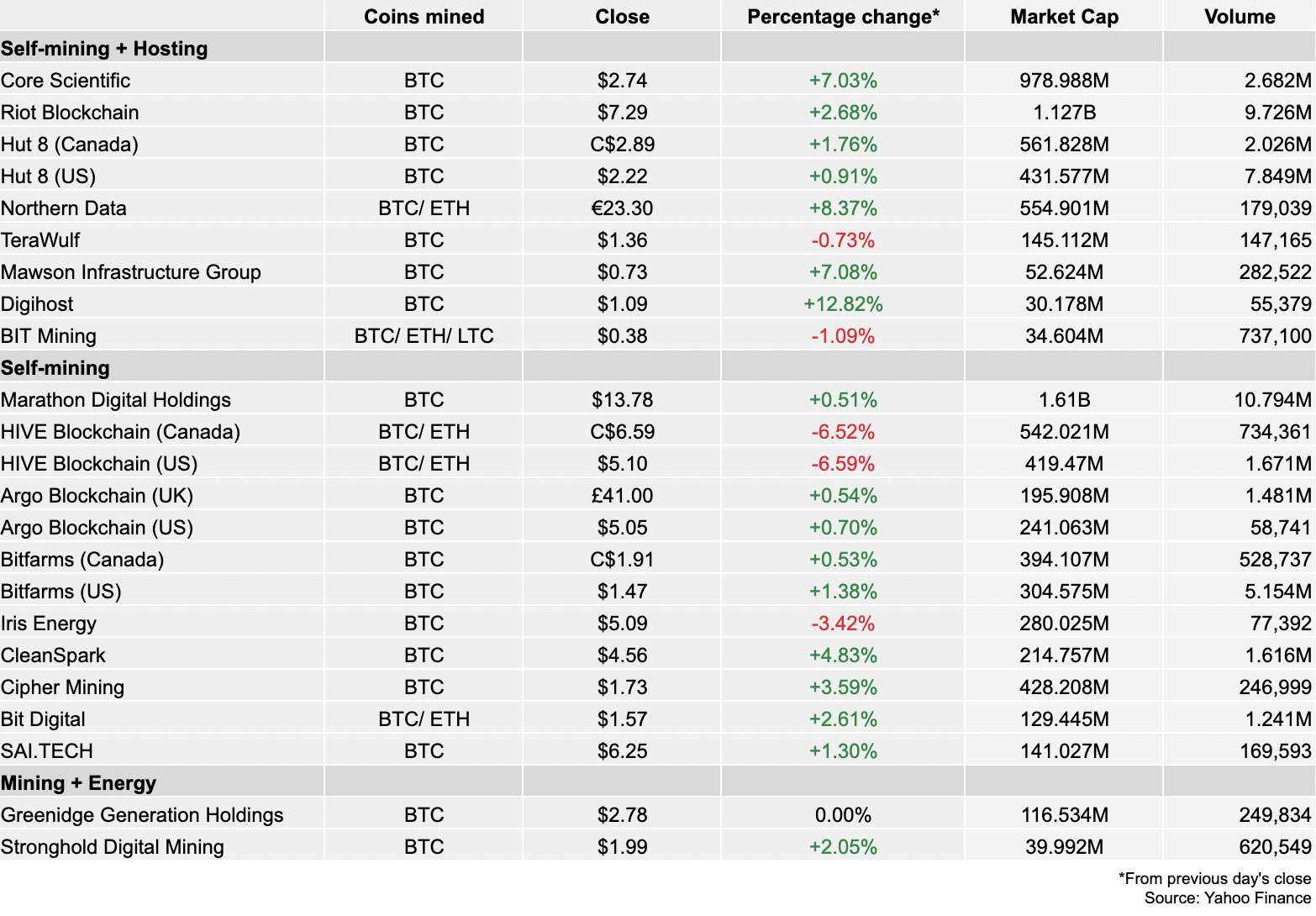
Bitcoin mining stock remained relatively stable into Wednesday.

The biggest percent change was from the bitcoin miner Digihost at a 12.82% increase, according to NASDAQ. Mawson Infrastructure Group (up 7.08%) and Core Scientific (up 7.03%) also fared well today. 

Stocks that fell the most today were both from HIVE Blockchain, with its US and Canadian stock down 6.59% and 6.52% respectively. 

Bitcoin’s price was nearly $21,700 at close, a modest increase from yesterday’s $21,500.  

Here’s how crypto mining companies performed on Wednesday, August 24:

© 2022 The Block Crypto, Inc. All Rights Reserved. This article is provided for informational purposes only. It is not offered or intended to be used as legal, tax, investment, financial, or other advice.

Go to Source
Author: MK Manoylov

Analysis of Tiger Global’s 13-F Filing

Quick Take

  • This report will focus on Tiger Global Management’s recent 13-F Public Filings 
  • Tiger Global sheds technology holdings amidst shaky YTD performance 
  • Fund performance has decline ~50% YTD
  • This report is part of The Block’s ongoing market commentary series 

This research piece is available exclusively to
members of The Block Research.
You can continue reading
this Research content on The Block Research.

Go to Source
Author: Greg Lim

Alameda Research co-CEO Trabucco resigns

Alameda Research co-CEO Sam Trabucco has resigned from his role at the crypto trading firm.

He will stay on as an adviser and Caroline Ellison will continue as sole CEO, Trabucco said in a Tweet. The company declined to comment further other than to confirm his exit.

“I can’t personally continue to justify the time investment of being a central part of Alameda,” Trabucco said. “Everyone works really hard here, and spending a ‘normal’ amount of time at work is tricky — especially when you’re trying to be a leader.”

Trabucco has been gradually scaling down his role at the company and doesn’t currently have any projects lined up, he also said. He joined as a trader in 2019.

“But I wouldn’t rule anything out in the future once I feel more ‘recovered,'” he added. “For years, I couldn’t think of anything more worthwhile to do with my time than to give it to Alameda. It’s honestly been a thrill to be a part of, despite being difficult and exhausting and consuming.”

© 2022 The Block Crypto, Inc. All Rights Reserved. This article is provided for informational purposes only. It is not offered or intended to be used as legal, tax, investment, financial, or other advice.

Go to Source
Author: Catarina Moura

Tether says it’s not freezing Tornado Cash until government tells it to

Tether is upholding its decision not to freeze sanctioned wallet addresses with ties to Tornado Cash because it has not received any requests from U.S. lawmakers or regulators to do so, the company said in a statement today. 

The US Treasury Department’s Office of Foreign Assets Control (OFAC) sanctioned the cryptocurrency mixer Tornado Cash on August 8, saying that criminals had used the service to launder more than $7 billion worth of virtual currency. 

“So far, OFAC has not indicated that a stablecoin issuer is expected to freeze secondary market addresses that are published on OFAC’s SDN List or that are operated by persons and entities that have been sanctioned by OFAC,” Tether said in a statement, which appears to be responding to a Washington Post article that said the company “may be in violation” of the new Treasury Department sanctions aimed at Tornado Cash. “Further, no US law enforcement agency or regulator has made such a request despite our near daily contact with US law enforcement whose requests always provide precise details,” Tether said.

The Treasury Department now lists several sanctioned wallet addresses for ether (ETH) and Centre’s dollar-pegged stablecoin USD Coin (USDC). While Tether’s U.S. dollar-pegged stablecoin USDT does not appear by name on the list, that currency can interact with ETH addresses using the ERC-20 token standard. For example, this Tornado Cash router address processed a USDT payment days after the Treasury sanctions.

Tether said that it “works closely” with U.S. law enforcement, and does freeze privately held wallets when it receives legitimate requests from authorities. But it said that it has not received any such requests from the United States government regarding the sanctioned wallets with ties to Tornado Cash. 

“Tether normally complies with requests from US authorities, being in contact with them almost on a daily basis,” the company said. “For example, we have been cooperating on various freezes with US law enforcement, including in the last two weeks after the OFAC public disclosure about Tornado Cash, and no specific request has been put to us related to freezing relevant Tornado Cash addresses.”

Furthermore, Tether said that “unilaterally freezing secondary market addresses could be a highly disruptive and reckless move” on its part. “Even if Tether recognizes suspicious activities on such an address, completing a freeze without the verified instruction of law enforcement and other government agencies might interfere with ongoing and sophisticated law enforcement investigations,” it said.

Meanwhile, the wider crypto industry has been seeking clarity on what kind of actions it must take to comply with the Treasury Department sanctions. Earlier this week, Rep. Tom Emmer, R-Minn., wrote a letter to Treasury Secretary Janet Yellen requesting answers about how the department plans to enforce these sanctions, considering they focus on computer code rather than specific individuals or companies. 

© 2022 The Block Crypto, Inc. All Rights Reserved. This article is provided for informational purposes only. It is not offered or intended to be used as legal, tax, investment, financial, or other advice.

Go to Source
Author: Kristin Majcher

Beijing lays out plan for metaverse development in tech development zones

Beijing released a new plan for developing “metaverse” technologies and NFTs.

The municipal government detailed its two-year “Beijing Urban Sub-Center Metaverse Innovation and Development Action Plan” in an Aug. 23 release

The plan leans heavily on existing development of the Beijing International Science and Technology Innovation Center and “the implementation plan for Beijing to build a global digital economy benchmark city in the city’s sub-center.”

It emphasizes a potential role for metaverse development in the city’s innovation center as a source for tourism and cultural interchange. That includes a metaverse theme park and “smart hotels.”

No budgets for actual grants or subsidies for developments were provided as part of the release. The term “metaverse” has elicited different interpretations and Beijing’s plan seems to lean heavily on a vision for a metaverse that largely just means virtual reality.

China famously banned cryptocurrency mining in early 2021, but has remained keenly interested in blockchain technological development and digital economies since. Though it is not on a public ledger and so volumes are unclear, China’s digital yuan is on beta testing whose scale likely makes it the largest operational central bank digital currency to date. 

© 2022 The Block Crypto, Inc. All Rights Reserved. This article is provided for informational purposes only. It is not offered or intended to be used as legal, tax, investment, financial, or other advice.

Go to Source
Author: Kollen Post

Crypto exchange Coinme adds ETH and five other cryptocurrencies to its crypto kiosks 

The Seattle-based crypto exchange Coinme will add six additional cryptocurrencies to its list of buyable assets from its kiosks, the company announced Wednesday.  

Individuals can now purchase ethereum, dogecoin, chainlink, litecoin, lumens and polygon at Coinme-powered Coinstar kiosks in the United States.  

While most crypto exchanges are accessible online, crypto kiosks like the Coinme-enabled Coinstar machines allow individuals to purchase cryptocurrency in person at one of these machines in more than 10,000 locations. 

Coinme is the crypto exchange providing compliant cryptocurrency sales, and Coinstar manufactures the large green coin machines. These machines are usually found in supermarket chains and allow users to cash in coins, purchase electronic gift cards and, as of January 2019, buy bitcoin. 

“Customers have asked us to make other coins available besides bitcoin on Coinme-enabled Coinstar kiosks,” Coinstar CEO Jim Gaherity said in a release. “We want to make it easy for anyone, regardless of their familiarity with crypto, to get started with digital currencies with cash in their local grocery stores.” 

Coinme-enabled Coinstar machines require know-your-customer safeguards such as photo ID and phone number, as well as limits to how much cryptocurrency a user can purchase, The Block previously reported.  

© 2022 The Block Crypto, Inc. All Rights Reserved. This article is provided for informational purposes only. It is not offered or intended to be used as legal, tax, investment, financial, or other advice.

Go to Source
Author: MK Manoylov

Neopets brings noughties nostalgia to web3 with metaverse launch

Neopets Meta, the web3 spin-off of the classic early noughties virtual pets online game, will launch the alpha version of its metaverse on Friday.

Those holding non-fungible tokens (NFTs) from the Neopets Metaverse, Pizzaroo’s Unique Pizza and Masterpiece NFT collections will be able to sign up and access the platform. Throughout September the team will release features allowing interactions with Neopets, decorating Neohomes and battling other players.

Several classic mini-games from the original platform are also getting the web3 treatment, including Turmac Roll, Meera Chase and Ultimate Bullseye.

Originally launched in 1999, 150 million users have played Neopets over its more than two decades in existence. Outliving competitors such as Club Penguin, it has retained a loyal following but struggled to return to the levels of popularity it experienced at its peak. That’s despite a surge in interest prompted by “nineties kid nostalgia.”

It also has had to contend with the retirement of Adobe Flash last year, which rendered most of its games unplayable, as well as a major hack last month.

The pivot to web3 has attracted its share of criticism since the company announced the move last year. Although the Neopets Meta team said it operates independently of the OG team and that it’s not intended to replace the original platform, long-time fans remain sceptical of the project and, particularly, its use of NFTs.

The largest community forum for Neopets, Jellyneo, quickly came out against the project upon launch with a #noneonfts campaign on social media, although much of its campaigning appears to have died down. Nevertheless Neopets Meta is hoping to get more community input, including through creating a DAO following the public game launch, which is expected in Q1 2023. 

“Similar to all major technological advancement in the past, it normally takes a few years for the mass adoption to take place. At this stage, we understand that NFTs are not for everyone, but there’s hope that Neopets Metaverse can be a propelling force to help the public to cross the chasm,” chief metaverse officer Dominic Law told The Block via email.

© 2022 The Block Crypto, Inc. All Rights Reserved. This article is provided for informational purposes only. It is not offered or intended to be used as legal, tax, investment, financial, or other advice.

Go to Source
Author: Callan Quinn

Republican Rep Lauren Boebert fails to report crypto transactions in 2021

Rep. Lauren Boebert, R-Colo., failed to file transactions reports for several crypto purchases made in 2021, according to her annual financial statement filed on August 13. 

Under the Stop Trading on Congressional Knowledge of 2012 (STOCK) Act, members of US House of Representatives are required to file a “periodic transactions report” for each securities trade over $1,000 made by them, their spouse and dependent children no later than 45 days after the transactions. 

In the annual financial statement, Boebert listed one checking asset jointly owned by her and spouse Jayson Boebert and several other assets solely owned by her husband, including a cryptocurrency with value between $1,001 and $15,000.  

The statement further listed eight crypto transactions – four purchases and four sales – between May 5 and 7. All transactions are made through Jayson’s account at trading site Robinhood.

The value of each transaction is unknown, as the report only noted their range of between $1,001 and $15,000. None of the transactions resulted in more than $200 in profits, according to the filing. 

A further search of the House financial disclosure database on Lauren Boebert in the 2021 filing year only generated the annual report, but not the periodic transactions report as required by the STOCK Act. 

The lawmaker did not respond to The Block’s request for comment. 

Several politicians in Congress are known to invest in crypto, including Sen. Ted Cruz, R-Texas, who purchased bitcoin valued between $15,001 and $50,000 in January; Sen. Pat Toomey, R-Pa.,  who invested between $1,000 and $15,000 in two Grayscale’s major cryptocurrency products; and Sen. Cynthia Lummis, R-Wyo., who bought up to $100,000 worth of bitcoin on August 16. 

© 2022 The Block Crypto, Inc. All Rights Reserved. This article is provided for informational purposes only. It is not offered or intended to be used as legal, tax, investment, financial, or other advice.

Go to Source
Author: Kharishar Kahfi

Fin Tech: Baby Shark creators announce second NFT drop

Just when you thought it was safe to dive back into the metaverse, the makers of Baby Shark announced a second non-fungible token (NFT) collection based on the franchise. Doo-doo-doo-doo-doo-doo.

The show, which was made famous via a viral song that is the most viewed video in YouTube history and will now reign in your head for the next week or so, said on Wednesday that the collection’s presale, available to a select and oh so lucky group of fans, will be available to mint at the end of August. It will then be open for public sale Sept. 1. 

The first Baby Shark NFT drop in December made a splash, selling out in an instant, according to The Pinkfong Company, which is behind the phenomenon that has become the theme song of parental nightmares.

It will be comprised of 10,000 computer generated images featuring Baby Shark and his family: Baby Shark, Mommy Shark, Daddy Shark, Grandma Shark and Grandpa Shark, released in three parts. 

NFT holders will be able to customize and/or mint new items and be given eligibility for exclusive airdrops and entry into raffles for prizes like tickets to Baby Shark events, merchandise and custom digital content. Collectors will also have priority access to limited goods and immersive experiences both online and offline.

NFT marketplace MakersPlace will play host to the drop. 

Baby Shark is not the first kids-focused project to stray into the metaverse and try to build out a web3 presence. The YouTube hit CoComelon, which is known for nursery rhymes, also said it would mint NFTs on the Flow blockchain via Zigazoo, a social media network for children. Zigazoo announced in June it had raised $17 million in a Series A fundraise led by Liberty City Ventures to develop its web3 offerings. 

© 2022 The Block Crypto, Inc. All Rights Reserved. This article is provided for informational purposes only. It is not offered or intended to be used as legal, tax, investment, financial, or other advice.

Go to Source
Author: Lucy Harley-McKeown

Ethereum Foundation confirms September dates for the Merge

Ethereum’s developers have officially confirmed September 6 as the date for Ethereum’s long-anticipated transition from proof of work to proof of stake, known as The Merge.

“Following years of hard work, Ethereum’s proof-of-stake upgrade is finally here!” the Ethereum Foundation wrote in a blog post on Wednesday. “The successful upgrade of all public testnets is now complete, and The Merge has been scheduled for the Ethereum mainnet.”

The Merge will be split into two upgrades, called Bellatrix and Paris. Bellatrix is timed to occur at 11:34 AM UTC on September 6 and Paris will be triggered sometime between September 10 and September 20, according to the blog post, which provided the image below. 

Source: Ethereum Foundation

Proof of stake relies on validators instead of miners. Instead of expending lots of computing power, like proof-of-work miners do, proof-of-stake validators lock up sums of money to prove their trustworthiness to the network. The switch has been a long-held goal for Ethereum’s developers. In the final testing step, the Goerli testnet successfully merged on August 10. 

The new blog post also includes links to download the necessary upgrades for the various Ethereum clients. Operators will need to do this before the Bellatrix update occurs. “Update your clients!” tweeted Ethereum Foundation comms lead Joseph Schweitzer.  

While this makes the date more official, Ethereum’s developers had previously suggested the September 6 date for the Bellatrix upgrade during a call on August 11. During that call, they also targeted the Paris upgrade to happen on September 15.  

Still, the date might change due to block times and hash rate fluctuations. The Paris upgrade could happen as many as five days earlier or five days later than expected. Should the hash rate drop significantly, the developers might manually override the chain — as they did on the Ropsten testnet. 


© 2022 The Block Crypto, Inc. All Rights Reserved. This article is provided for informational purposes only. It is not offered or intended to be used as legal, tax, investment, financial, or other advice.

Go to Source
Author: Kharishar Kahfi


Follow by Email
Facebook20
Pinterest20
fb-share-icon
LinkedIn20
Share