FreeCryptoCurrency.Me

Free stocks and money too!

Category Archive : Crypto News

Binance signs agreement with Busan, South Korea to develop blockchain infrastructure

Global cryptocurrency exchange Binance has signed an agreement with the city of Busan, South Korea to help develop the city’s blockchain infrastructure and support its efforts to boost crypto adoption and business development.

“We are happy to be working with the City of Busan to bring tangible blockchain-related developments that benefit and support the city’s innovation efforts,” Binance CEO Changpeng Zhao said in a statement. “Through our industry-leading position and technological expertise, combined with the City of Busan’s strong support for the blockchain industry, we hope to help grow crypto adoption within the city and beyond.”

Binance is also helping the city establish digital asset exchanges within the city through its “regulatory-free zone.” 

“With this agreement, we are one step closer to establishing the Busan Digital Asset Exchange as a global integrated platform for digital assets,” Park Heong-joon, Busan’s mayor, said in a statement. “By making Busan a blockchain-specialized city that is attracting worldwide attention, we will boost a new growth engine for the local economy and make it a global digital finance hub.”

Binance plans to set up an office in Busan later this year, South Korean newspaper Chosun Ilbo reported. 

Busan, a port city home to about 3.4 million people, is a popular beach tourism destination located in the southeast region of the country. Busan is home to a smart city test bed called the Eco Delta Smart City. 

© 2022 The Block Crypto, Inc. All Rights Reserved. This article is provided for informational purposes only. It is not offered or intended to be used as legal, tax, investment, financial, or other advice.
Go to Source
Author: Kristin Majcher

Host of 10% of Ethereum nodes prohibits crypto usage, discussing consequences

Cloud service provider Hetzner, which hosts 10% of Ethereum nodes, said that using its products for crypto mining and trading was against its terms of service, and it’s “discussing” what to do with the users who run them, the company wrote in a statement on its subreddit. 

Hetzner stated that this prohibition covered nodes on both proof-of-work and proof-of-chain networks. A user will be in violation of the Terms of Service (ToS) even if they “just run one node,” the company said.

“We are aware that there are many Ethereum users currently at Hetzner, and we have been internally discussing how we can best address this issue. If you, or any other potential customers are unsure about whether your use case will violate our ToS, please reach out to us,” Hetzner’s said in the Reddit post.

Hetzner did not immediately respond to The Block’s request for comment.

The company’s ToS says the company can lock customer’s access to their services if they do not comply.

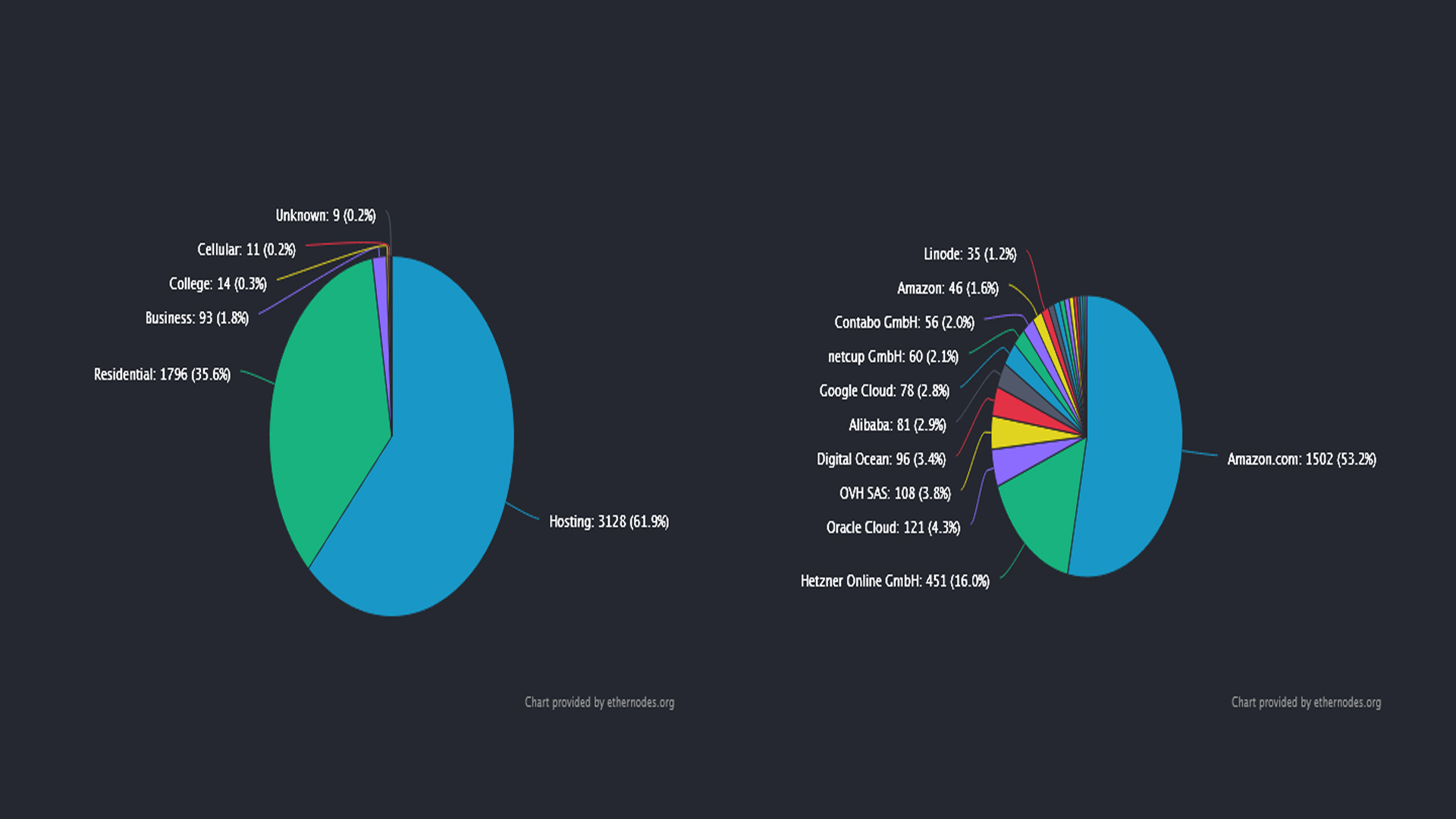
The cloud service provider currently hosts 16% of all Ethereum hosting nodes, according to data from Ethernodes. Hosting nodes make about 62% of the total node count on the Ethereum mainnet. As such, Hetzner is hosting approximately 10% of Ethereum’s node count.

Ethereum nodes

The situation once again brings up the issue of crypto’s technology stack centralization. Infrastructure service providers, both mainstream and crypto-native, tend to be centralized. As such, they pose single points of failure for crypto applications if they run into problems or discontinue their services. 

Decentralised tech stacks capable of supporting the current size of the crypto space don’t exist yet. 

Centralized crypto-native infrastructure providers like Infura have suffered outages in the past. These outages have caused temporary disruptions to the crypto apps like MetaMAsk.


© 2022 The Block Crypto, Inc. All Rights Reserved. This article is provided for informational purposes only. It is not offered or intended to be used as legal, tax, investment, financial, or other advice.
Go to Source
Author: Osato Avan-Nomayo

Markets whipsaw following Jerome Powell’s hawkish speech at Jackson Hole

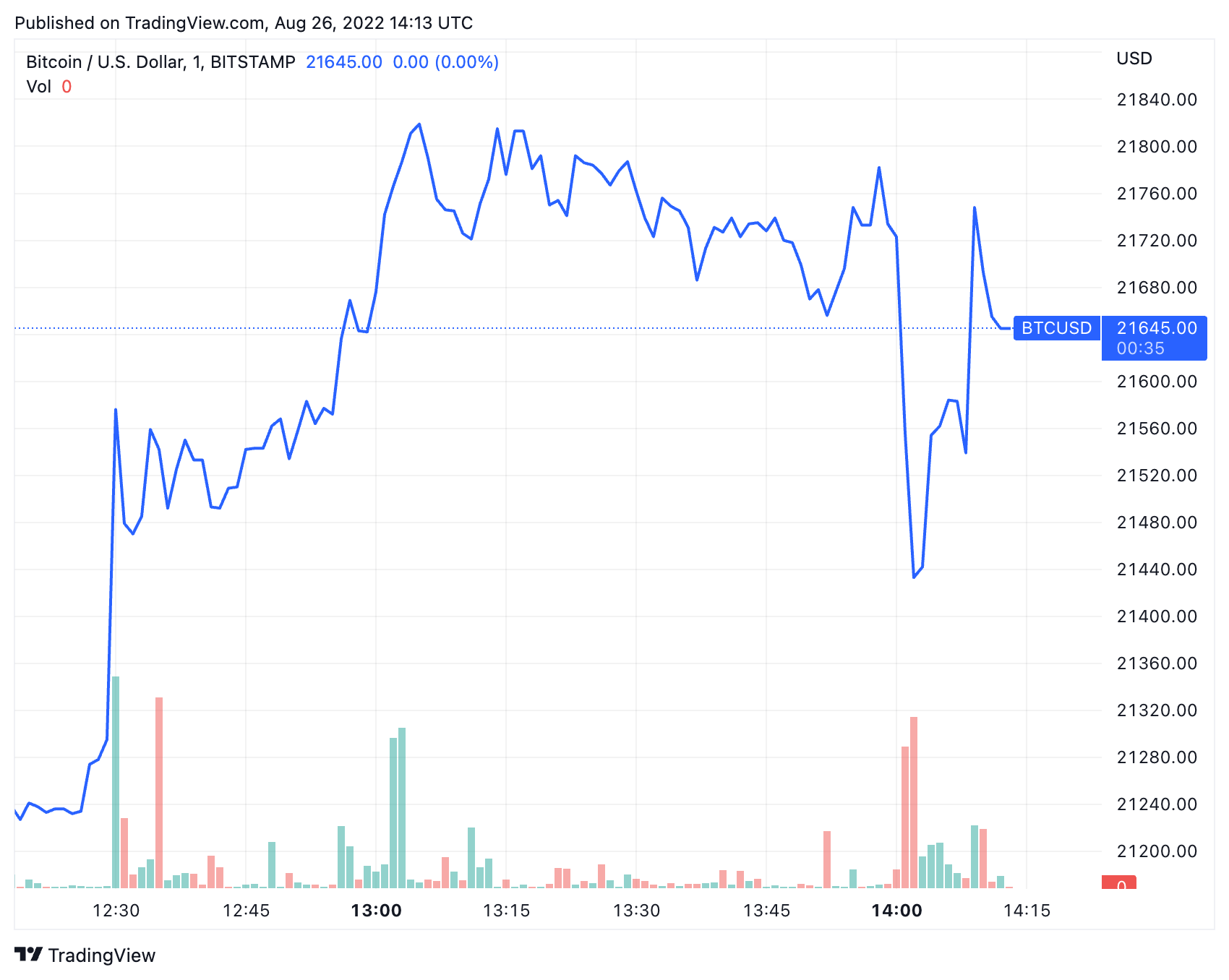
Crypto prices rose in the hour leading up to the speech, bitcoin was trading a little higher than $21,800 and ether rose above $1,700. Prices dipped during the speech as the Fed chair shared his colleagues median interest rate projections – just under 4% through the end of the year.

“While the lower inflation readings for July are welcome, a single month’s improvement falls far short of what the Committee will need to see before we are confident that inflation is moving down,” Powell said. He then went on to add that the Fed’s decision in September will depend on the “totality of the incoming data and the evolving outlook.”

The annual inflation rate in the US slowed to 8.5% in July from a more than 40-year high of 9.1% in June. That was below market forecasts of 8.7%. The US economy dropped by 0.6% during the second quarter, data yesterday showed. That was better than estimates of -0.7%.

An aggressive stance against inflation has and likely will continue to be a headwind in the short-term for all risk assets, including digital assets, Fidelity Digital Assets research analyst Jack Neureuter said.

Powell warned households and businesses will feel the pain as the bank acts to rein in inflation.

“If there is growing evidence that inflation has peaked, then it’s likely that longer-dated interest rates would fall substantially from their current levels – serving as a possible catalyst for both risk assets and relatively looser financial conditions,” Neureuter said.

Esther George, head of the Kansas City Fed, shared more revealing remarks on Thursday, telling Bloomberg TV rates may go above 4% at some stage. “We have to get interest rates higher to slow down demand and bring inflation back to our target,” George said. 

The Jackson Hole symposium takes place every year in Wyoming and is typically attended by central bankers, finance ministers, academics and other market participants from around the globe. The conference theme for 2022 is “reassessing constraints on the economy and policy.”


© 2022 The Block Crypto, Inc. All Rights Reserved. This article is provided for informational purposes only. It is not offered or intended to be used as legal, tax, investment, financial, or other advice.

Go to Source
Author: Adam Morgan McCarthy

Layer by Layer Issue 43: Canto, Dogechain, and Polkadot

Quick Take

  • In this weekly series, we dive into some of the most interesting data and developments across the Layer 1 blockchain landscape, from DeFi and bridges to network activity and funding
  • Newly launched L1 chains today are beginning to more deeply integrate DeFi into their core strategies
  • On Acala, a misstep in implementing a DeFi strategy spirals into a crisis for the parachain

This research piece is available exclusively to
members of The Block Research.
You can continue reading
this Research content on The Block Research.

Go to Source
Author: Kevin Peng

Zipmex in advanced rescue talks with investment firm, billionaire’s son: source

Zipmex is in advanced talks with Country Group Holdings (CGH), a Thailand-based investment firm, and Chalermchai Mahagitsiri, son of Thai billionaire and coffee king Prayudh Mahagitsiri, a source with direct knowledge of the matter told The Block.

The troubled South Asian crypto exchange, which halted client withdrawals last month, said Thursday that it is in “advanced” talks with two investors for a potential deal.

Mahagitsiri plans to invest in Zipmex via his cybersecurity services company called Cloudsec Asia, the source said, adding that Mahagitsiri is also one of Zipmex’s top creditors. Mahagitsiri owns 10% of Cloudsec Asia via his ventures unit V Ventures Technologies Company. Notably, V Ventures is also an existing investor in Zipmex, having participated in its Series B round last September.

CGH is an investor in Thailand-based Cryptomind Group, which operates a decentralized finance (DeFi) asset management platform called Elkrem Capital, according to its website.

Zipmex declined to comment on CGH and Mahagitsiri’s investment interest. 

“We are bound by a legal confidentiality agreement, so we cannot confirm or deny anything,” chief marketing officer Proud Limpongpan told The Block.

CGH and Mahagitsiri did not immediately respond to The Block’s request for comment.

Zipmex issues

Zipmex halted client withdrawals on July 20 due to volatile market conditions and the resulting financial difficulties of its “key business partners.” It later revealed that those business partners are Babel Finance and Celsius, two beleaguered crypto lenders that suspended withdrawals in June. Zipmex’s total exposure to Babel and Celsius is $53 million and it is reportedly looking to raise about that much from investors.

Zipmex has since moved to resume some withdrawals for certain assets. It is currently working towards re-enabling all fund transfers from its Z wallets to Trade wallets. Zipmex’s Z wallet allowed users to opt for its ZipUp+ feature to deposit their crypto holdings and earn rewards. The Trade wallet allowed users to deposit fiat currency and trade and store cryptocurrencies. This wallet also enables fiat and crypto withdrawals.

“By resuming the Z Wallet service and doing everything possible to resolve the aforementioned problems. I can confirm that we will continue to move forward to resume services to serve our customers effectively and fairly,” Zipmex co-founder and Thailand CEO Akalarp Yimwilai said in Thursday’s statement about advanced talks with two investors.

Zipmex yesterday also announced that it has appointed restructuring specialist KordaMentha Pte as its financial advisor. KordaMentha and Zipmex are expected to provide further updates regarding the restructuring process soon.

Zipmex has until December 2 to to sort out its financial problems, having received a moratorium extension of over three months from the Singapore High Court earlier this month.

© 2022 The Block Crypto, Inc. All Rights Reserved. This article is provided for informational purposes only. It is not offered or intended to be used as legal, tax, investment, financial, or other advice.

Go to Source
Author: Yogita Khatri

NFT Scoop with MK Manoylov: UTA’s head of web3 explains Hollywood’s push to represent NFT brands

Episode 80 of Season 4 of The Scoop was recorded remotely with The Block’s MK Manoylov and Lesley Silverman, Head of Web3 at United Talent Agency.

Listen below, and subscribe to The Scoop on AppleSpotifyGoogle PodcastsStitcher or wherever you listen to podcasts. Email feedback and revision requests to podcast@theblockcrypto.com.


While NFT projects grew in popularity, so too did brand recognition — and the interest of talent representatives to sign them on.

United Talent Agency (UTA) was among the first in August of 2021, when it signed CryptoPunks and Meebits creators Larva Labs, followed by Deadfellaz in April of this year. Other talent representatives got into web3 as well, such as Creative Artists Agency (CAA) signing on the NFT collector 0xb1 in October 2021 and even hiring a Chief Metaverse Officer in August of this year. 

But why did talent representatives like UTA sign on these NFT brands at all? Why do NFT brands need talent representation? 

To get to the heart of these questions, MK sat down with UTA’s head of web3, Lesley Silverman. Silverman has been at UTA for the past seven years, educating artists on the utility of web3 and helping interested artists launch their web3 brand. Before joining UTA, Silverman worked as a fine arts lawyer, and she says this experience shaped how she lead UTA through the NFT space. 

In this episode of NFT Scoop, Manoylov and Silverman discuss: 

  • The role talent representatives like UTA play in representing web3 brands — and why they’re necessary. 
  • The internal push in UTA to sign on NFT brands. 
  • Differences in representing web2 and web3 brands. 
  • Legal considerations when representing NFT projects.

This episode is brought to you by our sponsors Tron, Chainalysis &IWC Schaffhausen
About Tron
On August 1st, 2022, Poloniex launched a faster and more stable trading system along with a brand new user interface. Poloniex was founded in January 2014 as a global cryptocurrency trading platform. With its world-class service and security, it received funding in 2019 from renowned investors, including H.E. Justin Sun, Founder of TRON. Poloniex supports spot and margin trading as well as leveraged tokens. Its services are available to users in nearly 100 countries and regions with various languages available. For more information visit Poloniex.com

About Chainalysis
Chainalysis is the leading blockchain data platform. We provide data, software, services, and research to government agencies, exchanges, financial institutions, and insurance and cybersecurity companies in over 60 countries. Backed by Accel, Addition, Benchmark, Coatue, Paradigm, Ribbit, and other leading firms in venture capital, Chainalysis builds trust in blockchains to promote more financial freedom with less risk. For more information, visit www.chainalysis.com.

About IWC Schaffhausen
IWC Schaffhausen is a Swiss luxury watch manufacturer based in Schaffhausen, Switzerland. Known for its unique engineering approach to watchmaking, IWC combines the best of human craftsmanship and creativity with cutting-edge technology and processes. With collections like the Portugieser and the Pilot’s Watches, the brand covers the whole spectrum from elegant timepieces to sports watches. For more information, visit IWC.com

© 2022 The Block Crypto, Inc. All Rights Reserved. This article is provided for informational purposes only. It is not offered or intended to be used as legal, tax, investment, financial, or other advice.

Go to Source
Author: MK Manoylov

Banking behemoth MUFG invests in Animoca Brands Japan’s $45 million raise

Animoca Brands Japan, a subsidiary of web3 investment firm Animoca Brands, has raised $45 million from Mitsubishi UFJ Financial Group, Inc. (MUFG) and Animoca Brands.

This brings the subsidiary’s pre-money valuation to $500 million with the investment being split equally between the two investing firms, according to a press release on Friday. 

Animoca Brands is a Hong Kong-based web3 investing behemoth with a portfolio of more than 340 investments including The Sandbox, Axie Infinity, Open Sea and Dapper Labs, per the release.

In July, Animoca Brands raised $75 million at a pre-money valuation of $5.9 billion. 

The Japanese subsidiary formed in 2021 to support the adoption of web3 among Japanese intellectual property (IP) and content holders, according to the release. 

In February, Animoca Brands Japan completed a $10 million seed round from MCP IPX One Fund and Animoca Brands. Then in March, the subsidiary company announced it was considering a collaboration with MUFG for non fungible-token (NFT) related business opportunities. 

MUFG is a leading financial firm headquartered in Tokyo, Japan. It currently has 170,000 employees and operates in more than 50 countries, per the release. MUFG’s stock trades on the Tokyo, Nagoya, and New York stock exchanges. The firm manages $3.1 trillion in assets.

The new funds will be used to secure licenses for intellectual property, promote adoption of web3 and develop internal capabilities, according to the release. 

© 2022 The Block Crypto, Inc. All Rights Reserved. This article is provided for informational purposes only. It is not offered or intended to be used as legal, tax, investment, financial, or other advice.

Go to Source
Author: Kari McMahon

Blockchain explorer SolanaFM raises $4.5 million, plans to expand to Aptos

Solana blockchain explorer and indexing provider SolanaFM has raised $4.5 million in a seed funding round led by Japanese financial services company SBI Group’s Digital Asset Opportunity Fund. 

Other investors involved in the round include Spartan Group, Mirana Ventures, D1 Ventures and Petrock Capital, according to a press release on Friday. 

The Singapore-based startup formed out of a Solana hackathon where co-founders Nicholas Chen, Bing Huang and Fathur Rahman decided to focus on infrastructure solutions for the blockchain. 

This resulted in SolanaFM, which has two core tools. The first is an indexer, which enables people to gather and access Solana data at a highly efficient rate, Rahman said. The second is a blockchain explorer to view and interact with Solana data, he added. 

A blockchain explorer enables individuals to query information stored on the blockchain. One of the most well-known blockchain explorers is Etherscan. 

“Etherscan really did a good job in building out a very simple explorer,” Rahman said.  

SolanaFM wants to elevate this experience for the Solana ecosystem, creating a more user friendly and visual experience that will help bring “normies” into the ecosystem, Rahman said. 

Indexing as a service

The blockchain explorer is more of a public good, Rahman said.  

“We built it solely because we felt there was an issue right there and that we need to fix it,” Rahman said. The indexer will be the predominant way the startup earns revenue through indexing as a service, Rahman added.  

The funds from the new raise will be leveraged to scale SolanaFM and invest in hiring. The startup also secured an undisclosed amount in a funding round led by Etherscan and Coinhako in December. 

Expanding to Aptos

Despite the naming, SolanaFM is blockchain agnostic, Rahman said. The startup is exploring launching similar tooling on the Aptos blockchain alongside existing services on Solana. 

“Once you build an explorer, and people love it and we know that people love it then it sticks with them, [so] it makes sense for us to actually expand into Aptos as well,” Rahman said. “They already known how to interact with it in Solana, so when they go into Aptos, it’s a similar experience.” 

Aptos is a new Layer 1 blockchain that formed out of Facebook’s Diem blockchain project. It’s raised a total of $350 million in funding this year with a Series A in July and a seed round in March 

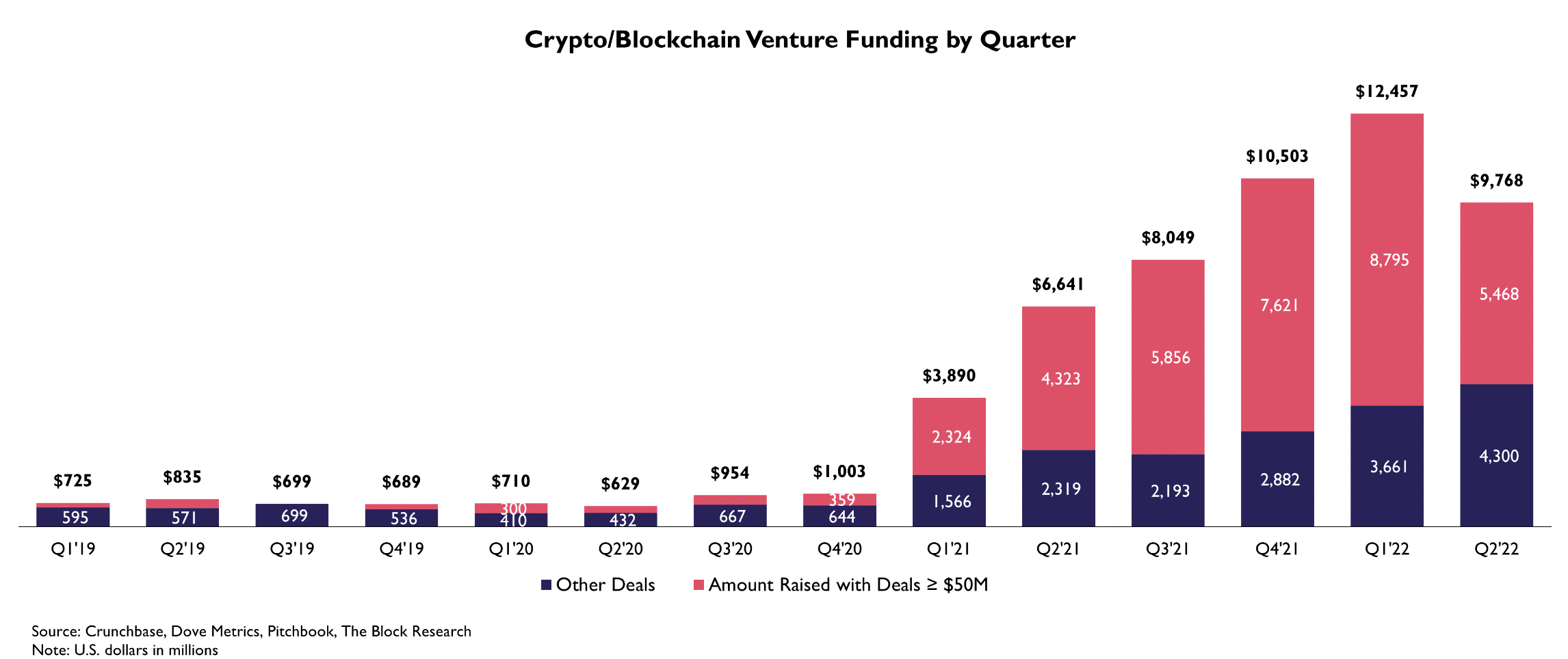
The blockchain’s most recent fundraise occurred at a challenging time in venture funding. Blockchain venture funding declined 22% from $12.5 billion in the first quarter to $9.8 billion in the second quarter of this year, according to The Block Research. 

Blockchain/crypto venture funding by quarter

Blockchain/crypto venture funding by quarter from The Block Research


© 2022 The Block Crypto, Inc. All Rights Reserved. This article is provided for informational purposes only. It is not offered or intended to be used as legal, tax, investment, financial, or other advice.

Go to Source
Author: Kari McMahon

NFT marketplace volumes fell further in August

The latest non-fungible token (NFT) marketplace data show that the summer volume doldrums continued through August.

The volume for this month is, as of August 24, $369.53 million, according to The Block’s Data Dashboard. By contrast, NFT marketplaces saw approximately $675.43 million in volume during July.

OpenSea continues to hold its place as the dominant market leader, accounting for $303.47 million or roughly 82% of the month’s reported volume activity. OpenSea’s volume was $528.64 million in July. That month, OpenSea announced a round of layoffs, citing difficult market conditions.

Declines can be seen elsewhere across the NFT marketplace ecosystem. As of August 24, Solana-focused Magic Eden has seen $36.17 million in volume, compared to $87.44 million in July — a roughly 59% decline. LooksRare’s volume for August is $13.51 million, compared to $30.55 million, representing a decline of about 56%. 

On-chain trading activity for Ethereum-based NFTs has trended downward since May as well, according to the Data Dashboard. 

Such a decline in NFT marketplace activity is perhaps unsurprising, given the volume declines across broader crypto exchange services since the spring. That decline in activity is reflected in The Block Legitimate Index, following the 2022 peak in May.

© 2022 The Block Crypto, Inc. All Rights Reserved. This article is provided for informational purposes only. It is not offered or intended to be used as legal, tax, investment, financial, or other advice.

Go to Source
Author: Michael McSweeney

SEC delays decision on VanEck’s latest bitcoin ETF application

The Securities and Exchange Commission has delayed a decision on VanEck’s latest bid to create a spot bitcoin exchange-traded fund (ETF).

The order set Oct. 11 as the date on which the SEC would “either approve or disapprove, or institute proceedings to determine whether to disapprove, the proposed rule change.” The previous deadline was Aug. 27. The SEC noted in the order that it had received no public comments on VanEck’s submission.

VanEck’s most recent application was filed on June 24.

VanEck previously sought SEC approval but was denied in November after a months-long process. Numerous other attempts to score the SEC’s nod for a crypto ETF have failed. In its disapproval orders, the SEC has consistently cited investor protection and market manipulation concerns. 

Among the firms trying to create a spot bitcoin ETF is issuer Grayscale, which received a rejection on June 29. Grayscale subsequently filed a lawsuit in an effort to challenge that decision.

Though the SEC has rejected all efforts to create the first US bitcoin ETF, it did clear the way for the listing of several futures-tied ETFs. 

© 2022 The Block Crypto, Inc. All Rights Reserved. This article is provided for informational purposes only. It is not offered or intended to be used as legal, tax, investment, financial, or other advice.

Go to Source
Author: Michael McSweeney


Follow by Email
Facebook20
Pinterest20
fb-share-icon
LinkedIn20
Share