FreeCryptoCurrency.Me

Free stocks and money too!

Category Archive : Crypto News

Web3 game developer Xterio raises $40 million in SAFT sale

Xterio, a web3 game developer and publisher, has raised $40 million in a funding round co-led by video game developer FunPlus, venture capital firm Makers Fund, FTX Ventures and blockchain gaming platform XPLA. 

Other investors in the round included Animoca Brands, HashKey, Foresight Ventures, Infinity Ventures Crypto and Matrix Partners, Xterio announced Tuesday. This was Xterio’s first fundraise and realized via a simple agreement for future tokens (SAFT) sale, co-founder Jeremy Horn told The Block in an interview. The round brings Xterio’s valuation to $300 million, he added.

While the current market downturn meant Xterio had to work to be “extra convincing” to investors, the firm ultimately closed an oversubscribed round and didn’t have to lower its valuation, said Horn, a former FunPlus and Jam City executive.

With fresh capital in hand, Xterio plans to develop and publish web3 games and scale its team. Horn declined to comment on specifics of planned games but said they will be “equal in quality to the best console games out there.” 

Horn also declined to comment on which blockchain Xterio is using for its native token but said it’ll be a “utility” token to reward users and partners. Xterio will first publish its own games and then add partners’ games in the future, said Horn.

Xterio aims to onboard regular web2 gamers into web3. Horn said Xterio is building its entire ecosystem around user participation. “We are going to always have users participate in the development of games and be really transparent on what’s happening on each game,” he said. 

Xterio is expected to release multiple games “in the upcoming quarters” for both mobile and browser interfaces. 

There are currently over 60 people working for Switzerland-based Xterio and it plans to hire more in the near future, said Horn. Xterio is helmed by game executives from Electronic Arts, Activision Blizzard and Krafton. Its chief technology officer is co-founder of FunPlus, Yitao Guan. 

“Xterio has the right team, the right technology and the right approach to be builders in these early days of creating the next generation developer and publisher designed for the web3 era,” said Chris Petrovic, chief business officer at FunPlus and a council member of the Xterio Foundation. “They understand that ultimately the entertainment value of experiences must come first to truly deliver the promise of web3 in the long run.”

© 2022 The Block Crypto, Inc. All Rights Reserved. This article is provided for informational purposes only. It is not offered or intended to be used as legal, tax, investment, financial, or other advice.

Go to Source
Author: Yogita Khatri

Reddit co-founder’s VC firm seeking $177.6 million to invest in crypto tokens: The Information

Seven Seven Six, the venture capital firm led by Reddit co-founder Alexis Ohanian, plans to raise a new $177.6 million crypto fund to invest in tokens, The Information reported Monday, citing fundraising materials.

The fund, dubbed Kryptós, will target tokens that are available at a discount thanks to the crypto market downturn. “This is the best time to buy if you’re really long on the industry,” Seven Seven Six founding partner Katelin Holloway told The Information. “It’s on sale. Everything is on sale.”

Seven Seven Six has registered as an investment adviser with the US Securities and Exchange Commission to invest in tokens. It received the registration in April. 

Kryptós will charge investors a 2.5% management fee, according to the fundraising materials. It will also receive carried interest, or a share of the fund’s profits, of 25%, with the possibility of 35% if the fund returns five times or more capital, per the materials.

This is Seven Seven Six’s first crypto-focused fund. The firm has previously raised two funds worth $500 million to invest across industries, including crypto. It manages more than $900 million in assets.

A growing number of high profile venture capital firms are raising funds specifically to invest in tokens. Earlier this year, Sequoia Capital raised $500 to $600 million to primarily invest in tokens and participate in the governance of projects. Bessemer Venture Partners also recently launched a $250 million crypto fund and created a decentralized autonomous organization or DAO to connect members of the crypto community for idea sharing, business development and tokenomics.

© 2022 The Block Crypto, Inc. All Rights Reserved. This article is provided for informational purposes only. It is not offered or intended to be used as legal, tax, investment, financial, or other advice.

Go to Source
Author: Yogita Khatri
Lemniscap leads investment in oracle provider Redstone’s $7 million round

Decentralized finance oracle provider Redstone closed a $7 million seed funding round led by investment firm Lemniscap. 

The new funding comes just over a year after Redstone’s founding and during a challenging time for fundraising in DeFi. For the second quarter of this year, venture deals for DeFi were at the their lowest point since the fourth quarter of 2020, according to The Block Research

Besides Lemniscap, other investors in Redstone’s round include Coinbase Ventures, Blockchain Capital, Lattice, Arweave and Maven 11, according to a press release on Tuesday. 

Oracles are tools that provide real-world data, from financial asset prices to blockchain smart contracts. They provide a way to access off-chain data in an on-chain environment, which can be essential for contracts that rely on real-world data to make decisions. 

How Redstone works

Redstone uses the Arweave blockchain to provide pricing data from sources like FTX and Yahoo Finance to protocols. Arweave, a decentralized storage network, provides Redstone with an affordable storage solution with a permanent audit trial, per the release. 

It also features a dispute mechanism that is backed by collateral from data providers. 

Redstone provides data feeds to over 30 chains including Ethereum, Avalanche, Celo, Arbitrum and Fantom, according to the release. It does this through a proprietary ‘EVM-connector’ to put data on-chain.

Expanding the product suite

However, the firm believes the oracle could become compatible with every chain though new implementations of its core technology like the Solana-connector or ZK-connector, according to the release. 

The idea for the startup was conceived during the Arweave OpenWebFoundry in 2020, it officially launched at the start of 2021. In July of that year, Redstone raised $525,000 in its first round of funding.

The new funds will be used to speed up the rollout of RedStone’s product suite. This product suite includes Warp Contracts, which are smart contracts built on top of Arweave that are suited to data processing and storage, per the release. 

Investing in infrastructure

“Given the conveyor belt of sophisticated DeFi protocols hitting the market, the need for decentralized oracles that can process huge amounts of data has never been more pronounced,” said Roderik van der Graaf, founder of Lemniscap, in the release.  

The Block Research’s July funding report highlighted that infrastructure deals decreased by 22% from June to July, but funding levels in the wider crypto space grew 178% from $297 million to nearly $827 million. 

The report notes that in previous cycles, during crypto market turmoil, infrastructure plays have often proven a favored investment choice.

Blockchain infrastructure venture funding by month from The Block Research

Blockchain infrastructure venture funding by month from The Block Research


© 2022 The Block Crypto, Inc. All Rights Reserved. This article is provided for informational purposes only. It is not offered or intended to be used as legal, tax, investment, financial, or other advice.

Go to Source
Author: Kari McMahon

Brazil’s central bank picks Itaú DeFi project among new innovation proposals

Brazil’s central bank picked proposals for eight new projects to advance through its innovation lab, including a decentralized finance (DeFi) staking pool from Itaú Unibanco, the country’s largest bank. 

The proposed project will be a “platform that, through blockchain and smart contracts, allows custody, currency exchange and alternative investments,” a Central Bank statement in Portuguese said. “The use case consists of creating a liquidity pool, with tokens that emulate stablecoins that can have parity with the [Brazilian] real, dollar or some other fiat currency, with its operation being similar to that of liquidity DeFis that operate in the digital asset market.”

The list of proposals also includes several other blockchain-related projects. One proposal from Lovecrypto involves converting a stablecoin on the Celo blockchain into what would be Brazil’s central bank digital currency (CBDC), the Real Digital. Another project from Delend Tecnologia would form a decentralized credit protocol aimed at small- and medium-sized businesses, while a separate proposal from Celso Jungbluth focuses on decentralized microcredit.

The lab will open on Sept. 9, and developers must submit a functional prototype and report for each project by Dec. 15.

Itaú is the largest Brazilian bank, according to S&P Global, holding more than $371 billion in total assets. The Central Bank also selected another Itaú project focusing on near-field communication (NFC) and QR code technology to further innovate PIX, the country’s instant payment system.

This marks the fifth round of projects the LIFT Lab has selected since its launch in 2018. In March, LIFT chose to develop nine projects aimed at developing a Brazilian CBDC. 

© 2022 The Block Crypto, Inc. All Rights Reserved. This article is provided for informational purposes only. It is not offered or intended to be used as legal, tax, investment, financial, or other advice.

Go to Source
Author: Kristin Majcher

Four numbers to know going into Ethereum’s Merge

Ethereum’s long-awaited Merge is expected to arrive next month, and would-be blockchain watchers may want to pay attention to some notable metrics.

The Merge — the final stage in Ethereum’s transition from proof-of-work to proof-of-stake — will see the so-called Beacon Chain and its fleet of validators become the underpinnings of the blockchain network.

This event follows a long phase of planning, iteration, trial-and-error and public discourse.

Here are some of the key numbers to keep in mind ahead of The Merge.

417,855

This figure refers to the number of validators in place as of August 28. The data comes from beaconcha.in, which provides a number of data points about the network.

Validators are essentially the miners of the proof-of-stake blockchain. In order to participate in the network, they must stake 32 ETH. Validators function in part to create the next block of transactions, thereby extending the chain as new transactions are added to the network. They also store information about the network.

13,218,949

That’s the amount of ETH deposited to date in Ethereum’s staking contract. The contract was first launched in November 2020 and kicked off the initial phase of Ethereum’s proof-of-stake transition.

The above figure comes from a Dune Analytics dashboard maintained by Dune co-founder Fredrik Haga.

79,322

To date, there are almost 80,000 unique depositors who have contributed funds to the staking contract and, thus have set aside the necessary funds to become a validator.

According to the data collected by Haga, the biggest depositor has deposited 288,160 ETH to the address.

58,750,000,000,000,000,000,000

Yes, that eye-popping number has a significant meaning for Ethereum’s Merge.

It refers to a value known as Terminal Total Difficulty, which is the trigger point at which Ethereum will actually shift from proof-of-work to proof-of-stake. 

Ethereum co-founder Vitalik Buterin tweeted earlier this month about the number’s setting, stating that “[t]his means the ethereum [proof-of-work] network now has a (roughly) fixed number of hashes left to mine.”

61

This last number is only indirectly related to the Ethereum network itself but speaks to the attention being paid as of late to the upcoming upgrade.

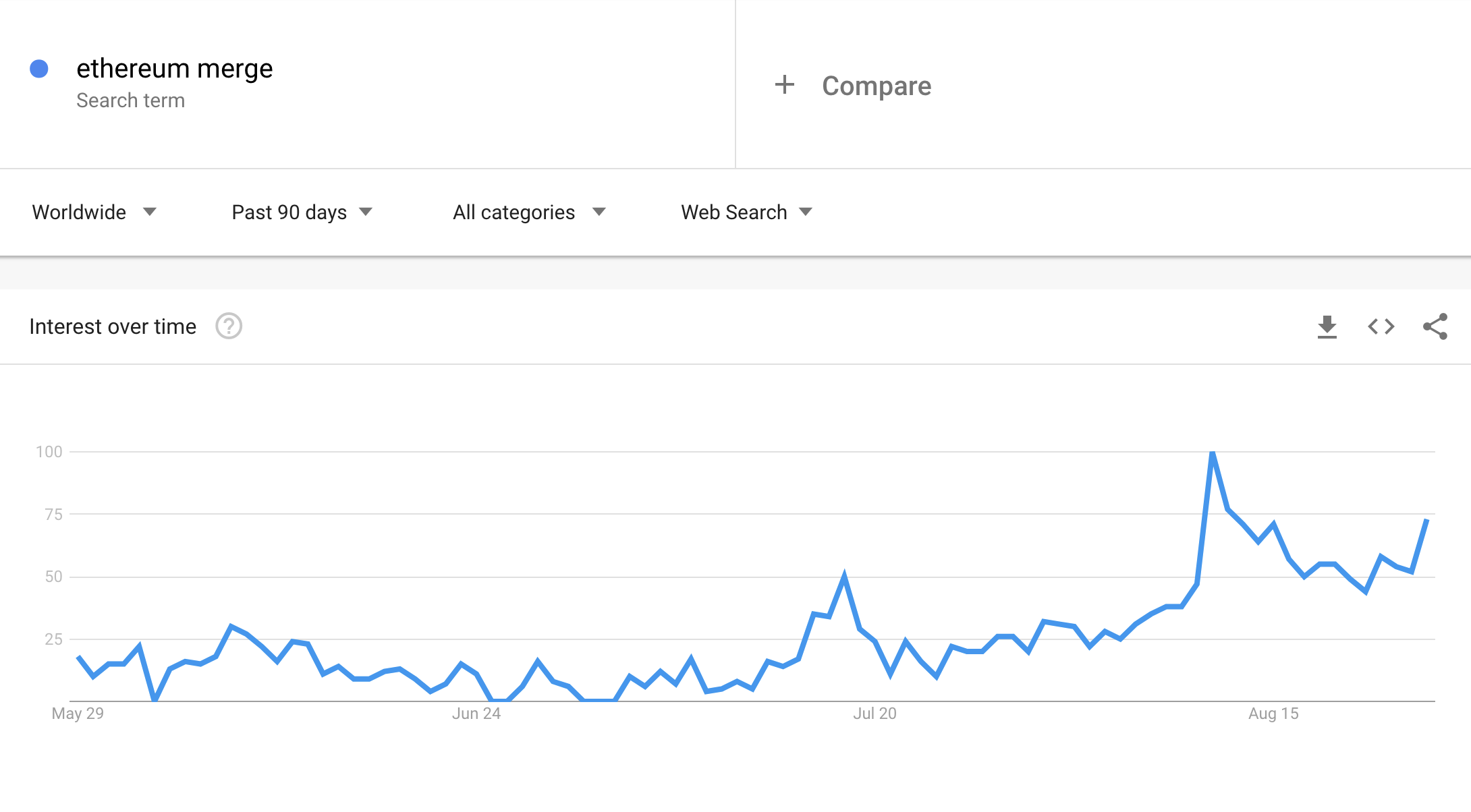
61 was the most recent Google Trends score for “ethereum merge” in the United States, having reached 100 for August 11, as shown in the chart below.

Looking at the worldwide data, “ethereum merge” similarly peaked on August 11, having scored a 65 on August 25.

© 2022 The Block Crypto, Inc. All Rights Reserved. This article is provided for informational purposes only. It is not offered or intended to be used as legal, tax, investment, financial, or other advice.

Go to Source
Author: Michael McSweeney

Iran allows use of crypto for imports amid sanctions

A new law from Iran is allowing the use of crypto in the processing of imports, according to semiofficial Iranian news agency Tasnim

The change comes under an agreement between the Ministry of Industry and the Central Bank of Iran. It allows businesses to transact in crypto for imports, including cars. Those transactions would previously have been executed in dollars or euros. 

Iran remains sanctioned by the US over its nuclear program. Using crypto rather than fiat currencies is one means to circumvent trade embargoes and sanctions. US lawmakers have raised the alarm over crypto as a sanctions-evasion tool in recent months, citing the possibility that heavily sanctioned Russian entities are leveraging crypto to mitigate the fallout. Now, it’s possible Iran is looking to do the same.

Indeed, in 2020, the commander of Khatam-al Anbiya Construction, an engineering firm controlled by the Iranian Revolutionary Guard Corps, a branch of the Iranian Armed Forces, reportedly called for the use of cryptocurrencies to evade sanctions.

Industry, Mines and Trade Minister Reza Fatemi Amin said the decision was finalized by the administration on Sunday, according to Tasnim. Alireza Peymanpak, a deputy Iranian trade minister who leads Iran’s Trade Promotion Organization (TPO), told Tasnim crypto and smart contract will be widely used in foreign trade with target countries by the end of September.

The first import order using crypto took place earlier this month, Peymanpak told Tasnim. The transaction totaled $10 million.

The approval for crypto use in imports appears to be part of a wider resolution detailing crypto regulations. Trade Minister Seyed Reza Fatemi Amin told Tasnim the law tackles all issues related to crypto-assets, including licensure and energy allocation for mining.

© 2022 The Block Crypto, Inc. All Rights Reserved. This article is provided for informational purposes only. It is not offered or intended to be used as legal, tax, investment, financial, or other advice.

Go to Source
Author: Aislinn Keely

Bitcoin mining stock report: Monday, August 29

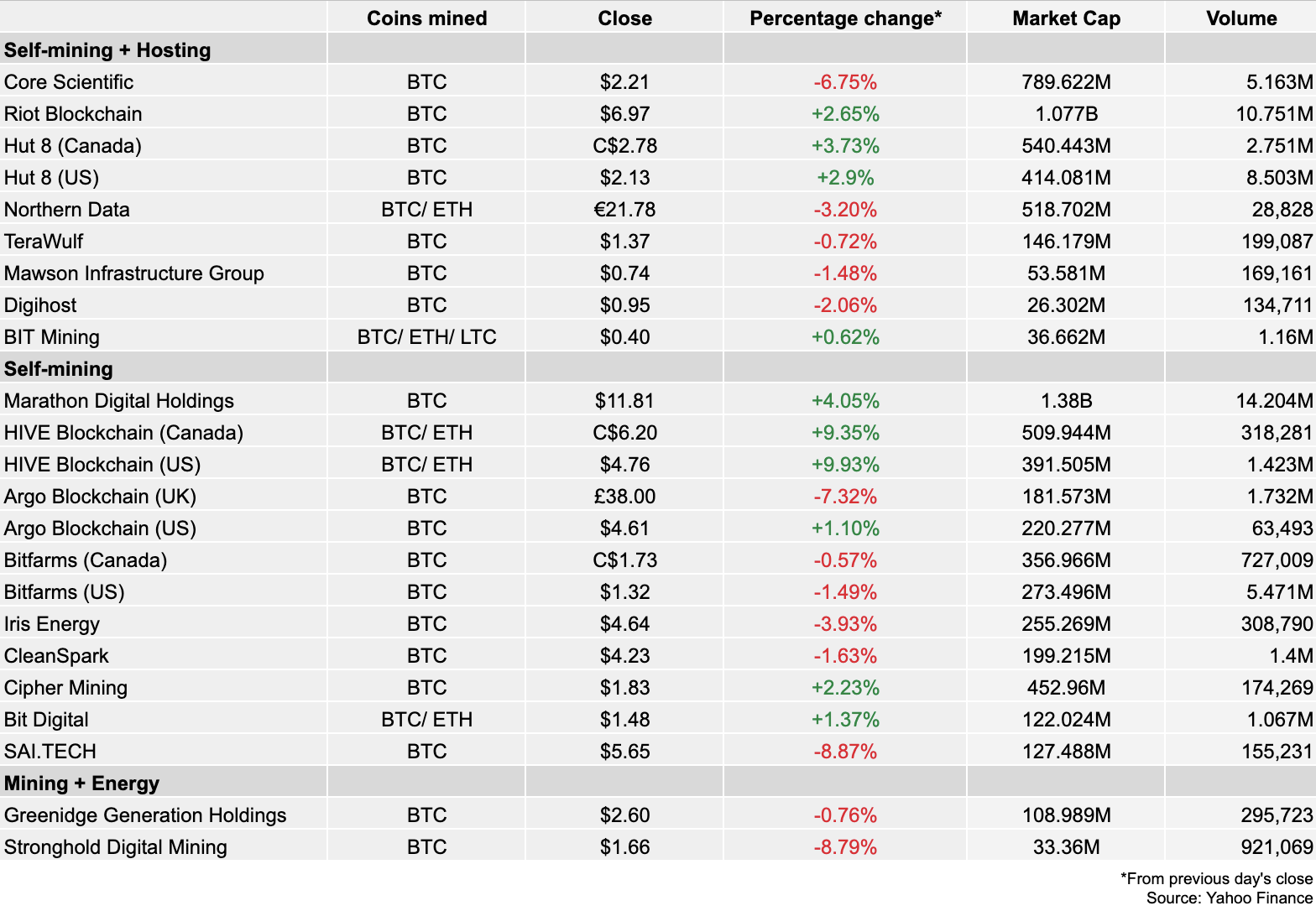
Bitcoin mining companies tracked by The Block saw mixed results in the markets on Monday.

The coin rose above the $20,000 mark and reached $20,100 by the end of the trading session, according to data from TradingView.

HIVE Blockchain, Marathon and Hut 8 were among the companies that performed the best, with stocks going up by 9.93% (on Nasdaq), 4.05% and 3.73% (on the Toronto Stock Exchange), respectively.

SAI.TECH, on the other hand, fell by 8.87%.

Here’s how crypto mining companies performed on Monday, August 29:

© 2022 The Block Crypto, Inc. All Rights Reserved. This article is provided for informational purposes only. It is not offered or intended to be used as legal, tax, investment, financial, or other advice.

Go to Source
Author: Catarina Moura

NFT project Art Blocks launches engine for generative asset creation

The team behind Art Blocks, the generative non-fungible token (NFT) project of technicolor squiggles, has launched a new product allowing creative teams to launch their own generative assets. 

It has two versions, according to the Art Blocks FAQ page. The first is Art Blocks Engine, which the Art Blocks team has used for on-chain storage of generative assets. Art Blocks Engine Flex is the second, creating and storing generative items off-chain using decentralized storage protocols, like IPFS.

These engines allow third parties, or Art Block’s partners, to use Art Block’s smart contracts and rendering infrastructure to create an unlimited amount of branded generative projects. 

“Our basic thesis is that often when people are presented with two equally priced options, they’re more likely to choose personalized things over impersonal ones. Unique over generic,” Art Blocks founder Erick Calderon, who goes by his first name on Twitter, wrote. 

Art Blocks Engine can be used not only by web3 teams but also by those in fashion, sports, events, media and gaming, Erick added.  

Art Blocks is one of the dozen or so blue-chip NFT projects to emerge in the NFT mania last year. At its height, Art Blocks earned more than $288.5 million in August of 2021, The Block’s data dashboard shows.  


© 2022 The Block Crypto, Inc. All Rights Reserved. This article is provided for informational purposes only. It is not offered or intended to be used as legal, tax, investment, financial, or other advice.

Go to Source
Author: MK Manoylov

Argentina’s wine-making haven now accepts crypto as tax payment

Residents of Argentina’s wine-making mecca Mendoza can now pay taxes and fees using cryptocurrency.

The government of the province of Mendoza — which includes the desert city of the same name and is located in the west of the country along the Andes mountain range — rolled out the new feature last week.

Taxpayers can get a QR code and send the funds from their wallets. According to this nifty step-by-step guide, any crypto wallet is supported.

It’s not the first government to accept taxes in crypto. In March of this year, Florida Governor Ron DeSantis announced he is taking steps to enable firms to pay taxes in cryptocurrencies. The canton of Zug, one of the Swiss Confederation member states, started accepting bitcoin and ether last year.

“This new service is part of the modernization and innovation strategic goal carried out by Mendoza’s tax authority so that taxpayers have different means to comply with their tax obligations,” the tax authority said.


© 2022 The Block Crypto, Inc. All Rights Reserved. This article is provided for informational purposes only. It is not offered or intended to be used as legal, tax, investment, financial, or other advice.

Go to Source
Author: Catarina Moura

Derivatives marketplace CME goes live with euro-denominated bitcoin, ether futures

CME Group, a derivatives marketplace, has launched bitcoin and ether futures denominated in the euro.

The offerings were first announced earlier this month and complement the existing dollar-denominated futures CME launched in 2021. 

“Designed to match their U.S. dollar-denominated counterparts, Bitcoin Euro and Ether Euro futures contracts will be sized at five bitcoin and 50 ether per contract,” CME said in a statement Monday. “These new contracts will be cash-settled, based on the CME CF Bitcoin-Euro Reference Rate and CME CF Ether-Euro Reference Rate, which serve as once-a-day reference rates of the euro-denominated price of bitcoin and ether.”

While derivatives volumes have dropped amid the fall in crypto prices, cryptocurrency derivatives trading on centralized exchanges rose 13% to more than $3 trillion last month from June, according to researcher CryptoCompare. The derivatives market comprised 69% of total crypto volumes in July compared to 66% in the previous month.

Volumes for CME bitcoin futures have trended downward since peaking in October. Last month, CME bitcoin futures volumes were a reported $38 billion, down from a record of more than $108 billion, according to data compiled by The Block Research.

CME’s ether futures volume reached nearly $16 billion in July, compared to more than $34 billion in November, per the Data Dashboard.

© 2022 The Block Crypto, Inc. All Rights Reserved. This article is provided for informational purposes only. It is not offered or intended to be used as legal, tax, investment, financial, or other advice.

Go to Source
Author: Michael McSweeney


Follow by Email
Facebook20
Pinterest20
fb-share-icon
LinkedIn20
Share