FreeCryptoCurrency.Me

Free stocks and money too!

Category Archive : Crypto News

Pantera Capital COO leaves after just two months with the firm

Samir Shah has stepped down as chief operating officer at Pantera Capital after just two months in the job, according to his LinkedIn profile.

Shah only joined the firm in July, having spent nearly 13 years at the investment bank JPMorgan, most recently serving as head of asset management sales. Pantera Capital is a crypto-focused venture capital and hedge fund with over $4.7 billion in assets under management, according to its website. The fund recently also lost its general counsel, Joe Cisewski. 

Commodity Futures Trading Commission (CFTC) Commissioner Christy Goldsmith Romero announced on July 26 that Cisewski was joining the agency as chief of staff and senior counsel. Cisewski previously worked for the CFTC under former Commissioner Mark Wetjen.

Earlier in the summer, Pantera made headlines as it cashed out nearly 80% of its investment in the Terra ecosystem before the TerraUSD stablecoin collapsed at the beginning of May. More recently, in July, the firm co-led a seed round in NFT fraud fighters Optic with Kleiner Perkins.

Pantera Capital did not immediately respond to request for comment from The Block, nor did Shah when contacted on LinkedIn.

© 2022 The Block Crypto, Inc. All Rights Reserved. This article is provided for informational purposes only. It is not offered or intended to be used as legal, tax, investment, financial, or other advice.

Go to Source
Author: Adam Morgan McCarthy

BlockFi CEO shares lessons learned from liquidating 3AC

Episode 81 of Season 4 of The Scoop was recorded remotely with The Block’s Frank Chaparro and BlockFi Founder & CEO Zac Prince.

Listen below, and subscribe to The Scoop on AppleSpotifyGoogle PodcastsStitcher or wherever you listen to podcasts. Email feedback and revision requests to podcast@theblockcrypto.com.


Earlier this summer, the collapse of Three Arrows Capital (3AC) sent the crypto lending world into chaos. Many lenders suffered heavy losses due to 3AC exposure and some were forced into bankruptcy.

BlockFi — a prominent crypto lender that was valued at nearly $5 billion during the height of the bull market — was one of the firms that took a big hit when 3AC collapsed, prompting the company’s shareholders to approve a $680 million deal with FTX US that outlines a path to a potential acquisition later next year. 

In this episode of The Scoop, BlockFi CEO Zac Prince candidly recounted the events surrounding his firm’s liquidation of Three Arrows Capital. He also explained his personal philosophy regarding the relationship that a crypto lender should have with its customers. 

Prince expressed during the interview that he firmly believes that BlockFi’s clients should be given priority consideration:

“I have a very fundamental belief that in the type of business that Blockfi is, you can’t screw over your clients and still have a business, period. That’s not an option and that’s not something that Blockfi is ever going to do on my watch.”

When asked directly about Three Arrows Capital, Prince responded,

“I also respect that these are still people and I hope that they’re doing okay, but there’s a whole mountain of legal and potentially civil and criminal things that they’ll be dealing with in the foreseeable future.”

During this episode, Chaparro and Prince also discuss:

  • How BlockFi’s risk management changed in light of the 3AC ordeal
  • Why BlockFi decided to take the FTX deal
  • What the future of crypto lending might look like

This episode is brought to you by our sponsors Tron, Chainalysis & IWC Schaffhausen

About Tron
On August 1st, 2022, Poloniex launched a faster and more stable trading system along with a
brand new user interface. Poloniex was founded in January 2014 as a global cryptocurrency trading platform. With its world-class service and security, it received funding in 2019 from renowned investors, including H.E. Justin Sun, Founder of TRON. Poloniex supports spot and margin trading as well as leveraged tokens. Its services are available to users in nearly 100 countries and regions with various languages available. For more information visit Poloniex.com.

About Chainalysis
Chainalysis is the leading blockchain data platform. We provide data, software, services, and research to government agencies, exchanges, financial institutions, and insurance and cybersecurity companies in over 60 countries. Backed by Accel, Addition, Benchmark, Coatue, Paradigm, Ribbit, and other leading firms in venture capital, Chainalysis builds trust in blockchains to promote more financial freedom with less risk. For more information, visit www.chainalysis.com.

About IWC Schaffhausen
IWC Schaffhausen is a Swiss luxury watch manufacturer based in Schaffhausen, Switzerland. Known for its unique engineering approach to watchmaking, IWC combines the best of human craftsmanship and creativity with cutting-edge technology and processes. With collections like the Portugieser and the Pilot’s Watches, the brand covers the whole spectrum from elegant timepieces to sports watches. For more information, visit IWC.com.

© 2022 The Block Crypto, Inc. All Rights Reserved. This article is provided for informational purposes only. It is not offered or intended to be used as legal, tax, investment, financial, or other advice.
Go to Source
Author: Davis Quinton and Frank Chaparro

Top market makers back new blockchain for trading founded by Goldman Sachs and Robinhood alums: Bloomberg

Leading market makers Flow Traders and Hudson River Trading backed Sei Labs, a new crypto startup that is launching a Layer 1 blockchain developed specifically for trading, according to a report from Bloomberg. 

Founded by Goldman Sachs and Robinhood alums Jeff Feng and Jay Jog, Sei Labs aims to build a blockchain that will speed up decentralized finance (DeFi) transactions. It uses code from the Cosmos blockchain and will be able to complete transactions in as little as 600 milliseconds, per a statement provided to Bloomberg. 

The investment by Flow Traders and Hudson River Trading comes as part of a $5 million seed round led by Multicoin Capital. Other investors include Coinbase Ventures and GSR, according to the report. 

Competing with Solana

The founders of Sei told Bloomberg they hope the network will overtake Solana as a preferred blockchain for building DeFi applications.  

DeFi applications allow individuals to trade, borrow and lend crypto without a central intermediary. In recent months, Solana has seen in its prominence in DeFi decline, as shown by data from The Block Research.  

Solana DeFi venture funding

Solana DeFi venture funding from The Block Research

Sei Labs’ lead investor Multicoin Capital is also a prominent investor in Solana. In a recent interview with The Block, Multicoin Capital’s managing partner Tushar Jain explained the firm’s thought process on backing competing Layer 1 blockchains. 

“To an outsider it can seem like these things are directly competitive, but really they have chosen different tradeoffs in their technical design. They’re not competing for the same thing,” Jain said, adding that Multicoin wouldn’t back two teams focused on the same tradeoff.   

Growing the network

Sei Labs expects the protocol to launch later this year. It will feature a built-in order book that aims to enable market makers and DeFi projects to process transactions at rapid speeds. According to the report, most of the startup’s engineering team hail from Robinhood’s clearing team. 

Proceeds from the recent raise will be used to fund growth of the network. 

© 2022 The Block Crypto, Inc. All Rights Reserved. This article is provided for informational purposes only. It is not offered or intended to be used as legal, tax, investment, financial, or other advice.

Go to Source
Author: Kari McMahon

Paraguay’s president vetoes proposed crypto industry regulation

Paraguay’s president vetoed a bill that would regulate commercial activities related to digital assets, including crypto mining. 

President Mario Abdo Benítez voted down the bill in full, according to an August 29 tweet from Paraguay’s official presidential Twitter account linking to the vetoed proposal. Spanish-language outlets including La Nación and Infobae also reported the news.

Abdo’s decision to veto the bill appears to center on a condition that crypto mining be recognized as an industrial activity with an electricity rate capped at 15% above the current industrial tariff, La Nación reported.

Fernando Silva Facetti, one of the senators who introduced the crypto bill in July 2021, strongly objected to the president’s decision in an Aug. 30 statement. In Silva’s view, the veto “ignores the existence of this activity that today functions in the regulatory shadows.” The crypto mining industry operates in a legal gray area and cannot access the country’s financial system, yet generates jobs and resources, the senator said.

The bill will go back to both chambers of Paraguay’s legislature, Infobae reported, where lawmakers can reconsider the proposal or accept the veto.

Félix Sosa, president of Paraguay’s National Electricity Administration (ANDE), told a local news station earlier this month that he would ask Abdo for a partial veto of the bill. He questioned whether the 15% cap would be enough to cover the costs of energy consumption, alleging that “illegal connections” in the country’s crypto mining sector had been causing economic losses. To solve that, Sosa said ANDE is looking to have crypto mining companies pay for their electricity usage in advance with U.S. dollars.

Paraguay’s Senate passed the crypto bill one last time on July 14 before sending it to the president’s desk. The proposed law, which previously cleared the country’s Chamber of Deputies in May, faced pushback from the country’s central bank over concerns, which include electricity consumption. 

The bill, as submitted to the president, focused on “regulating the activities of mining, commercialization, intermediation, exchange, transfer, custody and administration of crypto assets or instruments that allow control over crypto assets, in order to guarantee legal, financial and fiscal security to the businesses derived from its generation and commercialization.”


© 2022 The Block Crypto, Inc. All Rights Reserved. This article is provided for informational purposes only. It is not offered or intended to be used as legal, tax, investment, financial, or other advice.

Go to Source
Author: Kristin Majcher

Protocol upgrade accidentally freezes ETH on Compound for 7 days

Compound Finance, a borrowing and lending platform, executed a governance proposal updating its Chainlink price feeds that contained a code error.

This code error is causing people lending and borrowing cETH (Compound ETH) to have their transactions reverted. This means users cannot borrow or withdraw collateral. Users still will be able to repay debt and add collateral to borrowed positions with other assets to avoid potential liquidation.

The code error also caused Compound’s frontend to stop working temporarily.

“No funds seem immediately at risk,” Compound founder Robert Leshner said on Discord. “It will likely be seven days until cETH is functioning normally. There will potentially be more governance proposals to rectify the situation.”

The frontend should be back up “shortly,” Leshner said 3:47 p.m. EST.

A new governance proposal has been put forward to revert to the formerly used price feeds. This proposal will take seven days to go into effect, which is why the cETH market is temporarily frozen and users cannot borrow or withdraw collateral.

Compound is currently ranked third overall in total value locked within the decentralized lending market, according to DeFiLlama.

© 2022 The Block Crypto, Inc. All Rights Reserved. This article is provided for informational purposes only. It is not offered or intended to be used as legal, tax, investment, financial, or other advice.

Go to Source
Author: Mike Truppa

Commentary on Stronghold Digital Mining’s Q2’22 Earnings

Quick Take

  • Stronghold Digital Mining reported Q2’22 earnings on August 16, 2022 
  • $SDIG currently trades at $1.40 / share, down ~93% from its IPO price of $19.00 / share
  • Reported  $29mm quarterly revenue, ($40mm) net loss and ($1mm) Adj. EBITDA for the three months ended June 30, 2022 
  • Mined a reported 637 BTC through the three months Q2’22 with a total YTD amount of 1,075 BTC mined from January 1, 2022 to June 30, 2022 
  • Eliminated $67.4mm outstanding equipment financing with NYDIG 
  • Restructured equipment financing agreement with WhiteHawk Finance 
  • Reduced May 16, 2022 Convertible Notes & Warrants by $11.3mm in a restructuring
  • Disclaimer: This is a market commentary research piece and includes opinionated views from our research team. Nothing contained in this piece constitutes a solicitation, recommendation, endorsement, or offer by The Block Research
     

This research piece is available exclusively to
members of The Block Research.
You can continue reading
this Research content on The Block Research.

Go to Source
Author: Greg Lim

FBI issues recommendations for DeFi investors amid exploits

The U.S. Federal Bureau of Investigation (FBI) is encouraging investors in decentralized finance (DeFi) protocols to seek platforms that have undergone code audits in light of an uptick in criminals exploiting vulnerabilities in smart contracts.

“Cyber criminals are increasingly exploiting vulnerabilities in the smart contracts governing DeFi platforms to steal cryptocurrency, causing investors to lose money,” the FBI wrote in an August 29 public service announcement detailing recommendations for investors and DeFi platforms alike. 

DeFi has played a leading role in cryptocurrency theft this year. DeFi protocols were related to a whopping 97% of the cryptocurrency stolen through May 1, Chainalysis reported. By July, the blockchain analysis company found that hacks were responsible for the overall theft of $1.9 billion worth of cryptocurrency in 2022 so far.

The FBI made four key recommendations for investors in DeFi protocols. First, it encouraged people to be aware of the broad risks of DeFi and to do their research. Then, it recommended that people use platforms that have undergone one or multiple third-party code audits.

The FBI also recommended people to “be alert to DeFi investment pools with extremely limited timeframes to join and rapid deployment of smart contracts, especially without the recommended code audit.” It also highlighted the possible risks of  “crowdsourced solutions to vulnerability identification and patching” and open-source code repositories. 

Law enforcement also recommended that DeFi protocols use “real-time analytics,” monitoring and code testing to catch vulnerabilities and come up with a plan to notify platform users when a security incident occurs. 

The FBI also detailed a few situations where it has found criminals exploiting DeFi platforms to steal cryptocurrency. These include a signature verification exploit that cost about $320 million, theft of about $35 million related to manipulated price pairs and DeFi developers losing about $3 million due to a flash loan that set off a smart contract exploit. 

© 2022 The Block Crypto, Inc. All Rights Reserved. This article is provided for informational purposes only. It is not offered or intended to be used as legal, tax, investment, financial, or other advice.

Go to Source
Author: Kristin Majcher

Bitcoin mining stock report: Tuesday, August 30

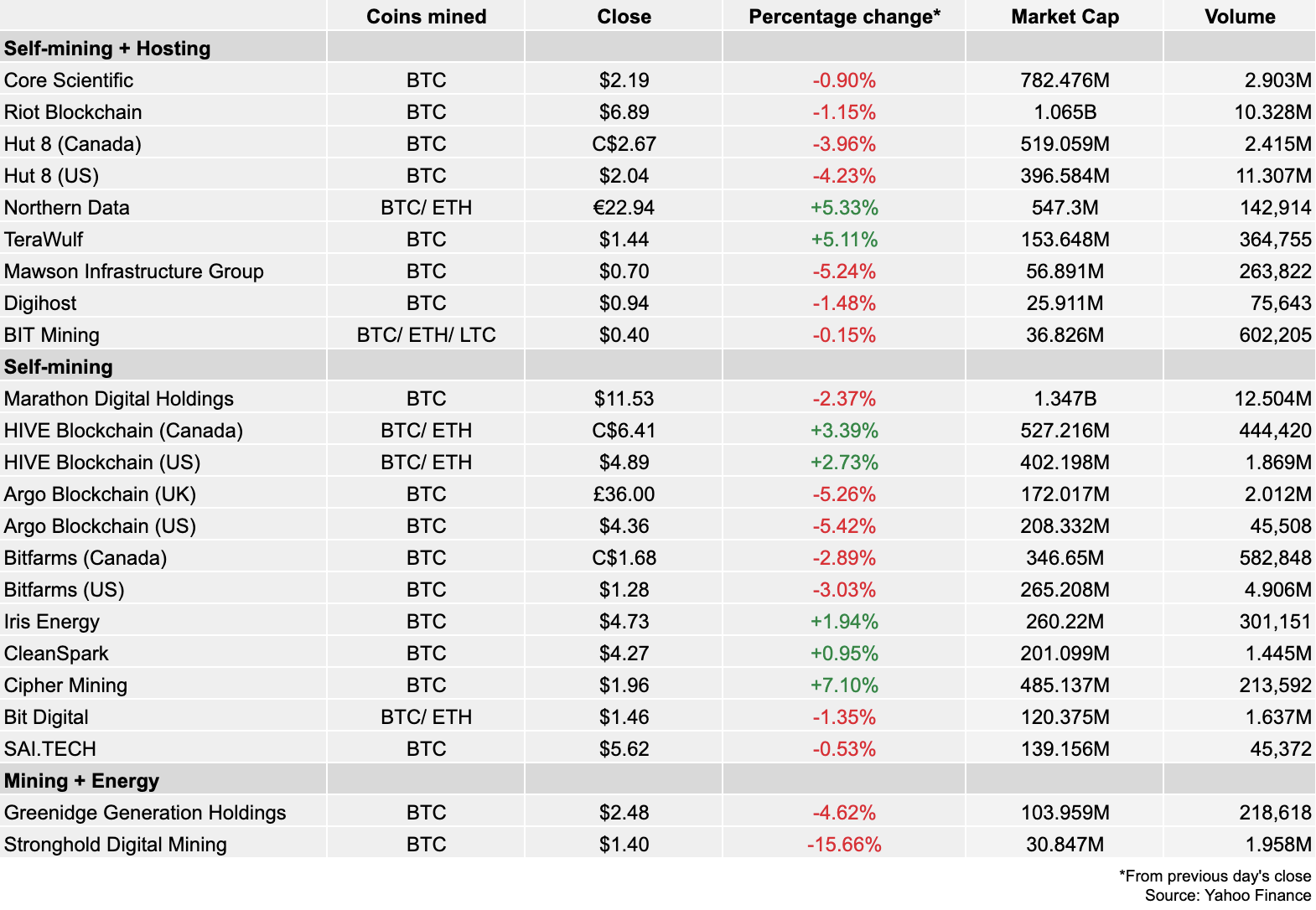
Most bitcoin mining companies fell on the stock market Tuesday, as bitcoin dropped below $20,000.

The coin was priced at around $19,900 at market close, according to data from TradingView.

Stronghold Digital Mining fell by 15.66%, followed by Argo Blockchain (-5.42% on Nasdaq), Mawson Infrastructure Group (-5.24%) and Greenidge Generation (-4.62%).

A few stocks still went up, including Cipher Mining (+7.10%) and Northern Data (+5.33%).

Here’s how crypto mining companies performed on Tuesday, August 30:

© 2022 The Block Crypto, Inc. All Rights Reserved. This article is provided for informational purposes only. It is not offered or intended to be used as legal, tax, investment, financial, or other advice.

Go to Source
Author: Catarina Moura

a16z leads $50 million in funding for NFT organization Proof Collective

a16z led a $50 million Series A fundraise for non-fungible token (NFT) organization Proof, a private members only collective of 1,000 dedicated NFT collectors and artists.

Additional participants in the round include Collab+Currency, Flamingo DAO, SV Angel, VaynerFund and Seven Seven Six, the team said Tuesday. Alexis Ohanian’s VC firm Seven Seven Six led a $10 million funding round in April for Proof.

This marks the first a16z investment in Proof, putting it on part with the likes of Yuga Labs and Larva Labs — with the notable distinction of having its two main NFT projects in the public domain. 

Moonbirds and Oddities were moved to CC0, or the public domain, earlier this month. That means the art is now in the public domain and can be freely distributed, augmented and commercialized without the owner’s consent. Proof got push back with people arguing that they had bought into the project believing they had exclusive rights to their NFT, only to have those taken away without prior notice.

Moonbirds are trading at around 13 ETH (about $20,000) today, down from 16.5 ETH on Aug. 8, when the CCo move was announced.

Proof also said today it is creating a Moonbirds DAO, which will oversee licensing of the Moonbirds name by granting trademark rights and deploying capital to projects that “further the Moonbirds mission.” The DAO will control a soon-to-be-formed DAO treasury.

Proof has also announced a forthcoming NFT project called Moonbirds Mythics slated launch in “early 2023.” Moonbirds Mythics is a profile-picture collection of 20,000 NFTs that have “an eye towards giving back to original Moonbirds and Oddities collectors,” the team wrote.


© 2022 The Block Crypto, Inc. All Rights Reserved. This article is provided for informational purposes only. It is not offered or intended to be used as legal, tax, investment, financial, or other advice.

Go to Source
Author: MK Manoylov

Congressman calls on crypto exchanges and regulators to account for fraud and scams in crypto

Crypto faces new scrutiny from the congressional financial watchdog.

In a series of letters sent on August 30, Rep. Raja Krishnamoorthi, D-Ill., called federal regulators and leading crypto exchanges to account for their work to combat frauds that use cryptocurrency. 

Krishnamoorthi in particular attacked decentralization as a source of scams. The letters read: “The lack of a central authority to flag suspicious transactions in many situations, the irreversibility of transactions, and the limited understanding many consumers and investors have of the underlying technology make cryptocurrency a preferred transaction method for scammers.”

Among regulators, the letters address the Treasury, the Securities and Exchange Commission, the Commodity Futures Trading Commission and the Federal Trade Commission. Meanwhile, recipient exchanges were Binance.US, Coinbase, FTX, Kraken, and KuCoin. 

The letters call on recipients to return to the committee vast sets of documents touching on the regulators’ and exchanges’ policies and practices in relation to crypto scams and user security. Krishnamoorthi asks that they do so by September 12. 

Krishnamoorthi leads the Subcommittee on Economic and Consumer Policy within the House of Representatives’ Oversight Committee. The Oversight Committee is, by and large, not a place where a company wants to be in the spotlight. The committee has a broad jurisdiction but focuses on investigative scrutiny. Another subcommittee of the Oversight Committee held a hearing on the impact of crypto mining in January. 

The logic for the exchanges chosen seems peculiar. Binance.US is the US branch of the largest global crypto exchange, Binance, which got no such letter. That is, despite FTX global receiving one, while FTX.US did not. KuCoin, meanwhile, is not licensed in the US. When reached, representatives for Krishnamoorthi did not provide an explanation. The list seems to mirror the five largest spot exchanges by volume on CoinMarketCap after Binance. 

© 2022 The Block Crypto, Inc. All Rights Reserved. This article is provided for informational purposes only. It is not offered or intended to be used as legal, tax, investment, financial, or other advice.

Go to Source
Author: Kollen Post


Follow by Email
Facebook20
Pinterest20
fb-share-icon
LinkedIn20
Share