FreeCryptoCurrency.Me

Free stocks and money too!

Category Archive : Crypto News

Volume on centralized exchanges, DEXs ticked down in August

Volumes across both centralized exchanges as well as decentralized exchanges, or DEXs, fell in August compared with the month prior, data collected by The Block Research show.

As TBR’s Lars Hoffmann noted in his monthly digest, volume for August hit $630.3 billion, according to The Block’s legitimate volume index. That figure reflects a slight decline compared to $632.7 billion in July.


Binance continued to be the dominant centralized exchange in terms of market share (69.5%) followed by Coinbase (9.3%) and FTX (7.8%).

Decentralized exchanges posted $53.9 billion in August volume, with Uniswap continuing to hold its market-dominant position.


The $53.9 billion figure represents a decrease month-over-month of 3.6%.

The ratio of volume on decentralized exchanges and centralized exchanges lost some ground in August, falling to 8.6%, Hoffmann’s report said.

© 2022 The Block Crypto, Inc. All Rights Reserved. This article is provided for informational purposes only. It is not offered or intended to be used as legal, tax, investment, financial, or other advice.

Go to Source
Author: Michael McSweeney

UBS, Wealthfront call off $1.4 billion deal

UBS nixed a $1.4 billion deal to buy robo-advisory firm Wealthfront, the companies said.

UBS said the two companies mutually agreed to terminate their merger agreement, which they announced in January. UBS will purchase a nearly $70 billion note convertible into Wealthfront shares, maintaining the $1.4 billion valuation.

“UBS remains committed to its growth plans in the U.S. and will continue the build-out of its digital wealth management offering,” the bank said in a statement.

“We’re incredibly excited about Wealthfront’s path forward as an independent company and are proud to share that thanks to the hard work of our team and the trust you put in us, we will be cash flow positive and EBITDA profitable in the next few months,” Wealthfront said on Twitter.

Wealthfront began offering exposure to Grayscale’s bitcoin and ether-tied investment trusts last year, as previously reported.

© 2022 The Block Crypto, Inc. All Rights Reserved. This article is provided for informational purposes only. It is not offered or intended to be used as legal, tax, investment, financial, or other advice.

Go to Source
Author: Michael McSweeney

Bitcoin mining stock report: Friday, September 2

Most bitcoin mining stocks tracked by The Block were down on Friday.

The coin was trading at around $19,900, similar to the previous day, according to data from TradingView.

Digihost was down by 11.74%, followed by Greenidge Generation (-3.51%), Cipher Mining (-3.35%), Riot (-3.21%).

CleanSpark was down 0.49% after announcing Friday morning that it mined 2.9% more BTC in August (395 in total) in its monthly update. 

Here’s how crypto mining companies performed on Friday, September 2:

© 2022 The Block Crypto, Inc. All Rights Reserved. This article is provided for informational purposes only. It is not offered or intended to be used as legal, tax, investment, financial, or other advice.

Go to Source
Author: Catarina Moura

FIFA launches digital World Cup collectibles project on Algorand

FIFA, soccer’s global governing body, will release a digital collectibles project on the Algorand blockchain ahead of November’s World Cup.  

The FIFA+ collection, set to launch later this month, will include notable moments, art and imagery from the World Cup and Women’s World Cup, according to a the organization. The project is akin to NFT sports collectibles like the basketball-focused NBA Top Shot.

“This exciting announcement makes FIFA collectibles available to any football fan, democratizing the ability to own a part of the FIFA World Cup,” said FIFA Chief Business Officer Romy Gai. “Just like sports memorabilia and stickers, this is an accessible opportunity for fans around the world to engage with their favorite players, moments and more on new platforms.” 

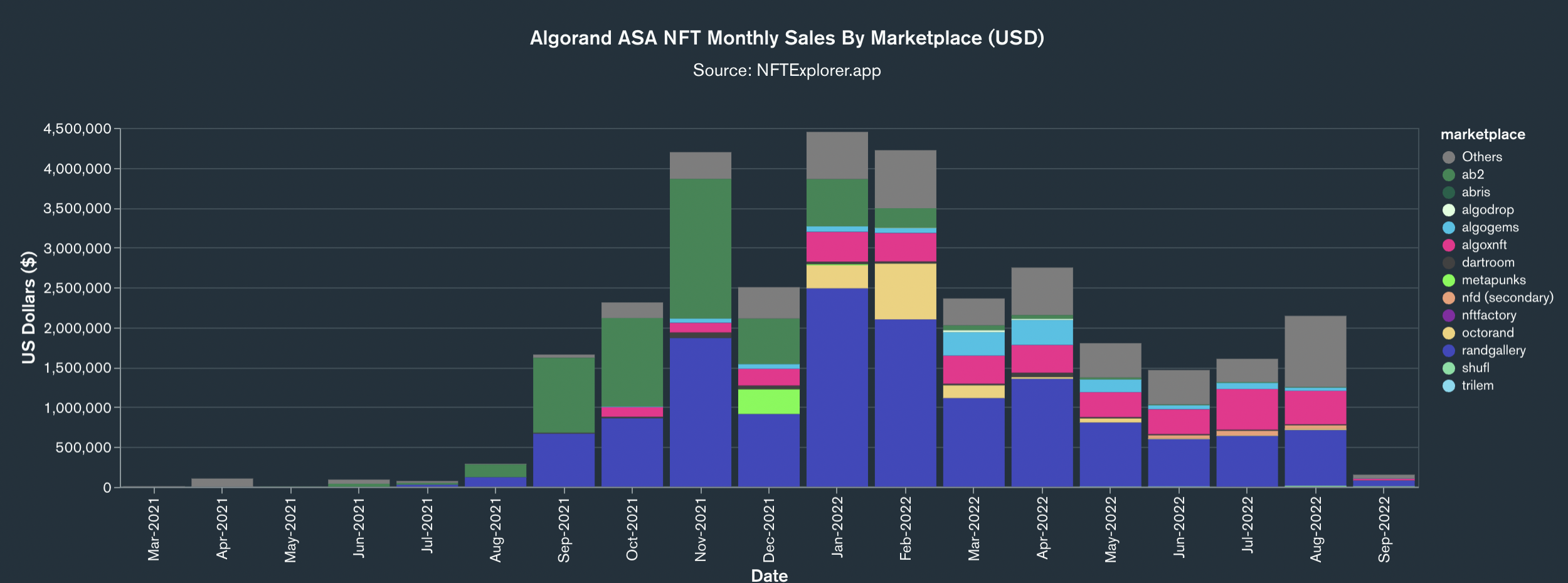
Algorand offers a proof-of-stake blockchain cryptocurrency protocol, but it is not known for NFT projects. The main chains for NFT collections (excluding the Axie Infinity-focused Ronin) are Ethereum and Solana. Trade volume peaked at $1.64 billion for Ethereum in May and $163.9 million for Solana in Aug. 2021, according to The Block’s data dashboard.  


Algorand’s all-time NFT trading volume high was $4.5 million in January, according to NFT Explorer.  

When FIFA secured a partnership with Algorand in May, the blockchain’s native token ALGO spiked, Coindesk said. In that partnership, Algorand would help FIFA launch a digital wallet and other blockchain-based projects, and FIFA would boost Algorand’s global presence.  

FIFA announced that it exceeded its target revenue goal of $6.44 billion across 2019 to 2022 and earned $766 million in 2021, according to FIFA’s 2021 annual report.  

© 2022 The Block Crypto, Inc. All Rights Reserved. This article is provided for informational purposes only. It is not offered or intended to be used as legal, tax, investment, financial, or other advice.
Go to Source
Author: MK Manoylov

Ethereum miners made $756 million in revenue in August ahead of the Merge

Ethereum miners generated $756 million in revenue in August, up 37% from July’s$545 million revenue.

Just over $30 million of that amount constituted transaction fees — that is, ETH paid for transactions to be included in the blocks — with the rest as block subsidies to miners, according to data collected by The Block Research.

August was the last full month of Ethereum mining. Between Sept. 10 and 20, the blockchain will shift as part of The Merge from a proof-of-work (PoW) mechanism for block creation to a proof-of-stake (PoS) system, after which PoW mining on Ethereum will no longer take place. Some in the industry have speculated that PoW forks of Ethereum may emerge post-Merge, providing a new source of income for miners. Whether those forks will succeed is unknown.

With proof-of-work, miners generate hashes in a competitive effort to match the hash of the current target block. By contrast, Ethereum’s proof-of-stake system involves an array of validators that commit their funds. 

The revenue figures for August were likely buoyed by growth in ETH’s price relative to its performance in June and July, as shown in the chart below:

Daily ETH mining revenue figures rose in August compared to June and July.

© 2022 The Block Crypto, Inc. All Rights Reserved. This article is provided for informational purposes only. It is not offered or intended to be used as legal, tax, investment, financial, or other advice.

Go to Source
Author: Michael McSweeney

DeFi Governance Roundup: Streamlining Operations and Recent Controversy

Quick Take

  • This DeFi governance roundup piece covers Aave, ApeCoin, Balancer, Fei Protocol, Olympus DAO and Optimism.
  • The proposals covered continue to focus on streamlining protocol operations.
  • The notable governance proposal covered was the controversy surrounding Fei protocol, its withdrawal from TribeDAO and the handling of the Fuse exploit victim repayments.

This research piece is available exclusively to
members of The Block Research.
You can continue reading
this Research content on The Block Research.

Go to Source
Author: Alex Ho

Ether derivatives smash milestones left and right as The Merge looms

Trading in ether derivatives soared in August as traders bet on the Ethereum blockchain’s impending move from proof of work to proof of stake – a transition dubbed The Merge.

Ethereum’s big move to proof of stake was confirmed in August, with the final upgrades (Bellatrix and Paris) set for Sept. 6 and Sept. 10-20. The long-anticipated upgrade spurred derivatives traders as ether options and futures soared throughout the month. The Block identified in July that ether derivatives trading was surging ahead of the Merge. 

Here’s a look at two of the most interesting milestones from our data dashboard. 

Ether options open interest 

Open interest in ether options surpassed bitcoin open interest for the first time in August,  as ether hurtled past $8 billion to an all-time high.

Hedge fund LedgePrime linked the surge to the emergence of new, more complex strategies, among traders positioning themselves ahead of Ethereum’s transition to proof of stake.

The long call butterfly – at that point the most traded structure for ether over the past month – had moved to the second position, with the bull call spread taking the lead at a volume of 160,000, LedgerPrime wrote in a Telegram message on Aug. 13.

A butterfly spread is an options strategy constructed using three different strikes within a single expiration period, made up of all calls or all puts. The distance between the strikes must be the same. 

These trades “show directional bets from institutions, as well as retail if we consider Deribit’s volume,” and “at the very least short-term directional bets,” LedgerPrime’s Laura Vidiella told The Block at the time. 

By the end of August, aggregated open interest of ether options reached $6.8 billion, which represents a continued month-over-month increase of 16.7%. Monthly volumes of ether options also increased, by 6.1%.

Ether futures eclipses bitcoin

For the first time the volume of ether futures was larger than bitcoin futures, during August.

The volume of ether futures exceeded that of bitcoin futures by 1.11 times in August, according to The Block Research. The Block’s Lars Hoffman attributed this to the carry play around the imminent Ethereum Merge.

Furthermore, ether futures crossed $1 trillion for the first time since May 2021 during August, clocking in at $1.64 trillion.

Trading volumes for the second-largest cryptocurrency by market cap were $1.05 trillion in August, up from $934.9 billion in July.

Meanwhile, the price of ether whipsawed throughout the month. Ether gained 18% over one seven-day period, before forfeiting all of those gains just a week later. However, the cryptocurrency wasn’t alone as most major cryptocurrencies fluctuated throughout the month – broadly in line with wider financial markets. 

Bitcoin lost 12.98%, according to The Block’s data dashboard, as the leading cryptocurrency by market cap also saw its dominance plummet during the month. 

© 2022 The Block Crypto, Inc. All Rights Reserved. This article is provided for informational purposes only. It is not offered or intended to be used as legal, tax, investment, financial, or other advice.

Go to Source
Author: Adam Morgan McCarthy

52 key crypto hires, exits and moves: August 2022

Quick Take

  • There were a lot of big exits last month, with a few coming as a result of the collapse of Three Arrows Capital.
  • There were also many new hires, including a few new job titles that you wouldn’t see outside of crypto. 
 

This feature story is available to
subscribers of The Block News Plus.
You can continue reading
this News Plus feature on The Block.

Go to Source
Author: Kharishar Kahfi

Why The Merge won’t solve Ethereum’s scaling challenges

The Merge — Ethereum’s pivot from proof of work to proof of stake is imminent but — despite common belief — the event will not solve the network’s scalability challenges.  

This pivot, scheduled to happen this month, is Ethereum’s biggest change to date. When finalized, Ethereum will have moved further away from Bitcoin’s original design into a new era of blockchain technology — one more in line with many newer blockchains that are cropping up. 

But despite The Merge being a big change, it won’t affect Ethereum’s core performance. There are common misconceptions that The Merge will boost speed or lower fees — only neither are set to happen. Instead, the bigger changes are to do with its consensus mechanism and its tokenomics. Here’s a look at what The Merge will and won’t do. 

What will The Merge do?  

The Merge will move Ethereum from proof of work to a proof of stake consensus mechanism. This transaction will happen due to a coming together of two layers, hence the term “merge.” The Merge will combine the current execution layer (which uses proof of work) with a new consensus layer called the Beacon Chain.  

When this happens, the Ethereum blockchain will continue as normal, but it will be running on proof of stake instead. 

Ethereum will go through a few changes as a result of The Merge. One of these changes will be to the security model of the network. By moving to proof of stake, Ethereum will no longer be secured by miners with powerful computers solving complex computations. Instead, participants will stake ether (ETH) tokens with validators to secure the network. The economic value of the staked ETH will now act as security for the chain. 

Validators, and not miners, will be responsible for ordering transactions on Ethereum after The Merge. These entities will be the ones to determine the order of slots (the new term for blocks after the event) once The Merge happens. 

With miners out of the picture, Ethereum’s carbon footprint is expected to reduce. Validators won’t need to run powerful computers that consume a lot of energy. As such, Ethereum’s energy usage is projected to go down by over 99%. 

The Merge will also affect Ethereum’s issuance of new ETH. The event will reduce the issuance of new ETH by around 90%. The network will also continue to burn tokens in every transaction. If network fees are high enough, this means it could burn more tokens in fees each year than it issues — resulting in a deflationary network. 

Why won’t The Merge increase scalability?  

The Merge won’t affect scalability in any meaningful way because it is outside of the scope of the upgrade. The Merge does not expand the capacity of the Ethereum blockchain. As such, it will not introduce any changes to the speed of the network or the cost of transactions on the base layer. It is only changing the consensus protocol that governs the network. 

Scalability has proven to be a difficult problem for blockchain networks to solve. This is due to something called the blockchain paradox or blockchain trilemma. The paradox has three sides — scalability, decentralization, and security. This trilemma has a simple argument; it is not possible to optimize for all three sides at the same time. Optimizing for any one or two will be at the cost of the others.  

Older blockchains like Bitcoin, Litecoin, and even Ethereum, work by having most of the participants on the network running full nodes. These full nodes verify every transaction on the network and store the complete data history of the chain. They tend to have high security and decentralization but are not usually scalable. Bitcoin can only process about five transactions per second. Ethereum’s capacity is between 13 to 20 transactions per second. 

Newer blockchains like Avalanche, Solana, Fantom, and Binance Smart Chain do not use this method. They instead rely on a limited number of nodes that are responsible for processing transactions. Users of these networks must trust that these nodes are working properly. Such chains have high transaction speeds at low cost, for example, Fantom can process 25,000 transactions per second. So, they are scalable, but they are not as decentralized. Apart from not being so decentralized, their networks can become bloated and much more expensive, and difficult to run. They can also lead to spam, something that has taken the Solana blockchain offline a few times. 

Ethereum is going down a different path to solve its scalability challenges. Rather than one big, bloated base layer doing everything, Ethereum developers want to achieve scalability through a system of multiple layers — and potentially also by splitting up its blockchain into multiple parts. This first part of this strategy is already underway but it’s still relatively early days and we can expect a lot more progress on both fronts after The Merge. 

By making the network more scalable, this will increase the number of transactions it can process per second and reduce fees for using the network. 

When will Ethereum be more scalable?  

There are two main ways Ethereum is aiming to be more scalable. It’s expanding vertically through a system of multiple layers (examples include Arbitrum, Optimism, and zkSync) and it might also expand horizontally through a technique known as sharding.  

These layers use rollups which is a type of scaling technology. Rollups allow these layers to process hundreds of transactions into one single batch transaction that is then submitted to the main Ethereum chain for final execution. Layer 2 networks using rollups can process up to 4,000 transactions per second at a fraction of the cost compared to putting them all on the Ethereum mainnet. 

The Merge will be followed by another upgrade called The Surge. This upgrade will introduce “sharding” and will help to increase Ethereum’s scalability by splitting the network into smaller chains called “shards.” Sharding is expected to improve Ethereum’s scalability by a factor of 100,000 and will likely happen in 2023.  

Three other upgrades will come after the Surge — The Verge, The Purge, and The Splurge. These upgrades will help to optimize data storage on Ethereum by reducing the memory space requirements for validators. Data optimization will help to reduce instances of network congestion on Ethereum.


© 2022 The Block Crypto, Inc. All Rights Reserved. This article is provided for informational purposes only. It is not offered or intended to be used as legal, tax, investment, financial, or other advice.

Go to Source
Author: Osato Avan-Nomayo

Celsius shareholder BnkToTheFuture set to acquire crypto lender Salt

BnkToTheFuture, an investment platform that allows its clients to invest in crypto, fintech companies and tokens, is set to acquire Salt Lending.

According to an announcement today, BnkToTheFuture has entered into a letter of intent to acquire Salt, contingent upon signing definitive agreements and regulatory approval. 

Founded in 2016, Salt Lending allows users to receive fiat cash loans against their cryptocurrency collateral. 

“Moving forward with this acquisition provides an opportunity to enhance our suite of products and advance our mission to preserve and grow your crypto wealth,” said Salt Lending CEO Rob Odell in a statement today. 

The company said that there would be no changes to its loans as a result of the acquisition offer. 

According to a CoinDesk report, BnkToTheFuture said the acquisition will complement its status as a registered excluded securities business in the Cayman Islands.

“By combining a registered securities business with a registered lending business we believe we are able to offer a regulatory-compliant lending and yield platform to users,” a company representative told CoinDesk.

The investment platform also said it plans to develop an option for helping distressed lending companies (and their customers) that are unable to resurface from bankruptcy amid regulatory constraints. It is reportedly eying the loan book of Celsius, according to people familiar with the matter cited by CoinDesk. It holds a 5% stake in the lending company

The deal, of which the terms were not disclosed, follows the struggles encountered by some of its crypto lender compatriots.

In June, Celsius paused withdrawals and transfers amid turbulent market conditions. The company ultimately filed for bankruptcy, revealing a $1.2 billion hole in its balance sheet. Troubles also beset cryptolender BlockFi amid the market downturn that saw bitcoin dip below $20,000. After pausing withdrawals, it struck a credit deal with FTX US with a pathway to acquisition.

© 2022 The Block Crypto, Inc. All Rights Reserved. This article is provided for informational purposes only. It is not offered or intended to be used as legal, tax, investment, financial, or other advice.

Go to Source
Author: Tom Matsuda


Follow by Email
Facebook20
Pinterest20
fb-share-icon
LinkedIn20
Share