FreeCryptoCurrency.Me

Free stocks and money too!

Category Archive : Crypto News

Sunak’s crypto charm offensive brought to an end as Truss named UK prime minister

The election of Liz Truss as the UK’s new prime minister on Monday has further clouded the outlook for the country’s crypto policy.

The new Conservative leader, who was voted in by party members to replace Boris Johnson in the nation’s top job, has not so far laid out a cohesive position on digital assets. Rishi Sunak, her defeated opponent, was seen as friendly to the industry.

Truss, who served in government under three different prime ministers, has held posts as secretary of state for foreign, Commonwealth and development affairs since 2021 and as minister for women and equalities since 2019.

In 2018, she tweeted that the UK should “welcome cryptocurrencies in a way that doesn’t constrain their potential. Liberate free enterprise areas by removing regulations that restrict prosperity.”

Since then, however she has not laid out specific crypto policies or regulatory intentions for the sector. It is rumored she is set to tap Kwasi Kwarteng for the top Treasury job who, as business minister, fast tracked laws to tackle “dirty money” being moved around by foreign oligarchs. 

Meanwhile, defeated leadership challenger Sunak was more overtly crypto curious when he served as chancellor for the exchequer between February 2020 and July 2022. In April this year, he set out plans to make the UK a crypto friendly tech hub, and said the Royal Mint would launch an NFT this summer. He also made moves for stablecoins to be brought within regulation, paving their way for use in the UK as a recognized form of payment.

The move came amid a protracted period of confusion around crypto regulation in the UK, as firms waited for verdicts from the financial regulator on anti-money laundering licensing. The process, conducted through the Financial Conduct Authority (FCA), forced many to consider their place in the UK market, including crypto market maker B2C2, Blockchain.com, and wallet firm Wirex, which have all chosen to seek licenses elsewhere. 

These policies also followed meetings with top crypto executives and venture capital firms. 

The Treasury ministers’ meetings log, published on the UK government website, shows Sunak met with Sequoia managing partner Douglas Leone to “discuss the UK’s Venture Capital sector” earlier this year. Previous disclosures also showed that at the end of last year, Sunak visited California and met with representatives from Sequoia and Andreessen Horowitz, as well as attending a roundtable with companies including Bitwise, Celo, Solana and Iqoniq. 

It is thought unlikely that Sunak will be given a place in Truss’s cabinet.

© 2022 The Block Crypto, Inc. All Rights Reserved. This article is provided for informational purposes only. It is not offered or intended to be used as legal, tax, investment, financial, or other advice.
Go to Source
Author: Lucy Harley-McKeown

UK regulators find flaws in audit of crypto-friendly neobank Revolut: FT

UK financial regulators have found flaws in the auditing process of Revolut, a neobank that offers crypto investment services, according to the Financial Times.

A Financial Reporting Council report in July said an audit by accountancy firm BDO of an unidentified “financial services provider” was “inadequate” and ran a “risk of an undetected material misstatement.” This unnamed company is Revolut, according to people familiar with the matter that the Financial Times spoke to. 

Revolut declined to comment when contacted by The Block. BDO didn’t immediately respond to a request for comment.

Europe’s second most valuable private fintech company is now under pressure to improve its internal controls — the systems that ensure its financial reporting is reliable — so that it complies with legal and regulatory requirements, according to the FT. 

A person that the FT spoke to also warned that a more rigorous approach by BDO could result in delays in filing its accounts, the majority of which are due at the end of the month. The company is currently late on filing accounts for Revolut Newco UK Ltd., the entity intended to house its delayed UK banking license. 

Failing to file an account on time could lead to the prosecution of company directors, in this case, Revolut founder and CEO Nikolay Storonsky, said the report. 

A person familiar with the situation told the FT that the neobank must improve “unsexy things like its back office and controls” because it “needs to have a back office like a bank and it’s got the culture of a tech firm.” 

The news comes as the company has been hit by resignations in its risk and compliance departments — including its UK heads of risk, compliance and money laundering — and after Storonsky complained in an interview with City AM about the time that regulators are taking to consider its banking license application. 

Revolut is also yet to receive a permanent license to offer cryptocurrency services in the UK. Most recently, however, it received authorization from the Cyprus Securities and Exchange Commission to provide cryptocurrency services and launch several new tokens. 

In a May interview with The Block, Storonsky confirmed to The Block that it is aiming to launch its own native token along with a non-custodial wallet. 

© 2022 The Block Crypto, Inc. All Rights Reserved. This article is provided for informational purposes only. It is not offered or intended to be used as legal, tax, investment, financial, or other advice.

Go to Source
Author: Tom Matsuda

August NFT data wrap: Is web3 gaming full of bots?

The NFT community was in a debating mood last month. To grant royalties or to not grant royalties? Commercial licensing rights or creative commons?

But when it comes down to the numbers, the bear market continues. Monthly NFT marketplace volumes are down again, according to The Block’s data dashboard.

Meanwhile in gaming, an anti-bot company has claimed web3 gaming is full of them — and some of the numbers put even Elon Musk’s wildest Twitter-bot estimates to shame. If accurate, the numbers could be a blow to blockchain gaming, which has enjoyed a surge of investment interest this year.

More than $100 million worth of NFTs were stolen in the last year

Over $100 million worth of NFTs were stolen between July 2021 and July 2022, including a total of 167 Bored Ape Yacht Club NFTs worth over $43.6 million. That’s according to a new report from blockchain analytics firm Elliptic released this month. After Bored Apes, the most targeting collections were Mutant Ape Yacht Club and Azuki.

The report also looked at money laundering using NFTs and found that, despite fears, it’s not that common. Over $8 million in illicit funds has been laundered through NFT-based platforms since 2017, representing 0.02% of trading activity originating from known sources.

The OpenSea trading ‘down 99%’ debate

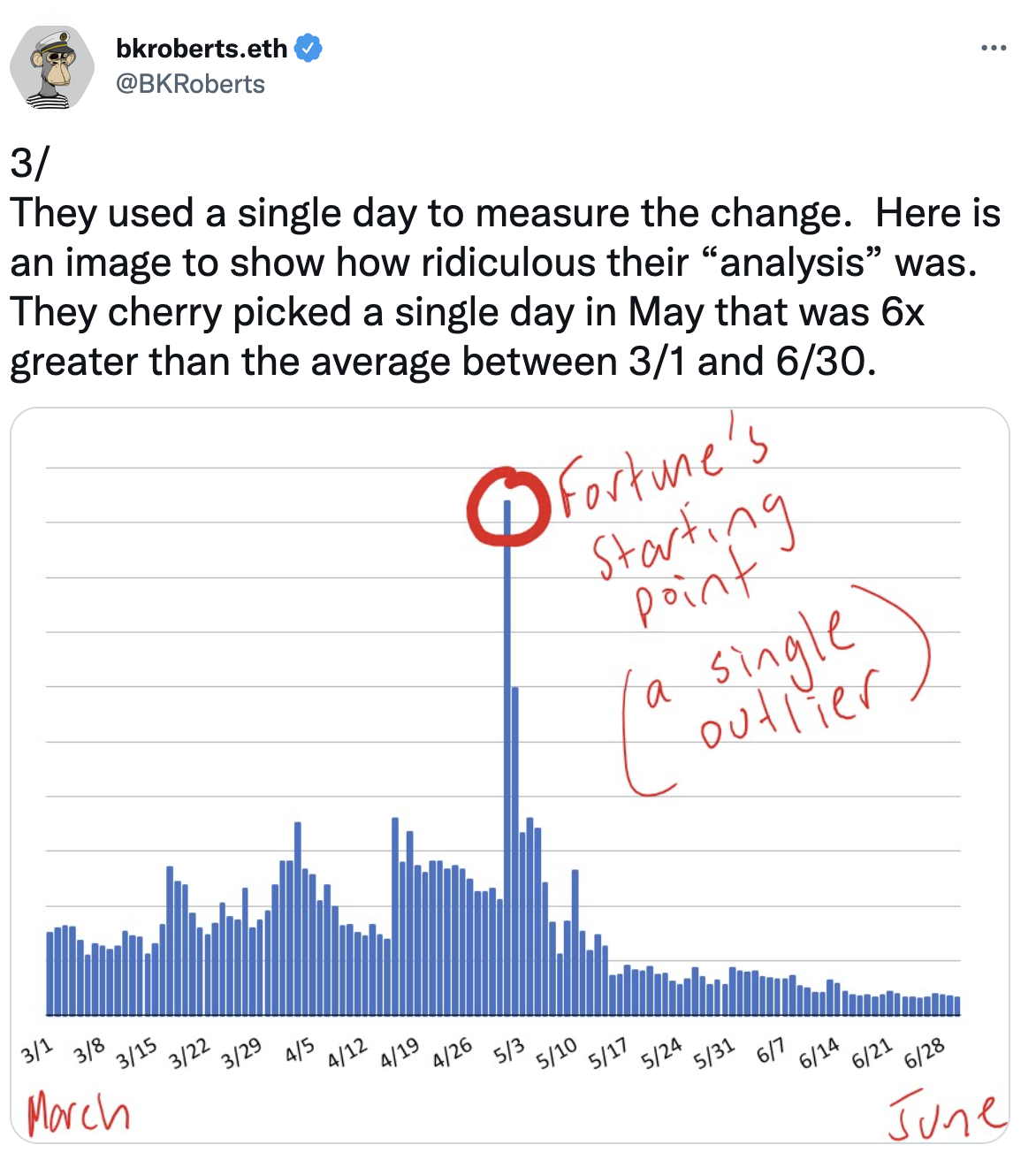
An article on Aug. 29 in Fortune described OpenSea transactions as “down 99%,” noting that the previous Sunday the marketplace had recorded just $9.34 million in NFT transactions, down from a record $2.7 billion on May 1.

However, OpenSea CFO Brian Roberts hit back at the claims on Twitter, accusing Fortune of having “cherry picked” a single day in May that saw six times greater than the average between March and June. The spike was likely driven by the Apr. 30 Otherdeed sale.

The peak the article used is likely attributable to the Otherdeed sale on Apr. 30. But that said, volume transactions for NFT marketplaces are nevertheless down, albeit less than the seismic drop from May to June. OpenSea’s monthly volume went from $528.64 million in July to $485.32 million in August.

Across the top ten marketplaces, volume was down from $675.43 million to 592.34 million.

The rise of no royalty marketplaces?

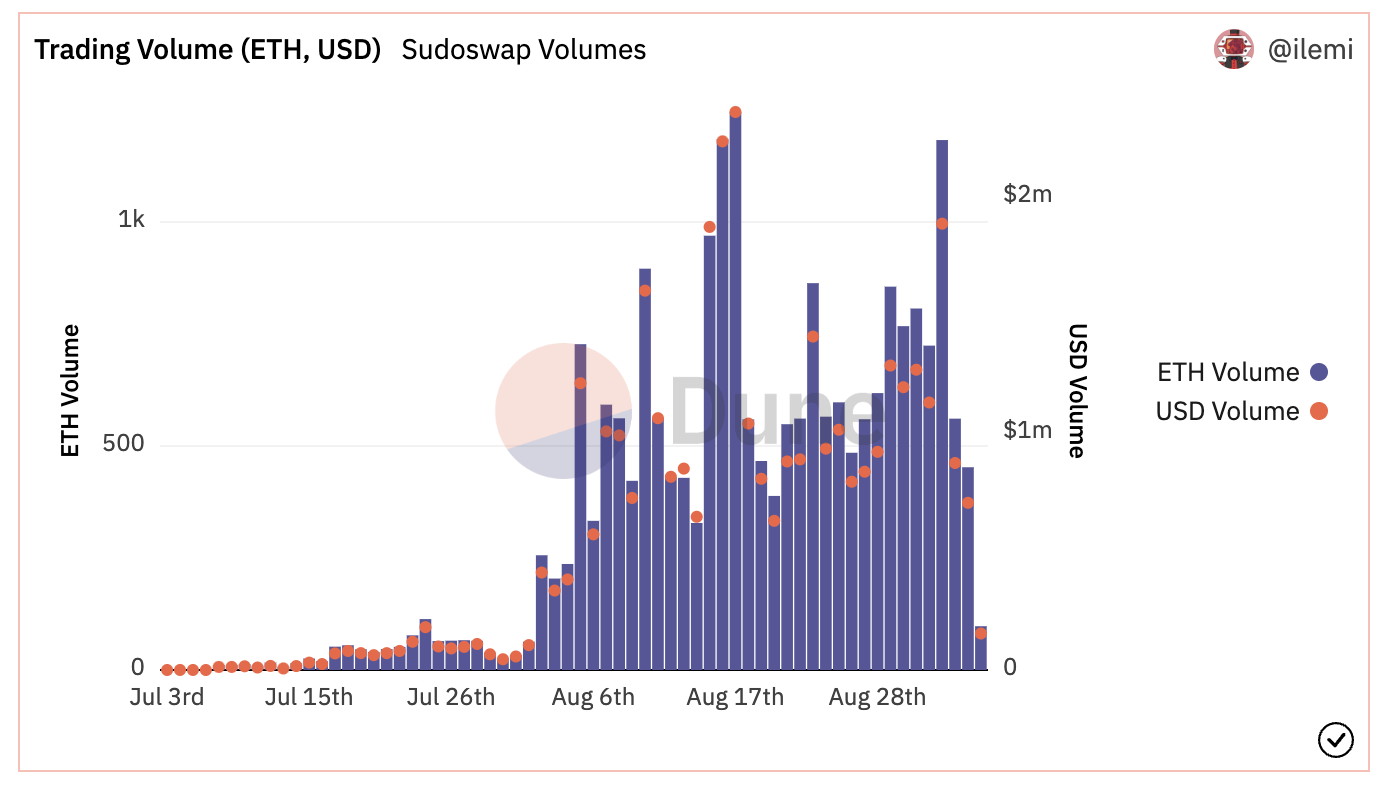
Decentralized NFT marketplace Sudoswap sparked controversy in mid-August with its automated market maker (AMM) that allows people to buy and sell automatically without having to wait for interested buyers or sellers. The gripe people have though is it bypasses royalties that go to creators.

But according to this Dune Sudoswap dashboard, since Sudoswap launched its AMM in July, it experienced a surge in volume.

Several no-royalty marketplaces have also popped up over the previous months, including Solanart and Yawww. X2Y2 also recently announced buyers would be able to choose how much in royalties they want to give to projects.

The result is an ongoing debate over the application and enforcement of royalties in the NFT space.

GameFi token market caps have declined

The market capitalization of the top 50 GameFi tokens dropped by over 60% from January to August 2022, according to The Block Research. That’s similar to the market cap decline of the top 50 DeFi tokens.

As of August 2022, it has also recorded a total of 1,575 GameFi projects — 40% of these are based on BNB Chain. Just over a quarter are Ethereum-based and 15% are on Polygon. But even they are faring much better than gaming-specific blockchains. Ones like Immutable X, Gala Games, WAX, Enjin, and Wemix are only snagging between 1% and 6% of the market share.

But players can only play around a third of all GameFi projects at the moment. According to The Block Research, “this is in line with the expectation of a long game development cycle of 3 to 5 years since most GameFi projects only receive funding between 2021 and 2022.”

Alien Worlds is the most played game

Alien Worlds is currently most popular blockchain-based game by active addresses. Axie Infinity, Solitaire Blitz, Splinterlands and Upland round out the top five.

…But are they bots?

Anti-bot protection software company Jigger came out with an interesting stat last week. It claims that 40% of the “players” in web3 games are bots. The research looked at over 60 web3 games and found evidence of around 200,000 bots across them all.

Half of PC and console gamers interested in metaverse

Google’s 2022 PC & Console Insights Report revealed that 47% of PC and console gamers are interested in interacting with the metaverse in the future. Respondents were also more interested in VR and AR than NFT-based games.

https://www.tbstat.com/wp/uploads/2022/09/Screenshot-2022-09-01-at-14.08.21-597x450.png

© 2022 The Block Crypto, Inc. All Rights Reserved. This article is provided for informational purposes only. It is not offered or intended to be used as legal, tax, investment, financial, or other advice.

Go to Source
Author: Callan Quinn

TV maker LG Electronics launches NFT platform with Hedera

LG Electronics, the Seoul-based television company, launched a new NFT platform with the help of the Hedera blockchain.

The company’s platform is called LG Art Lab. It will give customers a way to buy, sell and display digital art in the form of NFTs on their televisions, according to an announcement today.

LG is not the first large company to spy opportunity in the NFT space. Swiss watchmaker Tag Heuer in June announced a new tool that gave customers a way to display NFTs on the face of certain smartwatches.  

LG Art Lab is available in the US on televisions running webOS 5.0 of later, per the announcement. It includes a feature that offers profiles of artists and previews their upcoming work, as well as a countdown to upcoming NFT “drops.” The platform’s marketplace provides a venue for trading pieces.

The Hedera network underpins the new platform, with transactions run through Wallypto, an LG-patented crypto wallet for smartphones that is currently in beta testing.

Christian Hasker, CMO of Swirlds Labs, the Hedera developer, said in a statement that the announcement will bring NFTs “beyond being computer-based collectibles and toward becoming a piece of art displayed as any other artwork would be within the home of its owner.”

© 2022 The Block Crypto, Inc. All Rights Reserved. This article is provided for informational purposes only. It is not offered or intended to be used as legal, tax, investment, financial, or other advice.

Go to Source
Author: Ryan Weeks

Bridging DC and DeFi: Can crypto decentralize politics?

Political funding and lobbying are sensitive issues in America at the best of times. As the crypto industry has ascended as a power player in Washington, DC, stakeholders’ political work has attracted more attention.

The eminence of centralized players representing the decentralized world has proved a particular sticking point, sparking criticism during recent public — and televised — interactions.

Rep. Brad Sherman, one of the most vocal critics of crypto in Congress, derided a panel of crypto CEOs in December.

“The advocates of crypto represent the powers in our society. The powers in our society — on Wall Street and in Washington have spent millions, and are trying to make billions or trillions in the crypto world,” said Sherman. “Today we hear from the CEOs, with their lobbyists, their PACs, and their power.”

Many of the panelists run firms that have taken the lead on cryptocurrency lobbying and campaign donations. FTX’s Sam Bankman-Fried was one of the biggest donors to Biden’s 2020 campaign, while Coinbase — who sent CFO Alesia Haas rather than CEO Brian Armstrong — maintains the industry’s largest lobbying program, dropping $1 million per quarter.

At once, that investment in DC has opened the door to a massive increase in the industry’s political viability. Yet with increasing entanglements, ethical issues crop up.

DeFi operators’ history in lobbying

Non-profit Coin Center, for example, has long touted its dedication to decentralized networks as a distinction from trade associations like the Blockchain Association or the Chamber for Digital Commerce, which have to account for member companies. At the same time, many of those members are DeFi operators.

Firms like Uniswap Labs, the Stellar Development Foundation and the Celo Foundation have onboarded new teams to handle government relations.

Uniswap Labs and the Celo Foundation began reporting their first lobbying spending in the most recent quarter. Uniswap Labs hired Salman Banaei as head of policy in May. Both Stellar and Celo have dedicated internal lobbyists as well as outside contracts. Decentralized VPN developers Orchid Global began reporting lobbying in Q3 2021.

Those firms tout their distinctness from the protocols they program — that separation being a critical feature of DeFi. Seth Hertlein, who was the first registered lobbyist for the Stellar Development Foundation and who now works for Ledger, noted the distinction:

“It’s an interesting dichotomy if you think about purely decentralized elements of the blockchain community versus centralized entities that are building things that are decentralized,” says Seth Hertlein “The purely decentralized elements still haven’t really figured out how to lobby, is my assessment.”

For example, Uniswap is by far the largest decentralized exchange, with volumes comparable to centralized exchange Coinbase.

It is, however, a protocol operating independent of the firm, Uniswap Labs — an argument Uniswap Labs’ policy team has had to make before policymakers to ensure that the firm is not regulated as itself an exchange.

As one key piece of the puzzle, Uniswap Labs does not make money off of the platform’s transaction fees. It is, however, funded by reserving 21% of the supply of native UNI tokens. The total market cap for UNI today is about $2.9 billion, according to CoinGecko data. 

Still, just like a traditional tech company would, Uniswap needs someone familiar with the ways of Washington. As one barrier, the Federal Elections Commission tallies campaign donations. The Secretary of the Senate tracks lobbying disclosures. Hertlein continued:

“To be effective, especially with campaign finance and political giving, you really need a certain amount of centralization. You need someone running it who knows how Washington works. Then you need someone, some entity, some group that has a coherent vision of what they hope to accomplish.”

DAO-ification

In dollar terms, the biggest player in lobbying that sets the pace for DeFi-native is an offshoot of Uniswap. The DeFi Education Fund launched as a result of an on-chain Uniswap governance vote in July 2021, which allocated $20 million in UNI to the new political project.

The proposal established a new committee of seven members, including Uniswap’s chief legal officer Marvin Ammori and legal reps of several other DeFi projects.

“This entity will not replicate the great work of existing organizations such as Coin Center, Fight for the Future, the Blockchain Association, the Crypto Council for Innovation, the Defi Alliance, Blockchain for Europe, or others,” the governance proposal read.

The DEF quickly onboarded Miller Whitehouse-Levine, formerly of the Blockchain Association, as its policy director. In Q4 of 2021, the DEF reported its first lobbying expenses, quickly becoming one of the largest spenders in crypto. The fund reported $230,000 in the most recent quarter.

“DeFi’s on the radar of the most important international regulators in the world,” said Whitehouse-Levine. “There’s an increasing recognition that regulators and developers are not speaking the same language right now.”

“It is our hope that other DAOs will support policymaker education and advocacy efforts to help make the case for everyone to be able to develop and use DeFi protocols,” Whitehouse-Levine continued. The organization’s model has yet to attract imitators.

Campaign funding

HODLPac is another project aiming to decentralize politics, particularly election donations. The political action committee’s tagline is “Grassroots politics for the decentralized economy.”

Whirty launched HODLPac while an analyst at Takoma Group in early 2020. The core objective is to evolve into, effectively, a DAO.

The PAC distributes its receipts according to an endorsement panel of known figures in crypto, many with DC connections. But the endorsement scheme only unlocks matching donations from the SuperPAC; donors can allocate their funds to whatever candidates they please.

“HODLPac’s section of the market is really being the hard-money PAC,” Tyler Whirty told The Block. It technically operates as a hybrid PAC and super PAC but has not actually used its super PAC wing this cycle.

For reference, PACs can donate $5,000 to a political candidate per election. Super PACs can spend unlimited funds in support of a campaign but are prohibited from coordinating with those campaigns.

In the cycle leading up to the 2022 midterms, the PAC had reported just under a quarter million dollars in total receipts. As of the end of June, it had given $46,191.47 to campaigns. Of total receipts, it actually returned a significant amount — over $130,000 — that had gone to its Super PAC.

For comparison, in its first year, HODLPac raised under $30,000 in total, only giving $7,500 to candidates. The current cycle represents a massive rise, and these numbers don’t represent peak midterm campaigning season. However, they are still nowhere near the scale of spending that centralized entities in crypto have been able to field.

After losing the 2020 Democratic presidential primaries and a 2022 run for mayor of New York, Andrew Yang turned, in 2022, to Lobby3.

“The most profound opportunity to fight poverty lies in Web3 technologies. Unfortunately, our leaders in DC don’t really get these technologies and are a little bit nervous about them,” he said in a February 17 video announcing the project.

Lobby3 aimed to bring the virtues of Web3 to DC. At a July 22 roundtable conducted as a Twitter space, a representative described its ambition to become “an impact-advocacy DAO.”

Writing to The Block, community manager Renee Davis said of Lobby3’s 2,500 members: “This community is the first that is focused specifically on giving individual Web3 builders a real voice in the burgeoning policy conversation — so that it’s not just major industry players whose voices are being heard.”

Yet from the public’s vantage point, Lobby3 has largely fallen quiet.

Trading on membership NFTs in secondary markets has practically frozen over. At the end of July, the firm hosted a members-only Twitter Space. Fifteen people tuned in. The operation has reported no lobbying spending, no political donations nor any other open public work. Yang himself has not tweeted or blogged about it since announcing its launch.

While decentralizing political influence has its appeal, it remains in beta testing. And as with the broader world of funding in politics, the field is fraught.

© 2022 The Block Crypto, Inc. All Rights Reserved. This article is provided for informational purposes only. It is not offered or intended to be used as legal, tax, investment, financial, or other advice.

Go to Source
Author: Kollen Post

Mercado Bitcoin parent 2TM lays off more staff, calls for regulation

2TM, the parent company of Brazilian cryptocurrency exchange Mercado Bitcoin, is laying off about 15% of its staff, nearly 100 employees, following cuts in June.

CoinDesk first reported the news on Sept. 1. 

It’s the latest round of layoffs among Latin America-based crypto companies in recent months. Mexico’s Bitso, a crypto exchange, announced it would cut 80 employees in May, and Argentine exchange Buenbit told The Block the same month that it had reduced its staff from 215 to 115 employees. 

The job losses come amid a collapse in crypto asset prices, including the Terra/Luna crash earlier this year, as well as a general economic slowdown worldwide with inflation steadily expanding.

2TM also faulted a lack of regulation in Brazil that is putting local crypto companies at a disadvantage.

“At 2TM, we unified our brands and concluded the integration of companies acquired in 2021, seeking efficiency and synergy,” 2TM said in a  statement shared with The Block. “Even so, adversity in the economy continues, and the competitive environment continues deteriorated and unfair without the approval of the legal framework for crypto assets, with players that follow the laws penalized against companies that ignore local rules.”

Brazil’s Congress was expected to have already passed a long-awaited crypto regulation after the Senate approved it in April, but the bill has been delayed as it awaits approval in the lower house. It is unlikely to become law ahead of the country’s presidential elections in October.

In July, Congressman Expedito Netto rejected two provisions in the Senate version of the bill: One was related to asset segregation, and the other would require foreign companies to register as legal entities in Brazil, financial newspaper Valor Econômico reported in July.

Crypto companies have taken varying views on whether those provisions should be included, and how.

Binance, which has taken steps to acquire a local Brazilian brokerage authorized by the country’s securities regulator, told The Block in July that it supports regulation in Brazil and elsewhere. However, it believes smaller companies would be negatively impacted by having to comply with new regulations without an adjustment period. It also took the view that the Senate bill did not do enough to explain how the asset-segregation rules would apply to different institutions, therefore creating uncertainty.  

In July,  Mercado Bitcoin CEO Reinaldo Rabelo told The Block crypto regulation in Brazil is “a fundamental and urgent step.”

“Standardization, when done well, goes far from being a restriction and guarantees freedom with responsibility,” he said. “It brings legal certainty that stimulates innovation, investments and entrepreneurship, strengthening the country’s position in the new digital economy.”

2TM raised $50 million in a second closing for its Series B funding round in November, which followed a $200 million closing from the SoftBank Latin America Fund in July. The company announced in January that it was expanding into Europe with Lisbon-based exchange CriptoLoja.

Mercado Bitcoin’s Rabelo told The Block that the exchange reported its highest-ever volume in 2021, with transactions totaling more than 40 billion Brazilian reals (about $7.74 billion at today’s exchange rate).

© 2022 The Block Crypto, Inc. All Rights Reserved. This article is provided for informational purposes only. It is not offered or intended to be used as legal, tax, investment, financial, or other advice.

Go to Source
Author: Kristin Majcher

Ether and ada in the green ahead of respective upgrades: This week in markets

In a mixed week for crypto markets, ether and ada made gains, just weeks out from upgrades on both blockchains.  

Bitcoin has lagged so far in September, down 1.49% at $19,704 over the past week, having surrendered gains made on Friday following jobs data in the U.S. Elsewhere, ether gained more than 4% and was trading at $1,551, while Cardano’s native token ada soared 10.69%.  

The Merge is set to happen in September, completing Ethereum’s move from proof of work to proof of stake after years of planning. During the build-up, traders were busy betting on the upgrade.  

Elsewhere, Ethereum co-founder Charles Hoskinson’s Cardano has a firm date for its own upgrade, dubbed vasil. The blockchain’s native token rose more than 10% to $0.498 

Traders continue to bet on The Merge 

In August, ether derivatives soared while bitcoin declined, and LedgerPrime noted in its market report this week that bearish bitcoin options strategies have been predominant.  

“Strategies such as the bear put spread (2.8K), with limited risk have been predominant this week; some investors consider prices are low enough and as a consequence, strategies such as the bull call spread are gaining momentum,” it said. 

In fact, ether strategies were dominated by the bull call spread, according to the fund, as it was “the most traded strategy this week at 42K in volume, followed by the bear diagonal spread.” Interestingly, the investment firm said calls and puts traded evenly during the week, “with a clear interest in near-term downside exposure, while optimism for the end of the year remains strong.” 

Elsewhere, the U.S. non-farm payroll report on Friday held more significance than in previous months, as noted by crypto trading firm QCP Capital ahead of time on Wednesday.  

“We have not looked at NFP this year at all, relegating it to our 2nd tier data series behind all the various inflation releases. However, after last month’s blow-out print, we now assign a 25/75 importance to the upcoming NFP/CPI to decide the Sep FOMC.” 

Non-farm payrolls measure the number of workers, excluding farm workers and workers in several other classifications, and it is released on the first Friday of each month. The figure came in at 315,000 for August, slightly below estimates of 318,000.  

The U.S. unemployment rate rose to 3.7%, up from 3.5% in July — however, it still hovered around a multi-decade low.

© 2022 The Block Crypto, Inc. All Rights Reserved. This article is provided for informational purposes only. It is not offered or intended to be used as legal, tax, investment, financial, or other advice.

Go to Source
Author: Adam Morgan McCarthy

The Merge: 10 key people behind Ethereum’s biggest upgrade yet 

The Merge is expected to be one of the crypto industry’s biggest events. It’s the point in time when the Ethereum blockchain will shift from a proof-of-work consensus mechanism to a proof-of-stake mechanism. It’s just one step in a broader roadmap to make the Ethereum blockchain more scalable, more secure and more environmentally friendly. The momentous event has been in the works for years with collaboration taking place around the world from industry groups to individual developers and contributors.  

With 119 core developers working on The Merge, however, and thousands of programmers contributing to the overall Ethereum protocol, it’s impossible to give any one person credit for the blockchain’s evolution. Regardless, some people undeniably have played crucial roles in making The Merge happen. Here are 10 people who have been integral in contributing to the historic switch. 

Aidan Hyman, CEO and co-founder of Chainsafe  

Who he is: Aidan Hyman is the CEO and co-founder of Chainsafe, a blockchain research and development company. Chainsafe works on a variety of projects across different blockchains. Lodestar, one of the firm’s projects, is playing a key role in The Merge as a consensus client for implementing Ethereum’s proof-of-stake algorithm. 

What he’s doing: Lodestar aims to enable individuals to easily self-host a staking validator and verify blockchain data. Lodestar helps to remove a reliance on centralized providers to validate the network. The project is open source and written in the popular programming language Typescript, which also makes it accessible to the developer community. Ethereum founder Vitalik Buterin provided ChainSafe its first grant to develop Lodestar in 2018. Several members of ChainSafe were also involved with the launching of the Goerli testnet, which ended up being the final merge testing ground before mainnet launch.

Where to find Hyman: LinkedIn, ChainSafe website, Github 

Danny Ryan, researcher at the Ethereum Foundation  

Who he is: Danny Ryan is a researcher at the Ethereum Foundation, a nonprofit organization supporting Ethereum and its related technologies. He is a lead coordinator for the rollout of the Ethereum upgrades. He frequently contributes to the Ethereum Foundation blog, providing progress updates on The Merge and Ethereum’s roadmap. 

What he’s doing: Ryan started getting involved in Ethereum’s shift to proof of stake in 2017, according to an interview with A16z’s Future publication. He describes his role at the Ethereum Foundation as helping to facilitate conversations to decide on timelines and priorities related to helping Ethereum become more scalable, secure and sustainable as well as helping to do research and development to vet suggested solutions. 

Where to find Ryan: Twitter, Ethereum Foundation website 

Paul Hauner, Co-founder of Sigma Prime 

Who he is: Paul Hauner is the co-founder of Sigma Prime, an information security consulting company. He also founded the Lighthouse project, which is another proof-of-stake consensus client for Ethereum. Since 2018, the Lighthouse project has raised funds from the Ethereum Foundation, infrastructure firm ConsenSys, and Ethereum co-founder Vitalik Buterin. 

What he’s doing: Lighthouse is an Ethereum consensus client for implementing the proof-of-stake algorithm with a focus on speed and security. Sigma Prime maintains the client, which individuals can download to become a validator for the Ethereum consensus layer. The Lighthouse team has also been actively involved in the specification and security analysis of the Ethereum proof-of-stake consensus specification, according to Lighthouse’s website

Where to find Hauner: Github, Lighthouse website, Twitter

Justin Drake, researcher at the Ethereum Foundation 

Who he is: Justin Drake is a researcher at the Ethereum Foundation. He joined the foundation in 2017 and previously founded a startup called Duo Money, according to LinkedIn. Drake first got involved in crypto in 2013, when he founded the Cambridge Bitcoin Meetup group. He recently received a lot of public attention related to The Merge for his outlook on post-Merge staking rewards

What he’s doing: In an interview with CryptoStaker, Drake describes his role at the Ethereum Foundation as staying “up to date with the firehose of internal and public conversations” as well as doing technical coordination and research for the foundation. He’s recently been working on a deep dive into the intersection of Maximal Extractable Value (MEV) and consensus, according to the interview. 

Where to find Drake: Twitter, Ethereum Foundation website, LinkedIn 

Pooja Ranjan, Herder-in-Chief, Ethereum Cat Herders 

Who she is: Pooja Ranjan is Herder-In-Chief for Ethereum Cat Herders. She also founded Ethereum news site EtherWorld and once worked at Accenture as a senior software engineer.  

What she’s doing: The Ethereum Cat Herders describes itself as a group of people supporting Ethereum’s core developers with “project management and other aspects of communication and coordination.” In addition, the group puts together educational videos about Ethereum Improvement Proposals (EIPs), or design documents related to The Merge as well as other topics.  

Where to find Ranjan: LinkedIn, Medium, Twitter, GitHub 

Vitalik Buterin, Co-founder, Ethereum  

Who he is: Vitalik Buterin is easily the most high-profile Ethereum co-founder, often credited with creating the protocol. Buterin, a Russian-Canadian programmer, helped start Bitcoin Magazine in 2011 before publishing the Ethereum whitepaper in 2014. 

What he’s doing: While no longer an Ethereum core developer, Buterin has played an invaluable role in communicating the move from proof of work to proof of stake since introducing the design philosophy for the new consensus mechanism in 2016. Since then, Buterin has made regular appearances to discuss the Ethereum roadmap and share technical articles with views on wide-ranging crypto topics.  

“The switch to proof of stake, I think, is very important just for the environmental reasons and also the efficiency reasons, Buterin said last December during a talk in Buenos Aires. “It’s also an opportunity to make the protocol much better, to have transactions confirmed faster, to make the network more efficient, add light client support — just a big, long list of things.”  

Where to find Buterin: Website, Twitter, GitHub   

Tim Beiko, Protocol Support for the Ethereum Foundation  

Who he is: Tim Beiko is a core developer for Ethereum, who joined the Ethereum Foundation in 2021 after transitioning from a product manager job with ConsenSys.

What he’s doing: With the responsibility of running biweekly core developer meetings, Beiko is in many ways the glue that holds the Ethereum developer community together. The meetings center on important discussions about network upgrades and improvements, including the many updates needed to prepare for the switch to proof of stake.  

Beiko was the one who informed us in July about the current mid-September target for The Merge. He also played a big role in helping push out Ethereum Improvement Proposal 1559 (EIP-1559), which was part of the London upgrade that introduced new burn mechanism for the protocol. 

Where to find Beiko: Twitter, GitHub, LinkedIn 

Preston Van Loon, Co-founder, Prysmatic Labs  

Who he is: Preston Van Loon co-founded Ethereum-focused infrastructure company Prysmatic Labs in 2018, working alongside Raul Jordan. Van Loon previously worked at Google. 

What he’s doing: Van Loon’s company has been working on developing Prysm, the most popular of four primary consensus clients used for proof of stake. Prysmatic started out focusing on a scaling solution called sharding, which will be a highly-anticipated upgrade to Ethereum after The Merge happens.  

The process of transitioning from proof of work consensus has taken Ethereum developers years longer than anticipated, but Van Loon explains that Prysmatic has worked hard to get things right. “At Prysmatic Labs we were one of the first people to get into it, and we have, I think, rewritten our whole codebase at least three times,” Van Loon said in February during a panel at ETHDenver. “And that’s just sort of the way it goes with this kind of technology where once its deployed out there, it’s really difficult to change.”  

Where to find Van Loon: Twitter, GitHub, LinkedIn 

Ben Edgington, Product Lead, Teku at ConsenSys 

Who he is: Ben Edgington is the founder and product lead for the open-source consensus client Teku.  

What he’s doing: Edgington made the decision to focus his efforts solely on Ethereum scaling and proof of stake in early 2018, the developer wrote in a ConsenSys blog post. The same year, he started developing the consensus client that would become Teku. Edgington describes being “well and truly hooked” on Ethereum when he learned of the transition to proof of stake, as he was concerned about the proof-of-work model’s environmental footprint.  

“I had no idea on that day six years ago that it would take us so long to deliver proof of stake,” Edgington wrote in the blog post. “The journey has been longer and tougher than anyone thought. But The Merge is finally upon us.” 

Where to find Edgington: Website, GitHub, LinkedIn, Twitter 

Mikhail Kalinin, Lead Researcher at ConsenSys R&D 

Who he is: Now a lead researcher at ConsenSys, Kalinin is one of the longest-standing developers working on Ethereum. Kalinin started working on an Ethereum client in 2015 before the mainnet even launched, he wrote in a ConsenSys blog post.  

What he’s doing: Kalinin has contributed to several key technical steps in making The Merge happen, including publishing the proposal for the Executable Beacon Chain and contributing significantly to the Merge specifications. In a recent tweet, Tim Beiko cited Kalinin along with Danny Ryan as two key people involved in The Merge, saying that “they literally built and steered the ship.” In that blog post, Kalinin called his Merge experience “an example of true diversification and decentralization of work on an R&D project.” 

Where to find Kalinin: Twitter, GitHub 


© 2022 The Block Crypto, Inc. All Rights Reserved. This article is provided for informational purposes only. It is not offered or intended to be used as legal, tax, investment, financial, or other advice.

Go to Source
Author: Kristin Majcher and Kari McMahon

Two reasons why Vitalik Buterin is worried about Bitcoin’s long-term health

Ethereum co-founder Vitalik Buterin is worried that Bitcoin’s level of security is not going to be strong enough in the years to come. 

In an interview with economics writer Noah Smith, Buterin gave two reasons why he is concerned. 

The first was that Bitcoin’s long-term security will slowly switch from mining rewards to transaction fees (as mining rewards continue to be lowered every four years). Still, he argued that current transaction fees are not high enough to provide the same level of security. 

“First, in the long term, Bitcoin security is going to come entirely from fees, and Bitcoin is just not succeeding at getting the level of fee revenue required to secure what could be a multi-trillion-dollar system,” he said.

He noted that Bitcoin sees roughly $300,000 in fees per day, a figure that hasn’t grown much over the past five years — although it has spiked as high as $21 million. In contrast, Bitcoin miners currently earn around $18.5 million per day.

Buterin’s second point was that he claims proof of stake is a more efficient way of providing security to a blockchain network than proof of work. While Ethereum is on the verge of migrating from proof of work to proof of stake (scheduled to happen this month), this is unlikely to happen to Bitcoin — as most Bitcoiners are staunchly against it.

Yet Buterin remained optimistic that it could be a possibility.

“Of course, if Bitcoin actually gets attacked, I do expect that the political will to switch to at least hybrid proof of stake will quickly appear, but I expect that to be a painful transition,” he said.

A lot at stake

As for the differences between proof of work and proof of stake, Buterin acknowledged the argument that the latter has stronger centralization pressures. 

“These are definitely things that I worry about, though I think people overstate them,” he said.

In response to these issues, Buterin highlighted some problems related to the current state of staking on Ethereum — such as withdrawals not being enabled yet — but pointed out that these will be fixed within the next year or so. 

He then compared staking to mining and claimed that large mining pools are close to certain governments, which could lead to censorship in the future (something that Ethereum is also grappling with).

He added, “The highly democratized early proof of work era was a beautiful thing, and it helped tremendously in making cryptocurrency ownership more egalitarian, but it’s unsustainable and it’s not coming back.”


© 2022 The Block Crypto, Inc. All Rights Reserved. This article is provided for informational purposes only. It is not offered or intended to be used as legal, tax, investment, financial, or other advice.

Go to Source
Author: Tim Copeland

PwC Venezuela Twitter account hacked to promote scam XRP giveaway

The Twitter account of the Venezuelan branch of PwC has been hacked to promote a scam cryptocurrency giveaway. 

Starting at 2:13 AM UTC, the Twitter account began posting links to a website purporting to represent the company Ripple and claiming to give away a large amount of the cryptocurrency XRP — in an obvious scam. It has posted the same link 14 times so far.

Typically these scams ask victims to send an amount of cryptocurrency in the hope that they will receive more in return, only for nothing to be sent back.

So far, all the tweets remain live on the account, suggesting that the account owner is either unaware of the scam or has lost access to the account. The Block emailed the company for comment but had not heard back by time of publication.

The PwC Venezuela account has 37,100 followers, which is much smaller than the accounting firm’s main account with 189,200 followers.


© 2022 The Block Crypto, Inc. All Rights Reserved. This article is provided for informational purposes only. It is not offered or intended to be used as legal, tax, investment, financial, or other advice.

Go to Source
Author: Tim Copeland


Follow by Email
Facebook20
Pinterest20
fb-share-icon
LinkedIn20
Share