FreeCryptoCurrency.Me

Free stocks and money too!

Category Archive : Crypto News

Crypto lending platforms react to high ETH borrowing by traders ahead of The Merge

Following The Merge to proof of stake, holders of ETH are hoping for a potential bonus in the form of a “powETH” token airdrop. While it’s uncertain whether the fork will happen, or if the forked token would have any value whatsoever, that hasn’t stopped traders trying to game the system.

Many have taken the approach to borrow ETH on the current blockchain with plans to repay it after The Merge and sell any forked tokens they receive. But this has led to a huge surge in the amount of ETH getting borrowed from lending platforms — causing headaches for those protocols.

The powETH airdrop is anticipated to come as a result of miner operators whose machines facilitate the proof of work-based consensus mechanism used by pre-Merge Ethereum. If these miners opt to reject a transition to proof of stake-based consensus they will cause a fork in the blockchain by continuing to support transactions on the proof of work chain.

Before the airdrop takes place, DAO-based lending protocols are taking varying approaches to reduce widespread market disruption in light of the surge in borrowing activity.

Aave halts borrowing

Aave has proposed to halt ETH borrowing and increase the variable borrow APR at 100% utilization from 103% to 1,000% in the interim period leading up to The Merge. In a recently published risk mitigation plan, Aave laid out its reasoning, pointing to three latent risk factors related to increasing ETH utilization that include potentially difficult or impossible liquidations, negative APY on ETH positions, and an increase in ETH withdrawals by regular suppliers.

Compound increases interest

In contrast to Aave’s approach, Compound’s proposal to mitigate overutilization will see the implementation of a borrow cap, swap out the interest rate model with a jump rate model, and increase borrow rates to accommodate withdrawal liquidity. Compound’s jump rate interest model will set rates based on utilization with a 2% rate at 0% utilization, a 20% rate at optimal utilization at and a 1,000% rate at 100% utilization, where optimal utilization caps at 80%. Compound asserts that such levels will be sufficient to discourage full utilization of its borrowing and withdrawal markets and reduce cases of insolvency or other market disruption.

Euler maintains course

Meanwhile, in a storm of tweets, Euler Labs co-founder and CEO Michael Bentley today described a starkly different approach than those of both Aave and Compound: Do nothing. In a request for comment posted in Euler’s governance forums, Bentley wrote, “Borrowers trying to get in early and front-run the powETH-borrow trade may find that by the time The Merge comes around they’ve paid more in ETH borrow interest than they stand to earn in powETH because of the high last minute costs.”

Bentley went on to propose that Euler refrain from altering its interest rate model for ETH, allowing borrowers to accumulate ETH in the days leading up to the Merge, and letting lenders fill the demand. He added that this tactic may entice lenders targeting higher interest rates to migrate assets to Euler.

A divided history

Notably, this isn’t the first time a fork in Ethereum has resulted in the creation of a new cryptocurrency. In 2016, when a critical code issue resulted in the freezing of $60 million of ether, the controversial decision to fork and restore the stolen funds resulted in the establishment of Ethereum Classic and today’s Ethereum. In contrast, Bitcoin has also undergone a number of forks related to protocol changes spurring the 2017 creation of bitcoin cash (BCH), and bitcoin gold (BTG) in 2018.


© 2022 The Block Crypto, Inc. All Rights Reserved. This article is provided for informational purposes only. It is not offered or intended to be used as legal, tax, investment, financial, or other advice.

Go to Source
Author: Jeremy Nation,
Frax Finance launches Fraxlend, its own borrowing and lending market

Frax Finance, the largest fractional algorithmic stablecoin protocol, is launching Fraxlend, a permissionless lending market that allows anyone to lend or borrow assets with any token that is a part of a Chainlink data feed.

Frax leads all algorithmic stablecoin protocols with roughly $1.18 billion total value locked (TVL), according to DeFiLlama. It operates using two stablecoins: FRAX and FPI. FRAX is pegged to the U.S. dollar and partially collateralized, while FPI is pegged to the U.S. Consumer Price Index (CPI). FRAX has been one of the most stable algorithmic stablecoins, having never lost its peg to date.

Frax Finance core developer Drake Evans recently highlighted two important use cases for Fraxlend during an appearance on the Flywheelpod podcast.

First, Fraxlend will enable the protocol to mint new FRAX through the borrowing and lending process. Fraxlend allows the Frax Finance protocol to directly lend FRAX and earn interest through existing money markets.

Until now, the only way to do that was by taking out an over-collateralized loan on a lending platform such as Curve. With Fraxlend, the protocol can now do this whole process in-house, which generates an additional cash flow that can be used to “buy back and burn FXS (similar to how MakerDAO burns MKR from stability fees),” according to Frax Finance’s website.

The second new application Drake highlighted is the ability to create custom term sheets for protocol-to-protocol deals. Typically, these deals — such as when a DAO wants to send another DAO tokens  — are worked out via Telegram chats and finalized as OTC deals involving multi-sig wallets. Fraxlend lets DAOs set up the deal on chain, automating the process and making it more transparent.

“Fraxlend is one of the newest generations of lending protocols that will showcase new innovations in onchain debt origination,” said Frax Finance founder Sam Kazemian. “Some of these features have never been built before in any kind of lending system so we are extremely excited to finally bring these use cases to DeFi.”

© 2022 The Block Crypto, Inc. All Rights Reserved. This article is provided for informational purposes only. It is not offered or intended to be used as legal, tax, investment, financial, or other advice.

Go to Source
Author: Mike Truppa

NFT and metaverse trademark applications for 2022 have already eclipsed 2021’s total

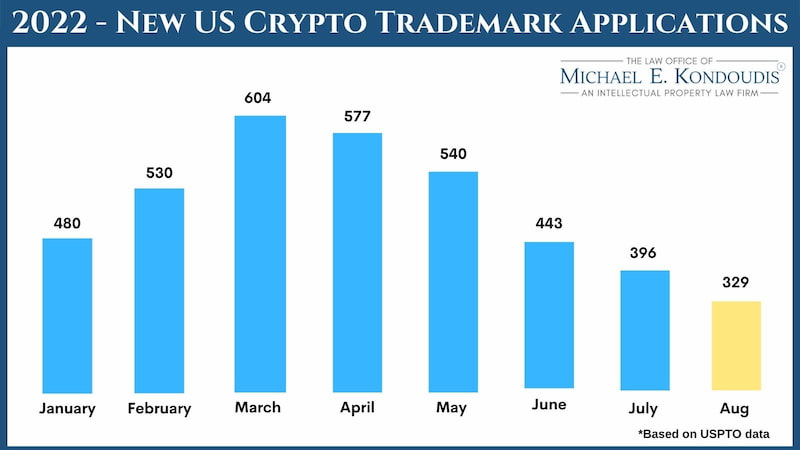
The number of metaverse-related trademarks filed so far in 2022 has already eclipsed last year’s numbers, as companies seek to protect their IP online.

That’s according to data shared by trademark attoney Mike Kondoudis on Tuesday. He recorded 4,182 US trademark applications filed for metaverse, virtual and web3 goods and services from January to August.

Numbers average at 523 a month, peaking in March with a record 759 filings. Last year saw a grand total of 1,866 trademark applications.

The numbers of companies applying for trademarks related to web3 services hit its stride following a court case related to NFT handbags in late 2021. French luxury fashion brand Hermes filed suit against Metabirkin NFT creator Mason Rotherschild, whose OpenSea collection included digital versions of Hermes iconic Birkin bag.

With the case still ongoing, on Aug. 26 the company looked to shore up its web3 brand protection further by also filing a trademark application.

The US Patent and Trademark Office (USPTO) has put a stop to several metaverse trademark applications for Gucci and Prada. Filed last year, it became clear that the two individuals filing them — Fenesha Holmes and Reath Mohammed — had no connection to either company.

A similar increase in trademark applications can also be seen in NFT patents. According to Kondoudis, over 5,800 related trademark applications have been filed in 2022. The total for the whole of 2021 was 2,087.

© 2022 The Block Crypto, Inc. All Rights Reserved. This article is provided for informational purposes only. It is not offered or intended to be used as legal, tax, investment, financial, or other advice.

Go to Source
Author: Callan Quinn

Crypto miner Hive Blockchain testing other GPU mineable coins ahead of The Merge

Bitcoin and Ethereum miner Hive Blockchain is looking into other coins that can be mined with graphics processing units (GPU), which are typically used to mine Ethereum.

The company is implementing beta-testing this week ahead of The Merge — when the blockchain’s proof-of-work consensus mechanism changes to proof-of-stake —, it said in its monthly update on Tuesday.

“The Company’s technical team is implementing a strategy to optimize the hashrate economics of the 6.5 Terahash of Ethereum mining capacity in the event of Ethereum’s transition to Proof of Stake, across various other GPU mineable coins,” it said in a statement. It also has a “pilot project for cloud computing.”

GPU mining represents 16% (or 21.5 megawatts) of the company’s total energy capacity. Most of its power is used to mine bitcoin.

Hive said that in the current “competitive” landscape, only miners with the lowest cost of power and most efficient GPUs will prevail. With its cost of $0.03 per kilowatt-hour, the company believes it is “well positioned to navigate the market ahead.”

However, it seems also to consider the option of using the 14.8 megawatts of power currently allocated to legacy GPU cards to mine Bitcoin, stating that if it did so, it would be able to add 0.4 to 0.4 exahashes per second (EH/s) to its bitcoin mining hashrate of 2.3 EH/s.

Bitcoin miner Hut 8, which has been growing its high-performance computing business, said also on Tuesday that it recently installed 180 GPUs, which are currently mining Ethereum and will “pivot on demand” to provide artificial intelligence, machine learning or VFX rendering services to customers.

© 2022 The Block Crypto, Inc. All Rights Reserved. This article is provided for informational purposes only. It is not offered or intended to be used as legal, tax, investment, financial, or other advice.

Go to Source
Author: Catarina Moura

Digital assets belong in traditional banking, ex-U.S. regulator says

More crypto business and innovation should be moved into the traditional banking industry, at least according to some bankers and a former bank regulator.

“The federal government doesn’t want basically unregulated third parties basically creating their own currency,” Gene Ludwig, a former top U.S. banking regulator who now runs a regulatory consultancy firm, said at the Bank Policy Institute annual conference in New York on Tuesday.

Instead of experimenting with a central bank digital currency, regulators should “allow banks to play more aggressively in the crypto market,” Ludwig said. “If we’re going to allow crypto at all, the banking industry is the right place to do it, because it is regulated.”

But regulators might view increased exposure to digital assets warily, cautioned Jeremiah Norton, managing member of Chain Bridge Partners, a regulatory advisory firm.

“I think the coin argument is the most tricky and fraught with peril,” said Norton, with U.S. regulators telling banks, “‘If you’re thinking about thinking about crypto, come to us first.’”

“I don’t see a lot of running room for algorithmic players in the regulated space anytime soon,” Norton said.

© 2022 The Block Crypto, Inc. All Rights Reserved. This article is provided for informational purposes only. It is not offered or intended to be used as legal, tax, investment, financial, or other advice.

Go to Source
Author: Colin Wilhelm

Fuel Labs raises $80 million for modular execution layer, touting superior speed

Fuel Labs, a startup that aims to speed up crypto transactions, has announced an $80 million funding round from some of the sector’s biggest investors.

Blockchain Capital and Stratos Technologies led the investment, according to an announcement on Tuesday, with Sam Bankman-Fried’s Alameda Research, CoinFund, Bain Capital Crypto, TRGC, Maven 11 Capital, Blockwall, Spartan, Dialectic and ZMT all participating. Ekram Ahmed, head of communications at blockchain developer Celestia Labs, is a strategic advisor.

The startup did not disclose further details of the raise, such as what valuation it placed on the project, or how the deal was structured. A spokesperson for the firm said it has no headquarters. Fuel last raised capital in a $1.5 million round led by CoinFund in September last year.

The latest raise comes with competition for supporting crypto projects heating up. New Layer 1 blockchains — challengers to the likes of Ethereum — are attracting significant investment, promising greater efficiency and reliability. Aptos Labs and its largely untested blockchain has drawn in $350 million in two funding rounds this year alone.

Fuel offers a different take on tackling blockchain’s perceived problems. It was conceived as a Layer 2 scaling technology, and it became the first optimistic rollup launched on Ethereum in late 2020, per today’s announcement.

Now, with more than 60 engineers working on the project, Fuel styles itself as a “modular execution layer” (MEL) — comparable with but subtly different from Layer 2 protocols like Polygon. It hopes to offer slicker execution without sacrificing the security and decentralization benefits of Ethereum.

Scaling criticism

The project marked its transition to MEL in a blog post published in April this year. In that, it defined an MEL as “a verifiable computation system designed for the modular blockchain stack.” The post criticized Ethereum scaling tools like optimistic and zero knowledge (ZK) rollups on the basis that, although they have delivered some cost savings for crypto users, “throughput increase has been modest at best.”  

“The main difference between a ‘Layer 2’ and a ‘modular execution layer’ is mostly contextual,” according to Arnold Toh, an analyst at The Block Research. “In the current state of blockchain development, almost all Layer 2s are modular execution layers. However, not all modular execution layers may be termed as ‘layer 2s.’” He pointed to the example of StarkNet’s vision for so-called Layer 3s, in which StarkNet would serve as a settlement layer for a MEL built on top.

“This is also why I perceive layer numbers as arbitrary. It would bring more clarity to define a layer by their responsibilities and stakeholders,” Toh added.  

Fuel highlighted three key aspects of its technology in its announcement: the capacity to execute parallel transactions; its own Fuel Virtual Machine; and a developer experience structured around a purpose-built coding language named Sway.

“The core premise is that we keep seeing new chains pop up all the time, but people are not trying to retain the security and decentralization of the existing systems that we have,” Nick Dodson, co-founder at Fuel Labs, told The Block in an interview.

Fuel, Dodson added, wants to deliver “the maximum amount of security possible, but also the highest possible flexible throughput.”

As to how a newcomer like Fuel can compete in an increasingly crowded field of Layer 1 blockchains and scaling apparatus, Dodson said the startup aims to work with “focused [DeFi] projects that really believe in what we’re doing.”

“We’ll just aim to have the absolute best developer experience out there,” he added. “I think it will set a new standard for how blockchain development will happen.”

© 2022 The Block Crypto, Inc. All Rights Reserved. This article is provided for informational purposes only. It is not offered or intended to be used as legal, tax, investment, financial, or other advice.

Go to Source
Author: Ryan Weeks

Russia’s Finance Ministry is working on stablecoin platforms to avoid cross-border dollar settlement: Tass

Russia’s finance ministry is looking to stablecoins to avoid international payment rails denominated in the U.S. dollar and euro, according to state media.

The September 6 report from state-owned news outlet Tass cites Aleksey Moiseyev, Russia’s deputy minister of finance, speaking at a conference in Vladivostok. 

“We are working with a whole range of countries to create new two-sided platforms without using dollars or euros,” said Moiseyev. “Stablecoins can be tied to some generally accepted instrument like, for example, gold, whose value is understood and appreciable for all parties.”

Russia has been coping with intensifying sanctions from the U.S. and Europe for the better part of a decade. In February, shortly after Russia invaded Ukraine, the U.S. and EU governments agreed to remove certain Russian banks from SWIFT, the primary global settlement layer. The country has explored many steps to get around this, including increasing the role of the ruble and yuan in its hydrocarbon exports and working to digitize the ruble. To date these efforts have had limited success, however. 

© 2022 The Block Crypto, Inc. All Rights Reserved. This article is provided for informational purposes only. It is not offered or intended to be used as legal, tax, investment, financial, or other advice.

Go to Source
Author: Kollen Post

Unstoppable Domains Company Intelligence

Quick Take

  • Unstoppable domains can be used to build a user’s Web3 identity, log in to Web3 applications (Login with Unstoppable), replace crypto wallet addresses and create decentralized websites
  • This July, Unstoppable Domains closed a $65 million Series A round (led by Pantera Capital) and reached a $1 billion valuation
  • For the next 12 months, Unstoppable Domains is focused on creating more utility for its NFT domains and building more integrations with apps, dApps, games, and metaverses
  • Key concerns for the future include (1) blockchain scalability bottleneck and (2) naming collision with competitors

This research piece is available exclusively to
members of The Block Research.
You can continue reading
this Research content on The Block Research.

Go to Source
Author: Wendy Hirata

Franklin Templeton launches metaverse ETF for European investors

Franklin Templeton is launching a metaverse exchange-traded fund (ETF) for European investors as it seeks to 

The fund, named the Franklin Metaverse UCITS ETF, will track Solactive Global Metaverse Innovation Net Total Return Index, which includes companies that have significant exposure to the metaverse, including blockchain applications, like payments firm Block, crypto investing firm Galaxy Digital and gaming company Electronic Arts, the company said Tuesday.

Franklin Templeton, which had more than $1.4 trillion assets under management as of July 31, is betting that the metaverse and blockchain “could profoundly impact societies and global economic growth,” said Dina Ting, head of global index portfolio management at Franklin Templeton. “Blockchain technology development is propelling metaverse expansion possibilities in compelling and far-reaching ways.”

The company joins other traditional U.S. asset managers exploring crypto offerings. Last month, BlackRock, the world’s biggest investment manager, launched a product offering institutional clients exposure to spot bitcoin. Asset manager T. Rowe Price, with $1.3 trillion under management, recently appointed Blue Macellari, who previously worked at crypto hedge fund, as its head of digital assets strategy. 

This isn’t Franklin Templeton’s first move in the digital asset space. Last year, the firm formed a blockchain venture fund that aimed to raise as much as $20 million and launched a U.S. mutual fund on the blockchain. In April, a veteran of investment bank Citi joined the asset manager to spearhead digital asset research.

The firm’s ETF platform itself has more than $12 billion in assets as of Aug. 31 and contains a range of active, smart beta and passive ETFs.  The companies are selected by Solactive’s proprietary natural language processing engine ARTIS, per the release. 

The new ETF will list on Deutsche Börse Xetra (XETRA) on Sept. 7, and Borsa Italiana as well as London Stock Exchange (LSE) on Sept. 9.


© 2022 The Block Crypto, Inc. All Rights Reserved. This article is provided for informational purposes only. It is not offered or intended to be used as legal, tax, investment, financial, or other advice.

Go to Source
Author: Kari McMahon

3AC withdraws $45 million from Curve and Convex

Troubled crypto hedge fund Three Arrows Capital (3AC) has reclaimed $45 million in deposits it had previously staked on two different decentralized exchanges: Curve and Convex Finance.

At 4:34 am ET on Tuesday, the firm withdrew 20,945 staked ether (stETH), worth $33.3 million, from Curve Finance, according to on-chain activity on an Ethereum address that Nansen has marked as belonging to 3AC. Staked ether is token offered by Lido Finance that allows staked ether (ETH) to be used in other trades in a process known as liquid staking.

On-chain data also shows the firm took out funds from Convex Finance, a yield optimizer for Curve. From Convex, it withdrew nearly $12 million worth of crypto, including 2,421 wrapped ether (3.98 million) 202.7 wrapped bitcoin ($4 million) and 4,051,367 USDT stablecoin.

The assets currently sit in the same wallet address used to transact with Curve. This address holds assets worth a total of $57.86 million. Crypto derivatives firm 21 Shares says that 3AC holds $86.8 million in tokens and NFTs holdings on Ethereum across several addresses tied to the firm.

Earlier this summer, the collapse of Three Arrows Capital sent the crypto space into chaos and caused many of its lenders to suffer heavy losses. The Block reported that the firm had owed creditors more than $3.5 billion. The fund filed Chapter 15 bankruptcy in New York on July 1. 

While social media commentators have speculated that the firm may be looking to liquidate its holdings to pay off creditors, the purpose of today’s withdrawals is unclear.

© 2022 The Block Crypto, Inc. All Rights Reserved. This article is provided for informational purposes only. It is not offered or intended to be used as legal, tax, investment, financial, or other advice.

Go to Source
Author: Vishal Chawla


Follow by Email
Facebook20
Pinterest20
fb-share-icon
LinkedIn20
Share