FreeCryptoCurrency.Me

Free stocks and money too!

Category Archive : Crypto News

Nexo to take 30 more days to decide on its potential Vauld acquisition

Crypto lender Nexo will take a further month to decide on its potential acquisition of Vauld, an embattled rival, according to an email obtained by The Block.

The email, sent by Vauld to its customers on Tuesday, reads that “the 60-day exclusivity period previously agreed with Nexo to conduct due diligence in relation to the potential acquisition has been extended for a period of a further 30 days from today. This is because more time is required for the due diligence process.”

Nexo co-founder Antoni Trenchev confirmed the extension to The Block when contacted. Vauld did not respond to The Block’s request for comment.

Nexo started conducting due diligence on Vauld on July 5 and had until September 5 to make its decision. The extension means no decision will be announced until the first week of October at the earliest.

Vauld halted client withdrawals on July 4 as it fought to stave off insolvency. The firm owes a total of $402 million to creditors, as The Block reported at the time. Of that sum, $363 million — or 90% — comes from individual retail investors’ deposits.

To add to its problems, last month, India’s Enforcement Directorate (ED), a law enforcement agency that investigates financial crimes, froze Vauld’s assets worth around $46 million. One of its clients was involved in a money laundering case, according to ED.

While Nexo has until early October to announce its decision, Vauld itself has until November 7 to decide its path forward, having received three months from the Singapore High Court in August to continue exploring its options. After that date, Vauld could be forced into liquidation unless the court grants another extension.

If the Nexo deal doesn’t happen, Vauld has said it has other plans, including raising more capital, waiting for some of its deployed money to be returned, converting debt to equity and issuing its own token.

© 2022 The Block Crypto, Inc. All Rights Reserved. This article is provided for informational purposes only. It is not offered or intended to be used as legal, tax, investment, financial, or other advice.

Go to Source
Author: Yogita Khatri

Former Revolut exec Alan Chang thinks web3 can solve the energy crisis

Tesseract, the startup co-founded by former Revolut chief revenue officer Alan Chang, plans to use crypto to help solve the UK’s energy crisis.

The startup, which just raised a $78 million round led by Balderton Capital and Lakestar, was founded earlier this year by Chang and Charles Orr, a former strategy lead at Revolut. Chang was the third employee at Revolut and was considered founder and CEO Nik Storonsky’s right-hand man, per reports.

Tesseract plans to buy and build renewable energy sources to sell directly to the customer, with crypto providing a novel way of paying. Much of the funding will be used to finance these purchases.

This funding model also means energy users can pay energy producers directly, rather than going via one of the huge brokers at the heart of the current set up. 

“By going directly to customers, we bypass the brokers,” said Chang, who formally left Revolut last week. “We can not only improve margins by doing that, but also sell energy much more competitively than everyone else.”

Tesseract, now valued at $145 million, takes its name from the cube capable of storing unlimited energy in the Marvel movies — of which Chang is “a big fan.”

Across the world, energy prices have soared as the war in Ukraine and a disruptions from the pandemic took their toll. While upcoming legislation aims improve the situation in the UK, household energy bills have continued to rise, with some analysts forecasting that they will reach £7,700 ($9,000) annually without more government support.

Chang believes that an opportunity to offset sky-high energy bills may emerge through Tesseract’s use of blockchain technology. The startup will tokenize the sale of energy, meaning users can buy and hold a token that equates to certain amount of energy. 

Chang describes it as a “virtual renewable power station” from which users can buy energy directly from solar panels and other renewable energy sources via tokens. This, he said, will create liquidity in a market that has historically lacked it.

Owning these tokens will allow users to reduce their energy bills, Chang explained.

“Let’s say you use 100 kilowatt hours of energy every month and your tokens also generate the same amount — that means you’re offset, and your energy bill will be zero,” he said.

It’s an ambitious plan and one that will likely face pushback from a public that largely views blockchain technologies as confusing and, generally, bad for the environment.

Launching on mobile, with a closed beta likely by end of the year and a public launch next year, Tesseract users will be able to purchase its tokens in-app with the click of a button, while those who wish to hold the tokens in their own non-custodial wallet will be able to do so.

The token itself will likely be an ERC-20 built on top of the Ethereum blockchain, using a compatible Layer 2 solution, said Chang.  

He wants to make the project as decentralized as possible, with the aim of listing it on both decentralized and centralized exchanges. But he said that doesn’t mean it’s an investment product.

“Initially we will be the only issuer of these renewable power tokens but eventually we want to invite more renewable energy companies in the world to participate in this network,” he says. “We want to create a truly decentralized renewable power network.”

© 2022 The Block Crypto, Inc. All Rights Reserved. This article is provided for informational purposes only. It is not offered or intended to be used as legal, tax, investment, financial, or other advice.

Go to Source
Author: Tom Matsuda

Singapore’s Whampoa Group to allocate more to crypto: Reports

Singapore’s Whampoa Group has plans to raise funds for a $50 million crypto-related hedge fund and to allocate $100 million in crypto-focused venture capital investments, according to media reports. 

The Whampoa Group is a family office and significant investment force. It has ties to the Lee families, related to Singapore’s founding prime minister and prominent business families that co-founded Southeast Asian bank OCBC (OCBC.SI) in addition to other companies, through co-founders Amy Lee and Lee Han Shih.

Whampoa’s co-founder and CEO Shawn Chan told Reuters the firm will invest in and incubate web3 start-ups through investments in equity and tokens, according to a report from Reuters. 

A separate report from Bloomberg indicates the Whampoa Group also has plans to pivot its asset-management business towards digital assets and will raise funds for a $50 million crypto-focused hedge fund. In an interview, Chan told Bloomberg the Whampoa hedge fund is market neutral to offset the volatility of crypto and primarily trades Bitcoin and Ether.

Singapore has been at the forefront of the crypto industry in terms of licensure and regulation. As recently as last month the Monetary Authority of Singapore communicated it remains interested in anchoring crypto players to Singapore that can add value to its digital asset ecosystem. Still, at that time the authority said it was considering adopting stricter rules for retail crypto market participants. 

© 2022 The Block Crypto, Inc. All Rights Reserved. This article is provided for informational purposes only. It is not offered or intended to be used as legal, tax, investment, financial, or other advice.

Go to Source
Author: Aislinn Keely

Vulnerability report highlighted attack that could have taken down the Avalanche Network

A vulnerability report was released to the public earlier today highlighting an attack that could have taken down the entire Avalanche Network, one of the largest Layer 1 blockchains.

The vulnerability was first discovered by Ethereum team lead Peter Szilagyi on March 29. At the time of discovery, Avalanche had more than $9 billion in total value locked (TVL) and a market capitalization of roughly $24 billion, according to DeFi Llama and Coingecko, respectively. This issue has since been patched.

Ava Labs declined to comment for this story.

The report released by Szilagyi laid out a timeline of events that occurred leading up to the public release, as well as details regarding the vulnerability.

When Szilagyi discovered the vulnerability on March 29, he suggested to Avalanche they push through a patch to fix it. The team responded quickly, patching the vulnerability that same day.

The vulnerability was a “remote node crash via malicious PeerList package,” Szilagyi said.

In other words, a malicious attacker could have funded an Avalanche node for roughly $179,000, sent out malicious PeerList packages (used for network communication) to other nodes, and effectively taken down the network.

The attacker could also have opted to run a non-validator node (connected to only validators vs. all nodes in the network) that would effectively give the same result but would take much longer to play out.

Szilagyi provided more details, writing, “Avalanche is very relaxed on the network connections it makes, and even a single connection is enough to take down a node.” “Since all nodes in the network connect to all validators, it’s pretty much an insta-death for the entire network,” he added

Szilagyi wrote in the case of an attacker funding a new validator to run this attack, they would opt to put in a short on the AVAX token even with the up-front cost of $179,000.

This is because “the network would rebound anyway after a few hours so no long-term value lost in the malicious validator,” Szilagy said in his report.

© 2022 The Block Crypto, Inc. All Rights Reserved. This article is provided for informational purposes only. It is not offered or intended to be used as legal, tax, investment, financial, or other advice.

Go to Source
Author: Mike Truppa

Binance adds former Mexico securities chief to new global advisory council

Binance has added Adalberto Palma Gómez, former president of Mexico’s National Banking and Securities Commission (CNBV), to its new global advisory board.

Mexican business news outlet El Economista first reported news of the appointment, which Binance confirmed to The Block in a statement.

Palma was appointed as the CNBV’s president in November 2018 and resigned from the role in March 2020. He has more than 30 years of financial experience, Binance said, serving in executive roles at Banamex, Citibank and Bankers Trust in addition to being an independent advisor for Mexico’s Institute for the Protection of Bank Savings (IPAB). 

Binance announced Palma’s addition to its advisory board just days after the exchange revealed that former Brazilian finance minister Henrique Meirelles would also be joining the group. Meirelles left his role as Sao Paulo’s finance minister in April and also served as Brazil’s finance minister between 2016-2018. 

Binance, the world’s largest cryptocurrency exchange, has been building its local presence in Latin American countries with a large focus on Brazil. 

“Binance will release more details about the new advisory board soon,” the exchange said in a Portuguese-language statement. 

© 2022 The Block Crypto, Inc. All Rights Reserved. This article is provided for informational purposes only. It is not offered or intended to be used as legal, tax, investment, financial, or other advice.

Go to Source
Author: Kristin Majcher

Creditor representatives support plan to appoint examiner in Celsius bankruptcy

The Committee of Unsecured Creditors in Celsius’s Chapter 11 bankruptcy case has reached an agreement with the Department of Justice on its request to appoint an examiner to the lender. 

If the proposed order approved, a neutral investigator would be appointed to conduct an investigation into Celsius’s storage of crypto holdings, account management for customers, status of its mining business, and taxes—issues that involved parties have continuously asked for clarity on.

Unsecured creditors in the case previously said they had concerns that the broad scope of a proposed third-party investigation could be costly to the estate and prolong the bankruptcy proceedings. Now they say they’ve reached consensus with the Justice Department’s Office of the U.S. Trustee.

“This resolution, if approved by the court, will balance the need for transparency with the risks of significant costs/delay. If the court orders the appointment of an examiner, we will work with that individual to ensure transparency and accountability for account holders,” the Unsecured Creditor Committee posted from its official Twitter account. 

If an examiner is assigned, they will prepare and file an investigation report within 60 days of receiving approval of their investigation plan. 

The U.S. Trustee called for an examiner last month, arguing it was necessary due to a continued lack of sufficient information. That initial motion planned to include a look into allegations of “fraud, dishonesty, incompetence, misconduct, mismanagement, or irregularity in the management of the affairs of [the Debtors] of or by current or former management of [the Debtors].” The U.S. Trustee argued an outside examiner could provide visibility into Celsius’s business model and balance sheet in addition to fostering public trust.

Yesterday, state securities regulators in Vermont and Texas filed their support for an examiner, saying Celsius’ public statements were inconsistent and may have misled investors. The evidence included in the filing suggested Celsius may have been using a Ponzi-like scheme to pay yields. 

A group of borrowers in the case also filed their support for an examiner yesterday, but proposed the appointment of a chapter 11 trustee to mitigate the expenses and time costs of an examiner. 

The issues and order will be discussed at the upcoming Sept. 14 hearing. 

© 2022 The Block Crypto, Inc. All Rights Reserved. This article is provided for informational purposes only. It is not offered or intended to be used as legal, tax, investment, financial, or other advice.

Go to Source
Author: Aislinn Keely

Florida man pleads guilty to securities fraud charge in $100 million crypto Ponzi scheme

A Florida resident pleaded guilty to a securities fraud conspiracy charge in a case involving a crypto Ponzi scheme said to have netted as much as $100 million from customers.

The Department of Justice announced the guilty plea, saying that Joshua Nicholas faces up to five years in prison at sentencing. Nicholas admitted that he and others fraudulently promoted EmpiresX by making numerous misrepresentations regarding, among other things, a purported proprietary trading bot and fraudulent “guaranteed” returns to investors and prospective investors in the company.

EmpiresX falsely claimed to use trading bot software but in reality paid out older investors using incoming funds — the definition of a Ponzi scheme.

“In addition, despite representations to the contrary, EmpiresX never registered, nor took steps to register, EmpiresX’s investment program as an offering and sale of securities with the U.S. Securities and Exchange Commission, nor did EmpiresX have a valid exemption from this registration requirement,” the DOJ said.

An Instagram account devoted to the EmpireX scheme promised high investment returns to would-be participants. 

Nicholas faces a maximum penalty of five years in prison. A sentencing date has not yet been scheduled.  


© 2022 The Block Crypto, Inc. All Rights Reserved. This article is provided for informational purposes only. It is not offered or intended to be used as legal, tax, investment, financial, or other advice.

Go to Source
Author: Michael McSweeney

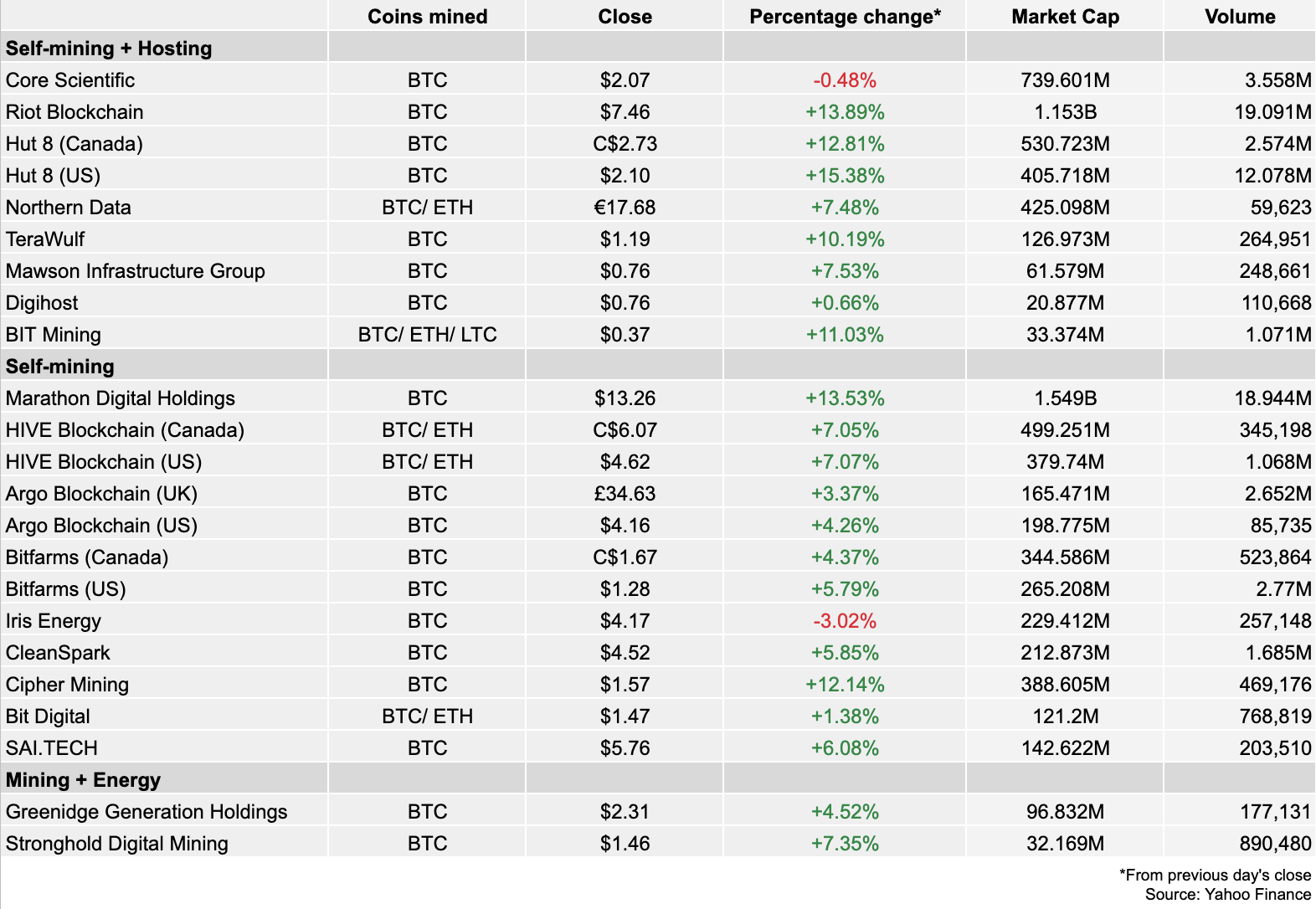
Bitcoin mining stock report: Thursday, September 8

Most bitcoin miners saw their stocks rise on Thursday, as the coin’s price stayed above the $19,000 mark.

Bitcoin’s price was close to $19,400 at market close, according to data from TradingView.

Hut 8’s stock rose by 15.38% (on Nasdaq), followed by Riot (+13.89%), Marathon (+13.53%) and Cipher Mining (+12.14%).

Here’s how crypto mining companies performed on Thursday, Sept. 8

© 2022 The Block Crypto, Inc. All Rights Reserved. This article is provided for informational purposes only. It is not offered or intended to be used as legal, tax, investment, financial, or other advice.

Go to Source
Author: Catarina Moura

Enthusiast Gaming taps Coinbase to help build its web3 game offerings 

Crypto exchange giant Coinbase will provide the infrastructure for gaming entertainment firm Enthusiast Gaming to build out its blockchain-based gaming offerings.  

Coinbase will provide Enthusiast Gaming the crypto wallets, blockchain nodes, fiat-to-crypto payment ramps and other tools via its Coinbase Cloud developer platform, Enthusiast Gaming said a release.  

Enthusiast Gaming will use these tools to build out EV.IO, a browser-based first-person shooter game that rewards players with cryptocurrency for their achievements, and other blockchain-based games. 

“We’re honored to have been selected by Enthusiast Gaming to power its growing portfolio of games with scalable blockchain infrastructure,” said Dan Kim, vice president of business development at Coinbase, said in a release. “Partnering with industry experts on game-changing titles like EV.IO is how we’ll help onboard the next 100 million users into web3 in the safest and most seamless way possible.” 

Enthusiast Gaming earned $51.1 million in revenue in the second quarter of 2022. The firm has partnerships with Adidas, the U.S. Navy, HBO Max, Universal Pictures as well as the gaming NFT marketplace Fractal.  

© 2022 The Block Crypto, Inc. All Rights Reserved. This article is provided for informational purposes only. It is not offered or intended to be used as legal, tax, investment, financial, or other advice.

Go to Source
Author: MK Manoylov

SEC to form a new office for crypto disclosures

The Securities and Exchange Commission will establish a new office for cryptocurrency filings.

The office will be within the Division of Corporation Finance, which handles disclosures for publicly traded firms, said Cicely LaMothe, the associate director for disclosure operations within that division.

LaMothe told the audience at a legal conference in Washington on Thursday that the SEC saw the new office as necessary to address “unique and evolving” filings around crypto assets, the vast majority of which the SEC views as securities. Much of the crypto industry has pushed back against the definition or otherwise avoided registering new coins as securities, often resulting in enforcement actions or ongoing litigation.

According to LaMothe, the SEC still needs someone to run the office, which is expected to have legal and accounting branches for crypto firms to consult and file with.

© 2022 The Block Crypto, Inc. All Rights Reserved. This article is provided for informational purposes only. It is not offered or intended to be used as legal, tax, investment, financial, or other advice.

Go to Source
Author: Kollen Post


Follow by Email
Facebook20
Pinterest20
fb-share-icon
LinkedIn20
Share