FreeCryptoCurrency.Me

Free stocks and money too!

Category Archive : Crypto News

South Korean authorities seek to invalidate Do Kwon’s passport: Munhwa

South Korean prosecutors asked the country’s foreign ministry to invalidate Terraform Labs founder Do Kwon’s passport on Thursday, according to a report by Korean newspaper Munhwa.

The news comes a day after the Seoul Southern District Prosecutors Office issued an arrest warrant for Kwon, who has been charged under the Capital Markets Act along with five others. The prosecutors also asked for their passports to be invalidated — except for Nicholas Platias, another Terraform Labs founder, who is not a Korean national.

Due to the length of time it may take to invalidate the passports — local media suggests up to a month — authorities will continue to pressure Kwon to return to South Korea. His last known whereabouts were in Singapore, where he has been based for much of the Terra collapse, and invalidating his passport would make him unable to travel.

In May, the company’s algorithmic stablecoin, TerraUSD, depegged from the dollar, ultimately collapsing the Terra ecosystem and wiping out around $40 billion in value. While Terraform Labs and related entity the Luna Foundation Guard attempted to repeg TerraUSD, they were ultimately unsuccessful.

Kwon has since released plans to try and rebuild the Terra ecosystem, but remains subject to lawsuits from angry investors.

In an interview in August, he said he had not been contacted at all by Korean investigators and that it was hard to make a decision about returning to South Korea, but emphasized he wasn’t in Singapore for the purpose of evading investigators. He added that dealing with due process was not a question of what you are prepared to face but how you are going to face it.

“What we’re going to do is we’re just going to put out the the facts as we know them. We’re going to be totally honest and deal with whatever consequences as they may be,” he said.

© 2022 The Block Crypto, Inc. All Rights Reserved. This article is provided for informational purposes only. It is not offered or intended to be used as legal, tax, investment, financial, or other advice.

Go to Source
Author: Callan Quinn

Final proof-of-work Ethereum block used to create ‘vanity’ NFT

The final Ethereum block mined before the network switched from proof-of-work (POW) consensus was used to mint a single NFT — at a cost of about $50,000.

The NFT is what’s known as a vanity block and was created by the VanityBlocks team, according to VanityBlocks founder MonkeyOnTheLoose. A vanity block contains a transaction so large that it intentionally fills up the entire block — leaving no room for any other transactions.

The NFT is called “The Last POW Block” and, like all VanityBlocks, shows a pair of eyes peering out from a black background.

VanityBlocks founder MonkeyOnTheLoose told The Block on Thursday that they had been working on this final-block project for about a month — despite being aware it had a slim chance of success.

“I guess it’s a meditation artsy kinda thing,” MonkeyOnTheLoose said via Telegram. “Been working on [VanityBlocks] for a year now. Going against all [odds]. We had like a 15% chance to actually get it.” 

The final proof-of-work block also contained the text, “You make the commitment and nature will respond to that commitment by removing impossible obstacles. Dream the impossible dream and the world will not grind you under, it will lift you up. This is the trick.”

VanityBlocks are an expensive way to mint an NFT. VanityBlocks paid 31 ETH ($49,600) directly to mining pool F2Pool to mint the NFT and spent 1.3 ETH on transaction fees (partly burned and partly sent to f2Pool). MonkeyOnTheLoose said they raised 70 ETH from investors in three days to make this happen.

VanityBlocks’ method of seizing entire Ethereum blocks gained some attention back in February. It caused some controversy since the method slows down the network for everyone else. 

The Merge took place at 6:44 a.m. UTC today as Ethereum transitioned from proof of work to proof of stake. This reduced the network’s environmental impact and made several changes to its tokenomics.

After The Merge

In an act of symmetry, not only was the last POW block dedicated to minting an NFT but the first block on proof of stake was also used to mint one.

The first POS block was used to create an NFT of a panda, including some key details relating to the block. A person using the name The Transition — who has just set up a new Twitter account and website — has claimed they created it. The collection appears to be a limited run of 100 NFTs, which are being auctioned on the website.

For the latest news and updates about The Merge, make sure to check out our live coverage.

© 2022 The Block Crypto, Inc. All Rights Reserved. This article is provided for informational purposes only. It is not offered or intended to be used as legal, tax, investment, financial, or other advice.

Go to Source
Author: Tim Copeland

Ethereum Classic’s hash rate soars 280% in a single day

Proof-of-work blockchain Ethereum Classic has recorded a large spike in hash rate as miners close shop on the now proof-of-stake Ethereum.

On Thursday, its hash rate — a measure of crypto mining output — shot up to 183 terahashes per second (TH/s), 280% higher than the 64 TH/s hash rate 24 hours ago.

Notably, Ethereum Classic’s hash rate has witnessed a 500% growth in the last 30 days, according to data from mining pool 2Miners.

The sudden hash rate growth followed Ethereum’s successful transition from proof of work to a proof of stake consensus. After this upgrade, Ethereum no longer requires miners. 

Prior to The Merge, Ethereum miners had collectively spent billions on mining equipment over the years. So it was expected that post-Merge, Ethereum’s hash rate would flow to other proof-of-work chains. Ahead of The Merge, mining pools had already mulled an expansion to Ethereum Classic, viewing it a viable proof-of-work alternative blockchain to Ethereum. 

Ethereum Classic’s mining algorithm called Ethash is compatible with mining equipment used on Ethereum. Hence, the native crypto asset on Ethereum Classic called ETC can be mined with the same GPU and ASIC-based mining machines manufactured previously for Ethereum.

Per the latest data, Ethermine is the largest mining pool on Ethereum Classic, contributing about 57 TH/s from a total number of 30,647 individual miners. Ethermine was the leading mining pool on Ethereum before The Merge.

Other proof-of-work blockchains have witnessed a similar trend. The hash rate on the Ergo blockchain shot up by more than 390%, up from 27 TH/s to now 107 TH/s in one day, per 2Miners. Similarly, Ravencoin’s hash rate has nearly doubled in a day as it soared from 8 TH/s to 15.52 TH/s.


© 2022 The Block Crypto, Inc. All Rights Reserved. This article is provided for informational purposes only. It is not offered or intended to be used as legal, tax, investment, financial, or other advice.

Go to Source
Author: Vishal Chawla

Ether and related Ethereum tokens pull back following Merge price bump

Ether, and other tokens related to the Ethereum ecosystem, have failed to hold on to the heady price gains made following the successful completion of The Merge. 

The Merge was completed at 06:44 UTC on Thursday, pushing ether up and over the $1,600 mark it has flirted with since Tuesday’s CPI data release, while also spurring growth in Ethereum Classic, Lido DAO’s token. 

The native token of the Ethereum blockchain had traded at around $1,583 directly before The Merge, jumping to around $1,640 in the immediate aftermath before surrendering much of those gains. It was trading at $1,604 on Coinbase at the time of writing, up 0.34% over the past 24 hours. 

The token associated with Ethereum Classic, the blockchain that Ethereum forked away from in 2016, jumped from around $35.82 prior to The Merge to just under $40, before falling to $37.20 as of the time of writing. 

This leaves the token up about 1.9% in the past day. With Ethereum now migrated to a proof of stake blockchain there is potential for Ethereum Classic to receive an influx of miners. Its hash rate soared in the thirty days leading up to the upgrade, spiking again following The Merge.

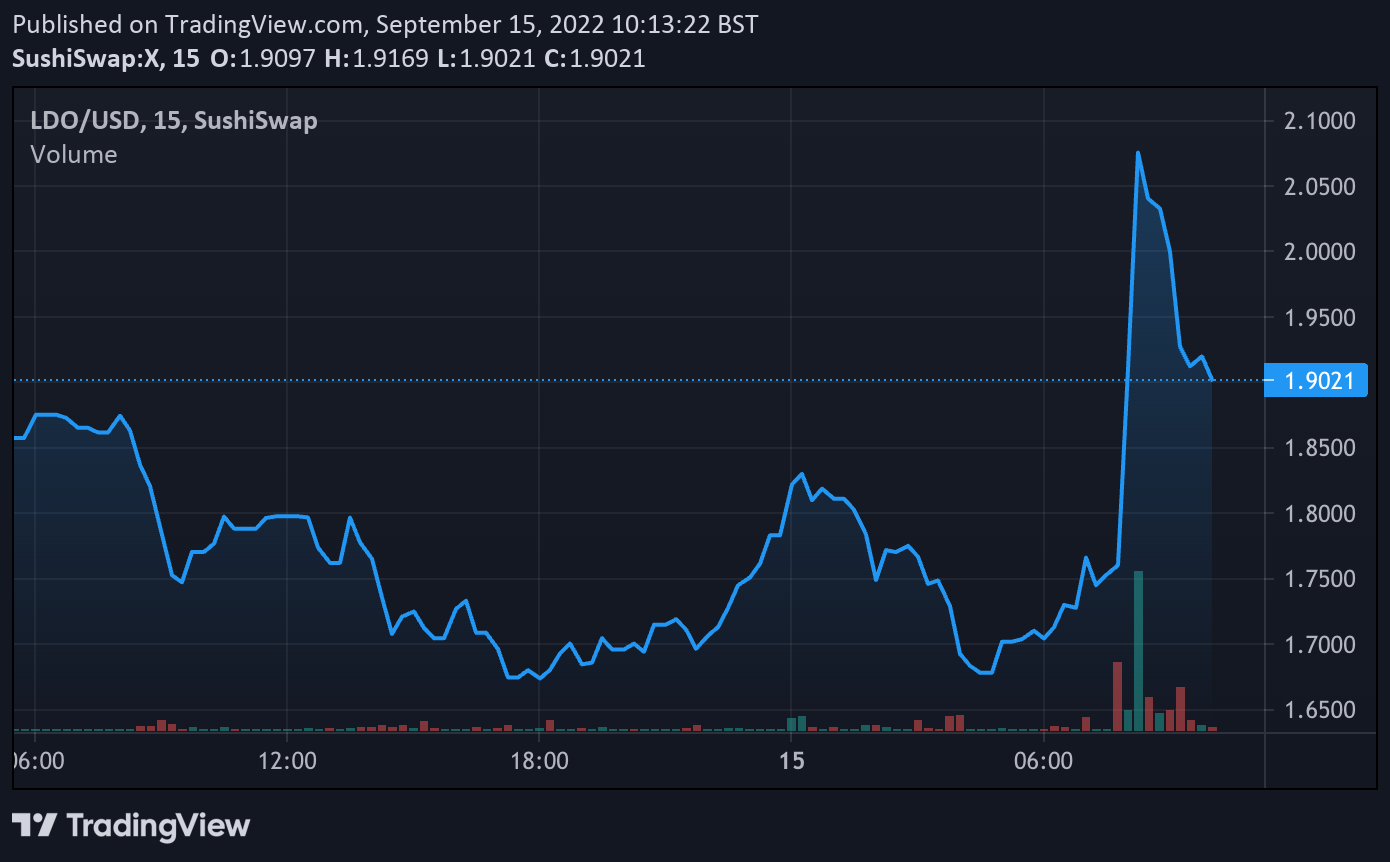
The biggest gainer following The Merge has been Lido DAO’s token, up 7.8% to trade at $1.90 at the time of writing, per CoinGecko data. In keeping with the other tokens that gained following the upgrade, Lido DAO went as high as $2.15 before shedding some of those gains.

© 2022 The Block Crypto, Inc. All Rights Reserved. This article is provided for informational purposes only. It is not offered or intended to be used as legal, tax, investment, financial, or other advice.

Go to Source
Author: Adam Morgan McCarthy

Ex-Citadel Securities employees raise $50 million for crypto market maker

Former Citadel Securities executives Leonard Lancia and Alex Casimo have raised $50 million as they launch crypto market maker Portofino Technologies. 

Backers of the company include Valar Ventures, Global Founders Capital and Coatue, according to a release on Thursday. The valuation was not disclosed. 

Founded in April last year, the startup is building a high-frequency trading technology for digital assets and claims to have already traded billions of dollars across both centralized and decentralized cryptocurrency exchanges and over the counter. Its customers include institutions and web3 projects that require access to liquidity in the digital asset market. 

“Having worked at the forefront of the modernization of traditional markets, we believe that our liquidity provisioning infrastructure can deliver enormous benefits to digital asset participants globally, and drive the next leg of adoption,” Lancia, the CEO, said in the statement. “This is only the start for Portofino. In web3, every action is a transaction and we’re building the underlying technology that is going to enable entirely new services and industries in the future.” 

Despite only emerging from stealth today, the company has already been on a recruiting spree. It’s hired a team of over 35 specialists in high-frequency trading across five locations globally. 

Along with acting as a market maker, the company also aims to support web3 projects to help them launch tokens and access liquidity. It will also invest as a venture capital firm, with those efforts headed up by former Speedinvest investor Charlie Boles, he said over Telegram message. 

The firm will likely compete with other crypto market makers such as Wintermute, B2C2 and Jump Trading. It also follows other deals in the digital asset market maker space. In June, Paris-based Flowdesk raised €28 million ($28 million) in a round led by Eurazeo and Aglaé Ventures. In January, Byte Trading raised $7 million in a seed funding round led by Redalpine.

© 2022 The Block Crypto, Inc. All Rights Reserved. This article is provided for informational purposes only. It is not offered or intended to be used as legal, tax, investment, financial, or other advice.

Go to Source
Author: Tom Matsuda

An NFT minted after The Merge cost $60,000 in transaction fees

The total terminal difficulty — a measure of the cumulative mining difficulty on the Ethereum network — was achieved at block 15537393 at 6:42:42 am UTC today, triggering the transition to proof of stake. 

Within just 17 seconds, the first NFT was minted on proof-of-stake Ethereum in the next block. The user paid over 36.8 ETH in transaction fees ($60,626.26) to mint the NFT named “The Transition.” It features an Ethereum panda mascot and is part of a collection of 100 on NFT marketplace OpenSea

The NFT also shows key details related to Ethereum, including the difficulty level at the time and a timestamp. 

The Transition

A user — who has just set up a new Twitter account and website — known as The Transition has claimed they created it. The NFTs are being auctioned on the website.

The collection now takes its place in Ethereum history, but it’s not the first time the panda mascot has appeared as an NFT, with PandETH minted back in early 2019.

For the latest news and updates about The Merge, make sure to check out our live coverage.

© 2022 The Block Crypto, Inc. All Rights Reserved. This article is provided for informational purposes only. It is not offered or intended to be used as legal, tax, investment, financial, or other advice.

Go to Source
Author: James Hunt

Ethereum activates The Merge as it shifts to proof of stake

Ethereum has activated The Merge and transactions are now being processed under proof of stake.

The Merge upgrade was activated at the agreed upon Total Terminal Difficulty (TTD) on Ethereum’s proof-of-work chain at 6:44 AM UTC today TTD is a combined measure of how difficult it is to produce a block for transactions and how this has fared over time.

The first epoch was finalized at 6:59 AM. This is the key development that core developers were looking for to see if the upgrade has gone to plan.

“And we finalized! Happy merge all. This is a big moment for the Ethereum ecosystem. Everyone who helped make the merge happen should feel very proud today,” said Ethereum co-founder Vitalik Buterin on Twitter.

The Merge has been in development since 2020 and is the second and final step in the transition to proof of stake.

It represents the official switch to using the proof-of-stake Beacon Chain for block production. The Merge also represents the shift from mining — using computing power to produce blocks for rewards — to validating, where it is no longer a competitive environment for validating transactions.

The Beacon Chain’s launch in 2020 was the first step of The Merge. Ethereum developers wanted to break The Merge into two steps, giving optimal time to test the upgrade prior to fully switching to proof of stake.

An analogy to better conceptualize this from the Ethereum Foundation is “Imagine Ethereum is a spaceship that isn’t quite ready for an interstellar voyage. With the Beacon Chain, the community has built a new engine and a hardened hull. After significant testing, it’s almost time to hot-swap the new engine for the old mid-flight.”

This reduces Ethereum’s energy consumption by more than 99%. This means that Ethereum is now Environmental, Social, and Governance (ESG) compliant, which has been a regulatory concern dissuading businesses from participating in novel sectors such as DeFi and NFTs.

This has been an overarching concern as of late, largely centered around the carbon footprint of proof-of-work blockchains.

The Merge will also reduce Ethereum’s issuance of ETH by roughly 90%, according to ultrasound.money.

Ethereum developers will now focus on growing the blockchain’s scalability via rollups. Rollups, often referred to as layer 2 networks, bundle transactions on their own respective chains and settle them en masse on Ethereum. This divvying approach allows layer 2s to execute vastly cheaper and faster transactions, while still receiving the benefit of Ethereum’s security (albeit with some compromises).

For the latest news and updates about The Merge, make sure to check out our live coverage.

This article has been updated after the first epoch was finalized.


© 2022 The Block Crypto, Inc. All Rights Reserved. This article is provided for informational purposes only. It is not offered or intended to be used as legal, tax, investment, financial, or other advice.

Go to Source
Author: Mike Truppa

Judge to appoint examiner in Celsius case

A U.S. bankruptcy judge in the Southern District of New York approved an order to appoint a neutral third party to examine the finances of embattled crypto lender Celsius. 

Lawyers from the Justice Department, securities regulators, and representatives of creditors and consumers seeking to recoup their losses pushed for the examiner, a step to which Celsius itself did not object. Smaller claimants had asked for a trustee instead, to begin more actively paying off the company’s debts. The use of an examiner in Chapter 11 bankruptcies is rare. 

The major consumer and creditor group, known as the Committee for Unsecured Creditors (UCC), earlier raised concerns about the cost associated with an examiner, but recently reached an agreement with the Justice Department’s bankruptcy office, the U.S. Trustee Program, to narrow the scope of the examiner’s investigation, causing them to change their position. The judge presiding over the case, Martin Glenn, left open the possibility of further changing the scope of the third-party examination of Celsius’s finances. 

The U.S. Trustee first moved to appoint an examiner last month, saying the case required a neutral investigator due to “extreme financial irregularities” and “the extensive mistrust of the Debtors’ customers.” The office will interview candidates for the examiner role next week.

Meanwhile, the UCC is also conducting its own investigation into Celsius. During today’s hearing, it said it’s made “significant progress” with Celsius and the firm has agreed in writing to cooperate with its investigation, already producing 16,000 documents. CEO Alex Mashinsky has retained his own counsel, and has also begun to produce information for the UCC, including on his own withdrawals from the platform.

Tomorrow, the UCC will join a call with state regulatory agencies to share the status of their respective investigations, according to counsel Gregory Pesce. State securities regulators filed their support for an examiner last week, submitting some of their preliminary findings. Those findings included allegations that Celsius had continuously misled customers on its financial health in the lead up to its collapse.

Celsius entered Chapter 11 bankruptcy proceedings in July of this year and has since withstood considerable scrutiny from a variety of parties in the proceedings over a perceived lack of clarity and allegations of fraud. 

© 2022 The Block Crypto, Inc. All Rights Reserved. This article is provided for informational purposes only. It is not offered or intended to be used as legal, tax, investment, financial, or other advice.

Go to Source
Author: Aislinn Keely

Bitcoin mining execs talk industry consolidation, CleanSpark’s asset deal

Consolidation in the bitcoin mining space is still in its early days, according to industry executives.

The industry will likely hit a “pain point” high in the fourth quarter — with more transactions happening — if it continues in the same trajectory, Argo Blockchain CEO Peter Wall argued Tuesday during a panel at the Digital Asset Summit.

The comments came days after bitcoin miner CleanSpark announced its second acquisition of a mining facility in the space of a month.

“That’s kind of the first we’re really seeing in this space. I would argue it’s definitely very, very early days,” said Jaime Leverton, CEO of Hut 8. “We’ve seen miners sell bitcoin (…), sell machines as well sell infrastructure, in order to cover some of their capital obligations. When when you run out of things to sell, that’s when you actually start to see some real opportunities for M&A and consolidation.” 

While “market stress is starting to bubble up,” BTIG analyst Gregory Lew said it “may be too early for the M&A cycle to start,” in a report published this week.

“Selling non-core infrastructure locations (like we saw last week) to increase liquidity makes sense in the near-term,” he added.

CleanSpark managed to leverage current market conditions, scoring over 16,000 mining machines at a discount since June and closing deals to acquire two sites in Georgia from Waha Technologies and the Nasdaq-listed Mawson Infrastructure Group.

Argo’s Wall anticipates more of these types of asset transactions in the future rather than M&A deals. He has also seen that in past market cycles, for example with Riot’s acquisition of Whinstone, a Texas facility previously owned by Northern Data.

“All of us have baggage, all of us have management teams, some of us have debt,” he said. “How you put those together is more complicated (…) so if you’re able to acquire either infrastructure or rig and leave out all the rest of the baggage, then it’d be a fortress.”

CleanSpark deal unpacked

CleanSpark’s acquisition “improves operating leverage” and drives hash rate growth “beyond Street expectations,” according to a recent analyst note from Chardan Research.

“CLSK will likely remain opportunistic, potentially pursuing similar bolt-on acquisitions,” the Chardan analysts wrote.

Comments from CleanSpark’s leadership suggest continued attention on this front. 

“The market has been preparing all summer for consolidation, and we are pleased to be on the acquiring side,” CleanSpark CEO Zach Bradford said last month. “Our focus on sustainability and maximizing value for our stakeholders have put us in a unique position to take advantage of the unprecedented opportunities that the current market has created.”

Mawson’s chief commercial officer Nick Hughes-Jones told The Block that the deal was a “win-win for both parties,” with CEO James Manning adding that the company will now focus its energy on its other facilities in the US.

As far as who will come out ahead as market troubles subside, Leverton said during the Tuesday event that much depends on how companies prepared themselves for a market downturn. 

“Those people in the space that have that have very healthy balance sheets, I think are in the best position to ultimately use this market as an opportunity to build and come out of it stronger,” he said.

Many bitcoin miners posted significant net losses in their second quarters, including CleanSpark, which reported $29.3 million in net losses in its most productive quarter to date, in terms of bitcoin mined (964 BTC, a 7% increase over the previous quarter).

Declining bitcoin prices (around 50% down in the past six months) and rising power prices have thinned bitcoin miners’ margins in recent months. Monthly mining revenues have also gone down consistently since October of last year — $1.72 billion versus $656.97 million last month, according to data from The Block’s Data Dashboard.

© 2022 The Block Crypto, Inc. All Rights Reserved. This article is provided for informational purposes only. It is not offered or intended to be used as legal, tax, investment, financial, or other advice.

Go to Source
Author: Catarina Moura

SEC sues Chicago-based crypto merchant for unregistered securities offering

The Securities and Exchange Commission has targeted another crypto issuer over an alleged unregistered securities offering. 

The SEC is trying to undue Chicago Crypto Capital’s $1.5 million initial coin offering for BXY tokens, according to a September 14 legal action. The agency is seeking disgorgement, or return of all investor funds, as well as penalties. 

The ICO took place between August 2018 and November 2019, well after the SEC’s 2017 DAO Report, which made the landmark determination that ICOs could be securities offerings. 

Chicago Crypto Capital, which describes itself an advisory firm “created to explore the new world of decentralized finance,” functioned as an unregistered broker-dealer in offering BXY to retail investors, the SEC has alleged.

After peaking at about $0.02 at launch in September 2019, BXY tokens are currently worth less than a thousandth of a dollar. 

The Commission is still actively pursuing cases against firms that were part of the 2017-2018 ICO boom, though such actions have largely stamped out the market for new issuances and the issuances in play have shrunk. SEC Chair Gary Gensler has pushed for more token issuers and intermediaries to register with the Commission.

© 2022 The Block Crypto, Inc. All Rights Reserved. This article is provided for informational purposes only. It is not offered or intended to be used as legal, tax, investment, financial, or other advice.

Go to Source
Author: Kollen Post


Follow by Email
Facebook20
Pinterest20
fb-share-icon
LinkedIn20
Share