FreeCryptoCurrency.Me

Free stocks and money too!

Category Archive : Crypto News

Treasury recommends ‘double down’ on crypto enforcement, but more guidance too

The U.S. Treasury Department wants financial market regulators to aggressively pursue investigations and enforcement actions against digital asset projects that aren’t following existing laws, a recommendation that fits with the approach regulators are already taking. 

But one of the reports issued Friday, as part of a broader effort towards a unified federal approach towards digital assets, also recommends regulators provide additional rules and guidance for projects that want to comply with the law. That may lead to a slight shift in approach from financial watchdogs, trying to emphasize a carrot of more explicit guidelines to go with the stick of legal action against companies that don’t follow them. 

Treasury wants agencies to “double down” on existing regulation, a senior official said during a Thursday press call previewing the reports, which were ordered by President Joe Biden in March. Senior administration officials requested to speak without direct attribution as a condition for fielding questions. 

While calling for increased enforcement, Treasury also wants regulators to provide additional guidance for digital asset developers and other companies involved in cryptocurrencies, so that they better understand how to follow existing rules. In theory that clarity should also reduce the need for future enforcements. That may be welcome news for industry advocates. 

“One of the recommendations is that regulators will issue new rules and guidance,” the senior Treasury official said. “That’s a recognition that we see work needed in this space.”

U.S. financial regulators largely operate independent of the White House, though the president nominates leaders to the different agencies, like the Securities and Exchange Commission and Commodity Futures Trading Commission, the primary American regulators of digital assets. The reports are expected to carry weight with agency leaders and Capitol Hill while they contemplate ways to better fit cryptocurrencies into existing financial law. 

“This is a new and very rapidly developing product space,” said a senior official. “Regulations need to be able to adjust to these new products and activities that are being offered.”

Though Treasury’s recommendations include an emphasis on more guidance and rulemaking from regulators, officials said the reports avoid specific legislative proposals. Multiple bills to change current laws that affect cryptocurrencies have been introduced on Capitol Hill, though none are likely to pass before the end of this Congress.

An official committed to, “working with the Hill closely, to ensure that we’re working arm-in-arm.”

© 2022 The Block Crypto, Inc. All Rights Reserved. This article is provided for informational purposes only. It is not offered or intended to be used as legal, tax, investment, financial, or other advice.

Go to Source
Author: Kollen Post

FTX’s Brett Harrison unpacks how regulatory uncertainty holds back the crypto industry

Episode 87 of Season 4 of The Scoop was recorded live with The Block’s Frank Chaparro and FTX US President Brett Harrison.

Listen below, and subscribe to The Scoop on AppleSpotifyGoogle PodcastsStitcher or wherever you listen to podcasts. Email feedback and revision requests to podcast@theblockcrypto.com.


Back in July, the SEC launched an investigation into Coinbase for allegedly listing several tokens that should have been listed as securities. 

Yesterday, SEC Chair Gary Gensler made comments that indicate he believes more crypto exchanges and broker-dealers are still in violation of guidelines put in place under former SEC Chair Clayton in 2017.

In this episode of The Scoop, FTX President Brett Harrison shares how FTX US is striving to avoid regulatory issues, and why regulatory clarity in the digital asset space will lead to more domestic innovation in the US. 

According to Harrison, the onus of “deciding what to list is on the exchange.. but that doesn’t necessarily prevent future enforcement if the regulatory agency in this case disagrees.”

Given this dynamic, FTX US lists a limited number of tokens out of an abundance of caution. As Harrison explains:

“We have fewer than 30 tokens on our exchange, and we think that’s fortunately or unfortunately the long term play that will work for us until there is better clarity in terms of what registration is going to be required.”

Although FTX US is not currently listing a broader selection of tokens, Harrison does believe many crypto projects would gladly register with the SEC if a clear framework existed:

“I think a lot of token projects would register and quite happily do so if there was a clear process for it, because they want to get listed on US exchanges, they want to be able to operate their company in the US without worrying about enforcement action down the road — they would like for their tokens to have security like properties.”

During this episode, Chaparro and Harrison also discuss:

  • How Coinbase and FTX US are building for different kinds of customers
  • Why the line dividing crypto retail and institutions is getting “blurrier”
  • Harrison’s personal management philosophy

This episode is brought to you by our sponsors Tron, Chainalysis & IWC Schaffhausen

About Tron
On August 1st, 2022, Poloniex launched a faster and more stable trading system along with a
brand new user interface. Poloniex was founded in January 2014 as a global cryptocurrency trading platform. With its world-class service and security, it received funding in 2019 from renowned investors, including H.E. Justin Sun, Founder of TRON. Poloniex supports spot and margin trading as well as leveraged tokens. Its services are available to users in nearly 100 countries and regions with various languages available. For more information visit Poloniex.com.

About Chainalysis
Chainalysis is the leading blockchain data platform. We provide data, software, services, and research to government agencies, exchanges, financial institutions, and insurance and cybersecurity companies in over 60 countries. Backed by Accel, Addition, Benchmark, Coatue, Paradigm, Ribbit, and other leading firms in venture capital, Chainalysis builds trust in blockchains to promote more financial freedom with less risk. For more information, visit www.chainalysis.com.

About IWC Schaffhausen
IWC Schaffhausen is a Swiss luxury watch manufacturer based in Schaffhausen, Switzerland. Known for its unique engineering approach to watchmaking, IWC combines the best of human craftsmanship and creativity with cutting-edge technology and processes. With collections like the Portugieser and the Pilot’s Watches, the brand covers the whole spectrum from elegant timepieces to sports watches. For more information, visit IWC.com.

© 2022 The Block Crypto, Inc. All Rights Reserved. This article is provided for informational purposes only. It is not offered or intended to be used as legal, tax, investment, financial, or other advice.

Go to Source
Author: Davis Quinton and Frank Chaparro

El Salvador’s president Bukele says he’ll run again in 2024

El Salvador’s president Nayib Bukele told a crowd on the night of the country’s Independence Day that he plans to run for the top office again in 2024, despite the country’s constitution long-prohibiting candidates from serving two terms in a row.

Bukele spearheaded El Salvador’s controversial move to make bitcoin legal tender on September 7, 2021, making the Central American country the first in the world to do so. He has also discussed plans to build a tax haven called Bitcoin City in a remote region. 

While the president has maintained high approval ratings, he has faced criticism over the impact his bitcoin-buying strategy has had on the country’s financial position and for lacking transparency. 

El Salvador’s constitution has long prohibited presidential candidates from seeking two consecutive, five-year terms. But days before El Salvador made bitcoin legal tender last year, El Salvador’s newly-revamped top court ruled that candidates could, after all, serve a second term. The US government blasted the ruling, saying that it “undermines democracy” and was the “direct result” of a legislative decision to remove justices in favor of those supporting Bukele’s administration. 

Bukele’s decision to run again does not necessarily come as a surprise, with many expecting the announcement ever since the court’s re-election ruling. 

Hours before the reelection announcement, Fitch Ratings downgraded El Salvador’s long-term foreign currency issuer default rating. 

© 2022 The Block Crypto, Inc. All Rights Reserved. This article is provided for informational purposes only. It is not offered or intended to be used as legal, tax, investment, financial, or other advice.

Go to Source
Author: Kristin Majcher

Fitch downgrades El Salvador’s rating to ‘CC’

Fitch Ratings downgraded El Salvador’s long-term foreign currency issuer default rating (IDR) to “CC” from “CCC,” saying that the country faces a “dire” liquidity situation as a January bond maturity deadline approaches. 

The move reflects Fitch’s view that “El Salvador’s tight fiscal and external liquidity positions and extremely constrained market access amid high fiscal financing needs and a large $800 million external bond maturity in January 2023 make default of some sort probable”  

Fitch estimates that El Salvador will need about $3.7 billion in financing between now and January 2023, and that it has an “unidentified financing gap” of close to $900 million. 

“El Salvador’s liquidity situation is dire ahead of the January 2023 Eurobond payment,” it wrote. 

El Salvador, which made bitcoin legal tender in September 2021 alongside the U.S. dollar, has been dealing with broader financing concerns as it moves closer to its next debt repayment date. The country is also facing significant unrealized paper losses on its bitcoin purchases, which to date total 2,381 based on available public information. 

Reuters reported in July that the Central American country would use $560 million to fund a voluntary bond repurchase offer for part of its debt due between 2023-2025, but then El Salvador’s president Nayib Bukele tweeted out a press release on September 12 indicating that the country had officially launched the offer with a buyback amount of $360 million. 

According to Fitch, El Salvador’s buyback plan “will likely further weaken its already strained liquidity position.”

“The size and scope of the transaction does not materially alter the probability of default in Fitch’s opinion,” Fitch wrote.

Fitch previously downgraded El Salvador’s IDR in February, at the time citing concerns about the uncertainty of external financing sources such as the country’s planned “bitcoin bonds” that it has yet to launch.


© 2022 The Block Crypto, Inc. All Rights Reserved. This article is provided for informational purposes only. It is not offered or intended to be used as legal, tax, investment, financial, or other advice.

Go to Source
Author: Kristin Majcher

GPU miners left searching for profit post Merge

Miners searching for new blockchains in the wake of Ethereum’s Merge are struggling as intense competition for blocks reduces profitability.

With Ethereum’s move away from proof-of-work based GPU mining to a proof-of-stake based consensus mechanism, many of the miner operators who formerly supported the world’s second-largest blockchain network are moving to other PoW networks like ETC and RVN.

But with the eager embrace of new miners to these networks comes a rise in block difficulty that, at current market conditions and energy costs, is making it difficult for GPU miners to turn a profit, according to Ben Gagnon, chief mining officer at bitcoin miner Bitfarms (BITF).

“GPU #mining is dead less than 24 hours after the #merge,” Gagnon tweeted, adding that three of the largest chains that utilize the mining method offer negligible profits and that “the only coins showing profit have no marketcap or liquidity.”

Rising hashrates, falling profits

As the hash difficulty of networks like ETC and RVN continues to rise, profit among competing miners has driven down potential rewards. On ETC block rewards fell from a 24 hour average of around 58 cents to just over 1 cent, while rewards for blocks on RVN fell from a 24 hour average of $1.77 to just over 4 cents in more recent hours according to Minerstat data.

“Even running new generation hardware at sub 3 cent power is not profitable on ETC now,” tweeted Ethan Vera, COO of Luxor, which runs an Ethereum mining pool.

Without a profitable network to mine, as many as 20% to 30% of miners have simply shut down operations according to Vera.

Vera had previously estimated that only miners contributing around 100 terahash per second to the Ethereum network would find a home on other blockchains, citing a need for state-of-the-art hardware and low electricity prices to remain competitive.

Now, it would appear that even the latest hardware rigs and cut-rate energy costs may not be enough to turn a profit on networks like ETC, where as much as a 280% rise in hash rates occurred over the last 24 hours.

© 2022 The Block Crypto, Inc. All Rights Reserved. This article is provided for informational purposes only. It is not offered or intended to be used as legal, tax, investment, financial, or other advice.

Go to Source
Author: Jeremy Nation

Brazil’s jailed ‘bitcoin pharaoh’ will have to sit out next month’s election

A Brazilian court unanimously moved to prohibit “bitcoin pharaoh” Glaidson Acácio dos Santos from running for office because of his company’s alleged role in a pyramid scheme.

Dos Santos was hoping to run as a federal deputy candidate under the Christian Democratic party, Brazil’s state news agency Agência Brasil reported on Sept. 13. The country will hold general elections on Oct. 2. 

The Regional Electoral Court of Rio de Janeiro (TRE-RJ) objected to dos Santos’ candidacy because his company was allegedly involved in a bitcoin Ponzi scheme that, according to the Associated Press, promised investors monthly returns of 10%.

Brazil’s federal police said it seized 591 bitcoins as part of what they called Operation Kryptos last year, which were worth nearly $28 million at the time. Police also seized almost 14 million Brazilian reais (nearly $2.7 million) and other currencies, as well as 21 luxury vehicles, high-value watches, jewelry, cell phones and documents.

Cryptocurrency is becoming increasingly popular in Brazil. In July, digital institution Nubank announced it had amassed one million users for its crypto platform just a month after its launch. At the same time, Latin America-focused cryptocurrency exchange Bitso said it had hit one million users in the country after a year of operation.

“The candidacy of the businessman, who remains in prison, was unanimously challenged by the Regional Electoral Court (TRE-RJ), on the grounds that Santos is the director of a financial establishment subject to liquidation,” Agência Brasil wrote. “The rapporteur of the case, judge Luiz Paulo da Silva Araújo Filho, pointed out that Santos is accused of federal crimes, including links with the militia.”

Dos Santos, who held a job as a waiter before turning to bitcoin, owns the company G.A.S. Consultoria e Tecnologia in Cabo Frio, Rio de Janeiro. In January, he was facing charges including “racketeering, financial crimes and ordering the murder and attempted murder of two business competitors,” the Associated Press reported. He is currently in “preventive detention” following a complaint filed by Brazil’s public prosecutor’s office, according to a court statement.


© 2022 The Block Crypto, Inc. All Rights Reserved. This article is provided for informational purposes only. It is not offered or intended to be used as legal, tax, investment, financial, or other advice.

Go to Source
Author: Kristin Majcher

A new bitcoin futures ETF signals possible step forward in U.S. regulation

A new bitcoin futures exchange traded fund (ETF) by Hashdex could be a game-changer for traditional bitcoin ETF hopefuls. 

The Hashdex Bitcoin Futures ETF is slated to list tomorrow on NYSE Arca under the ticker $DEFI after getting the green light from the Securities and Exchange Commission (SEC). Though the product itself isn’t novel – multiple bitcoin futures ETFs have reached the market – its wrapper is. Unlike other bitcoin futures ETFs, it received approval under the Securities Act of 1933, which could possibly be used to get SEC approval for physical bitcoin ETFs.

Multiple futures-based products have listed under the Investment Company Act of 1940, which Gavin Filmore, COO of the fund’s sponsor, Toroso Investments, said cannot become physical products, though a ’33 Act could. The approval of a crypto product under the ’33 Act, even if it’s another futures fund, could be seen as an important shift in regulatory sentiment.

“I would say to a savvy market participant who understands these two wrappers and the nuances within them and what it could mean from a regulatory approval standpoint, that is a fair view, that this could be a small step in that direction,” Filmore said in an interview with The Block. “But it really is about the wrapper. It’s not about this product. It’s about the wrapper being utilized for crypto exposure.

The SEC has appeared to be reluctant to approve crypto products under the ’33 Act until now. In Aug. 2021, SEC Chair Gary Gensler said he’d be interested in approving bitcoin futures products under the Investment Company Act of 1940, a path that effectively closed off approval to spot-based products. 

The ’40 Act regulates investment companies, mutual funds and their product offerings, while the ’33 Act lays out a registration and disclosure process for securities offerings. Products under the ’40 Act have a specific structure that precludes physical products, while the ’33 Act allows for a broader range of offerings holding a variety of assets.

Filmore said Hashdex had intended to be a first mover for the futures ETF, but a long regulatory road led it to a delayed launch date. The Brazilian firm lodged its application under the ’33 Act before the first bitcoin futures ETF, ProShares’ $BITO, listed in Oct. 2021. It elected to go the ’33 route not out of novelty, but because it appeared to be the best wrapper for the product, mainly due to tax efficiency. 

In its regulatory process, Hashdex head of new markets Bruno Souza said the scrutiny of crypto products appears to be more about how the product itself works rather than scrutiny of crypto as a whole, which he said is a positive.

“I think there is a normalization of the asset class that all of us who have been involved in crypto for some years knew that was going to happen at some point,” Souza said.

That long road has led it to list in a down market. ProShares’ $BITO has slumped 70% since going public, echoing wider market fallout.

TradingView

But as Souza noted, industry players often say the best time to build is in a bear market. 

© 2022 The Block Crypto, Inc. All Rights Reserved. This article is provided for informational purposes only. It is not offered or intended to be used as legal, tax, investment, financial, or other advice.

Go to Source
Author: Aislinn Keely

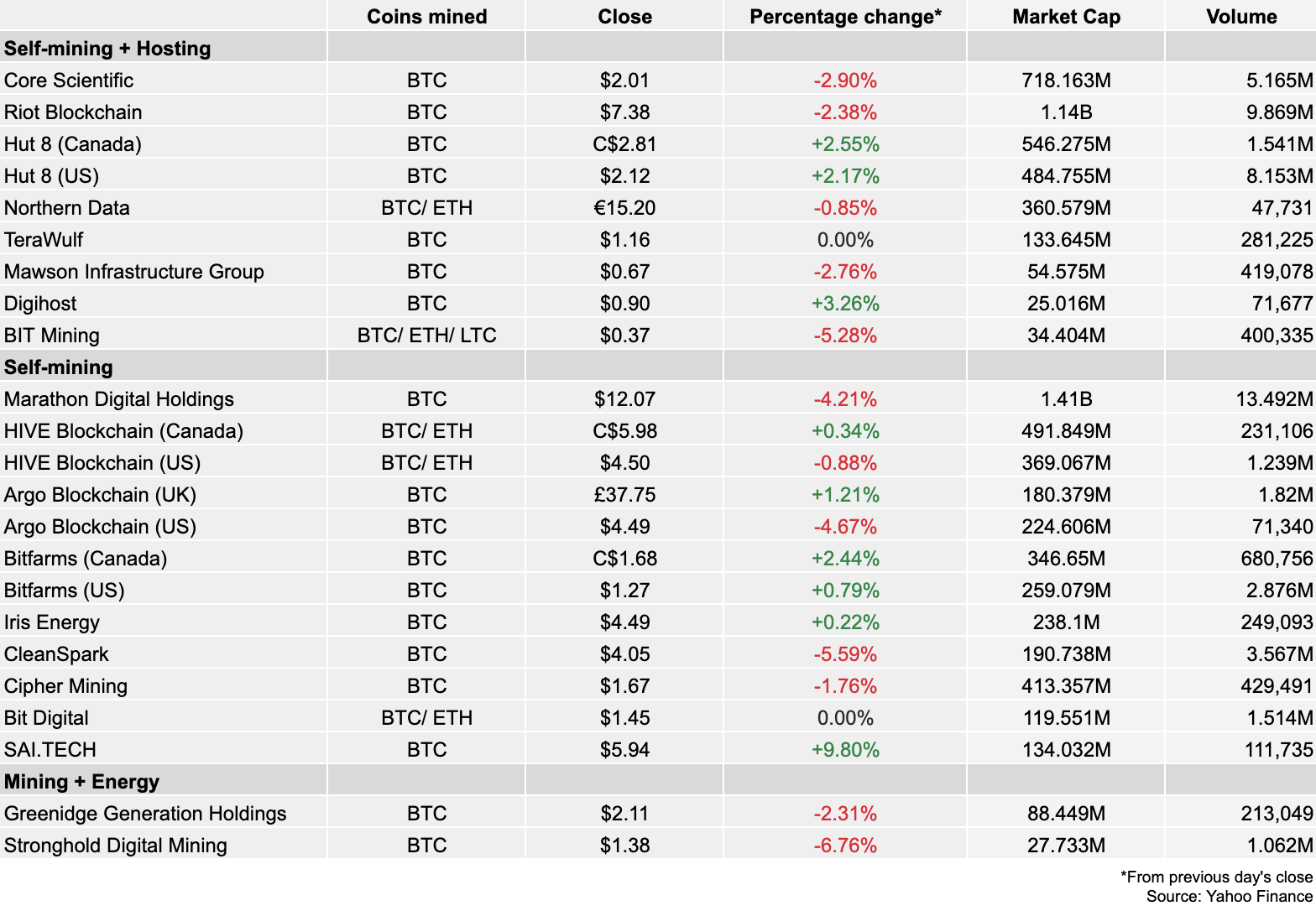
Bitcoin mining stock report: Thursday, September 15

Most mining companies trended downward alongside bitcoin, though a handful traded higher.

Bitcoin was trading at around $19,800 at market close, according to data from TradingView.

Stronghold Digital Mining’s stock fell 6.76%, followed by CleanSpark (-5.59%), BIT Mining (-5.18%) and Argo Blockchain (-4.67% on Nasdaq).

On the other hand, SAI.TECH’s stock was up 9.80%, followed by Digihost (+3.26%), Hut 8 Mining (+2.55% on the Toronto Stock Exchange) and Bitfarms (+2.44% on the Toronto Stock Exchange).

Here’s how crypto mining companies performed on Thursday, Sept. 15:

© 2022 The Block Crypto, Inc. All Rights Reserved. This article is provided for informational purposes only. It is not offered or intended to be used as legal, tax, investment, financial, or other advice.

Go to Source
Author: Catarina Moura

Ethereum could face SEC scrutiny after The Merge: WSJ

Ethereum’s shift from proof of work to proof of stake may cause the Securities and Exchange Commission to take a closer look at regulating the cryptocurrency as a security, Chair Gary Gensler hinted on Thursday.

Gensler’s comments came hours after Ethereum’s big shift, known as The Merge, took place. The SEC chair mentioned the Howey test, a tool regulators use to determine whether an asset is a security, when he spoke with reporters after a Senate hearing. 

“From the coin’s perspective…that’s another indicia that under the Howey test, the investing public is anticipating profits based on the efforts of others,” Gensler said, according to The Wall Street Journal. He noted he was not referring to a specific cryptocurrency. 

Gensler appeared before the Senate Banking Committee for a regular SEC oversight hearing. He also said he believes a crypto exchange offering staking services to customers “looks very similar—with some changes of labeling—to lending.”  

© 2022 The Block Crypto, Inc. All Rights Reserved. This article is provided for informational purposes only. It is not offered or intended to be used as legal, tax, investment, financial, or other advice.

Go to Source
Author: Stephanie Murray

Bitcoin slips below $20,000, ether teeters on the edge of $1,500 after The Merge

Crypto markets slumped during a subdued trading day following Ethereum’s official shift to proof of stake.

Bitcoin was trading at $19,763 on Coinbase, down about 0.48% over the past 24 hours, according to data from the exchange.

Meanwhile, ether was down 4.88% over the past 24 hours, trading at $1,498, according to Coinbase data. Ether whipsawed earlier in the day, trading between $1,583 and $1,640 directly before and after The Merge.

Ethereum Classic and Lido DAO’s token also spiked post-Merge before surrendering those gains.

Meanwhile, the global crypto market cap is again flirting with the $1 trillion mark, having flipped either side of this mark several times in the past few months. 

Word on the street

Matt Weller, global head of market research at Forex.com, told The Block that Ethereum’s upgrade went as smoothly as could have been hoped.

However, he went on to say that, “in a classic ‘buy the rumour, sell the news’ reaction, we’re seeing ether fall to its lowest levels of the month.”

Weller puts this down — in part — to “unsophisticated traders who bought in anticipation of a quick win” rushing to sell, as the short-term benefits of the merge are unlikely to offset the tough macroeconomic environment.

“Both the narrative benefit of Ethereum’s 99.95% reduction in energy consumption and the fundamental supply and demand shift to a deflationary asset are likely to be felt only over longer-term periods,” he concluded.

Ryan Shea, a crypto economist at Trakx, shared a similar sentiment with The Block on Thursday, noting the dip in price might merely be profit-taking.

“While such price action may have some ether fans concerned, the most likely explanation is that having rallied strongly (up over 25%) in the weeks prior, the correction is simply profit-taking on the part of crypto speculators,” he said.

Shea noted that this would explain why ether has underperformed significantly compared to bitcoin today, down over 5.4% compared to 1.7%. 

© 2022 The Block Crypto, Inc. All Rights Reserved. This article is provided for informational purposes only. It is not offered or intended to be used as legal, tax, investment, financial, or other advice.

Go to Source
Author: Adam Morgan McCarthy


Follow by Email
Facebook20
Pinterest20
fb-share-icon
LinkedIn20
Share