FreeCryptoCurrency.Me

Free stocks and money too!

Category Archive : Crypto News

Infura to launch open source decentralized protocol for Web3 APIs

ConsenSys powered Web3 API provider Infura will look to deploy a decentralized protocol early next year in the interest of offering a more decentralized model for the management of Ethereum’s application layer, Coindesk reports.

The progressive update will see Infura augment its Web3 API services by developing open-source repositories for the protocol’s core processes, and decentralizing the JSON RPC API responsible for connecting users to Ethereum. Infura’s first step will be to establish an open-source initiative to engage the wider DeFi community according to Infura co-founder Eleazar Galano, who today invited “early partners” to collaborate on the decentralized infrastructure.

Serving roughly 350,000 users and 430,000 developers, Infura’s software connects decentralized applications, or dApps, to Ethereum without setting up a full node. Infura facilitates many widely used dApps such as MetaMask, ENS, as well as many layer 2 scaling solutions. Those that wish to forgo the operational costs associated with running a full node can turn to Infura, and in exchange, Infura harvests available IP and wallet address data from users that a full node otherwise shields.

Infura will develop its decentralized infrastructure while continuing parallel development on its centralized products that use ConsenSys, and Amazon-hosted cloud services to power Web3 platforms.

“What we’re focused on decentralizing is the lower level infrastructure layer beneath that so there’s more interoperability between operators that serve this type of traffic,” Galano told CoinDesk, adding that certain things in the customer experience can’t be decentralized.

© 2022 The Block Crypto, Inc. All Rights Reserved. This article is provided for informational purposes only. It is not offered or intended to be used as legal, tax, investment, financial, or other advice.

Go to Source
Author: Jeremy Nation
Amazon among five companies to develop digital euro prototype for the ECB

The European Central Bank (ECB) announced the selection of five new partners to support the development of a digital euro prototype.

Each of the companies will take on a different role in putting together the prototype. Among them is the tech giant Amazon, which will be responsible for developing e-commerce payments within the project.

Spanish bank CaixaBank will develop online peer-to-peer payments for a mobile application, while the French multinational payment service, Worldline, is responsible for the offline version.

Point of sale payments from the payer and payee are in the hands of the ECB-backed European Payment Initiative and the Italian paytech company, Nexi, respectively. 

The ECB opened a call for partners at the end of  April and received 54 respondents from the likes of national banks and multinational tech firms. The five chosen service providers were selected based on their compliance to “specific capabilities” which were an advantage on top of the basic criteria required. 

The prototyping exercise is set to begin within the month of September and finish at the end of December.

This process forms part of an ongoing investigation phase spanning over two years. The ECB expects to complete this phase by March 2023 by evaluating the prototypes produced as well as the success of the collaboration between the partners. 

The ECB launched its investigation into the digital euro in July 2021, without promising that it would issue the digital currency at the end. 

© 2022 The Block Crypto, Inc. All Rights Reserved. This article is provided for informational purposes only. It is not offered or intended to be used as legal, tax, investment, financial, or other advice.

Go to Source
Author: Inbar Preiss

Grayscale files for rights to ETHPoW tokens after The Merge

Grayscale Investments has the rights to Ethereum Proof of Work tokens as a result of The Merge, and may or may not distribute them to holders in the form of a cash disbursal, the asset manager said in a Securities and Exchange Commission filing on Friday.

ETHPoW, a fork of the proof of work Ethereum chain, went live on Thursday when Ethereum shifted to proof of stake. As a result of the fork, the Grayscale Ethereum Trust and the Grayscale Digital Large Cap Fund received the rights to ETHPoW tokens. The former received the rights to approximately 4 million, while the latter holds rights to approximately 41,000 ETHPoW tokens.

However, it’s not clear how much those assets are worth.

“There is uncertainty as to whether digital asset custodians will support ETHPoW tokens or if trading markets with meaningful liquidity will develop,” the filing said. 

Trading venues for ETHPoW tokens are not broadly established because the Ethereum Proof of Work Network is so new, the filing noted. The price of ETHPoW tokens is expected to fluctuate.

“In the event digital asset custodians do support ETHPoW tokens and trading markets do develop, it is expected that there will be widely fluctuating values for ETHPoW tokens for some time,” the filing said. “As a result of this uncertainty and the potential for significant volatility in prices it is not possible to predict the value of rights to ETHPoW tokens, if any.”

The filing noted future forks or airdrops on the Ethereum Network will be evaluated on a case-by-case basis, and may not be addressed in the same manner as the ETHPoW fork.

Holders of each fund as of the end of business on Sept. 26 will be eligible for any proceeds.

© 2022 The Block Crypto, Inc. All Rights Reserved. This article is provided for informational purposes only. It is not offered or intended to be used as legal, tax, investment, financial, or other advice.

Go to Source
Author: Stephanie Murray

Celsius asks bankruptcy court for permission to sell stablecoin holdings

Bankrupt crypto lender Celsius sought permission in a late Thursday court filing to sell its stablecoin holdings.

The firm disclosed $23 million worth of stablecoins held by thee of its corporate entities. Celsius said it “owns eleven different forms” of stablecoins though it did not disclose which ones.

Celsius believes “that the sale of their stablecoin consistent with past practice and in the ordinary course of business is an
efficient way to generate liquidity to help fund the Debtors’ operations,” according to the filing. 

The court has not yet granted approval for the sales and a court hearing has been scheduled for Oct. 6 to discuss the Celsius motion.

Celsius declared Chapter 11 bankruptcy in July amid severe financial headwinds after halting withdrawals the previous month. At the time, the firm declared assets between $1 billion and $10 billion, with an equal amount in estimated liabilities. It claimed more than 100,000 creditors, and said it had $167 million in cash on hand, “which will provide ample liquidity to support certain operations during the restructuring process.”

On Wednesday, the bankruptcy court approved the appointment of a third-party examiner to look into the current state of the crypto lender’s finances as the Chapter 11 process continues. 

The U.S. Trustee first pushed last month for the appointment, having highlighted what it characterized as “extreme financial irregularities” and “the extensive mistrust of the Debtors’ customers.”

© 2022 The Block Crypto, Inc. All Rights Reserved. This article is provided for informational purposes only. It is not offered or intended to be used as legal, tax, investment, financial, or other advice.

Go to Source
Author: Michael McSweeney

On-chain Trends 24 Hours After The Merge

Quick Take

  • The hashrates of multiple proof-of-work networks such as Ethereum Classic surged to record levels on the day of The Merge.
  • Ether borrow rates have returned to normal levels as speculators unwound their positions.
  • Total ether supply increased due to low network activities despite a 90% reduction in issuance.

This research piece is available exclusively to
members of The Block Research.
You can continue reading
this Research content on The Block Research.

Go to Source
Author: Eden Au

Web3 compliance company Satschel raises $5.2 million, partners with Assure

Compliance company Satschel has raised a $5.2 million seed round led by early-stage venture firm Brand Foundry Ventures, according to a spokesperson for the startup.

Leveraging web3 technologies, Satschel helps financial services companies become compliant with regulations through its automated Compliance Fabric technology, which enables investors and customers to be onboarded quickly while still meeting regulatory standards, per a release on Tuesday. 

“Compliance burdens and costs have ballooned since the financial crisis, and the development of a crypto ecosystem has accelerated the imperative to improve speed and accuracy in KYC [know your customer] and AML [anti-money laundering],” said Andrew Mitchell, founder of Brand Foundry Ventures, in a statement to The Block. 

The seed raise comes just days after Satschel’s announcement of a partnership with Assure, a fintech company for Special Purpose Vehicles (SPVs). Assure’s customers will be the first to leverage Satschel’s Compliance Fabric technology. 

“We are excited about Satschel and look forward to seeing their innovative service deliver immediate value by eliminating pain points for Assure SPV customers and their investors,” Mitchell said. “The partnership represents a major step forward in the accessibility and quality of private market transactions.”

Assure enables clients to structure and close deals faster, according to the Tuesday release. The company has structured and closed more 8,500 deals with over $9 billion in assets under administration. Clients include Republic, Forge and Tech Coast Angels, the release said. 

“With Assure, we are demonstrating web3’s potential to enhance value and experience, even for off-chain businesses, and bringing those benefits to what has traditionally been a very opaque market,” Eric Choi, co-founder and president of Satschel, said in the statement. 

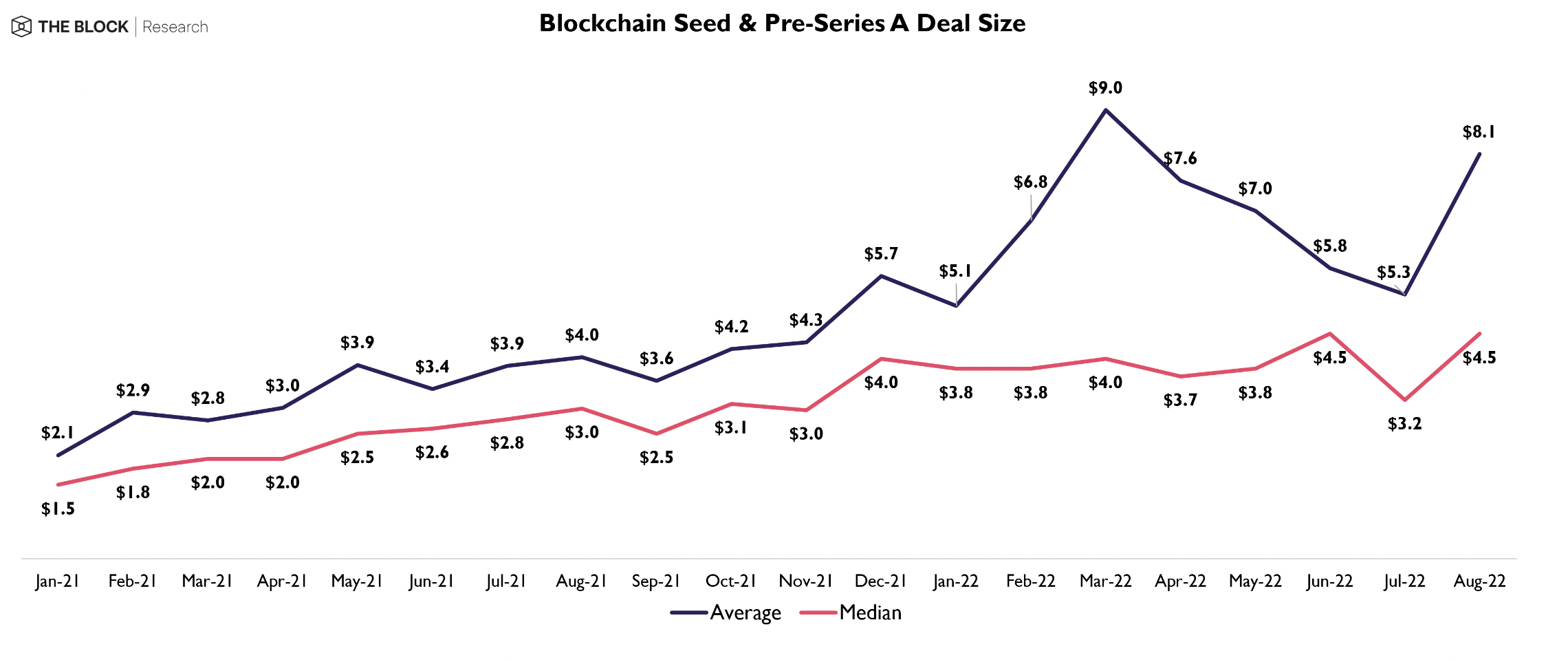
The average deal size for projects at the seed level has declined for four straight months through July, before rebounding in August, according to funding data from The Block Research. 

Blockchain seed and pre-Series A deal size


© 2022 The Block Crypto, Inc. All Rights Reserved. This article is provided for informational purposes only. It is not offered or intended to be used as legal, tax, investment, financial, or other advice.

Go to Source
Author: Kari McMahon

ETHPoW (ETHW) plunges over 60% a day after mainnet launch

The native token of EthereumPoW, a continuation of the proof-of-work Ethereum blockchain, was trading down over 60% on Friday a day after its mainnet launch.

ETHW spiked as high as $60.68 in the early hours of Thursday morning following The Merge, before crashing back towards $30 shortly after. The miner-led chain launched its mainnet on Thursday, but this had little impact as the price of ETHPoW continued its downward trend. It’s now trading at $12.80 for a loss of 61% in the past 24 hours, per CoinMarketCap data at the time of writing.

ETHPoW was planned ahead of Ethereum’s upgrade, led by a miner called Chandler Guo, who hoped to split away from Ethereum following The Merge. Prior to this, Guo was warned by the ETC Cooperative, an Ethereum Classic community, that his fork would not succeed and miners should simply migrate to Ethereum Classic. 

Ethereum Classic recorded a massive spike in hash rate on Thursday, as miners moved over to the network, soaring 280% at one stage. The network even reached 307  terahashes per second (TH/s) on Thursday. Currently the hash rate is around 234.41 TH/s, per data from mining pool 2Miners.

Ethereum Classic was trading at $34.19 at the time of writing per CoinMarketCap data, down 9.44% in the past 24 hours. 


© 2022 The Block Crypto, Inc. All Rights Reserved. This article is provided for informational purposes only. It is not offered or intended to be used as legal, tax, investment, financial, or other advice.

Go to Source
Author: Adam Morgan McCarthy

Fintech unicorn TrueLayer announces plans to cut headcount by 10%

London-based open banking firm TrueLayer has announced it plans to cut headcount by 10%, according to a blog post published by the company on Friday. 

The layoffs were announced during an all-hands meeting on Thursday and re-iterated in the blog post on Friday for “transparency to our partners, customers and wider TrueLayer community,” said Francesco Simoneschi, CEO and co-founder of TrueLayer. 

“You may understandably ask what has changed in the past twelve months. We are now operating in a very different context and more challenging market conditions,” said Simoneschi in the post. “TrueLayer, while being in a position of strength, is not immune to these broader factors.” 

What is TrueLayer?

TrueLayer provides tools to enable companies to take advantage of the UK’s open banking regulatory framework. The regulation enables authorized third parties to access data held by banks at the request of the customers who own that data. Many fintech firms leverage this framework to power their services. 

Crypto companies like MoonPay and Ramp have teamed up with TrueLayer to enable crypto purchases through open banking. Other customers of TrueLayer include Revolut, Freetrade and Cazoo, according to their website. 

TrueLayer closed a $130 million fundraise led by Tiger Global Management in September 2021. The raise brought TrueLayer’s valuation above $1 billion, providing the startup with “unicorn” status. 

What does this mean for employees? 

Staff affected will be invited to a one-to-one meeting with a member of leadership to explain the next steps, according to the blog post. 

The exit package will include salary to cover notice periods and an additional number of months based on period of service, three months of employer pension contributions extended access to health insurance and mental health support, the post said. 

“Our aim throughout is to treat you with the gratitude, dignity, fairness and respect that you deserve,” said Simoneschi in the post. 

Impacted employees will also be connected to other job opportunities through the TrueLayer network. 

“We are leveraging our network to fast track this process, and have also arranged for opt-in outplacement support including interview preparation, CV review and coaching to be available,” Simoneschi said. 

© 2022 The Block Crypto, Inc. All Rights Reserved. This article is provided for informational purposes only. It is not offered or intended to be used as legal, tax, investment, financial, or other advice.

Go to Source
Author: Kari McMahon

Biden administration takes a step closer towards a digital dollar

The Biden administration is bringing the U.S. a step closer to the creation of a digital dollar.

As part of a series of reports issued by different parts of the administration Friday, an interagency working group will begin meeting regularly to support the Federal Reserve’s ongoing research into the possibility of a central bank digital currency (CBDC), and to prepare the rest of the federal government if or when the Fed decides to create one.

National Economic Council Director Brian Deese and Treasury Secretary Janet Yellen told reporters during a Thursday press call that the White House, Treasury and other executive branch agencies want to do their part to support the Fed’s continued analysis and experimentation with a digital dollar. Separate from a CBDC but related to faster payments services, the Treasury also recommends federal regulators develop a framework for nonbank payment providers, who currently must register state-by-state as money transmitters.

A senior administration official, speaking on background as a condition for answering questions, explained that the U.S. wanted to be in position to issue a CBDC if the Fed decides it’s in the country’s best interest to create one.

Government officials continue to weigh whether a digital dollar would be necessary to keep the dollar competitive with the currencies of countries that are already experimenting with CBDCs, like China. A CBDC acts as a national stablecoin, with instant payments using rails similar to bitcoin, but under central bank control. That raises questions about privacy and whether a digital dollar would radically disrupt the banking sector. 

The interagency group will meet regularly to further contemplate those issues.

Administration officials stressed that the decision ultimately will be made by the Fed. The central bank’s point person on the project, Vice Chair Lael Brainard, said last week that a digital dollar isn’t at the top of the Fed’s agenda.

The Fed is continuing to push for real-time payments using non-crypto technology, and plans to launch the service, called FedNow, next summer. 

That project has not been without its own controversy, however. Former Fed Vice Chair of Supervision Randy Quarles voted against the project, under the objection that the Fed had told private sector banks to move forward on costly investments to develop their own real-time payments system, under what he argued was the condition that the government wouldn’t create a competitor. 

“In a commercial context when you deal with a counterparty that makes promises and then repeatedly breaks them at the last minute and it costs you money, you don’t do business with them anymore,” Quarles said during a panel on CBDCs at last week’s Bank Policy Institute conference in New York City. Quarles, a Republican former Donald Trump appointee to the Fed board dryly added, “and then apparently you elect them president of the United States,” an allusion to Trump’s reported habit of refusing payment to those he hired for work. 

© 2022 The Block Crypto, Inc. All Rights Reserved. This article is provided for informational purposes only. It is not offered or intended to be used as legal, tax, investment, financial, or other advice.

Go to Source
Author: Colin Wilhelm

FSOC to report on regulatory gaps around digital assets next month

The Financial Stability Oversight Council (FSOC) plans to identify regulatory gaps on digital assets and recommend ways to plug them next month, as the final part of a long-awaited federal framework for U.S. digital asset policy, according to senior Biden administration officials. 

The report will discuss financial-stability risks of digital assets, identify related areas for additional regulation, and make recommendations to foster financial stability, according to a fact sheet provided by the administration. 

In addition to beefing up federal crypto policy coordination, the administration also wants to pursue global leadership in digital asset policy, across different international organizations. 

“U.S. agencies will also continue and expand their leadership roles on digital assets work at international organizations and standard setting bodies,” including the G7 and Organisation for Economic Co-Operation and Development, an administration summary document said. “Agencies will promote standards, regulations, and frameworks that reflect values like data privacy, free and efficient markets, financial stability, consumer protection, robust law enforcement, and environmental sustainability,” in those international forums. 

Domestically, the administration cited stablecoin concerns and the wider market fallout that occurred due to the collapse of popular stablecoin project Terra/Luna as a major area for FSOC to address. 

“Stablecoins, in particular, could create disruptive runs if not paired with appropriate regulation,” said fact sheet. “The potential for instability was illustrated in May 2022 by the crash of the so-called stablecoin TerraUSD and the subsequent wave of insolvencies that erased nearly $600 billion in wealth.”

FSOC published a separate report on stablecoins in December of 2021, at which time it said it would consider taking action if Congress did not pass a framework. During a background press briefing on Thursday, Biden administration officials told journalists that none of the reports published Friday included recommendations for congressional action. But it was not clear if FSOC’s new report would also steer clear of asking Congress to pass new laws.

When asked to clarify if the still-pending FSOC report would include legislative proposals, a Treasury spokesperson declined to comment. 

© 2022 The Block Crypto, Inc. All Rights Reserved. This article is provided for informational purposes only. It is not offered or intended to be used as legal, tax, investment, financial, or other advice.

Go to Source
Author: Aislinn Keely


Follow by Email
Facebook20
Pinterest20
fb-share-icon
LinkedIn20
Share