FreeCryptoCurrency.Me

Free stocks and money too!

Category Archive : Crypto News

Crypto companies are finally looking to buy insurance. But are the policies out there worthwhile?

There is a cliché in crypto that bear markets are a time to focus on building. A time, in other words, to eschew splashier work like fundraising and partnerships in favor of the quieter business of product development.  

For one of the world’s largest insurance brokers, USI, it’s been quite the opposite. The firm’s digital asset team is using this period to make a concerted push for clients and deals. 

USI has quietly been building out a crack team of 40 individuals who specialize in risk associated with cryptocurrency and fintech since 2019. 

Brokers act as the intermediary between consumers and insurance companies. Their role is to act as an advocate for the insured and to help find the best policy for their needs. Insurance companies rarely directly interact with clients. 

The digital assets sector is woefully underserved by the broader insurance market, in part because it is so young but also due to its volatility. Broker Aon estimates the crypto market insurance rate is below 2%, according to a Bloomberg Law article. 

But crypto firms are now starting to realize how valuable insurance can be, and demand is on the rise. Besides USI, specialist insurance firms like Evertas and Relm have emerged to offer crypto-specific insurance policies.  

Still, these policies are prohibitively expensive for many smaller firms. And some wonder whether they are worthwhile. 

Taming a crypto Wild West

Crypto firms can look to take out insurance for a variety of reasons, whether to cover loss of assets or secure property protection for data centers and miners. Last year, at the height of the bull market, insurance for digital asset firms could be a hard sell. 

The crypto market was a “Wild West,” said Dave Roque, head of digital assets insurance at USI. 

“Do we want to buy insurance? Maybe yes, maybe no,” said Roque, recalling conversations with clients who range from some the largest exchanges to crypto mining firms. 

That mentality shifted dramatically as the market soured.  

From roughly the start of this year, crypto plunged into a bear market. Bellwether cryptocurrencies like bitcoin and ether dropped more than 50% in value as investors grappled with rising interest rates, surging inflation and geopolitical tensions. 

Struggling with multiple macro challenges, the crypto industry started to tear at the seams. A popular algorithmic stablecoin TerraUSD (UST) collapsed, taking an estimated $40 billion in value with it. 

Several crypto lenders struggled to navigate a subsequent liquidity crunch. Players like Celsius and Voyager froze withdrawals, leaving thousands of retail customers in the lurch. 

Hacks on crypto protocols and projects also became more prevalent this year, too. A Chainalysis report shows that $1.9 billion worth of crypto had been stolen as of July, compared with $1.2 billion in July of 2021.  

“I think now more than ever, they realize how important insurance is,” said Roque, noting that the plausible prospect of new regulation has made it even more important. With little-to-no crypto-specific regulation, the average purchase of insurance varied from client to client compared to other industries, whereas future regulation might demand “sufficient insurance” for crypto companies, Roque said.  

Whatever the motivation, now crypto companies are actively taking steps to become sufficiently insured. 

In the last year, USI has seen a 350% increase in client acquisition, and all are fintech or crypto companies, Roque said. 

Early adopters

Not every crypto company waited until the bear market to secure insurance. USI’s digital assets team has been serving customers since 2019. 

“That first policy, I can tell you, it was a bit scary,” Roque said.   

The policy involved multiple exposures, including coverage for decisions made by executives and directors, with no limitation on crypto as well as industry specific exposures like loss of crypto funds, breach and embezzlement, Roque said. 

“Thank God, we had the backing of USI, who was 9,000 [people strong],” said Roque. “And we have great technical resources here that was able to help us in really building that first policy.” 

Specialist firms like Evertas and Relm have cropped up to serve crypto clientele. They offer insurance for everything from theft and loss in relation to crime and custody, to more niche services like coverage for malfunctioning smart contracts and losses from when a staking validator is “slashed” for what the network considers harmful behaviour.  

Over the years, big name companies like custodian BitGo and exchanges such as Gemini and Bitstamp have all integrated insurance into their services. 

It’s all about that D&O

The hottest service right now by far, however, is known as directors’ and officers’ (or D&O) insurance. 

A D&O policy can cover claims made against directors and key managers from regulators, investors, employees as well as third parties. 

It’s been a growing trend for last year or two, said Jeff Hanson, senior vice president at Paragon Brokers — and demand is only intensifying in the bear market.  

The collapses of multiple crypto companies this year has triggered a corresponding increase in lawsuits filed against crypto firms and their directors. One prominent example is a lawsuit filed against bankrupt lender Celsius, which accuses the firm’s CEO of running a Ponzi scheme. 

Breaches of fiduciary duty owed to the company and its shareholders will typically be covered in D&O policies, said J. Gdanski, CEO and founder of Evertas. With no clear regulatory direction laid out yet, however, the actions of an aggressive regulator can’t be covered, he added. 

Gdanski describes this as the “Gensler effect”, referring to the Securities and Exchange Commission chair Gary Gensler. He explains that if Gensler were to wake up one day and sue a significant number of crypto companies that would be a massive hit for the insurance companies. 
 
Insurers fear the risk because there are no standards or clarity around what could trigger regulatory action, Gdanski said. This makes D&O high risk, which makes it expensive and hard to find, he added. 

Still, as companies start to strengthen their board compositions, talent is asking, ‘how much D&O do you have?” said Hanson. 

“You’re actually, in many cases, preventing some of the high quality, high calibre, risk minded veterans of various industries joining crypto companies, because there is no D&O insurance,” Gdanski said. 

Wave Financial is one example of a crypto asset manager that has managed to get D&O insurance. 

“When we were getting insurance — again, SEC regulated, large, profitable, have a high level of big-name advisors around us and things like that — it was very expensive,” said David Siemer, CEO of Wave Financial, describing how only three out of 50 companies would bid on the policy. 

“If you’re an early-stage startup, you don’t have a million dollars a year for just D&O insurance,” he added. “So, I know a very few companies in crypto that actually have that.” 

Is it worth it?

Getting a good quote is based on many core elements such as the company’s management team, employee turnover, size of balance sheet, litigation history and capital raising initiatives, said Joseph Ziolkowski, co-founder and CEO of Relm, an insurance provider for emerging industries. 

“We start with traditional reserving methodologies and then we tailor the products and the pricing, and I’m reserving based on some of the unique characteristics of the crypto marketplace,” said Ziolkowski. He then tailors the policy to account for the uncertain regulatory environment and the volatility of the cryptocurrencies.  

For those that can secure insurance, however, it remains questionable how useful the policies are, due to how proscriptively insurance companies approach the outlined risk factors and potential exposures.  

For instance, companies often need to list out exactly what policy and procedures they have and the corresponding risk factors. The majority are self-declared activities that are almost impossible to follow, Wave Financial’s Siemer said. 

“If you do get it, it’s probably so narrowly written that it wouldn’t be useful in a bad event anyway,” Siemer said. He explains how human error is rarely covered making the value of these policies questionable. 

“You’re paying an enormous premium for very weak insurance in almost every case,” he added. 

Finally, there’s another crypto-specific problem. Whereas most crypto companies operating a traditional business model are at least able to get a quote, insurance companies are much less certain about more experimental models like Decentralized Autonomous Organization (DAOs). 

“That’s still a bit of a work in progress,” said Hanson. 

© 2022 The Block Crypto, Inc. All Rights Reserved. This article is provided for informational purposes only. It is not offered or intended to be used as legal, tax, investment, financial, or other advice.

Go to Source
Author: Kari McMahon

Three momentous crypto stories from the past week

It’s safe to say that the past week will go down in crypto history. Not only did Ethereum activate The Merge as it shifted to proof-of-stake, but the Biden administration also dropped its much-anticipated digital asset reports. Additionally, South Korean courts put out a warrant for the arrest of Terraform Labs CEO Do Kwon — that’s quite a week!

Here are the three biggest stories: 

Ethereum successfully activates The Merge

On Sept. 15 at 6:44 am UTC, Ethereum’s Merge upgrade was finally activated, a development that had been in the works since 2020. This was the final step in the blockchain’s transition to proof-of-stake, meaning that the use of computing power to validate the network (or mining) is no longer needed to validate transactions. 

“And we finalized! Happy merge all. This is a big moment for the Ethereum ecosystem. Everyone who helped make the merge happen should feel very proud today,” said Ethereum co-founder Vitalik Buterin on Twitter.

The move was particularly momentous as it reduces Ethereum’s energy consumption by more than 99%, meaning that it’s now Environmental, Social, and Governance (ESG) compliant. 

In the lead-up to The Merge, many traders were hedging their bets, expecting market volatility if the transition didn’t go to plan, but the reaction was muted with the Ether native token hovering around the $1,500 mark. 

Developers are now focused on growing Ethereum via rollups or layer 2 networks so that it can achieve greater scalability to process faster and cheaper transactions. 

Biden administration releases crypto reports

On Friday, the Biden administration released a set of reports that aimed to outline a possible framework for U.S. digital asset policy. 
 
The reports were a crucial step in the government’s efforts to lay out a framework for its policy toward cryptocurrencies and included calls from the Treasury Department to “double down” on regulation, further support for research on central bank digital currencies (CBDC) and plans of action against digital asset usage by bad actors.
 
Still, some cryptocurrency industry groups and Republican lawmakers slammed the documents. Crypto Council for Innovation CEO Sheila Warren described the reports as “outdated and unbalanced” and criticized a lack of clear policy recommendations. Republican Patrick McHenry of the House Financial Services Committee also panned the reports for not providing more specific actions. 
 
They were received well by some figures in the industry, however, with general counsel at crypto infrastructure firm Paxos saying they were pleased with the efforts. Binance CEO Changpeng Zhao also praised the reports. 

Legal troubles for Do Kwon

On Wednesday, a South Korean court issued an arrest warrant for Do Kwon, CEO of Terraform Labs, charging him and his co-former head of research, Nicholas Platias, with violating the Capital Markets Act. 

The warrant came four months after Kwon’s Terra blockchain halted as its algorithmic stablecoin TerraUSD de-pegged from its intended $1 mark.

In an attempt to restore the peg, billions of dollars in bitcoin were sold by related entity Luna Foundation Guard, while unprecedented volumes of Terra’s native currency luna were issued. TerraUSD was once the third-largest stablecoin by issuance and its de-pegging resulted in heavy losses for investors. Kwon has since tried to rebuild the ecosystem with a new native currency. 

Claiming in an August interview that South Korean investigators looking into the crash had not contacted him, Kwon’s last known whereabouts were in Singapore. Following the warrant, prosecutors asked the South Korean Foreign Ministry to invalidate his passport so that he would be unable to travel.

© 2022 The Block Crypto, Inc. All Rights Reserved. This article is provided for informational purposes only. It is not offered or intended to be used as legal, tax, investment, financial, or other advice.

Go to Source
Author: Tom Matsuda

Binance CEO praises Biden digital asset reports amid industry criticism

Binance CEO Changpeng Zhao commended the digital asset reports released by the Biden administration despite a lackluster reception from some corners of the crypto industry.

“It’s great to see the US moving towards a proposed crypto framework,” said Zhao in a Twitter thread. “Getting it right will help protect consumers, markets and spark responsible innovation… the US’s whole-of-government approach to crypto regulation will bring much-needed consistency and clarity vs the current patchwork of state laws and regulations that govern this space. “

Released on Friday, the reports were a crucial step in the US government’s efforts to lay out a framework for its policy toward cryptocurrencies. It included calls from the Treasury Department to “double down” on regulation, further support for research on central bank digital currencies (CBDC) and plans of action against digital asset usage by bad actors.
 
Zhao, in particular, was particularly complimentary of the focus on consumer protection, fraud and financial crime, saying that Binance embraces the opportunity to work with regulators.
 
His comments come as cryptocurrency industry groups including the Blockchain Association and the Crypto Council for Innovation criticized the reports for a lack of clear policy recommendations. 
 
Still, Zhao’s comments may represent his latest attempt to curry favor with regulatory officials around the globe. Last week, during Binance Blockchain Week in Paris, the CEO praised European Union’s Markets in Crypto Assets (MiCA) legislation, saying that it will become “a global regulatory standard”
 
In Europe, the cryptocurrency exchange has so far garnered licenses in France, Italy and Spain despite facing regulatory hurdles in countries such as the UK and the Netherlands. 

© 2022 The Block Crypto, Inc. All Rights Reserved. This article is provided for informational purposes only. It is not offered or intended to be used as legal, tax, investment, financial, or other advice.

Go to Source
Author: Tom Matsuda

Financial stability regulators to meet on digital assets next week

The Financial Stability Oversight Council, chaired by Treasury Secretary Janet Yellen, will meet Sept. 23 to work on its report regarding regulatory gaps for digital assets and potential risks posed by them.  

The report from the group of U.S. regulators is the last outstanding piece of a broader framework from the Biden administration that represents the first attempt to harmonize the approach of federal agencies towards digital currrencies. 

The President’s Working Group on Financial Markets, another convention of multiple regulators led by the Treasury, recommended last fall to give FSOC authority over stablecoins should Congress fail to pass legislation governing them. 


© 2022 The Block Crypto, Inc. All Rights Reserved. This article is provided for informational purposes only. It is not offered or intended to be used as legal, tax, investment, financial, or other advice.

Go to Source
Author: Kollen Post

‘Outdated and imbalanced’: Crypto industry, lawmakers slam Biden administration reports

Cryptocurrency industry groups and Republican lawmakers panned a set of highly anticipated digital asset reports from the Biden administration, saying the new documents “miss the mark” and “kick the can down the road” on crypto regulation.

The Democratic administration released several reports Friday morning that examine digital assets. The move is part of an effort by the administration to unify the many federal departments and agencies that touch cryptocurrency.

The White House is “laying the groundwork for a thoughtful, comprehensive approach to mitigating digital assets’ acute risks and—where proven—harnessing their benefits,” top White House economic policy advisor Brian Deese said in a statement on Friday.

“We remain committed to working with allies, partners, and the broader digital asset community to shape the future of this ecosystem,” said Deese, the director of the National Economic Council.

But much of the digital asset community Deese referenced panned the effort, saying it fell short of providing a clear path forward on U.S. policy towards digital assets, at least for now. The reaction is unsurprising, given the administration’s call for regulators to “aggressively pursue” enforcement actions within the industry.

Officials coordinating the reports, who asked not to be directly identified during the briefing portion of a Thursday press call, said existing laws governing the financial sector were sufficient to regulate digital assets. That’s the exact opposite of the message from industry groups in Washington, though senior officials speaking to press expressed that clearer guidance should be issued around the still-nascent asset class.

The Blockchain Association, one of the largest digital asset industry groups, said the new reports lack “substantive recommendations.”

Executive Director Kristin Smith called the reports “a missed opportunity to cement U.S. crypto leadership” in a statement, and criticized them as focused too much on the risks of cryptocurrencies.

The reports were “outdated and unbalanced” in the eyes of Crypto Council for Innovation CEO Sheila Warren, who in her own statement criticized what she saw as a lack of clear policy recommendations.  

At least one company in the industry cheered the new reports.

“We are pleased that the administration is directing federal agencies to better enforce existing laws on the books,” said Ben Gray, the general counsel and chief compliance offer at Paxos Trust Company, in a statement.

Rep. Jim Himes, a crypto-friendly lawmaker who has proposed legislation for a digital dollar, also praised the reports during a telephone interview with The Block.

“I’m glad for the momentum,” said Himes. “I didn’t come away with an awful lot in the way of specific recommendations.”

On the other side of the aisle, senior Republicans were unimpressed.

Rep. Patrick McHenry, the top Republican on the House Financial Services Committee, knocked the reports for not providing more specific actions.

“Reports are not a substitute for legislative clarity,” McHenry said in a statement. “With clear rules of the road, this innovative technology can revolutionize our financial markets, modernize our payments system infrastructure, and provide new opportunities to consumers.”

McHenry’s Republican counterpart in the Senate echoed the criticism.

“While I appreciate the Biden administration’s engagement on digital assets, true regulatory clarity will require much more than just reports,” Sen. Pat Toomey (R-Pa.), the top Republican on the Senate Banking Committee, said in a statement. “What’s clearly needed is a comprehensive, tailored framework that allows these new technologies to thrive with appropriate guardrails for consumers.”

Both Toomey and McHenry also took aim at the administration’s decision not to support stablecoin legislation.

“Glaringly absent from these reports is any significant acknowledgment of the benefits that stablecoins—if issued under a clear regulatory framework—can provide to our payments system and consumers,” McHenry said.

McHenry blasted the decision to form an interagency working group to prepare for a possible digital dollar, should the Federal Reserve choose to create one.

“Republicans have consistently said the benefits of a potential U.S. CBDC must outweigh the risks—these reports fail to make the case,” said McHenry. 

A proponent of a digital dollar, Himes felt differently. But like McHenry and Toomey, he saw Congress playing a bigger role than the reports might indicate.

“I continue to believe that the real action is in the Congress right now,” he said.

© 2022 The Block Crypto, Inc. All Rights Reserved. This article is provided for informational purposes only. It is not offered or intended to be used as legal, tax, investment, financial, or other advice.

Go to Source
Author: Stephanie Murray

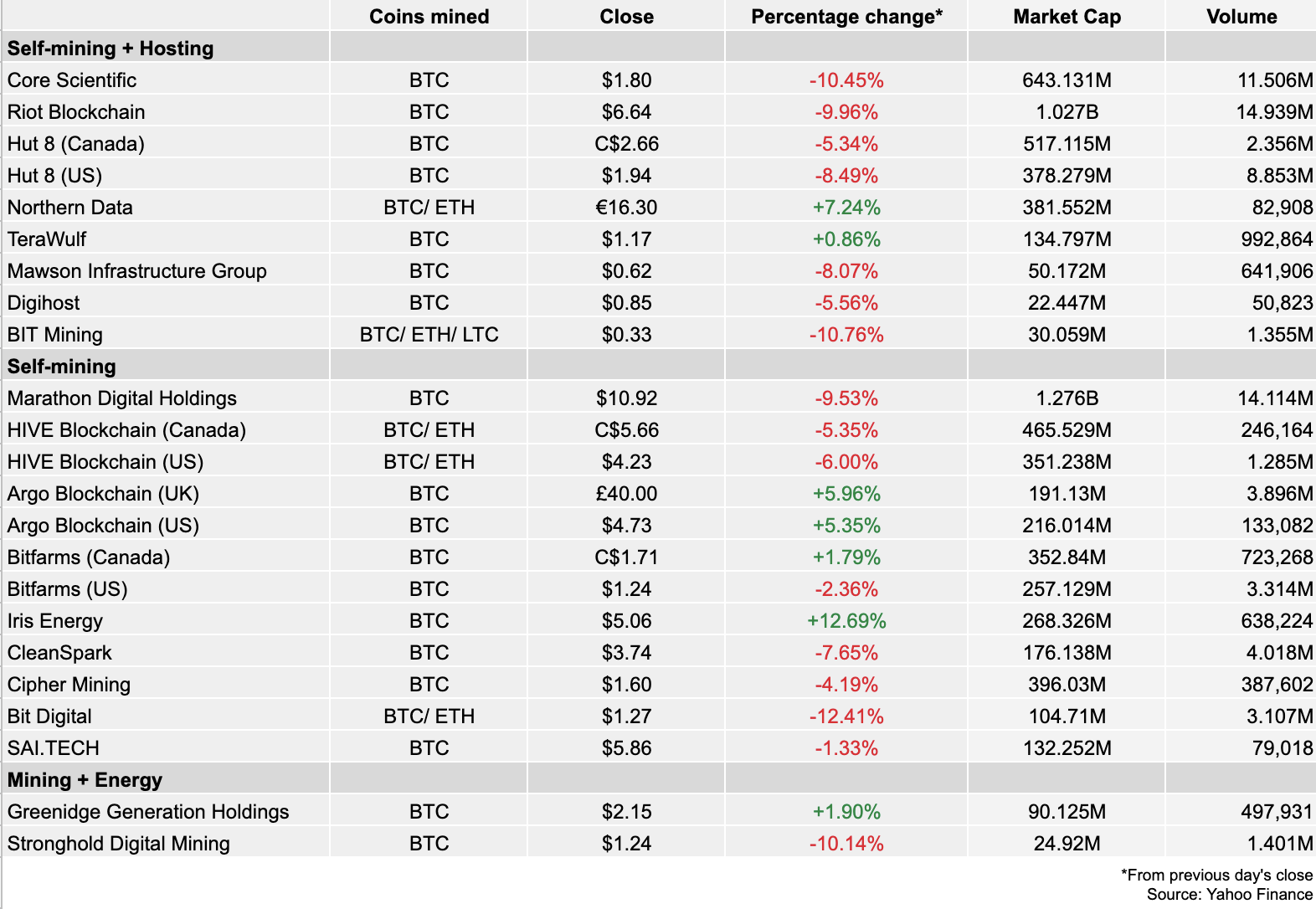
Bitcoin mining stock report: Friday, September 16

Most bitcoin mining stocks fell Friday as bitcoin itself continued to trade below $20,000.

The cryptocurrency was priced at around $19,700 at market close, according to data from TradingView.

Bit Digital’s stock fell 12.41% on Nasdaq, followed by BIT Mining (-10.76%), Core Scientific (-10.45%) and Stronghold Digital Mining (-10.14%).

Here’s how crypto mining companies performed on Friday, Sept. 16:

An overview of how miners fared over the week of trading:

© 2022 The Block Crypto, Inc. All Rights Reserved. This article is provided for informational purposes only. It is not offered or intended to be used as legal, tax, investment, financial, or other advice.

Go to Source
Author: Catarina Moura

Binance accounting bug leads to $20m misallocation of HNT tokens

Helium foundation has alerted Binance about a bug that resulted in users erroneously receiving about $20 worth of HNT.

An accounting error discovered by Binance at some point last night resulted in the misallocation of funds. The error, where Helium’s MOBILE token was mistaken for HNT, allowed users to send MOBILE balances to HNT wallets and then sell that into the market.

The glitch effectively gave users dollars for pennies and allowed some 4,829,043 MOBILE tokens to exploit Binance’s accounting system, the error is not a chain issue and is isolated to the exchange, The Helium Foundation told The Block.

“We advise token holders to suspend HNT and MOBILE deposits on Binance until a comprehensive situation update is provided,” the foundation said.

Reacting to what may have been the selloff by users taking advantage of the exploit, HNT is trading down, currently around $4.05. 

Binance didn’t immediately respond to a call for comment.

© 2022 The Block Crypto, Inc. All Rights Reserved. This article is provided for informational purposes only. It is not offered or intended to be used as legal, tax, investment, financial, or other advice.

Go to Source
Author: Jeremy Nation

Commentary of Robinhood’s Barclays Financial Services Conference Update

Quick Take

  • On September 13, 2022, Robinhood ($HOOD) presented at Barclay’s Financial Services Conference 
  • This is a summary of their Q&A panel with Robinhood’s Co-founder, President & CEO Vladimir Tenev and part of The Block’s ongoing market commentary series
  • Continuation of Robinhood’s earnings coverage
  • Disclaimer: This is a market commentary research piece and includes opinionated views from our research team. Nothing contained in this piece constitutes a solicitation, recommendation, endorsement, or offer by The Block Research

This research piece is available exclusively to
members of The Block Research.
You can continue reading
this Research content on The Block Research.

Go to Source
Author: Greg Lim

Here are all of the Biden administration’s crypto reports

A trio of reports released Friday morning by the Biden administration represent a key step in the federal government’s efforts to lay out a comprehensive approach for American crypto policy and oversight. 

As of today, some eight publications, including the three from the Treasury, have been published since Biden’s executive order. The White House characterized President Joe Biden’s March executive order as “outlining the first ever, whole-of-government approach to addressing the risks and harnessing the potential benefits of digital assets and their underlying technology.”

The Biden administration’s reports are linked below, with summaries of each report. You can also read The Block’s coverage of a call from the Treasury Department to “double down” on regulation, take another step towards a digital dollar, and of the one report that’s still pending: recommendations on how to plug regulatory gaps from the Financial Stability Oversight Council. 

  • Action Plan to Address Illicit Financial Risks of Digital Assets (Department of the Treasury): One of the three Friday reports, this release focuses on both existing and potential future efforts on anti-money laundering and illicit finance regulations as they relate to crypto. The action plan contained in the report “identifies priority and supporting actions to support this commitment in line with the priorities and supporting actions identified in the Illicit Financing Strategy specific to uncovering and mitigating the misuse of digital assets by illicit actors.”
  • Crypto-Assets: Implications for Consumers, Investors and Businesses (Department of the Treasury): Much of this Treasury report focuses on government recommendations on consumer protection, including calls for greater access to information about the risks of investing in digital assets. 
  • The Future of Money and Payments (Department of the Treasury): This expansive report focuses on the intersection of crypto, payments and the U.S. economy. Further, it touches on another area — central bank digital currencies — that was previously explored in a White House Office of Science and Technology Policy report. Indeed, the report features recommendations that focus on the broader shape of the U.S. payments ecosystem from regulatory and technology perspectives. 
  • Climate and Energy Implications of Crypto-assets in the United States (White House Office of Science and Technology Policy): Perhaps one of the most eagerly awaited reports given the size of the U.S. crypto mining ecosystem, this White House report sparked a wide range of commentary. In particular, its long-term call for possible restrictions on proof-of-work mining — namely, bitcoin — signaled a desire to reign in the energy costs associated with mining. The report also highlighted that certain forms of energy generation may actually create overall climate benefits. To wit: “[C]rypto-asset mining operations that capture vented methane to produce electricity can yield positive results for the climate, by converting the potent methane to CO2 during combustion.”
  • Policy Objectives for a U.S. Central Bank Digital Currency System (White House Office of Science and Technology Policy): This report laid out a series of objectives and policy goals for a potential U.S. CBDC, known colloquially as a digital dollar. Currently, the Federal Reserve is conducting research into this area, but such a launch would carry implications for the broader U.S. government, thus spurring the creation of “considerations related to choices and limitations that should inform the design of a U.S. CBDC system.”
  • Technical Evaluation of a U.S. Central Bank Digital Currency System (White House Office of Science and Technology Policy): A more expansive version of the above report, this particular release provides a greater focus on the technological aspects of a digital dollar. Among the recommendations: supporting the Fed’s work by involving the National Science Foundation (NSF) and improving the overall technological infrastructure of the U.S. government. 
  • The Role Of Law Enforcement In Detecting, Investigating, And Prosecuting Criminal Activity Related To Digital Assets (Department of Justice): The DOJ’s report provided an overview of the Department’s work around cryptocurrency law enforcement to date. In addition, it contains a series of recommendations “on how to further strengthen our ability to detect, investigate, prosecute, and otherwise disrupt criminal activity.”
  • Responsible Advancement of U.S. Competitiveness in Digital Assets (Department of Commerce): The Commerce Department report’s aim is to lay out a path toward achieving regulatory and technological leadership in the area of digital assets. “Organized around four categories, the framework details actions that, if taken, could advance the competitiveness of the U.S.-based digital asset industry and further a whole-of-government agenda for digital assets,” the report’s introduction notes.


© 2022 The Block Crypto, Inc. All Rights Reserved. This article is provided for informational purposes only. It is not offered or intended to be used as legal, tax, investment, financial, or other advice.

Go to Source
Author: Michael McSweeney

Crypto investment advisor faces SEC fraud charges after raising $4.3 million

The U.S. Securities and Exchange Commission filed fraud charges on Thursday against a crypto advisor who raised close to $4.3 million from four investors.

The SEC alleged that Gabriel Edelman fraudulently sold securities via his two businesses, Creative Advancement LLC and Edelman Blockchain Advisors LLC, telling clients that he would invest their funds in digital assets. Instead, he purportedly used most of the money for his personal expenses and only a small amount to pay investors early and “encourage their ever-larger investments” in a “Ponzi-like fashion,” the complaint said.

Of the $4.9 million he raised, “at most” $447,300 was used for digital assets, while Edelman pocketed at least $1.5 million, the complaint said. 

All of the investors were US residents “relatively unknowledgeable regarding digital assets” and three of them were elderly, the SEC said. Edelman himself has lived in Spain since 2020, but also lived in New York while committing the alleged securities fraud sometime between 2017 and 2021, according to the complaint.

Edelman had previously been named in a lawsuit brought by a New Jersey resident  and two companies, including a financial services firm he previously worked for, according to the complaint filed in 2o21 with the U.S. District Court for the Southern District of New York.

© 2022 The Block Crypto, Inc. All Rights Reserved. This article is provided for informational purposes only. It is not offered or intended to be used as legal, tax, investment, financial, or other advice.

Go to Source
Author: Catarina Moura


Follow by Email
Facebook20
Pinterest20
fb-share-icon
LinkedIn20
Share