FreeCryptoCurrency.Me

Free stocks and money too!

Category Archive : Crypto News

BlockSec detects replay exploit with ETHPoW tokens

The Ethereum proof-of-work blockchain suffered a replay exploit with the attacker getting an extra 200 ETHW tokens after replaying a message from the proof-of-stake chain on ETHPoW, according to a cybersecurity firm that alerted the issue on Sunday. 

“The exploiter (0x82fae) first transferred 200 WETH through the omni bridge of the Gnosis chain, and then replayed the same message on the PoW chain and got extra 200 ETHW,” security company BlockSec said on Twitter. The attack happened because the bridge didn’t correctly verify the chain ID of the cross-chain message, the company claimed. 

The ETHPoW blockchain developer team said that an attack exploited the contract vulnerability of the bridge, and not their blockchain itself. 

“ETHW itself has enforced EIP-155, and there is no replay attack from ETHPoS and to ETHPoS, which ETHW Core’s security engineers have planned in advance,” the ETHW Core developers wrote in a Medium post.

The developer team also said that it had been trying to get in contact with Omni Bridge since Saturday to inform them of the risks. Omni Bridge did not immediately respond to a request for comment. 

“We have contacted the bridge in every way and informed them of the risks,” it said. “Bridges need to correctly verify the actual ChainID of the cross-chain messages,” they said.

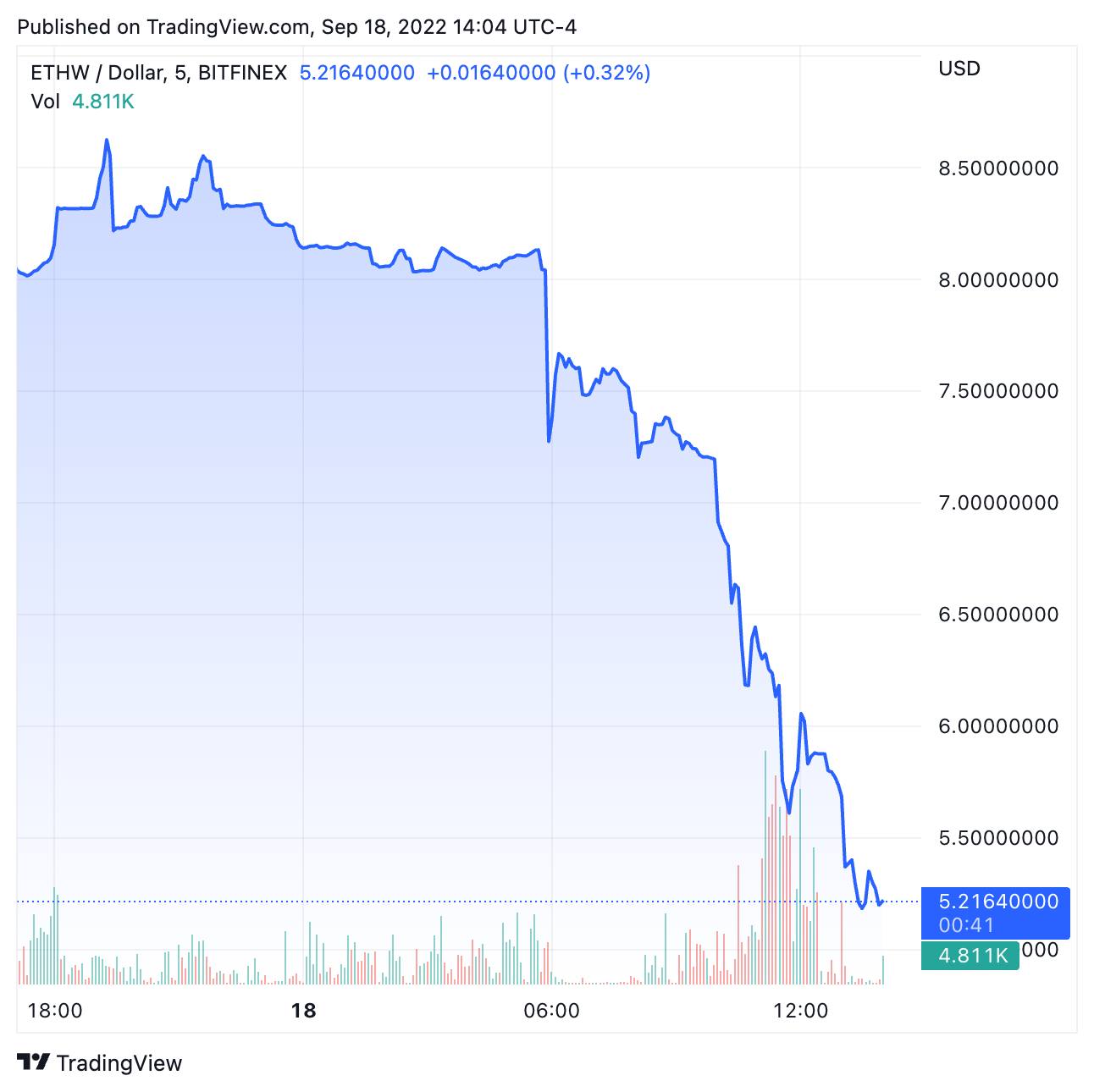
The ETHPoW fork on the proof-of-work Ethereum blockchain went live this week after The Merge. The token has fallen over 35% following the news of the exploit Sunday morning, according to data from TradingView.
 

© 2022 The Block Crypto, Inc. All Rights Reserved. This article is provided for informational purposes only. It is not offered or intended to be used as legal, tax, investment, financial, or other advice.

Go to Source
Author: Catarina Moura

Ether plummets 20%, trading below $1,500: This week in markets

Crypto markets were roiled by inflation data from the U.S. on Tuesday and Ethereum’s successful Merge on Thursday did nothing for prices.

Bitcoin was down 8.49% at $19,832 over the past week, while ether shed more than 20% and was trading at $1,418, at the time of writing per Coinbase data.

U.S. inflation came in above estimates; the data showed a 0.1% month-on-month increase since July and a jump of  8.3% year-on-year. Estimates called for a reading of 8% year-on-year, down from the 8.5% in July, and drop of 0.1% month-on-month.

The Fed is set to make its next interest rate decision on Wednesday, with most analysts expecting a 75 basis point increase — while a 100 basis point increase hasn’t been ruled out either, per the CME’s FedWatch dashboard.

Macro matters and The Merge

Crypto trading firm QCP Capital wrote in its market report on Thursday that while the inflation trend has no doubt peaked and is headed lower, it will be a long and winding road back from month-to-month as the market pendulum over-swings on either side.

QCP went on to say that market pricing for a 100 basis point hike next week is overdone on the bearish side, with the Fed likely to stick to 75 basis points.

Indeed, Fed chair Powell noted during his Jackson Hole address in August that the lower inflation reading in July was welcome, but a single month’s improvement was short of what the FOMC needed to see. He went on to add that the Fed’s decision in September will depend on the “totality of the incoming data and the evolving outlook.”

LedgerPrime’s Laura Vidiella told The Block that macro factors will continue to affect the market in the short run, as evidenced by Tuesday’s slide following the U.S. CPI release.

source: FRED economic data.

Elsewhere, Ethereum’s long-awaited upgrade, known as The Merge, was activated on Thursday without a hitch. However, the affect on markets was negligible, with prices of several adjacent tokens, including Ethereum Classic and Lido DAO’s token, briefly increasing before surrendering those gains.

Crypto trading firm Cumberland wrote on Twitter that the fact it was “successful yet uneventful” was a testament to the people involved, “what they’ve done for the world of crypto, digital assets, and decentralized computing. Massive congrats to the ETH core devs from Cumberland.”

© 2022 The Block Crypto, Inc. All Rights Reserved. This article is provided for informational purposes only. It is not offered or intended to be used as legal, tax, investment, financial, or other advice.

Go to Source
Author: Adam Morgan McCarthy

Marathon’s Thiel: Regulators should incentivize renewables for bitcoin miners

Marathon CEO Fred Thiel believes U.S. regulators should create incentives for bitcoin miners to use renewable energy and disincentives for fossil fuel-based sources.

Thiel’s comments came following a White House report on the environmental implications of crypto mining. In an interview, Thiel pointed to his firm’s operations as a model for the industry.

“Unlike other miners who may be on the grid just sucking energy off the grid in competition with consumers, we do it behind the meter,” said Thiel. “It’s more symbiotic to the grid versus parasitic.”

The company announced earlier this year that it would relocate miners from Montana to new locations with “more sustainable” power sources. One of those is based in West Texas, next to a wind farm with a connection to the grid for periods of inactivity.

Thiel argued that the company is serving two functions. First, as a customer for renewable energy stations, and second by providing the grid access to a large amount of power that it can call upon when needed.

Thiel also believed that the bitcoin mining industry would respond positively to this idea. He added that excess gas which would otherwise be flared should be an exception within fossil fuels.

“If you provide an incentive for miners to co-locate behind the mediator at renewable energy plants, then miners are going to move there.”

The White House report said that while miners located in places with excess renewable energy like West Texas “can provide additional revenue to renewables developers and incentivize the construction of additional renewable energy capacity,” they can also “reduce the financial incentives to construct transmission from these renewables to existing users.”

In response, Thiel argued that the transmission grid won’t build more connection capacity unless there is more generation capacity available.

“It’s a chicken-and-egg thing,” he said. “Generation capacity can only be increased if there’s an economic incentive for the generator to build more capacity.”

Conflicting reactions

Thiel argued that the White House’s findings essentially encourage people to look at ways to look for opportunities to make proof of work more energy efficient while reducing the impact on the environment.

“Regulators, I think, are educating themselves. They’re learning about Bitcoin mining,” he also said. “The understanding of what proof of work is and why proof of work is superior to proof of stake is slowly starting to permeate. But it takes time.”

In reaction to the White House report, Kyle Schneps, the director of public policy at Foundry, said that it was a “clear case of scapegoating a nascent industry for the purpose of political posturing.”

“We must ask ourselves why the cryptocurrency industry is being held to a different standard than every other major business enterprise,” Schneps said.

Rachel Silverstein, CleanSpark’s general counsel and senior vice-president of compliance, said the company would welcome the opportunity of working with the White House in setting “fair standards” for the mining industry.

“We firmly believe that proof-of-work mining is the only way to keep Bitcoin accessible, transparent and open,” Silverstein said.

© 2022 The Block Crypto, Inc. All Rights Reserved. This article is provided for informational purposes only. It is not offered or intended to be used as legal, tax, investment, financial, or other advice.

Go to Source
Author: Catarina Moura

SEC and Ripple each seek ruling in long-running unregistered securities case

Ripple and the Securities and Exchange Commission (SEC) have each asked for a swift judgment in the regulator’s case against the crypto firm over its sale of XRP tokens.

Both the plaintiff and the defendant are seeking a so-called summary judgment, according to documents dated Sept. 13 that were filed on Saturday. The filings suggest that neither party wants the legal action to continue to a full trial. 

The SEC sued Ripple, its CEO Brad Garlinghouse and its co-founder Chris Larsen in 2020, alleging they sold unregistered securities when they issued $1.3 billion worth of XRP tokens. Ripple denies that XRP is a security. 

The original SEC complaint alleges that Ripple “raised funds, beginning in 2013, through the sale of digital assets known as XRP in an unregistered securities offering to investors in the U.S. and worldwide. Ripple also allegedly distributed billions of XRP in exchange for non-cash consideration, such as labor and market-making services.”

A major point of contention has emerged over a 2018 speech by former Commissioner Bill Hinman, when he explained why he didn’t consider rival cryptocurrencies bitcoin and ether to be securities. Ripple has been seeking to obtain documents and communications related to the speech, while the SEC has attempted to shield them. 

© 2022 The Block Crypto, Inc. All Rights Reserved. This article is provided for informational purposes only. It is not offered or intended to be used as legal, tax, investment, financial, or other advice.

Go to Source
Author: Andrew Rummer

Crypto exchange FTX obtains European investment firm license

Crypto exchange giant FTX said that its European division has received a license to operate as an investment firm in the region.

The Cyprus Securities and Exchange Commission granted FTX a Cyprus Investment Firm License, according to a statement issued on Thursday. This requires FTX Europe to meet standards outlined in the European Union’s MiFID II directive, including those on the segregation and protection of client funds, business transparency and capital adequacy, according to the company. 

The Cypriot license allows FTX to serve the whole European Economic Area, which includes the EU, Iceland, Liechtenstein and Norway. FTX says it’s the only crypto exchange to provide a full suite of exchange services under a full MiFID II license. 

“Securing this license in the European Union is an important step in achieving our goal of becoming one of the most regulated exchanges in the world,” FTX CEO Sam Bankman-Fried said in the statement. 

FTX launched its European division in March. FTX Europe’s main base is in Switzerland, with subsidiaries in Dubai and Cyprus, with the latter serving the European Economic Area.

Patrick Gruhn, the head of FTX Europe, told The Block in an interview in March that FTX’s goal was to become the top crypto exchange in the region. He said at the time that the company planned an ambitious marketing program that would include paid social media ads and sponsorship of music festivals. 

© 2022 The Block Crypto, Inc. All Rights Reserved. This article is provided for informational purposes only. It is not offered or intended to be used as legal, tax, investment, financial, or other advice.

Go to Source
Author: Andrew Rummer

The week ahead’s three biggest cryptocurrency stories

As the crypto industry emerges blinking from a week dominated by Ethereum’s successful switch to proof of stake from proof of work, attention will shift this week to more mundane matters of economic policy.

Although, not to be outdone, the Cardano blockchain is also planning its own network upgrade, known as Vasil.

The Fed is expected to hike, again

Federal Reserve policymakers are expected to unveil a fresh hike to U.S. interest rates on Wednesday. The Fed will raise rates by 75 basis points for a third consecutive meeting, according to a Bloomberg survey of economists, bringing their key rate to a range of 3% to 3.25%.

The Fed has been hiking aggressively to head off inflation that has surged thanks to a booming economy, an energy crisis and a supply chain crunch following the Covid pandemic. Markets currently expect U.S. interest rates to breach 4% by year-end.

So far this year, bitcoin’s price has reacted to U.S. monetary policy as if it’s a fast-growing tech stock, tending to fall as interest rate expectations rise.

The Fed announcement is due at 2 p.m. ET on Sept. 21, with the Bank of England following the next day with an expected increase in UK interest rates.

Crypto oversight

Sticking with the U.S., the Financial Stability Oversight Council, a body chaired by Treasury Secretary Janet Yellen, will meet on Friday to work on its report regarding regulatory gaps for digital assets and their potential risks.

The report is the last outstanding piece of a broader framework from the Biden administration that represents the first attempt to harmonize the approach of federal agencies toward digital currencies.

The President’s Working Group on Financial Markets, another convention of multiple regulators led by the Treasury, recommended last fall to give FSOC authority over stablecoins should Congress fail to pass legislation governing them.

After The Merge, Cardano gets its own upgrade

Another Thursday, another software upgrade.

On Sept. 22, a week after Ethereum underwent The Merge, the Cardano blockchain is due to implement a hard fork known as Vasil.

Vasil is designed to increase Cardano’s scalability, while also reducing transaction costs. The switch will also allow developers to create more powerful and efficient blockchain-based applications amid enhancements to its Plutus smart contract platform.

A group of developers involved in the project have described it as the “most significant Cardano upgrade to date.”

The release had been set for earlier in the summer but was hit with delays.

© 2022 The Block Crypto, Inc. All Rights Reserved. This article is provided for informational purposes only. It is not offered or intended to be used as legal, tax, investment, financial, or other advice.

Go to Source
Author: Andrew Rummer

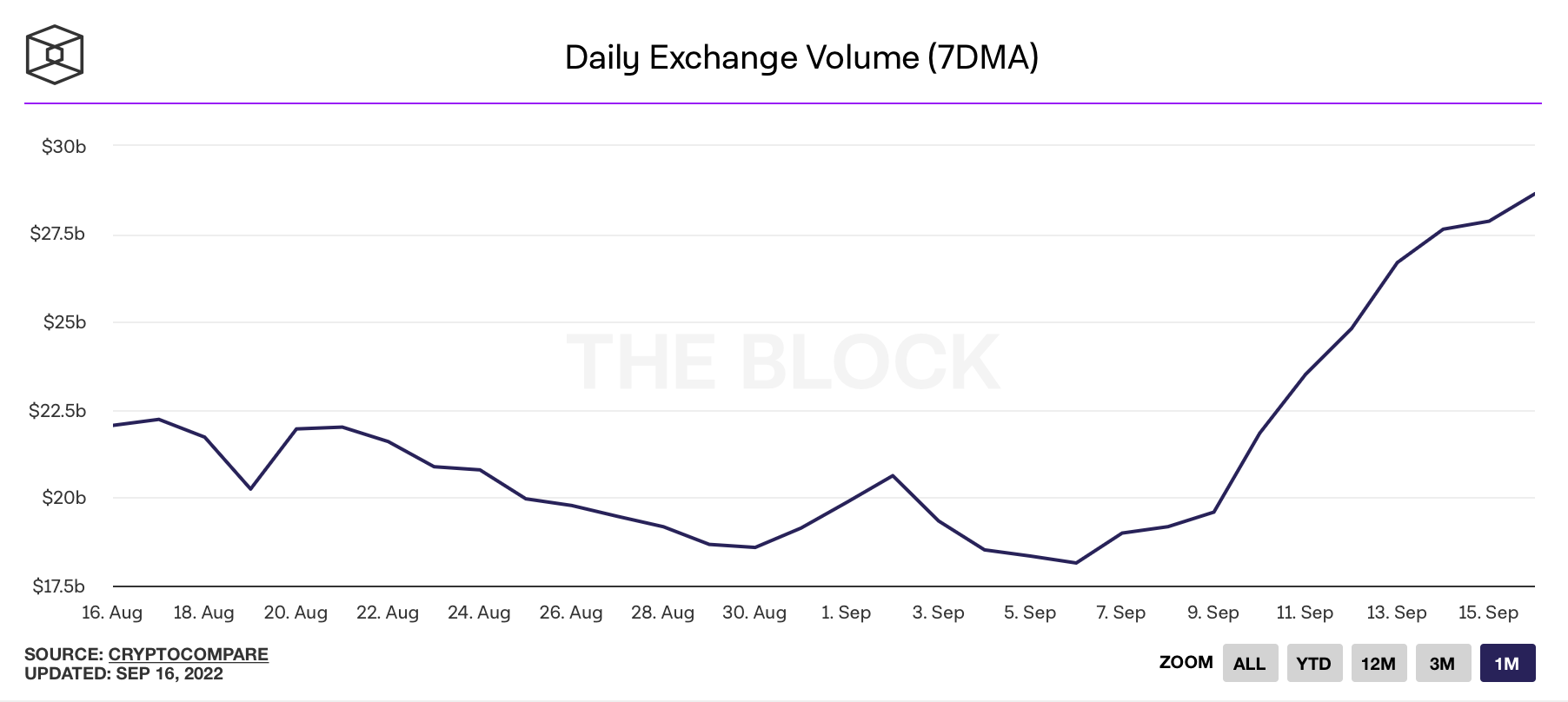
Crypto exchange volumes surge amid The Merge

Even as the price of cryptocurrencies trade in the red, crypto exchanges are benefiting from a boost in trading activity, according to data compiled by The Block Research.

As per data provided by Crypto Compare, the seven day daily moving average for crypto trading volumes has increased from $18.1 billion on September 6 to $28.6 billion on September 16.

The increase in trading activity comes amid Ethereum’s transition from proof-of-work to proof-of-stake. The transition—which is known as The Merge—occurred last week. 

On FTX.US, ETH traders accounted for a majority of the surge in volume, which encompassed close to 43% of overall exchange volume over the last 24 hours, data from CoinGecko indicates.

Likewise, ETH also led in 24 hour exchange volume on Coinbase at around 34%, data shows.

As for price, the 24 hour price on ETH shows a small uptick at nearly 2.6% with a price of $1,468.23. It is down more than 2o% over the last month. 

© 2022 The Block Crypto, Inc. All Rights Reserved. This article is provided for informational purposes only. It is not offered or intended to be used as legal, tax, investment, financial, or other advice.

Go to Source
Author: Jeremy Nation

Do Kwon says he is “not on the run,” cooperating with authorities

Terraform Labs founder Do Kwon said on Saturday he is not trying to evade any relevant authorities. 

“I am not ‘on the run’ or anything similar – [from] any government agency that has shown interest to communicate, we are in full cooperation and we don’t have anything to hide,” Do Kwon said in a tweet thread, responding to reports that Singaporean police officials have said the South Korea-native is not currently in the city-state nation. 

Do Kwon, who is currently wanted by South Korean authorities according to Reuters, went on to say he would disclose his location to individuals if they are friends, have plans to meet, or are involved in a gps based web3 game, adding that “otherwise you have no business knowing my gps coordinates.”

While Do Kwon’s exact whereabouts remain unclear, South Korean authorities have already sought to limit his capacity to travel, issuing a warrant for the crypto founder’s arrest and freezing his passport. The actions come four months after the fall of the TerraUSD stablecoin, which wiped out approximately $40 billion in value and precipitated a wider crash in the crypto market. 

© 2022 The Block Crypto, Inc. All Rights Reserved. This article is provided for informational purposes only. It is not offered or intended to be used as legal, tax, investment, financial, or other advice.

Go to Source
Author: Jeremy Nation

Do Kwon is not in Singapore, according to police: Reuters

Singapore police said in a statement late Saturday that Terraform Labs founder Do Kwon, who is wanted by South Korean authorities, is not in the city-state, according to reporting by Reuters.

Singapore police are willing to assist South Korea “within the ambit of its domestic legislation and international obligations,” according to the report.

On Wednesday, a South Korean court issued an arrest warrant for the crypto project founder, four months after the collapse of the Terra ecosystem, its native luna token and its TerraUSD algorithmic stablecoin — which together wiped out about $40 billion in value. 

The next day, South Korean prosecutors asked the country’s Foreign Ministry to invalidate his passport, so the crypto developer would be unable to travel.

Do Kwon’s last known whereabouts were reportedly in Singapore. He is still active on social media, tweeting Saturday: “One can tell a lot about a society by the way it raises its young and buries its dead.”

Do Kwon did not respond to a message seeking comment at the time of publication. 

© 2022 The Block Crypto, Inc. All Rights Reserved. This article is provided for informational purposes only. It is not offered or intended to be used as legal, tax, investment, financial, or other advice.

Go to Source
Author: Mike Millard

Yuga Labs hires its first chief gaming officer to oversee Otherside project

Non-fungible token (NFT) heavyweight Yuga Labs said it has hired Spencer Tucker as its first chief gaming officer.

Previously president of games at mobile gaming studio Scopely, Tucker will oversee Yuga’s efforts in gaming, including its Otherside metaverse project, according to a news release

“Web3 is revolutionizing gaming, entertainment, and community in much the same way the shift to mobile revolutionized communication,” Tucker said in the Friday announcement. “I am beyond excited to join the Yuga Labs team and to continue building toward the new era of interoperability and community-empowered growth in the Otherside metaverse.”

Previously, the company set out its vision for Otherside in a litepaper, which championed open development, user-generated content and interoperability for its online world. It also held a recent tech demo, which allowed holders of their Otherdeed NFTs to test out Otherside.

Otherdeed NFTs allow holders to own land in the Otherside metaverse — all 55,000 Otherdeed land NFTs sold out within three hours in May. 

“Yuga today is known most prominently for being the home of Bored Ape Yacht Club, CryptoPunks, and Meebits, but Yuga is more than that. Gaming is one of our main focus areas,” said Yuga Labs CEO Nicole Muniz. “We are uniquely situated to revolutionize the way we all think about web3 gaming through core principles such as ownership, utility, community, and storytelling.”

© 2022 The Block Crypto, Inc. All Rights Reserved. This article is provided for informational purposes only. It is not offered or intended to be used as legal, tax, investment, financial, or other advice.

Go to Source
Author: Tom Matsuda


Follow by Email
Facebook20
Pinterest20
fb-share-icon
LinkedIn20
Share