FreeCryptoCurrency.Me

Free stocks and money too!

Category Archive : Crypto News

Summarizing The NFT Royalties Debate

Quick Take

  • Lately, the topic of NFT royalties has sparked a heated debate that has divided the market
  • NFT royalties are not enforceable on-chain, but instead are a socially constructed concept
  • A variety of potential solutions have been proposed to cater to the specific needs of different market segments

This research piece is available exclusively to
members of The Block Research.
You can continue reading
this Research content on The Block Research.

Go to Source
Author: Thomas Bialek

SEC files ICO suit against crypto influencer Ian Balina

The U.S. Securities and Exchange Commission charged crypto investor and YouTuber Ian Balina over his involved in an unregistered initial coin offering (ICO).

The allegations center around the ICO for Sparkster, which was pitched as “no-code” development platform. The ICO, which ended in July 2018, raised $30 million from participants.

Per the court documents:

“This action concerns Ian Balina’s unregistered offering and promotion in 2018 of crypto asset securities called SPRK Tokens. Balina, a self-described crypto asset investor, promoter, and influencer, who claimed he could help people “make millions with initial coin offerings,” failed to disclose the compensation he received from the issuer while he publicly promoted the tokens. He also failed to file a registration statement with the SEC for the tokens that he re-sold using an investing pool that he organized.”

The SEC’s charges centered around his communications around the ICO, focusing both on YouTube as well as activities on Telegram.

As previously reported by The Block, Balina made his name during the 2017-2018 ICO boom and later suffered a personal wallet hack, losing $2.5 million in the process. In June 2019, Balina appeared to issue a mea culpa related to Sparkster in a Twitter thread. The SEC is seeking to permanently bar Balina from participating in securities offerings or promoting them, as well as disgorgement and civil penalties.

Balina did not immediately respond to a request for comment.

Notably the SEC’s filing includes language that argues that because the majority of nodes in the Ethereum blockchain are U.S.-based, the commission views the transactions made in connection to Balina’s investing pool as taking place in the U.S. 

“The U.S.-based investors in Balina’s pool irrevocably committed to the transaction when, from within the United States, they sent their ETH contributions to Balina’s pool. At that point, their ETH contributions were validated by a network of nodes on the Ethereum blockchain, which are clustered more densely in the United States than in any other country,” the filing reads. 

© 2022 The Block Crypto, Inc. All Rights Reserved. This article is provided for informational purposes only. It is not offered or intended to be used as legal, tax, investment, financial, or other advice.

Go to Source
Author: Michael McSweeney

Animoca Brands Company Intelligence

Quick Take

  • Shifting its focus to blockchain technology in 2018, Animoca Brands became one of today’s most active web3 investors – the company made +60 investments in H1 ’22 and +340 investments since its inception
  • Animoca Brands has subsidiaries and original products (web3 platforms, blockchain games, tokens) focusing on different verticals such as motorsports, fitness and entertainment
  • IP licensing/brand collaboration is another strategic focus of Animoca Brands (i.e. sports teams, celebrities, games, cartoon characters etc.)
  • After being delisted from ASX in March 2020, Animoca Brands raised US$764.6 million from private investors (US$544.2 million in 2022)

This research piece is available exclusively to
members of The Block Research.
You can continue reading
this Research content on The Block Research.

Go to Source
Author: Wendy Hirata

Crypto markets head lower in anticipation of Wednesday’s FOMC rate hike decision

Crypto markets traded lower over the weekend and into Monday after last week’s inflation data came in hotter than expected, dashing the hopes of investors who thought July’s CPI print might have indicated inflation had peaked. 

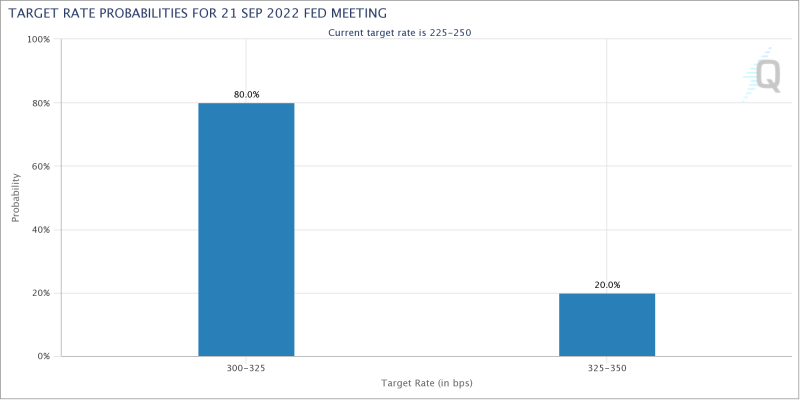
The CME FedWatch Tool now indicates a 20% likelihood of a 100bps hike during Wednesday’s FOMC meeting — up from 0% just one week ago.

The total crypto market cap currently sits around $890 billion, after once again slipping below the $1 trillion dollar mark last week.

At the time of writing, bitcoin was trading at around $19,090, down over 16% since the CPI print. Meanwhile ether is trading at $1,343, down more than 23% over the same period.

A research note from Goldman Sachs indicates the bond market is also pricing in a 25% chance of a 100bps hike for Wednesday’s meeting, with analysts expecting “50bp hikes in November and December, taking the funds rate to 4-4.25% at year end.”

© 2022 The Block Crypto, Inc. All Rights Reserved. This article is provided for informational purposes only. It is not offered or intended to be used as legal, tax, investment, financial, or other advice.

Go to Source
Author: Davis Quinton

Yellow Card crypto exchange raises $40 million in Series B round

Pan-African cryptocurrency exchange Yellow Card Financial raised $40 million in its Series B funding round, the company announced on Monday.

“This fundraise in this market not only showcases the resilience of our team but also reiterates the appetite and necessity for cryptocurrency in Africa,” Yellow Card CEO and co-founder Chris Maurice said in a statement. 

Polychain Capital led the fundraising round, which comes after Yellow Card raised $15 million in a Series A round last year. Yellow Card launched in Nigeria in 2019 and operates in 16 countries. 

Participants in the latest fundraising round included Valar Ventures, Third Prime Ventures and Sozo Ventures, among others.

© 2022 The Block Crypto, Inc. All Rights Reserved. This article is provided for informational purposes only. It is not offered or intended to be used as legal, tax, investment, financial, or other advice.

Go to Source
Author: Stephanie Murray

Bitcoin miner Bitdeer bought Singaporean maximum-security vault Le Freeport: Report

Bitcoin miner Bitdeer has bought Le Freeport, a Singaporean maximum-security vault, according to Bloomberg.

The deal, which closed in July, was worth S$40 million ($28.4 million), sources told Bloomberg.

Previously owned by Swiss art dealer Yves Bouvier, Le Freeport was also a repository for fine art, precious gems, and gold and silver bars.

Bitdeer did not immediately respond to a request for comment from The Block.

The company has been aiming to go public since last year when it announced a $4 billion SPAC deal with blank-check firm Blue Safari Group Acquisition Corp. The deadline for the deal has been delayed three months from September 14 to December 14, according to a US Securities and Exchange Commission filing from this month.

The company is led by Jihan Wu, who previously co-founded bitcoin mining manufacturer Bitmain. Wu stepped down from the company in early 2021.

© 2022 The Block Crypto, Inc. All Rights Reserved. This article is provided for informational purposes only. It is not offered or intended to be used as legal, tax, investment, financial, or other advice.

Go to Source
Author: Catarina Moura

Ethereum Name Service says it has regained control of ‘eth.link’ domain name

True Names Ltd., the parent company of the Ethereum Name Service (ENS), says it has regained control of the  web domain name “eth.link” after securing an injunction from an Arizona court.

“We’re delighted to report that eth.link is now back online! Our injunction was successful and the name has been returned to us,” ENS said in a tweet on Monday.

The company behind ENS had filed a suit against web domain registrar GoDaddy for selling the domain name to a third party, as previously reported by The Block. The suit accused GoDaddy of breaching a domain name registration contract. According to the complaint filed by True Names, GoDaddy wrongfully deemed the eth.link domain registered by the plaintiff as expired, and then sold it to a third party.

The court granted True Names’ motion for a preliminary injunction in the matter. As such, the court ordered the return of the eth.link domain to True Names. GoDaddy had previously sold the domain to Dynadot who then sold it to DeFi aggregator Manifold Finance. The complaint also names both Dynadot and Manifold.

ENS founder Nick Johnson told The Block that the company was pleased with the outcome. “We have won the legal complaint against GoDaddy with the court granting our request for preliminary injunctive relief,” said Johnson, adding that the ruling ordered the return of the domain to True Names. The court ruling itself states: “To the extent ownership interest in the Domain has been sold or transferred away from Plaintiffs as the registrants, Defendants shall immediately transfer ownership in the Domain back to Plaintiffs.”

However, Manifold Finance founder Sam Bacha told The Block that the matter had not, in fact, been settled. “DNS Services were restored to ensure the domain value remains. DNS is still held in escrow per the injunction and has not been transferred to True Names. Once the court opens in the morning more information will be available after the court opens,” said Bacha. DNS stands for domain name service.

Johnson addressed this, saying: “The eth.link domain has been returned to us fully pending the outcome of the court case. Should the case not be pursued the return would effectively be permanent.”

“While we cannot rule out the possibility of future litigation from GoDaddy or others over the name, at this time it is truly returned to us and users can resume use of the service,” Johnson added.

The ENS founder said users can resume using eth.link without disruption. ENS owners use eth.link as a gateway to access their “dot eth” (.eth) ENS address as a typical browser website. They do this by adding a “dot link” (.link) to their .eth ENS on a browser tab, which causes the link to open as a normal page on a web browser.

© 2022 The Block Crypto, Inc. All Rights Reserved. This article is provided for informational purposes only. It is not offered or intended to be used as legal, tax, investment, financial, or other advice.

Go to Source
Author: Osato Avan-Nomayo

South Korea asks Interpol to issue red notice for Do Kwon: FT

South Korean prosecutors have reportedly asked Interpol, an international organization that facilitates police cooperation and crime control between countries, to issue a red notice against Do Kwon.

The Financial Times reported the news on Monday, stating that Kwon, the co-founder of crypto firm Terraform Labs, is allegedly refusing to co-operate with a probe into the $40 billion implosion of the tokens terraUSD and luna.

Red notices are issued for fugitives wanted either for prosecution or to serve a sentence. Interpol’s website states that a red notice is “a request to law enforcement worldwide to locate and provisionally arrest a person pending extradition, surrender, or similar legal action.”

South Korean prosecutors have reportedly also asked the country’s foreign ministry to cancel Kwon’s South Korean passport, as he was “obviously on the run and has no intention to appear before us for questioning.”

“We have begun the procedure to place him on the Interpol red notice list and revoke his passport,” the prosecutors’ office said Monday, adding that Kwon had not co-operated with investigations into Terraform’s collapse.

Kwon said on Saturday that he is not trying to evade any relevant authorities. “I am not ‘on the run’ or anything similar – [from] any government agency that has shown interest to communicate, we are in full cooperation and we don’t have anything to hide,” Kwon tweeted recently, responding to reports that Singaporean police officials have claimed he is not currently residing in the city-state nation.

The South Korean prosecutor’s office reportedly said that Kwon told investigators through his lawyer that he did not want to respond to their summons immediately.

“We are doing our best to locate and arrest him,” a spokesperson for the office told the FT. “He is clearly on the run as his company’s key finance people also left for the same country during that time.”

The red notice comes a few days after Korean authorities issued an arrest warrant for Kwon and sought to freeze his passport, which in theory would require him to return to Seoul within 14 days of receiving the notice of revocation.

Kwon’s Singapore employment pass is due to expire Dec. 7 and an application for another pass is pending, according to a Bloomberg report, citing government records.

© 2022 The Block Crypto, Inc. All Rights Reserved. This article is provided for informational purposes only. It is not offered or intended to be used as legal, tax, investment, financial, or other advice.

Go to Source
Author: Yogita Khatri

Hacker stole $3.3 million from Ethereum ‘vanity addresses’ created with Profanity tool

A hacker drained $3.3 million from multiple Ethereum addresses generated with a tool called Profanity, according to on-chain data from Etherscan.

Anonymous security analyst ZachXBT first noticed the exploit, which took place on September 16. 

Vanity addresses are a type of custom wallet that contain identifiable names or numbers within them. They are used in the crypto sector primarily to show off, much in the way car drivers pay over the odds for expensive license plates. These addresses can be created using certain tools, one of them being Profanity.

Last week, decentralized exchange aggregator 1inch published a security disclosure report claiming that “vanity addresses” generated with Profanity were not secure. Per 1inch, the private keys linked to Profanity-generated addresses could be extracted with brute force calculations.

But the security issue highlighted by 1inch could not be fixed in time to prevent an exploit. Development work on Profanity stopped a few years ago, according to its anonymous developer who goes by “johguse.”

Even before 1inch’s report, johguse had recognized the vulnerability in the tool and warned users against its use. In a subsequent investigation, on-chain sleuth ZachXBT last Friday claimed an unknown hacker had seemingly exploited the very same vulnerability to drain an estimated $3.3 million in crypto assets from various Profanity-based addresses soon after the report by 1inch. The stolen funds moved from victims’ addresses to a new Ethereum address believed to be controlled by the hacker

The $3.3 million exploit has drawn comments from experts who suspect that malicious hackers may have known about the security issue in advance. 

“Seems like the attackers were sitting on this vulnerability, trying to find as many private keys as possible of vulnerable Profanity-generated vanity addresses before the vulnerability gets known. Once publicly exposed by 1inch, the attackers cashed out in a few minutes from multiple vanity addresses,” Tal Be’ery, security lead and chief technology officer at ZenGo, said.

Notably, 1inch had also stated in its report that the vulnerability had previously been used by hackers for potential exploits worth millions of dollars. To come to its conclusion, 1inch claimed that it was able to recompute some of the private keys of Profanity’s vanity addresses with GPU chips. 

“We have proof of concept of recovering a private key from a public key. So you can send us a public key (not address) generated via Profanity and we’ll send you back a private one,” the team told The Block in a statement.

© 2022 The Block Crypto, Inc. All Rights Reserved. This article is provided for informational purposes only. It is not offered or intended to be used as legal, tax, investment, financial, or other advice.

Go to Source
Author: Vishal Chawla

Why crypto domain names could evolve into the internet’s first identity system

Episode 88 of Season 4 of The Scoop was recorded live with The Block’s Frank Chaparro and Unstoppable Domains Founder & CEO Matt Gould.

Listen below, and subscribe to The Scoop on AppleSpotifyGoogle PodcastsStitcher or wherever you listen to podcasts. Email feedback and revision requests to podcast@theblockcrypto.com.


Unstoppable Domains allows users to register domain names via non-fungible tokens (NFTs) which can then be used to receive crypto payments, and as digital identity markers around Web3.

In July, the company raised $65 million in a Series A, successfully clinching ‘unicorn’ status at a $1 billion valuation.

In this episode of The Scoop, Unstoppable Domains’ Founder and CEO Matt Gould explains why NFT domain names are likely the future identity system for Web3, and how persistent digital identities will redefine the importance of online reputation. 

As Gould explains, once people start using an NFT domain as part of their online identity, additional interactions with Web3 applications will link more information to that NFT domain name, and a digital identity begins to emerge: 

“We think this is a big deal because there really isn’t an identity system for the Internet yet, and a lot of people in the space think this is probably one of the big unlocks for crypto and blockchain over the next several years.”

If this new NFT-based identity system develops the way Gould anticipates, then it will also be significantly harder for people to create fake reputations on Web3 platforms.

Given bots and scammers are notorious problems on existing Web2 platforms, Gould thinks the implications could fundamentally change how we view online interactions:

“Reputation that comes from having persistent digital identities is another huge benefit — not only owning your data, but being able to create your reputation will make online interactions hopefully more pleasant.”

During this episode, Chaparro and Gould also discuss:

  • Why the advertisement model is inferior to users owning their own data
  • How new digital identity solutions can improve physical world as well
  • Unstoppable Domain’s upcoming integration with Brave Browser

This episode is brought to you by our sponsors Tron, Chainalysis & IWC Schaffhausen

About Tron
On August 1st, 2022, Poloniex launched a faster and more stable trading system along with a
brand new user interface. Poloniex was founded in January 2014 as a global cryptocurrency trading platform. With its world-class service and security, it received funding in 2019 from renowned investors, including H.E. Justin Sun, Founder of TRON. Poloniex supports spot and margin trading as well as leveraged tokens. Its services are available to users in nearly 100 countries and regions with various languages available. For more information visit Poloniex.com.

About Chainalysis
Chainalysis is the leading blockchain data platform. We provide data, software, services, and research to government agencies, exchanges, financial institutions, and insurance and cybersecurity companies in over 60 countries. Backed by Accel, Addition, Benchmark, Coatue, Paradigm, Ribbit, and other leading firms in venture capital, Chainalysis builds trust in blockchains to promote more financial freedom with less risk. For more information, visit www.chainalysis.com.

About IWC Schaffhausen
IWC Schaffhausen is a Swiss luxury watch manufacturer based in Schaffhausen, Switzerland. Known for its unique engineering approach to watchmaking, IWC combines the best of human craftsmanship and creativity with cutting-edge technology and processes. With collections like the Portugieser and the Pilot’s Watches, the brand covers the whole spectrum from elegant timepieces to sports watches. For more information, visit IWC.com.

© 2022 The Block Crypto, Inc. All Rights Reserved. This article is provided for informational purposes only. It is not offered or intended to be used as legal, tax, investment, financial, or other advice.

Go to Source
Author: Davis Quinton and Frank Chaparro


Follow by Email
Facebook20
Pinterest20
fb-share-icon
LinkedIn20
Share