FreeCryptoCurrency.Me

Free stocks and money too!

Category Archive : Crypto News

Grand Theft Auto creator backs web3 gaming studio in $7.6 million round

David Jones, one of the creators of the Grand Theft Auto series, has backed blockchain gaming studio Random Games in a $7.6 million round. 

Along with Jones, the round was co-led by Resolute Ventures and Asymmetric and featured participation from Ignia, 2 Punks Capital, ID345 and Polygon, according to a release on Tuesday. The valuation was not disclosed. Jones will also act as an advisor to the company. 

Random Games is a blockchain gaming studio founded in September last year by Tony Harman, who has held executive positions at Nintendo and DMA Designs (the gaming studio behind the Grand Theft Auto series), and Wyeth Ridgway, who has worked on Star Trek and Pirates of the Caribbean. 

It’s creating a “community owned” gaming franchise named the Unioverse, which will allow developers and fans to use in-game assets as they please to make their own games, comic books or even T-shirts, said Random Games. Those who do so can also sell their creations and keep the money. 

“Imagine if Marvel released character art and 3D models and told fans to go make – and profit from – their fan films and comics,” said co-founder Tony Harman. “That’s how big this idea is. We have a team of world-class writers, artists and developers building the Unioverse and we are basically giving it away.”

To access this gaming world, players can purchase NFTs that are interoperable across games in the franchise. 

The company says it will use the funding to expand its team so that it can start work on the first Unioverse games. 

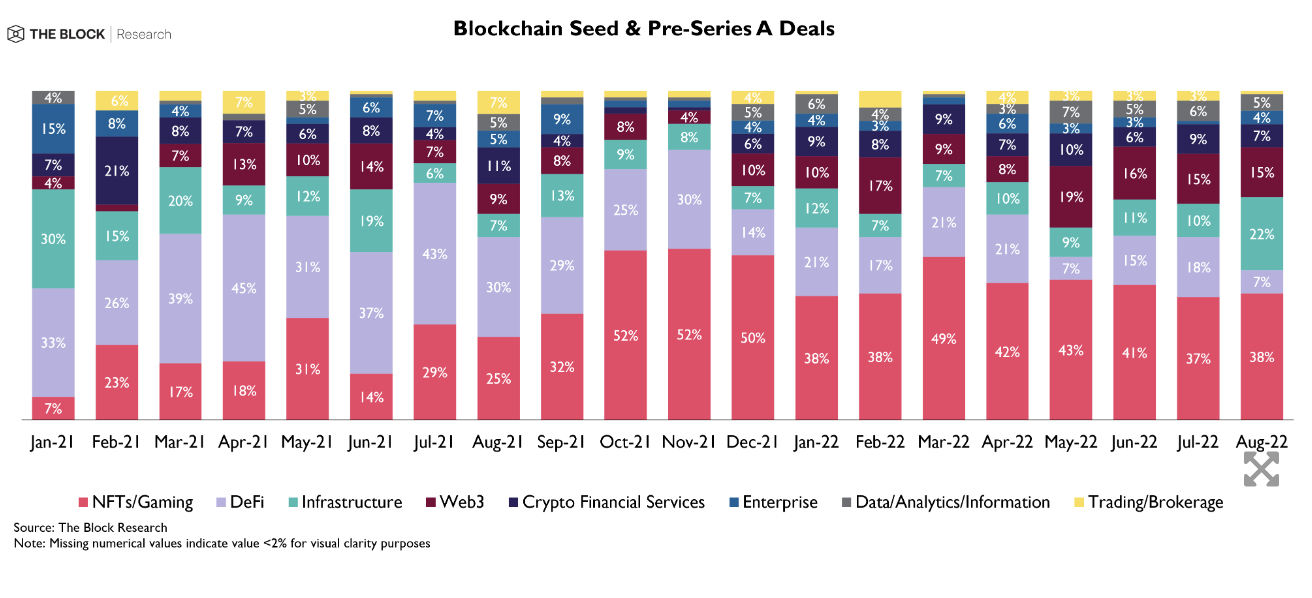
According to The Block Research, crypto venture deals in the gaming and NFT subsector accounted for 38% of seed and pre-Series A deals last month. 

© 2022 The Block Crypto, Inc. All Rights Reserved. This article is provided for informational purposes only. It is not offered or intended to be used as legal, tax, investment, financial, or other advice.

Go to Source
Author: Tom Matsuda

Treasury official: Sanctions against crypto mixers can deter financial crimes 

Sanctions against cryptocurrency mixers like Tornado Cash can strengthen the United States’ sanctions regime against Russia and other illicit actors, and can serve as a deterrent to criminals that would use the technology to launder money, Treasury Department Assistant Secretary Elizabeth Rosenberg said during a hearing on Tuesday.

“That’s an effective avenue we can use in order to signal that we cannot tolerate money laundering,” said Rosenberg, who serves as assistant secretary for terrorist financing and financial crimes, a top U.S. sanctions policy position. “Whether that’s for a Russian criminal actor, an Iranian, a North Korean or wherever they may come from.”

Rosenberg appeared before the Senate Banking Committee for a hearing titled “Tightening the Screws on Russia: Smart Sanctions, Economic Statecraft and Next Steps.” Rosenberg was responding to questions from Sen. Elizabeth Warren (D-Mass.), who ripped the crypto industry for “downplaying” and “lying” about the risks posed by crypto mixers. 

“One thing I’ve learned over the past couple of years: When the crypto boosters cry the loudest, you’re probably on to something.” Warren said. “If crypto has nothing to hide on money laundering for oligarchs or drug lords or tax evaders, then they shouldn’t mind a little transparency.”

The Treasury Department was met with fierce criticism from the crypto industry when it sanctioned crypto mixer Tornado Cash last month. The department added Tornado Cash to its Specially Designated Nationals, barring Americans from interacting with the tech.

Warren asked Rosenberg whether digital assets could be used by Russian oligarchs to avoid sanctions on Russia.

“Yes, senator. That’s possible,” Rosenberg said.

© 2022 The Block Crypto, Inc. All Rights Reserved. This article is provided for informational purposes only. It is not offered or intended to be used as legal, tax, investment, financial, or other advice.

Go to Source
Author: Stephanie Murray

Colorado now accepts crypto payments for state taxes

Residents of the U.S. state of Colorado can now pay their taxes in the form of cryptocurrency.

According to Colorado’s Department of Revenue, payments can be made via PayPal, though at this time only personal accounts may be used. PayPal supports bitcoin, ether, bitcoin cash and litecoin. 

To make such a payment, a fee of $1.00 as well as 1.83% of the total amount will be charged, per the DOR site.

“As a state, we’re on the forefront of digital innovation, whether it’s applying blockchain and shared-ledger technology as a new model for funding, or whether it’s simply being consumer-friendly and making sure that we allow for the kind of innovation that will disrupt legacy business practices and government practices to make them more efficient,” Polis said during an event this week, according to the Denver Business Journal

Polis, a long-time crypto advocate, had announced his intention to push for crypto tax payments earlier this year. Polis was one of the co-founders of the Congressional Blockchain Caucus in 2016. He has served as governor of Colorado since January 2019.

© 2022 The Block Crypto, Inc. All Rights Reserved. This article is provided for informational purposes only. It is not offered or intended to be used as legal, tax, investment, financial, or other advice.

Go to Source
Author: Michael McSweeney

Maple’s Icebreaker Finance launches $300 million lending fund for bitcoin miners

Icebreaker Finance, part of the DeFi lending platform Maple, has launched a $300 million fund for bitcoin miners,

The move comes as the mining industry struggles with access to capital markets. The pool will offer 12 to 18-month loans with interest rates ranging from 15% to 20% to blue-chip bitcoin mining and digital asset infrastructure companies in North America, Canada and Australia, Maple said in an announcement Tuesday.

“Recent market headwinds have caused lenders to pull back, while traditional financing vehicles have been slower to engage this sector,” said Sidney Powell, CEO and co-founder of Maple Finance. “Miners play an essential role in growing the crypto ecosystem and local economies, and we are proud to extend a new financing vehicle to direct capital where it is needed the most.”

The company is targeting companies with “effective treasury management and prudent power strategies” while offering only fully collateralized loans, either by “real-world” or digital assets. That includes, for instance, mining hardware, power transformers and other physical assets.

“The market is now maturing to appreciate that non-recourse SPV ASIC backed financing can be inappropriate given the volatility in value of ASICs. Instead, a more diverse security package is required,” said Glyn Jones, CEO and founder of Icebreaker Finance.

Before helping start Icebreaker earlier this year, Jones was a managing director at Deutsche Bank and Standard Chartered Bank, as well as general manager for ANZ.

Bitcoin sell-off

Several of the biggest bitcoin miners were forced to sell a large portion of their bitcoin holdings earlier in the summer as the sharp decline in the cryptocurrency’s value put pressure on bitcoin-backed loans.

Some of those companies had historically maintained a policy of holding the mined bitcoin. Yet Bitfarms sold 3,000 BTC in June to pay down a $100 million bitcoin-backed loan from Galaxy, while Argo sold 637 BTC and CleanSpark 328 BTC.

Core Scientific sold 7,202 bitcoin in June (worth about $167 million at the time and almost all of their holdings), stating that the money was used for equipment payments, capital investments in additional data center capacity and scheduled repayment of debt.

“We are working to strengthen our balance sheet and enhance liquidity to meet this challenging environment,” CEO Mike Levitt said at the time.

© 2022 The Block Crypto, Inc. All Rights Reserved. This article is provided for informational purposes only. It is not offered or intended to be used as legal, tax, investment, financial, or other advice.

Go to Source
Author: Catarina Moura

MakerDAO governance votes yes to adding GnosisDAO token as collateral for DAI

The MakerDAO Governance has voted in favor of a proposal to add GnosisDAO (GNO) token as new collateral for the DAI stablecoin.

Details on the voting page show that participants in favor of the move voted with a combined total of almost 70,000 Maker (MKR) tokens. This amounted to a 77% approval rating for the proposal.

The positive outcome of the vote by the DAO does not mean GNO will immediately become collateral for DAI. Core Units will conduct risk, technical, and oracle assessments for GNO, per the proposal document. These assessments will be followed by two subsequent votes — one by MakerDAO delegates and another by MakerDAO executives. Only at the end of this process will GNO be included as collateral in the Maker Protocol.

According to the proposal, MakerDAO stands to benefit from adding GNO to DAI’s multi-collateral suite.

DAI is the main stablecoin on Gnosis chain — an EVM-compatible blockchain created by Gnosis. It is also used to pay transaction fees on the chain.

© 2022 The Block Crypto, Inc. All Rights Reserved. This article is provided for informational purposes only. It is not offered or intended to be used as legal, tax, investment, financial, or other advice.

Go to Source
Author: Osato Avan-Nomayo

WAX: The Most Active Gaming Chain

Quick Take

  • According to our report, State of Crypto Gaming, WAX is the most popular chain with 3 million daily active addresses, largely thanks to Alien Worlds and Farmers World.
  • WAX is an EOS fork chain that requires users to understand the distinction between NET, CPU, and RAM prior to using the chain.
  • The top 5 games on WAX are all clicker games. Clicker games typically involve clicking on screens with simple graphics, making them easier to create than other genres.
  • This research piece will discuss the WAX ecosystem, including its underlying technology, token model, and gaming ecosystem.

This research piece is available exclusively to
members of The Block Research.
You can continue reading
this Research content on The Block Research.

Go to Source
Author: Erina Azmi

Experts blame a ‘vanity address’ bug for Wintermute’s $160 million hack

On Tuesday, crypto market making firm Wintermute said that it had $160 million stolen from its Ethereum vault, a type of crypto wallet account holding its assets in a smart contract. 

While the Wintermute team has yet to provide an official post-mortem, security analysts have offered some insights into the hack. According to Mudit Gupta, Polygon’s chief information security officer, a vulnerability may well have enabled the hacker to calculate the private keys of the vault’s admin address — allowing them to drain the vault of its funds.

As a market maker, Wintermute maintained several crypto assets in a vault. This vault relied on an admin address with a prefix “0x0000000,” which analysts say is a “vanity address.” At the same time, the vanity address functioned as an admin account (in the form of a hot wallet) to authenticate transactions for Wintermute’s vault.

Vanity addresses contain identifiable names or numbers within them — or have a particular style — and can be generated using certain online tools like Profanity. Last week, decentralized exchange aggregator 1inch published a security disclosure report claiming that “vanity addresses” generated with Profanity were not secure. Per 1inch, the private keys linked to Profanity-generated addresses could be extracted with brute force calculations.

Gupta and other security analysts have hypothesized that since the admin address is a vanity address, the hacker calculated its private key, took over Wintermute’s vault and transferred funds out to another address in their control.

“The vault only allows admins to do these transfers and Wintermute’s hot wallet is an admin, as expected. Therefore, the contracts worked as expected but the admin address itself was likely compromised,” Gupta wrote in a separate blog post.

Gupta said that it seems like Wintermute moved all the ether (ETH) from the vanity address wallet itself prior to the hack, perhaps as a precuation in light of the Profanity disclosures — but the firm didn’t change its admin privileges.

Wintermute hints at the issue

Wintermute founder Evgeny Gaevoy did not reply to a request for comment on whether the vanity address was the cause of the hack. On Twitter, Gaevoy did not address this directly but he quote tweeted a tweet by Yearn Finance lead developer Banteg referencing a previous case of a hack involving vanity addresses, saying, “Karma is a bitch:)

Why use a vanity address at all? Gupta told The Block that Wintermute may have used one because it’s more efficient for making transactions. He said it saves 12 gas — a term used in relation to Ethereum transaction fees — per transaction. Gaevoy confirmed on Twitter that this was why the firm used one.

SlowMist, a smart contract security firm, corroborated Gupta’s findings. It told The Block: “After analysis, we think that the reason may be that Wintermute’s stolen externally-owned account (EOA) is a wallet created by Profanity (starting with 0x0000000).”

According to SlowMist, the hacker has now deposited $114 million worth of stolen assets into decentralized exchange Curve.


© 2022 The Block Crypto, Inc. All Rights Reserved. This article is provided for informational purposes only. It is not offered or intended to be used as legal, tax, investment, financial, or other advice.

Go to Source
Author: Vishal Chawla

Galaxy Digital left acquisition deal ‘prematurely,’ BitGo claims

Crypto custodian BitGo has accused its former merger partner Galaxy Digital of leaving their $1.2 billion tie-up agreement “prematurely,” court filings that became public yesterday show. 

Earlier this month, Galaxy Digital was sued for $100 million for abandoning the deal to acquire BitGo, three months after it was announced. BitGo specified its allegations against Galaxy Digital in a verified complaint which became public on Monday.

“Galaxy’s decision to abandon the merger with BitGo prematurely had nothing to do with BitGo’s financial statements and everything to do with Galaxy’s massive losses and unanticipated predicament with the SEC,” BitGo lawyers wrote.  

Galaxy Digital stated in a release in August that its decision to break up the merger was due to BitGo’s “failure to deliver, by July 31, 2022, audited financial statements for 2021 that comply with the requirements of our agreement.” 

BitGo has now addressed this claim, clarifying that Galaxy Digital “concocted a pretext” that it failed to deliver these financial statements.

“This  false  assertion  was  purely  an  after-the-fact  contrivance  to  justify  abandoning  the merger without paying the agreed-upon termination fee,” the documents read. The fee in question is $100 million, the same amount BitGo is suing for. 

BitGo claimed that its financial audits were timely and audited by generally accepted auditing standards (GAAS) in the document. Galaxy Digital claimed that BitGo should have used a different auditing standard, although BitGo apparently never heard any concerns on the matter at the time, the filing shows. 

The filing also states that Galaxy Digital was running late in managing its SEC registration due by the end of the year, which was part of the acquisition agreement. The risk of failure or delay to complete the registration would fall under Galaxy Digital’s responsibility. With both regulatory and financial pressure, they were “desperate” to leave the agreement, the documents show.

Despite its losses of $554 million over one year, Galaxy Digital is still looking towards making new acquisitions over the coming months. 

© 2022 The Block Crypto, Inc. All Rights Reserved. This article is provided for informational purposes only. It is not offered or intended to be used as legal, tax, investment, financial, or other advice.

Go to Source
Author: Inbar Preiss

Visa and ConsenSys back fraud detection platform Sardine’s $52 million raise

Fraud detection platform Sardine announced it has closed a $51.5 million Series B round led by Andreessen Horowitz (a16z), just seven months after announcing its last fundraise. 

Other investors include ING Ventures, ConsenSys, Cross River Digital, Visa, Eric Schmidt and Google Ventures, according to a company release on Tuesday. 

Soups Ranjan, Sardine’s CEO and co-founder, previously headed up risk for Coinbase and worked as Revolut’s head of crypto before starting Sardine in early 2020. During his tenure at these companies, he realized that not every fintech or crypto entrepreneur wants to become an “overnight expert in fraud and compliance,” he told The Block in an interview.  

Sardine wants to remove this burden for fintechs by handling compliance and fraud flows, enabling startups to focus on growth. 

“Every company will be a fintech company, if fraud doesn’t kill them first,” Ranjan said. “But we want to be there to actually prevent that from happening.” 

Attracting crypto players

Since founding, the startup has secured over 135 customers, according to Ranjan. This includes big-name players in the crypto ecosystem such as FTX, Blockchain.com and Brave. 

Most of these customers have come inbound to Sardine because fraud rates are typically very high in these new finance industries, Ranjan said. 

“We like to say that as you need money to move faster, it just attracts faster fraud,” Ranjan said. “Faster payments lead to faster fraud. So, the more savvy the fintech or crypto entrepreneur, they quicky realize if they don’t solve for fraud at the time of launch then their company won’t survive. That’s one of the main reasons we’ve been successful in this space.” 

Sardine provides two key product offerings. The first is an application programming interface (API) that companies can leverage to solve for fraud and know-your-customer checks at the time of account opening or whenever money moves. The second is a payments platform, which enable individuals to buy crypto and NFTs using bank transfers and bank cards. 

Conversion rates for buying crypto in the US with a card is only around 50% to 55% because bank algorithms are not granular enough to tell the difference between a valid card use and when someone has stolen it for crypto purchases, Ranjan said. Sardine’s fraud detection algorithm is helping to improve this payments flow. 

“The conversion rate, typically in NFT marketplaces you would see is around 80 to 85%,” Ranjan said. “We were actually able to hit 98%, with no consequent increase to fraud, because we were able to convince some of these partners to turn off their fraud algorithms.” 

Sardine recently launched their direct fiat to NFT checkout product and first partnered with NFT platform Autograph for their Tom Brady signature experience launch. 

Raising in a bear market

The Series B raise comes just months after the February announcement of a $19.5 million Series A raise, which was also led by A16z.  The new raise was oversubscribed by six times, Ranjan said. He declined to comment on the startup’s valuation. 

The team decided to raise so quickly after the Series A based on inbound interest and the coming market downturn, Ranjan said. 

“Given that we foresaw the market downturn coming, we realized it’s better to have more cash on the balance sheet and have a long runway so we can continue to continue to gain market share,” Ranjan said. 

“We’ve crossed pretty comfortably over 100 customers now,” said Alex Kushnir, Sardine’s head of commercial development. “And once you get to that point, you get a lot of confidence in terms of what the roadmap should be on the product — and so we just want to accelerate right now.” 

With most of Sardine’s customers coming from inbound enquiries, the new funds will be used to up the ante on marketing as well as scaling sales and expanding internationally, Ranjan said. 

The team are also cooking up a risk insights platform, which will provide traditional finance players with insights into what’s happening downstream once they load money into a fintech wallet or connect to a crypto exchange, Ranjan said. He expects to announce more details shortly. 

Mid-stage blockchain deals from The Block Research

© 2022 The Block Crypto, Inc. All Rights Reserved. This article is provided for informational purposes only. It is not offered or intended to be used as legal, tax, investment, financial, or other advice.
Go to Source
Author: Kari McMahon

China expands trial of its e-CNY CBDC to four new provinces: SCMP

China will reportedly expand trials of the e-CNY to four new provinces including Guangdong, the most populous, as it seeks to boost the adoption of its central bank digital currency (CBDC). 

Along with Guangdong, it will also be trialed in Jiangsu, Hebei and Sichuan provinces, according to a report in the South China Morning Post citing People’s Bank of China deputy governor Fan Yifei. 

Fan described the program as “an important infrastructure in the digital era” yet did not give a specific timetable as to when the expansion will happen.

Previously, the central bank tested out the digital yuan in 2020 in the cities of Shenzhen, Suzhou, Xiongan and Chengdu.

Earlier this year, the app for the digital yuan wallet went live in the iOS and Android app stores in China. According to disclosures, there were 261 million unique users of the wallet even before it was released in app stores. It currently encourages tests by using consumer cash rewards and asking retailers to accept e-CNY payments. 

While an official date of nationwide release is yet to be announced, China has seized an early lead in readying a CBDC for public use.

Some players in the U.S. government, however, view the digital yuan as a tool for surveillance that could also undermine the global dominance of the dollar.

In March, a new senate bill was signed that aimed to hold China accountable on its use of the digital yuan, particularly how it might expand its network into the U.S. 

© 2022 The Block Crypto, Inc. All Rights Reserved. This article is provided for informational purposes only. It is not offered or intended to be used as legal, tax, investment, financial, or other advice.

Go to Source
Author: Tom Matsuda


Follow by Email
Facebook20
Pinterest20
fb-share-icon
LinkedIn20
Share