FreeCryptoCurrency.Me

Free stocks and money too!

Category Archive : Crypto News

Nilos raises $5.2 million to build a crypto treasury platform for businesses

Nilos, a startup that aims to build a unified platform for managing crypto and fiat treasuries, raised $5.2 million in a round led by Viola Ventures and Fabric Ventures. 

The deal, which closed in April, also involved investors such as Mensch Capital Partners, and angels backers including The Sandbox co-founder Sebastien Borget and the former deputy CEO of French banking giant Société Générale, according to an announcement today. Nilos did not disclose its valuation.

Nilos aims to unify crypto wallets, fiat corporate accounts, and payment service providers so that income, money flows and payments can be tracked on one platform. It will also allow crypto to fiat currency payouts, the ability to create accounting reports on such data, and can monitor suspicious sources of funds in line with anti-money laundering requirements. 

“We are big believers in web3 infrastructure plays,” said Omry Ben David, partner at Viola Ventures. “The Nilos team is solving a huge gap, bridging financial and treasury services for both web2 and web3 companies who are looking to embed on-chain revenues with their fiat operations in a seamless, compliant and secure way.” 

Nilos said in the announcement that it wants to tap into the growing number of businesses that find themselves dealing with both fiat and crypto treasuries, or those that are looking to get into crypto. It says its clients include AnotherBlock, Rocket3, Metafight, and Rarecubes.

As things stand, companies have to deal with two very separate financial systems to keep track of multiple accounts, which can throw up a host of compliance issues. 

The company will use the funding to bring in new clients, finance research and development, and build the sales and marketing team. 

The news follows a number of recent rounds closed by startups building the accounting software for businesses with crypto exposure.

Yesterday, web3 accounting software Tres raised $7.6 million in seed funding. In March, Coinbooks raised $3.2 million to build accounting software for decentralized autonomous organizations (DAOs). In June, Request Finance, which automates payroll for crypto companies, won the backing of venture capital firm Balderton Capital and gaming firm Animoca Brands in a $5.5 million seed round. 
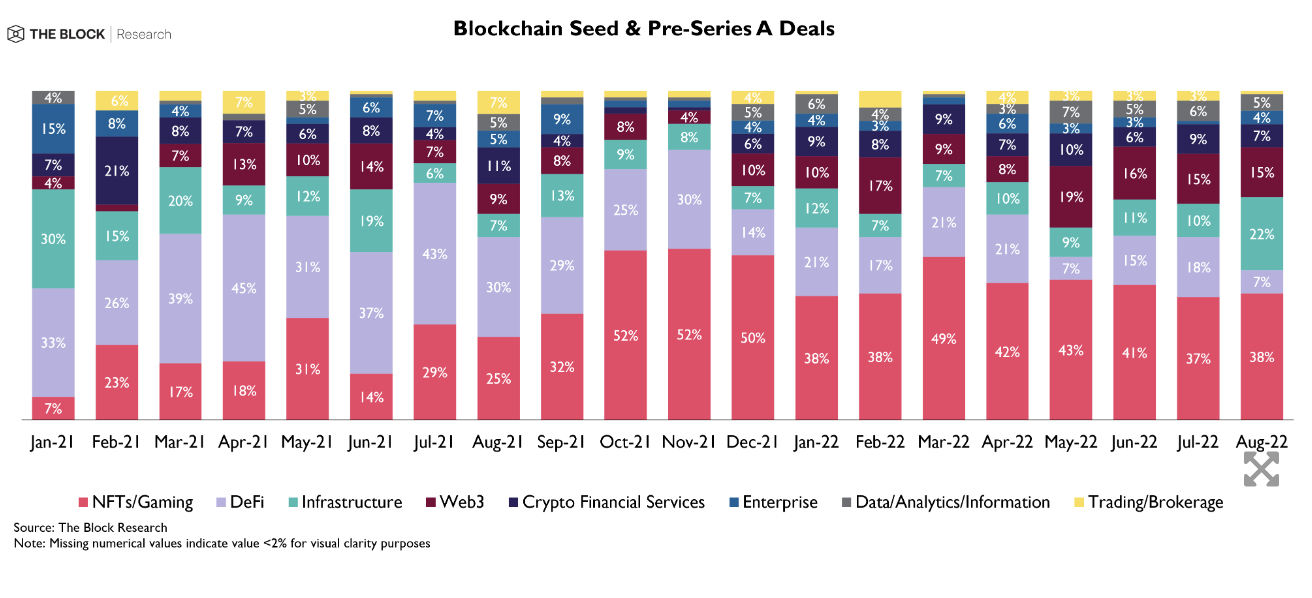
According to The Block Research, 22% of August’s blockchain seed and pre-Series A deals came from the infrastructure sub-sector — second only to NFTs and gaming. 

© 2022 The Block Crypto, Inc. All Rights Reserved. This article is provided for informational purposes only. It is not offered or intended to be used as legal, tax, investment, financial, or other advice.

Go to Source
Author: Tom Matsuda

MoonPay, Universal create an in-person NFT-based scavenger hunt with more than 6 million tokens 

The crypto payment platform MoonPay has helped its partner Universal Studios create an NFT-based scavenger hunt at its Universal Theme Parks. 

MoonPay will use its utility minting service Hypermint to create up to 7 million NFTs, which can be claimed at a Universal Theme Park in Orlando, Florida or Hollywood, California as part of the “Halloween Horror Nights” NFT scavenger hunt. 

“We’re really excited about this because this is a real world use case that we’ve been trying to demonstrate with people,” MoonPay CEO Ivan Soto-Wright told The Block. “We’re going beyond just the profile picture identity movement with NFTs to actual real world utility.”

Park guests won’t require advanced crypto knowledge — or even knowing how to set up a crypto wallet — to claim these NFTs. “It’s just basically a claim page where you put in your email address, and boom, what we do in the background is we mint that NFT, we spin up a wallet for that particular person and then they’re able to claim it when they’re ready,” Soto-Wright said. 

Seven types of NFTs can be found in both the Orlando and Hollywood Universal Parks. Those who collect all seven NFTs receive a “gold medal NFT,” which is “eventually going to do something” Soto-Wright said, without sharing additional details. 

MoonPay originally launched Hypermint in June of this year as a service that lets brands mint up to 100 million digital assets at once. In the case of the Halloween Horror Nights scavenger hunt, these NFTs will be used as proof of attendance protocols or POAPs, or digital tokens that prove someone attended an event such as The Ethereum Merge.  

Universal Pictures, the U.S. film studio behind Universal Theme Parks, was one of Hypermint’s launch partners, The Block previously reported. 

© 2022 The Block Crypto, Inc. All Rights Reserved. This article is provided for informational purposes only. It is not offered or intended to be used as legal, tax, investment, financial, or other advice.

Go to Source
Author: MK Manoylov

Court orders Brazil’s ‘bitcoin pharaoh’ to deposit $3.7 billion to pay back creditors: O Globo

A Rio de Janeiro federal court judge has ordered Brazil’s so-called “Bitcoin Pharaoh” Glaidson Acácio dos Santos to pay 19 billion Brazilian reais (nearly $3.7 billion) to a business court, with the aim of reimbursing investors and creditors that lost money in a Ponzi scheme his company allegedly participated in.

Dos Santos had 72 hours to deposit the funds after the September 19 decision, Brazilian newspaper O Globo and its sister outlet G1 first reported. 

The business owner has been ordered to deposit the funds to a business court, the reports said, which would eventually be passed on to the creditors and investors that did business with Dos Santos’ firm, G.A.S. Consultoria e Tecnologia. The debts would only be paid out to creditors if the company can prove their lawful origin, O Globo reported. 

Dos Santos, a former waiter, has been in jail on charges related to a pyramid scheme called Operation Kryptos. Brazil’s federal police said in August 2021 that it had seized 591 bitcoins (then worth nearly $28 million) as part of the operation, among other items like watches, jewelry and documents. 

More than 122,000 investors have registered on a G.A.S creditor website, O Globo reported, and they are seeking about $9 billion Brazilian reais so far. The news outlet also reported on September 15 that a federal regional court had newly granted habeas corpus to Dos Santos. 

Whether Dos Santos will pay the court-ordered amount remains unclear. 

Last week, a regional electoral court in Rio de Janeiro unanimously voted to block Dos Santos’ candidacy for a congressional deputy seat. 


© 2022 The Block Crypto, Inc. All Rights Reserved. This article is provided for informational purposes only. It is not offered or intended to be used as legal, tax, investment, financial, or other advice.

Go to Source
Author: Kristin Majcher

Analysis of Alameda Research’s $200mm Loan Repayment to Voyager Digital

Quick Take

  • Alameda to return ~$200mm of BTC and ETH to Voyager Digital 
  • Repayment must be completed by September 30, 2022 per filings
  • Failure to repay by 5:00 PM EST on September 30, 2022 will subject Alameda to daily penalty fees 
  • For additional coverage of Voyager Digital’s Chapter 11 proceedings[1][2][3]
  • Lender and debtor wallet addresses to remain redacted and confidential 
  • Disclaimer: This is a market commentary research piece and includes opinionated views from our research team. Nothing contained in this piece constitutes a solicitation, recommendation, endorsement, or offer by The Block Research

This research piece is available exclusively to
members of The Block Research.
You can continue reading
this Research content on The Block Research.

Go to Source
Author: Greg Lim

Crypto.com invests in web3 back-office platform Headquarters’ $5 million raise

Web3 back-office platform Headquarters has closed a $5 million round co-led by Crypto.com Capital, Forge Ventures and MassMutual Ventures. 

The pre-seed raise also includes backing from Saison Capital, 500 Startups and Longhash Ventures as well as prominent angel investors such as Nansen CEO Alex Svanevik, Race Capital’s Chris McCann and Etherscan founder Matthew Tan, according to a release today. 

Headquarters draws on the perspectives of angel investors and web3 funds who see a need for companies to better manage their working capital across custodial and non-custodial wallets, per the release. Headquarters aims to solve this problem and reduce human error in web3 bookkeeping. It’s starting with the launch of HQ Teams, a tool for web3 firms to manage their financial operations. 

“We built HQ Teams to make finance best practices less exhausting by taking out the tedious manual work,” Sharon Paul, Headquarters co-founder and CEO, said in the release. “Getting this right means teams can finally expect the same operational excellence for their internal financial workflows as they do with everything else in the sector.” 

Improving web3 financial operations

HQ Teams will provide a balance management tools to track funds across wallets and enable the labelling and filtering of transactions to ensure wallets are accounting ready, per the release. 

The new funds will be used to accelerate the development of the HQ Teams product. 

“The Headquarters team is building an essential service for any web3 company,” said Jon Russell, investment partner at Crypto.com Capital, in the release. “Say goodbye to the arduous task of manually transferring tokens and making payments. Instead, teams can now automate their treasury flow for day-to-day operations.” 

Before founding Headquarters, Paul was head of payments at Fazz.com, while her co-founder and chief technology officer Sunny Singh has led engineering teams at companies such as Traveloka and Grasshopper. 

“HQ’s founding team’s experience in traditional finance and web3 provides them with a deep understanding of the operational pain points the industry most needs to solve,” said Carlos Jo-Loo, principal at Mass Mutual Ventures, in the release.

© 2022 The Block Crypto, Inc. All Rights Reserved. This article is provided for informational purposes only. It is not offered or intended to be used as legal, tax, investment, financial, or other advice.

Go to Source
Author: Kari McMahon

Arbitrum announces 400 ETH bug bounty payout

Details emerged this morning of a vulnerability and bounty paid by Arbitrum. The patched exploit could have compromised more than $250 million.

The vulnerability was discovered by pseudonymous solidity bounty hunter “0xriptide.” It could have affected any user who attempted to bridge funds from Ethereum to Arbitrum Nitro, 0xriptide said.

Arbitrum has paid 0xriptide 400 ETH (about $520,000) as compensation for alerting it to the vulnerability.

0xriptide’s day-to-day is comprised of scouring ImmuneFi, a bug bounty platform that has prevented hacks of more than $20 billion. His primary focus lately has been centered on preventing cross-chain exploits, as they pose a sizably larger amount of funds at risk due to the “honeypot” structure of most bridge protocols, he said in the report.

His initial search for the Arbitrum exploit began a few weeks ago ahead of the Arbitrum Nitro upgrade. Upon his initial investigation, he found a vulnerability where the bridging contract was able to accept deposits, even though the contract was initialized previously.

0xriptide said,

“When you stumble upon an uninitialized address variable in Solidity — you should always take a moment to pause and investigate further because you never know if it was purposefully left uninitialized or by accident.

The bridge exploit 

After digging into the uninitialized address, 0xriptide found that a hacker would be able to set their own address as the bridge, mimicking the actual contract, and steal all the incoming ETH deposits from Etheruem to Arbitrum Nitro.

The hacker would have had the flexibility of either targeting larger ETH deposits in order to obscure the their actions, or begin a guerrilla-type of attack and siphon all the funds coming in.

The largest deposit during the period when the exploit could have occurred was roughly 168,000 ETH, or $250 million. The average deposits in any 24-hour time period when the vulnerability could have been exploited was anywhere from 1,000 to 5,000 ETH.

© 2022 The Block Crypto, Inc. All Rights Reserved. This article is provided for informational purposes only. It is not offered or intended to be used as legal, tax, investment, financial, or other advice.

Go to Source
Author: Mike Truppa

Draft stablecoin bill in Congress to require Fed, state regulator approval

Draft legislation to create a U.S. federal framework around stablecoins would temporarily ban the types of payment coins that are not backed by outside assets — similar to TerraUSD, an algorithmic stablecoin that collapsed earlier this year.

 Nonbank issuers of stablecoins backed by fiat currency would also be overseen by state banking regulators and the Federal Reserve, according to a source familiar with discussions and draft text obtained by The Block. 

Banks or credit unions could issue their own stablecoins, which would be overseen by the Office of the Comptroller of the Currency and the Federal Deposit Insurance Corp., both of which serve as federal bank regulators in the United States.

Issuing a stablecoin without approval from those regulators could be punishable by up to five years in prison and a $1 million fine.

The current draft bill, under negotiation between House Financial Services Committee Chair Maxine Waters (D-Calif.) and the committee’s top Republican, Rep. Patrick McHenry (R-N.C.), would create a two-year ban on stablecoins that aren’t fully backed by cash or highly liquid assets, like U.S. Treasury bonds. The bill would also create a two-year grace period for operators with coins that aren’t currently collateralized by those assets to change their business model and receive approval. 

The Federal Reserve would also be directed to study the economic impact of a U.S. digital dollar, a process the central bank has already begun.

Multiple sources familiar with talks, speaking on condition of anonymity due to the closed-door nature of discussions, said that McHenry had yet to sign off on the legislation. The draft is meant for negotiations and still subject to possible change. Spokespeople for Waters and McHenry did not immediately respond to requests for comment. 

Bloomberg News was first to report news of the proposed temporary ban on certain stablecoins. 

McHenry told a Washington audience earlier today that any stablecoin bill will be collaborative, rather than drafted by one side, and that a comprehensive bill around the technology is a top priority for him. McHenry, the ranking Republican on the Financial Services Committee, is up to take the chair’s gavel should control of the House of Representatives change after the November midterm elections. 

The bill would also allow U.S. federal banking regulators and state regulators to create their own set of standards for interoperability around stablecoins. The legislation aims to create asset and accounting standards similar to banks and credit unions. 

Under the bill’s current form, it would prohibit the comingling of customer funds and keys with the stablecoins and other assets of an issuer. In theory, this would allow customers to more easily recoup their money if a stablecoin issuer fails. 

© 2022 The Block Crypto, Inc. All Rights Reserved. This article is provided for informational purposes only. It is not offered or intended to be used as legal, tax, investment, financial, or other advice.

Go to Source
Author: Colin Wilhelm and Stephanie Murray

Wintermute CEO Gaevoy updates on hack, says firm will continue on-chain trading

Wintermute CEO Evengy Gaevoy provided updates on the $160 million Ethereum hack it suffered this morning and attributed it to “human error.”

Gaevoy in a Twitter thread explained the attack vector was associated with Wintermute’s Ethereum vault that it used for on-chain decentralized finance (DeFi) trading operations, emphasizing this wallet is separate from its centralized finance (CeFi) and Over the Counter (OTC) operations.

Providing more color, none of Wintermute’s CeFi or OTC wallets were affected or compromised, and neither has any of its internal or counterparty data, he said.

The attack was most likely caused by a “Profanity-type exploit” on Wintermute’s DeFi vault, Gaevoy added. Profanity, which it used for the key generation on the compromised wallet address, was exploited last week, according to a post published by 1inch contributors.

The hack Wintermute suffered was due to an “internal (human) error,” Gaevoy wrote, following its discovery of the Profanity exploit. Even after suffering its financial loss, Gaevoy said Wintermute will not be laying off any employees, changing any strategies, fundraising additional capital or stopping its DeFi operations.

When Wintermute initially set up its DeFi vault, it utilized Profanity, an open-source tool for generating multiple addresses, and an internal tool to generate an address with multiple zeroes in the front.

Gaevoy said their reasoning behind this was for “gas optimization, not vanity,” where vanity addresses have admin privileges and a prefix “0x0000000.” This prefix, as security analysts have hypothesized since the announcement of the exploit, could be taken advantage of by hackers when they can calculate the private key.

Wintermute in June began moving away from this type of set up, switching to a more secure key-generation script.

During the expedited process of “retiring” the old key, Wintermute moved all its ETH from the compromised vanity address wallet. Although they were able to move the ETH prior to the hack, it “failed to remove this address’s ability to sign for and do other things,” Berkeley ICSI staff researcher Nicholas Weaver tweeted.

Gaevoy ended his thread by acknowledging the fact that operating on-chain trading comes with its inherent risks that Wintermute was well aware of, mainly no safeguards such as 2FA protected key generation or the ability to use multisigs due to the nature of high frequency trading (HFT).

© 2022 The Block Crypto, Inc. All Rights Reserved. This article is provided for informational purposes only. It is not offered or intended to be used as legal, tax, investment, financial, or other advice.

Go to Source
Author: Mike Truppa

Binance and FTX lead Voyager auction: WSJ

Crypto exchanges FTX and Binance are leading the auction for embattled crypto-lender Voyager, according to a new report from the Wall Street Journal.

The auction for Voyager began last week in the law offices of Kirkland & Ellis, though a bid has yet to be accepted six days on. According to today’s report, Binance bid approximately $50 million for the platform’s assets. That’s a slightly higher bid than FTX, according to the WSJ’s sources. 

Lawyers in the bankruptcy process have yet to give an update on the bidding process, disclosing only that it remains ongoing. Bidders may submit a variety of types of proposals, from a simple purchase of Voyager’s assets to an attempted restructuring and resuscitation of the firm.

Voyager has not broadly disclosed its ideal proposal, though it did push back when FTX publicized its plan to provide early liquidity to customers, saying the exchange failed to respect the confidentiality stipulations of the bidding process. At the time, counsel called it a low-ball bid and sought to dispel the notion that FTX was a frontrunner for the platform. 

Meanwhile, reports have circulated that Binance is facing some opposition over its bid due to concerns that the U.S. government might take issue with its attempt to purchase the platform. 

The auction winner is slated for announcement at a Sept. 29 hearing.

© 2022 The Block Crypto, Inc. All Rights Reserved. This article is provided for informational purposes only. It is not offered or intended to be used as legal, tax, investment, financial, or other advice.

Go to Source
Author: Aislinn Keely

Senior Republican: Stablecoins bill will have multiple authors

Rep. Patrick McHenry (R-N.C.) managed expectations on future stablecoins legislation by telling an audience in Washington that whatever becomes law will need ownership from multiple policymakers, even if control of the House of Representatives flips and McHenry becomes chair of the House Financial Services Committee. 

“Whether it goes down now or later, we’re still going to have to deal with the Senate. We’re still going to have to deal with a Democrat White House most likely,” McHenry said. “Let’s admit reality and understand we cannot get perfection.”

But the fintech-friendly congressman said that he believes legislation creating established rules for stablecoins should be a top priority, no matter who gets credit. The North Carolina Republican and the current chair of the House committee governing financial regulations, Rep. Maxine Waters (D-Calif.), have negotiated a stablecoins bill for months, though McHenry cast doubt as to whether it would happen this year. 

“Whether or not it happens this Congress or next Congress, it doesn’t matter to me,” McHenry said. “Whether it’s Chairwoman Waters or Chairman McHenry who gets to take credit for it, I don’t think anybody cares,” as long as it gets done, he added. 

The Financial Stability Oversight Council, a group of federal regulators formed after the 2008 financial crisis to monitor systemic risks the U.S. financial sector, will meet on Friday to discuss “regulatory gaps” around cryptocurrencies, the subject of the final report in a series on digital assets from the Biden administration.

Last year the group was especially concerned over stablecoins, echoing warnings made by the president’s working group on the payments tokens that they were susceptible to withdrawals that might exceed the assets of issuers, a scenario that played out for multiple companies this past spring. 

© 2022 The Block Crypto, Inc. All Rights Reserved. This article is provided for informational purposes only. It is not offered or intended to be used as legal, tax, investment, financial, or other advice.

Go to Source
Author: Stephanie Murray


Follow by Email
Facebook20
Pinterest20
fb-share-icon
LinkedIn20
Share