FreeCryptoCurrency.Me

Free stocks and money too!

Category Archive : Crypto News

U.S. Federal Reserve hikes interest rates by 75 basis points

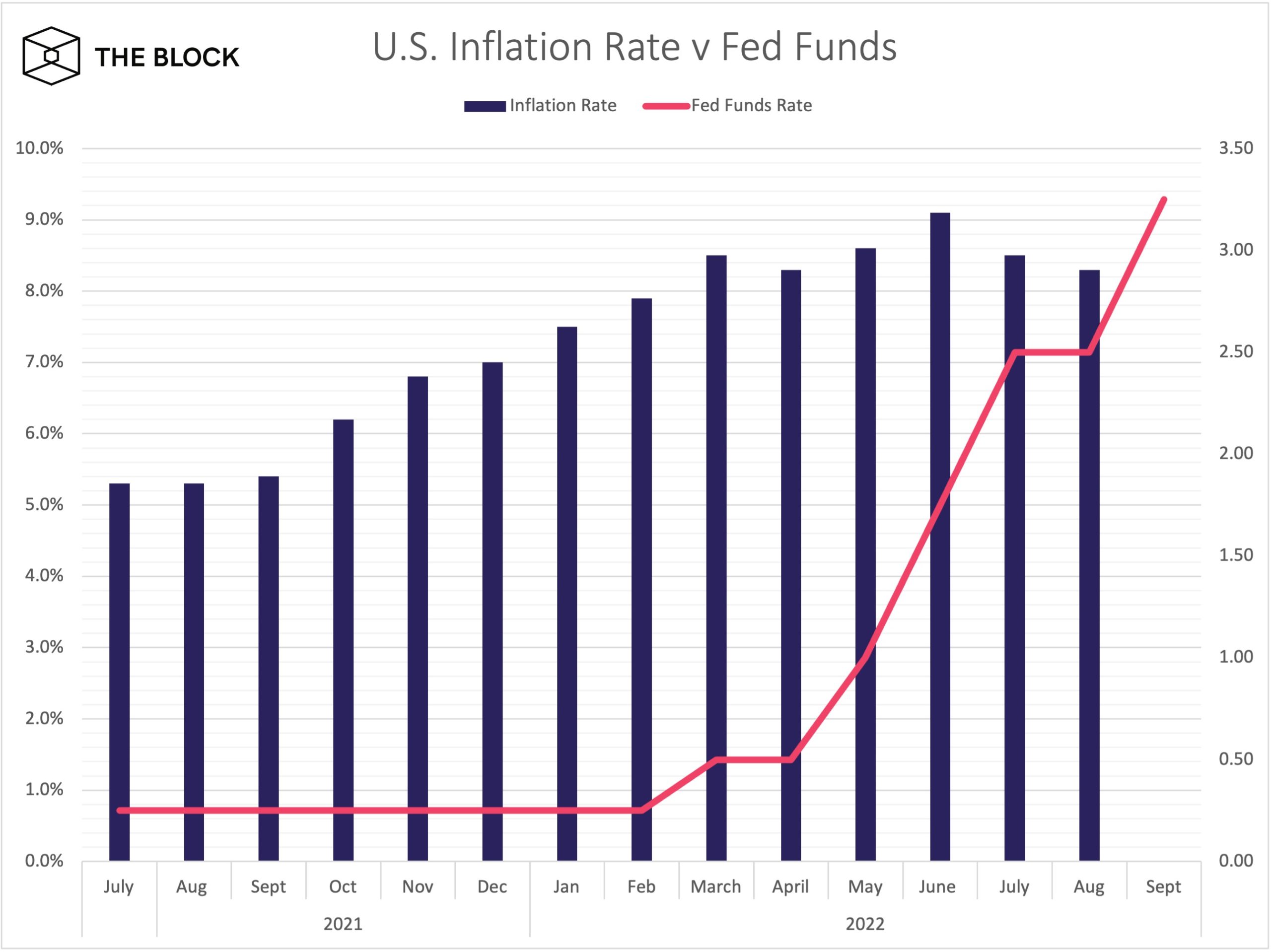
The US Federal Reserve has raised the US federal funds rate by 75 basis points and marking a 15-year high.

Wednesday’s decision was largely expected, with the market pricing in a rise of 75 basis points ahead of time.

“The Committee seeks to achieve maximum employment and inflation at the rate of 2 percent over the longer run. In support of these goals, the Committee decided to raise the target range for the federal funds rate to 3 to 3-1/4 percent and anticipates that ongoing increases in the target range will be appropriate,” the Fed said.

The move is intended to fight inflation which remains hot, having risen 0.1% month-on-month from July to August and 8.3% year-on-year in August. Jerome Powell said in August that today’s decision would depend on the “totality of the incoming data and the evolving outlook.”
The price of bitcoin gyrated around $19,000 on the news, having traded close to $19,500 prior to the announcement.

At the time of writing, bitcoin is trading hands at about $18,900 according to TradingView data. 

What now for crypto?

With crypto prices stuck in the doldrums and without any major events on the calendar following last week’s Merge, it’s unclear what could boost prices in the near term.

Speaking to The Block ahead of the announcement, James Malcolm, head of FX strategy at UBS, spoke to this point.

“Now the Merge is over and activity in the space has sagged back it’s difficult to envisage a new catalyst for crypto beyond a simple recovery in risk asset,” he said. Malcolm went on to say that a slightly more dovish Fed would be an example of such a catalyst, however, the threat of tighter regulation should weigh on crypto going forward. 

Malcolm went on to say there is a disconnect between crypto advocates and potential adopters that is “seemingly impossible bridge.” Notably, he said advocates need to “amend their message and recognize setbacks and address remaining hurdles, rather than just keep reiterating how they think this is the next best innovation since the internet.”

Finally, traditional asset managers have specific needs and constraints according to Malcolm, and longstanding legal and regulatory hurdles can’t be brushed aside by increasingly tired hype.

“Crypto service providers still refuse to meet them where they are, metaphorically speaking, and address their specific concerns. And infrastructure-wise, what the space calls an ‘institutional grade offering’ is quite different from what we understand that to be, in terms of prime brokerage services, liquidity provision, and so on,” he concluded. 

Michael Brown, head of market insights at Caxton, told The Block that more aggressive action from the Fed — primarily via hawkish messaging through a steep upward revision to the dot plot this year and next — will be bearish for risk assets in general, including crypto.

“With the Fed funds rate set to rise to a 15-year high, the era of cheap money is certainly at an end, and with downside economic risks mounting, the outlook remains poor for crypto in general,” he said. 

Conversely crypto investment firm QCP Capital said in its Wednesday market report that it expected a 75 basis point increase, with a downshift to 50 basis points in the next meeting. The firm went on to say this could be enough to drive a relief rally in markets. 

source: QCP Capital

“Every FOMC meeting this year has preceded an uptick in markets, per the below chart QCP shared in its update. How long this rally lasts is another question though,” the QCP team wrote.

© 2022 The Block Crypto, Inc. All Rights Reserved. This article is provided for informational purposes only. It is not offered or intended to be used as legal, tax, investment, financial, or other advice.

Go to Source
Author: Adam Morgan McCarthy

A sign of the times: Bitmain slashes price of flagship S19 mining rig

Bitcoin hardware manufacturer Bitmain on Tuesday announced a discounted price for one of its more popular models, the S19 Pro, reflecting an industry-wide decline in the cost of bitcoin mining rigs. 

The company is now selling those machines at $19 per terahash per second (TH/s), reflecting the trend of declining ASIC machine prices, which have fallen more than 60% in the past six months, according to Bitcoin mining pool Luxor’s index data dashboard.

“Prepare during the bear market, prosper during the bull market,” Bitmain said in the announcement.

One company that has recently been scooping up ASICs at discounted prices, CleanSpark, announced a bulk order of 10,000 S19j Pro machines at a rate of roughly $28 per TH/s — stating also that that same model was sold at Bitmain’s website for as much as $116 per TH/s. This would indicate a 75.9% decrease since the beginning of the year.

Bitmain also said that customers that bought S19 Pro machines with scheduled deliveries in the third and fourth quarters of this year would be eligible for discount coupons.

A couple of other models are also included in this deal, namely S19 Pro Hyd and S19 Pro+ Hyd. Details of the coupon offer are laid out here.

© 2022 The Block Crypto, Inc. All Rights Reserved. This article is provided for informational purposes only. It is not offered or intended to be used as legal, tax, investment, financial, or other advice.

Go to Source
Author: Catarina Moura

Big bank CEOs don’t plan to finance crypto mining

Some of the largest banks in the United States do not have plans to finance crypto mining, CEOs said during a congressional hearing on Wednesday.

Chief executive officers of major banks including Citigroup and Bank of America appeared on Wednesday before the House Financial Services Committee. During the hearing, Rep. Brad Sherman (D-Calif.) asked three CEOs whether they intend to finance crypto mining,

“Are you going to finance crypto mining, which creates electricity that is then wasted in something that doesn’t keep anybody’s lights on, doesn’t cook anybody’s food,” Sherman, an outspoken critic of digital assets, asked. Cryptocurrency mining has faced sharp criticism from environmental advocates who say the technology uses too much energy. 

Citigroup CEO Jane Fraser said she does “not believe” her bank will finance crypto mining. Similarly, Bank of America Chair and CEO Brian Moynihan said “we do not have any” plans to do so. Wells Fargo & Company President and CEO Charles Scharf said he was “not aware of anything” on the topic. 

Sherman, who chairs the Subcommittee on Investor Protection, Entrepreneurship, and Capital Markets, has urged regulators to increase investigations into digital asset exchanges and suggested he is open to an outright ban on cryptocurrencies. 

© 2022 The Block Crypto, Inc. All Rights Reserved. This article is provided for informational purposes only. It is not offered or intended to be used as legal, tax, investment, financial, or other advice.

Go to Source
Author: Stephanie Murray

Layer 2 solution Boba Network integrates with Avalanche

Boba Network, a multi-chain Layer 2 scaling project, has expanded to Avalanche.

Boba will help meet scalability demands for Avalanche, a Layer 1 blockchain that presents itself as a faster Ethereum. Boba is Avalanche’s first Layer 2, according to a Wednesday announcement from Avalanche’s core contributor Ava Labs.

It will be available to help scale dApps built on C-Chain — Avalanche’s main smart contract platform that offers compatibility with the Ethereum Virtual Machine and hosts over several decentralized applications (dApps).

Boba is an Optimistic rollup that reduces gas fees and improves transaction throughput for blockchains. While Boba was originally launched on Ethereum last year, it first went multi-chain in June of this year by simultaneously integrating with Fantom and Moonbeam blockchains.

Besides its Optimism-based scaling solution, the Boba Network team plans to give Avalanche developers access to its offering called Hybrid Compute. This is a cloud environment using which blockchain applications can interact with data from web2 apps such as social media platforms.

“By deploying to additional chains, Boba breaks fresh ground and brings Avalanche its very first L2, equipping our talented developers with yet another way to make dApps cheap, fast, and scalable will only benefit users,” Luigi D’Onorio DeMeo, head of decentralized finance at Avalanche’s core development firm Ava Labs, said of Boba’s integration. “We’re excited to see how this integration evolves and where the story of Avalanche L2s leads.”

The Avalanche integration will see EvoVerses, a 3D play-to-earn strategy game, go live on Avalanche’s Boba implementation as a launch partner dApp.

SushiSwap, one of the largest decentralized exchanges, is also deploying on the Boba Network layer 2 on Avalanche.

© 2022 The Block Crypto, Inc. All Rights Reserved. This article is provided for informational purposes only. It is not offered or intended to be used as legal, tax, investment, financial, or other advice.

Go to Source
Author: Vishal Chawla

Stablecoin restriction dropped from E.U. digital asset framework

European Union officials have taken the next step in crafting a comprehensive framework to govern digital assets, with a major win for stablecoin advocates included in the latest version.

A new draft of the markets in crypto-assets (MiCA) regulation, expected to be the final version of the rulemaking, obtained by The Block shows that limitations on the use of U.S. dollar-pegged tokens within the E.U. have been removed.

Digital asset industry lobbyists were concerned over the language, arguing that it could cause unintended consequences for the trading of cryptocurrencies in Europe.

Once final, the rulemaking will place binding guardrails on the digital asset industry in Europe. Per E.U. procedure the document must be translated into member country languages. Provisions for stablecoins are expected to come into force in January 2024, and the rest of the provisions in June 2024.

 “It is now clear that transactions for trading are not to be counted to reach those thresholds,” said Tommasso Astazi, head of regulatory affairs at the Blockchain for Europe lobbying group. “It could have been a real problem for the whole trading market for cryptocurrencies in Europe.”

The legislation focuses more on stablecoins and other digital asset trading, but leaves the door open for further rulemaking on decentralized finance (DeFi) and non-fungible tokens (NFTs) by the European Banking Authority and other financial regulators.          

The rulemaking is the result of official “trilogue” discussions between the European Parliament, European Commission and European Council, which concluded on June 30. Unusually, parts of the text were intentionally left open for further discussion despite receiving initial tri-institutional approval.

European officials began the rulemaking process in response to the Facebook-supported Libra digital currency initiative, which has since stalled, though other stablecoins have since proliferated.

© 2022 The Block Crypto, Inc. All Rights Reserved. This article is provided for informational purposes only. It is not offered or intended to be used as legal, tax, investment, financial, or other advice.

Go to Source
Author: Inbar Preiss

Amber to remain ‘prudent’ in crypto winter even as revenue climbs, Huang says

Amber Group will remain “prudent” during crypto winter even as the crypto trading firm’s revenue climbed by 25% in the first half of the year. 

“We’ve seen, unfortunately, a number of firms haven’t managed their liquidity well, or their counterparty exposure well and are no longer with us,” Annabelle Huang, Amber’s head of business development, said in an interview on Wednesday. “We are able to continue to outperform because we have built that risk management and continue to iterate on this since day one.” 

“That continues to be our bread and butter and our core competencies to continue to weather through market cycles like this,” she added. 

The fim, which has more than $5 billion in assets, announced its financial results for the first half of the year today, with revenue hitting $250 million, a 25% increase on the prior year. 

The unaudited results didn’t include profit and loss figures. However, Huang said the firm is profitable and said the company is working with a Big Four accounting firm to get its financial statements audited “hopefully as soon as possible.” 

Founded in 2017, Amber Group provides a wide range of services to institutional clients from trading and liquidity services to yield products and recently branched into the consumer segment with its wealth management platform WhaleFin. It’s turned over $1 trillion in volumes since inception, according to the company’s website. 

Revenue drivers

A key driver of revenue success this year was WhaleFin and WhaleFin Club, according to a statement from Amber that accompanied the half-year results. WhaleFin Club is a private wealth management service, which has a minimum threshold of $5 million in assets to become a member and provides access to Amber’s services team alongside the WhaleFin platform.

“We’re fortunate in that sense that we have expanded space and captured more market share during the bull run, and then we’re able to continue to maintain that base,” Huang said. 

 For the first half of the year, the firm has also homed in on security and compliance. It currently holds 12 regulatory licenses globally and is building out a comprehensive global insurance plan that aggregates over a $100 million in coverage, according to the release. 

Eyeing acquisitions

Amber is well capitalized after securing an infusion of cash from closing a Series B investment round earlier this year. The firm raised $200 million and is currently valued at $3 billion. The Block reported in May that Amber is seeking further funding, which would place the company’s valuation between $5 billion and $8 billion. 

Some of the capital from the Series B raise could go towards strategic opportunities in core markets and business areas, Huang said. Already this year, Amber Group has acquired Japanese exchange Decurrent as well as financial group Celera Markets. 

Huang said these sorts of acquisitions are likely to continue. 

“If anything, right now might be a better market timing because there are a lot of distressed opportunities out there,” she added.

A prudent approach

While the company has been cashflow positive since day one, Amber still wants to remain “prudent” with short-term goals, Huang said. This means staying focused on core markets like the Asia Pacific region and homing on the core businesses that provide value to institutional and high net worth clients. 

Some of this prudence was on display earlier this month when Bloomberg reported that the firm was cutting between 5% to 10% of headcount. Huang explained that these cuts are part of the company’s standard quarterly business planning. 

“We wanted to stay prudent and refocus on the on the key areas in the core businesses,” Huang said. “So that unfortunately means making some difficult decisions and we have done that.” 

“We’re in a better position now to continue to build what we think could be the short term to long term prospects,” she added. 

© 2022 The Block Crypto, Inc. All Rights Reserved. This article is provided for informational purposes only. It is not offered or intended to be used as legal, tax, investment, financial, or other advice.

Go to Source
Author: Kari McMahon

Brevan Howard leads $35 million round for crypto analytics platform Messari

Crypto data and analytics company Messari has raised a $35 million Series B funding round led by Brevan Howard Digital.

Other new investors include FTX Ventures, Morgan Creek Digital and Samsung Next, among others. Existing investors like Point72 Ventures — which led Messari’s $21 million Series A in August 2021 — also took part, according to a statement

The Block previously reported that Messari was raising a funding round at a $300 million valuation. At the time, a source told The Block that the projected raise amount was $35 million. 

The new funds will be used to fund product development and to expand its team, according to Messari. 

“We’re excited to welcome a remarkable group of investors as partners in our next phase of growth,” Messari co-founder and CEO Ryan Selkis said in a statement. 

© 2022 The Block Crypto, Inc. All Rights Reserved. This article is provided for informational purposes only. It is not offered or intended to be used as legal, tax, investment, financial, or other advice.

Go to Source
Author: Michael McSweeney

NFT gaming studio Vulcan Forge raises $8 million in Series A round

The NFT-based gaming firm Vulcan Forged raised $8 million in a Series A funding round.

The round was led by the crypto exchange giant FTX and investment firm SkyBridge Capital, according to a company release. Both companies have the option to invest an additional $33 million in Vulcan Forged. 

Vulcan Forged will use the fresh funding to build out its multiplayer online game VulcanVerse, expand its offering beyond its current 13 NFT gaming platforms and continue growing its team of 130 individuals. After two years, the firm has 200,000 regular players and built 15 games. 

SkyBridge announced its interest in funding web3 startups in July of this year via a new investment fund, maintaining the firm’s vision to be the vanguard of decentralized finance. 

However, SkyBridge’s interests are FTX’s interests, as FTX’s investment arm FTX Ventures took a 30% stake in SkyBridge Capital earlier this September.

Venture interest in blockchain-based gaming remains high — even seeing a 66% jump in month-over-month funding from July and August, The Block previously reported. 

© 2022 The Block Crypto, Inc. All Rights Reserved. This article is provided for informational purposes only. It is not offered or intended to be used as legal, tax, investment, financial, or other advice.

Go to Source
Author: MK Manoylov

EOS Antelope Protocol update severs network’s ties to Block.one and Bullish

The EOS Network Foundation (ENF) today announced the release of the Antelope Leap 3.1 consensus update.

“With the hardfork now activated, we will continue iterating with the community to optimize the user and developer experiences to best leverage the new features and functionality that Leap 3.1 enables,” ENF CEO Yves La Rose told The Block.

Details on the foundation’s decision to move away from an EOS codebase managed by Block.one were provided to The Block during an interview with ENF director of communications Zack Gall.

The changeover to Antelope Leap 3.1 will see EOS block producers who operate the public network formally adopt code solely developed under the helm of the ENF. Formerly, the code for the EOSIO public network was maintained by Block.one, later acquired by digital asset exchange Bullish.

The non-backward-compatible fork will prompt node operators to update systems or fall out of sync with the network.

A developmental effort led by EOS community engineers and spearheaded by the ENF, the Antelope protocol is a new codebase comprising updated code forked from the EOSIO 2.0 repository.

The update reintroduces backported elements as well as several new features such as transaction lifecycle improvements, upgraded crypto primitives that power EVM-related cryptography functions, and others, according to the announcement.

Background on the fork

Gall offered perspective on the events leading up to the EOS public blockchain’s transition away from reliance on code maintained by Block.one.

“It was undeniable that Block.one was pivoting away from EOSIO,” said Gall, who pointed out that the community was signaled by events such as the resignation of Dan Larimer, the company’s loss of core engineers, a short-lived EOSIO for Business campaign, and the switch of any remaining engineers from EOSIO to Bullish related development.

In August 2021, the ENF was formed. The group was spearheaded by La Rose, existing EOS members, and block producers. The foundation found a leader in La Rose, who formerly ran the EOS Nation block producer and played a significant role in rallying the EOS community.

The ENF took action on December 8th, 2021, days after Block.one announced that it had given or sold Helios, a foundation set up by Block.one co-founder Brock Pierce, 45 million EOS tokens, of which 37 million remained unvested. The foundation formed a supermajority among block producers running the EOS public blockchain, who opted to change a single line of the network’s code and halt ongoing fund transfers to Block.one.

“The line in the sand was drawn. The tokens that hadn’t been vested yet, over the 10-year schedule, those belonged to the network,” said Gall.

A hiring spree

Before building out its own team, the ENF attempted a partnership with Larimer to fork the EOSIO code base — but the goals of the foundation, EOS token holders, and the developer would soon fall out of alignment, according to Gall.

In January 2022 the foundation went on a “hiring spree,” picking up former Block.one and Bullish team members such as current ENF COO Ted Cahall, ENF CMO Patty Fisher, ENF Principal Engineer Bucky Kittinger, and ENF Director of Engineering Areg Harapetain.

“We basically poached all the best engineering talent because they were working on an exchange product that they had no interest in building, they wanted to build the underlying technology for web3, they wanted to build EOS essentially, so we gave them an opportunity,” said Gall.

In addition to building out its own development team, ENF formed a partnership with OCI, a development studio-for-hire that had previously worked with Block.one in order to rapidly scale engineering efforts and deliver system updates like the Antelope code fork.

Cutting ties and looking ahead

In what he described as the cutting of the final ties to Block.one, Gall said the updates will mean that the code behind EOS will now be community driven, closing a chapter on what he called a complicated history.

By adopting a community-led codebase, the network is aligning incentives across EOS stakeholders, La Rose told The Block. “No longer is the network reliant on a corporate entity for survival.”

La Rose said ENF developers will put efforts toward upcoming features for Antelope protocol, including upgraded crypto primitives and encryption libraries to improve EOS EVM performance and lay the groundwork for the integration privacy enabling zero-knowledge proofs (zk-Snarks).

“Another exciting new feature coming soon is Antelope inter-blockchain communication (IBC) which is currently running on testnets with plans to deploy it into production in Q4,” said La Rose.

© 2022 The Block Crypto, Inc. All Rights Reserved. This article is provided for informational purposes only. It is not offered or intended to be used as legal, tax, investment, financial, or other advice.

Go to Source
Author: Jeremy Nation

Coinbase Cloud to lure developers with ‘free’ infrastructure platform called Node

Blockchain infrastructure firm Coinbase Cloud has launched Node, a revamp of its previous Query & Transact (QT) platform that offers a node service accessible free of cost to developers.

Founded in 2020, the platform has serviced enterprise customers dedicated blockchain nodes that are managed on Coinbase Cloud. The platform is currently used by blockchain companies such as CoinList, Chainalysis, and Crypto.com.

Now the platform has been rebranded to Node to let both open source and enterprise developers build and monitor their applications from a single platform, with up to 120,000 free daily blockchain queries.

With the Node application programming interface (API), web3 developers will be able to delegate the underlying cloud infrastructure to Coinbase Cloud and also run data queries needed for decentralized apps. These queries provide comprehensive data for balances, transfers, and smart contract events on multiple blockchains.

“Node will offer free and enterprise options for its customers. With the free option, developers will get 120,000 daily requests – enough to get them started and scale to thousands of users. As they look to scale their apps further, they can opt-in to a monthly fee-based enterprise plan,” Luv Kothari, group product manager for Node at Coinbase Cloud, told The Block.

As part of the Node offering, Coinbase Cloud has added new features not present in QT. These include new “advanced APIs” which the team claims will simplify querying various blockchains. These advanced APIs abstract away the complexities of building on the blockchain so developers get aggregated and filtered data in one API call. The product also features another application programming interface to query NFT data.

The objective of Node will be to enable developers to focus on their products and customers, leaving blockchain infrastructure requirements to Coinbase Cloud, per the team.

Coinbase Cloud positions Node against similar API offerings from Alchemy and Infura, which are its closest competitors in the blockchain infrastructure space.

“Each of the different blockchain infrastructure providers take a unique approach to building developer tools,” Kothari said. “Coinbase Cloud is focused on building a robust enterprise-grade self-service developer platform. We’re building products to simplify blockchain development through features like Advanced and NFT APIs.”

© 2022 The Block Crypto, Inc. All Rights Reserved. This article is provided for informational purposes only. It is not offered or intended to be used as legal, tax, investment, financial, or other advice.

Go to Source
Author: Vishal Chawla


Follow by Email
Facebook20
Pinterest20
fb-share-icon
LinkedIn20
Share