FreeCryptoCurrency.Me

Free stocks and money too!

Category Archive : Crypto News

Bain Crypto leads $6.5 million round for MEV infrastructure provider Skip

Miner Extractable Value infrastructure provider Skip Protocol has raised $6.5 million in a seed round led by Bain Capital Crypto. 

Galaxy Digital, Robot Ventures and Jump Crypto are also among the investors also participating in the round, according to a company release on Thursday. 

Miner Extractable Value (MEV) is a strategy where miners and validators have found ways to profit from including, excluding or ordering transactions within blocks to be validated. Pending transactions are held in a public area called a “mempool” before being selected for within the block. 

Founded in 2022 by Barry Plunkett and Maghnus Mareneck, Skip aims to democratize access to MEV opportunities and profits on the Cosmos blockchain ecosystem and other emerging proof-of-stake ecosystems, according to the release. 

Cosmos is a Layer 1 blockchain on which apps and services are connected by the inter-blockchain communication protocol (IBC). 

“The presence of toxic forms of MEV, including spam and latency wars, have capped the financial upside and harmed the user experience of those who build on and invest in them,” said Plunkett, Skip’s co-CEO. “Skip’s goal is to give chains and their communities a toolkit that allows them to decide how MEV is extracted and where profits accrue.” 

How does Skip protocol work?

Skip’s technology enables users and traders to pay for transaction prioritization and privacy in sealed-bid auctions, according to the release. It is designed to make it easier for traders to execute their strategies while sharing MEV profits among validators, stakers and protocols.  

“The Cosmos ecosystem is currently exploring a new portion of the design space of decentralized protocols via application-specific blockchains — and Skip is greatly expanding the value and type of MEV in the marketplace,” said Tarun Chitra, managing partner at Robot Ventures, in the release.  

“The Skip team has a very unique background that combines academic mechanism design research and practical software engineering that allows them to improve the efficiency of the Cosmos ecosystem in the same way that MEV auctions improved Ethereum,” he added. 

In May, Skip finished in first place at Jump Crypto/Terra hackerhouse event, per the release. 

The average deal size for blockchain projects at the seed level has declined for four straight months through July, before rebounding in August, according to funding data from The Block Research. 
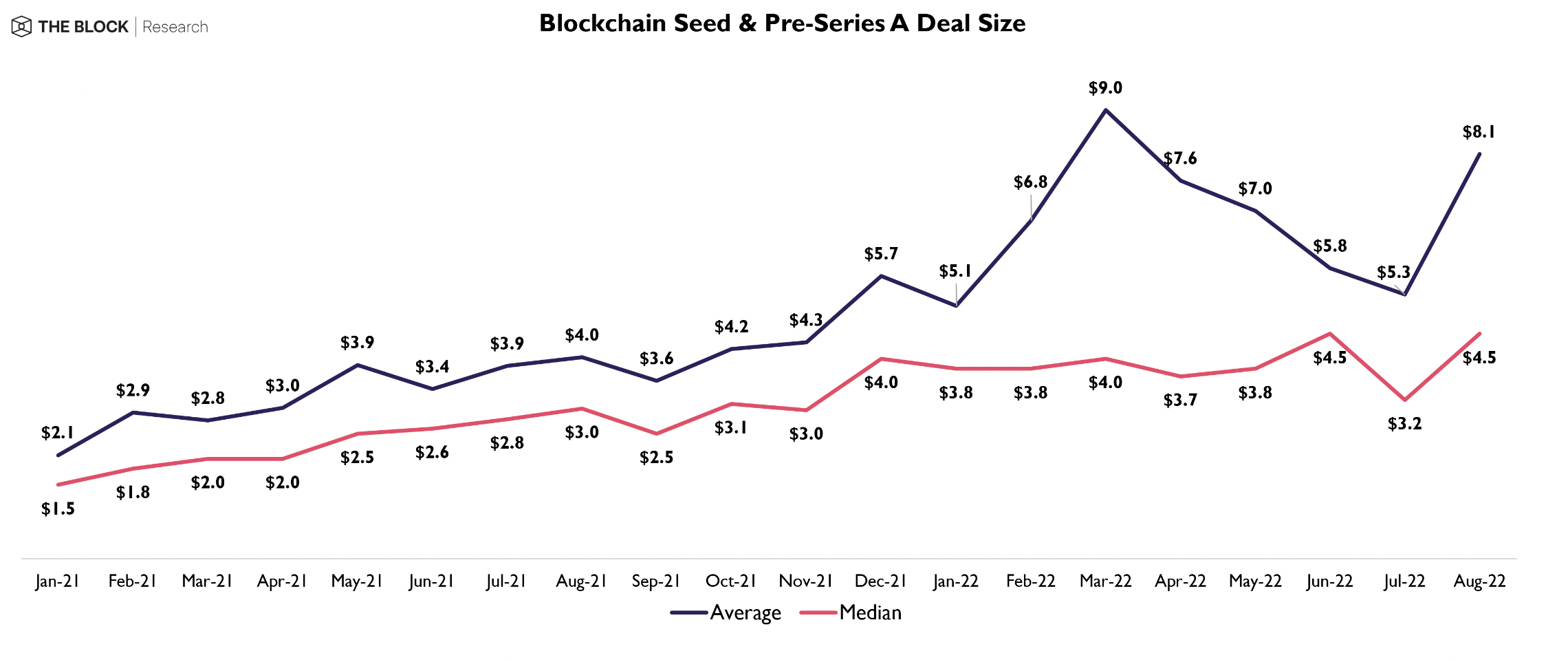
Blockchain seed and pre-Series A deal size

Blockchain seed and pre-Series A deal size

© 2022 The Block Crypto, Inc. All Rights Reserved. This article is provided for informational purposes only. It is not offered or intended to be used as legal, tax, investment, financial, or other advice.

Go to Source
Author: Kari McMahon

Klarna announces fresh round of lay offs, less than a month after CEO said cuts were done

Klarna, a Swedish fintech offering credit to people shopping online, has announced a fresh round of job cuts just weeks after its CEO had said cost cutting via job losses was over. 

The buy-now, pay-later (BNPL) pioneer revealed plans to cut more staff on Monday, local Swedish outlet SvD first reported. The cuts were announced by chief operating and expansion officer, Camilla Giesecke, in a video broadcast on Monday afternoon — which was later circulated on the company’s intranet. 

Per a statement shared with The Block a company spokesperson said that following appointment of a new COO in the summer it is “natural that a new manager makes changes, which is what is happening now.” The statement also noted the latest “adjustments” were smaller than the changes made in May, which it attributed to “the turbulent environment.”

In May, the firm laid off around 700 staff, about 10% of its workforce at the time. CEO Sebastian Siemiatkowski recently told Bloomberg the firm was finished with cuts.

The latests cuts are set to affect around 100 employees globally, a spokesperson told The Block. 

Once Europe’s most valuable fintech, Klarna’s valuation plunged 85% from about $45 million in 2021 to $6.7 billion in July when it announced it had raised $800 million in common equity. The firm’s investors include the likes of Sequoia, Silver Lake and Commonwealth Bank of Australia, as well as the Emirati state-owned Mubadala Investment Company. 

© 2022 The Block Crypto, Inc. All Rights Reserved. This article is provided for informational purposes only. It is not offered or intended to be used as legal, tax, investment, financial, or other advice.

Go to Source
Author: Adam Morgan McCarthy

Binance sets up a new global advisory board to navigate regulation

The crypto exchange giant Binance is bringing together a collection of former government officials and financial experts to create a new global advisory board.

The board of 10 is led by former U.S. Senator Max Baucus, who joined Binance last year. Members include Bruno Bezard, former head of the French Treasury and former economic advisor to the prime minister; Henrique de Campos Meirelles, a Brazilian former minister of the economy; and former European Commissioner David Wright.

“This collaboration highlights our commitment to compliance, transparency and ensuring a collaborative, trusting relationship with the world’s regulators,” Changpeng Zhao, Binance’s founder and CEO, wrote in a tweet on Thursday to announce the new board.

An advisory board with a focus on navigating the regulatory landscape is a culmination of a trend for Binance, which has actively hired former institutional officials in the past two years. 2021 saw the firm hire multiple former U.S. Internal Revenue Service agents, as well as a former British regulator and a Financial Industry Regulatory Authority regulator.

Fully embracing regulation is a shift for Binance, which previously was slower to adjust to regulatory measures. Reports suggest that Zhao ignored concerns from his employees in 2018 about the need to comply with anti-money laundering and know-your-customer regulations and lacked transparency in communicating with regulators.

© 2022 The Block Crypto, Inc. All Rights Reserved. This article is provided for informational purposes only. It is not offered or intended to be used as legal, tax, investment, financial, or other advice.

Go to Source
Author: Inbar Preiss

Coinbase tested an internal crypto trading desk last year: WSJ

U.S. cryptocurrency exchange Coinbase started setting up an internal crypto trading desk last year despite previous assurances to Congress that it was not running a proprietary trading business, the Wall Street Journal reported today.

Coinbase created an internal business unit for crypto trading and staking in July 2021, according to the WSJ. The report, which cites unnamed internal sources, says the firm hired senior Wall Street traders to helm the effort to invest the company’s own funds in crypto trading activities.

Proprietary trading by exchanges is frowned upon by regulators as it can constitute a conflict of interest. Internal trading desks can lead to exchanges trading against their customers and can lead to significant client losses.

Last December, Coinbase executives appeared before Congress to state that they were not running a proprietary trading business. Prior to this, the platform had established a business unit for trading crypto on behalf of clients called Coinbase Risk Solutions and in 2022 this unit completed a $100 million crypto transaction from which it profited, according to the WSJ. 

Coinbase ended its attempt to create an internal trading desk after the $100 million deal was completed. The WSJ report claims that some people within the company were no longer sold on the idea of doing proprietary trading. The Wall Street traders hired to helm the unit also left the company, the report added.

“Coinbase does not, and has never, had a proprietary trading business,” a spokeperson for the exchange told the WSJ. “Any insinuation that we misled Congress is a willful misrepresentation of the facts.”

Coinbase did not immediately respond to requests for comment from The Block.

These attempts at running an internal trading desk are coming at a time when Coinbase is trying to diversify its business to drive further growth. The company’s revenue dipped $1.1 billion in Q2 2022 amid the broader crypto price downturn that has characterized the year so far.

© 2022 The Block Crypto, Inc. All Rights Reserved. This article is provided for informational purposes only. It is not offered or intended to be used as legal, tax, investment, financial, or other advice.

Go to Source
Author: Osato Avan-Nomayo

Uniswap Foundation splashes $1.8 million in first round of grants

Uniswap Foundation, an organization created to promote the growth of the exchange’s ecosystem, has announced its first wave of grants.

According to the Foundation’s announcement, this grant sum totals $1.8 million across 14 recipients. It is the first round of grants from the Uniswap Foundation and it comes less than a month since the Uniswap community voted to establish it.

These grants will be awarded to projects and teams working on three main areas: protocol growth, community growth, and governance stewardship.

Uniswap Diamond is one of the grant recipients and will receive $808,725, the single largest for any project or team in this first wave. The project aims to help Uniswap to translate its dominance of the decentralized exchange market into the broader crypto trading arena. This is because, despite its dominance of the decentralized exchange market, Uniswap only accounts for about 1% of the entire crypto trading market — including centralized platform giants like Binance, FTX, and Coinbase, among others. Uniswap Diamond will use the grant to develop tools similar to those on offer on centralized exchanges.

Apart from Uniswap Diamond, other grant recipients in the protocol growth category include Uniswap.fish, Numoen, and projects working on data extraction and decentralized volatility oracle. In the community growth section, grants will go towards projects like Phi, DeFi LATAM, and DeFi Africa — the latter two supporting crypto communities in Latin America and Africa.

Devin Walsh, executive director of the Foundation, told The Block that funding for the grants will be disbursed according to agreed-upon milestones with the recipients.

“Additionally, because all grants work is open source, the Uniswap Foundation and everyone else in the community can track their progress over time. The Uniswap Foundation also schedules regular calls with some grantees to check in on their progress and offer assistance as they build, and has a Slack channel for grantees to support one another,” said Walsh.


© 2022 The Block Crypto, Inc. All Rights Reserved. This article is provided for informational purposes only. It is not offered or intended to be used as legal, tax, investment, financial, or other advice.

Go to Source
Author: Osato Avan-Nomayo

State of Rollups and ZK Applications | Full Video

This research piece is available exclusively to
members of The Block Research.
You can continue reading
this Research content on The Block Research.

Go to Source
Author: The Block Research

Azuki creator closes in on $30 million fundraise: sources

Chiru Labs, the Los Angeles-based creator of the much-hyped Azuki NFT collection, plans to raise at least $30 million in an upcoming Series A funding round.

Three people familiar with the fundraising effort confirmed the intended size of raise. One of those sources suggested that the bulk of the funds are already committed and that the round, if closed, would value Chiru at between $300 million and $400 million. A fourth person with knowledge of the deal cautioned that the details are yet to be finalized, but will be soon. 

Neither Chiru nor the project’s pseudonymous founder Zagabond responded to requests for comment.

The news comes just a week after fellow NFT maker Doodles bagged $54 million at a $704 million valuation, in a round led by Reddit co-founder and NFT enthusiast Alexis Ohanian’s venture capital firm 776. On August 30, Proof Collective, the startup behind Moonbirds, raised $50 million in a round led by Andreessen Horowitz (a16z). The creators of Azuki, Doodles and Moonbirds follow in the footsteps of Bored Ape Yacht Club creator Yuga Labs, which raised $450 million in a round led by a16z in March, valuing the startup at a whopping $4 billion.

Azukis are a collection of 10,000 sideways-facing anime characters, pictured in varying moods and adorned with accessories like headwear and weapons. Around six months ago, a particularly rare item in the set sold for 420 ETH, more than a million U.S. dollars at the time. The cheapest Azukis are today worth 11.2 ETH (roughly $14,000), according to OpenSea data.

The collection is a favorite among the crypto elite. Arthur Cheong, founder of web3 investment firm DeFiance Capital, employs a rare Azuki as his Twitter profile picture. So too does Hong Kong real estate tycoon and billionaire Adrian Cheng, who recently purchased 101 Azuki NFTs. Cheng is currently raising $200 million to invest in the crypto sector, according to Bloomberg.

Azuki’s rise, however, has not been without incident. In May, its founder Zagabond published a blog post in which they effectively outlined the details of three failed NFT projects they had worked on and later abandoned before starting Azuki. Around the same time, the average price of an Azuki plummeted from over 30 ETH to 10 ETH — and is yet to recover.

The NFT market, more broadly, has struggled in recent months. Data from The Block Research suggests art and collectibles NFTs have failed to top $100 million in weekly sales since May. In August last year, close to $1 billion in sales of the same type of NFTs were generated in a single week.

© 2022 The Block Crypto, Inc. All Rights Reserved. This article is provided for informational purposes only. It is not offered or intended to be used as legal, tax, investment, financial, or other advice.

Go to Source
Author: Ryan Weeks

CoinFLEX reveals restructuring proposal

CoinFLEX, a Seychelles-based crypto exchange, today announced an official restructuring proposal and what immediate next steps the company will take.

Creditors, defined in a term sheet the company released, will own 65% of the company. The CoinFLEX team will be allocated 15% of remaining company shares, to vest over time in an employee share option program (ESOP). Series B investors, in turn, will also remain shareholders in the restructured company.

CoinFLEX said that the proposal also includes an agreement with the BCH alliance that would see the alliance assume responsibility of the SmartBCH Bridge. If approved, CoinFLEX said the takeover would mean that “BCH on the SmartBCH network will be 1:1 redeemable for BCH via the SmartBCH Alliance.”

Although in the past, CoinFLEX indicated recovery tokens would come in the form of rvUSD, equity, and FLEX Coin, the exchange explained that for now the proposal offers USDC instead of FLEX Coin. CoinFLEX opted to use its FLEX Coin holdings “to grow the business or keep them on the balance sheet, benefiting all shareholders,” a decision with which it said both Series B investors and the Ad Hoc Group agreed.

The terms of the proposal were broken down in an announcement on the exchange’s site. CoinFLEX said major stakeholders had come to an agreement over the course of their negotiations. Next, the proposal will go before a community vote CoinFLEX said will be held on Snapshot

“​​The team will release a separate blog explaining how the voting will work and what steps you need to take to be ready to vote,” CoinFLEX said. 

A price recorded at 10:00 a.m. UTC, Sept. 22, 2022 will be used to calculate the dollar value of locked balances.

In August, CoinFLEX announced the restructuring efforts to customers via email, after it suspended withdrawals in June. The suspension came over what the exchange called “extreme market conditions” amid accusations that investor Roger Ver had defaulted on a $47 million loan agreement, allegations that Ver denied. In July, withdrawals on CoinFLEX partially resumed.

© 2022 The Block Crypto, Inc. All Rights Reserved. This article is provided for informational purposes only. It is not offered or intended to be used as legal, tax, investment, financial, or other advice.

Go to Source
Author: Jeremy Nation

FTX wants to raise up to $1 billion at its $32 billion valuation: CNBC

Crypto exchange FTX reportedly is in talks to raise up to $1 billion in new funding and keep its valuation close to the previously established $32 billion. 

CNBC first reported the news, citing people with knowledge of the discussions. An FTX spokesperson declined to comment to The Block.

The firm was looking to raise more funding in July of this year. At that time, reports indicated it was looking for a similar valuation to its previous raise. The January Series C round saw the exchange raise $400 million at a $32 billion valuation. 

Negotiations are still ongoing and terms are subject to change. The capital would go towards additional dealmaking, CNBC reported. 

Since the onset of crypto winter, FTX has been on a buying spree, purchasing distressed assets and making deals with struggling firms. In June, it brokered a deal with BlockFi that outlines a path to acquiring the lender. 

© 2022 The Block Crypto, Inc. All Rights Reserved. This article is provided for informational purposes only. It is not offered or intended to be used as legal, tax, investment, financial, or other advice.

Go to Source
Author: Aislinn Keely

Celsius revival plan appears to include issuing wrapped assets

A newly leaked recording of Celsius’ leadership further details executives’ proposal to pay back customers, which includes issuing new wrapped assets to trade on other platforms.

The firm’s co-founder and CTO Nuke Goldstein appears to give a more in-depth explanation of the firm’s proposal to repay Earn customers in the recording posted by Tiffany Fong, the Celsius customer and public figure credited with posting the previous leaked all-hands meeting recording.

The idea is to funnel Celsius’ remaining funds allocated to repaying customers into wallets, then issue wrapped tokens, known as Cx tokens, to represent the ratio of how much the firm owes to how much it has on hand. For example, customers waiting to redeem their bitcoin will receive CxBTC tokens.

Customers can redeem their wrapped tokens or wait for a larger payout when additional revenue hits. Goldstein pointed to incoming mining, staked ETH revenue and other coins that may become liquid.

“So the more you wait, there’s a better chance that the gap will be closed,” he said on the recording. “However, you can always redeem.”

In addition to the redemption mechanism, Goldstein says Celsius plans to enable trading for the wrapped tokens on other venues. Users could withdraw their tokens and go to Uniswap or other platforms and allow the market to price the tokens, he said. 

Representatives for Celsius and the creditor committee were not immediately available for comment.

Fong said she obtained this recording on Sept. 1, prior to receiving the leaked all-hands meeting recording. Because of the time lag, Fong noted that Celsius’ plans could have changed in the days since she received the file.

Celsius entered Chapter 11 proceedings in July of this year and has since been winding its way through the bankruptcy process with customers hoping for a return of their assets. Two weeks ago, a recording of CEO Alex Mashinsky circulated in which he detailed a plan to revive the company, code-named Kelvin, at a company all-hands meeting.

The creditor committee, which represents the interests of customers and creditors in the bankruptcy process, confirmed that Mashinsky had met with them and presented a proposal. However, the committee refrained from publicly stating an opinion on the proposal. Creditor committee counsel Gregory Pesce told the court at that time that the team is in talks with Celsius and wants the company to file a full plan in court. 

During that hearing, a judge ruled to appoint an outside examiner to conduct an investigation into Celsius’ management and financials – a rare measure deemed necessary due to perceived inconsistencies in executives’ statements and “extreme financial irregularities.”

© 2022 The Block Crypto, Inc. All Rights Reserved. This article is provided for informational purposes only. It is not offered or intended to be used as legal, tax, investment, financial, or other advice.

Go to Source
Author: Aislinn Keely


Follow by Email
Facebook20
Pinterest20
fb-share-icon
LinkedIn20
Share