FreeCryptoCurrency.Me

Free stocks and money too!

Category Archive : Crypto News

Proof of security? Gensler eyes proof of stake after The Merge

Ethereum’s successful shift from proof of work to proof of stake was a public relations win for the cryptocurrency thanks to dramatically shrinking the network’s energy consumption. 

But the most influential markets regulator in the world suggested the code shift could have an unintended consequence that would disrupt the world’s second-largest cryptocurrency and likely reverberate through digital asset markets. 

Securities and Exchange Commission Chair Gary Gensler raised eyebrows last week when he hinted that the commission could classify tokens in proof of stake networks as securities. While Gensler did not specifically mention ether, according to multiple reports, the question was asked on the same day developers shifted ether’s blockchain from proof of work to proof of stake in an event called The Merge. 

If ether were designated a security, it would effectively reverse unofficial guidance towards the token that the SEC gave four years ago. And it would come with a whole host of reporting requirements for transactions that could throw the cryptocurrency into chaos, as well as broader digital asset markets.   

Gensler told reporters that a digital asset switching its network validation could be classified as a security because “the investing public is anticipating profits based on the efforts of others.” The SEC chief made the remarks after an appearance before the Senate Banking Committee last week. The SEC did not respond to a request for additional comment. 

Cryptocurrency advocates responded with disbelief.  

“The false premise that proof of stake tokens are securities because of the way that transactions are validated on the protocol, quite frankly, shows the need for more education and more common-sense and pro-innovation crypto regulations and laws,” said Alison Smith Mangiero, the acting head of the Proof of Stake Alliance, an industry group. Mangiero called the Howey test, the main legal standard by which assets are classified as securities, “antiquated” and said Gensler’s interpretation of how it applies to proof of stake is “overly broad.” 

Coin Center Research Director Peter Van Valkenburgh agreed that the securities standard should not apply to ether, disputing Gensler’s application of the legal standard to staking.  

“I do not think that anything about the choice of whether to use a proof of work consensus mechanism internal to a protocol versus proof of stake has any real bearing on the relationship between an owner or investor and promoter or more persons maintaining the network,” said Van Valkenburgh. It also isn’t clear to digital asset developers where the SEC stands on public remarks from a former official, Van Valkenburgh said. Several years ago, former Director of Corporation Finance William Hinman said he viewed bitcoin and ether as outside the traditional designation of a security due to their decentralized networks.  

“The SEC doesn’t seem interested in general about doing these public rulemakings about crypto policy. They seem content to have sort of vague guidance,” Van Valkenburgh said. “Does the newer vague guidance override the old bit of guidance? They’re not clear about it. And that is a big part of the problem.” 

Others in the financial policy world say Gensler’s statement is justified. Because Ethereum’s code shift was decided by humans with a financial stake, the cryptocurrency looks like a security, argued Tyler Gellasch, the president and CEO of the Healthy Markets Association and a one-time staffer to former Democratic SEC Commissioner Kara Stein.  

“It’s a very obvious example of the asset fundamentally changing based on the decisions of human beings, and the valuation of that asset and performance of that asset changing in a very fundamental way,” Gellasch said. “The value of the asset has changed, based on the decisions of the people that are controlling the asset itself.”  

Since the SEC began actively enforcing securities laws around blockchain projects during the ‘Initial Coin Offering’ boom of 2017, cryptocurrency supporters have pushed for their assets to be considered commodities, or decentralized ‘utility’ tokens that would fall outside of the paperwork requirements and more stringent regulation that comes with being considered a security. Hinman’s 2018 speech, and similar remarks from then-SEC Chair Jay Clayton about tokens reaching a point of utility, rather than being a pure financial instrument, seemed to classify ether in one of those categories rather than as a security. 

But Gellasch dismissed the argument that ether could be a commodity, noting ether’s properties changed to reduce environmental impact.    

“A slab of aluminum doesn’t do that,” he said.

© 2022 The Block Crypto, Inc. All Rights Reserved. This article is provided for informational purposes only. It is not offered or intended to be used as legal, tax, investment, financial, or other advice.

Go to Source
Author: Stephanie Murray
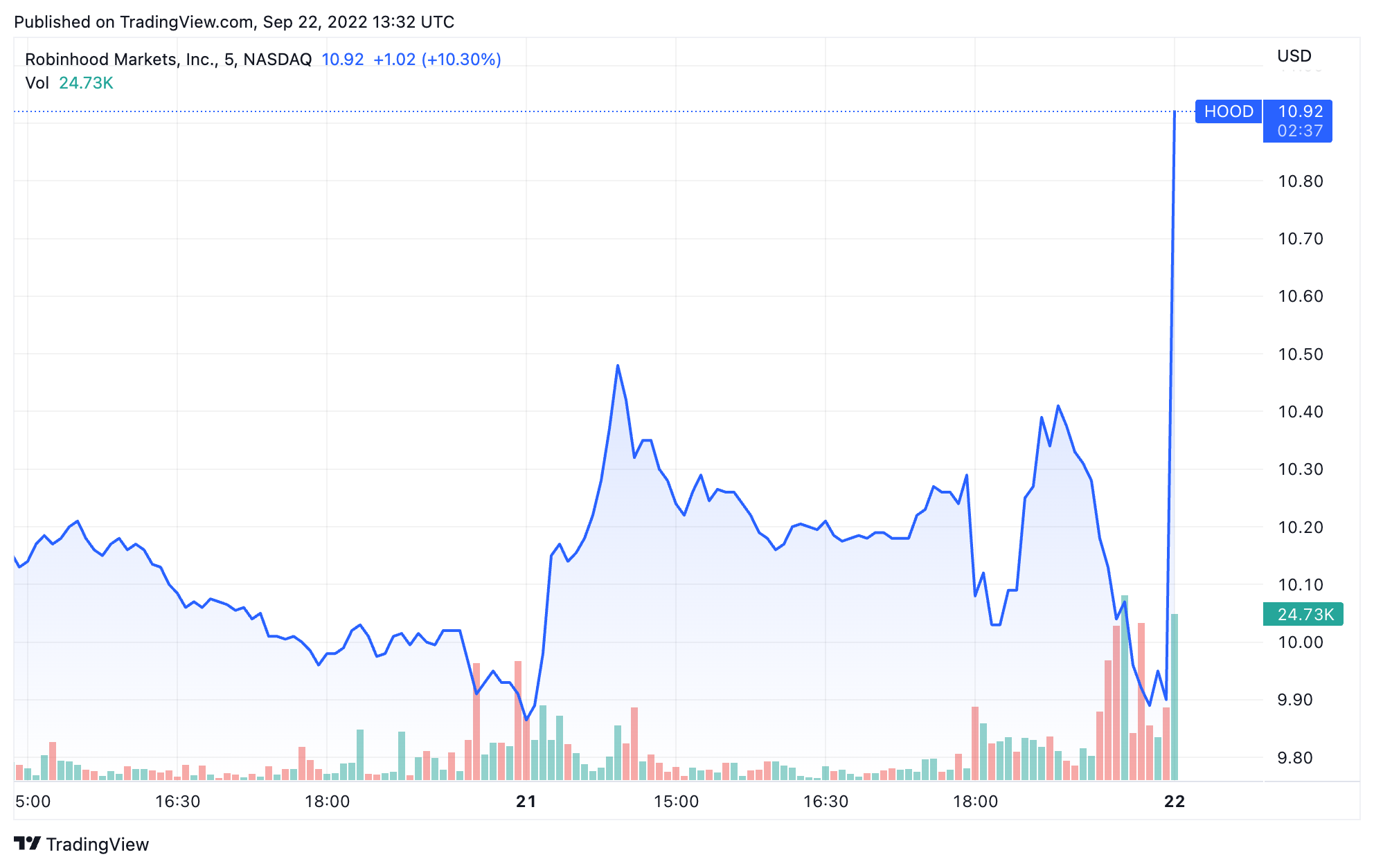
Robinhood shares up 9% as SEC reportedly scraps plan to limit PFOF deals

Robinhood shares soared at the open on Thursday following news that the U.S. Securities and Exchange Commission (SEC) won’t limit it in making payment-for-order-flow (PFOF) deals.

Shares in the retail investing platform traded up 9.3% on Thursday, trading at $10.92 on the open, up from $9.92 at the close on Wednesday.

The stock rose sharply following a report from Bloomberg saying the SEC won’t limit Wall Street firm’s making payment-for-order-flow deals, a major part of firms such as Robinhood and Charles Schwab’s business models. This system allows Robinhood to offer commission-free trading.

Shares in market maker Virtu Financial, which benefits from executing trades for the likes of Robinhood,  jumped on the open — up almost 8% per Nasdaq data via TradingView. 

This system has been criticized for routing orders through a handful of large electronic trading firms that are paying the broker, and not giving retail traders the best price. Robinhood previously settled with the SEC for $65 million over its failure to disclose its PFOF activity, and failing “to satisfy its duty to seek the best reasonably available terms to execute customer orders.”

SEC chair Gary Gensler had proposed an auction system to replace PFOF. This would see trading firms compete to fill orders similar to the options market, in an effort to increase competition and ensure retail traders received a better price.

© 2022 The Block Crypto, Inc. All Rights Reserved. This article is provided for informational purposes only. It is not offered or intended to be used as legal, tax, investment, financial, or other advice.

Go to Source
Author: Adam Morgan McCarthy

Animoca brands hires Gemini finance head as CFO, bulks out exec team

Software and crypto funding heavyweight Animoca Brands announced a new group of top-level executives on Thursday, with the appointment of a new chief financial officer, head of legal for commercial and M&A and group human resources director.

Gemini’s former head of finance Jared Shaw will join as the firm’s CFO. He had been in the role at Gemini since January 2021, according to his LinkedIn page. 

Shaw will “oversee and support the strategic financial direction of Animoca Brands and its more than 380 portfolio companies,” according to a release. 

“Jared has a wealth of experience spanning audit, asset management, crypto, and more. He joins us at a time when the finance team is growing rapidly and building strong capabilities,” added Evan Auyang, president of Animoca Brands.

Shaw joins alongside May Szeto, group HR director; former Meridian Capital general counsel Jamii Quoc as the head of legal for commercial and M&A; and former Ant Group employee Samuel Tse as M&A director. Josh Du also joins as the head of digital assets portfolio. 

The latest $110 million in backing brings Animoca Brands’ total funding to date to over $600 million. Its subsidiary, The Sandbox, has also separately raised $93 million recently.

© 2022 The Block Crypto, Inc. All Rights Reserved. This article is provided for informational purposes only. It is not offered or intended to be used as legal, tax, investment, financial, or other advice.

Go to Source
Author: Lucy Harley-McKeown

Ryan Breslow’s ‘truth seeking’ healthcare DAO releases its litepaper: Exclusive

Ryan Breslow, the co-founder of U.S. fintech Bolt, has released more details of his ambitious bid to upend the $1.4 trillion pharmaceutical industry — with a promise to “unlock the power and momentum” around alternative therapies.

The 28-year-old entrepreneur’s Love DAO project, a decentralized autonomous organization that’s already raised $7.5 million, published its litepaper today — and The Block was allowed to review it exclusively ahead of its release. 

Love DAO wants to enable “people-powered pharma” by getting its community to learn about new healing solutions and then vote on whether to fund trials for them. 

Breslow says he was inspired to take on the pharmaceutical industry after seeing untapped potential in the energy of alternative therapy-focused communities on networks like Reddit, Facebook and Telegram. 

“Currently, they don’t have much of a platform to convert that potential energy into kinetic energy,” Breslow said in an interview with The Block in late August. “I’m not here as a health expert. I’m here as a DAO expert and a community builder and hoping to unlock the power and momentum that already exists.” 

Breslow calls Love a “truth-seeking organization” as decisions are in the hands of community and will be tracked in a transparent manner showing how community members’ dollars or time are making an impact in the health industry. 

“We’re seeing a lot of interest already,” Breslow told The Block. “Just between the few press pieces that we’ve done, we’ve got close to 10,000 people who signed up for our waitlist.” 

‘Mob bosses’

Breslow captured the attention of Silicon Valley in January when his startup Bolt announced a $335 million Series E fundraise, just months after a $393 million Series D raise. 

Not long after the raise, Breslow, who tweets a lot, reflected on the challenges Bolt faced in raising funds in a string of 40-plus tweets in which he took aim at the “mob bosses” at rival Stripe and startup accelerator Y Combinator. A week on from the Twitter tirade, Breslow stepped down as CEO and is now executive chairman at Bolt. 

While Breslow is best known for his role in multiple fintech platforms like Bank Me, Bolt and Eco and his books on entrepreneurship, he’s still found time to dabble in DAOs.

He founded the Peace Movement DAO, which aims to provide assistance and support for Ukrainian refugees following Russia’s February invasion of Ukraine — although reaction has so far been lukewarm. The DAO has received $33,996 since launching on funding protocol Juicebox and currently has just 53 followers on Twitter.

DAO mindset shift

Running a DAO requires a mindset shift as the organization is collectively owned and decisions are not influenced by a central authority. Many DAOs use blockchain technology to help ensure transparency and decentralization of ownership. 

Love DAO’s newly released litepaper sets out Breslow’s vision for the organization. 

First off, Love DAO decisions will be be made, in the first instance, on Snapshot, an off-chain voting system, before transitioning to on-chain voting. In the early days, it will also be financially and operationally supported by Love Health, the founding team that kickstarted the DAO platform, before transitioning to a fully decentralized organization. 

Love Health’s first initiatives will focus on funding studies related to non-patentable medicines and therapies, per the litepaper. 

Governance will be managed by the holders of LOVE tokens, which will not be issued to any party and instead will be open to the public for purchase upon launch, per the litepaper. 

To participate and engage in the DAO, in addition to purchasing LOVE tokens, members must also hold a membership NFT that will be authenticated by the DAO. Once verified, voting power is determined by total LOVE ownership. 

To get the NFT, people must join the DAO’s Discord group and fill out a form about why they want to become a member. They can then purchase the membership NFT to get authenticated, ensuring users can’t be double counted. 

Love DAO isn’t completely without structure, however. It has elected leaders and council members who will be re-elected on regular governance cycles, and who will have pre-defined term limits. 

“DAO treasury assets will be managed via a multi-signature Gnosis Safe, managed initially by the DAO’s founding council members,” the litepaper said. “Council members are responsible for tasks such as project diligence, reviewing proposals, executing governance actions and managing treasury functions.” 

Can it work?

Love DAO’s mission is bold — and the pharmaceutical industry, dominated by giant conglomerates, is notoriously difficult to break into.

DAOs are also a completely new concept with many kinks still needing to be worked out. What place does a fintech entrepreneur have trying to combine the two? 

“I think I have a track record of being able to pick up complex things quickly, and understand them at a first principles level, and create a vision for the future that’s different than how it works today,” Breslow said.  

“Bolt is a very radical new approach to commerce that hadn’t been thought of before and we’re taking a radical approach to health that hadn’t been thought of before,” he added. 

Breslow explains that the DAO is “building a really serious internal team,” which will provide in-house expertise and the infrastructure to run trials.  

The DAO recently brought on board Kevin Horgan as chief medical officer, who previously worked as chief medical officer and EVP of Seres Therapeutics, and Stacy McIntosh as chief regulatory officer, who recently led efforts for the regulatory approval of the Ebola therapeutic Ebanga. 

“We are open to partnerships and are not going to be trying to own everything ourselves,” Breslow said. “In fact, anybody can become a trial infrastructure provider to the DAO community and then community can pick anybody to run the trial. It doesn’t need to be Love.” 

Love’s internal team will operate as a “trusted node” that will simply provide research or suggestions on areas to explore and thoughts on providers, Breslow said. “Ultimately, the community will do their own due diligence, and make their own decisions.” 

In the future, he expects that society will ask, “What good have you done? Show me your proof of good on the blockchain.”  

© 2022 The Block Crypto, Inc. All Rights Reserved. This article is provided for informational purposes only. It is not offered or intended to be used as legal, tax, investment, financial, or other advice.

Go to Source
Author: Kari McMahon

Alameda Research joins Clearpool’s permissioned pool ecosystem

Crypto trading firm Alameda Research is launching a permissioned borrower pool on Clearpool. 

Investment management firm Apollo Capital and decentralized finance (DeFi) trading platform Compound Capital will be the first lenders to contribute to the Alameda pool, according to a statement from Clearpool today. 

Clearpool offers liquidity for decentralized marketplaces, focused on institutional capital. Their permissioned pools are adapted for borrowers and lenders with higher know-your-customer (KYC) requirements.

Proprietary trading firm Jane Street and institutional investment company BlockTower are already part of Clearpool’s permissioned pool ecosystem in a partnership that was announced in May.

“The demand for KYC-compliant lending and borrowing is increasing and Clearpool is leading the way with its sophisticated blockchain-enabled infrastructure,” Jakob Kronbichler, chief commercial officer and co-founder of Clearpool, said in the press release. “We have a long pipeline of lenders and borrowers ready to join the Clearpool ecosystem with our new permissioned pool product soon ready to launch.”

© 2022 The Block Crypto, Inc. All Rights Reserved. This article is provided for informational purposes only. It is not offered or intended to be used as legal, tax, investment, financial, or other advice.

Go to Source
Author: Inbar Preiss

Peter Thiel’s Founders Fund leads $3.7 million round into Block Green

Peter Thiel’s Founders Fund led a $3.7 million seed equity round into Block Green, a lending protocol that aims to enable bitcoin staking. 

Other investors in the round, which closed in early June, included Coinbase Ventures, Blizzard and Dao5, according to an announcement. Founder Sebastien Hess didn’t disclose the valuation to The Block. He founded the company in December last year with former Mastercard exec Bastian Becker. 

Built initially on the Bitcoin Core with plans to move to other chains thereafter, Hess said that he wants to build what he calls “Bitcoin DeFi.” He aims to serve miners who he says haven’t been served well by traditional lenders. 

“Right now, loans are backed by Asics — the hardware used to mine crypto — which is essentially pegged to the price of bitcoin,” explained Hess. “As a lender, your collateral is basically very sensitive to the price of Bitcoin. If Bitcoin goes down, it’s very likely the miners will actually go bust.” 

Block Green allows bitcoin miners to use their future Bitcoin production as collateral by borrowing against their hash power. Bitcoin holders can then lend their assets and receive a cut of the Bitcoin produced by such miners.

According to The Block Research, Bitcoin’s hash rate is currently estimated to be at 229.19 exahashes per second as of last week. 

News of the round comes as other players seek to offer access to capital for bitcoin miners who struggle to access traditional capital markets. On Tuesday, Icebreaker Finance and DeFi lending platform Maple launched a $300 million lending fund for bitcoin miners

Block Green, as the name suggests, said that it would only work with sustainable miners with two big-name mining players already signed up for its early October pilot.  

“We’re running a form of due diligence on the miners,” explained Hess. “Aside from the classical financial aspects of due diligence, there’s also the energy side. Along with the renewable energy requirement, we look at other aspects such as how the energy is used, and how they recycle their eco emissions, and then give them a form of credit scoring.” 

This credit scoring is then used to judge whether a miner is onboarded to Block Green. 

The company will use the funding to develop the protocol further and build out its team. Hess also said it is hiring the current director of miner finance at crypto lender BlockFi, Patrick Guerriero. It will also continue to establish partnerships with miners, focusing on the US and Canada, and liquidity providers. 

© 2022 The Block Crypto, Inc. All Rights Reserved. This article is provided for informational purposes only. It is not offered or intended to be used as legal, tax, investment, financial, or other advice.

Go to Source
Author: Tom Matsuda

Web3 bug bounty platform Immunefi raises $24 million in Series A funding

Immunefi, a platform that helps web3 projects launch bug bounty programs and whitehat hackers earn money, has raised $24 million in a Series A funding round amid increasing crypto hacks.

Framework Ventures led the round in the largest deal the crypto investment firm has publicly announced, according to a statement on Thursday. Other investors include Electric Capital, Polygon Ventures, Samsung Next, North Island Ventures, Third Prime Ventures and Lattice Capital.

Immunefi was founded in December 2020 and hosts bug bounty programs for crypto projects, including Chainlink, MakerDAO and Compound. The Singapore-based firm claims to have over 300 clients, guard over $100 billion in users’ funds, and collectively offer $136 million in bounties to whitehat hackers.

Bounties can be an effective way to discover vulnerabilities and prevent potential hacks, especially in the vulnerable crypto space. According to The Block’s Data Dashboard, hackers have stolen nearly $2.5 billion from decentralized finance (DeFi) projects to date.

Immunefi claims to have saved over $25 billion in users’ funds to date and has paid out $60 million in bounties.

The startup takes a 10% commission on those payouts, founder and CEO Mitchell Amador told The Block. For example, if a whitehat hacker receives $1 million from a crypto project, Immunefi gets $100,000, meaning that the project pays $1.1 million in total, said Amador.

Immunefi can be compared with traditional bug bounty platforms like HackerOne and Bugcrowd. But the firm says it has facilitated the largest bug bounty payments in the history of software, including $10 million for a vulnerability discovered in Wormhole, a blockchain bridge, and $6 million for a vulnerability discovered in Aurora, a bridge and scaling solution for Ethereum. For comparison, the largest conventional bug bounties — offered by Apple — top out at $2 million, according to Immunefi.

With fresh capital in hand, Immunefi plans to expand its team in order to meet the growing demand for its services, said Amador. The current headcount of Immunefi is around 50 and it could double in the near future, he added.

The Series A round brings Immunefi’s total funding to date to more than $29.5 million. The firm raised a $5.5 million seed round last year. Amado declined to comment on Immunefi’s valuation with the latest round and any new board seat additions, but said it was an equity round like the firm’s seed round.

Last year, Amador told The Block that Immunefi is ready to decentralize its operations, meaning it could launch its own token. When asked if that plan is still intact, he said the firm is “exploring different options but can’t share more at the moment.”

© 2022 The Block Crypto, Inc. All Rights Reserved. This article is provided for informational purposes only. It is not offered or intended to be used as legal, tax, investment, financial, or other advice.

Go to Source
Author: Yogita Khatri

Market maker Wintermute tells hacker to return funds or face legal action

Market making firm Wintermute has sent a message over the Ethereum blockchain to the hacker that stole $160 million from the firm on Tuesday.

Sent at midnight UTC on Thursday, the message told the hacker to return the funds by end of the day, or else Wintermute would proceed to approach the authorities. It urged the hacker to accept a $16 million “whitehat” bounty reward and return the remainder of nearly $144 million back to Wintermute.

“We want to cooperate with you and resolve this matter immediately. Accept the terms of the bounty and return the funds within 24 hours before September 22nd UST by 23:59 while we can still consider this a white-hat event for a 10% bounty as offered,” the message said.

The message went on to say that if the hacker returned the funds, the person would be labeled as a “white hat,” — a term given to ethical hackers. This points to an assurance that no legal action would be taken if the person complies with the request. 

At the time of writing, the hacker has another 12 hours to accept the bounty offer. On the flip side, if the exploiter does not give back the assets (minus the bounty), the team would move to approach the “appropriate authorities and avenues,” the firm said in its on-chain message. 

“If the stolen funds are not returned by the deadline, you will force us to remove our bounty offer and white-hat label; we will then proceed accordingly with the appropriate authorities and avenues,” Wintermute wrote.

Wintermute grapples with its vanity address exploit 

On Tuesday, Wintermute’s Ethereum vault, a type of crypto wallet account holding its assets in a smart contract, was drained of $160 million in various crypto assets.

The exploit occurred because the vault relied on a vulnerable admin address with a prefix “0x0000000,” which analysts say is a “vanity address.” Vanity addresses contain identifiable names or numbers within them.

Wintermute’s vanity address was generated using certain online tools Profanity. A few days prior to the attack on Wintermute, a security report from 1inch disclosed that all Profanity-based vanity addresses had a critical vulnerability. This vulnerability could allow hackers calculate their private keys using “brute force” attacks.

Wintermute used its Profanity-based address as an admin account to authenticate transactions on its Ethereum vault. Because of the same vulnerability, someone brute forced the private key of the same admin address. This gave the hacker control over Wintermut’s vault enabling the actor to drain the funds.

The firm picked this address because of potential transaction fee savings. These can be made with vanity addresses that have a string of several zeroes, Mudit Gupta, Polygon’s chief information security officer, told The Block.

This was not the first time Wintermute has lost funds in a security exploit. In June, a hacker was able to take ownership of 20 million Optimism tokens sent to Wintermute by Optimism Foundation for market making of the token.

After the June incident, Wintermute offered a 10% bounty, which the hacker accepted after one day of on-chain correspondence between the two parties. This time, however, the hacker has yet to reply to Wintermute’s request.


© 2022 The Block Crypto, Inc. All Rights Reserved. This article is provided for informational purposes only. It is not offered or intended to be used as legal, tax, investment, financial, or other advice.

Go to Source
Author: Vishal Chawla

Coinbase successfully registers with the Dutch Central Bank

Global crypto exchange Coinbase has successfully registered with the Dutch Central Bank (De Nederlandsche Bank), the company announced on Thursday, opening the firm’s products and services to the Netherlands with full regulatory approval.

Coinbase is added on to a list of more than 30 other crypto-asset service providers on the national central bank’s register. The company joins other exchanges such as OKCoin and Bitstamp.

Rival exchange Binance was fined €3.3 million earlier this summer for failing to obtain this registration. 

Coinbase is formally supported in a total of 40 European countries, with its European branch registration based in Ireland. It is seeking to continue expanding and collecting licenses in “several major markets.”

The EU’s comprehensive regulatory framework focused on centralized crypto-asset service providers completed its negotiations in the European institutions this week. This harmonizes licensing requirements across the 27-state bloc and paves the way for exchanges to operate in Europe.

© 2022 The Block Crypto, Inc. All Rights Reserved. This article is provided for informational purposes only. It is not offered or intended to be used as legal, tax, investment, financial, or other advice.

Go to Source
Author: Inbar Preiss

Binocs raises $4 million to help crypto investors stay on top of their taxes

Crypto tax reporting app Binocs announced it has raised $4 million to help crypto investors stay on top of their tax responsibilities. 

The seed round was co-led by Beenext and Arkam, according to a release on Thursday. Other investors include Accel, Saison Capital and Better Capital. 

Founded in May by Tonmoy Shingal and Pankaj Garg, Binocs aims to help crypto investors manage their tax responsibilities. The company said in the release it can compute crypto taxes in less 30 minutes and has over 1,000 customers. 

“In essence Crypto is a web3 currency but has to comply with a web2 world of accounting principles and compliance. We are bridging this gap,” Shingal, Binoc’s CEO, said in the release. “Our software is compliant with the latest regulations, ensuring our users can calculate their taxes efficiently.” 

The market opportunity is huge

The market for crypto tax is huge, according to Binocs. It estimates the overall tax liability that could be imposed on investors is around $70 billion based on equal split between short-term and long-term capital gains from crypto’s total market cap and a blended tax rate of around 20%. 

Binocs’ platform enables tax computation while adhering to local regulation and laws, per the release. It covers a range of transactions from traditional buy and sell trades to staking and airdrops. 

“With complete transparency, the algorithm breaks down the transaction fee and TDS already paid on the transactions and then calculates tax on the net amount,” the release said. 

Binocs can link to user’s crypto wallets and exchange accounts enabling individuals to track their overall portfolio value and download quarterly and annual tax statements, according to the release. 

The rise of back-office functions

The startup is tax compliant in the U.S., UK, Australia, South Africa and India and is targeting other markets in the coming months. The funding round will help Binocs launch in these additional markets and expand to catering to institutional crypto investors. 

“20 countries currently have tax regulations and compliances in place for cryptocurrency and there are another 50 that will implement such policies in the near future,” said Anirudh Garg, investor at Beenext, in the release. “This is a great market opportunity to build an easy-to-use, yet powerful, system early on.” 

Binocs is just one of many web3 back-office platforms to announce a seed round raise in recent days. Financial operations platform raised $5 million to help crypto companies manage working capital across custodial and non-custodial wallets, while web3 accounting tool Tres raised $7.6 million to improve the accounting process for web3 firms.

© 2022 The Block Crypto, Inc. All Rights Reserved. This article is provided for informational purposes only. It is not offered or intended to be used as legal, tax, investment, financial, or other advice.

Go to Source
Author: Kari McMahon


Follow by Email
Facebook20
Pinterest20
fb-share-icon
LinkedIn20
Share