FreeCryptoCurrency.Me

Free stocks and money too!

Category Archive : Crypto News

Committee to represent creditors formed in FTX bankruptcy case

A committee to represent unsecured creditors and serve as the voice for most FTX customers in court was established in the U.S. bankruptcy case of FTX and its affiliated companies.

The formation of the committee, meant to represent anyone who had money in FTX or affiliated companies but was not given collateral for what FTX owes them, will allow the bankruptcy proceedings to move forward. Representatives for the U.S. Trustee, an office within the Justice Department that represents the U.S. government in bankruptcy proceedings and helps formalize such committees, said earlier this week that forming this one had been difficult due to the highly international nature of FTX’s customer base.

While U.S. government lawyers have pushed for more transparency in identifying large businesses that FTX owes money to, the collapsed exchange, under its new leadership, has argued to keep that information under seal on the grounds that its client list is a valuable company asset that could be sold to help recoup money. The formation of a creditor committee will allow the matter to move to a conclusion, as the judge presiding over the case had wanted to wait until the committee was formed and able to express its view before making a decision on the matter.

Friction also remains over the fate of the Bahamas arm of FTX’s group of companies, FTX Digital Markets. Former FTX CEO Sam Bankman-Fried put that part of his corporate empire into a separate bankruptcy process, with a different group of lawyers charged with liquidating the company. Lawyers representing the rest of the corporate family, now headed by corporate bankruptcy and restructuring expert John Ray III, have claimed that movement of hundreds of millions of dollars-worth of assets out of accounts controlled by that subsidiary violated U.S. bankruptcy law.

Members of the unsecured creditor committee include:

  • Zachary Bruch, an individual investor with New York-based representation.
  • Coincident Capital International, Ltd., a cryptocurrency hedge fund whose corporate LinkedIn profile places them in the Cayman Islands.
  • GGC International Ltd., a Bermuda-based firm.
  • Octopus Information Ltd., a British Virgin Islands-based firm.
  • Pulsar Global Ltd., a Hong Kong-based crypto trading firm and market maker.
  • Larry Qian, an individual investor.
  • Acaena Amoros Romero, an individual investor.
  • Wincent Investment Fund PCC Ltd., a Gibraltar-based investment fund.
  • And Wintermute Asia PTE. Ltd., an algorithmic trading firm that appears to have multinational operations but is identified in court documents as Manchester, UK-based.

Disclaimer: Beginning in 2021, Michael McCaffrey, the former CEO and majority owner of The Block, took a series of loans from founder and former FTX and Alameda CEO Sam Bankman-Fried. McCaffrey resigned from the company in December 2022 after failing to disclose those transactions.

© 2022 The Block Crypto, Inc. All Rights Reserved. This article is provided for informational purposes only. It is not offered or intended to be used as legal, tax, investment, financial, or other advice.

Go to Source
Author: Colin Wilhelm

‘Only $99!’: Former US president Donald Trump unveils NFT trading card collection

Donald Trump, the former U.S. president long-known for releasing branded products, has added another to the list: an NFT collection.

The so-called Donald Trump Digital Trading Card collection was unveiled on Trump’s Truth Social account.

“Would make a great Christmas gift. Don’t Wait. They will be gone, I believe, very quickly!” Trump wrote. 

The cards are selling for “only $99!” apiece, according to the collection’s website. A sweepstakes associated with the collection launch offers prizes like a 1-on-1 Zoom call or one hour of golf with Trump. 

The collection will be minted on the Polygon blockchain, with a total of 45,000 NFTs created in the “initial” run of the collection, per the site.

Trump’s announcement follows the unveiling of his 2024 presidential election campaign. Trump, who served as U.S. president between 2017 and 2021, failed in his 2020 reelection bid and falsely claimed the election was stolen. The former U.S. president faces a potentially steep climb to once again secure the Republican Party presidential nomination, based on recent polling and his party’s mixed performance in the 2022 midterm elections. 

© 2022 The Block Crypto, Inc. All Rights Reserved. This article is provided for informational purposes only. It is not offered or intended to be used as legal, tax, investment, financial, or other advice.

Go to Source
Author: Michael McSweeney

OpenZeppelin releases metaverse security service, signs up The Sandbox as client

Blockchain firm OpenZeppelin has announced the launch of its metaverse security service with The Sandbox, a gaming virtual world and a subsidiary of Animoca Brands, becoming the first to sign up.

With the service, OpenZeppelin aims to provide a comprehensive security analysis of metaverse-based applications. The firm plans to achieve this by applying real-time monitoring to detect potential threats and anomalies in such protocols on an ongoing basis, starting with The Sandbox.

“Metaverse projects can now leverage ongoing audit expertise to go beyond the code to support better security practices for on-chain monitoring, access control and other enhancements that are crucial for securing future growth,” said Michael Lewellen, head of solutions architecture at OpenZeppelin.

How will this work?

OpenZeppelin’s metaverse security service has multiple components. The first is that the existing logging, key management systems and API-based systems used by The Sandbox will be integrated with a single security dashboard via a security tool called Defender. This tool will provide better visibility over web3 transactions taking place within the metaverse ecosystem, which will be useful in continuous audits of The Sandbox.

Secondly, the service combines OpenZeppelin’s expertise with Forta, a project that will monitor all activities on the metaverse and send notifications if any risks or anomalies on The Sandbox are detected. 

“It’s important to ensure safety for our users, and we’re pleased to use OpenZeppelin’s security service as an important part of our suite of security tools and strategies,” said Sebastien Borget, chief operating officer and co-founder of The Sandbox in a statement.

As a blockchain-based app, the metaverse has potential but also carries risks for both users and developers. Cyber threats such as phishing, identity protection and verification, and hardware security are all concerns that must be addressed to ensure the safety of participants. In recent times there have been numerous hacks and exploits targeting decentralized finance. Similar threats could easily apply to any applications built on a metaverse protocol.

OpenZeppelin elaborated on the difference between smart contract audits in decentralized finance versus a metaverse. The team said even though both the metaverse and DeFi may rely on smart contracts, there are many elements to the underlying code of a metaverse platform like Sandbox, which results in a much wider attack surface.

Such components relate to The Sandbox’s ERC-20 token, the many non-fungible token contracts and NFT auctions feature.

“Yes, there is crossover in smart contract auditing across the web3 board, but a metaverse entails complications such as native assets and land tokens as well as offering a marketplace for users, the need to monitor native metaverse tokens, meta-transaction implementations and additional required dependencies,” Stephen Lloyd Webber, developer advocate at OpenZeppelin, told The Block.

© 2022 The Block Crypto, Inc. All Rights Reserved. This article is provided for informational purposes only. It is not offered or intended to be used as legal, tax, investment, financial, or other advice.

Go to Source
Author: Vishal Chawla

Binance’s Zhao defends exchange during CNBC grilling

Binance CEO Changpeng Zhao was grilled by CNBC reporters regarding hiccups with withdrawals from the exchange this week and the firm’s solvency.

Binance earlier this week temporarily paused withdrawals of the USD Coin stablecoin due to inadequate USDC reserves on the platform. Zhao said the issue was related to a New York bank it uses to swap Paxos-issued BUSD holdings into USDC not being open at the time.

“We have the assets to convert,” Zhao said. “There’s no margin, there’s no leverage, we just needed the banks to open. When banks are closed and you try to withdraw money it doesn’t work.”

Zhao said Binance owes money to no one, doesn’t have venture capital investments and has no loans.

“We manage our cash very simply,” the CEO said.

“Just because bitten by one snake doesn’t mean any other animal is the same,” he said, referring to the downfall of Sam Bankman-Fried’s FTX.

More transparent 

He defended the company’s EARN program, saying the customer money there is used for other margin traders to borrow from and “sometimes we do run out because the demand supply some time don’t match up but the money never leave the platform and we do margin controls.”

He also insisted that his industry is more transparent than most traditional businesses, and he wants to set the gold standard for reliability.

“In our industry we don’t depend that much on trust we depend very much on verification.” 

Pushed to answer whether Binance could afford to pay back $2.1 billion that it received from its exit from FTX last year, Zhao said, “We’re financially strong. We’ll let the lawyers handle it.” 

© 2022 The Block Crypto, Inc. All Rights Reserved. This article is provided for informational purposes only. It is not offered or intended to be used as legal, tax, investment, financial, or other advice.

Go to Source
Author: Christiana Loureiro and Adam Morgan McCarthy

Coinbase now helps recover unsupported ERC-20 tokens sent by mistake

Crypto exchange operator Coinbase launched a new asset recovery tool for approximately 4,000 unsupported ERC-20 tokens.

If a user has mistakenly sent unsupported tokens to their Coinbase address, the company will help recover those tokens by charging a fee.

“Our recovery tool is able to move unsupported assets directly from your inbound address to your self-custodial wallet without exposing private keys at any point,” Coinbase said. “We did this by using patent-pending technology to send the funds directly from your inbound address without processing the funds through our centralized exchange infrastructure.”

Coinbase charges a 5% fee for recovering assets worth over $100, and a separate network fee applies to all recoveries. To recover their funds, customers will need to provide two details — the Ethereum transaction ID for the transaction where the asset was lost and the contract address of the lost asset — Coinbase said.

The feature is not available for Coinbase’s Japan and Prime (or institutional) customers, the company said.

Coinbase rival Binance does not offer coin recoveries. Still, if a customer has suffered a “significant loss” due to incorrectly depositing unlisted tokens, Binance may assist them in recovering those tokens solely at its discretion, and the recovery isn’t guaranteed, according to information on its website.

Coinbase said it is the first major crypto company to offer ERC-20 recoveries at scale while preserving the security of customer deposit addresses. “We’re reducing the points of friction and focus on improving usability to better serve and earn the trust of mass consumers,” it added.

Earlier this week, Coinbase CEO Brian Armstrong told staff in a memo that it is the company’s “moment to shine” amid market fear and volatility. Armstrong urged employees to be “prepared to serve” customers amid challenging market conditions.

© 2022 The Block Crypto, Inc. All Rights Reserved. This article is provided for informational purposes only. It is not offered or intended to be used as legal, tax, investment, financial, or other advice.

Go to Source
Author: Yogita Khatri

Zero-knowledge proofs could solve CBDC privacy concerns, research shows

Deploying zero-knowledge proof cryptography could allow for “trustless privacy” in a central bank digital currency (CBDC), according to new research, addressing a major area of concern for a state-backed crypto projects.

The report by Mina Foundation, a decentralized network, and Etonec, a crypto payments group, looks to show that CBDCs can provide the same privacy levels as cash while also being compliant to anti-money laundering regulations. 

“Providing anonymity for payments, while ensuring regulatory compliance, is not a technological question, but a policy question,” Jonas Gross, head of digital assets and currencies at Etonec and chairman of the Digital Euro Association, said in a statement to The Block.

To achieve cash-imitating levels of privacy, transaction details can be kept confidential between the sender and receiver using zero-knowledge (ZK) technology. A third party, like a financial authority, would not be able to access the details unless it hits certain preset thresholds. Then, the transacting pair will only be able to continue making payments after they are confirmed to be compliant with regulation, according to the study.

‘Essential backbone’

“Zero-knowledge technology will be an essential backbone of the future of payments because it enables privacy preservation of confidential payment data in the digital realm,” Gross added. 

Privacy is a major concern when it comes to a state-backed digital currency. In a survey conducted in 2021 by the European Central Bank, the protection of privacy topped European citizens’ priorities in a future digital euro.

The findings of the research will be sent to central bankers, Gross confirmed. 

“We see that there is a strong demand for preserving privacy around CBDCs — even if there are cultural differences,” he wrote in the statement. “Some central banks are already experimenting with a CBDC that utilizes privacy-preserving technologies to satisfy this demand.”

© 2022 The Block Crypto, Inc. All Rights Reserved. This article is provided for informational purposes only. It is not offered or intended to be used as legal, tax, investment, financial, or other advice.

Go to Source
Author: Inbar Preiss

Amber Group acquires Singapore crypto exchange Sparrow: Business Times

Asian crypto investment firm Amber Group has acquired Singaporean crypto exchange Sparrow, according to a report in The Business Times citing regulatory filings.

Amber’s move is surprising as the firm faces questions about its financial health. In recent months it has undertaken significant cost-cutting efforts, including layoffs and a retreat from overseas operations in regions such as the UK and U.S.

Neither Amber or Sparrow immediately responded to requests for comment.

Amber experienced a rapid expansion last year, with its headcount peaking at about 1,100, according to Annabelle Huang, managing partner at Amber. That figure has now fallen to around 400, according to a Bloomberg report last week.

Homing on Asia

Sparrow is based in Amber’s home region. The crypto exchange was founded in 2018 and has raised a total of $14.2 million, according to data from Crunchbase. It announced in August that it had obtained a Major Payment Institution license from the Monetary Authority of Singapore, which enabled the startup to provide digital payment token services in Singapore. 

“Amber will continue to service our global HNW [high net worth] and institutional clients,”said Huang in a recent statement to The Block. “As our home base is in Asia, and this is where we have the most resources, it has always been our core market too.”

Founded in 2017, Amber provides a wide range of services to institutional clients, from trading and liquidity services to yield products. It recently branched into the consumer segment with its wealth management platform, WhaleFin. 

Amber’s struggles

Bloomberg reported today that Amber would be cancelling bonuses and reducing management salaries as part of the cost saving measures. 

Amber has been in the process of trying to raise additional funds, seeking to raise $100 million at a flat valuation of $3 billion. The Financial Times reported last week that Amber had managed to secure $50 million of the $100 million, with the deal to be announced in January. 

The firm denied that the $50 million raise was an emergency fundraise and said the funds came from a new investor in a previous statement to The Block. Last week, Amber had to assure customers it was “business as usual” following reports of further layoffs and paused withdrawals on some of its platforms.

To compound Amber’s problems, one of the firm’s co-founders, Tiantian Kullander, known as TT, died in his sleep at the age of 30 on Nov. 23. It also owes about $130 million to Darshan Bathija, the CEO of troubled crypto lender Vauld.

© 2022 The Block Crypto, Inc. All Rights Reserved. This article is provided for informational purposes only. It is not offered or intended to be used as legal, tax, investment, financial, or other advice.

Go to Source
Author: Kari McMahon

Mithril demands $53 million BNB refund from Binance following delisting

Mithril, a blockchain social media project, has asked Binance to refund 200,000 BNB ($53 million) after the crypto exchange delisted its token from the platform earlier today.

The project stated that it paid a 200,000 BNB deposit to Binance as part of the initial listing in November 2018. “Given that Binance has unilaterally decided to end this partnership, we respectfully ask to have our 200,000 BNB deposit returned,” the project tweeted.

At the time of listing in 2018, the BNB deposit would have been worth about $1 million.

Mithril also claimed that the project had been a longtime collaborator of the crypto exchange. Mithril’s token, which carries the ticker MITH, was the first token on the Binance Chain when it launched in April 2019. It was also the first listed pair on the Binance decentralized exchange. Mithril also added it made donations to Binance Charity and collaborated on other initiatives as part of a longstanding working relationship with the company since 2018. The listing announcement from 2018 shows a 20,000 BNB donation to the Blockchain Charity Foundation.

Binance delists Mithril

MITH token tumbles 20% amid Binance delisting announcement. Image: CoinGecko.

Mithril stated that the refund was necessary to continue its operations. The blockchain social media project has largely been inactive for almost two years. Its last Twitter post before today was on Jan. 7, 2021. The project’s website also appears to be offline.

MITH was among four tokens delisted by Binance on Thursday. The announcement stated that the tokens no longer met the exchange’s listing standard.

Binance did not immediately respond to The Block’s request for additional comments before publication.

Data from CoinGecko shows Mithril’s token ranks outside the top 1,000 crypto tokens according to market capitalization. MITH currently has a market cap of $5.9 million. The token’s spot price has declined more than 20% since the Binance delisting announcement.

© 2022 The Block Crypto, Inc. All Rights Reserved. This article is provided for informational purposes only. It is not offered or intended to be used as legal, tax, investment, financial, or other advice.

Go to Source
Author: Osato Avan-Nomayo

Not Boring Capital, Polygon Studios back virtual-pet company in $3-million round: Exclusive

Developers of the recently launched augmented-reality NFT project Onlybots secured an additional $3 million investment in a funding round led by Polygon Studios, Not Boring Capital, HashKey and others, the company said.  


Similar to Dapper Labs’ long-running NFT project CryptoKitties, Onlybots is a collection of digital pets consumers are able to buy and sell to each other — although Onlybots appears to be breaking new ground with the addition of AR.  


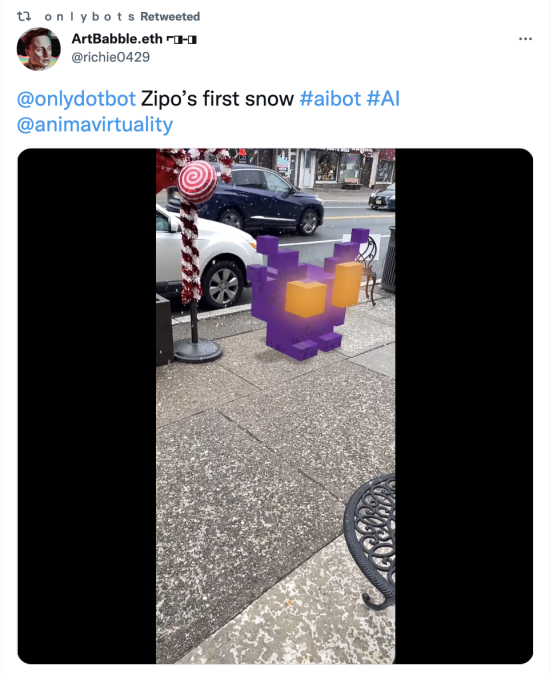
Onlybots is actually the first on-chain AR,” said Anima Cofounder Alex Herrity, adding that the NFTs have GPS coordinates attached to each token and are viewable through a smartphone camera; meaning owners can superimpose the digital creatures over the physical world. 


Herrity and Neil Voss — who between them have video-game experience working with Nintendo and Epic Games — cofounded Anima in 2021. With a pre-seed round of $500,000 led by Coinbase Ventures, Voss and Herrity created Anima to become a “protocol for dynamic and ownable augmented reality.” Anima launched its initial project called Onlybots last week. The collection consists of unique AR-enabled, Lego-like pets users can collect and trade.

During the last week, Onlybots’ Twitter feed has been flooded with posts from owners inserting, maneuvering and filming their AR-powered pets, making it appear as though the digital creatures exist in the natural world.

Screenshot from Onlybots’ Twitter feed.

Not Boring Capital’s Packy McCormick said in a statement that Anima’s project allows users to “carry their creativity from the screen to the physical world.” 


Like CryptoKitties, the Onlybots collection are Ethereum-based NFTs that trade on the marketplace OpenSea. Anima says the first two batches of about 500 virtual pets, released last week, sold out in less than an hour. At one point the collection ranked fifth on OpenSea’s top-10 trending list. 


Anima plans to not only release more Onlybots virtual pets but also eventually introduce new ways for owners to interact and play with the digital creatures. Herrity said he and his team will monitor the creative ways people use and express themselves with the digital creatures and then adapt future functionality accordingly. 


Onlybots is for Anima both a “showcase” of its blockchain-enabled technology and the first phase of a plan to introduce more people to “ownable” AR assets, Herrity said. 


“We want to enable creators to make projects in AR,” he added. “We want to show that you can make interesting, magical, dynamic AR and sell it.” 

© 2022 The Block Crypto, Inc. All Rights Reserved. This article is provided for informational purposes only. It is not offered or intended to be used as legal, tax, investment, financial, or other advice.

Go to Source
Author: RT Watson

Microsoft prohibits crypto mining on online services without permission

Microsoft updated its policy terms to specify it will not allow cryptocurrency mining on its online services without prior approval.

The update came into effect on Dec. 1 and applies to all users, including Microsoft’s paid customers. The Register was first to report the change.

The update prohibits users from mining — the process of verifying and adding transaction records to proof-of-work blockchains — on Microsoft’s online services, largely relating to its cloud platform Azure.

Microsoft’s updated universal license terms under “accepted use policy” states: “Neither Customer, nor those that access an Online Service through Customer, may use an Online Service … to mine cryptocurrency without Microsoft’s prior written approval.” 

A post shared with Azure users listed the update as one of many actions made to “secure the partner ecosystem,” referring to partner firms that work to sign up software clients to Azure’s cloud services. Microsoft did not offer further explanation in the post.

The decision brings Microsoft in line with other tech giants like Google, which prohibits crypto mining on its cloud platform without approval. Amazon Web Services also bans its free-tier users from mining. 

© 2022 The Block Crypto, Inc. All Rights Reserved. This article is provided for informational purposes only. It is not offered or intended to be used as legal, tax, investment, financial, or other advice.

Go to Source
Author: Vishal Chawla


Follow by Email
Facebook20
Pinterest20
fb-share-icon
LinkedIn20
Share