FreeCryptoCurrency.Me

Free stocks and money too!

Category Archive : Crypto News

Bitcoin, ether lower; Binance’s BNB up after deal to acquire Voyager assets

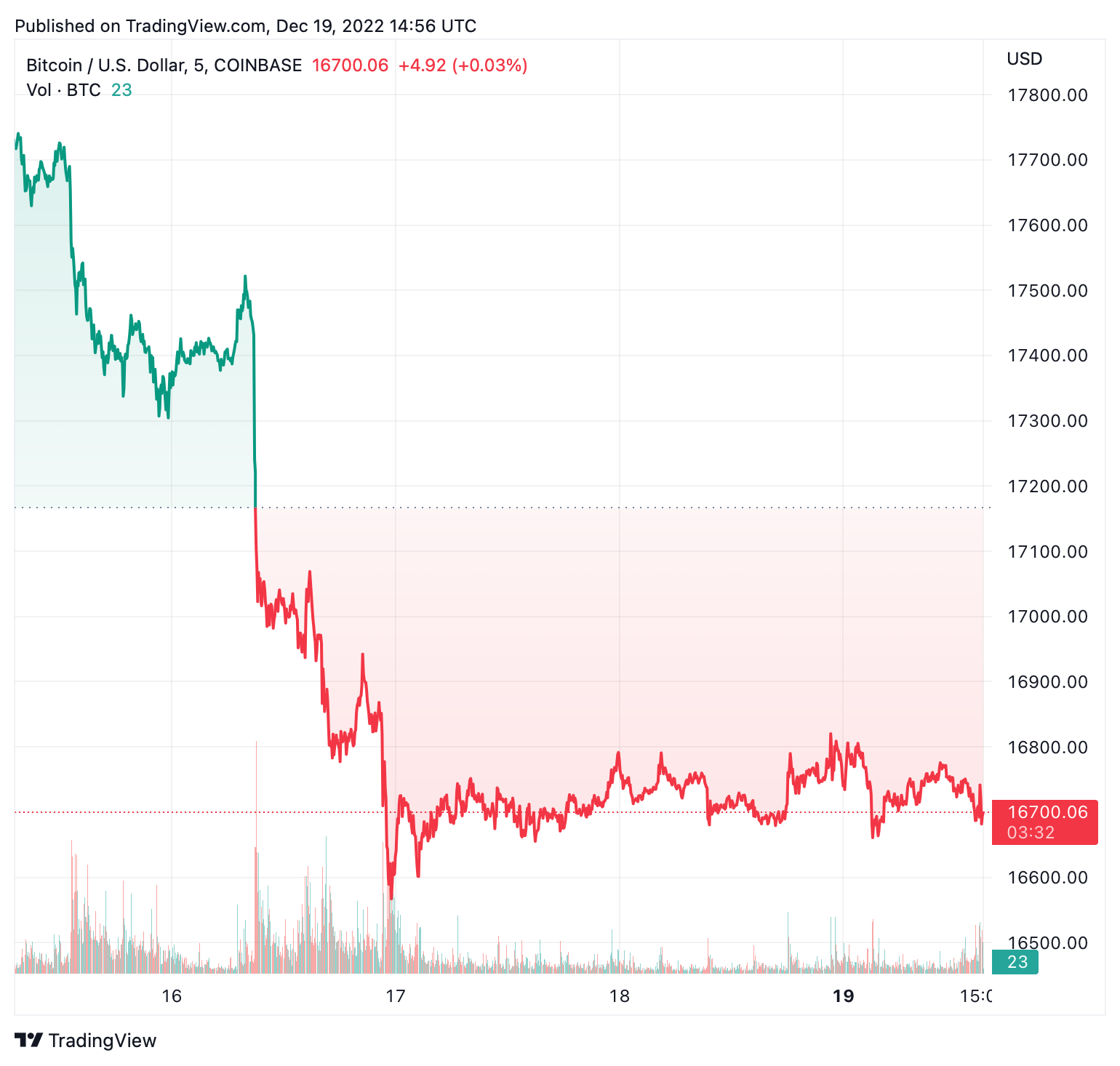
Crypto prices started off the week mixed, with bitcoin and ether down less than 1% and fluctuating around $16,600 and $1,170, respectively.

Traditional markets were also slightly lower, with the S&P 500 off 0.3% and the Nasdaq 100  down 0.5%.

BTCUSD Chart by TradingView

Binance’s BNB token was up 0.2% in the past 24 hours. Earlier today it agreed to buy bankrupt crypto lender Voyager’s assets and the remaining 40% stake in Indonesian exchange Tokocrypto that it didn’t already own. 

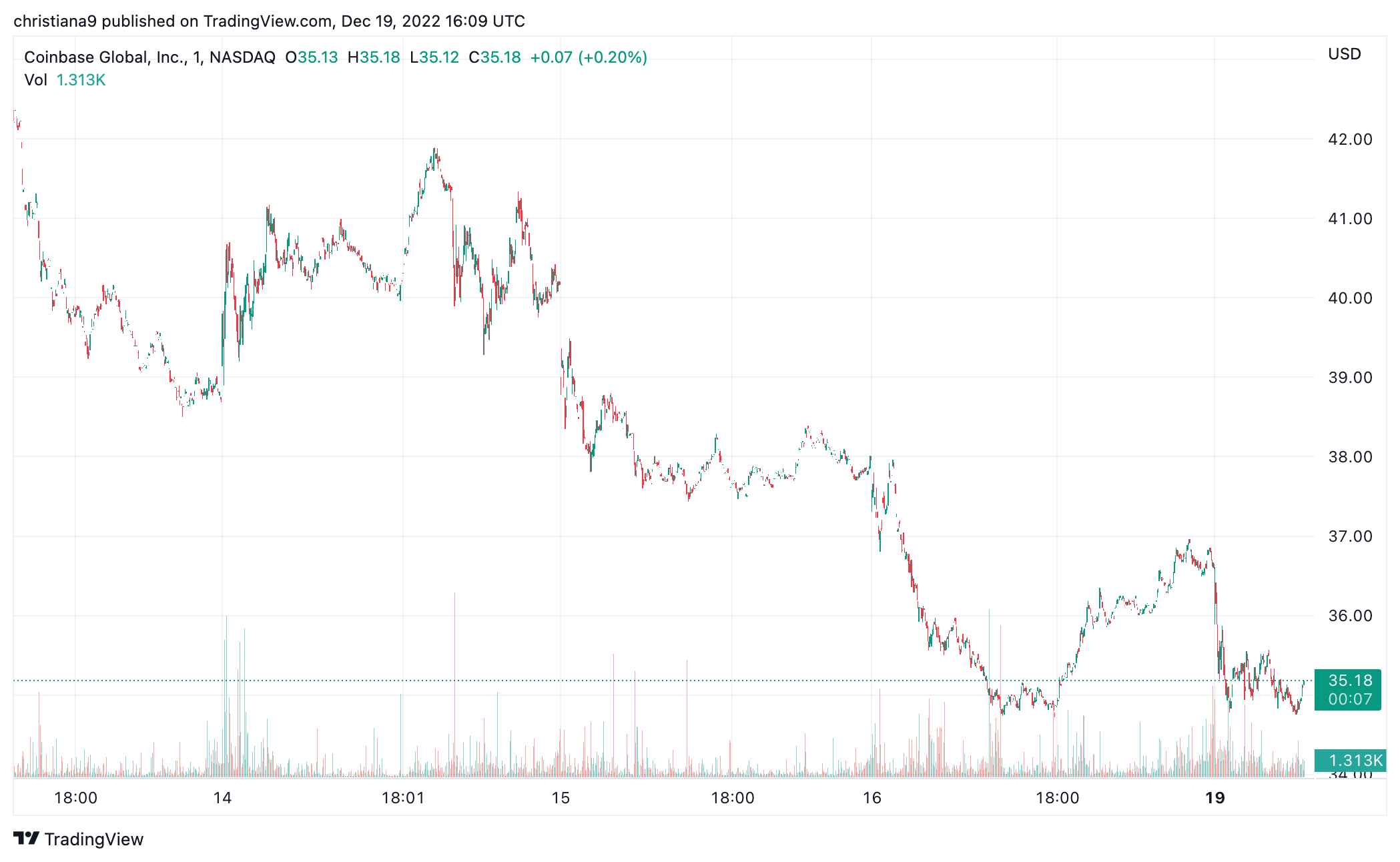
Coinbase was down about 5%, while shares of Silvergate were trading lower by 3.8%.  MicroStrategy slipped 0.9%.

Coinbase Chart by TradingView

Also making headlines on Monday, Grayscale said it is looking at ways to return up to 20% of its Grayscale Bitcoin Trust’s capital to shareholders in case in case it fails to turn the product into an exchange-traded fund (ETF).

Grayscale’s GBTC was trading at 48.7% discount on Friday, according to the most recent data from The Block’s data dashboard.

Former President Donald Trump’s new NFT collection, which was launched last week with a $99 price tag, had a floor price at around 0.2593 ETH — or about $290 — on Monday morning. It hit a peak of 0.839 ETH late Saturday afternoon. The total volume has hit 6,492 ETH.

© 2022 The Block Crypto, Inc. All Rights Reserved. This article is provided for informational purposes only. It is not offered or intended to be used as legal, tax, investment, financial, or other advice.
Go to Source
Author: Catarina Moura

More crypto exchanges likely to ‘blow up’ like FTX, Wave Financial CEO says

Wave Financial, a crypto asset manager with over $1 billion under management, succeeded in navigating the collapse of crypto exchange FTX with zero client losses. Now it’s warning of potential risks with other exchanges.

“We did have assets on FTX for clients a week or two before it actually imploded, but we knew what was going on or started to hear what’s going on long before there was a real problem and got all the assets out,” David Siemer, Wave Financial’s CEO, said on an end-of-year client call last week that The Block was invited to attend.

FTX filed for bankruptcy protection in November, leaving hundreds of thousands of clients with funds frozen on the exchange. U.S. prosecutors last week charged former CEO Sam Bankman-Fried with fraud and money laundering. Siemer said it’s unlikely the pain will stop there.

“Our expectation is there are a whole bunch of others, some of them even top 10, exchanges that are probably functionally insolvent as well,” Siemer told clients. “And we’re just sitting around waiting to see when they blow up.” 

Distressed crypto assets 

Wave Financial’s risk-first approach has helped the firm to maintain a strong balance sheet in the crypto bear market, which it’s now using to snap up distressed assets, Siemer said.

The asset manager was among several bidders for the assets of bankrupt crypto exchange Voyager Digital, which filed for bankruptcy in July. Wave also recently announced its intention to acquire Swiss-based investment firm Criptonite Asset Management. 

“We bid on two companies last week,” Siemer said. “I mentioned we completed one acquisition a few months ago, which is also pretty distressed, not distressed like bankruptcy but running out of money. And there are probably three others we are leaning toward making offers for, things are really cheap in crypto.”

Prices are dropping as many of the bigger buyers in the space are no longer in the game, Siemer said. 

“A couple of deals we are making offers on we are literally offering them zero and a teeny bit of stock and we are going to get it because it’s either that or they put the lights off,” Siemer said. “It’s really just tactical hires.” 

“The first crypto winter we went through, which is right when we launched the company in 2018, we were completely on defense. That was not fun,” he added. “We survived but that was about all we did. This time we are set up to take advantage of this.”

Is Binance safu?

Any further exchange collapses will bring more bad press and greater focus on the crypto industry from regulators, but the damage will be a fraction of FTX’s impact, Siemer said. 

This implies that Binance, the world’s largest crypto exchange, isn’t counted on Siemer’s danger list. There’s been speculation about the health of the exchange by some market participants, and last week it experienced significant withdrawals. Reuters published an investigation on Monday pointing to the lack of transparency in Binance’s finances. 

“They’re the biggest exchange in the world,” Siemer said on the call. “There’s no chance in my mind that Binance lost money the way FTX lost most of the money — and they don’t do directional bets. They don’t have a hedge fund attached to them that’s out there just punting and arbing and taking all these weird bets that sometimes go wrong.” 

Even with this confidence, the Wave Financial team, which is made up of traditional finance veterans, still takes a cautious approach to trading on Binance. 

“We’ll put on the coins, we’ll trade it, we’ll get it off within an hour,” Siemer said. “And we just keep our exposure really, really limited. At any point in time, we have close to zero exposure.” 

Disclaimer: Beginning in 2021, Michael McCaffrey, the former CEO and majority owner of The Block, took a series of loans from founder and former FTX and Alameda CEO Sam Bankman-Fried. McCaffrey resigned from the company in December 2022 after failing to disclose those transactions.

© 2022 The Block Crypto, Inc. All Rights Reserved. This article is provided for informational purposes only. It is not offered or intended to be used as legal, tax, investment, financial, or other advice.

Go to Source
Author: Kari McMahon

a16z’s Chris Dixon sees community builders as future of web3 gaming

Chris Dixon, founder and general partner of a16z, is excited for where web3 gaming could go over the coming year. 

“There’s a whole bunch of launches within the next 12 months that I’m excited about,” Dixon said during an exclusive interview on The Block’s podcast The Scoop.

Dixon described how, within the past three years, most teams building web3 games were “crypto people who were game enthusiasts.” But now, “top tier gaming teams” such as those in Blizzard, Riot and Valve “have decided that they want to either build traditional games that include games with NFTs, or in the more extreme case […] build fully on-chain games” that would allow for things like “modding on steroids; who can take the game and fork it and add to it.”

“The game becomes built by community instead of built by a company,” he said. “And I think that’s really exciting.”

a16z launced a $600 million fund to build out the web3 game industry in May. The firm has since invested $23 million in the collectibles and NFT gaming platform Cryptoys, led a $56 million round in the metaverse avatar platform Ready Player Me and led a $150 million raise for the blockchain gaming startup Mythical Games

Web3 gaming is presently dominated by two entities, according to The Block’s Data Dashboard. The first is Axie Infinity, the game that popularized the play-to-earn web3 gaming model before its economic instability spurred its decline. The next is Yuga Labs’s metaverse gaming project Otherdeed, which launched in May of this year.

In addition to games, Dixon thinks of NFTs “as taking crypto out of the financial world and into the media world, which is a just a bigger world objectively. There are more people in the world who are more interested in media than in finance.”

“I think a path to get us to a billion people actively engaging with crypto will probably goes through media in some way.”

© 2022 The Block Crypto, Inc. All Rights Reserved. This article is provided for informational purposes only. It is not offered or intended to be used as legal, tax, investment, financial, or other advice.

Go to Source
Author: MK Manoylov

Binance to acquire remaining 40% stake in Indonesian exchange Tokocrypto: Source

Binance is fully acquiring Tokocrypto, after first purchasing a controlling stake in the Indonesian crypto exchange in 2020.

In May 2020, when the investment in Tokocrypto was first announced, Binance purchased a 60% stake in the business, and is now acquiring the remaining 40%, a source with direct knowledge of the matter told The Block. The Block had revealed at the time that Binance’s investment in Tokocrypto gave it a majority or controlling stake.

Tokocrypto today announced that Binance “will gradually increase its stake to nearly 100%,” building on its previous investment in 2020. Binance CEO Changpeng “CZ” Zhao tweeted that “Binance was the majority shareholder of Toko[crypto] from the beginning. Just injected more cash and increased our shareholding a bit.”

A Binance spokesperson declined to comment to The Block when contacted about the stake acquisition percentages. Rieka Handayani, vice president of corporate communications at Tokocrypto, also declined to comment on those details.

“In light of this upcoming deal, Tokocrypto will make some changes to their organizational structure to better adapt to the refreshed business model,” today’s announcement reads. “The company’s founder and CEO, Pang Xue Kai, will step down from his position and pass the helm over to Yudhono Rawis, who will step in as Interim CEO. Pang Xue Kai will become part of Tokocrypto’s Board of Commissioners and continue to provide leadership support in his new role.”

Tokocrypto will also reduce its headcount as part of the deal, according to the announcement. An “employee adjustment of around 58%” is expected, Handayani told CoinDesk. The company reportedly laid off 45 employees, or about 20% of its workforce, in September.

Regulated exchange 

Tokocrypto was founded in 2018 and is regulated by Indonesia’s Commodity Futures Trading Regulatory Agency (locally known as Bappebti). It is one of the largest exchanges in Indonesia, claiming to have more than 2 million registered users. It is backed by Singapore-based crypto market maker QCP Capital. QCP was a founding investor in Tokocrypto and will no longer hold a stake in Tokocrypto after the Binance deal, the source said.

QCP, which was left with at least $97 million stuck on FTX after the crypto exchange filed for bankruptcy last month, declined to comment.

Tokocrypto’s native token is currently trading 15% up at around $0.33, according to CoinGecko.  

Binance appears to be targeting the Asian market for expansion lately. Last month, the company acquired Japan-based licensed exchange Sakura Exchange BitCoin (SEBC) for an undisclosed sum. Earlier this year, it bought a strategic stake in Malaysian crypto exchange MX Global.

Binance hopes to invest more heavily in crypto firms in the near future. It recently announced a $1 billion “industry recovery initiative” to help mitigate fallout stemming from FTX’s collapse. The initiative will invest in otherwise strong firms that are facing a liquidity crisis. Jump Crypto, Polygon Ventures, GSR, Animoca Brands and others are also part of Binance’s initiative and have together committed around $50 million.

Disclaimer: Beginning in 2021, Michael McCaffrey, the former CEO and majority owner of The Block, took a series of loans from founder and former FTX and Alameda CEO Sam Bankman-Fried. McCaffrey resigned from the company in December 2022 after failing to disclose those transactions.

© 2022 The Block Crypto, Inc. All Rights Reserved. This article is provided for informational purposes only. It is not offered or intended to be used as legal, tax, investment, financial, or other advice.

Go to Source
Author: Yogita Khatri

Bitcoin mining jumps 3.27% after substantial dip. What does luck have to do with it?

Bitcoin mining difficulty in October had its highest spike since last summer, when China cracked down on the industry and forced mining firms to flee to other countries. Meanwhile, its lowest ebb since then was just a few days ago. 

Now it’s back up by 3.27%, according to the latest adjustment posted Monday by BTC.com. Why the yo-yoing? The reasons aren’t completely clear to industry experts.

A probable explanation is the switching on and off of machines depending on spot energy prices and profitability, with more efficient models also being deployed. But it also might be a case of luck, said Daniel Frumkin, director of research at Braiins.

“My theory is that the ‘capitulation’ that appeared to happen in the last epoch (leading to the Dec. 6 adjustment) was greatly overstated and it was really just a very ‘unlucky’ period of variance,” he told The Block.

The difficulty adjustments are based on what is the average block time for that epoch, meaning the period in between. So it takes longer to mine those blocks, the network will assume that the hashrate has dropped and accordingly lower the difficulty.

In greater detail: Let’s say you have 10% of the total network hashrate. That means you should be mining 10% of the blocks. However, due to the probabilistic nature of mining, you could be unlucky and only mine 5% just as you could be lucky and mine 15%, Ethan Vera, COO of Luxor, a bitcoin mining software company that runs a mining pool, said.

In theory, the entire industry could be lucky or unlucky. With the same amount of total network hashrate, it could hit 140 blocks one day and 150 blocks the next.

Vera said that while it’s “very likely” that luck did have an effect on the 7.32% drop a few days ago, it’s also very hard to know for certain “what impact of the difficulty adjustment is coming from luck versus what is coming from actual right network hashrate changes.”

Frumkin said the real-time hashrate was above 250 EH/s for the entire month of November (unlike hashrate estimates), which is why he believes that the drop that happened on Dec. 6 wasn’t from that much hashrate coming offline. “It could have just been an unprecedented event where there really was just bad luck by multiple pools all at the same time.”

“It’s also true that some miners were shutting off,” Frumkin said. “There’s new hashrate coming on by more efficient miners and then there’s hashrate going off.”

“Any time there’s extreme volatility in the price (of bitcoin), the same could be found with hashrate,” said Kevin Zhang, senior vice president at mining pool Foundry. “Recently, we had a really dynamic scenario of an immense amount of newer gen (higher efficiency) ASIC’s being deployed coupled with large miners capitulating with bankruptcies.”

 Miners without a fixed power agreement are at the whim of market prices and “energy is really driving a lot of people’s decisions,” said Riot CEO Jason Les.

And although there is “a lot of short-term variability in hashrate that’s driven by spot energy prices,” over the next six months hashrate will likely keep growing as companies continue to deploy efficient machines, Marathon’s CEO Fred Thiel said.

© 2022 The Block Crypto, Inc. All Rights Reserved. This article is provided for informational purposes only. It is not offered or intended to be used as legal, tax, investment, financial, or other advice.

Go to Source
Author: Catarina Moura

Polychain Capital leads bitcoin wallet developer Foundation’s $7 million raise

Foundation has raised $7 million to develop bitcoin-centric tools which enable what they call “digital sovereignty.”

The seed round was led by Polychain Capital. Other backers include Greenfield Capital, Lightning Ventures, Warburg Serres and Bolt, according to a company release. 

The Boston-based startup, which was founded in 2020, develops tools to make bitcoin more accessible. Its flagship product is a bitcoin hardware wallet called Passport and it has also developed a mobile app that contains a bitcoin software wallet, called Envoy. 

Foundation's bitcoin devices

Foundation’s bitcoin wallets

Weathering the bear market

The startup closed the fundraise in December as a pure equity round Zach Herbert, co-founder and CEO of Foundation, said in a statement to The Block. 

“The current environment certainly made things more difficult, but I think we were buoyed by our clear vision of sovereignty and self-custody,” Herbert said. “In the wake of FTX, it’s more important than ever that we empower individuals with the ability to store their own keys. The current generation of wallets have served early adopters, but the majority of funds still remain on centralized exchanges.” 

The funds from the raise will be used to continue building products with a short-term focus on software services, according to the release. The funding will also be used for expanding the design and engineering teams. 

“The rave reviews that Foundation’s Passport has garnered already is indicative of the demand for sovereignty and freedom in this new era,” said Tyler Mincey, Foundation board member and partner at Bolt, in the release. “This is a giant step in the right direction, both for self-custody and digital sovereignty, which is one of the many reasons we are excited to continue supporting the Foundation team through this fundraise.” 

Foundation previously raised $2.5 million in a pre-seed round led by Bolt in July last year. 

The rise of hardware wallets

Hardware wallets are in focus following the collapse of crypto exchange FTX, where many users lost their assets after allowing the exchange to take custody of them. Hardware wallets mean users can self-custody their assets offline in a secure manner. 

Pascal Gauthier, the CEO of Ledger which is one of the top hardware wallet manufacturers, told The Block that the FTX catastrophe has spurred the best sales month to date for its devices, which almost doubled its previous record. He said that last month’s sales were in the “few hundred thousand” range. Ledger also recently debuted a new device designed by iPod inventor Tony Fadell.

Likewise, a spokesperson from hardware wallet developer Trezor told The Block that demand for its products jumped by more than 300% in mid-November following the FTX collapse. 

© 2022 The Block Crypto, Inc. All Rights Reserved. This article is provided for informational purposes only. It is not offered or intended to be used as legal, tax, investment, financial, or other advice.

Go to Source
Author: Kari McMahon

Binance.US agrees to buy Voyager’s assets

Binance.US has entered into an agreement with Voyager Digital to acquire the bankrupt crypto lender’s assets.

The bid from the largest crypto exchange’s U.S. arm “sets a clear path forward for Voyager customers’ funds to be unlocked as soon as possible, and returned to them in the form of the cryptocurrencies previously held in their Voyager accounts,” an official blog post notes.

Binance.US’s winning bid beats other industry players, such as CrossTower, Wave Financial and INX.

“Our bid is a reflection of our guiding principle that customers should come first,” Brian Shroder, Chief Executive Officer and President of Binance.US, said, adding:

“Our goal is simple: return users their cryptocurrencies on the fastest timeline possible. We hope our selection brings to an end a painful bankruptcy process which saw customers unfairly dragged into it at no fault of their own. Upon close of the deal, users will be able to seamlessly access their digital assets on the Binance.US platform where they will continue to receive future disbursements from the Voyager estate.”

The announcement comes during financial turmoil for the blockchain and cryptocurrency industry, with centralized exchanges under increased scrutiny. Shroder noted on Twitter that “Binance.US is well capitalized: our assets exceed our liabilities,” explaining: “All of our customers could withdraw their assets tomorrow, which is their right & we would still have hundreds of millions of current assets.”

Voyager filed for Chapter 11 bankruptcy protection in July due to its over $650 million exposure to the collapsed crypto hedge fund Three Arrows Capital.

Updated to provide additional context on other bidders and Voyager.

© 2022 The Block Crypto, Inc. All Rights Reserved. This article is provided for informational purposes only. It is not offered or intended to be used as legal, tax, investment, financial, or other advice.

Go to Source
Author: Adam James

BAYC creator Yuga Labs rounds off year with new CEO from Activision Blizzard

Bored Ape Yacht Club creator Yuga Labs is the latest crypto company set to change its leadership with the appointment of Daniel Alegre, former president and COO of Activision Blizzard, as its CEO. 

The NFT brand, which also owns CryptoPunks and Meebits, has so far been shepherded by Nicole Muniz, who will stay on as a partner and strategic advisor, according to a company release. Alegre will officially start in the first half of 2023. 

Activision Blizzard is known for developing blockbuster games such as Call of Duty and World of Warcraft. Alegre had been in the seat since early 2020. The business is currently being acquired by Microsoft for $68.7 billion, pending regulatory approval. The deal was expected to close as early as 2023 but recently hit a bump in the road when the U.S. Federal Trade Commission formally opposed it. 

The hire puts a firm stake in the ground for Yuga Labs’ gaming ambitions as it prepares for additional tests of its Otherside ‘metaverse’ — the multiplayer web3 game it is developing for Bored Ape Yacht Club faithful. Yuga has previously outlined ambitions to become the Disney of web3. 

“The company’s pipeline of products, partnerships, and IP represents a massive opportunity to define the metaverse in a way that empowers creators and provides users with true ownership of their identity and digital assets,” said Alegre.

Alegre has also spent 16 years in leadership roles at Google (President of Global Retail and Shopping, President of Global and Strategic Partnerships, and President of Asia-Pacific and Japan).

“The move reinforces the notion that Yuga is doubling down on becoming the backbone of web3 gaming,” said Thomas Bialek, a research analyst focussing on NFTs at The Block Research. “Under the new leadership, efforts to proliferate the lifestyle aspects of the brand might take a backseat for now as gaming endeavors become the primary focus.”

Yuga is the latest NFT brand to bring in a CEO outside of crypto to lead its expansion ambitions. Julian Holguin moved over from a top job at Billboard earlier this year to lead NFT collection Doodles. 

Yuga has also bolstered its gaming efforts recently by hiring former Scopely executive Spencer Tucker as its chief gaming officer. 

“Nicole, Greg, and I have been on the hunt for someone with Daniel’s skill set for some time. The business, our ambitions, and the complexity of the work have grown beyond our wildest expectations,” said Yuga Labs co-founder Wylie Aronow in a statement.

In March, it was revealed that Yuga Labs raised $450 million at a $4 billion valuation from a16z, Animoca Brands, Coinbase and MoonPay.

Read more: How Bored Apes became the foundation for a metaverse

© 2022 The Block Crypto, Inc. All Rights Reserved. This article is provided for informational purposes only. It is not offered or intended to be used as legal, tax, investment, financial, or other advice.

Go to Source
Author: Lucy Harley-McKeown

Grayscale may return some capital to investors if GBTC’s ETF dreams fail: WSJ

Grayscale Investments will explore how to return up to 20% of its Grayscale Bitcoin Trust’s capital to shareholders if it cannot turn the product into an exchange-traded fund.

A tender offer for 20% of the outstanding shares could be on the table, according to a letter from chief executive Michael Sonnenshein seen by The Wall Street Journal. However, a timeline still needed to be clarified.

The Grayscale Bitcoin Trust carries the ticker GBTC and is a closed-end fund, with a 2% annual fee. It’s currently trading at a nearly 50% discount compared to the bitcoin price.

Crucially, shares in the fund cannot be redeemed, forcing sellers to part with their holdings at a discount. Converting GBTC into an exchange-traded fund could resolve this. However, the U.S. Securities and Exchange Commission has thus far proven harshly critical of spot bitcoin ETFs — having rejected every application for years. Grayscale is currently involved in a lawsuit against the SEC.

© 2022 The Block Crypto, Inc. All Rights Reserved. This article is provided for informational purposes only. It is not offered or intended to be used as legal, tax, investment, financial, or other advice.

Go to Source
Author: Adam James

Ren Protocol’s imminent shutdown likely, $15 million still at risk

Ren Protocol may shut down at any moment, taking $15 million of funds remaining on the network with it — hence the project’s warnings on Twitter.

What’s unique here is that the project’s team doesn’t know exactly when the network will stop functioning. This is because the wrapped bitcoin-focused project was acquired in February 2021 by the now-collapsed trading firm Alameda Research. It appears that Alameda was controlling the infrastructure behind the network — separately from its node operators — and the team doesn’t have all the information.

“We don’t know exactly when, depends on when infrastructure [shuts] down which we aren’t in control of, could be in the next few days, or a week or two, we don’t know [at the moment] but trying to figure out,” said Maximilian Roszko, ecosystem advocate at Ren protocol, in the project’s Discord channel.

The network supports tokens wrapped from other blockchains. Chief among them is renBTC, a tokenized version of bitcoin on the Ethereum blockchain. If Ren goes down, these tokens won’t necessarily have any value, and they won’t be able to be sent back to their original chains to unlock the collateral. 

As a result, Ren has warned users to send these tokens back to their respective chains to unlock this collateral before the network suddenly shuts down. Yet, despite these warnings, more than $15 million of renBTC remains on Ethereum and is at risk of getting stuck.

Roszko said the team wouldn’t have access to any funds when the network gets shut down. That said, it could be theoretically restarted in the future, which might allow for a recovery process.

When asked whether the node operators on the network could force a manual restart, Roszko said this was not possible due to Alameda’s involvement.

Disclaimer: Beginning in 2021, Michael McCaffrey, the former CEO and majority owner of The Block, took a series of loans from founder and former FTX and Alameda CEO Sam Bankman-Fried. McCaffrey resigned from the company in December 2022 after failing to disclose those transactions.

© 2022 The Block Crypto, Inc. All Rights Reserved. This article is provided for informational purposes only. It is not offered or intended to be used as legal, tax, investment, financial, or other advice.

Go to Source
Author: Tim Copeland


Follow by Email
Facebook20
Pinterest20
fb-share-icon
LinkedIn20
Share