FreeCryptoCurrency.Me

Free stocks and money too!

Category Archive : Crypto News

Polygon co-founder launches web3 startup accelerator Beacon

Sandeep Nailwal, co-founder of Polygon and Symbolic Capital, has launched a web3 startup accelerator.

Called Beacon, the New York City-based accelerator said it will support early-stage crypto projects through mentorship and financing. Fifteen startups have already received funding from Beacon, Nailwal told The Block. He declined to share names of those startups, saying they will be announced in January.

Beacon is part of Nailwal’s Symbolic Capital, a crypto venture capital firm he launched in August with a $50 million fund. Nailwal runs Beacon with Kenzi Wang, co-founder of Symbolic Capital, Prateek Sharma, former vice president at Sequoia Capital, and Uri Stav, former chief security officer at Digital Currency Group, among others.

Beacon offers a 12-week program to mentor and finance startup founders. The program’s first cohort, “Cohort 0,” got underway in October, with over 30 founders from 15 startups, across areas including DeFi, infrastructure, and gaming. The next cohort is open for applications until Jan. 31. SoftBank’s Neil Cunha-Gomes, Coinbase’s Dan Kim, Electric Capital’s Maria Shen and Pantera Capital’s Paul Veradittakit are among Beacon’s other mentors.

“Our ultimate goal is to build the greatest network of web3 founders in the world,” Nailwal said. “Having gone through an accelerator before (Binance Labs), I found that the greatest resource in any accelerator is the other founders going through the program alongside you. We think that as our alumni network grows, the overall quality of projects being built in web3 will increase as founders help each other find success.”

Beacon is building a social network for founders and alumni to connect with each other during and after their time in programs. For investors, Beacon said it has already built a custom platform for them to review projects, watch video pitches, read up on founder backgrounds and receive direct introductions to founders.

Beacon is set to host a live demo day next month, where founders will be able to pitch their projects to over 300 investors. It aims to create the next 100 web3 unicorns.

© 2022 The Block Crypto, Inc. All Rights Reserved. This article is provided for informational purposes only. It is not offered or intended to be used as legal, tax, investment, financial, or other advice.

Go to Source
Author: Yogita Khatri
Crypto regulators should leave DeFi alone, Coinbase’s Brian Armstrong says

Brian Armstrong, the co-founder and CEO of crypto exchange Coinbase, called on regulators to focus on centralized entities and leave decentralized finance (DeFi) projects alone. 

“It’s best to create regulatory clarity first around centralized actors in crypto (stablecoin issuers, exchanges, and custodians) because this is where we’ve seen the most risk of consumer harm, and pretty much everyone can agree it should be done,” Armstrong wrote in a Dec. 19 blog post.

Regulating the crypto industry is at the top of policymakers’ agendas following the collapse of FTX, a crypto exchange that filed for bankruptcy protection in November after reportedly misusing billions in client funds. U.S. prosecutors last week charged co-founder and former CEO Sam Bankman-Fried with fraud and money laundering.

Like FTX, Coinbase is also a centralized exchange. Armstrong’s firm is, however, publicly traded on U.S. stock markets and regulated by the U.S. Securities and Exchange Commission.

Let DeFi innovate

Armstrong argued that regulation should start with stablecoins, followed by centralized exchanges and custodians — leaving room for DeFi to innovate.

Self-custodial wallets, for example, should be regulated as software companies rather than financial services because they don’t take possession of customer funds, he said. Equally, creating decentralized protocols should be equivalent to publishing open-source code and hence protected by U.S. rules around freedom of speech. 

“Regulating stablecoin issuers is a good place to start, because there is broad interest in D.C., and we can get some momentum with a quick win,” Armstrong said. “We don’t need to do anything fancy or crypto specific here; stablecoins can be regulated under standard financial services laws by using, for instance, a state trust charter or an OCC national trust charter.”

By borrowing regulatory frameworks from traditional financial services, Armstrong estimates a stablecoin law could be passed in the first half of next year, which leaves regulators with room to focus on the more challenging tasks of creating a regulatory framework for centralized crypto players and identifying which digital assets count as securities or commodities.

Coinbase only lists assets that it classes as commodities through its own self-developed detailed legal analysis of assets, Armstrong said. This was developed due to the lack of clarity provided by U.S. securities and commodities regulators, he said. Though he would prefer to see clarity emerge on this topic as well as the development of “a robust market” to register and issue crypto securities in the U.S.

“The role of financial regulators should be limited to centralized actors in cryptocurrency, where additional transparency and disclosure is needed,” Armstrong said. “In an on-chain world, this transparency is built in by default, and we have an opportunity to create even stronger protections.”

‘An open secret’

Still, regulation can only go so far, Armstrong said. He highlighted that enforcement, domestically and abroad, is equally as important.

“It’s an open secret in the crypto industry that there are still a handful of questionable actors who are not following rules like those above,” Armstrong said. “And we will continue to see issues in the crypto space until both regulatory clarity emerges and a level playing is enforced.”

FTX operated its main exchange offshore from the Bahamas, which helped it to skirt regulations around the world.

Andreessen Horowitz (a16z) general partner Chris Dixon, who has invested in Coinbase, emphasized this open secret in a recent interview on The Block’s podcast The Scoop. He referenced  a “whack-a-mole” pattern that frequently forms where new off-shore exchanges would crop up and then disappear each cycle. FTX’s offshore model is part of the reason Dixon didn’t take the exchange seriously.

“If you don’t have on-chain trust, and you don’t have off-chain regulated trust, I wouldn’t put my money there,” he said.

Disclaimer: Beginning in 2021, Michael McCaffrey, the former CEO and majority owner of The Block, took a series of loans from founder and former FTX and Alameda CEO Sam Bankman-Fried. McCaffrey resigned from the company in December 2022 after failing to disclose those transactions.

© 2022 The Block Crypto, Inc. All Rights Reserved. This article is provided for informational purposes only. It is not offered or intended to be used as legal, tax, investment, financial, or other advice.

Go to Source
Author: Kari McMahon

Wintermute sees revenue plunge but CEO remains optimistic: Forbes

Digital asset trading firm Wintermute booked $225 million in revenue during the first nine months of 2022, compared to $1 billion for all of 2021, Forbes reported.

In 2021, the firm — led by former Optiver trader Evgeny Gaevoy — reported $582 million in profit. Wintermute has $400 million in equity and $720 million in assets, Gaevoy told the magazine. 

The CEO received $12 million last year in the form of dividends paid to shareholders. 

Gaevoy told Forbes he is preparing for another 2021-like year, noting that “we don’t necessarily care about making the most now because it’ll be just a tiny fraction of the bull markets that can come.”

Underpinning the firm’s revenue slump this year was a broader credit crunch that forced some of its competitors to step back from certain trading or lending activity or to declare bankruptcy. That’s been coupled with a steep decline in trading volumes, which firms like Wintermute rely on to turn an outsized profit. 

Wintermute also got hit by a $160 million hack on the firm’s decentralized finance operation in September.

© 2022 The Block Crypto, Inc. All Rights Reserved. This article is provided for informational purposes only. It is not offered or intended to be used as legal, tax, investment, financial, or other advice.

Go to Source
Author: Frank Chaparro

BitDAO mulls $100 million token buyback for next year

BitDAO is considering a $100 million buyback of its bit token beginning from the start of next year as part of the DAO’s capital deployment strategy.

The plan is contained in a governance proposal filed with the DAO on Monday. This proposal calls for BitDAO to set its target daily purchase amount at $2 million in USDT for 50 days beginning from Jan. 1 next year. If approved, the DAO will have spent $100 million in USDT to repurchase its bit token at the end of the proposed 50 days. The proposal is also an extension of previous buyback schemes.

The suggested buyback is part of BitDAO’s efforts to promote internal capital deployment. Launched in 2021, BitDAO is unlike other DAOs built around DeFi protocols. Instead, BitDAO is an investment DAO that aims to support web3-based research and development via grants. The DAO has also begun to develop its own projects and plans to release an Ethereum Layer 2 network called Mantle in 2023.

More bit tokens for the treasury

The funds for the buyback will come from BitDAO’s $1.7 billion treasury, half of which is in its native bit token. As such, the percentage of the DAO’s holdings in its native token will increase at the end of the buyback period — if the community agrees to the plan.

DAOs whose native tokens form the bulk of their treasuries have had to deal with massive declines in the value of their reserves this year. This is because these tokens, like the rest of the crypto market, have gone down in price throughout 2022. In response, DAOs are looking into ways to diversify their treasuries. They are doing so by increasing their exposure to stablecoins and also investing in low-risk real-world assets like U.S. Treasuries.

BitDAO owns the second-largest DAO treasury behind Uniswap. The DAO’s reserve currently holds $326 million in ether and $410 million worth of USDT and USDC stablecoins.

© 2022 The Block Crypto, Inc. All Rights Reserved. This article is provided for informational purposes only. It is not offered or intended to be used as legal, tax, investment, financial, or other advice.

Go to Source
Author: Osato Avan-Nomayo

Central African Republic delays listing Sango coin to 2023

The listing of Sango, the Central African Republic’s national cryptocurrency, has been delayed until the first quarter of 2023. 

Market conditions and seasonal factors such as the holiday season were cited as reasons for the delay by moderators of the project’s Telegram channel.

CAR’s President Faustin-Archange Touadéra announced Sango Coin as the country’s national crypto in July. It is set to be used as part of the country’s plans to tokenize its mineral resources.

The cryptocurrency’s public sale also began in July, with 200 million Sango Coins available for purchase at a price of $0.10. Investors have been promised a 5% return of their stake at the moment of listing. 

Sango Coin will run on a bitcoin sidechain, as previously reported by The Block. This sidechain is reportedly similar to Blockstream’s Liquid Network with a two-way peg mechanism. Bitcoin and Sango Coin will be the tokens in the peg architecture.

CAR became the first African nation, and the second in the world, to adopt bitcoin when it recognized BTC as legal tender in April.

© 2022 The Block Crypto, Inc. All Rights Reserved. This article is provided for informational purposes only. It is not offered or intended to be used as legal, tax, investment, financial, or other advice.

Go to Source
Author: Lucy Harley-McKeown

BlockFi seeks to reopen withdrawals for certain users

Bankrupt crypto lender BlockFi is seeking to reopen withdrawals for users who have crypto locked in wallet accounts.

The lender filed a motion on Dec. 19 with the U.S. Bankruptcy Court in the District of New Jersey. The motion seeks to authorize the debtors to honor withdrawals from wallet accounts, update the user interface to reflect transactions and conduct ordinary course reconciliation of accounts.

“The BlockFi Wallet Terms of Service are clear,” said BlockFi in the filing. “They provide that ‘title to the cryptocurrency held in your BlockFi Wallet shall at all times remain with you and shall not transfer to BlockFi.’ The Debtors have no legal or equitable interest in cryptocurrency that was present in the Wallet Accounts as of Platform Pause, and clients should be able to withdraw such assets from the platform if they choose.”

A hearing on the matter is scheduled for Jan. 9 at 10 a.m. ET.

A separate hearing will take place on Jan 13. regarding wallet accounts held by BlockFi International Ltd., a subsidiary that runs its non-U.S. operations based out of Bermuda.

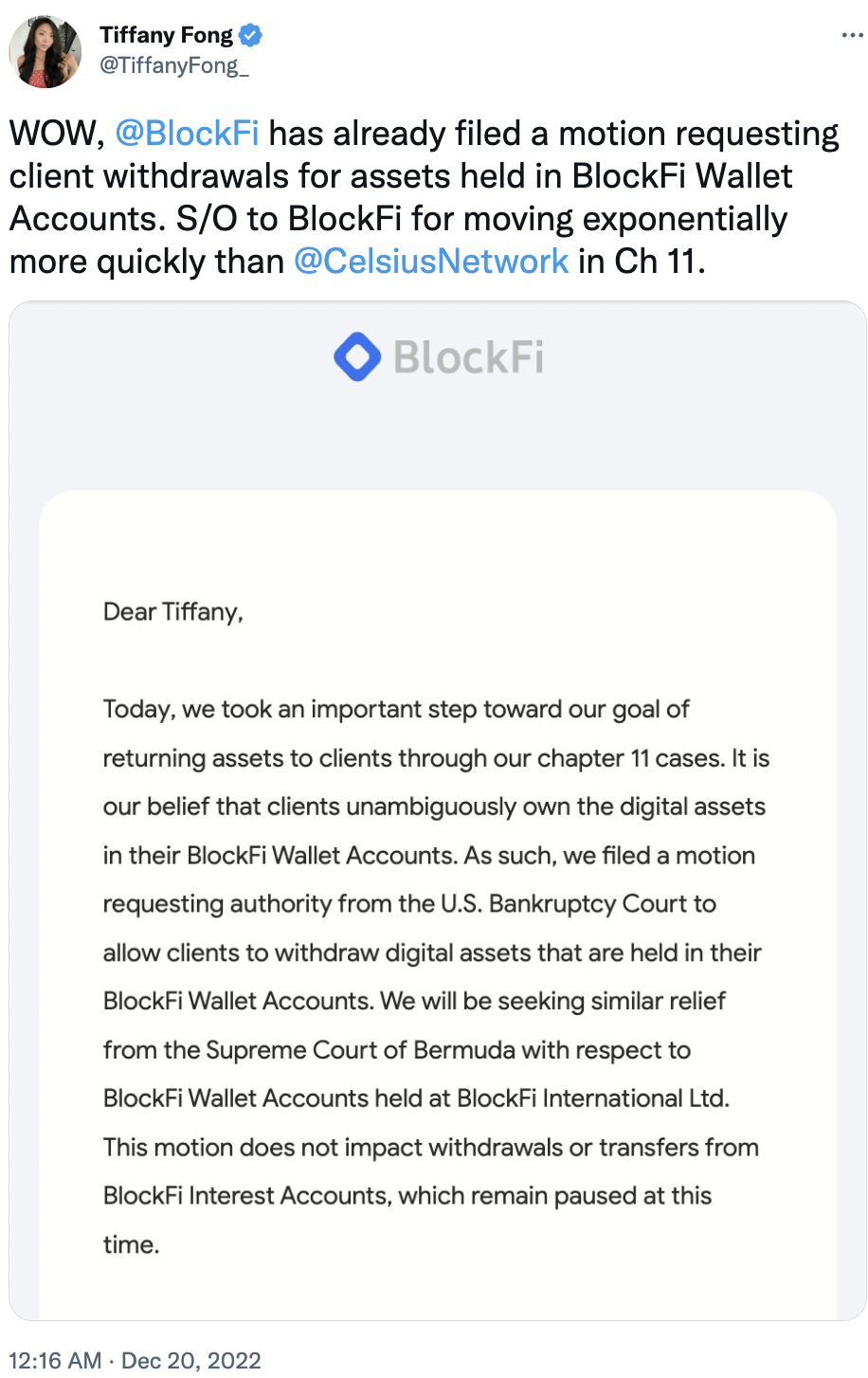
BlockFi clients were also contacted on Dec. 19 regarding the firm’s intentions to reopen withdrawals for wallet users, according to reports from users on Twitter.

Crypto blogger Tiffany Fong on communication received from BlockFi

Source: Twitter

Why did BlockFi file for bankruptcy?

BlockFi, which brokered a $680 million deal with now collapsed crypto exchange FTX.US , paused withdrawals as concerns surrounding FTX’s financial health escalated. On Nov. 28, the lender filed for Chapter 11 bankruptcy protection.

BlockFi claimed more than 100,000 creditors as well as between $1 billion and $10 billion in both assets and liabilities, according to the firm’s bankruptcy petition. At the time, the firm said it had $257 million in cash on hand, which is expected to provide sufficient liquidity during the restructuring process.

Bankrupt crypto lender Celsius also made a similar motion in its restructuring process. On Dec. 8, the lender provided a status update on the motion and said the court had authorized Celsius to return “pure custody accounts,” which were never in Celsius’s earn or borrow programs.

The court also approved withdrawals from “transferred”custody accounts with assets below $7,575 and granted the firm authority to return digital assets that are not supported on the platform.

Disclaimer: Beginning in 2021, Michael McCaffrey, the former CEO and majority owner of The Block, took a series of loans from founder and former FTX and Alameda CEO Sam Bankman-Fried. McCaffrey resigned from the company in December 2022 after failing to disclose those transactions.

© 2022 The Block Crypto, Inc. All Rights Reserved. This article is provided for informational purposes only. It is not offered or intended to be used as legal, tax, investment, financial, or other advice.

Go to Source
Author: Kari McMahon

Auros bankruptcy protection filings show funds tied up on FTX

Market making firm Auros filed to begin bankruptcy proceedings in the British Virgin Islands, court documents show.

A digital asset market maker and algorithmic trading platform, Auros maintained operations via “a series of loans and financing arrangements with various lenders.” However, Auros found its capacity to manage those agreements affected due to its exposure to the collapse of FTX, the filing said. Auros is based in the British Virgin Islands. 

“A significant proportion of the Company’s assets” — worth roughly $20 million — were held on the FTX on Nov. 11, when FTX filed for Chapter 11 bankruptcy protection in the U.S., according to Auros. With those assets frozen, Auros was effectively rendered insolvent.  

Auros now seeks an order to be liquidated by the court, and it has proposed Interpath Advisory as its liquidator.

Disclaimer: Beginning in 2021, Michael McCaffrey, the former CEO and majority owner of The Block, took a series of loans from founder and former FTX and Alameda CEO Sam Bankman-Fried. McCaffrey resigned from the company in December 2022 after failing to disclose those transactions.

© 2022 The Block Crypto, Inc. All Rights Reserved. This article is provided for informational purposes only. It is not offered or intended to be used as legal, tax, investment, financial, or other advice.

Go to Source
Author: Jeremy Nation and Benjamin Robertson

Visa proposes using StarkNet for automatic recurring payments

Visa said that StarkNet, a layer 2 blockchain built on top of Ethereum, may help bridge the gap between crypto and the real world by letting people who use self-custodial wallets pay their bills more easily.  

While automatic recurring payments are common on traditional mobile banking apps, it’s a harder task on the blockchain, according to a crypto thought leadership proposal from Visa. The team utilized a novel concept called account abstraction to explore how smart contracts can be implemented to enable automated and programmable payments.

“We see auto payments as a core functionality that existing blockchain infrastructure lacks,” the authors of the proposal wrote.

Visa implemented its proof of concept with crypto wallet Argent using the StarkNet scaling platform because account abstraction, which allows smart contracts to carry out transactions for a user, isn’t live yet on Ethereum. The proposal outlines a way for users to automatically send payments using the self-custodial wallet without having to sign each transaction. 

“Using the approach we have introduced, other real-world applications beyond recurring payments could be brought to the blockchain,” the authors wrote.

Visa has been focused on crypto infrastructure and protocols for payments, researching areas such as privacy and security for payments that need to be improved before real-world implementations. The company said that it is open to discuss ideas in programmable payments with companies working on the subject.

© 2022 The Block Crypto, Inc. All Rights Reserved. This article is provided for informational purposes only. It is not offered or intended to be used as legal, tax, investment, financial, or other advice.

Go to Source
Author: Mike Truppa

Alameda gave $400 million to startup based in SBF’s Bahamian condo community: CoinDesk

Modulo Capital, a relatively unknown firm that appears to have a lot in common with Sam Bankman-Fried and Caroline Ellison, received a $400 million loan from Bankman-Fried’s investment firm, Alameda Research, CoinDesk first reported. Ellison was the CEO of Alameda

Modulo Capital was founded by three former Jane Street traders, a New York-based company that employed Bankman-Fried and Ellison prior to their moves into the crypto industry. Modulo Capital operates out of the same Bahamian luxury condominium community that the two resided in. 

Modulo Capital is one of the largest investments Alameda Research made, coming in at $400 million. People familiar with the matter told CoinDesk that Modulo approached other institutional finance investors before landing on Alameda. 

Bankman-Fried was arrested on Dec. 12 in the Bahamas for charges including wire fraud conspiracy, securities fraud and money laundering. He has since agreed to be extradited to the U.S. to face fraud charges, The Block previously reported. 

Disclaimer: Beginning in 2021, Michael McCaffrey, the former CEO and majority owner of The Block, took a series of loans from founder and former FTX and Alameda CEO Sam Bankman-Fried. McCaffrey resigned from the company in December 2022 after failing to disclose those transactions.

© 2022 The Block Crypto, Inc. All Rights Reserved. This article is provided for informational purposes only. It is not offered or intended to be used as legal, tax, investment, financial, or other advice.

Go to Source
Author: MK Manoylov

Bitcoin mining report: Most miners tracked Bitcoin lower

Most bitcoin mining stocks tracked by The Block fell on Monday, in line with the coin’s price.

Bitcoin prices were around $16,600 by market close, according to data from TradingView.

BTCUSD Chart by TradingView

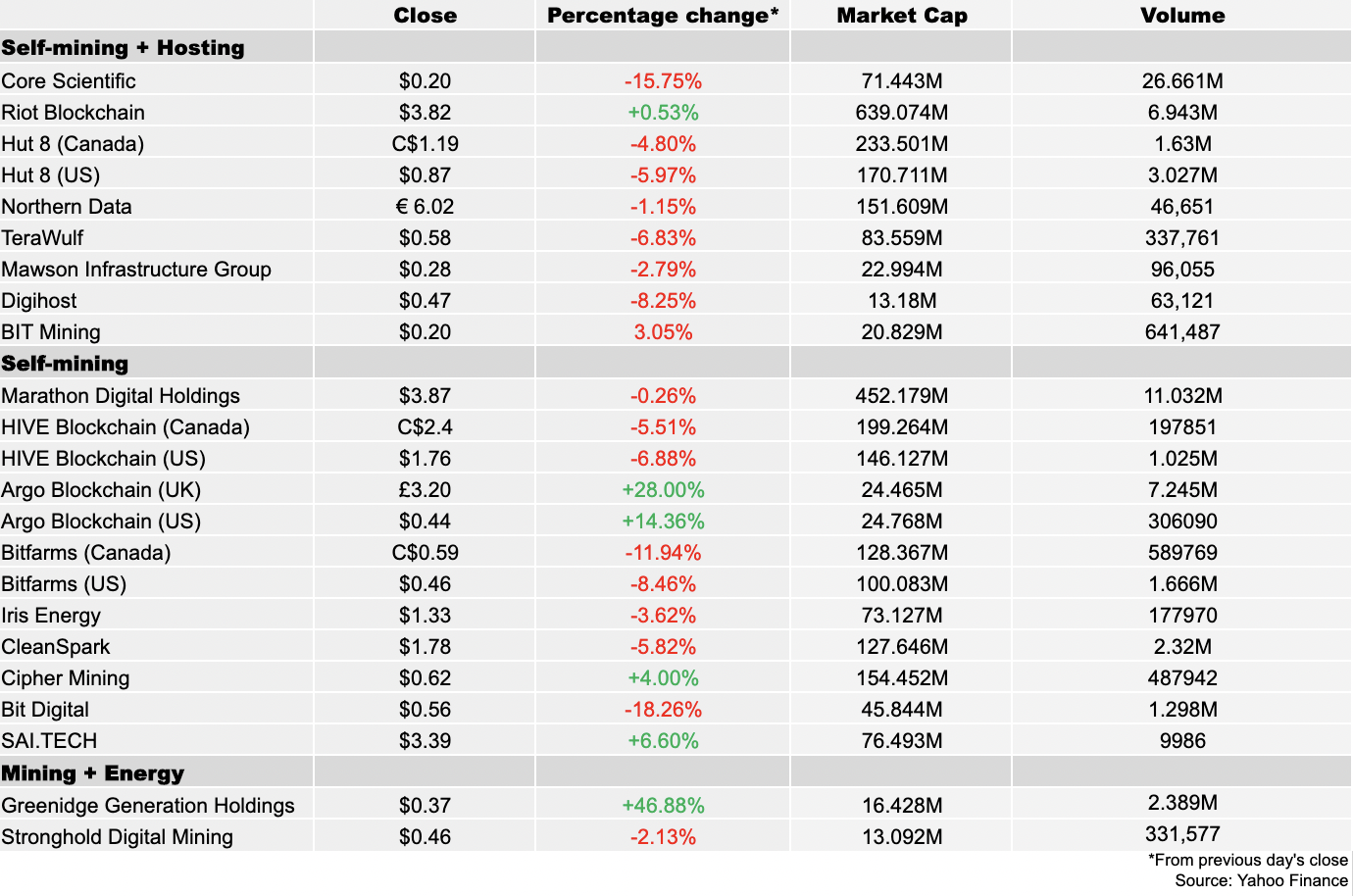
Bit Digital’s stock fell by 18% and Core Scientific’s by 16%. Meanwhile, shares of Greenidge Generation Holdings went up by 47% and Argo Blockchain by 28%.

Here’s how crypto mining companies performed on Monday, Dec. 19:

© 2022 The Block Crypto, Inc. All Rights Reserved. This article is provided for informational purposes only. It is not offered or intended to be used as legal, tax, investment, financial, or other advice.

Go to Source
Author: Catarina Moura


Follow by Email
Facebook20
Pinterest20
fb-share-icon
LinkedIn20
Share