FreeCryptoCurrency.Me

Free stocks and money too!

Category Archive : Crypto News

2023 Digital Asset Outlook

Quick Take 

  • 2023 Digital Asset Outlook report focuses on 2022 key developments from 10 sectors in the cryptocurrency industry and trends to look out for in 2023 
  • Download your free copy today  

In 2022, the digital assets industry did not experience the same euphoria as the previous year. And yet, the pace of news, events, and technological advancement has not slowed. The Block Research distilled this year’s development into more than 420 unique research pieces for our members.  

We present the 2023 Digital Asset Outlook Report to provide all readers with a comprehensive outlook on the rapidly evolving industry. This report provides a granular look at the most significant developments in cryptocurrency in 2022 and highlights several key trends to watch over in 2023.  

The 199-page report covers 10 sectors within the cryptocurrency industry: 

  1. State of the general market 
  2. BTC and ETH mining market 
  3. Investment trends 
  4. Layer-1 platforms 
  5. Blockchain scaling solutions and bridges 
  6. Decentralized finance (DeFi) 
  7. Web3 infrastructure 
  8. ‘NFT landscape  
  9. Web3 Gaming and Metaverse  
  10. Macroeconomics 

10 Key Highlights 

  • Market performance: All top ten cryptocurrencies (BTC, ETH BNB, XRP, DOGE, ADA, MATIC, DOT, OKB, and LTC) by market capitalization experienced negative price returns as low as 81%. 
  • Mining: As bitcoin’s price dropped more than half throughout 2022, many miners faced increasing financial distress. Core Scientific stated it would consider bankruptcy if its financial situation did not improve.  
  • Investment trends: The number of funding deals increased 18% year-on-year, and the NFTs/Gaming vertical attracted the most funding this year at $8.3 billion. Nevertheless, there are indications of a slowdown as the overall growth of funding decelerates compared to the previous year. 
  • Crypto hires: Number of employments in the digital asset industry jumped over 351% to 82,248 from 18,200 in 2019. Yet, the number of layoffs peaked in 2022 at 9,564, with Crypto.com laying off the most employees, contributing 24% to the total attrition, followed by Coinbase, Kraken and Bybit, each contributed ~6%.  
  • Layer-1 networks: As developers work towards abstracting blockchain complexities, 2022 saw an emergence of application-focused chains, such as Cosmos ecosystem, Avalanche subnets, and Polkadot’s parachains. 
  • Layer-2 solutions: Optimistic rollups are currently dominating Ethereum-based rollups. It remains to be seen whether it can maintain its position as rollup space becomes increasingly competitive, with Celestia set to launch next year. 
  • Decentralized Finance (DeFi): DeFi space experienced a contraction in 2022. Value locked in DeFi decreased 74.6% from $166 billion to $42.1 billion. Terra’s ecosystem collapse in May marked the most drastic crash in value locked.  
  • Non-fungible tokens (NFTs): 2022 had been a seminal year for NFTs, with Solana becoming the second home for NFTs, a heated debate over creator royalties, Yuga Labs’ ecosystem expansion, a war on IPs, storytelling NFTs, and much more. 
  • Web3 Games: Web3 games have not proven market-proof as they suffered from user retention and token price crashes. They have also undergone unsuccessful rebrand attempts from play-to-earn to play-and-earn, play-to-own, and free-to-own. We believe that Web3 games in 2023 will focus more on game launchers, wallets, and on-chain games. 
  • Metaverse: Web3 Metaverse struggled to find the right product-market fit in 2022, and it will continue in 2023. That said, we are looking at The Sandbox, which may do a full launch in 2023 and change the trend. 

© 2022 The Block Crypto, Inc. All Rights Reserved. This article is provided for informational purposes only. It is not offered or intended to be used as legal, tax, investment, financial, or other advice.

Go to Source
Author: The Block Research
Crypto market maker Auros defaults on $7.5 million Maple Finance loan payment

Crypto market making firm Auros failed to make a payment on a $7.5 million stablecoin loan from uncollateralized lending platform Maple Finance, according to security and analytics firm PeckShield.

Auros filed for bankruptcy protection in the British Virgin Islands last month after losing access to about $20 million of funds it held on the collapsed crypto exchange FTX. A spokesman for Auros declined to comment on the Maple default. 

To date, Auros has defaulted on the required principal repayments on debt worth about $18 million across different Maple-based loans. Previously, Auros also missed repayments after it borrowed 8,400 wrapped ether (WETH) worth $10.8 million, according to The Block Research.

Maple Finance runs as a decentralized protocol that lets firms access loans without collateral. The platform has continued to suffer from contagion risk from the fallout related to the collapse of FTX. 

Auros not alone

Auros joins fellow market maker Orthogonal Trading in defaulting on a Maple Finance loan. Just like Auros, Orthogonal had funds frozen on FTX. 

“The fallout of FTX has caused an industry-wide credit crunch which has negatively impacted many market participants,” noted Arnold Toh, research analyst at The Block.

Recently, Maple updated its protocol to a second version aimed at opening up the lending platform to a wider range of institutional borrowers, including those from outside the crypto industry. With the new update, called Maple 2.0, the team hopes to reduce the risks by diversifying the quality of borrowers using its platform.

Disclaimer: Beginning in 2021, Michael McCaffrey, the former CEO and majority owner of The Block, took a series of loans from founder and former FTX and Alameda CEO Sam Bankman-Fried. McCaffrey resigned from the company in December 2022 after failing to disclose those transactions.

© 2022 The Block Crypto, Inc. All Rights Reserved. This article is provided for informational purposes only. It is not offered or intended to be used as legal, tax, investment, financial, or other advice.

Go to Source
Author: Vishal Chawla

Paxful pulls ether, citing centralization and scams used to steal billions

Paxful is removing ether from its crypto marketplace tomorrow, linking related tokens to scams that have “robbed people of billions.”

“Revenue is nice, but integrity trumps all,” CEO Ray Youssef said in an email to users. 

Youssef said that by switching to proof-of-stake over proof-of-work earlier this year, ether has become “essentially a digital form of fiat.”

“ETH is not decentralized. It is controlled by a small group of people and one day you will need permission to use it,” Youssef wrote. “The tokens that ETH has spawned have been scams that have robbed people of billions.”


© 2022 The Block Crypto, Inc. All Rights Reserved. This article is provided for informational purposes only. It is not offered or intended to be used as legal, tax, investment, financial, or other advice.

Go to Source
Author: Christiana Loureiro

Swyftx crypto exchange exits $1 billion merger amid regulatory scrutiny: AFR

Swyftx, a crypto exchange based in Australia, has been forced to pull out of a planned 1.5 billion Australian dollar ($1 billion) merger deal with superannuation fund platform Superhero, the Australian Financial Review reported on Tuesday.

Both parties first announced the merger in June. The deal was to create a wealth management behemoth that would administer $1 billion in crypto, superannuation and direct equities investments, for up to one million customers in Australia.

Now, the deal is off and the regulatory climate for crypto in Australia is reportedly to blame. AFR quoted Superhero co-founder John Winters as saying that investor sentiment for crypto products had declined in the country. Winters also linked the failure of the merger to the fallout of the recent FTX collapse. The Superhero co-founder added that the firm was turning its attention to “long-term traditional investments” that had “more transparency.”

AFR also quoted sources close to Superhero who offered more context for the collapse of the merger. These sources say Superhero was concerned about Swyftx’s exposure to the Binance crypto exchange. Binance continues to come under scrutiny from regulators, especially in the U.S. where the platform is being investigated for alleged money laundering.

The Block contacted Swyftx, Superhero and Binance for comment but did not hear back before publication time. 

The demerger news is the latest business failure for Swyftx. The Australian crypto exchange laid off 90 employees from its workforce earlier in the month. This was the second round of employee redundancies after the crypto exchange laid off 74 employees in the summer.

The collapse of the deal is also the latest crypto-related merger to fall through this year. The likes of Circle, crypto miner Prime Brokerage, and Binance have seen SPAC deals fail to materialize in 2022.

© 2022 The Block Crypto, Inc. All Rights Reserved. This article is provided for informational purposes only. It is not offered or intended to be used as legal, tax, investment, financial, or other advice.

Go to Source
Author: Osato Avan-Nomayo

Mask Network acquires Mastodon server Pawoo.net

Mask Network, a privacy-focused tool that allows users to send encrypted messages and cryptocurrencies over the top of social media platforms such as Twitter and Facebook, acquired Pawoo.net, a server on the decentralized social media platform Mastodon.

Pawoo is Mastodon’s second-largest server, with around 800,000 users, Mask Network said Wednesday while announcing the acquisition via its entity Social Coop Ltd. Pawoo has been operating since 2017 from Japan. As part of the deal, Mask will now take over its operation and maintenance.

Mask is not new to the Mastodon ecosystem. The network said it has been the maintainer of two of the most active servers — mstdn.jp and mastodon.cloud — and helped build the Mastodon official iOS app with the Mastodon core team and New York-based design firm Lickability.

Mastodon was founded in 2016 and boasts around 2 million monthly active users. It recently caught the media attention as Twitter briefly suspended its account and banned promotion links to Mastodon servers. Twitter CEO Elon Musk reportedly said taking down accounts for posting links of rival Mastodon was “a mistake.”

Decentralized social network

Mask Network said the Pawoo acquisition marks another milestone towards building a decentralized social network. “We hope to play a crucial role in driving the future growth of Pawoo, of the decentralized social network, and of free, open internet,” it said.

Mask Network is backed by investors including Sino Global Capital, HashKey Capital and Balaji Srinivasan, having raised over $50 million in funding to date. In July, it launched a $42 million fund called Bonfire Union to invest in decentralized social networks, infrastructure and creative content. Mask Network is also part of the BlueSky ecosystem, according to its website. Bluesky is the decentralized social network initiative backed by Twitter founder Jack Dorsey. 

© 2022 The Block Crypto, Inc. All Rights Reserved. This article is provided for informational purposes only. It is not offered or intended to be used as legal, tax, investment, financial, or other advice.

Go to Source
Author: Yogita Khatri

Waves blockchain founder asks exchanges to disable futures trading for native token

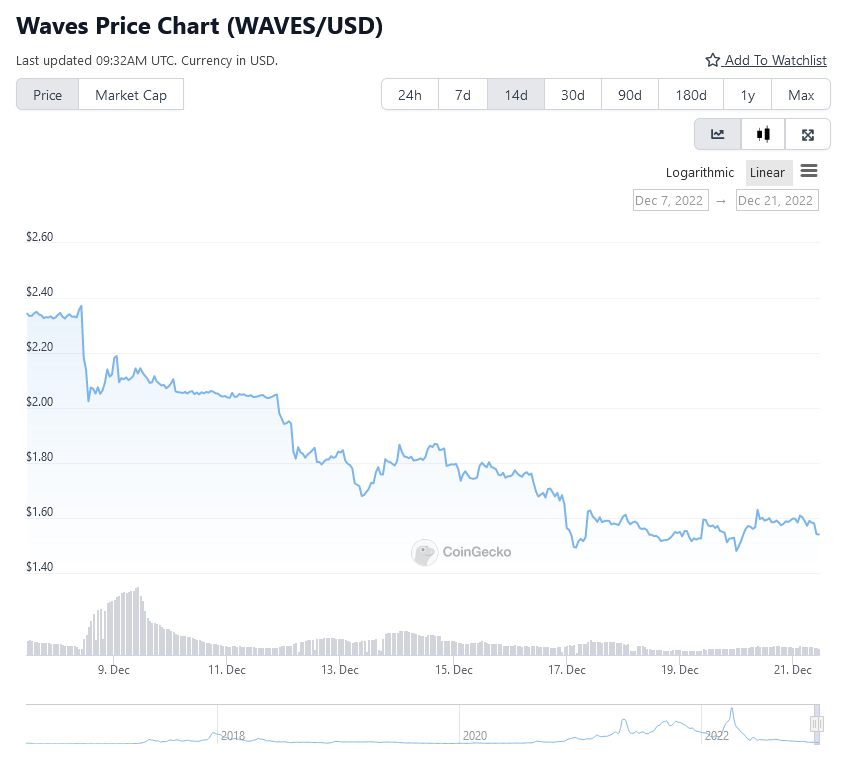
Waves blockchain founder Sasha Ivanov has called on centralized exchanges to disable the ability for traders to short the protocol’s native token called waves, amid a 40% decline in its price over the last two weeks.

Ivanov asked exchanges such as Binance, Kraken and KuCoin, among others, to disable the waves token futures market.

“Waves does not need waves [token] futures markets,” Ivanov tweeted, adding, “They are a breeding ground for FUD and making money off short positions, profitable because of it.” FUD stands for fear, uncertainty, and doubt and it refers to a general feeling of pessimism around a token or the market itself that can lead to downward price action.

The waves token has declined steeply over the last two weeks. Data from CoinGecko shows a 40% drop from $2.37 to $1.54 within that period.

waves token

Waves token down 40% in the last two weeks. Image: CoinGecko

A reportedly misleading DAXA warning about the market health of wave is to blame for the recent downward price action, Waves Labs stated on Monday. DAXA is a South Korean digital asset collective. Major South Korean exchanges such as Upbit responded to the warning by halting waves token deposits.

This warning came amid mounting short interest in the waves token, according to the report. As such, the liquidity crunch created by halting deposits fostered the perfect environment for short sellers to make a significant profit, the report argued.

A new Waves stablecoin

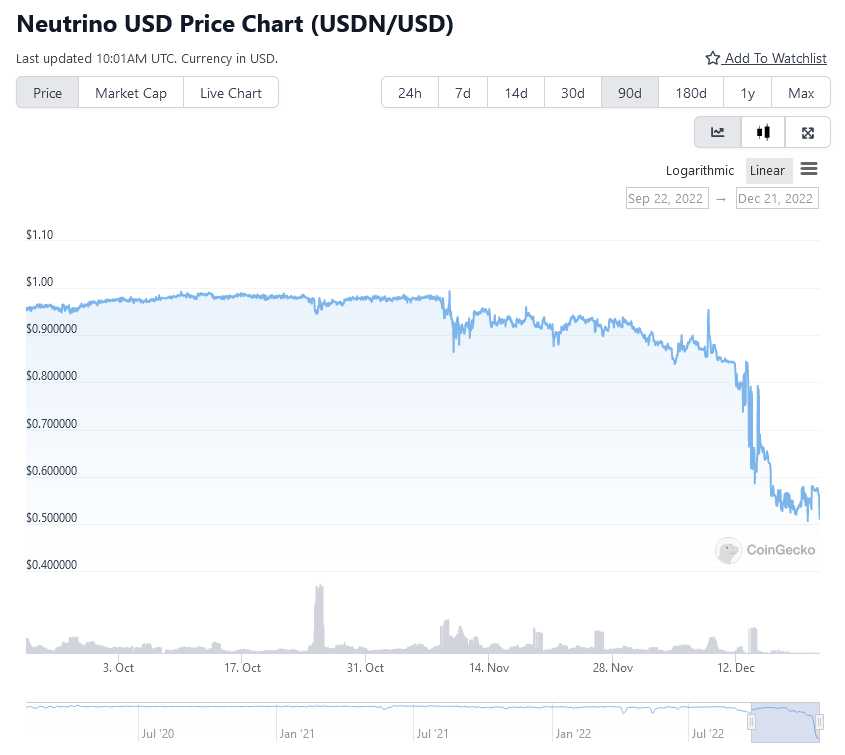
The waves token is not the only one in the protocol’s ecosystem that is in a downward trajectory. Neutrino dollar (USDN), the Waves ecosystem algorithmic stablecoin has also lost its peg to the U.S. dollar by a significant amount. USDN is currently trading at $0.51 as of the time of publishing.

USDN lost its peg at the same time as waves began to decline following the DAXA warning. The stablecoin is backed by waves token and is supposed to trade at par with the U.S. dollar. Users mint USDN by staking their waves token in a protocol called Neutrino.

USDN depeg deepens

USDN depegs further. Image: CoinGecko

Ivanov has stated that he will launch a new stablecoin. He also stated that the protocol will come up with a way to remedy the USDN situation but did not provide any details.

It’s just time to create a protocol more attuned to the current market conditions,” said Ivanov, while adding, “It will be easier to stabilize USDN first and launch the new protocol after.”

USDN is no stranger to losing its peg. The algorithmic stablecoin lost its parity with the U.S. dollar earlier in the year amid a spat between Waves and the now-bankrupt crypto trading firm Alameda Research. The spat led to a liquidity crisis on Vired Finance, a Waves-based DeFi protocol that had to be resolved later in the year.

© 2022 The Block Crypto, Inc. All Rights Reserved. This article is provided for informational purposes only. It is not offered or intended to be used as legal, tax, investment, financial, or other advice.

Go to Source
Author: Osato Avan-Nomayo

UK advertising regulator bans Crypto.com, Turtle United NFT promotions

The UK’s advertising regulator has ruled against NFT promotions by Crypto.com and a project called Turtle United for failing to lay out the risks of investing in NFTs and not properly illustrating transaction fees.

The decision by the Advertising Standards Authority concerned paid Facebook ads for both Crypto.com and Turtle United from July. 

Contesting the ruling, which concerned its NFT marketplace, Crypto.com confirmed the ad is no longer live and argued that the company did not believe the NFTs available on its platform, which included artists’ work and sports collectibles, to be financial in nature. It said that due to the fact NFTs were excluded from recent Treasury consultation papers on crypto, it believed they would be exempt from the financial rules of the ASA’s code and should not have to make clear that profits from cryptocurrencies were subject to capital gains tax and that they were unregulated.

Nevertheless, the ASA upheld the complaint. 

Not clear

The ASA had similar concerns about Turtle United, which did not respond to its complaint. The regulator said that Turtle United did not make clear that past performance or experience does not necessarily give a guide for the future. The project claimed it was “offering a lot of value for its holders,” which implied the NFTs had an assured significant value, the ASA said.

Turtle United’s current floor price is 0.02 ETH, or about $24, according to OpenSea data. The mint price was advertised at 0.2 ETH, plus transaction fees. 

The Block contacted Turtle United for comment but did not hear back before publication time. 

The ruling represents a mere slap on the wrist for both companies, which have been told not to run the adverts in the same format again. Earlier this year the ASA said it would step up its focus on crypto advertising and introduce new guardrails for consumers.

In January, Crypto.com was reprimanded by the ASA for two adverts which “failed to illustrate the risks of the investment, were irresponsible and took advantage of consumers’ inexperience or credulity.”

© 2022 The Block Crypto, Inc. All Rights Reserved. This article is provided for informational purposes only. It is not offered or intended to be used as legal, tax, investment, financial, or other advice.

Go to Source
Author: Lucy Harley-McKeown

Publicly traded crypto miner Core Scientific files for Chapter 11 bankruptcy

Core Scientific, one of the world’s largest publicly traded bitcoin miners, filed for Chapter 11 bankruptcy protection as this year’s slump in crypto prices claimed another victim.

The company estimated its assets and liabilities at between $1 billion and $10 billion, according to the filing with the U.S. Bankruptcy Court for the Southern District of Texas on Wednesday.

Bitcoin miners have suffered significant falls in revenue this year as crypto prices fell. Mining revenues sank by 20% in November, with the price of bitcoin hovering below $17,000 for a good portion of the month.

Core Scientific estimated it had between 1,000 and 5,000 creditors, with $42.4 million owed to its largest creditor, financial services firm B. Riley. As recently as last week, B. Riley had argued that bankruptcy is not the answer to Core Scientific’s problems and proposed $72 million in fresh funding. 

Insufficient cash flow

While Core Scientific is still generating positive cash flow, it’s not enough to repay debt owed on the Bitcoin mining equipment it leases, CNBC reported earlier, citing a person familiar with the situation.

The company’s shares had fallen 29% in pre-market trading as of 5 a.m. ET. 

The case is number: 22-90342.

© 2022 The Block Crypto, Inc. All Rights Reserved. This article is provided for informational purposes only. It is not offered or intended to be used as legal, tax, investment, financial, or other advice.

Go to Source
Author: Andrew Rummer

Bitcoin miner Core Scientific set to file for Chapter 11 bankruptcy protection: CNBC

Bitcoin miner Core Scientific is planning to file for Chapter 11 bankruptcy protection in Texas in the early hours of Wednesday morning, according to a CNBC report

One of the largest publicly traded mining firms, Core Scientific is still generating positive cash flow, but not enough to repay debt owed on the equipment it was leasing, said a person familiar with the upcoming filing, who was cited by CNBC. Core Scientific did not immediately respond to a request for comment. 

The news comes as bitcoin miners struggle to deal with cratering crypto prices and soaring energy costs.

Despite the filing, Core Scientific is opting not to enter liquidation and will continue to operate normally as it reaches a deal with senior security noteholders that hold the bulk of the company’s debt, according to CNBC’s report. 

It was only last week that one of its largest creditors, B Riley Financial, extended a $72 million lifeline to help stave off bankruptcy. Previously, in November, Core Scientific reported a $435 million loss following an October warning of a possible bankruptcy filing. 

Crypto miners have suffered significant falls in revenue throughout this year. Mining revenues fell by 20 percent in November, with the price of bitcoin hovering below $17,000 for a good portion of the month.

© 2022 The Block Crypto, Inc. All Rights Reserved. This article is provided for informational purposes only. It is not offered or intended to be used as legal, tax, investment, financial, or other advice.

Go to Source
Author: Tom Matsuda

Besting Trump, NBA legend Scottie Pippen’s NFT drop sells out in record 77 seconds

NBA Hall of Famer Scottie Pippen’s NFT collection has broken the OpenSeas sales record previously set by actor Anthony Hopkins, after his digital-asset collection sold out in less than one-and-a-half minutes.  


Pippen’s 1,000-piece NFT collection sold out in a mere 77 seconds on Tuesday, according to Orange Comet, the company responsible for producing both the former NBA legend’s and Hopkins’ NFT collections. Selling out at such a rapid pace also means Pippen’s NFT drop outpaced last week’s highly publicized drop inspired by former President Donald Trump. 


“After an amazing year for Orange Comet, selling out this iconic NFT collection and beating our previous record with Sir Anthony Hopkins’ drop is an incredible way to close out 2022 and a true testament to the work our team puts into the creation of these collections,” Orange Comet CEO and co-founder Dave Broome said in a statement.  


Orange Comet’s Pippen collection, which are essentially digital sneakers, also represents the company’s first foray into releasing a line of “digital wearables it is calling “Metawear.” Pippen and Broome recently appeared on The Scoop, a podcast by The Block.

So far Pippen’s collection has yielded more than $240,000 in sales volume, according to OpenSea data.

NFT sales volumes, in U.S. dollar terms, have plummeted amid a prolonged crypto winter, making it increasingly harder to successfully launch new collections. 
 

© 2022 The Block Crypto, Inc. All Rights Reserved. This article is provided for informational purposes only. It is not offered or intended to be used as legal, tax, investment, financial, or other advice.

Go to Source
Author: RT Watson


Follow by Email
Facebook20
Pinterest20
fb-share-icon
LinkedIn20
Share