FreeCryptoCurrency.Me

Free stocks and money too!

Category Archive : Crypto News

Sam Bankman-Fried criminal case assigned to new judge: Reuters

The criminal case against former FTX CEO Sam Bankman-Fried was reassigned to U.S. Judge Lewis Kaplan after U.S. District Judge Ronnie Abrams recused herself on Friday, Reuters reported, citing a court filing.

Kaplan is also overseeing high-profile defamation lawsuits against former President Donald Trump, Reuters said. Abrams withdrew from the case because her husband is a partner at the law firm Davis Polk & Wardwell, which advised FTX in 2021.

“My husband has had no involvement in any of these representations,” Abrams said in a Friday filing. “Nonetheless, to avoid any possible conflict, or the appearance of one, the Court hereby recuses itself from this action.”

Bankman-Fried was arrested on Dec. 12 in the Bahamas and is accused by U.S. authorities of committing or conspiring to commit fraud, money laundering and conspiracy to defraud the U.S. and violate campaign finance disclosure laws. He was extradited to the U.S. last week and released on bail while he awaits trial. 

Disclaimer: Beginning in 2021, Michael McCaffrey, the former CEO and majority owner of The Block, took a series of loans from founder and former FTX and Alameda CEO Sam Bankman-Fried. McCaffrey resigned from the company in December 2022 after failing to disclose those transactions.

© 2022 The Block Crypto, Inc. All Rights Reserved. This article is provided for informational purposes only. It is not offered or intended to be used as legal, tax, investment, financial, or other advice.

Go to Source
Author: Nathan Crooks

Stablecoin DEX Mercurial rebrands to distance itself from FTX

Stablecoin DEX Mercurial is rebranding to Meteora in an attempt to distance itself from FTX. 

Mercurial, which provides liquidity for major stable and pegged assets on Solana, said it will replace its MER tokens with Meteora tokens. Out of a supply of 100 million Meteora tokens,  20% will circulate and be and fully liquid, while 80% will be given to the DAO to manage. 

There were “vast amounts of MER involved in FTX,” Mercurial Fi said in a blog post, noting FTX had hosted Mercurial’s token sale in 2021. “In light of the events around FTX/Alameda, we need a token reset to ignite user interest, build up market confidence and set the foundations, community & ecosystem-wise, for our project to succeed long-term,” it said on Twitter.

MER had fallen more than 46% to $0.0077 cents since the early November implosion of FTX, according to price data from CoinMarketCap. 

MER price activity from CoinMarketCap.

FTX filed for Chapter 11 bankruptcy protection on Nov. 11. Its founder Sam Bankman-Fried has since been extradited from the Bahamas to the U.S.

Disclaimer: Beginning in 2021, Michael McCaffrey, the former CEO and majority owner of The Block, took a series of loans from founder and former FTX and Alameda CEO Sam Bankman-Fried. McCaffrey resigned from the company in December 2022 after failing to disclose those transactions. 

© 2022 The Block Crypto, Inc. All Rights Reserved. This article is provided for informational purposes only. It is not offered or intended to be used as legal, tax, investment, financial, or other advice.

Go to Source
Author: MK Manoylov

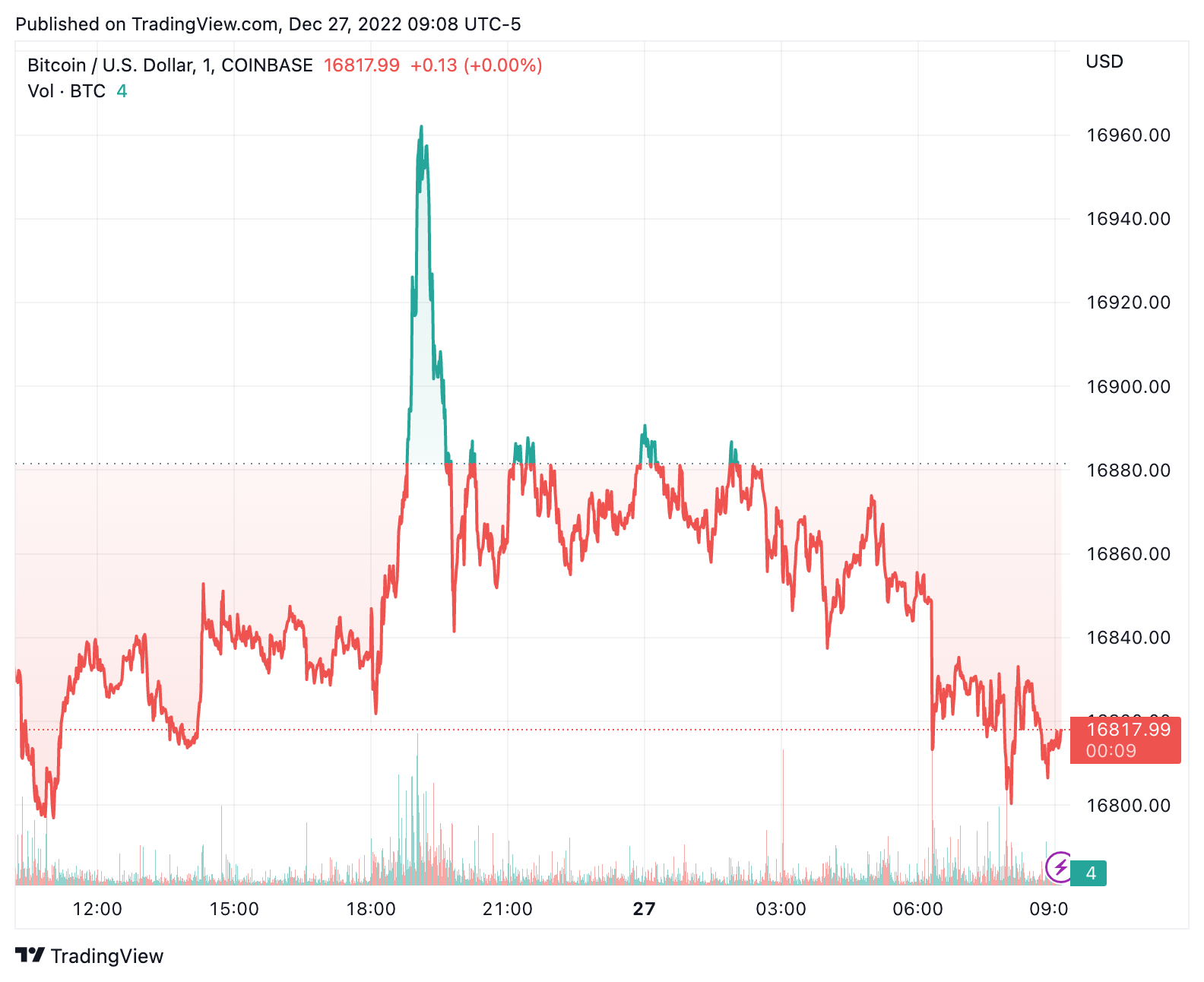
Crypto markets little changed after Christmas; Bitcoin at $16,800

Crypto prices have mostly kept steady through the beginning of the week, with bitcoin and ether fluctuating 0.2% over the past 24 hours.

The coins traded at around $16,800 and $1,200, respectively.

Traditional markets were slightly lower at the opening, with the S&P 500 falling 0.9% and the Nasdaq 100 down by 0.4%.


BTCUSD Chart by TradingView

Solana dropped 3.5%, while OKB, which is issued by exchange OKX, was up 5%. Ripple’s XRP rose by 3%.

OKBUSD Chart by TradingView

Coinbase and Silvergate were down by 6%, while Galaxy Digital and MicroStrategy fell around 3%.

Bitcoin miner Argo Blockchain suspended trading on Nasdaq in an anticipation of an announcement that it will release Wednesday before the open.

© 2022 The Block Crypto, Inc. All Rights Reserved. This article is provided for informational purposes only. It is not offered or intended to be used as legal, tax, investment, financial, or other advice.

Go to Source
Author: Catarina Moura

Pudgy Penguins floor price jumps 25%. Why? Because, penguins.

The floor price of the Pudgy Penguins NFT collection rose 25% over the past day as the NFT market shows signs of a minor resurgence. And because, penguins.

The cute collection has seen its floor price, a measure of the cheapest NFT in the collection, almost double this month. It’s currently around 6 ETH ($7,310), according to nftpricefloor.com data. 

Pudgy Penguins chart by nftpricefloor.com

Pudgy Penguins CEO Luca Schnetzler told the Financial Times that the project is returning some profits to token holders even as other NFTs have seen their value collapse. It’s been making deals to produce cuddly toys and children’s books based on its NFTs.

“Every generation has had its great penguin IP from Pingu to Club Penguin to Happy Feet . . . there’s a huge opportunity for the next great penguins to invade not only the metaverse but the real world,” Schnetzler said.

In early December, a collection dubbed “Snowed In: A Rare Pudgy Penguins Sale” sold out in an auction held by Sotheby’s at the top of the month for almost $129,000. The pieces on offer included several rare Pudgy Penguins featuring traits such as gold skin and an egg accessory. 

The latest jump in prices comes as NFTs experience somewhat of a resurgence in sales volume. Ethereum, in particular, has surged over the past day, with sales rising 56% to $19 million, according to CryptoSlam data. There were over 50,000 transactions on the blockchain in that time, up 30%. 

© 2022 The Block Crypto, Inc. All Rights Reserved. This article is provided for informational purposes only. It is not offered or intended to be used as legal, tax, investment, financial, or other advice.

Go to Source
Author: Adam Morgan McCarthy

1inch upgrades to offer gasless custom swaps and MEV protection

1inch, the largest decentralized exchange aggregator by daily volume, carried out a protocol upgrade called Fusion that offers DeFi users the ability to place custom swap orders at specific prices without having to pay gas fees — a feature usually missing on DEXs.

1inch lets traders access liquidity from multiple DEXs on a single platform. It remains the market leader in the DEX aggregation niche with over $1 billion in trading volume within the past week alone, ahead of competitors like Paraswap, Matcha and Cowswap.

The Fusion upgrade is an improvement of 1inch’s Swap Engine, a mechanism that connects users with professional market makers that serve liquidity requirements. The changes make it easier and more cost-effective by allowing pre-set orders on the 1inch Network that don’t require gas fees upfront.

The upgrade will also help protect users against maximum extractable value (MEV), which refers to a common type of front-running prevalent on blockchains. 

“Fusion makes swaps on 1inch dramatically more cost-efficient, as users won’t have to pay network fees, plus, an extra layer of security is added, protecting users from sandwich attacks,” 1inch Network co-founder Sergej Kunz said.

© 2022 The Block Crypto, Inc. All Rights Reserved. This article is provided for informational purposes only. It is not offered or intended to be used as legal, tax, investment, financial, or other advice.

Go to Source
Author: Vishal Chawla

Bitcoin miner Argo Blockchain suspends Nasdaq trading pending announcement

Bitcoin miner Argo Blockchain requested that trading be temporarily suspended on Nasdaq pending an announcement by Wednesday’s open.

Trading is expected to resume on Wednesday, it said in a statement.

The UK-based company is also listed on the London Stock Exchange, which is closed Tuesday and where trading was temporarily suspended earlier this month after the company accidentally published draft materials on its website saying that it was voluntarily filing for Chapter 11 bankruptcy protection in the U.S.

Instead, the miner said that it was in “advanced negotiations with a third party” to sell certain assets and secure equipment financing.

“The company is hopeful that it will be able to consummate the transaction outside of a voluntary Chapter 11 bankruptcy filing in the United States, although there is no assurance that the company can avoid such a filing,” it said 0n Dec. 12.

Argo warned in October that it would become cashflow negative if it failed to raise money after a financing deal fell through. In that scenario it would also have to cease operations, the company said at the time.

Rival Core Scientific filed for Chapter 11 bankruptcy last week.

© 2022 The Block Crypto, Inc. All Rights Reserved. This article is provided for informational purposes only. It is not offered or intended to be used as legal, tax, investment, financial, or other advice.

Go to Source
Author: Catarina Moura

From CryptoPunks to Redditors — and a Trump card: The year in NFT charts

From the dizzying highs of the bull run, when NFT Google searches were up what felt like thousands of percentage points, to the dark corners of the bear market, it’s been a tumultuous year for NFTs. 

As “What is an NFT?” became one of the most searched terms, marketplaces squabbled over royalty payments, volume dwindled, and some surprising players entered the space. The pervading theme for 2022 seemed to be mainstream adoption. 


The Block right-clicked and saved some of the year’s most dramatic data points. Here’s the year in NFTs:

NFT marketplace wars and a drop in volume

Earlier this year, a wave of new, disruptive NFT marketplace entrants looked to shake up fee structures, including all-important artist royalty payments.

These levies, sometimes called creator fees, have been used to justify the existence of NFTs for artists — offering consistent income on future sales of work. 

XY2Y was at the forefront of this, offering an optional payment model – which means that users themselves can choose to enforce (or not enforce) royalties. The marketplace launched in February, with a ‘vampire attack’ airdrop of millions of tokens to users of OpenSea. The fruits of this, however, didn’t come good until five months later. 

This was around the time the team behind the decentralized NFT marketplace Sudoswap launched a new platform called SudoAMM on July 8, nixing all creator royalties to keep fees down to 0.5% per transaction. SudoAMM saw $50 million in total trading volume two months after the platform launched. 
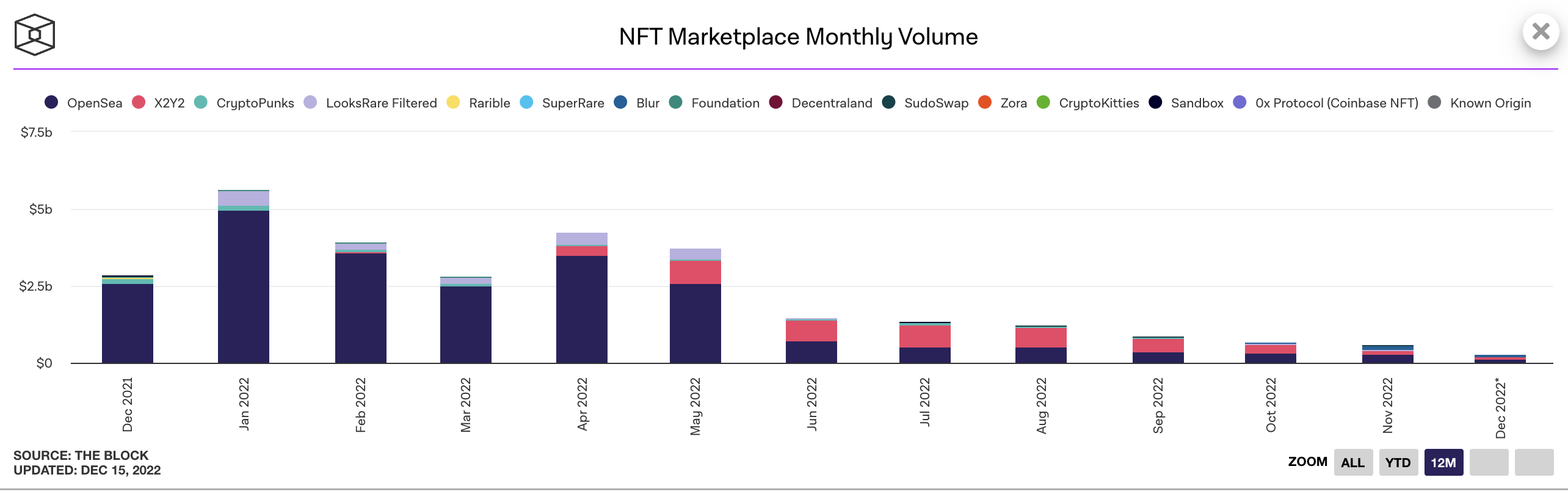
The surge in low-fee marketplaces sparked an ongoing, and sometimes labored, debate among people working in the sector, causing some artists to get creative about the terms of their smart contracts.

On Sept. 28 Fidenza artist Tyler Hobbs launched the QQL Mint Pass; a project which protests those dodging royalties through blocking X2Y2’s wallet in the smart contract coding, effectively blacklisting it. 

Solana’s biggest NFT marketplace Magic Eden also subsequently switched to an optional royalty payment model in October, a move it later modified by issuing code allowing the enforcement of royalties and ‘gamification’ of collections. 

Meanwhile, heavyweight OpenSea also rolled out tools to help artists enforce royalties on-chain; an action that was later criticized for having tenants of centralization. 

As squabbles have died down somewhat, it’s unclear who will emerge as the moral winner in this debate. What’s clear, though, is that despite the erosion of OpenSea’s market share over the course of the year — competitors are still not close to touching it in terms of volume. It might take more than cut trading fees to lure customers away. 

Read more: The TL;DR on NFT royalties

You’ve been CryptoPunk’d

Blue-chip project CryptoPunks saw more action in 2023 than most NFT collections will see in their entire lifecycle — with a buyout, a new manager and a play for exclusive utility. 

Yuga Labs acquired the rights to the collection in March from Larva Labs for an undisclosed sum. In the same fell swoop, the NFT giant also bought out gaming collection Meebits. This meant a new set of terms and conditions, and question marks surrounding what the new heavyweight manager had in store. 

By June, Christie’s NFT maven Noah Davis had been poached by Yuga to shepherd the collection’s future. At Christie’s, Davis was responsible for bringing Beeple’s piece ‘The First 5,000 Days’ to auction. The sale made headlines at the time in March 2021 for its $69 million price tag, a figure which  put Beeple — the American graphic artist Mike Winkelmann — “among the top three most valuable living artists.”
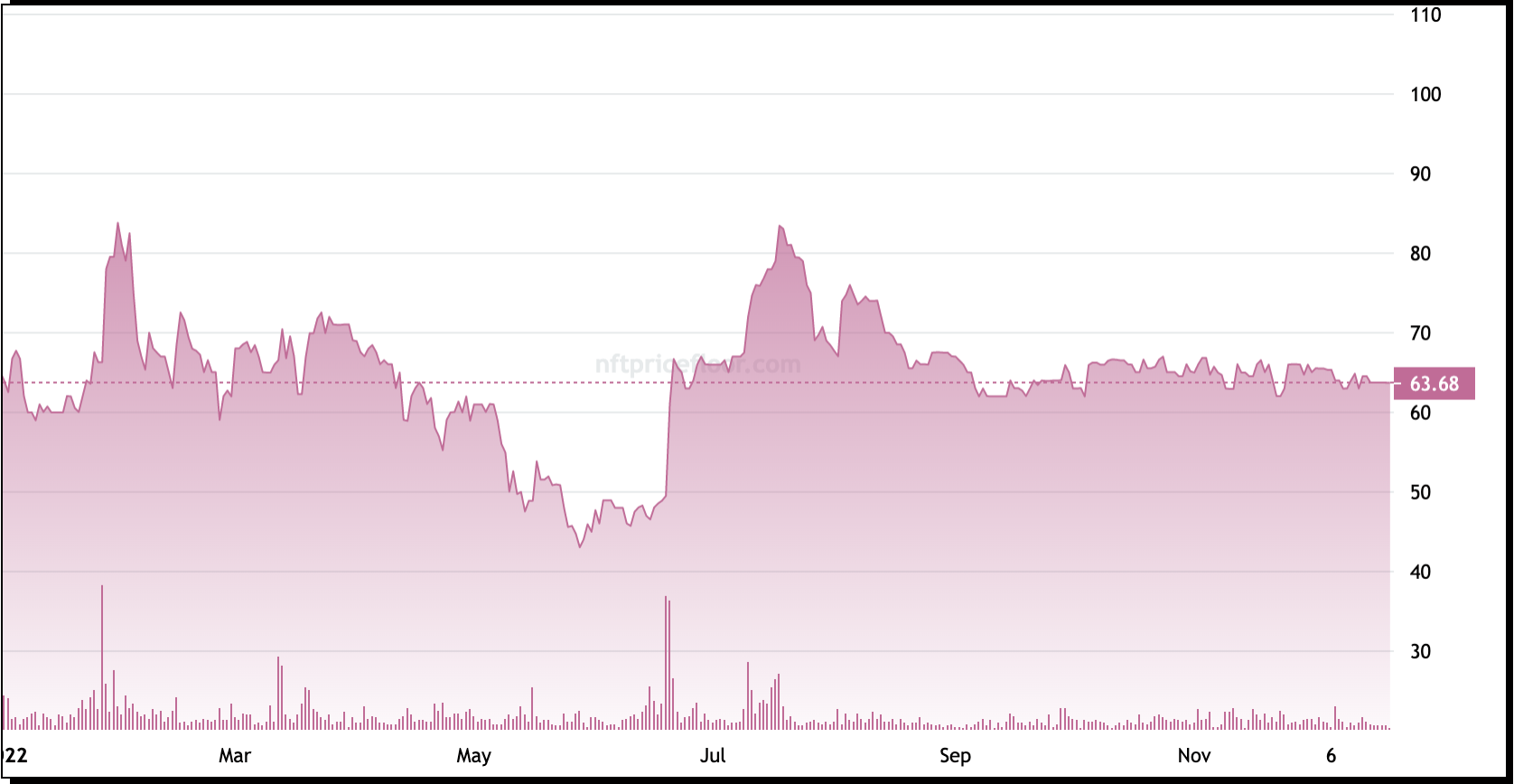
CryptoPunks floor price in ETH up to Dec. 20. Chart: NFT Price Floor

August saw the Punks team up with luxury jewelry retailer Tiffany & Co. to create bespoke pendants and corresponding NFTs dubbed NFTiffs. The limited run sold out in about 20 minutes for around $50,000 each.

Total volume for the collection had surpassed $3.5 million by mid-December, according to data provider NFT Go, with an average price of about 29 ETH, or about $35,000. 

Read more: Tiffany CryptoPunk NFTs are already being ‘flipped’

OtherSide’s gas wars

OtherSide not only sold out all available 55,000 Otherdeed metaverse land NFTs within three hours of its public sale in May; it also momentarily caused a gas war on the Ethereum network. 

Ethereum users tried to buy NFTs at the same time and outbid each other by using the network’s transaction fees. Such bids can cause the fees on the blockchain to spike, as was the case during the mint.

On-chain data revealed the Otherdeed gas war led to the sale running up an additional $172 million in transaction fees that cost individual buyers between $4000 and $10,000. Such high mint fees caused many to complain they were unable to make purchases.

Read more: Yuga Labs champions openness, collaborative development in Otherside litepaper

‘More buyers than sellers’ — the ETH trading ratio 

Quite simply put, the data shows that there were more buyers than sellers by the end of the year for Ethereum NFTs.

Despite the rise of other chains, Ethereum still remains the dominant blockchain in NFT land. 

A Solana September

No blockchain had a hotter year than Solana in terms of piqued NFT interest. 

The number of NFTs minted on Solana hit a high of 312,000 on Sept. 7, up from 39,000 just three days earlier. On Sept. 6, Solana-based NFT market volume his $11.5 million, the highest level since May.

The surge was likely influenced by the excitement surrounding the y00ts mint. The 15,000-strong NFT collection was a new release from Dust Labs, the team behind the DeGods NFT collection.

Reddit’s stealth recruitment drive

With an eye on distancing itself from perplexed users’ qualms about NFTs, Reddit launched a collection of cute ‘digital avatars,’ available to buy with regular fiat currency rather than cryptocurrency.

The net result was that since the inception of its NFT marketplace in July, users have created about 3 million crypto wallets, a company executive said in October. That’s several hundred thousand more than the 2.3 million active wallets held on OpenSea, the world’s largest NFT marketplace, which has been in operation for nearly five years.
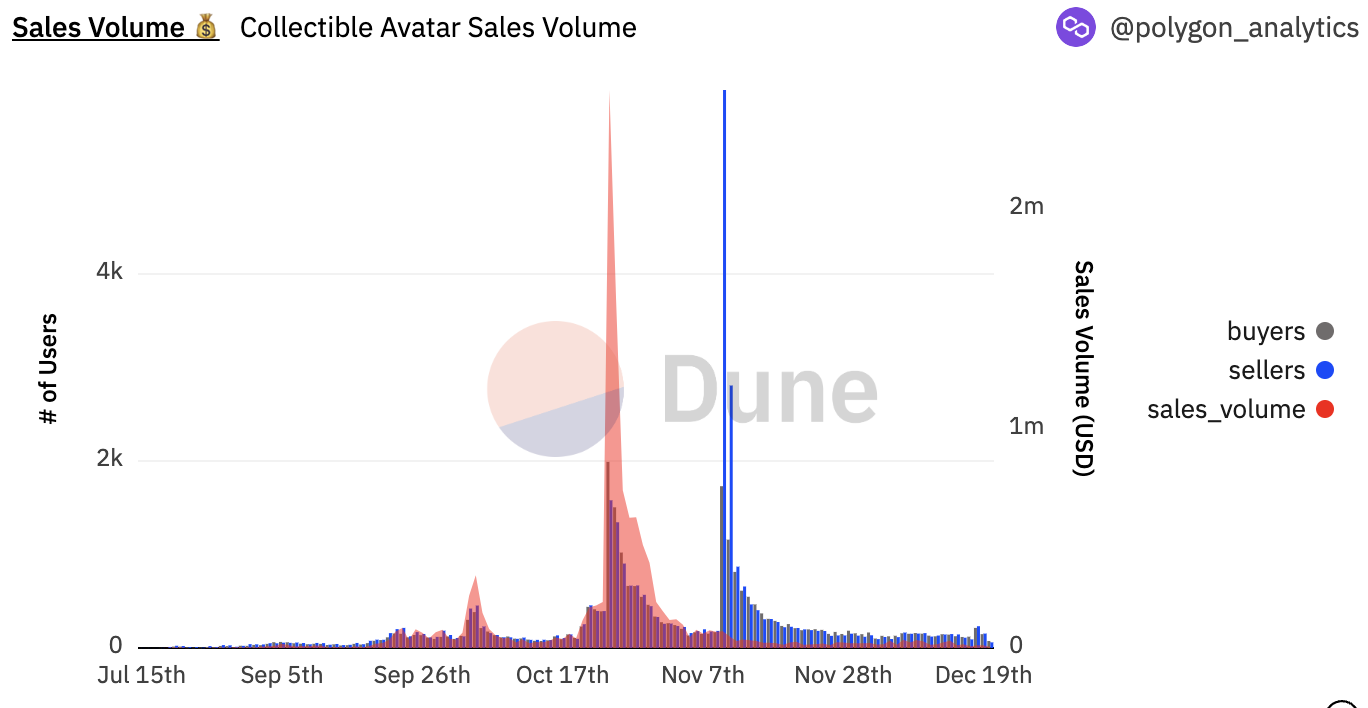
Reddit Avatar trading volume. Chart: Dune Analytics

Subtracting the number of active OpenSea wallets —again, the most popular NFT marketplace— by the number of Reddit wallets suggests that Reddit’s strategy may have helped encourage as many as half a million or more people to buy an NFT for the first time.

It was lauded across the ecosystem as an example of successful ‘onboarding’ of non-crypto normies. 

Read more: Reddit avoids crypto lingo, shows how to take NFTs mainstream

A last-minute Trump card

Former U.S. President Donald Trump swooped in at almost the last moment in 2022, conspiring to Make NFTS Great Again with a so-called trading card collection of 45,000 items. 

The collection sold out within hours, with the majority of holders hanging onto one NFT each from the collection, according to data from Dune Analytics.
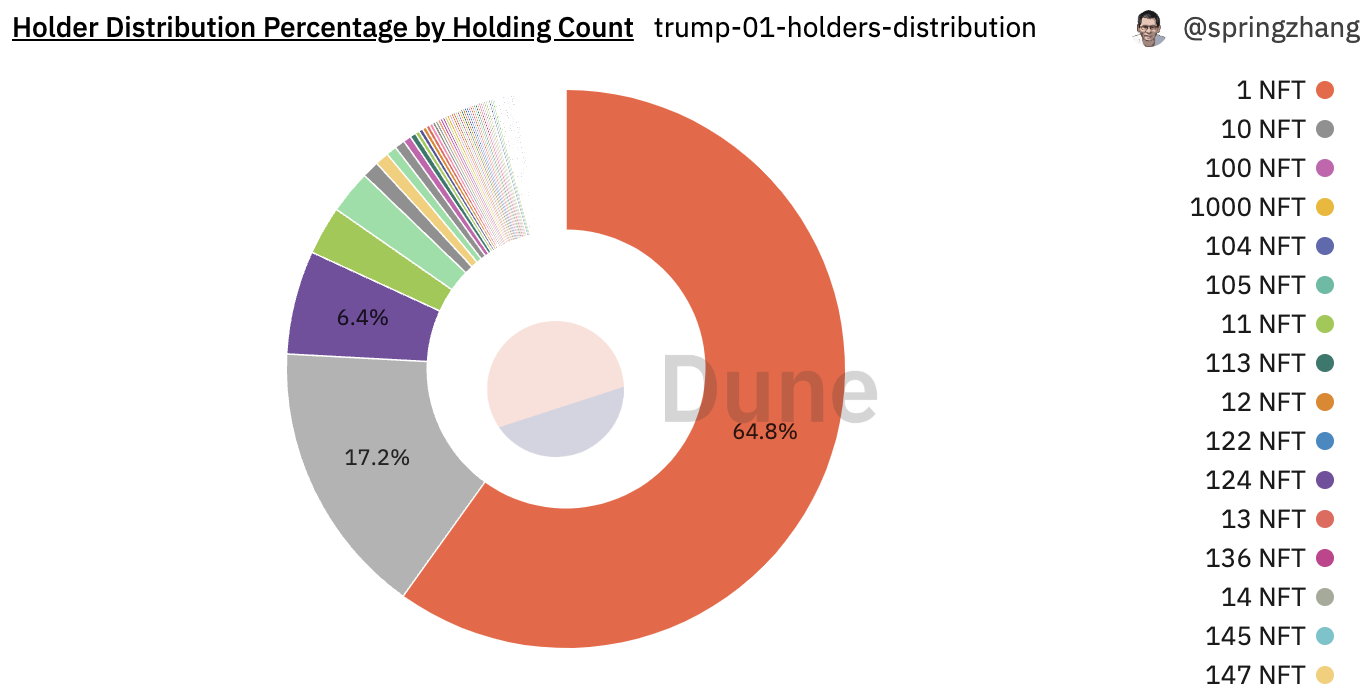
Trump NFT holder distribution. Chart: Dune Analytics

Still, even hours after the sale there were already some Trump NFT whales among holders. 34 wallets held 100 or more items from the collection the day after launch. OpenSea figures also suggest that 1,000 of the NFTs were airdropped to one wallet hours before the public sale. 

Read more: Donald Trump NFT collection sells out within hours

© 2022 The Block Crypto, Inc. All Rights Reserved. This article is provided for informational purposes only. It is not offered or intended to be used as legal, tax, investment, financial, or other advice.

Go to Source
Author: Lucy Harley-McKeown

Crypto.com promotes COO to president as exchanges face scrutiny

Crypto.com promoted COO Eric Anziani to President as the industry grapples with scrutiny over the health of crypto exchanges. 

Anziani will oversee operations, including customer experience, onboarding and global payments. He will also maintain his COO responsibilities, including leading strategy, sales and international expansion.

Anziani joined Crypto.com in 2018.

“Eric’s expanded role will allow him full visibility of growth opportunities for the company and the ability to continue building and innovating to position Crypto.com for continued success,” said Kris Marszalek, CEO of Crypto.com.

Crypto.com, founded in 2016, said it has more than 70 million customers worldwide.

Last week, the UK’s advertising regulator ruled against NFT promotions by Crypto.com and a project called Turtle United for failing to lay out the risks of investing in NFTs and not properly illustrating transaction fees.

The news comes as crypto exchanges scramble to prove solvency following the collapse of FTX. On Dec. 9, the company released a proof-of-reserves study by Mazars about a week before the auditing firm said it would no longer provide auditing services to the industry. 

Disclaimer: Beginning in 2021, Michael McCaffrey, the former CEO and majority owner of The Block, took a series of loans from founder and former FTX and Alameda CEO Sam Bankman-Fried. McCaffrey resigned from the company in December 2022 after failing to disclose those transactions.

© 2022 The Block Crypto, Inc. All Rights Reserved. This article is provided for informational purposes only. It is not offered or intended to be used as legal, tax, investment, financial, or other advice.

Go to Source
Author: Christiana Loureiro

Biggest crypto C-suite departures of 2022

This was the year of exchange collapses, bankruptcies and the executives leaving their positions mid-scandal.  

Trouble started in May when the TerraUSD stablecoin de-pegged from the dollar before inevitably crashing — taking down its sister coin, Luna, with it. What followed was a domino effect of firms falling to their knees, including Celsius, BlockFi and the crypto exchange giant FTX.  

While numerous C-suite executives left their positions this year, The Block compiled the top 10 most memorable departures this year.   

Sam Bankman-Fried resigned as CEO of crypto exchange FTX 

FTX collapsed nearly a week after a scoop from CoinDesk revealed that Alameda Research, a trading firm established by Sam Bankman-Fried, held $3.66 billion in unlocked FTT, FTX’s token. Not only that, but Alameda had around $8 billion in liabilities — $7.4 billion worth of which were loans. The leaked balance sheet revealed an unusually close link between the firms. 

After Binance CEO Changpeng “CZ” Zhao revealed that the firm would sell off his FTT, which Binance received from selling off its FTX shares in 2021. FTT tanked by 19% and customers flocked to withdraw $8.2 million in funds before FTX inevitably paused such activity. Bankman-Fried insisted that “FTX is fine” before a failed acquisition deal from Binance.  

The former CEO of FTX resigned right as the company filed for Chapter 11 bankruptcy protection on Nov. 11. The firm was found to have over 100,000 creditors and up to $50 billion in liabilities.  The FTX exchange token, FTT, also crashed 90.6% in value the day before the firm filed for bankruptcy, according to The Block’s Data Dashboard.

Sam Bankman-Fried was later arrested on charges including wire fraud, wire fraud conspiracy, securities fraud, securities fraud conspiracy and money laundering. The arrest occurred the day before Bankman-Fried was set to testify in front of the House Financial Services Committee in Congress regarding the FTX collapse and its wider impact on the crypto industry.  

Alameda Research co-CEO Sam Trabucco stepped down, leaving Caroline Ellison as sole CEO 

Sam Trabucco had been CEO of Alameda Research, a trading firm established by Sam Bankman-Fried, for one year before stepping down in August. His departure meant Caroline Ellison would be the only CEO of the trading firm.  

Following the leaked balance sheet that in part led to the downfall of FTX, Ellison attempted to downplay concerns by claiming that the balance sheet was incomplete and didn’t paint the full picture.  

Bankman-Fried’s successor John J. Ray III would later testify before the House Financial Services Committee that FTX executives had “free rein” over Alameda Research. In September, a week after Trabucco stepped down, Bankman-Fried considered closing down Alameda Research.  

Celsius CEO Alex Mashinsky resigned

Celsius’s former CEO Alex Mashinsky resigned from his position on Sept. 27. Before he departed, he was found to have taken $10 million before the firm froze withdrawals and eventually filed for bankruptcy protection on July 13.  

Mashinsky used these funds to pay back state and federal taxes amassed from his Celsius asset income. A Celsius creditor committee had called for his removal before he resigned.  

Genesis’s CEO Michael Moro left amid staff layoffs

Michael Moro, former CEO of the crypto lender Genesis Trading, stepped down from his role on August 17. Amid Moro’s departure, Genesis also cut 20% of its staff to meet “strategic priorities,” The Block previously reported.  

Gensis was a prodigious lender for other crypto firms, having $14.6 billion in active loans as of March of this year. Genesis would later pause customer withdrawals on Nov. 16 after taking financial hits from the collapses of crypto hedge fund Three Arrows Capital (3AC) and FTX.  

The firm owes creditors $1.8 billion, including $900 million to users of Gemini’s Earn program, in which customers lent their digital assets to third party borrowers to earn a yield. Gemini would pause its Earn customer redemptions on Nov. 16.  

Loans originating from Genesis have fallen steadily over 2022, according to data from The Block. Loans fell 8.8% between the first and second quarters of this year. 

OpenSea’s CFO Brian Roberts left after less than one year  

Brian Roberts, former Chief Financial Officer to the NFT marketplace OpenSea, left his position on Oct. 8. Roberts joined OpenSea as CFO 10 months earlier in December of 2021. Roberts moved to an advisory role at OpenSea now.  

OpenSea was embroiled in controversy in June when its former head of product Nathaniel Chastain was charged with wire fraud and money laundering related to an insider trading scheme.  

Chaistain purportedly bought NFTs before they were featured on OpenSea’s front page, using confidential information to select these NFTs as Chastain was responsible for the featured home page NFTs. He would later claim the FBI violated his rights before his arrest and seek a subpoena against OpenSea in an attempt to omit “insider trading” from his case, The Block previously reported.  

Kraken’s CEO Jesse Powell moved to chairman position

Jesse Powell stepped down from his role as CEO of the crypto exchange Kraken on Sept. 21. He said this was because he wanted to focus on working on product and industry advocacy. Kraken’s then COO David Ripley ascended to CEO, and Powell now serves as chairman of the firm.  

Powell had been a controversial figure in the crypto industry. The U.S. Treasury Department has been investigating Kraken for allegedly allowing users in Cuba, Iran and Syria to trade digital assets despite sanctions. Kraken would later agree to pay $362,000 for violating Iran sanctions. 

Powell also made waves for a commitment to a specific culture at Kraken, one which focuses above crypto above all else and sets aside debates of pronouns and biological sex — whether it “triggers” employees or not.  

GameStop’s CFO Mike Recupero fired before a round of layoffs  

GameStop’s CFO Mike Recupero was fired on July 7 amid company layoffs, CNBC reported. Recupero was reportedly too hands off and not a good fit for the role, and Diana Jajeh filled in the CFO position after being the firm’s Chief Accounting Officer.  

GameStop made several moves into the web3 gaming space. The firm built an NFT platform, supported by Immutable X, to sell web3 gaming assets. GameStop even announced a partnership with FTX on Sept. 7, in which the video game seller would offer FTX gift cards in its stores. 

GameStop would later have another “big” round of layoffs on Dec. 6 that affected its crypto team. The firm’s head of blockchain Matt Finestone departed the firm on Sept. 12.   

Voyager’s CFO Ashwin Prithipaul departed the troubled crypto lender

Ashwin Prithipaul departed as the bankrupt crypto lender Voyager’s Chief Financial Officer on Sept. 23. The firm filed for Chapter 11 bankruptcy protection on July 6 after pausing trading, withdrawals and deposits days before. Voyager was found to have over 100,000 creditors and more than $650 million in claims against the bankrupt hedge fund Three Arrows Capital. 

Before the firm’s collapse, FTX had won the auction to buy Voyager’s digital assets on Sept. 26. 

MicroStrategy’s Michael Saylor moved to executive chairman position from CEO role 

MicroStrategy’s Michael Saylor moved to an executive chairman position from his prior role as CEO on Aug. 2. By the end of the month, D.C.’s attorney general alleged that Saylor evaded over $25 million in taxes. 

After buying up bitcoin in instances of $190 million, $25 million and $6 million this year, MicroStrategy would come to hold around 130,000 in bitcoin holdings, according to The Block’s Data Dashboard — despite missing its third quarter revenue estimates.  

Michael McCaffrey resigned as CEO of The Block

Michael McCaffrey resigned from his position as CEO of The Block after failing to disclose a combined $43 million in loans from Alameda Research.  

Beginning in 2021, McCaffrey, the former CEO and majority owner of The Block, took a series of loans from founder and former FTX and Alameda CEO Sam Bankman-Fried. McCaffrey resigned from the company in December 2022 after failing to disclose those transactions. 

McCaffrey used $27 million in Alameda loans to finance The Block and to facilitate an employee buyout, in which McCaffrey would hold more than 50% of the company’s shares. He then used a $16 million loan to buy property in the Bahamas. 

The Financial Times first cited two of McCaffrey’s shell companies, Red Sea Research and Lonely Road, as Alameda loan recipients on Dec. 6Axios publicly linked the two companies to McCaffrey three days later. Former Chief Revenue Officer Bobby Moran became the new CEO following McCaffrey’s departure. 

© 2022 The Block Crypto, Inc. All Rights Reserved. This article is provided for informational purposes only. It is not offered or intended to be used as legal, tax, investment, financial, or other advice.

Go to Source
Author: MK Manoylov

Nexo writes open letter to Vauld’s creditors, presents final proposal

Shortly after Vauld founder and CEO Darshan Bathija sent an email to the firm’s creditors yesterday saying that the potential Nexo deal has been called off, Nexo sent an open letter to Vauld’s creditors that it is not over yet.

The open letter, dated Monday and obtained by The Block, includes Nexo’s final proposal to Vauld with some changes to its previous proposal from earlier this month. The open letter also alleges that Vauld’s financial advisor, Kroll, misrepresented and manipulated Nexo’s previous proposal when presented to Vauld’s creditors.

“The ‘Nexo Deal Terms’ contained in the presentation delivered at the CoC [committee of creditors] meeting on October 10, 2022 were not provided by Nexo, rather they were pieced together by Kroll without Nexo’s prior knowledge,” the letter reads. “Kroll Singapore’s conduct raises multiple questions about the administrator’s objective and independent approach to presenting the possible restructuring scenarios as opposed to actively pushing a self-serving agenda towards the involvement of a fund manager.”

Bathija’s email yesterday noted that Vauld plans to go for the fund management option for its restructuring, given that the potential Nexo deal had fallen through. Bathija said that Vauld has identified six potential candidates as fund managers and is finalizing one.

In its open letter, Nexo claims that the fund management option isn’t good for creditors. The letter reads:

“Vauld’s Creditors, please read this carefully — while Nexo is proposing a fixed-income arrangement between Nexo and Vauld’s Creditors, in which it is Nexo’s responsibility to generate the loan revenue in order to pay the fixed interest it owes to the creditors, on the other hand, the creditors will assume the full risk of assigning their remaining assets to a fund manager to pursue returns and charge fund management fees in the process. We cannot help but wonder why there is such an aggressive push toward the fund management option and what kind of ulterior motives could justify taking an alternative direction to the detriment of Vauld’s Creditors.”

The final proposal

Nexo’s final proposal is slightly different from its previous proposal presented earlier this month, which the Vauld CoC rejected, per Bathija’s email. Nexo now believes that the final proposal will be accepted by the CoC.

A fundamental change in the final proposal pertains to withdrawals. Specifically, it pertains to key performance indicators, or KPIs, related to withdrawals. Previously, there was a requirement of a turnover of at least 2х the account balance or a minimum trading turnover of $10,000 to withdraw funds. Now those KPIs have been changed to a turnover of at least 5х the account balance and no minimum turnover in absolute terms.

“We made a few changes to the KPIs so that we ensure a greater probability for Vauld’s customers to achieve the KPIs,” Nexo co-founder Antoni Trenchev told The Block. “For example, we removed the minimum volume in absolute terms to be traded on Nexo’s platform. The withdrawal fee is assumed to be reduced by 50% in the event that Vauld’s customers in any jurisdiction are not able to achieve even one of the KPIs due to regulatory restrictions and/or are mandated to be offboarded from the Nexo platform for the same reasons.”

Further, Vauld creditors were previously required to swap at least 20% of the total account balance into Nexo tokens and lock it into a fixed-term deposit of a minimum of $1,000 for at least 12 months. Now, there is no minimum size of the deposit in absolute terms per the final proposal. Most other terms of the two proposals remain the same.

“Nexo has not given up on its attempt to save Vauld and help its creditors recover the maximum possible platform funds,” Nexo co-founder Kalin Metodiev told The Block.

It remains to be seen whether Vauld creditors accept Nexo’s final proposal. Vauld and Kroll did not respond to The Block’s request for comment.

Vauld has until Jan. 20 to sort out its financial issues, having received another credit protection extension last month. The firm, however, has applied for yet another extension, as The Block reported yesterday. The hearing for the moratorium extension is scheduled for Jan. 17.

© 2022 The Block Crypto, Inc. All Rights Reserved. This article is provided for informational purposes only. It is not offered or intended to be used as legal, tax, investment, financial, or other advice.

Go to Source
Author: Yogita Khatri


Follow by Email
Facebook20
Pinterest20
fb-share-icon
LinkedIn20
Share