FreeCryptoCurrency.Me

Free stocks and money too!

Category Archive : Crypto News

SushiSwap to deprecate Kashi and MISO platforms

SushiSwap, a notable decentralized exchange, has announced plans to deprecate two of its offerings — the Kashi lending platform and MISO token launchpad — its chief technology officer, Matthew Lilley, noted.

Lilley cited poor design and a lack of resources as the primary reasons for retiring these offerings. “We made the decision to deprecate Kashi (Sushi Lending) and Miso (Sushi Launchpad),” he tweeted. “Kashi for a number of reasons, had a number of design flaws, ran at a loss, and had a lack of resources to dedicate to it.”

Lilley added that SushiSwap will wind down the two offerings in the first quarter of 2023 and shift its focus entirely on its core decentralized exchange — which has $390 million in total value locked.

In March 2021, the SushiSwap team introduced Kashi as a way for users to borrow crypto assets within the DeFi space. MISO, short for Minimal Initial SushiSwap Offering, was also introduced by Sushi around the same time for bootstrapping DeFi projects with crowdfunding. Neither of these services had any significant uptake from users and has thus been deemed unsuccessful. 

The decision to shutter its Kashi lending service and MISO launchpad comes as part of a larger effort to restructure SushiSwap. The protocol has only 1.5 years of operational runway available, according to its “head chef,” Jared Grey.

The SushiSwap team did not immediately respond to a request for comment.

© 2022 The Block Crypto, Inc. All Rights Reserved. This article is provided for informational purposes only. It is not offered or intended to be used as legal, tax, investment, financial, or other advice.
Go to Source
Author: Vishal Chawla

Bitcoin developer claims loss of $3.3 million after PGP exploit

Bitcoin core developer Luke Dashjr claimed his wallet was hacked due to a Pretty Good Privacy (PGP) key compromise. Dashjr’s wallet had multiple outgoing transactions on Dec. 31, totaling over 200 BTC — with an estimated loss of assets worth $3.3 million at current market prices.

“My PGP key is compromised, and at least many of my bitcoins stolen,” Dashjr tweeted on Jan. 1, adding that they “have no idea how.” He did not say how exactly the attackers gained access to his PGP keys.

Pretty Good Privacy is a cryptographic method to encrypt and decrypt data. It can be used to encrypt information that is stored on a server — to protect against unauthorized access or tampering. Notably, keys generated via PGP can be used to verify a specific piece of data, such as the legitimacy of a software download.

While what exactly caused the exploit is not yet confirmed, many speculate a server Dashjr used may have been accessed to steal data, including private keys to his bitcoin wallet. In November, Dashjr noted that his server had been compromised.

The pseudonymous developer of Yearn Finance, Banteg, commented on Twitter the incident may be a potential “supply chain attack.” Supply chain attacks happen when a hacker enters and modifies software by injecting malicious code into a system. In this case, it’s possible that the hacker gained access to Dashjr’s server with the help of a compromised PGP key and later extracted the private key to his hot wallet connected to the server. However, a formal investigation is yet to confirm this. 

The incident has garnered a lot of attention. Binance CEO Changpeng Zhao said his team monitored the assets and would freeze them if sent to the centralized exchange. 

© 2022 The Block Crypto, Inc. All Rights Reserved. This article is provided for informational purposes only. It is not offered or intended to be used as legal, tax, investment, financial, or other advice.

Go to Source
Author: Vishal Chawla

The week in markets: Bitcoin dips while dogecoin drops 10% and MicroStrategy stock falls

Crypto prices fell over the past week as dogecoin led the losses. Crypto stocks traded higher for the most part, while MicroStrategy declined. 

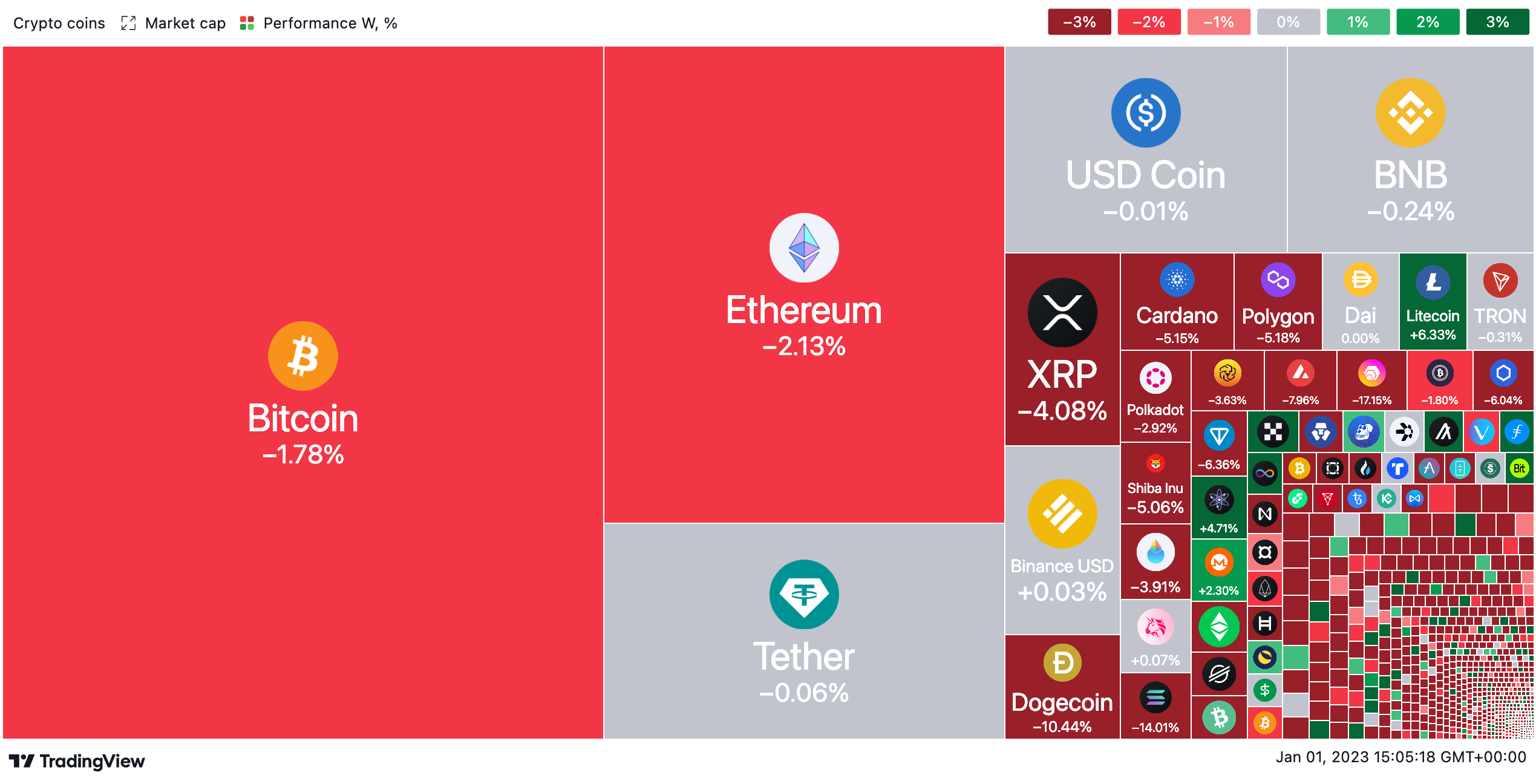
Bitcoin was changing hands for $16,550 at 10 a.m. EST on Sunday, according to data via TradingView. The leading cryptocurrency by market cap was down about 1.8% over the past seven days. Ether dropped 2.1% in the same period. 

Altcoins fell even more than bitcoin and ether throughout the week. Ripple’s XRP slipped 4%  and dog-themed memecoins had a rough week. Dogecoin plunged more than 10%, shiba inu dropped 3% and dogelon mars fell about 5%. 

Crypto stocks 

Nasdaq dipped 0.26%, while the S&P 500 shed 0.64%. 

Coinbase rose 1.8% over the week, according to Nasdaq data. Shares in the crypto exchange reached an all-time low of $31.86 during the week, paring losses ahead of the weekend. 

Block was trading at $62.84 at the close on Friday, up 4.95% over the previous week. Shares in crypto bank Silvergate rose more than 4% to trade at $17.40. 

Michael Saylor’s MicroStrategy was in the red, dropping about 14.5% to trade around $141. It was revealed this week that the firm sold bitcoin for the first time, almost $12 million worth. The firm noted that the sale was made for tax benefits.

Markets are closed in the U.S. on Monday to mark the new year; trading resumes on Tuesday.

© 2022 The Block Crypto, Inc. All Rights Reserved. This article is provided for informational purposes only. It is not offered or intended to be used as legal, tax, investment, financial, or other advice.

Go to Source
Author: Adam Morgan McCarthy

Biggest stories to look for in crypto as we embark on the new year

Here are the major stories and events to keep an eye on as 2023 gets underway. 

The last week of December was relatively quiet compared with the previous few weeks. Still, things may heat up again in the beginning of the new year as crypto conferences, economic data and Sam Bankman-Fried’s legal case loom large. 

Bankman-Fried arraignment in New York

Disgraced FTX founder Sam Bankman-Fried is set to be arraigned by the U.S. District Court for the Southern District of New York on Jan. 3.

Bankman-Fried faces two charges of wire fraud and six counts of conspiracy. He also faces civil cases from federal regulators, the Commodity Futures Trading Commission (CFTC) and the Securities and Exchange Commission (SEC). 

The criminal case against Bankman-Fried was reassigned to U.S. Judge Lewis Kaplan after U.S. District Judge Ronnie Abrams recused herself in December.

U.S. inflation data

U.S. inflation began to show signs of cooling off toward the end of 2022. The U.S. Federal Reserve began increasing interest rates in March to combat the rising cost of goods and services. 

CPI data for December is scheduled to be released on Jan. 12 at 8:30 a.m. EST. November’s data showed inflation was 7.1%, below estimates of 7.3%.

The Fed slowed the pace of its interest rate increases in December, but there will be no Fed decision this month. The next meeting is set for Feb. 1.

Crypto conferences kick off

The World Crypto Conference will happen Jan. 13-15 and aims to be a bridge between traditional finance, Defi, and the Metaverse. 

Quantum Miami also takes place this month, Jan. 25-27. Andre Cronje is slated to speak in Miami, as well as the city’s mayor Francis X. Suarez. 

Disclaimer: Beginning in 2021, Michael McCaffrey, the former CEO and majority owner of The Block, took a series of loans from founder and former FTX and Alameda CEO Sam Bankman-Fried. McCaffrey resigned from the company in December 2022 after failing to disclose those transactions.

© 2022 The Block Crypto, Inc. All Rights Reserved. This article is provided for informational purposes only. It is not offered or intended to be used as legal, tax, investment, financial, or other advice.

Go to Source
Author: Adam Morgan McCarthy

Crypto exchanges finish 2022 with the lowest volumes in two years

Crypto exchange trading volumes finished off 2022 at the lowest level in two years, according to The Block’s Data Dashboard. 

Source: Cryptocompare

The seven day moving average of crypto exchange volumes hit $352.6 million — a 47.6% decrease compared to November of this year. Crypto exchange volumes have not been this low since December 2020 when bitcoin was trading around $20,000

Cryptocurrency prices fell considerably in 2022, with Bitcoin trading around $16,000 in December compared to $47,000 in January of this year. 

Source: Cryptocompare

The implosion of crypto exchange FTX, which filed for Chapter 11 bankruptcy protection on Nov. 11, underpinned the nearly 50% decrease in crypto exchange volumes. FTX’s token FTT crashed 96% following the bankruptcy filing and now trades at $0.84, according to crypto price tracker CoinMarketCap. 

Source: Cryptocompare

To be sure, trading volumes tend to dip during the holidays — especially for NFTs, which had lower trading volumes around Christmas for the second year in a row, The Block previously reported. 

© 2022 The Block Crypto, Inc. All Rights Reserved. This article is provided for informational purposes only. It is not offered or intended to be used as legal, tax, investment, financial, or other advice.

Go to Source
Author: MK Manoylov

Bored Ape Yacht Club ends 2022 with 69 ETH floor price

Yuga Labs backed NFT project Bored Ape Yacht Club (BAYC) ended the year with a floor price around 69 ETH, or $82,740, according to The Block’s Data Dashboard. 

Source: NFT Price Floor

BAYC held the highest floor price among all NFT projects this year, only dipping below its fellow Yuga Labs collection CryptoPunks briefly in November before rising above once more. At its peak, BAYC’s floor price reached 144.9 ETH, worth $409, 720 in May. 

Yuga Labs NFT projects nabbed some of the most expensive sales of 2022. Of the 12 highest NFT transactions this year, eight were from Yuga Labs’s CryptoPunks, BAYC or Mutant Ape Yacht Club collections, The Block previously reported. Larva Labs had originally launched CryptoPunks in 2017, but Yuga Labs bought the intellectual property in March. 

To be sure, Yuga Labs faced some headwinds in 2022. Along with dozens of other people and companies, Yuga Labs was named in a California class action lawsuit pertaining to undisclosed celebrity endorsements on Dec. 9. 

© 2022 The Block Crypto, Inc. All Rights Reserved. This article is provided for informational purposes only. It is not offered or intended to be used as legal, tax, investment, financial, or other advice.

Go to Source
Author: MK Manoylov

Three crypto stories you might have missed this week

Even in the no man’s land between Christmas and New Year, there’s news to be had in crypto. 

Here are three stories you might have missed while tucking into festive leftovers or trying to keep track of the many threads of the FTX saga

Nexo and Vauld’s season finale

Nexo and Vauld looked set to end their courtship this past week, having been in discussions about a potential tie-up since July, according to a report from The Block’s Yogita Khatri.

An email seen by The Block, dated Dec. 26 and sent by Vauld founder and CEO Darshan Bathija to the firm’s creditors, said that “our discussions with Nexo have unfortunately not come to fruition.”

A source familiar with the matter offered a number of reasons for the breakdown. These included Vauld losing a significant amount in the collapsed Terra ecosystem, Indian authorities seizing its assets, funds stuck on the bankrupt crypto exchange FTX and huge loan receivables from Amber Group. Also, Vauld has many customers in the U.S. and Nexo recently announced plans to leave the country, so the potential deal may not have made make sense for Nexo, the source added.

Nexo persisted, however, in an open letter, including a final proposal to Vauld with some changes to its previous proposal from earlier this month. The open letter also alleged that Vauld’s financial adviser, Kroll, misrepresented and manipulated Nexo’s previous proposal when presenting it to Vauld’s creditors.

DeGods and y00ts spread their wings

DeGods and y00ts, two of the leading non-fungible token collections on Solana, announced plans to bridge to Ethereum and Polygon early next year.

The two collections were created on Solana in October 2021 by Rohun Vora, an NFT creator who goes by the pseudonym “Frank DeGods.” They are the two most significant NFT projects on the Solana blockchain in terms of floor price.

The move came as Solana’s native token took a bath, dipping below $10. Later in the week the market cap of Avalanche’s native AVAX token surpassed Solana’s, reaching $3.47 billion compared with Sol’s $3.43 billion.

Valkyrie makes a play for Grayscale’s GBTC

Valkyrie Investments said it has a proposal for Digital Currency Group’s struggling Grayscale Bitcoin Trust and that it’s ready to become a “sponsor and manager” of the fund.

“We are well-equipped to handle the unique challenges and opportunities presented by GBTC,” the company said in a statement on Dec. 28. “Our combination of technical and regulatory knowledge and hands-on experience makes us the ideal choice to take on this role.”

Grayscale’s fund hit an all-time low of 48.89% in terms of the discount to NAV on Dec. 13, and GBTC’s price is down 77% year-to-date.

“In light of recent events involving Grayscale and its family of affiliated companies, it is time for a change,” Valkyrie said.

© 2022 The Block Crypto, Inc. All Rights Reserved. This article is provided for informational purposes only. It is not offered or intended to be used as legal, tax, investment, financial, or other advice.

Go to Source
Author: Lucy Harley-McKeown

Animoca Brands allowed deadline extension for filing results

Metaverse heavyweight Animoca Brands has been allowed an extension to file its audited financial report for 2020, which was originally due to Australian regulators by the end of 2022. 

The formerly listed firm negotiated a later filing date, pushing its new deadline to the end of the first quarter with subsequent years’ accounts to be filed later in 2023, the company said.

“We do not expect to miss our filing deadlines — as of right now we are on track for the schedule agreed upon with ASIC, our regulator with whom we are working closely,” said Animoca’s chief communications officer, Ibrahim El Mouelhy, in an emailed statement. 

As has previously been shown by centralized exchanges including Binance and Kraken, auditing crypto firms is no mean feat. Like Binance, in order to complete its 2019 accounts, Animoca was forced to look for a new auditor ahead of its most recent filing, bringing in DFK International for the job.

Those audited 2019 accounts were eventually filed in July. In a statement within the report, Animoca chair Yat Siu said the company’s “financial auditing process required breaking entire swathes of new ground,” tackling questions about how to account for token sales and NFTs. 

“When confronted with uncertainties in accounting processes, it is typical to look at how other companies address similar challenges. But there were no other companies to which we could compare ourselves. Animoca Brands is, at least for the time being, a unique and special case,” he said. 

Animoca was listed on the Australian Securities Exchange (ASX) from 2015 to 2020. In December 2019, ASX issued a letter to Animoca with a list of breaches, including governance items, involvement in crypto-related activities and substantial use of SAFEs issued by subsidiaries.

After the ASX delisting, Animoca noted that the company “intends to pursue an initial public offering on another exchange as soon as practicable.”

Since delisting, it has closed a number of headline-grabbing fundraises and doubled down on its crypto investing with a seemingly endless pipeline of deals. Its hundreds of bets include The Sandbox, Dapper Labs and Star Atlas. The company made more than 60 investments in the first half of this year, and had made more than 380 investments in total as of Dec. 6.

But whatever the accounting issues Animoca has faced, there is no question that the company’s token holdings will have taken a hit in value this year, alongside a broader downturn. In an investor update for the period ending April 30, Animoca reported digital asset reserves of about $4.2 billion held in Animoca tokens sand, quidd, primate, revv, tower, gmee and others. A simple analysis of those tokens’ prices shows an average decline of more than 80% over the past year, according to CoinGecko data. 

© 2022 The Block Crypto, Inc. All Rights Reserved. This article is provided for informational purposes only. It is not offered or intended to be used as legal, tax, investment, financial, or other advice.

Go to Source
Author: Lucy Harley-McKeown and Ryan Weeks

FTX Debtors will seek return of crypto held by Bahamas regulator

FTX Trading and its affiliated debtors said Friday that they would seek the return of crypto controlled by the Securities Commission of the Bahamas to their chapter 11 estates for the benefit of creditors.

The Bahamas security commission on Thursday said it had been holding on to more than $3.5 billion worth of FTX customer assets since Nov. 12. The FTX Debtors alleged that the funds were transferred after bankruptcy proceedings had started by former FTX CEO Sam Bankman-Friend and former CTO Gary Wang at the request of local authorities in the Bahamas.

“The FTX Debtors have informed the Bahamas Commission that none of Mr. Bankman-Fried, Mr. Wang or the Bahamas Commission had a right to take cryptocurrency of the FTX Debtors,” the group said in a statement.

The debtors said the value of the cryptocurrency in a Fireblocks wallet controlled by the Bahamas regulator was valued at $296 million at spot market prices when it was initially transferred and currently worth $167 million.

“There can be no assurances such a large amount of FTT could be sold at spot prices, or at all,” the debtors said in the statement, referring to FTX’s native token. “The FTX Debtors urge the Bahamas Commission to clear up any confusion created by their recent statements and provide the public with accurate information concerning the cryptocurrency seized and how it was valued for the purposes of these statements.”

Disclaimer: Beginning in 2021, Michael McCaffrey, the former CEO and majority owner of The Block, took a series of loans from founder and former FTX and Alameda CEO Sam Bankman-Fried. McCaffrey resigned from the company in December 2022 after failing to disclose those transactions.

© 2022 The Block Crypto, Inc. All Rights Reserved. This article is provided for informational purposes only. It is not offered or intended to be used as legal, tax, investment, financial, or other advice.

Go to Source
Author: Nathan Crooks

Bitcoin’s mining industry is in survival mode. What’s in the cards for 2023?

Bitcoin miners are clinging to life. It’s a far cry from a year ago, when they were racing to keep up with incessant demand. So what’s in store for miners in 2023? 

Bankruptcies have already been filed and there may be more to come with many miners continuing to face severe liquidity crunches. Companies have been operating for months at depressed margins and dealing with high energy costs. That could also mean mergers and acquisitions, a movement that has already started to gain traction.

“There’s a lot of moving pieces out here and the industry is going to look a lot different 12, 18, 24 months from now,” said Riot CEO Jason Les in an interview with The Block.

Mining executives agree that those without a fixed low-cost power or too much debt will have a hard time hanging on, while the network hashrate will likely continue to go up. They shared their thoughts with The Block.

The sword of Damocles

The price of bitcoin drives everything in mining, from hashrate to ASIC machine prices. Bitcoin’s price is currently hovering around $16,545, down about 65% in 2022.

Marathon’s CEO Fred Thiel believes that the price will remain in the $15,000 to $21,000 range until “there’s some broader good news on the macro front.”

“The Fed has to ease interest rate increases or some major institution has to take a position. Somebody has to start transacting,” Thiel said.

While the Fed has indicated that it would slow down interest rates, “we need to get all the way to stop the hikes,” Cipher Mining CEO Tyler Page said.

The next bitcoin halving — which happens after a certain number of blocks are mined and cuts mining rewards in half — should happen around March 2024. 

“Bitcoin needs to double in price between now and the halving for this industry to continue to operate,” Thiel said.

On the other hand, the halvings have historically been followed by price appreciation because the supply of bitcoin drops while demand stays the same, Cipher’s Page said. 

“You need to plan to sort of survive the halving,” he said. “That halving an event is like the sword of Damocles hanging over the industry.”

Consolidation

Machines have been trading hands this year, and that’s likely to continue, Les said. After all, there is no shortage of ASICs at depressed prices and more distressed assets will probably flood the market.

Buying them, however, requires cash, and many miners are far from flush. But not all are in dire straights. Most notably, CleanSpark has scooped up over 15,000 ASICs and two mining sites since mid-year.

“There’s more consolidation to come, some of that [is] going to come from pain of other players,” said CleanSpark CEO Zach Bradford earlier this month during an earnings call

Marathon recently considered bidding on part of a facility but decided against it. That’s not to say it’s out of the game.

“If the right opportunities arise we’re obviously going to look at things,” Thiel said.

Riot’s CEO said it’s in a position to acquire assets, but it has its “own pipeline of expansion.” The CEO had expected to see more consolidation taking place this year.

“The problem with that, though, is you can’t take two underperformers and put them together. Two problems don’t come together and form a solution,” he said.

In recent weeks, NYDIG and Galaxy Digital cut deals with miners. The former agreed to buy most of Greenidge’s machines, and the latter inked a deal to purchase Argo’s flagship facility for $65 million, on top of a $35 million loan. In both cases, the parties will enter into a hosting agreement.

Galaxy is looking to sign a fixed-price power purchase agreement — something Argo had been seeking for months. Analysis firm D.A. Davidson downgraded Argo in October to neutral precisely over a lack of fixed power purchase agreements.

The biggest player in the industry, Core Scientific, last week filed for Chapter 11 bankruptcy protection with a prearranged deal and plans to turn most of its debt into equity. It might consider selling facilities under development but not any that are already operating.

Looking at the 20 or so public miners out there, “I don’t know if that’s going to like just shrink to five because they all get gobbled up by the bigger ones,” Cipher’s Page said. “Not very many people want to take on an overleveraged miner that doesn’t have good unit economics.”

Hashrate and difficulty

Network hashrate will continue to grow in 2023, executives said.

“There’s a lot of short-term variability in hashrate that’s driven by spot energy prices. But over the next six months, I think you’re going to continue to see hashrate grow because there are people like us who are continuing to deploy miners,” Thiel said. “We’re not stopping.”

The company is projecting to grow from around 7 EH/s now to around 23 EH/s mid-year 2023. CleanSpark, however, recently slashed its 2023 hashrate guidance from 22.4 EH/s to 16 EH/s because of build-out delays coming from its infrastructure partner, Lancium.

“Is that much going to come off of miners closing down? I don’t know,” Thiel said. “If the price of coin moves up, then I think the likelihood is hashrate will grow faster too. If Bitcoin stays here then, you know, it’ll only grow modestly.” 

Looking to spring

Companies that took a more prudent approach to growth are generally in a better position. CleanSpark and Cipher, for instance, didn’t overleverage to buy machines at top prices only to see them lose 80% of their value.

“What’s important to us and our success is to really always kind of assume the worst,” said Riot’s Led. “We’re not betting on a future price. We’re not betting things are gonna turn around. Even in this depressed market, we’re focused on how can we be the most efficient producer.” 

Marathon will keep operating assuming the price of bitcoin will come back.

“It’s all a question of making sure we get through this winter period in as good shape as possible so that when spring comes, we’re able to grow again,” Thiel said.

© 2022 The Block Crypto, Inc. All Rights Reserved. This article is provided for informational purposes only. It is not offered or intended to be used as legal, tax, investment, financial, or other advice.

Go to Source
Author: Catarina Moura


Follow by Email
Facebook20
Pinterest20
fb-share-icon
LinkedIn20
Share