FreeCryptoCurrency.Me

Free stocks and money too!

Category Archive : Crypto News

Regulators say not so fast to Binance US acquisition of Voyager Digital

U.S. regulators want a judge to stop the acquisition of Voyager Digital, a crypto lender in Chapter 11 bankruptcy proceedings, by Binance.US until the company discloses more about its own finances and corporate relationship with the global Binance crypto exchange.

The Securities and Exchange Commission, the U.S. Trustee within the Justice Department and state regulators from New Jersey and Vermont have filed motions objecting to the acquisition in Voyager’s bankruptcy proceedings in the Southern District of New York. 

The objections take aim at the proposed buy-out of the distressed lender. The current disclosures for the purchase don’t include “necessary information,” the SEC argued, and the commission cast doubt on Binance’s financial ability to go through with the over $1 billion transaction.

Regulators also raised concerns about the relationship between Binance.US and the global Binance crypto exchange.

The New Jersey Bureau of Securities in particular stressed that “following transfer of coins to Binance.US, Binance.US will have the freedom to direct the cryptocurrency as it wishes, such that without customer knowledge, the cryptocurrency might wind-up in an offshore (non-US custodial) account, outside the reach of U.S. regulatory and enforcement authorities.”

The concern ties into complications caused by the fact that FTX’s operations largely took place offshore, making customer assets placed in the Bahamas harder to reach. That dynamic has caused friction between the Bahamian government, FTX’s Bahamian subsidiary FTX Digital Markets, and the rest of the FTX corporate empire as it goes through U.S. bankruptcy proceedings. 

Former CEO Sam Bankman-Fried also faces criminal charges over the mishandling of customer funds, facilitated by offshore entities. FTX co-founder Gary Wang and former Alameda Research CEO Caroline Ellison have already pleaded guilty to fraud in the case. 

Disclaimer: Beginning in 2021, Michael McCaffrey, the former CEO and majority owner of The Block, took a series of loans from founder and former FTX and Alameda CEO Sam Bankman-Fried. McCaffrey resigned from the company in December 2022 after failing to disclose those transactions.

© 2022 The Block Crypto, Inc. All Rights Reserved. This article is provided for informational purposes only. It is not offered or intended to be used as legal, tax, investment, financial, or other advice.

Go to Source
Author: Kollen Post

DOJ seizing millions in Robinhood shares linked to FTX, lawyer says 

The Justice Department is in the process of seizing hundreds of millions of dollars in Robinhood shares linked to FTX, a lawyer said during a Delaware court proceeding on Wednesday. 

A New York court ordered federal officials to seize a number of assets in connection with the criminal case against FTX founder Sam Bankman-Fried. The former crypto boss pleaded not guilty to fraud charges this week. 

The Robinhood Markets shares are worth about $450 million. The disgraced former CEO owns 90% of Emergent Fidelity Technologies, an entity that owns 56 million shares in Robinhood stock. Bankman-Fried stepped down as FTX CEO when the firm filed for bankruptcy protection in November,

Seth Shapiro, senior trial counsel for the Justice Department, told a bankruptcy court judge that the Robinhood shares are also linked to a separate bankruptcy case filed by failed crypto lender BlockFi in New Jersey.

“We did want the court to know about those seizures,” Shapiro said. “We either believe that these assets are not the property of the bankruptcy estate, or that they fall within the exceptions … of the bankruptcy code.” 

Bankman-Fried, BlockFi and an FTX creditor have all sought to control the Robinhood shares. 

The seized Robinhood assets are from accounts that the FTX debtors do not control, said James Bromley, a lawyer for the troubled crypto exchange. He stressed that the owner of the Robinhood shares was unclear even before the seizure began, pointing to proceedings underway in Antigua and Barbuda that are linked to the assets. 

“The ownership of those Robinhood shares was an open question before the seizure took place,” Bromley said. “Those shares were already at issue.”

The Justice Department plans to file a notice of seizure to clearly disclose what assets the government has in its possession, Shapiro noted. Assets seized will be subject to future criminal or civil asset forfeiture proceedings. 

During the bankruptcy scheduling conference, a judge agreed to move pending matters in the case to Jan. 13. The court also delayed the U.S. Trustees’ motion to appoint an independent examiner to Jan. 20.

Disclaimer: Beginning in 2021, Michael McCaffrey, the former CEO and majority owner of The Block, took a series of loans from founder and former FTX and Alameda CEO Sam Bankman-Fried. McCaffrey resigned from the company in December 2022 after failing to disclose those transactions.

© 2022 The Block Crypto, Inc. All Rights Reserved. This article is provided for informational purposes only. It is not offered or intended to be used as legal, tax, investment, financial, or other advice.

Go to Source
Author: Stephanie Murray

Comparing Layer-1 Platforms: 2022 Edition- Presented by Solana Foundation and Ava Labs

TL;DR 

Many smart contract blockchains built using novel technologies have seen significant user adoption in the past few years. Currently, research and development activity is largely focused on scaling blockchain technologies to accommodate potentially billions of regular users. Several scaling approaches are being experimented on across smart contract platforms:  

  • New Layer-1 (L1) technologies: Incorporate novel technologies (e.g., sharding, zero-knowledge proofs, parallel runtime environments, etc.) within monolithic chains. 
  • Interoperable chains: An ecosystem of app chains, ideally with high security as well as seamless communication and interaction between them. 
  • Sidechain/Layer-2 (L2) solutions: Connect a new chain to an existing chain to leverage its security/decentralization while increasing scalability. 
  • Modular approaches: Multiple task-specific chains that leverage the function of one another to fulfill the core functions of a monolithic blockchain – data availability, consensus, settlement, and execution. 

Entities that interact with smart contract platforms can be divided into two groups – developers that build and deploy blockchain-enabled decentralized applications (DApps) as well as the community of end users that interact with the said DApps.  

Major takeaways for DApp end-user communities across ecosystems: 

  • End-user adoption trends are a mixed bag: Most ecosystems show a decrease in active addresses coinciding with the downturn in the market starting in late 2021. However, a few individual ecosystems, notably Tron, have defied this trend. Lower market prices also impact the total value locked (TVL) and the average transacted value on-chain, both of which have generally decreased significantly. 
  • Low-fee transactions are in-demand: We can see this in the robust numbers for active address and transaction counts for low-fee ecosystems such as Tron and BNB Chain. However, there is sustained strength in demand for Ethereum L1 block space despite its high fees. 
  • Multichain ecosystems are growing but have a long way to go: Daily active addresses and transaction counts of app chains and L2 scaling solutions show an increasing trend despite weak market conditions, especially for the rollup-centric Ethereum scaling solutions (e.g., Arbitrum & Optimism).  
  • Social metrics show resilience despite market conditions: Interest from the general public is showing strength as measured by the increasing number of Twitter, Reddit, and YouTube traffic. However, recent news events (e.g., FTX collapse, etc.) may be short-term catalysts for the elevated social metrics.  

Major takeaways for DApp development activity: 

  • Battle of the execution environments? We observe the emergence of EVM alternatives such as Solana’s Sealevel runtime, MoveVM, WebAssembly (Wasm), MoveVM, and CairoVM that compete for the attention of DApp developers. 
  • Decreasing trend in developer activity. The proxies for measuring developer activity in this report show a decreasing trend across all L1s, coinciding with the market downturn since late 202. 
  • Ecosystem growth: A thriving blockchain ecosystem relies on a self-sustaining community of developers and end users. Many of the ecosystems discussed have significant funding dedicated toward ecosystem expansion. Funding efforts may include developer grants, native token airdrops, incentivized liquidity mining to increase locked value on-chain, funding developer and community education, strategic partnerships, and many others. 

Outlook and challenges for the smart-contract platform landscape: 

  • Fragmented ecosystems: Independent blockchain ecosystems may not have native interoperability with one another due to fundamental differences in their design. Tools that enable trustless messaging/interoperability between incompatible chains (e.g., Ethereum and Cardano) is a lively area of research and development that will be crucial in addressing audience fragmentation and liquidity across blockchain ecosystems. 
  • Exploits and hacks: The severity of smart contract exploits/hacks continues to be a major issue. Sophisticated DApps (e.g., money markets, bridges, DEXs, and more) may also require complex code that increases the surface area for malicious attacks. Uncovering vulnerabilities within specific DApps and complex development environments with broad expressivity remains extremely challenging. 
  • Discovery of new blockchain-enabled applications: What are the next “killer apps” of blockchain technology? Decentralized finance (DeFi) and non-fungible tokens (NFTs) are examples that have garnered significant interest since 2020, helping bring DApps to the mainstream for the first time. Continued interest from DApp developers incentivized to discover and build innovative blockchain-enabled applications may be an important indicator for the health of the industry as a whole. 

© 2022 The Block Crypto, Inc. All Rights Reserved. This article is provided for informational purposes only. It is not offered or intended to be used as legal, tax, investment, financial, or other advice.

Go to Source
Author: Dipankar Dutta

Coinbase shares jump over 12% following settlement with New York regulator

Coinbase shares soared following the exchange’s $100 million settlement with a New York state financial regulator.

Coinbase shares rose 12.3% to $37.65 at 12:30 p.m. EST, according to Nasdaq data. The news of the settlement with the New York Department of Financial Services (NYDFS) buoyed the stock, which had plunged 5% yesterday.

The exchange will pay a $50 million fine as part of the settlement and invest another $50 million into its compliance program. The NYDFS found gaping holes in how Coinbase reviewed customer identities and alerted on transactions, with the exchange failing to keep up with the growth in its customer base from 2020 through 2021.

“Such settlements are generally viewed as the regulator having their say and then moving on from the entity in question,” said Stéphane Ouellette, CEO at FRNT Financial. 

Relative to the size of Coinbase, the settlement was relatively small, he added.

“There is a view that ‘OK, the regulators have made their point, and they will leave Coinbase alone for now,'” Ouellette said. “There is a recent precedent to support that view as well. Following the NYAG suit against Bitfinex/Tether and then the settlement, both entities have seen relatively little US-administrative attention and the regulatory focus appears to have shifted to other entities or lawsuits.”

Coinbase reached an all-time low of $31.86 last week. 

© 2022 The Block Crypto, Inc. All Rights Reserved. This article is provided for informational purposes only. It is not offered or intended to be used as legal, tax, investment, financial, or other advice.

Go to Source
Author: Adam Morgan McCarthy

Magic Eden updates verification system after fake y00ts and ABC NFTs

Solana’s top NFT marketplace Magic Eden updated its verification layers for NFT collections following a series of fake duped projects. 

Magic Eden thanked the community for alerting it of fake ABC, or Abracadabra, NFTs, in a tweet on Wednesday, adding that affected parties should contact its help desk.

Earlier, Magic Eden blamed third-party cachers for NFT projects displaying wrong images, even adult content, for its collections and claimed it wasn’t hacked.  

As one Twitter user showed, supposedly fake ABC NFTs were being sold for 55 SOL, or $740. 

View on Twitter.

The same user also flagged fake NFTs of the popular Solana-based NFT project y00ts. 

View on Twitter.

y00ts has a 2.5 million SOL ($33.7 million) total trading volume and is Solana’s second most popular NFT project, according to Magic Eden. ABC currently sits at fourth place 1.2 million SOL ($16.1 million) total trading volume and maintains a floor price of 165 SOL, or about $2,200. 

© 2022 The Block Crypto, Inc. All Rights Reserved. This article is provided for informational purposes only. It is not offered or intended to be used as legal, tax, investment, financial, or other advice.

Go to Source
Author: MK Manoylov

Logan Paul hits back at claims that his CryptoZoo NFT game is a scam

Internet personality Logan Paul hit back at claims that his CryptoZoo NFT game is a scam, blaming bad hiring choices for the lack of progress in the project’s development.

Paul suggested the project was still under development in a video released on Tuesday, and that both he and his manager had lost money trying to “pick up the pieces” following disputes with hires.

The comments came as a response to a three-part series by YouTuber Stephen “Coffeezilla” Findeisen, who accused Paul of peddling a scam and not paying developers involved in CryptoZoo. Paul has since threatened legal action in response to the claims.

The CryptoZoo, which currently consists of NFTs, a marketplace and a yield product, launched in 2021. Players can buy eggs that hatch to create NFTs of animals, some of which caused controversy when they debuted due to the use of stock images. These can then be merged to create hybrid animals which generate yield based on their rarity.

With over 2.3 million subscribers on YouTube, Coffeezilla rose to prominence over the past year for his deep dives into crypto scams, several of which have involved celebrities. Topics he’s previously tackled include a pump-and-dump involving former members of FaZe Clan and an investigation into the token SafeMoon, which involved Paul’s younger brother and fellow YouTuber Jake Paul.

It’s not the first time Paul has blamed his team for problems with the game. In April 2021, he told The Block that there had been problems with the project’s initial team. He said the situation had been rectified and that there was “a great team now that are still working on it.”

Developer lies

Among Paul’s more interesting hires were Eddie Ibanez, CryptoZoo’s lead developer. Both Paul and Findeisen have said Ibanez lied about his educational background and work history, including claims to have worked for the CIA and helped the Philadelphia Eagles win the Super Bowl using data science.

Another team member, developer Zack Kelling, held the game code hostage last year for $1 million, an amount he claimed was owed to himself and his team by Paul. Findeisen’s video and Paul dispute whether the size of this team was 50 or three people. 

“The space is unfortunately ripe for bad actors to infiltrate projects that start with even the best intentions,” said Paul.

Yet despite staffing changes, there has still been little progress in the project or mention of it by Paul, which has worried retail investors who have spent millions buying CryptoZoo eggs. A retweet of Paul’s response video was the first activity from the CryptoZoo Twitter account since May 27 last year. 

Kardashian fine

Paul is just one among many celebrities who are finding themselves in hot water over crypto projects they have supported. In October, Kim Kardashian agreed to pay $1.26 million to the U.S. SEC after it charged her with unlawfully promoting EthereumMax token on social media.

Others who promoted MoonPay such as talkshow host Jimmy Fallon and Paris Hilton are also subject to an ongoing lawsuit which alleges they worked with MoonPay to misleadingly promote Yuga Labs “financial products.”

Paul himself has come under fire for his association with another crypto project. In the summer of 2021, he promoted a token named Dink Doink. It’s unclear to what extent he was involved in the project, but he talked about it on social media and featured in a cartoon shared on the token’s Twitter. Dink Doink is currently down 99% from its all-time high.

© 2022 The Block Crypto, Inc. All Rights Reserved. This article is provided for informational purposes only. It is not offered or intended to be used as legal, tax, investment, financial, or other advice.

Go to Source
Author: Callan Quinn

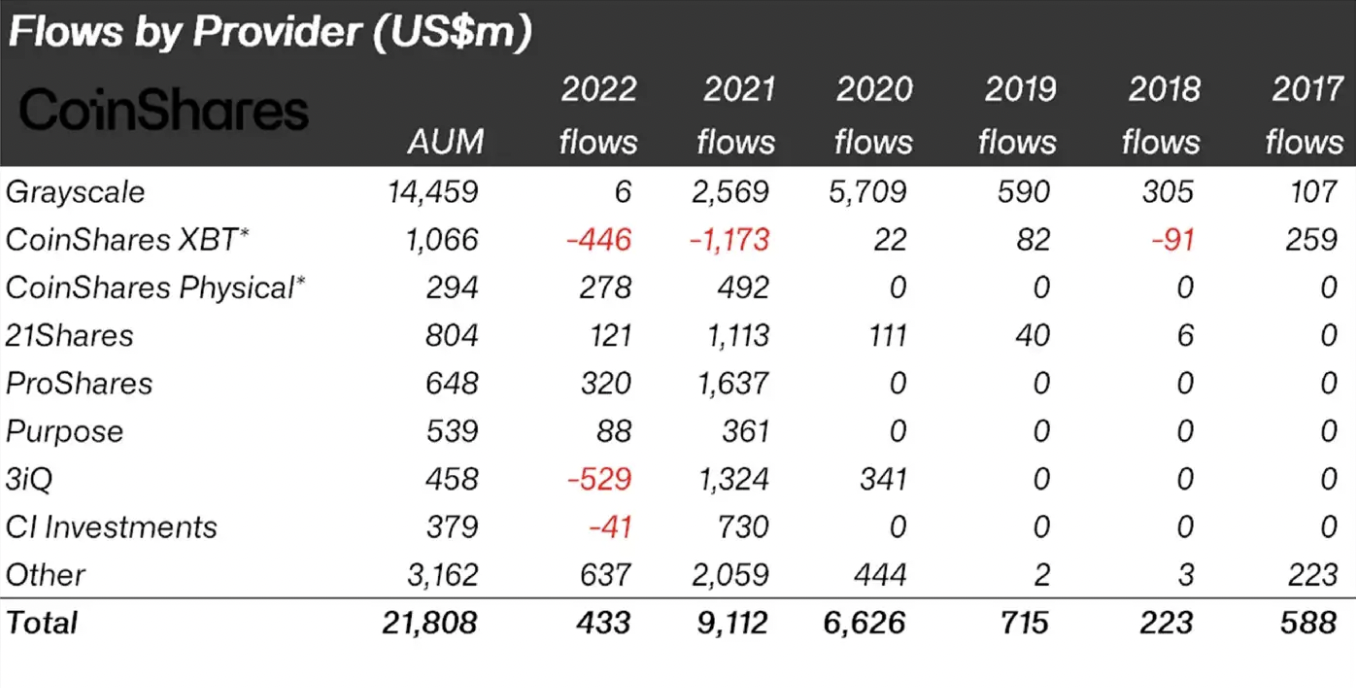
Crypto asset funds saw inflows plummet 95% last year to just $433 million

Crypto asset funds clocked the worst year since 2018, with inflows plummeting 95%.

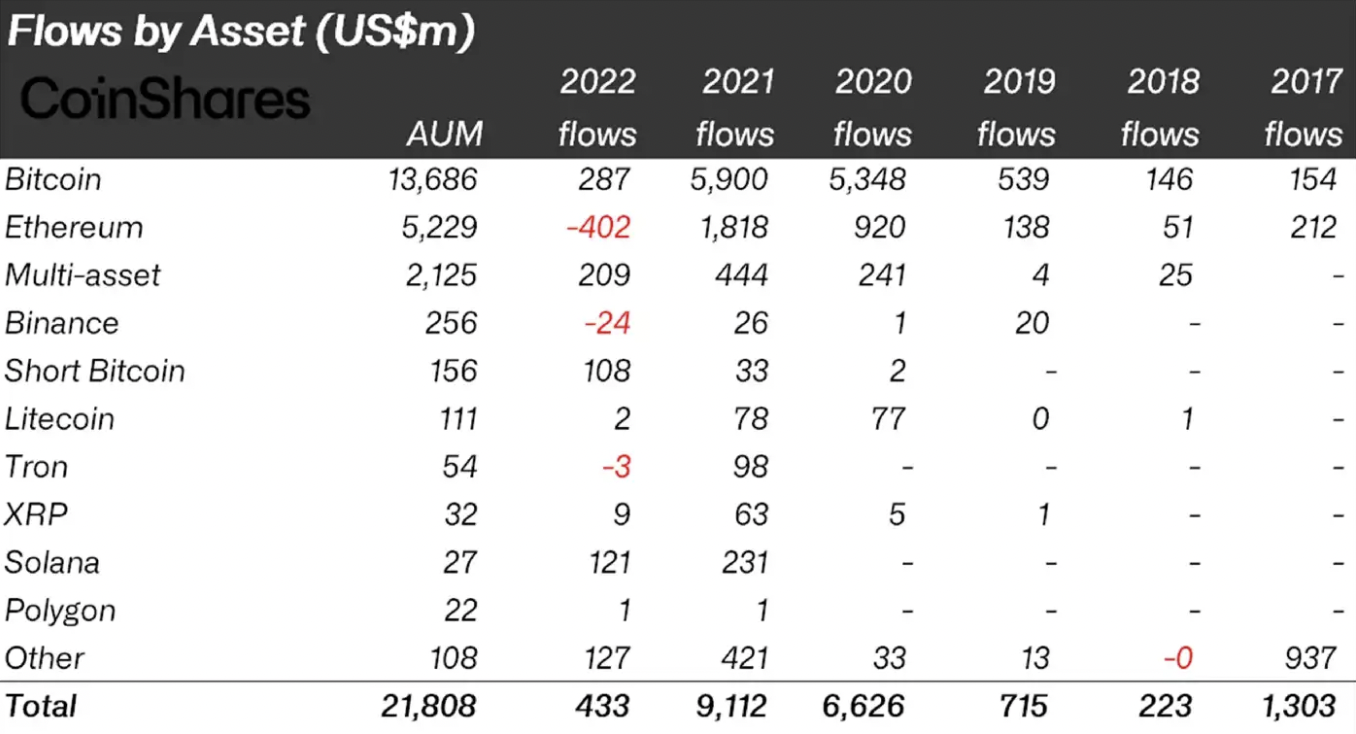
Funds tracked by CoinShares netted a total of just $433 million in 2022 compared to a massive $9.1 billion in the previous year, a decline of 95%. The price of bitcoin fell about 60% over the same period, as a crypto winter engulfed the market amid U.S. Federal Reserve interest rates hikes to combat red-hot inflation.

3iQ experienced the most significant net outflows, which totaled $529 million during the year. CoinShares’ XBT product saw outflows of $446 million, while ProShares crypto funds experienced the most inflows, reaching $320 million.

CoinShares Head of Research James Butterfill said it was difficult to predict what the new year would look like. The collapse of crypto exchange FTX kicked off a crisis of confidence in crypto, and questions remain over the liquidity of some key crypto platforms and lenders, he added.

“Sadly, we expect it will take many years for investor confidence to improve to match the levels seen in 2021 and early 2022,” Butterfill said in a report from the asset manager. “We believe a continued weaker U.S. dollar and a pivot from the Fed in the second half of 2023 are likely to be very supportive for bitcoin due to it being an interest rate-sensitive asset, but until this happens, the market is unlikely to see significant investor inflows.”

Bitcoin was the best-performing cryptocurrency of the year, with inflows of $287 million. That’s still its worst year since 2018, when inflows totaled $146 million, and a decline of 95% from the previous year. 

Ether saw its worst year ever with outflows of $402 million, with CoinShares attributing the tumultuous year to “investor concerns over a successful transition to proof of stake and continued issues over the timing of un-staking” that could occur in the second quarter of this year. 

© 2022 The Block Crypto, Inc. All Rights Reserved. This article is provided for informational purposes only. It is not offered or intended to be used as legal, tax, investment, financial, or other advice.

Go to Source
Author: Adam Morgan McCarthy

Genesis says it needs more time for lending crisis solution

Crypto lender Genesis told clients on Wednesday that it’s continuing to work toward finding a solution for its troubled borrowing and lending unit but that it will need more time to do so. 

“While we are committed to moving as quickly as possible, this is a very complex process that will take some additional time,” interim CEO Derar Islim said in a letter to clients obtained by The Block. “We believe we can arrive at a solution.”

Progress has been made in refining business plans for client offerings that include cost reductions and “driving efficiencies,” he said, adding that the company’s derivatives and spot trading businesses are fully operational

Genesis Global Capital, the lending business of Genesis Trading, had to halt withdrawals and new loan originations in November amid fallout from the collapse of the FTX crypto exchange. It has warned about  potential bankruptcy, and the company said last month that a solution could take weeks.

Digital Currency Group

“We continue working with our advisors, in collaboration with DCG and advisors appointed by various client groups, to evaluate options to preserve client assets and move the business forward,” Islim said, referring to parent company Digital Currency Group.

DCG has been facing heat involving other subsidiaries including Gemini, whose Earn program has been frozen since mid-November. Gemini co-founder Cameron Winklevoss earlier this week accused DCG head Barry Silbert of “bad faith stall tactics” and comingling funds in an open letter he posted on Twitter.

Islim, former Genesis COO , stepped into the role of interim CEO after Michael Moro resigned as CEO in August. The company’s active loans fell over 80% in 2022 from a peak of $14.6 billion in March to $2.8 billion in September, The Block’s Data Dashboard shows. 

© 2022 The Block Crypto, Inc. All Rights Reserved. This article is provided for informational purposes only. It is not offered or intended to be used as legal, tax, investment, financial, or other advice.

Go to Source
Author: MK Manoylov and Frank Chaparro

Coinbase to pay $100 million over failure to scale AML as business boomed

Coinbase reached a $100 million settlement with the New York Department of Financial Services following investigations into failures in its compliance program.

The NYDFS fined Coinbase $50 million and required the company to invest another $50 million into its compliance program following a settlement with the regulator, which found gaping holes in the crypto exchange’s review of customer identities and alerts on transactions. Particularly, it noted that the exchange failed to keep up with the growth in its customer base from 2020 through 2021. 

“Coinbase lacked sufficient personnel, resources, and tools needed to keep up with these alerts, and backlogs rapidly grew to unmanageable levels,” the settlement reads. “By the end of 2021, Coinbase had a backlog of unreviewed transaction monitoring alerts grew to more than 100,000 (many of which were months old), and the backlog of customers requiring enhanced due diligence (‘EDD’) exceeded 14,000.”

Coinbase has had a digital asset business license with the NYDFS — more commonly called a BitLicense — since 2017. By reputation the most rigorous regulatory regime in U.S. crypto, the BitLicense entails ongoing examinations, including one in 2020 that kicked off its issues with Coinbase. In February 2022, the company hired an independent monitor in an effort to resolve these concerns, but their initial efforts did not fully appease the NYDFS. 

Noting that the NYDFS investigation was initially revealed on a filing with the Securities and Exchange Commission, Chief Legal Officer Paul Grewal said in a statement that “Coinbase has taken substantial measures to address these historical shortcomings and remains committed to being a leader and role model in the crypto space, including partnering with regulators when it comes to compliance. We believe our investment in compliance outpaces every other crypto exchange anywhere in the world, and that our customers can feel safe and protected while using our platforms.”

Coinbase shares gained 6% in early trading. 

© 2022 The Block Crypto, Inc. All Rights Reserved. This article is provided for informational purposes only. It is not offered or intended to be used as legal, tax, investment, financial, or other advice.

Go to Source
Author: Kollen Post

Ether, altcoins higher as solana soars 14%, Coinbase gains pre-market after Tuesday’s drop

Crypto prices rose, with solana experiencing the most significant gains. Coinbase rose in pre-market trading after slumping 5% yesterday. 

Bitcoin was trading at $16,803 at 8 a.m. EST, up 0.6% from Tuesday, according to data via TradingView. Ether experienced a more significant jump, tacking on 3% in the same period to trade at $1,250. 

Altcoins also traded higher. Binance’s BNB and Cardano’s ADA rose more than 4%, and Polygon’s MATIC gained 2.7%. Solana led the way, jumping 14% to $13.49 from $11.82. 

Last month NFT trading volumes on Solana showed signs of strength. The week of Dec. 25 saw the most activity for Solana NFTs since September. Amid the rout in NFTs, Solana never lost its second spot to Ethereum throughout 2022, according to The Block’s Data. 

The U.S. Federal Reserves meeting minutes from its December meeting will be released at 2 p.m. EST. 

Crypto stocks and structured products

U.S. stock indices futures were trading higher, with the S&P 500 up 0.4%, and the Nasdaq 100 gaining 0.6% by 8:20 a.m. EST. 

Coinbase gained 1.2% to trade around $34 in pre-market, according to Nasdaq data. The company’s shares fell 5% on Tuesday, closing at $33.60. 

Block shares were trading up in the early session, adding 1.1%.

Crypto bank Silvergate and software firm MicroStrategy were both unchanged.

Grayscale’s bitcoin fund saw its discount to net asset value (NAV) widen yesterday. Shares in the GBTC fund now trade at a discount of 46% to the value of the bitcoin in the fund. The discount to NAV had narrowed to around 45% from 48% ahead of the new year. 

The asset manager’s ether trust (ETHE) is trading at a record-high discount of around -60%. The Block’s VP of Research, Larry Cermak, attributed the decline in ETHE to a lack of faith in the fund being redeemable anytime soon, a spot ETF being approved anytime soon, alongside the general crypto-market outlook.

© 2022 The Block Crypto, Inc. All Rights Reserved. This article is provided for informational purposes only. It is not offered or intended to be used as legal, tax, investment, financial, or other advice.

Go to Source
Author: Adam Morgan McCarthy


Follow by Email
Facebook20
Pinterest20
fb-share-icon
LinkedIn20
Share