FreeCryptoCurrency.Me

Free stocks and money too!

Category Archive : Crypto News

Coinbase shares drop 10% as Cowen downgrades stock and slashes price target

Coinbase shares fell shortly after the open as Cowen analysts downgraded the stock and cut their price target, citing dwindling retail volumes, lower revenue expectations and a harsh regulatory environment. 

Shares in the crypto exchange were trading at $33.26 by 10:40 a.m. EST, down over 11%, according to Nasdaq data. 
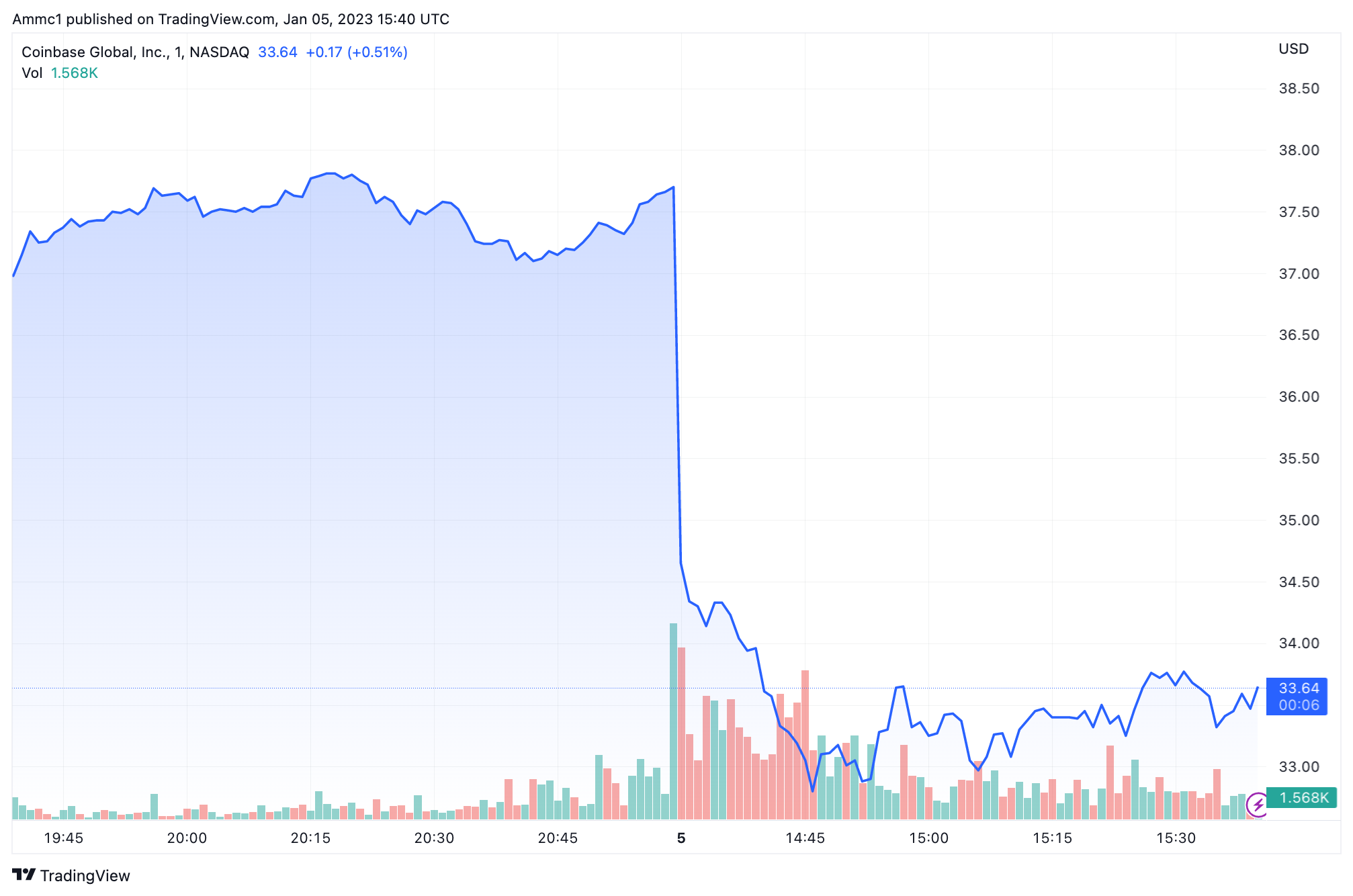
Cowen analysts downgraded the stock to market perform from outperform, citing reduced revenue estimates, low visibility for stabilization in retail trading volumes and potential SEC enforcement action post-FTX. The firm also slashed its price target to $36 from $75.

Coinbase shares had risen 12% yesterday following a settlement with the New York Department of Financial Services (NYDFS) in which the exchange agreed to pay a $50 million fine and invest another $50 million in its compliance program.

Lower 2023 revenue estimates

Cowen’s Stephan Glagola and George Kuhle lowered their revenue estimates for 2023 by around 40% to $2.1 billion from $3.6 billion.

The firm also lowered expectations for adjusted earnings before interest, taxes, depreciation, and amortization (EBITDA) to a loss of $361 million from an expected loss of $61 million. 

Trading volumes have fallen consistently since November 2021, when bitcoin reached an all-time high just below $69,000, and there is a low chance of this stabilizing or rebounding in 2023, according to Cowen. Analysts cited the turbulent macroeconomic backdrop and contagion risks on crypto asset prices relating to FTX. 

Utilizing Nomics data, Cowen now assumes total trading volumes of $420 billion in 2023, which would represent a drop of 49% year-on-year. 

Harsh regulatory landscape 

Regulatory concerns will persist in 2023, according to Cowen analysts. 

Cowen’s Washing Research Group analyst Jaret Seiberg holds that the SEC must bring enforcement actions against trading platforms in the first quarter of 2023 before Chair Gensler testifies before Congress.

There is a risk to a material portion of the exchange’s non-bitcoin or ether trading volumes and assets under custody, which could be deemed securities by regulators, according to the report.

“There is also uncertainty on the impact any potential separation of custody and exchange/trading would have on the company, potentially severing custodial fee revenue,” analysts wrote.

Seiberg doesn’t see Congress enacting crypto legislation this year. He said hearings will offer insight into what may become law in 2024 and “believes there is a risk that Congress will over-regulate on crypto legislation in the next two years.”

© 2022 The Block Crypto, Inc. All Rights Reserved. This article is provided for informational purposes only. It is not offered or intended to be used as legal, tax, investment, financial, or other advice.

Go to Source
Author: Adam Morgan McCarthy

Bitcoin miner Marathon closes 2022 with $103.7 million cash after paying down debt

Bitcoin miner Marathon Digital said that it paid down its revolver borrowings last month, freeing up bitcoin held as collateral and bringing its unrestricted holdings from 4,200 to 7,815 BTC.

At the end of a difficult year for the mining industry, the company held $103.7 million unrestricted in cash. Total bitcoin holdings were 12,232 BTC.

“Given the macroeconomic uncertainty heading into 2023, we decided to fully pay down outstanding balances under our revolving credit agreement,” Marathon CEO Fred Thiel said in a statement Thursday. Its revolver borrowings totaled $30 million as of Nov. 30.

Mining companies had faced a liquidity crunch after months of operating at depressed margins, and many in the sector have strived to reduce their leverage. Stronghold this week reached a deal to convert $17.9 million of debt into equity and Core Scientific filed for Chapter 11 bankruptcy with a strategy to turn most of its debt into equity.

Hash rate

Marathon closed out the year with a hash rate of 7 EH/s, which it still expects to grow to 23 EH/s by mid-2023.

The company began an immersion-cooled pilot project in November. Its initial findings suggest it could reduce capital expenditure on servers by approximately 10% versus traditional air-cooled setups and almost 7% compared to single-phase immersion systems, according to the statement.

“While it remains to be seen if such improvements in performance can be consistently replicated and implemented at scale, the Company is encouraged by these preliminary results and their ability to potentially increase Marathon’s competitive advantages,” the company said.

In December, Marathon expanded an agreement with hosting provider Applied Digital to include 12,000 machines set to come online next month, pending regulatory approval to energize.

© 2022 The Block Crypto, Inc. All Rights Reserved. This article is provided for informational purposes only. It is not offered or intended to be used as legal, tax, investment, financial, or other advice.

Go to Source
Author: Catarina Moura

Senator who spearheaded SBF-backed crypto bill to retire

Sen. Debbie Stabenow, D-Mich., will not seek reelection in 2024. 

“Inspired by a new generation of leaders, I have decided to pass the torch,” she said in an announcement, with plans to serve out the rest of her term, which will end in early 2025. It’s a seat she has held for over two decades. 

Stabenow chairs the Senate Agriculture Committee, which has jurisdiction over the Commodity Futures Trading Commission, the primary regulator for bitcoin in the U.S. In that capacity, Stabenow co-authored legislation that would expand the CFTC’s jurisdiction over crypto exchanges and spot markets; the bill had the support of both former FTX CEO Sam Bankman-Fried and current CFTC Chair Rostin Behnam, but became a lightning rod for decentralized finance advocates.  

After FTX’s bankruptcy the fate of that bill fell into question, due to how much the now-indicted Bankman-Fried tied himself to the bill. In addition to frequent trips to Washington to support the bill, Bankman-Fried also donated $26,600 to Stabenow’s re-election campaign, according to Federal Election Commission data. 

Stabenow and her coauthor, Sen. John Boozman, R-Ark., as well as Behnam, have said the bill remains necessary to tighten rules around crypto exchanges following the FTX collapse. The Democrat and her Republican counterpart on the committee, Boozman, pledged last month to rework and reintroduce the bill during this Congress. 

Disclaimer: Beginning in 2021, Michael McCaffrey, the former CEO and majority owner of The Block, took a series of loans from founder and former FTX and Alameda CEO Sam Bankman-Fried. McCaffrey resigned from the company in December 2022 after failing to disclose those transactions.

© 2022 The Block Crypto, Inc. All Rights Reserved. This article is provided for informational purposes only. It is not offered or intended to be used as legal, tax, investment, financial, or other advice.

Go to Source
Author: Kollen Post

Fanatics to sell Candy Digital stake to Galaxy amid slumping NFT market: CNBC

Fanatics is selling its majority stake in NFT shop Candy Digital, according to CNBC.

The sports merchandising company owned by Michael Rubin is seeking to divest its 60% stake in Candy Digital, CNBC reported, citing an internal email that stated Fanatics would be selling its interest in the NFT company to “an investor group led by Galaxy Digital.”

Galaxy Digital is run by CEO and crypto billionaire Mike Novogratz.

The move comes amid a prolonged downturn in digital assets, which has seen NFT trading volumes plummet along with cryptocurrency prices.

Once valued at $1.5 billion, Candy Digital laid off a large number of its employees at the end of last year. The company was founded in 2021 and backed by both Novogratz and Gary Vaynerchuk.

Candy Digital has worked on NFT projects linked to major brands like Major League Baseball, NASCAR, World Wrestling Entertainment and Netflix.

Neither Fanatics, Candy Digital or Galaxy Digital responded to requests for comment.

© 2022 The Block Crypto, Inc. All Rights Reserved. This article is provided for informational purposes only. It is not offered or intended to be used as legal, tax, investment, financial, or other advice.

Go to Source
Author: RT Watson

Telegram-linked TON blockchain launches decentralized file-sharing solution

The TON Foundation, a non-commercial group of contributors behind the The Open Network (TON) blockchain, has launched a decentralized file-sharing and data storage solution called TON Storage, taking on similar projects like Filecoin and Storj.

TON Storage works similarly to internet-based peer-to-peer file sharing that uses torrents. But instead, it relies on the TON blockchain network to transfer data files of any size, which are backed-up and encrypted without needing centralized web servers.

Traditional torrents lack long-term storage guarantees. TON Storage aims to overcome this by offering financial incentives to node operators on the network, with smart contracts ensuring users pay them a fixed amount in toncoin to host files for a certain amount of time.

“Anyone can become a node operator on the TON network and receive payments from other users for hosting files even if operating just one node,” the TON Foundation said in a statement. “The accessibility of this new product will incentivize new, independent users to join the TON network, helping to grow the TON ecosystem even further,” it added.

Telegram began exploring blockchain technology in 2018, developing the Telegram Open Network, as it was then known. It raised $1.7 billion in a private sale of toncoin tokens the same year, but Telegram abandoned the project following SEC investigations. In 2022, open-source developers saved and rebranded it as The Open Network with a functional mainnet.

In October, Telegram allowed users to buy usernames for its messaging app via the decentralized auction platform Fragment, based on The Open Network. With the launch of TON Storage, TON-secured sites can also be hosted on the network, a move that TON Foundation founding member Anatoly Makosov said marks “the next step in realizing our vision of a decentralized, open internet.”

© 2022 The Block Crypto, Inc. All Rights Reserved. This article is provided for informational purposes only. It is not offered or intended to be used as legal, tax, investment, financial, or other advice.

Go to Source
Author: James Hunt

Silvergate shares plunge as company cuts workforce amid ‘transformational shift’

Shares in crypto-friendly bank Silvergate plunged in early morning trading after the firm released preliminary fourth-quarter results and said it cut 40% of its staff amid a “crisis of confidence across the ecosystem.” 

Shares were down around 43% by 9:45 a.m. EST, trading at $12.27. They had risen 27% yesterday, trading around $22 at the close. Most of the losses occurred in pre-market trading, shortly after the firm released preliminary fourth quarter financials. 

The preliminary metrics showed that customer deposits fell by 68% in the three months ending Dec. 31, to $3.8 billion from $11.9 billion as a “transformational shift” rocked the industry with significant over-leverage leading to several high-profile bankruptcies, including the beleaguered FTX crypto exchange. Average customer deposits also fell, dropping by $4.7 billion during the quarter to $7.3 billion. 

“In response to the rapid changes in the digital asset industry during the fourth quarter, we took commensurate steps to ensure that we were maintaining cash liquidity in order to satisfy potential deposit outflows, and we currently maintain a cash position in excess of our digital asset related deposits,” Silvergate CEO Alan Lane said in a statement.

The firm sold $5.2 billion of debt securities for cash proceeds during the fourth quarter of 2022 in order to “accommodate sustained lower deposit levels and to maintain a highly liquid balance sheet.” As of Dec. 31, Silvergate said it held total cash and equivalents of about $4.6 billion, which is in excess of deposits from digital asset customers.

Layoffs announced

Silvergate announced layoffs affecting approximately 200 employees or 40% of its current headcount. The bank cited “economic realities” that face the industry and the firm, adding the reduced headcount will help the firm manage expenses in a “more challenging macro environment.”

“As Silvergate prepares for what it expects will be a sustained period of transformation, it is taking several actions to help ensure the business is resilient, including recalibrating its expense base and evaluating its product portfolio and customer relationships going forward,” the company said. 

Silvergate said that its mission had not changed and that it continues to believe in the digital asset industry. It’s SEN platform continues to operate 24/7, with average daily volume totaling $1.3 billion in the fourth quarter compared to $1.2 billion in the third quarter. 

‘Industry turmoil’

The company said that all SEN leverage loans continued to perform as expected, with zero losses and no forced liquidations. It will be streamlining its product portfolio over the coming weeks to reduce complexity.

“Despite significant industry turmoil, Silvergate stands ready to support its digital asset customers,” the company said. 

Silverage said it would take an impairment charge of $196 million in the fourth quarter related to technology assets purchased from the Diem Group.

“Given the significant changes in the digital asset industry landscape, this charge reflects the Company’s belief that the launch of a blockchain-based payment solution by Silvergate is no longer imminent,” the bank said. 

© 2022 The Block Crypto, Inc. All Rights Reserved. This article is provided for informational purposes only. It is not offered or intended to be used as legal, tax, investment, financial, or other advice.

Go to Source
Author: Adam Morgan McCarthy
Crypto exchange Gemini is over three months late in filing its UK accounts

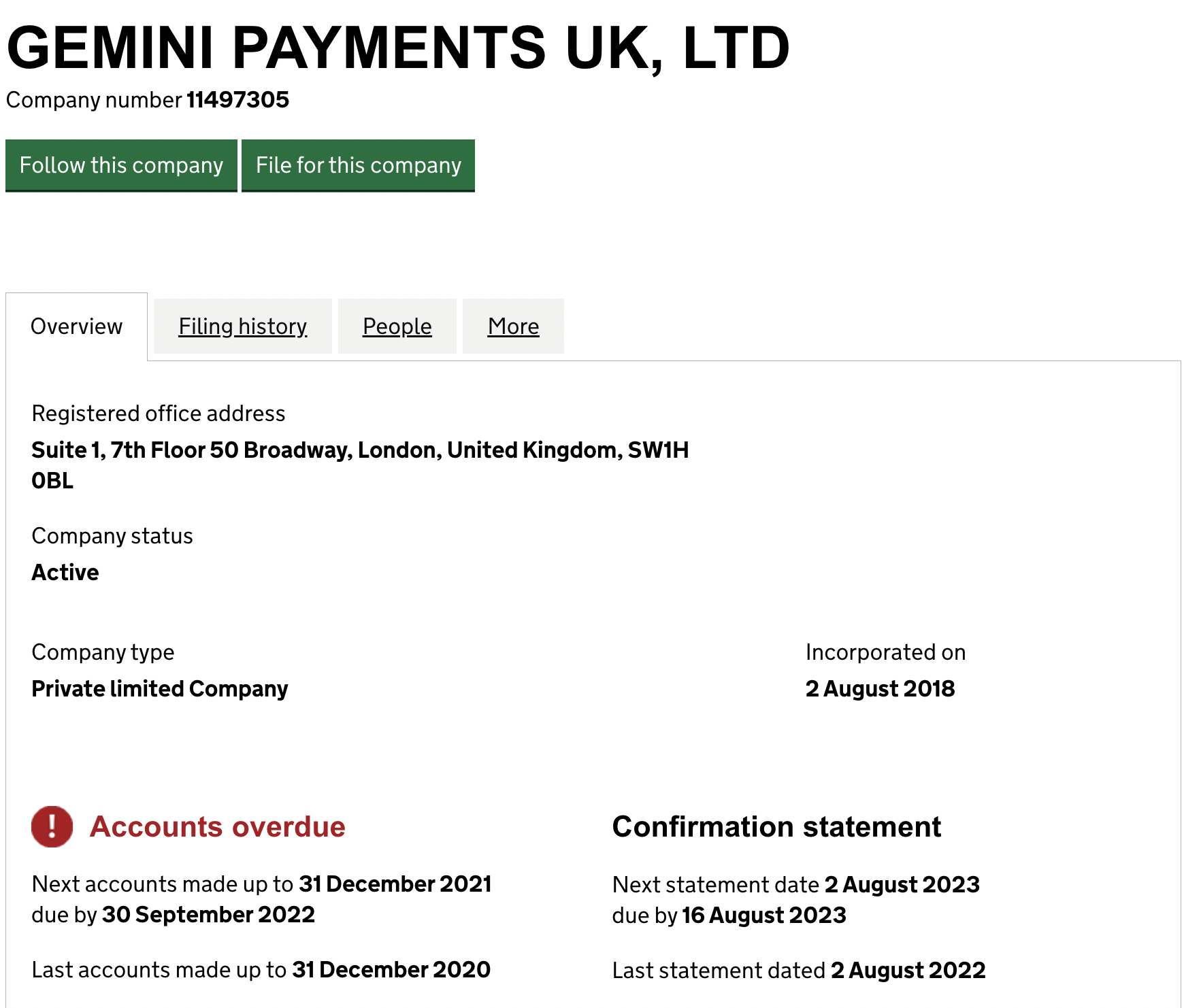
Crypto exchange Gemini’s UK subsidiaries have missed the deadline to file their 2021 accounts by over three months.

UK tax authorities require companies to file accounts with Companies House nine months after the end of a financial year. The deadline for the filing of Gemini’s 2021 accounts was Sept. 30, 2022. Gemini did not respond to multiple requests for comment on the delay.

While failing to file a company’s accounts on time is fairly common, it’s considered a criminal offence under the Companies Act 2006. Companies that don’t submit promptly receive a penalty, determined by the length of delay. For example, accounts that are between three and six months late are fined £750 ($900). The amount is doubled if accounts are filed late in two successive financial years. 

Companies can also request an extension. Fintech giant Revolut, for example, missed its Sept. 30 deadline and received an extension until Dec. 31, which it also missed. 

Companies House records, however, don’t show that either of Gemini’s UK subsidiaries, Gemini Payments UK Ltd. and Gemini Intergalactic UK Ltd., received an extension. It just lists the accounts as overdue.

Gemini Payments UK screenshot

A screenshot from Gemini Payments UK Ltd on Companies House

Gemini’s UK operations

Gemini was co-founded by twins Cameron Winklevoss and Tyler Winklevoss and is headquartered in New York. However, the exchange has operated in the UK since 2020 and is an FCA-registered cryptoasset business. Its UK subsidiaries were recently renamed from Gemini Europe Ltd. and Gemini Europe Services Ltd., according to Dec. 22 Companies House filings

The exchange, which has raised over $400 million from investors such as Pantera Capital and 10T Holdings, also recently secured a Virtual Asset Service Provide (VASP) license in Ireland, which enables the exchange to expand into Europe.

This isn’t the first time Gemini’s been late in filing its UK accounts. Gemini Payments UK only filed its 2020 accounts on March 2022, with Gemini Intergalactic UK following in August 2022. 

Gemini’s woes

Gemini recently became embroiled in the collapse of rival crypto exchange FTX when it had to pause withdrawals for its Gemini Earn program, which enabled users to lend out their crypto for returns. 

The exchange partnered with Genesis Global Capital, the lending arm of crypto trading firm Genesis, for its Earn program. Genesis’s lending arm took a significant hit from the collapses of FTX and hedge fund Three Arrows Capital and ultimately had to pause withdrawals. This meant Gemini also had to freeze funds in its Earn program.

Cameron Winklevoss recently sparred with Barry Silbert, the head of Digital Currency Group (DCG), on the issue. Winklevoss said that Gemini had tried to engage with Silbert and DCG, Genesis’s parent company, on multiple occasions but had been unable to move forward with its attempts to unlock funds.

Silbert pushed back on Twitter, defending DCG and saying his company delivered its own proposal to Gemini on Dec. 29 without receiving a response.

Last week, investors filed a proposed class-action complaint against Gemini and the Winklevoss twins. They accuse the company and its founders of fraud and violations of the Exchange Act. Gemini’s chief operating officer Noah Perlman also left the company at the start of this year, according to a report from Bloomberg that cites a source familiar with the matter.

It’s unclear whether Gemini’s broader troubles have had anything to do with the exchange missing its UK accounting deadline. 

Do you work at Gemini? Got a story to share? Email our reporter at kmcmahon@theblock.co. 

Disclaimer: Beginning in 2021, Michael McCaffrey, the former CEO and majority owner of The Block, took a series of loans from founder and former FTX and Alameda CEO Sam Bankman-Fried. McCaffrey resigned from the company in December 2022 after failing to disclose those transactions.

© 2022 The Block Crypto, Inc. All Rights Reserved. This article is provided for informational purposes only. It is not offered or intended to be used as legal, tax, investment, financial, or other advice.

Go to Source
Author: Kari McMahon

Vauld rejects Nexo’s ‘final’ acquisition proposal, questions company’s solvency

Troubled crypto lender Vauld and its committee of creditors (COC) rejected rival Nexo’s “final” acquisition proposal due to concerns about Nexo’s financial health and others issues.

“We have taken the terms of the Final Nexo Proposal into consideration and further consulted with the COC, and we unanimously do not accept your proposal as it stands,” Vauld co-founder and CEO Darshan Bathija wrote to Nexo in a letter dated Wednesday that was obtained by The Block.

Nexo presented the proposal to Vauld’s creditors on Dec. 26 in an open letter. The letter came on the same day Bathija said in an email to Vauld’s creditors that the potential Nexo deal had been called off. But Nexo said it hadn’t yet given up on its attempt to make a deal with Vauld.

Vauld, however, rejected Nexo’s offer as it did not contain significant changes from its previous proposal, and therefore, it continues to seek answers from Nexo on its two key concerns. Those concerns are how Nexo will treat claims of U.S.-based Vauld creditors since it recently announced plans to exit the market and whether Nexo is in good financial health.

“Overall, you have failed to adequately respond to our repeated requests (which echoes the COC’s requests) for a comprehensive due diligence exercise including a solvency assessment of Nexo, or otherwise to elaborate on what measures may be able to be agreed upon to provide Vauld’s creditors with a greater level of assurance in the event of insolvency of Nexo,” Bathija said in the letter.

‘Ironclad assurance’

A Vauld creditor speaking on condition of anonymity told The Block that they “want ironclad assurance that Nexo is solvent, so we don’t get swept up into another insolvency crisis.”

They further said that “there is too much uncertainty for Vauld’s U.S. creditors who make up 45% of the firm’s AUM, no protection if Nexo goes bust, and Nexo still hasn’t given us their financial model so we have a reasonable estimate of hole reduction.”

Vauld has given Nexo until Friday to respond to its concerns. “As these requests are not new to you, we hope that you will be able to show your sincerity in this proposal by providing us satisfactory responses to our queries before the close of business in Singapore on Friday, 6:00pm (SGT) on 6 January 2023,” Bathija said in the letter.

“Mid-next week, Nexo will host a live AMA [ask-me-anything] session to address all outstanding questions about our proposal, and we are adamant about the fact that this is the offer that creates most value for Vauld’s customers,” Kalin Metodiev, co-founder and managing partner at Nexo, told The Block. “In contrast to most everyone in the space, Nexo has a third-party confirmation that our assets exceed liabilities via our real-time attestation that is live since mid-2021.”

Vauld and Nexo have been in discussions for a potential deal since early July, when the former halted client withdrawals after facing a severe liquidity crunch. Vauld owes over $400 million to its creditors.

The firm has until Jan. 20 to sort its financial issues, having received another credit protection extension last November. Vauld, however, has applied for yet another extension and a hearing for the extension is scheduled for Jan. 17. It remains to be seen whether the firm receives yet another extension.

Vauld and its financial advisor, Kroll, did not respond to The Block’s requests for comment.

© 2022 The Block Crypto, Inc. All Rights Reserved. This article is provided for informational purposes only. It is not offered or intended to be used as legal, tax, investment, financial, or other advice.

Go to Source
Author: Yogita Khatri

NFT protocol Collection creates DEX for instant NFT trading: Exclusive

NFT protocol Collection launched an NFT DEX protocol that allows users to create liquidity pools for NFTs that target specific criteria.

Users can set price parameters and restrict pools to certain collections, in-collection traits or socially curated lists to allow people to buy and sell NFTs more quickly and easily.

“The protocol uses Merkle proofs to specify and target specific NFTs by token IDs, allowing users to target individual tokens, user-defined groups, or the whole collection, according to NFT infrastructure startup Gomu, the open-source project’s core contributor. These NFTs can be grouped based on what users desire such as traits, rarity, or even whether they are banned on Opensea. 

Sound confusing? Imagine you want to buy a Bored Ape Yacht Club NFT that has a solid gold fur trait, a trait shared by just 0.46% of the BAYC collection. Instead of searching and bidding on other marketplaces, you could create a liquidity pool and deposit ETH into it. Someone wishing to sell a solid gold fur Ape would then be able to deposit the Ape into the pool and be paid for it immediately.

Likewise, if you wanted to sell an NFT, you could find a pool that matches the criteria of your NFT and sell it straight away, providing there is enough ETH in the pool.

Testnet and rollout 

Collection will launch on Ethereum’s Goerli testnet today before rolling out on the Ethereum mainnet later on in Q1 2023.

“The difference between the NFT DEXs versus the traditional marketplaces like OpenSea is that you can automatically buy and sell,” said Spencer Yang, core contributor for Collection.xyz & CEO of Gomu. “We believe that NFT DEX infrastructure is essential for the growth of the NFT industry in all market conditions.”

Based in Singapore, Gomu launched early last year and raised a $5 million seed funding round in October from investors including Coinbase Ventures, Defiance Capital, and Saison Capital. In November, it announced Mutant Hideout, an NFT marketplace and community hub for members holding Mutant Ape Yacht Club NFTs.

© 2022 The Block Crypto, Inc. All Rights Reserved. This article is provided for informational purposes only. It is not offered or intended to be used as legal, tax, investment, financial, or other advice.

Go to Source
Author: Callan Quinn

Aptos-based multisig wallet Msafe raises $5 million led by Jump Capital

Aptos-based wallet startup Momentum Safe (MSafe) raised $5 million in seed funding led by Jump Capital. 

The round for the multi-signature wallet protocol, which was founded in July last year, featured participation from Superscrypt, Circle Ventures, Coinbase Ventures and Shima Capital, among others.

It chose not to disclose how the deal, which was a simple agreement for future equity with a token warrant, valued the startup. 

Multi-sig, or multi-signature, is a digital signature arrangement used in crypto wallets that requires more than one user to authorize and send transactions.

Such solutions are favored over single signature wallets by enterprises as they enable a team to have more control, CEO Wendy Fu said in an interview with The Block. 

“They’re not going to hold all their assets in a single key wallet — that’s where we see the gap,” she added. 

Through MSafe, account holders can not only manage multi-signature accounts but also lending, yield farming and NFT transactions. 

New blockchain

While there are popular multisig iterations already in operation on other blockchains — notably Safe on Ethereum — Fu, a former software engineer for Meta’s crypto payments wallet Novi, said that MSafe is the first such solution on Aptos. 

Aptos is a new layer one blockchain built by Mo Shaikh and Avery Ching, both of whom previously worked on Meta’s Diem project. It uses a programming language called Move that was originally intended for Diem. The blockchain launched on mainnet in October last year.  

“Their approach is to introduce enterprises onto the layer one…  and then with that, attract the users of these enterprises,” said Fu, explaining the strategy of Aptos and Sui, another layer one built on Move, created by former Meta employees. 

MSafe itself is led by Fu and CTO Jacky Wang, who was previously a developer at blockchain network Harmony.

The team plans to use the funding to push forward with its plans for an integrated app store that shows selected and trusted applications on Aptos. There are also plans to integrate cross-chain asset support and tooling for decentralized autonomous organizations. 

© 2022 The Block Crypto, Inc. All Rights Reserved. This article is provided for informational purposes only. It is not offered or intended to be used as legal, tax, investment, financial, or other advice.

Go to Source
Author: Tom Matsuda


Follow by Email
Facebook20
Pinterest20
fb-share-icon
LinkedIn20
Share