FreeCryptoCurrency.Me

Free stocks and money too!

Category Archive : Crypto News

Borderless Capital backs cultural heritage platform Quantum Temple

Web3 platform Quantum Temple raised $2 million to fund its efforts to preserve cultural heritage using blockchain technology and non-fungible tokens (NFTs).

The pre-seed round is led by Borderless Capital. Other backers in the round include Shima Capital, Algorand Foundation, Outliers Fund and New Moon Ventures, according to a press release from the company.

Quantum Temple is a decentralized platform that hopes to preserve and fund expressions of cultural heritage through a variety of NFTs. Anthropologists, government institutions, artists and academics are involved in the project. 

“We’re committed to using blockchain as regenerative finance infrastructure to allow a new transparent and equitable funding model to preserve cultural heritage and positively impact ancestral communities working in the sector,” Linda Adami, CEO of Quantum Temple, said in the release.

The use of NFTs can create new revenue opportunities for local artists and cultural keepers, which can drive regenerative funding for communities, the company contended.

The project currently offers two membership levels which come with the purchase of a Cosmic Egg NFT. A silver egg costs 1 ETH ($1,391) and a gold egg 4 eth ($5,564). Half of the cost of membership goes towards the impact fund treasury and secures member governance votes.

© 2023 The Block Crypto, Inc. All Rights Reserved. This article is provided for informational purposes only. It is not offered or intended to be used as legal, tax, investment, financial, or other advice.
Go to Source
Author: Kari McMahon

Bitcoin miner Iris Energy revenue falls 27% in December

Bitcoin mining firm Iris Energy reported that its operating revenue declined 27% in December compared to the previous month to $2.1 million — reflecting the first full month of operations after terminating some hosting arrangements. 

The firm mined 19% less bitcoin in December, with its average operation hashrate falling 25% to 1,086 PH/s. Operating capacity increased 30% over the period to 1.5 EH/s in that time. 

Iris Energy said it held $39 million in cash at the end of the calendar year with no debt. 

The investor update comes after Iris Energy unplugged miners that were used as collateral for $100 million of debt on Nov. 21. Based in Sydney, Australia, the company says it uses 100% renewable energy to power its mining rigs. 

© 2023 The Block Crypto, Inc. All Rights Reserved. This article is provided for informational purposes only. It is not offered or intended to be used as legal, tax, investment, financial, or other advice.

Go to Source
Author: MK Manoylov

Crypto market maker CyberX raises $15 million led by Foresight Ventures

Crypto investment firm Foresight Ventures led a $15 million Series A round into digital asset market maker CyberX. 

The deal for the company, which saw its valuation lift to the “few hundred million dollar range” per an interview with founder Zack Fan, saw no other investors participate in the round.

He said that despite interest from other investors, the firm ultimately decided on a single investor as it shared a belief in building for the long-term in crypto.

“In general, we were pretty selective as to who we want to be an investor,” he said. 

CyberX’s raise follows several other market makers procuring capital in recent months. In November, Brussels-based Keyrock raised a $72 million Series B led by crypto payments company Ripple and decentralized market-making protocol Arrakis Finance announced a $4 million round last month. 

The core business model of crypto market making relies on offering a buy-and-sell price for an asset to platforms like exchanges. Typically, market makers earn revenue by charging higher selling prices than what they buy the asset for, pocketing the difference between the two — known as the spread.  

For CyberX, Fan said that it secured the capital primarily to improve its proprietary risk management framework which monitors on-chain and off-chain data in real-time. 

“This year there’s a lot of market turmoil and if you monitor that realtime, you can even tell if a centralized exchange is stressed or not by looking at on-chain data,” he said. 

Troubled market 

Market makers in crypto are currently operating under a time of significant pressure following the fall of crypto exchange FTX. Last year, leading firms such as GSR and Wintermute came under the microscope for possible exposure to the failed exchange, although they ultimately said their exposure was manageable.

Some market-making firms were hit particularly hard by FTX’s collapse. In one case, The Block reported in December that with the majority of funds tied up on the beleaguered exchange, market maker Auros filed for bankruptcy. 

With the fall of trading firm Alameda Research, which was closely aligned with FTX, there’s also talk of a so-called “Alameda Gap” in liquidity in the market. 

Fan said that the company did not have any exposure to FTX but did say that he noticed a change in the market post-Alameda. 

“After Alameda going down, there’s more of a need for a professional market maker,” Fan said. “And now especially on some of the smaller coins, the spread is actually bigger because there are less market makers in general.” 

With the funding from Foresight, the CyberX co-founder said that along with building out its risk management framework, a portion of the capital would go towards procuring regulatory licenses and further research and development into its trading capabilities. 

Disclaimer: Beginning in 2021, Michael McCaffrey, the former CEO and majority owner of The Block, took a series of loans from founder and former FTX and Alameda CEO Sam Bankman-Fried. McCaffrey resigned from the company in December 2022 after failing to disclose those transactions.

© 2023 The Block Crypto, Inc. All Rights Reserved. This article is provided for informational purposes only. It is not offered or intended to be used as legal, tax, investment, financial, or other advice.

Go to Source
Author: Tom Matsuda

Polygon eyes hard fork in January to address reorgs and gas fee spikes: Exclusive

The developers at Polygon PoS blockchain proposed the launch of a hard fork software upgrade to address gas spikes and enhance the security of blocks on the sidechain network. 

The upgrade, proposed by the developers at Polygon Labs, is planned to take place on Jan. 17, according to a note shared with The Block. If approved by the community, the hard fork will aim to reduce the impact of transaction fee spikes and chain reorganizations, thereby claiming to improve Polygon’s performance and security. The upgrade has been discussed by the Polygon community for some time on the governance forum.

The upgrade is part of a broader initiative to improve the technical capabilities of the Polygon side chain, including parallelization and Polygon zkEVM. Polygon PoS runs parallel to Ethereum and hosts some of the biggest Web3 projects like Uniswap and Aave as well as major companies like Robinhood, Adobe and Stripe. 

Preventing reorgs

The first goal of the hard fork is to make Polygon more secure against reorganization. A chain reorganization, also known as a “reorg,” occurs when a new version of the blockchain is temporarily created by diverging from the previous version. The Polygon PoS chain is prone to reorgs, when blocks may overwrite previous ones due to different nodes reaching consensus at different times. This can lead to confusion when trying to verify if a transaction has been completed successfully or not.

To address this issue, developers plan to implement measures to help reduce the amount of time it takes for block finality with regards to verifying successful transactions. The upgrade proposes to decrease the sprint length that will lower the chances of a secondary or tertiary validator kicking in to produce blocks, resulting in fewer reorgs overall.

In the context of the Polygon PoS chain, a sprint length refers to the number of blocks that a validator can produce consecutively. By reducing the sprint length to 16 blocks from 64, it means that a single block producer will be able to produce blocks continuously for a shorter period of time (approximately 32 seconds, as opposed to the current 128 seconds), which developers said should reduce reorgs on the chain.

Reducing gas spikes

The upgrade will reduce the severity of gas spikes by changing the “BaseFeeChangeDenominator” to 16 from 8 to smooth out the rate of change of the base fee. BaseFeeChangeDenominator is a parameter that inversely determines the rate at which the base fee for a transaction changes, depending on the current demand for block space. 

The current value of BaseFeeChangeDenominator on Polygon is 8, and the proposal is to change it to 16. The goal of this change is to smooth out the rate of change of the base fee, reducing severe fluctuations in gas prices during high demand periods, leading to better experience when interacting with the chain.

© 2023 The Block Crypto, Inc. All Rights Reserved. This article is provided for informational purposes only. It is not offered or intended to be used as legal, tax, investment, financial, or other advice.

Go to Source
Author: Vishal Chawla

NFT sales rise 13% in December, breaking 8-month streak of declines

Monthly trading volume of NFTs in December broke an 8-month streak of declines in 2022, rising 13% from November to $549.5 million, according to The Block’s data dashboard. 

The increase is “most likely a combination of tax loss harvesting and a revitalization of popular narratives around some of the blue-chip PFP projects, most notably Yuga Labs, given their upcoming ‘Trial of Jimmy the Monkey’ event,” says Thomas Bialek from The Block Research.

Despite the month-over-month increase, trading volumes are still just a fraction of what they were a year ago, with December of 2021 seeing around $2.8 billion of activity.  

NFTs did see some hopeful moments in 2022, even with the downturn. An NFT benefitting WikiLeaks founder Julian Assange sold for $52.7 million in February, while NFTs from Yuga Labs also topped the most expensive NFT sales last year.


© 2023 The Block Crypto, Inc. All Rights Reserved. This article is provided for informational purposes only. It is not offered or intended to be used as legal, tax, investment, financial, or other advice.

Go to Source
Author: MK Manoylov

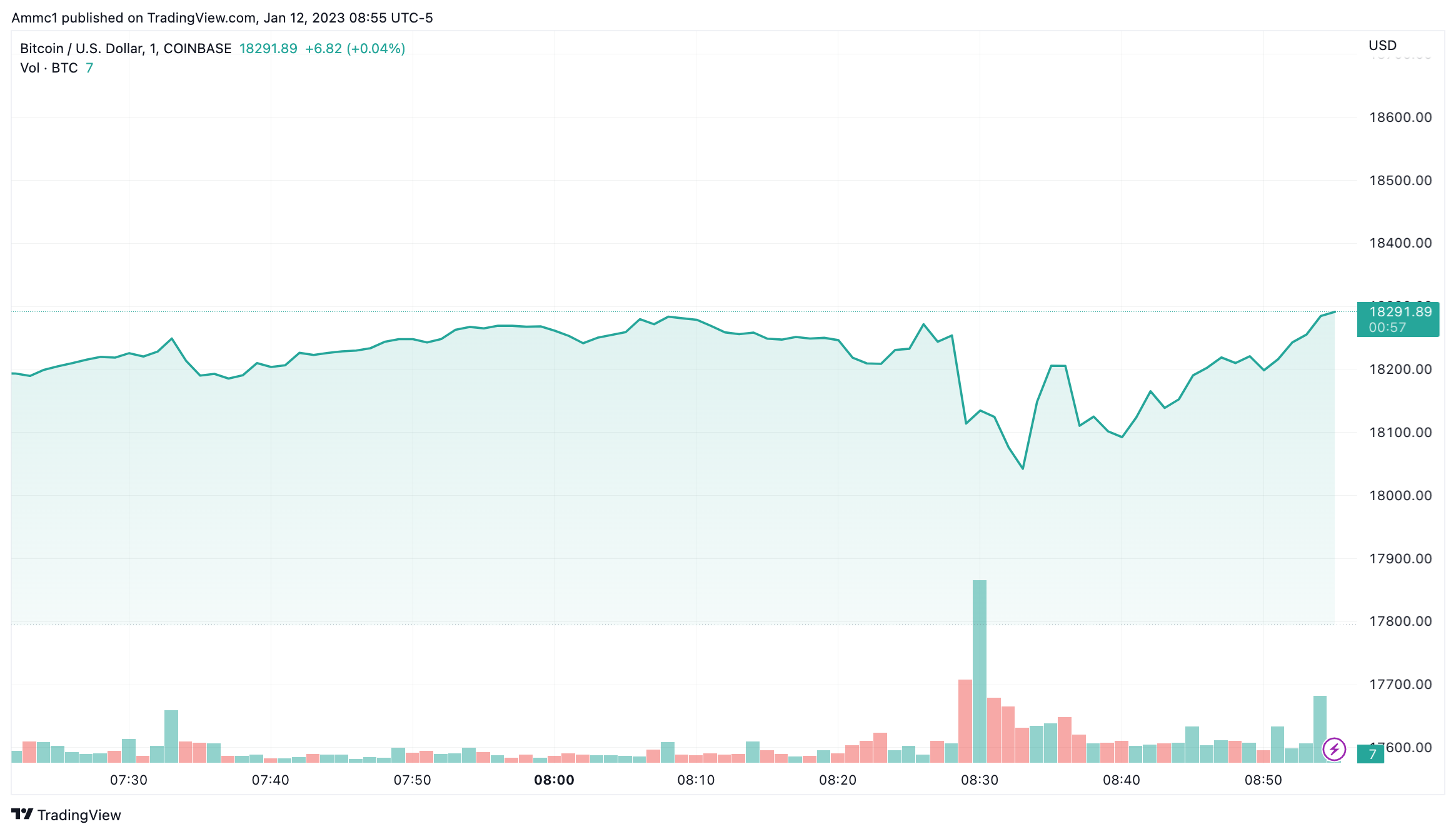
Bitcoin above $18,000 as US inflation slows in December

Inflation in the U.S. increased by 6.5% year-on-year in December and decreased by 0.1% month-on-month. 

Cryptocurrencies and traditional stock markets were buoyed as CPI data met estimates. Bitcoin initially dipped following the news before recovering to trade higher.

The leading cryptocurrency by market cap was trading at $18,291 by 8:55 a.m. EST, according to TradingView data. 

Financial markets have been trading higher over the past few days following last Friday’s jobs report in the U.S.; some commentators see the rally continuing. 

Traders will continue to be bullish as long as the year-on-year increase is below 6.6% or 6.7%, Bit Mining’s Chief Economist Youwei Yang told The Block ahead of the news. 

“This could give the macro environment and crypto market some sentiment to rally for the short term,” Yang said. “The market is betting the Fed won’t have the guts to raise the final interest rate above 5.25%, as it could mean difficulty to pay back national debt and also market liquidity.”

© 2023 The Block Crypto, Inc. All Rights Reserved. This article is provided for informational purposes only. It is not offered or intended to be used as legal, tax, investment, financial, or other advice.

Go to Source
Author: Adam Morgan McCarthy

Tinder’s chief product officer joins web3 gaming studio N3twork

Tinder’s former chief product officer Josh Sell has swiped right on web3 gaming, with a new job as N3twork Studios’ chief operating officer.

N3twork, which was spun off last year to create a blockchain-focused gaming business, is known for its mobile RPG Legendary: Game of Heroes.

It also has two new RPGs — Legendary: Heroes Unchained and Triumph — in development. While shepherding these, Sell will support N3twork’s President Matt Richetti in running the studio’s day-to-day operations, according to a company release. 

“The folks I met with prior to joining were all intrinsically motivated by consumer experience. Their views lined up perfectly with my own around how web3 can drive genuine and sustained player benefit,” said Sell in a statement. 

The studio has also attracted developers from from EA, Kabam, Zynga, Glu and Disney. 

N3twork Series A

In May last year, N3twork completed a $46 million Series A fundraise led by Griffin Gaming Partners, alongside Kleiner Perkins, Galaxy Interactive, Floodgate, LLL Capital, N3twork Inc. (the parent company of N3twork Studios) and others.

Tinder’s parent company Match pulled back from web3-related activities following disappointing second-quarter earnings last year and the departure of its CEO Renate Nyborg. New CEO Bernard Kim said it would also mothball plans to release an in-app digital currency called Tinder Coins.

© 2023 The Block Crypto, Inc. All Rights Reserved. This article is provided for informational purposes only. It is not offered or intended to be used as legal, tax, investment, financial, or other advice.

Go to Source
Author: Lucy Harley-McKeown

Crypto in space: Cryptosat and DoraHacks complete ZK proof experiment on space station

The first successful experiment to launch a Zero-Knowledge (ZK) proof system in space occurred onboard the International Space Station (ISS) today, in a partnership between crypto-satellite developer Cryptosat and global hackathon organizer DoraHacks.

The experiment performed onboard the ISS demonstrated the capacity of a satellite-based computation environment to perform part of the trusted setup process necessary to utilize a ZK proof protocol, DoraHacks and Cryptosat said. 

The success of the ZK proof experiment is an important step forward in proving the efficacy of space-bound computational environments, according to Cryptosat, which is seeking to launch a constellation of cubesats into orbit and build out its satellite fleet.

For the ISS experiment to be successful, the teams needed to work with infrastructure that accounted for lapses in ground station connectivity. “ISS has a regular radio frequency communication link with [a] ground station,” Cryptosat founder Yonatan Winetraub told The Block. “We used that link for our demonstration.”

The procedure involved transmitting pre-uploaded open source programs via secure link to the ISS to output a string file for the ZK proof-based voting program used by DoraHacks.

Cryptosat already launched two mug-sized satellites, cubesats Crypto1 and Crypto2, the latter of which is undergoing testing, Winetraub said.

A major component of ZK proofs is the deployment of a trusted setup that must be managed by an impartial party, and Cryptosat’s cubesats “essentially provide the perfect environment for those trusted setups,” Cryptosat founder Yan Michalevsky told The Block.

There are still some limitations with the cryptographic scheme behind the ZK proof used in the experiment, Groth16, which requires a new setup for any updates to the voting program. In addition, the experiment only encompassed the second phase of a Groth16 setup.

“There are already multiple use-cases that are ready to move to production, including random beacons, trusted setups, private ballots, etc. However, a larger satellite fleet enables us to tackle new use cases that require even higher and available bandwidth,” Michalevsky said.

© 2023 The Block Crypto, Inc. All Rights Reserved. This article is provided for informational purposes only. It is not offered or intended to be used as legal, tax, investment, financial, or other advice.

Go to Source
Author: Jeremy Nation

Unstoppable Domains, Ready Player Me to connect metaverse avatars with domain names

Unstoppable Domains introduced a new integration that will allow users to add their Ready Player Me avatars to their Unstoppable Domains profiles. 

Ready Player Me is a platform where metaverse users and gamers create avatars that are usable across different worlds such as Mona, Somnium Space, Spatial and The Nemesis. By linking it with their Unstoppable Domain profiles, they will be able to set their avatar as a profile picture and use it in thousands of compatible platforms supported by Unstoppable Domains.

With the rise of platforms such as the Ethereum Name Service (ENS) and Unstoppable Domains, interest has grown around web3 domains and digital identity.

Unstoppable Domains claims it has registered over 3.1 million domains since launch. The company compares web3 domains to web extensions like “.com” or “.info” launched as smart contracts on public blockchains.

The domains are then stored in a wallet by the owner as an NFT and can be used in lieu of a wallet address for making financial transactions and for enabling decentralized websites. 

So long, anon?

For proponents of web3 domain usage, the idea is to create a system where people have a persistent identity online as they do in real life. They point to certain advantages of having such a system including being able to log into different services with the same account (and not needing to remember different passwords) and the potential to reduce online harassment.

Despite potential privacy and security concerns, investors are on board. Unstoppable Domains raised $65 million at a $1 billion valuation during its Series A round last July. 

Trying to come up with one system that works across the board is the challenge here. Last year Unstoppable joined with several other domain naming systems including Tezos Domains and the Polkadot Name System to form the Web3 Domain Alliance. The group aims to address challenges around domain fraud and naming collisions as the services’ popularity grows. 

© 2023 The Block Crypto, Inc. All Rights Reserved. This article is provided for informational purposes only. It is not offered or intended to be used as legal, tax, investment, financial, or other advice.

Go to Source
Author: Callan Quinn

Want to rub shoulders at the Tribeca Film Festival? You’ll need an NFT for that

Want to schmooze with celebrities at the The Tribeca Film Festival this year? You’ll need an NFT for that. 

The festival and crypto exchange OKX are releasing NFTs that give users exclusive VIP access to events featuring actor Robert de Niro and Jane Rosenthal, the co-founder and CEO of Tribeca Enterprises, as well as select screenings. 

Nate Zou, OKX’s head of Web3 global growth, said that Tribeca NFT holders will use their OKX Wallet app to scan a QR code at certain entry points, verifying their pass and allowing them to enter events. These NFT passes cost 0.6 ETH to mint with gas to mint on the OKX Launchpad, the firm’s NFT platform, or $899 to buy on the Tribeca Film Festival website. There are 500 Tribeca passes available to be used at the 2023 Tribeca Film Festival between June 7-18 in New York. 

OKX and Tribeca Film Festival signed a partnership in “early spring 2022 and began working together immediately,” Zou said. 

© 2023 The Block Crypto, Inc. All Rights Reserved. This article is provided for informational purposes only. It is not offered or intended to be used as legal, tax, investment, financial, or other advice.

Go to Source
Author: MK Manoylov


Follow by Email
Facebook20
Pinterest20
fb-share-icon
LinkedIn20
Share