FreeCryptoCurrency.Me

Free stocks and money too!

Category Archive : Crypto News

Ignoring digital assets would be like sticking with paper over computers, BNY Mellon CEO says

BNY Mellon is committed to continue exploring the digital asset space, albeit cautiously.

CEO Robin Vince said on an earnings call today that digital assets are the bank’s “longest-term play” and acknowledged the world’s oldest continuously operating bank has to adapt to technology changes.

“We’re investing for a future that probably will come to be, but it may not. But if it does come to be, we have to be there,” he said. “We do think it’s important for us to participate in the broader digital asset space.” 

The bank’s chief compared ignoring the digital asset space to “being the custodian of 50 years ago and sticking with paper and not adopting a computer … That’s not going to be us.”

BNY Mellon is one of several traditional institutional players entering the digital asset space. Fidelity opened retail crypto accounts in November, before filing metaverse trademark applications last month. BlackRock launched a private bitcoin trust last August as well as a crypto and blockchain-linked ETF in Europe.

Custody Push 

BNY Mellon reported a 38% drop in profits during the fourth quarter to $509 million from $822 million a year earlier. The bank plans to cut 3% of staff or around 1,500 jobs, according to a WSJ report

Last year, the bank received approval from New York’s financial regulator to receive select customers’ bitcoin and ether deposits. BNY Mellon is working with Fireblocks and Chainalysis as its two main partners on its custody push while also leveraging other firms including Blockdaemon. 

The bank also offers two Digital Asset Platforms, the Digital Asset Fund Services and Digital Asset Custody.

The Digital Asset Fund Services provides services to about 19 crypto ETFs and mutual funds, including Grayscale’s Bitcoin Trust (GBTC). Its Digital Asset Custody product was recently launched and is only available to select U.S.-domiciled institutional clients. 

© 2023 The Block Crypto, Inc. All Rights Reserved. This article is provided for informational purposes only. It is not offered or intended to be used as legal, tax, investment, financial, or other advice.

Go to Source
Author: Adam Morgan McCarthy

Gemini, Winklevoss twins hit with new lawsuit seeking class-action status

Crypto exchange Gemini and its co-founders, Tyler and Cameron Winklevoss, were hit with a lawsuit that’s seeking class-action status.

The main plaintiff, Joshua Berdugo, invested $13,000 in Gemini Earn and accused the twins of defrauding hundreds of thousands of investors by ”luring unsuspecting investors into purchasing unregistered securities.”

The Securities and Exchange Commission charged Gemini Trust Company this week, along with DCG’s Genesis Global Capital for the alleged offer and sale of unregistered securities to retail investors through a Gemini crypto lending program.

The lawsuit claims “Gemini made repeated false and misleading statements to promote Gemini Earn.”

For instance, Gemini’s website said it partnered with “vetted and accredited third party institutional-grade borrowers,” when in reality it only partnered with one, Genesis, the complaint said.

It also accuses the exchange of failing to disclose to Gemini Earn investors that Genesis could not honor redemptions in Gemini Earn after it became known that Genesis had significant exposure to troubled crypto hedge fund Three Arrow Capital.

Berdugo pointed to specific tweets by the Winklevoss twins, like one from Nov. 9 where Cameron Winklevoss stated Gemini had no material exposure to FTX or Alameda Research. Those comments were ”entirely misleading and/or false,” Berdugo alleged.

Gemini did not immediately respond for a request to comment.

© 2023 The Block Crypto, Inc. All Rights Reserved. This article is provided for informational purposes only. It is not offered or intended to be used as legal, tax, investment, financial, or other advice.

Go to Source
Author: Catarina Moura and Benjamin Robertson

Crypto execs agree lending needs to mature, outgrow its cliquish nature to thrive

Crypto lending needs to diversify if it hopes to thrive, according to panelists speaking at the CFC Conference in St Moritz.

The bull cycle of 2021 marked a period of wild exuberance that sent the price of cryptocurrencies to astronomical heights, with the price of bitcoin hitting an all-time high of almost $69,000. Underpinning that froth was a surge in lending activities, supercharged by active traders seeking leverage to make large bets on coins.

In one case, Genesis Global Capital, owned by Digital Currency Group, originated $131 billion in loans for the year — seven times more than in 2020. During the third quarter, Genesis originated $8.4 billion in new loans, down 80% from the previous period. The firm is now verging on bankruptcy following last year’s credit crunch stemming from the meltdown of Three Arrows Capital and Sam Bankman-Fried’s Alameda and FTX.

Crypto’s credit crisis was underpinned by a lack of diversity in counterparties and parameters that would give traders a better sense of their counterparties’ risk, Diogo Monica, co-founder of crypto financial services provider Anchorage, said.

In traditional finance, “since there’s more counterparties … you end up not having huge risk,” he said. “And in fact, there’s a lot of rules and regulations that make you give enough data so that you can actually judge what other people’s positions are at other prime brokers. None of that exists in crypto. It’s all the same people.”

The desire to draw upon the principles of traditional finance was echoed by SwissBorg’s Cyrus Fazel, who said that the market “should take what was in asset management, what was in banking, and power it with many institutions in crypto.”

Decentralized lending

Fazel, Monica and fellow panelist David Olsson of Kraken agreed that decentralized lending could also play a larger role in the crypto credit market.

Olsson, who recently joined Kraken to lead its prime finance business, said that the crypto exchange could draw upon pools of decentralized credit from protocols like Aave and Compound.

“There is a model where you can have a two-speed solution where we could do certain lending for a client on balance sheet … and then if there are risks that we are not comfortable with as an institution … we could participate in a DeFi protocol,” Olsson said.

DeFi lending for institutions will have to be permissioned, Olsson said, noting that institutional investors need “a lot of hand-holding and human intelligence around … red flags that are outside the world of pure protocol and computational power.”

“That’s going to be the way it is 30 years from now,” Olsson said.

Disclaimer: Beginning in 2021, Michael McCaffrey, the former CEO and majority owner of The Block, took a series of loans from founder and former FTX and Alameda CEO Sam Bankman-Fried. McCaffrey resigned from the company in December 2022 after failing to disclose those transactions. 

© 2023 The Block Crypto, Inc. All Rights Reserved. This article is provided for informational purposes only. It is not offered or intended to be used as legal, tax, investment, financial, or other advice.

Go to Source
Author: Frank Chaparro

MetaMask Staking beta now live with Lido and Rocket Pool, ConsenSys Says

Crypto wallet provider MetaMask will now support liquid staking through Lido and Rocket Pool, ConsenSys announced today.

In a public beta for the protocol, users that want to stake ETH, and earn rewards for contributing to network consensus, may do so directly within MetaMask’s web3 application by selecting a desired staking provider and confirming the amount of ETH to be allocated with a signed transaction.

“It is important to note that MetaMask Staking isn’t providing staking services,” MetaMask senior product manager Abad Mian told The Block in an email. “We simply connect users to Lido and Rocket Pool to stake their ETH and receive liquid staking tokens directly from the staking provider.”

Lido and Rocket Pool were chosen based on user feedback and “are among the most popular options for Ethereum liquid staking,” according to Mian.

The Merge

Interest in staking has been on the rise since the launch of the Ethereum Beacon chain and The Merge, according to Mian. However, despite its surge in popularity, staking suffers from convoluted interfaces that may present a barrier to adoption.

“We believe staking is a core component of web3,”Mian said. “Clean, convenient, and comprehensible user interfaces are critical for driving the adoption of web3 products and services.”

Those who wish to swap from stETH or rETH received for staking on Lido or Rocket Pool back to ETH may do so within MetaMask for a fee.

“MetaMask Staking users can direct themselves to MetaMask Swaps from the Staking interface if they want to make a swap. Swaps aggregate data from decentralized exchange aggregators, market makers and DEXs, to help you compare prices for your swap,” Mian said.

© 2023 The Block Crypto, Inc. All Rights Reserved. This article is provided for informational purposes only. It is not offered or intended to be used as legal, tax, investment, financial, or other advice.

Go to Source
Author: Jeremy Nation

Coinbase, crypto-related stocks buoyant as traditional markets slide

Crypto-related stocks from Coinbase to Hut 8 are trading higher, bucking the trend for the S&P 500 and Nasdaq, which are sliding. 

Bitcoin has been trading firmly above $19,000 over the past hour, with cryptocurrency and digital asset firms reaping the benefits.

Coinbase is up nearly 5%, with Silvergate advancing 3%. MicroStrategy rose 4.8% at around 10:40 a.m. EST. Hut 8 advanced 9%, and Marathon Digital rose 14%.

“We’re absolutely seeing some surprising positive performance in crypto assets,” said Stephane Ouellette, CEO at FRNT Financial. “The top 10 largest cryptocurrencies by market cap are all up over 10% in the last 7-days, some up well over 20%. Furthermore, many of those equities have significant short interests that are likely contributors to the accelerated moves.” 

Chart

BTCUSD chart by TradingView

The S&P 500 was down 0.2%, while the Nasdaq was marginally down. 

“Crypto markets are diverging from equities and continuing their upward trend with bitcoin leading the charge forward,” GSR said in a market update. “U.S. equities are moving lower, with financials leading the plunge lower behind challenging bank earnings.”

© 2023 The Block Crypto, Inc. All Rights Reserved. This article is provided for informational purposes only. It is not offered or intended to be used as legal, tax, investment, financial, or other advice.

Go to Source
Author: Christiana Loureiro and Adam Morgan McCarthy

Celsius sells bitcoin mining machines for $1.3 million

The bitcoin mining arm of bankrupt crypto lender Celsius is selling machines worth $1.3 million.

The firm is letting go of nearly 2,700 “new-in-box” MicroBT M30S units, according to a Jan. 11 notice of sale filed with the U.S. Bankruptcy Court for the Southern District of New York.

The buyer is investment firm Touzi Capital, which will be responsible for all shipping costs. Touzi is a small firm based in Cupertino, Calif. that invests in multifamily apartment buildings, senior living real estate and bitcoin mining.

“Debtors held discussions with several brokers and market participants,” the filing said. “The debtors determined the price offered by Touzi Capital LLC was the best offer.”

Celsius’ hosting provider Core Scientific, which also recently filed for bankruptcy, got the greenlight last week to power off all of Celsius’ machines.

The two firms had been in a dispute for the past few months over the terms of their hosting agreement, with Celsius filing a motion to enforce the automatic stay in September. The firm is also one of Core’s creditors.

Bitcoin miners have faced tough economics over the past year, with the coin’s price declining and energy prices spiking. As mining becomes less profitable, prices for ASIC machines have followed, losing over 80% of their value last year.

© 2023 The Block Crypto, Inc. All Rights Reserved. This article is provided for informational purposes only. It is not offered or intended to be used as legal, tax, investment, financial, or other advice.

Go to Source
Author: Catarina Moura

Ethereum developers release devnet 2 ahead of mainnet shadow fork for Shanghai

Ethereum has released a new developer network, called “devnet 2,” to help client teams prepare for the upcoming Shanghai upgrade

The devnet has come a few months after developers spun devnet 1 back in November. Devnet 2 was released on Jan. 11, Ben Edgington, product lead of the Teku client team, noted at the latest Ethereum consensus layer (CL) meeting. 

The devnet has been launched primarily to test and look for bugs in software for the Shanghai upgrade that will allow users to withdraw coins staked with validators. This feature, which is currently unavailable, will be launched on the mainnet in March, enabling users to access their staked coins that were made temporarily inaccessible during the transition known as “The Merge” in September.

Shadow fork coming

Developers are also preparing to conduct a shadow fork of Shanghai on the Ethereum mainnet in the next few weeks as part of the dress rehearsals for the Shanghai upgrade. A shadow fork is a test on a version of the actual mainnet to ascertain whether the code would work on the real blockchain.

The shadow fork will add more complexity to the Shanghai testing, making it more akin to the final rollout in March, said Marius Van Der Wijden, Ethereum developer at the Geth client team. “The shadowfork will just add more load to the test — more transactions and more state and others,” Van Der Wijden told The Block.

Developers are also considering a public test network for the Shanghai upgrade before the end of February, which would onboard staking firms to test the Shanghai upgrade.

© 2023 The Block Crypto, Inc. All Rights Reserved. This article is provided for informational purposes only. It is not offered or intended to be used as legal, tax, investment, financial, or other advice.

Go to Source
Author: Vishal Chawla

Bitfarms seeks to avoid BlockFi loan default with renegotiation

Bitfarms is seeking to modify a loan with BlockFi to avoid default as the value of equipment plummets.

Last year, Bitfarms’ Backbone Mining Solutions entered into a $32 million equipment financing facility with BlockFi Lending LLC. BMS owns and operates the assets of Bitfarms’ 20-megawatt active crypto mining facility in Washington state. The loan is secured by certain assets of BMS, which has a  market value of about $5 million, while the outstanding principal and interest is approximately $20 million. 

“During 2022, Bitfarms began taking proactive actions to increase financial flexibility and to reduce indebtedness and capital expenditure obligations,” Bitfarms CFO Jeff Lucas said in a statement. “Considering today’s challenging market conditions, we are seeking to modify our Washington state debt facility to achieve terms that are better aligned with the market outlook and our business strategy.”

The value of mining equipment has dropped after miners went on a spending spree when bitcoin was hitting all-time highs in 2021. But as cryptocurrency prices sank and energy costs rose, mining has become a far less lucrative venture, and miners across the board are struggling to survive.

As of December, Bitfarms and its subsidiaries had cash and unencumbered crypto assets with a value of approximately $36 million, which the company believes provides sufficient liquidity to support ongoing operations for the foreseeable future and to make future payments under its various other loan agreements.

Bitfarms and its subsidiaries have approximately $47 million of outstanding indebtedness, including approximately $20 million in debt under the BlockFi loan. 

© 2023 The Block Crypto, Inc. All Rights Reserved. This article is provided for informational purposes only. It is not offered or intended to be used as legal, tax, investment, financial, or other advice.

Go to Source
Author: Christiana Loureiro

Tiny Colony game bids farewell to Solana, will migrate to ImmutableX

Construction and management simulation game Tiny Colony will migrate to ImmutableX.

Originally built on Solana, the move will come with new features for the Tiny Colony ecosystem, dubbed “the Tinyverse,” including a built-in crypto wallet and the option to pay for in-game assets in fiat. 

It will join the Australian-based Immutable’s roster of games including Gods Unchained, Illuvium, Guild of Guardians and Ember Swords.

Tiny Colony is not the only project that’s announced plans to leave Solana of late. In December, two of the largest NFT projects on Solana, DeGods and y00ts — both the product of NFT creator Rohun Vora, who goes by the pseudonym “Frank DeGods” — said they would bridge to Ethereum and Polygon this year.

Off the chain

Hit by an exploit and the collapse of FTX last year — FTX’s former CEO Sam Bankman-Fried had been a vocal supporter of Solana — Solana has also had to contend with increasing competition among chains for projects.

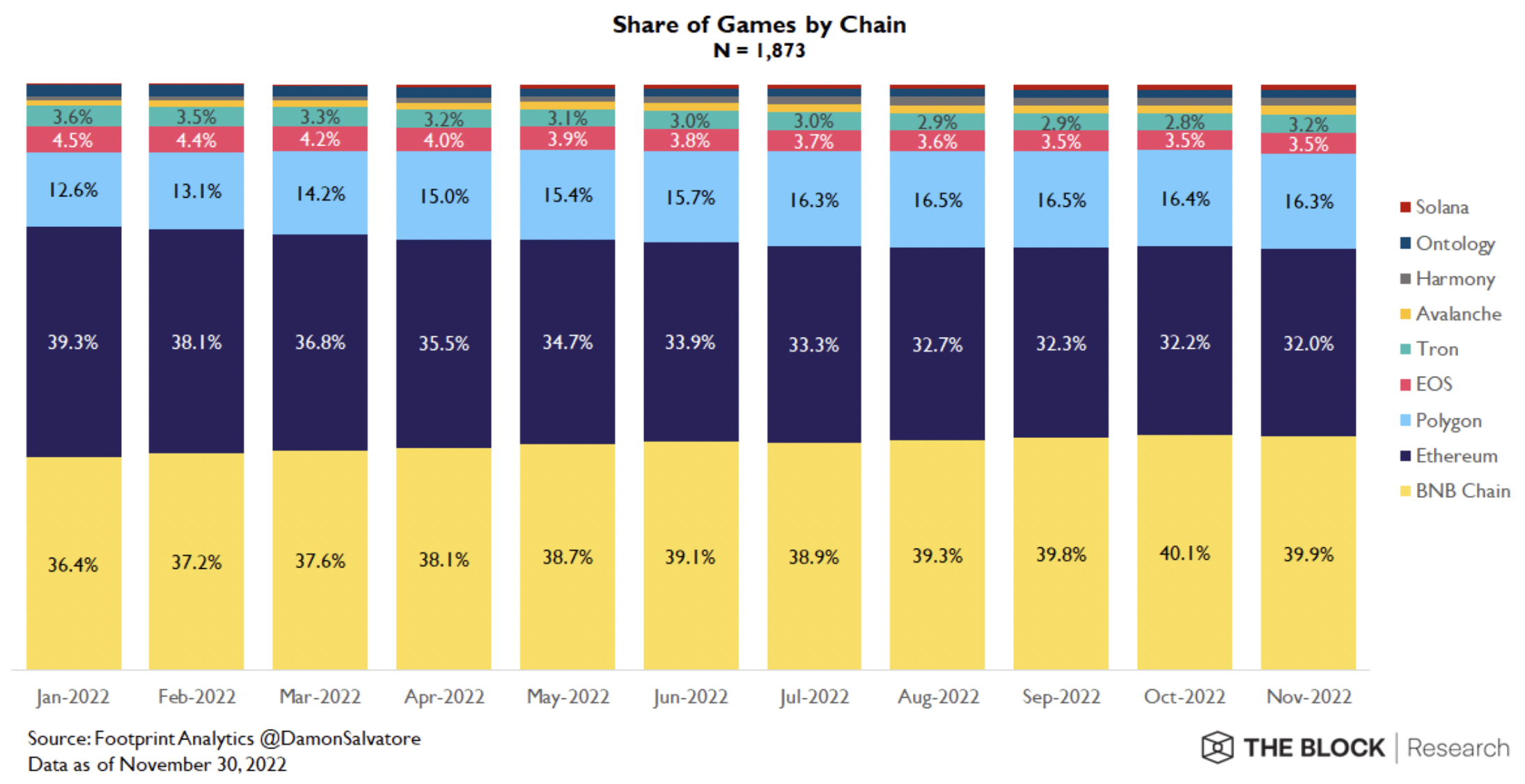
Share of games by blockchain as of Nov. 30, 2022. Source: The Block Research

New gaming-focused chains have been trying to attract new projects from other chains with grants and promises of greater support. Among them, South Korean blockchain Klaytn successfully lured Defi Kingdoms away from Harmony last year.

© 2023 The Block Crypto, Inc. All Rights Reserved. This article is provided for informational purposes only. It is not offered or intended to be used as legal, tax, investment, financial, or other advice.

Go to Source
Author: Callan Quinn

European cross-border crypto fraud network dismantled

European law enforcement agencies have dismantled a crypto fraud network across Serbia, Germany, Cyprus and Bulgaria. The cross-border operation allegedly used call centers to defraud international victims out of tens of millions of euros.

The European Union Agency for Criminal Justice Cooperation and Europol arrested 14 people in Serbia and one in Germany after the online scam investigation launched in 2021.

The asset seizures include 150 computers, three cars, two luxury apartments, $1 million in cryptocurrencies and 50,000 euros in cash, according to the announcement

Victims were reportedly based in Germany, Switzerland, Austria, Australia and Canada. While the exact number was not disclosed, the law enforcement authorities said that the number identified is “almost certainly only the tip of the iceberg.” During investigations, they found “high volumes of financial transactions.” 

The organized crime group “operated the call centers from Serbia and used a technological infrastructure in Bulgaria to run the scheme,” the announcement said, adding that “allegedly, Cyprus was the base for laundering the illegal proceedings.”

There is no connection between this case and the raid of crypto lender Nexo, according to Bulgarian news outlet Free Europe, which cited a spokesperson for the Sofia City Prosecutor’s Office. Nexo’s offices were raided by police on Thursday as Bulgarian prosecutors began investigating alleged criminal financial conduct, including money laundering and tax violation. Nexo’s co-founder and managing partner, Antoni Trenchev, called the allegations “absurd.”

© 2023 The Block Crypto, Inc. All Rights Reserved. This article is provided for informational purposes only. It is not offered or intended to be used as legal, tax, investment, financial, or other advice.

Go to Source
Author: Inbar Preiss


Follow by Email
Facebook20
Pinterest20
fb-share-icon
LinkedIn20
Share