FreeCryptoCurrency.Me

Free stocks and money too!

Category Archive : Crypto News

Bithumb ordered to pay damages for outage during bitcoin’s 2017 rally: Yonhap

Crypto exchange Bithumb has been ordered to pay $200,000 in damages to more than a hundred investors over an exchange outage during bitcoin’s rally in 2017.

Bithumb has been ordered to pay each of the 132 investors damages from 8,000 won ($6.47) to 8 million won ($6,470), according to South Korean news agency Yonhap.

The exchange went down for 11.5 hours on Nov. 12 2017, when bitcoin’s price fell by $700 to $6,300 on the road to its epic rally to $20,000. The exchange went down because it couldn’t handle the number of trades being made, which had doubled in size.

The ruling initially went against the investors but it was later overturned on appeal. “The burden or the cost of technological failures should be shouldered by the service operator, not services users who pay commission for the service,” said the appeals court.

© 2023 The Block Crypto, Inc. All Rights Reserved. This article is provided for informational purposes only. It is not offered or intended to be used as legal, tax, investment, financial, or other advice.
Go to Source
Author: Tim Copeland

Shiba Inu about to launch Ethereum Layer 2 network Shibarium in beta

Shiba Inu developers are preparing to release the meme token’s Layer 2 network called Shibarium in beta form — with the full launch to follow not long after.

Shibarium is a planned Ethereum-based Layer 2 network for the Shiba Inu ecosystem. Transactions on the chain will be paid for using bone, the governance token of the Shiba DAO. Bone tokens will also be used to reward validators and delegators in the Shibarium network, according to the announcement. As such, 20 million bone tokens, currently worth $27 million, have been reserved to pay out these rewards. Shiba Inu developers say this move will improve the utility of the bone token.

Shiba Inu’s planned Layer 2 network will also utilize other Shiba Inu-based tokens like leash and the ecosystem’s native meme coin shib. Shibarium transactions will trigger shib token burns, the announcement stated. Token burning results in the permanent destruction of tokens by sending them to a project’s “burn address,” thus removing them from the total circulation forever.

Layer 2 networks are built to scale up their Layer 1 counterparts by increasing transaction speeds at reduced costs while relying on the security of the base layer. Shiba stated that Shibarium, when fully built, will be able to serve several blockchain verticals including metaverse and gaming. The announcement added that its planned Layer 2 network will reduce the transaction load associated with these sectors.

“Combined, web3 and Shibarium’s layer 2 blockchain technology can enable a new decentralized metaverse and gaming ecosystem, where players can interact and transact in a trustless and decentralized way and where players can own, buy and sell the digital assets they acquire,” said the Shiba Inu team.

Shiba Inu is working towards a testnet launch for Shibarium, according to the announcement. The mainnet launch will see the team integrate ShibaSwap into the Layer 2 network.

© 2023 The Block Crypto, Inc. All Rights Reserved. This article is provided for informational purposes only. It is not offered or intended to be used as legal, tax, investment, financial, or other advice.

Go to Source
Author: Osato Avan-Nomayo

Bitcoin mining difficulty jumps 10%, its biggest move since October

Bitcoin’s mining difficulty metric has risen just over 10%.

The mining difficulty — which determines how hard it is to create the next block of transactions — reset just after 4 p.m. ET, following its roughly two-week schedule. The metric rose 10.26%, according to BTC.com data.

Such a move was anticipated, as The Block’s Catarina Moura reported this weekend. The bitcoin mining hashrate has also climbed in recent days after a slump in late December, according to The Block’s Data Dashboard.

© 2023 The Block Crypto, Inc. All Rights Reserved. This article is provided for informational purposes only. It is not offered or intended to be used as legal, tax, investment, financial, or other advice.

Go to Source
Author: Michael McSweeney

3 biggest crypto stories to look for this coming week: where will Bitcoin’s price head next?

We’re two weeks into 2023, and the crypto news cycle shows no signs of slowing down. Heading into the new week, some of the month’s major headlines continue to develop.

There’s the drama around crypto financial services firm Genesis, which last week drew the ire of the Securities and Exchange Commission. Elsewhere, digital asset prices continued to post significant gains over the weekend.

Let’s take a look at some of the biggest stories in crypto right now.

What’s next for Genesis?

Genesis, a subsidiary of Digital Currency Group, is waging a war on several fronts: with creditors, including crypto exchange Gemini, and U.S. regulators.

The firm halted withdrawals and new loan redemptions in its lending unit in November amid significant financial headwinds. Since then, it has sought new funding in a bid to fill what’s been reported to be a multi-billion-dollar hole.

Recent days have also seen an escalating war of words between Digital Currency Group and Gemini over funds locked up in Genesis. Gemini and Genesis partnered on the exchange’s Earn program, which offered interest to users who loaned their funds.

The situation was further inflamed last week when the SEC accused Gemini and Genesis of conducting an unregistered sale of securities via Earn.

What’s next for bitcoin?

Bitcoin’s price is on a bit of a tear, in case you haven’t noticed.

The cryptocurrency — largest by market capitalization — is trending near $21,000 across major exchanges. Bitcoin began 2023 at around $16,600, according to data from TradingView.

Reporting from The Block’s market-focused journalists suggests that activity in the futures market could be responsible for some of the momentum. The market might also benefit from a slightly less chaotic period compared to November during the peak throes of FTX’s collapse.

As The Block noted this weekend, crypto-related stocks have also benefited from the environment. Coinbase, for example, gained more than 41% last week.

Still, the famously fickle market for digital assets means that no future is assured, meaning that you’ll have to watch in the days ahead to see where bitcoin will fly — or fall — next.

What’s next for Nexo?

Last week, the story broke that crypto lender Nexo is the subject of an investigation in Bulgaria.

Nexo’s offices in the country were raided by local police in what is said to be an investigation into alleged money laundering and tax crimes.

Nexo has denied any wrongdoing. “The allegations are absurd — we are one of the most stringent entities with regards to KYC/AML,” Nexo co-founder and managing partner Antoni Trenchev said last week.

Fears over Nexo’s long-term viability led to an upswing in withdrawals from its platform.

The situation represents the latest development in a wide arc of scrutiny around crypto lenders. Other lenders in the crypto space, including Celsius and BlockFi, previously drew the ire of regulators.

© 2023 The Block Crypto, Inc. All Rights Reserved. This article is provided for informational purposes only. It is not offered or intended to be used as legal, tax, investment, financial, or other advice.

Go to Source
Author: Michael McSweeney

Scaramucci investing in company set up by former FTX US president

Anthony Scaramucci is investing in a company set up by former FTX US president Brett Harrison.

Bloomberg reported that the American financier and former White House director of communications will support the venture with his own money. Scaramucci also tweeted about the investment in reply to a lengthy tweet thread from Harrison that lambasted disgraced FTX co-founder and CEO Sam Bankman-Fried, writing: “Brett I am proud to be an investor in your new company. Go forward. Don’t look back. Wishing you the best.”

“Anthony has been a true mentor and friend to me since I joined the crypto industry two years ago,” Harrison told Bloomberg News, adding: “I’m honored to have him as an investment partner, and know his guidance will be invaluable as I begin this new chapter.” He also tweeted: “Thank you so much, Anthony. Your support and advice means the world to me. I can’t wait to work together!”

Scaramucci only recently changed his tune on the FTX debacle, telling CNBC that “it’s very clear now that there was fraud” — something he was hesitant to proclaim previously “because that’s actually a legal term.” He said his mind was changed when FTX co-founder Gary Wang and former Alameda Research co-CEO Caroline Ellison pleaded guilty last month.

Disclaimer: Beginning in 2021, Michael McCaffrey, the former CEO and majority owner of The Block, took a series of loans from founder and former FTX and Alameda CEO Sam Bankman-Fried. McCaffrey resigned from the company in December 2022 after failing to disclose those transactions.

© 2023 The Block Crypto, Inc. All Rights Reserved. This article is provided for informational purposes only. It is not offered or intended to be used as legal, tax, investment, financial, or other advice.

Go to Source
Author: Adam James

The storm has passed, but bitcoin mining difficulty is about to blow through the roof

Bitcoin miners are bracing for a massive jump in difficulty this weekend.

The increase could land somewhere around 10%, according to estimates from BTC.com, Bitrawr, Luxor and Braiins. Numbers could still change between now and Sunday, but estimates strongly indicate a sharp increase.

Difficulty refers to the complexity of the computational process behind mining, and it adjusts roughly every two weeks (or every 2,016 blocks), based on the average block time.

It fell 3.6% in the last update, following a winter storm that led a number of miners to power down, either due to price incentives or requests from grid operators.

Now a lot of that hashrate seems to have gone back online, along with newly deployed and more efficient machines.

“It’s a combination of the institutional miners scaling a bit over that longer time period, and some positive variance,” said Daniel Frumkin, director of research at Braiins.

Companies like Marathon and Hive Blockchain have been continually deploying efficient machines like S19 XPs and blockscale BuzzMiners, he said.

“But due to the winter storm, we wouldn’t have seen any of that in the previous epoch, meaning that we are now seeing ~3 weeks of deployments rather than just one,” he said.

Additionally, “there’s probably a good bit of positive luck by pools in aggregate that’s contributing to this large adjustment,” he said.

According to the most recent round of operational updates from December, Hive installed 1,423 machines powered by Intel Blockscale, while Marathon said 12,000 S19 XPs would be energized in the coming month. Cipher Mining has been quickly ramping up production, increasing hashrate by 40% last month. Riot, which deployed 16,128 S19-series miners in December, said the storm knocked about 2.5 EH/s offline.

Riot CEO Jason Les told The Block that the hashrate has been coming back online.  

While the past week has been more bullish for the industry, with bitcoin now rallying above $20,000 and shares of public miners increasing, they are still facing tough economics.

“We’re not seeing any change in the energy costs associated with mining … There’s not a great amount of profitability unless you’ve got the most efficient miner,” said Anthony Power, an accountant and mining analyst who puts together a monthly roundup. “If you haven’t got those you’re not probably not making sufficient money to cover your costs.”

© 2023 The Block Crypto, Inc. All Rights Reserved. This article is provided for informational purposes only. It is not offered or intended to be used as legal, tax, investment, financial, or other advice.

Go to Source
Author: Catarina Moura

Ex-president of FTX US says relationship with SBF reached ‘total deterioration’

Brett Harrison, former president of FTX US, shared his experience at the company and working with Sam Bankman-Fried — and ultimately why he left his so-called “dream job.”

In a 49-part Twitter thread surpassing 1,200 words, Harrison claims Bankman-Fried showed emotionally volatile behavior, avoided conflict, pushed back against criticism and even isolated Harrison from communication on key decision-making. 

“My relationship with Sam Bankman-Fried and his deputies had reached a point of total deterioration, after months of disputes over management practices at FTX,” Harrison wrote.

Harrison recalled working with Bankman-Fried at Jane Street, a global proprietary trading firm based in New York City, in which Bankman-Fried seemed like a promising trader as well as a sensitive and intellectual person. During his first few months as FTX US President, Harrison helped expand the U.S. team and cement professional relationships, such as with the crypto derivatives platform LedgerX.

“Six months into my time at the company, pronounced cracks began to form in my own relationship with Sam. Around then I began advocating strongly for establishing separation and independence for the executive, legal, and developer teams of FTX US, and Sam disagreed.”

Harrison added that Bankman-Fried seemed rarely engaged in the U.S. business and that would impart decisions impacting the U.S. without warning from the Bahamas.

“I saw in that early conflict his total insecurity and intransigence when his decisions were questioned, his spitefulness, and the volatility of his temperament. I realized he wasn’t who I remembered,” he wrote.

After further workplace hostility for five months, Harrison decided to make one last attempt at change. In his 11th month at the company, he wrote a formal complaint detailing the company’s biggest obstacles to success and that he would resign if they weren’t addressed. 

“In response, I was threatened on Sam’s behalf that I would be fired and that Sam would destroy my professional reputation. I was instructed to formally retract what I’d written and to deliver an apology to Sam that had been drafted for me. That event solidified my decision to leave. I knew an abrupt departure would be harmful to the company and my FTX US reports, and I wanted to best position the company for future success after I left. So I gradually wound down, finished building and releasing the U.S. stock brokerage, and saw FTX U.S. employees through their mid-year reviews.”

“I never could have guessed that underlying these kinds of issues — which I’d seen at other more mature firms in my career and believed not to be fatal to business success — was multi-billion-dollar fraud,” Harrison added. “It’s clear from what has been made public that the scheme was held closely by Sam and his inner circle at FTX. com and Alameda, which I was not a part of, nor were other executives at FTX U.S.”

Harrison stepped down as president of FTX U.S. on Sept. 27, 2022. The Jan. 14 thread is a follow-up to the FTX U.S. information that Harrison said he would share “in time” on Jan. 9.

FTX filed for Chapter 11 bankruptcy protection on Nov. 12, 2022, and Bankman-Fried was arrested in the Bahamas on Dec. 12 for charges related to wire fraud and money laundering.

Disclaimer: Beginning in 2021, Michael McCaffrey, the former CEO and majority owner of The Block, took a series of loans from founder and former FTX and Alameda CEO Sam Bankman-Fried. McCaffrey resigned from the company in December 2022 after failing to disclose those transactions.

© 2023 The Block Crypto, Inc. All Rights Reserved. This article is provided for informational purposes only. It is not offered or intended to be used as legal, tax, investment, financial, or other advice.

Go to Source
Author: MK Manoylov

This week in markets: Bitcoin breaks $20,000 as altcoins, crypto stocks surge

Bitcoin, ether and other cryptocurrencies extended last week’s rally heading into the weekend. 

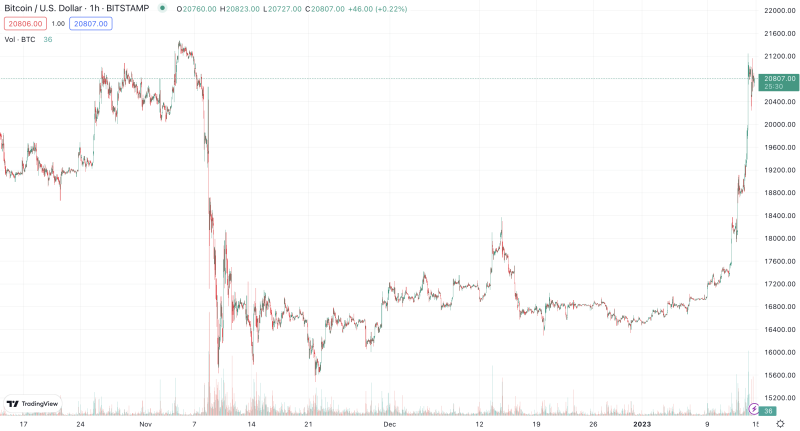
After flirting with the psychological breakthrough level for several days, bitcoin broke past $20,000 this week. The coin’s price on Saturday dipped to around $20,800, up 22% compared to last week’s price of $16,900.

Bitcoin hasn’t seen this level since the November market crash of last year, according to the crypto data tracker TradingView. 

Bitcoin price on TradingView.

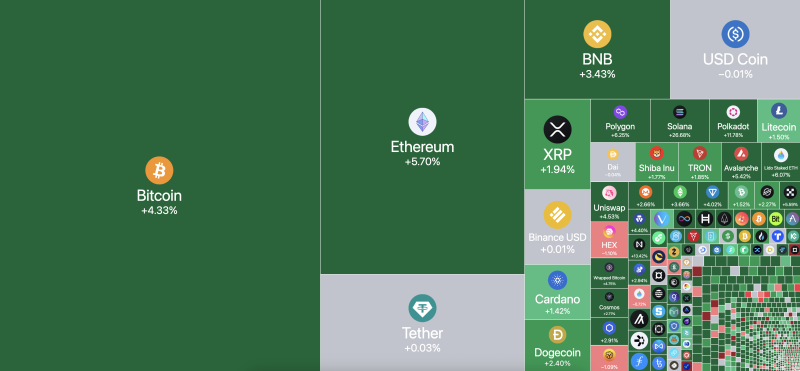
Cryptocurrency market capitalizations rose as a whole this week, including Bitcoin’s 4.33% increase, ether’s 5.7% rise and Solana’s soar of over 26%. Other coins with prosperous market cap gains include Polkadot (11.8%), Polygon (6.3%) and Avalanche (5.4%). 

Crypto heat map on TradingView.

Crypto stocks and structured products

Crypto stocks also did well as bitcoin neared $19,000 — even as S&P 500 stocks remained relatively steady. 

Coinbase shares ($COIN) surged 41% and the bitcoin miner Marathon Digital saw its stock rise 80%, most likely due to the rise in bitcoin’s price. Traditional markets rose about 2% during that time. 

For structured products, GBTC surged 28% and ETHE rose 17%.

In addition, recent data found that digital asset-focused funds started 2023 out with a bang: Ondo Finance launched three tokenized U.S. Treasuries and bonds on Jan. 10, and two Abu Dhabi-based venture firms partnered to create a billion-dollar web3 investment fund on Jan. 11, The Block previously reported.

© 2023 The Block Crypto, Inc. All Rights Reserved. This article is provided for informational purposes only. It is not offered or intended to be used as legal, tax, investment, financial, or other advice.

Go to Source
Author: MK Manoylov

NFT blue-chip Azuki’s new virtual city Hilumia touches physical and digital worlds

The blue-chip NFT project Azuki has launched a virtual city called Hilumia.

Hilumia boasts a toy store, arcade center, gym and even a romance competition called “Love Island.” The virtual city launched earlier this week to celebrate Azuki’s one-year anniversary, and the project’s trading volume spiked 86% on the day of the announcement, according to the NFT data tracker CryptoSlam.

“Hilumia is an interactive virtual city that is shaped by the community and will expand over time,” the firm told The Block, adding that its native Physical Backed Token (PBT) threads its ecosystem together. “PBT will also play a part in how Azuki bridges digital and physical. For example, the owners of the physical golden skateboard, upon scanning the PBT, will be enshrined in the Ruins.”

The Ruins are another area in the Azuki universe, connected to Hilumia and the bustling marketplace called Alley.

Launched by Chiru Labs on Jan. 12, 2022, Azuki is a Japanese-inspired anime universe, complete with its titular collection of 10,000 avatar NFTs as well as its sister NFT project Beanz, which contains nearly 20,000 cartoon beans to act as sidekicks to Azuki characters. Azuki brought in $120.99 million at its peak trading volume during the week of May 8, 2022, The Block’s Data Dashboard shows.

Chiru Labs was closing in on a $30 million Series A raise in September, bringing the firm’s valuation between $300 million and $400 million, The Block previously reported.

© 2023 The Block Crypto, Inc. All Rights Reserved. This article is provided for informational purposes only. It is not offered or intended to be used as legal, tax, investment, financial, or other advice.

Go to Source
Author: MK Manoylov

Alameda lost $1M in liquidations: report

Troubled crypto trading firm Alameda Research lost over $1 million in assets from liquidation last night, according to a report from the crypto intelligence firm Arkham.

The account initially held 9,000 ETH worth $10.8 million, with $20 million USDC and $4 million DAI as collateral. In all, the account’s net balance was $15.2 million.

But a Jan. 14 report from Arkham shows that the account was “forcibly reduced,” and $1.2 USDC was liquidated for 731 ETH. The account now maintains a $1.1 million ETH short against $1.14 million USDC and a net balance of $300,000.

Surprisingly, transactions out of the wallet were made before and during liquidation, indicating that whoever was in control of the wallet either was unable to understand how to close out the positions, or was simply unwilling to,” Arkham said in the report.

The news comes after $72,000 of Alameda funds were liquidated on Aave after consolidating funds into a single wallet on Jan. 12. Twitter users noticed Alameda funds changing wallets, with some tying the movement to Alameda founder Sam Bankman-Fried. However, Bankman-Fried ended his social media hiatus on Dec. 30, 2022, which started when he was arrested in the Bahamas on Dec. 12, 2022, to affirm that he did not move Alameda funds.

Disclaimer: Beginning in 2021, Michael McCaffrey, the former CEO and majority owner of The Block, took a series of loans from founder and former FTX and Alameda CEO Sam Bankman-Fried. McCaffrey resigned from the company in December 2022 after failing to disclose those transactions

© 2023 The Block Crypto, Inc. All Rights Reserved. This article is provided for informational purposes only. It is not offered or intended to be used as legal, tax, investment, financial, or other advice.

Go to Source
Author: MK Manoylov


Follow by Email
Facebook20
Pinterest20
fb-share-icon
LinkedIn20
Share