FreeCryptoCurrency.Me

Free stocks and money too!

Category Archive : Crypto News

EU’s final vote on MiCA regulation postponed until April

The European Union’s landmark crypto regulation, Markets in Crypto Assets (MiCA), won’t see a final vote in the European Parliament until April, stalling the process for the new rules to be enforced. 

The delay is “technical” and most likely caused by issues in translating the almost 400-page file into the 24 official languages of the bloc, an EU Parliament spokesperson told to The Block.

The vote in Parliament’s plenary session, which was previously expected to take place by the end of 2022, was postponed to February in November, also due to translation issues.

MiCA is one of the first EU regimes to supervise the crypto sector and aims to tame what policymakers call the “wild west of crypto assets.” Most significantly, MiCA lays out rules for licensing firms offering crypto services in the EU and regulates stablecoin issuance.

With the final vote delayed, the European financial regulators need to wait longer before they can start drafting implementation rules. Bodies like the European Securities and Markets Authority and the European Banking Authority have 12 to 18 months to draft the technical standards on MiCA once it is officially approved. 

MiCA is not the only regulation that has been held back. The Transfer of Funds Regulation (TFR), which is meant to be implemented in tandem with MiCA, is also postponed to the same voting session in April. The TFR requires crypto transfers to include know-your-customer information on both the recipient and receiver side.

Some European countries are pushing for stricter crypto regulation ahead of MiCA spurred by the turbulent year in crypto markets. For instance, French policymakers and central bankers are calling for the implementation of mandatory crypto firm licensing in 2023.

© 2023 The Block Crypto, Inc. All Rights Reserved. This article is provided for informational purposes only. It is not offered or intended to be used as legal, tax, investment, financial, or other advice.

Go to Source
Author: Inbar Preiss
Forkast Labs created with CryptoSlam and Forkast.News merger

Data provider CryptoSlam and crypto news site Forkast.News have combined to become Forkast Labs, a web3-focused media company.

The pair, which are portfolio companies of software investment giant Animoca Brands, will build data tools, indices, and methodologies to value the digital economy, alongside providing reporting and analysis, a release said. 

Animoca Brands founder and executive chairman Yat Siu shepherded the merger, according to a report in Bloomberg. The terms of the deal were not disclosed. 

Former Bloomberg anchor and founder of Forkast.News, Angie Lau, and founder of CryptoSlam, Randy Wasinger, will be co-CEOs of Forkast Labs. Sarah Chang, co-founder of Forkast.News, will be COO of the combined entity.

“This merger comes at a pivotal moment for the crypto industry,” said Lau. “The entire industry has been valued against volatile price movements, which has created a high degree of speculation. Trust in crypto has been eroded as a result, but we have the power to change that with this merger.”

CryptoSlam was created in 2018 and has become a popular destination for tracking NFT prices. This time last year, it raised $9 million in an oversubscribed round led by Animoca. Forkast.News was founded the same year and raised a seed round in 2021, according to Crunchbase data. 

© 2023 The Block Crypto, Inc. All Rights Reserved. This article is provided for informational purposes only. It is not offered or intended to be used as legal, tax, investment, financial, or other advice.

Go to Source
Author: Lucy Harley-McKeown

Vauld gets creditor protection until Feb. 28 — shorter than requested

Troubled Asian crypto lender Vauld has received a further extension to its legal protection from creditors — albeit a shorter delay than requested.

The company now has until Feb. 28 to explore options to ease its financial troubles, two sources with direct knowledge of the matter told The Block. Vauld, however, had sought protection through Apr. 21, according to an affidavit obtained by The Block. The firm’s previous creditor protection expires on Jan. 20. The latest extension was granted today in the Singapore High Court at a hearing before Justice Aedit Abdullah, the sources said.

Vauld halted client withdrawals in July and has been in discussions with rival Nexo since then for a potential acquisition. Earlier this month, the two parties entered a dramatic tussle. Vauld and its committee of creditors had rejected a “final” takeover proposal from Nexo because of concerns about its financial health and others issues, and Nexo said that Vauld CEO Darshan Bathija doesn’t have the best interest of its creditors in mind. Last week, Nexo’s office in Sofia, Bulgaria, was raided by the local authorities. The raid was part of a probe into suspected money laundering and tax crimes.

Meanwhile, Vauld customers’ funds remain stuck. The firm owes over $400 million to its creditors. Vauld has been pursuing an alternative restructuring, which would involve bringing in a third-party fund manager to oversee its assets. Vauld’s envisioned end goal is for the fund manager to invest its assets and use the target investment returns to repay the creditors.

“We are at advanced stages of discussions with potential fund crypto asset fund manager candidates with preliminary indicative terms having been obtained from two shortlisted fund managers,” the affidavit reads. “There is now clarity to pursue this option of establishing a fund with Vauld’s assets as we are unable to accept Nexo’s proposals.”

It remains to be seen whether Vauld is able to reach a solution for creditors with its latest extension. If the firm is able to make progress, the judge could approve the extension until April, said one of the two sources. Vauld did not immediately respond to a request for comment.

© 2023 The Block Crypto, Inc. All Rights Reserved. This article is provided for informational purposes only. It is not offered or intended to be used as legal, tax, investment, financial, or other advice.

Go to Source
Author: Yogita Khatri

Coinflex says new exchange with 3AC founders won’t use GTX name after Twitter ridicule

Coinflex said that a proposed exchange for trading claims won’t use GTX for its name after a proposal to raise $25 for the project had been widely mocked on Crypto Twitter. 

“Building a marketplace for trading claims (in addition to crypto and potentially other assets) is an evolution of Coinflex’s commitment to building open and transparent financial markets,” the company said in a blog post. “New funds raised will be used for operational growth, which we strongly believe will increase value for Coinflex creditors.”

The Block reported earlier in the day that Su Zhu and Kyle Davies, the founders of collapsed crypto hedge fund Three Arrows Capital, were looking to raise the money with Coinflex founders Mark Lamb and Sudhu Arumugam for a new exchange that would give depositors the ability to transfer claims related to the also collapsed FTX crypto exchange for an immediate credit in a token to be called USDG. 

A pitch deck obtained by The Block had dubbed the new exchange GTX, “because G comes after F.” Coinflex, which is in the process of restructuring, said that was just a placeholder. 

Nic Carter, a founding partner at Castle Island Ventures, compared the latest venture to “arsonists returning to the scene of the crime, hawking buckets of water to their victims,” while Wintermute founder and CEO Evgeny Gaevoy warned anyone that invests in the exchange might find it difficult to work with his firm in the future – “on the relationship building side.” He added that Wintermute won’t participate in venture rounds where they appear on the cap table.

FAQs

The two Coinflex executives will remain with the company, though “key members” may be added as funds are raised, the company said, adding that it could be rebranded into the new entity. 

“CoinFLEX creditors/Series B will be the largest class of shareholders, and we are also discussing other benefits,” the company said, noting that it was also considering adding other asset classes such as equities and bonds. “Above all, we are committed to ensuring that any decisions and actions taken by Coinflex are in the best interest of Coinflex creditors.”

The company said it will provide a further update once a possible round or partnership materializes. 

© 2023 The Block Crypto, Inc. All Rights Reserved. This article is provided for informational purposes only. It is not offered or intended to be used as legal, tax, investment, financial, or other advice.

Go to Source
Author: Christiana Loureiro and Adam Morgan McCarthy

ChatGPT says it has bills to pay as crypto AI tokens rise in wake of potential Microsoft deal

Crypto tokens linked to artificial intelligence have seen a surge in interest after reports that Microsoft could invest $10 billion into ChatGPT creator OpenAI.

The rally has cooled slightly since news of the deal first broke last week, but nine coins connected to the sector have surged over 50% in the past week, according to CoinGecko. Many of the tokens are considered “small cap” with low liquidity, meaning it doesn’t take much to move the price.

ImgnAI, a token linked to an anime-based AI image generator, has been one of the top performers, rising a whopping 718% over the past week. The coin has seen transaction volume of $750,198 in the past 24 hours. Fetch.ai, a more liquid AI-related coin, saw volume of $77.6 million over the past 24 hours. It’s up 65.1% over the past week.

The crypto tokens rising this week have yet to prove if they are viable long-term beyond the typical governance promises common to other utility coins. While the protocols themselves may use AI, how intertwined the tokens are to the technology isn’t totally clear.

ChatGPT

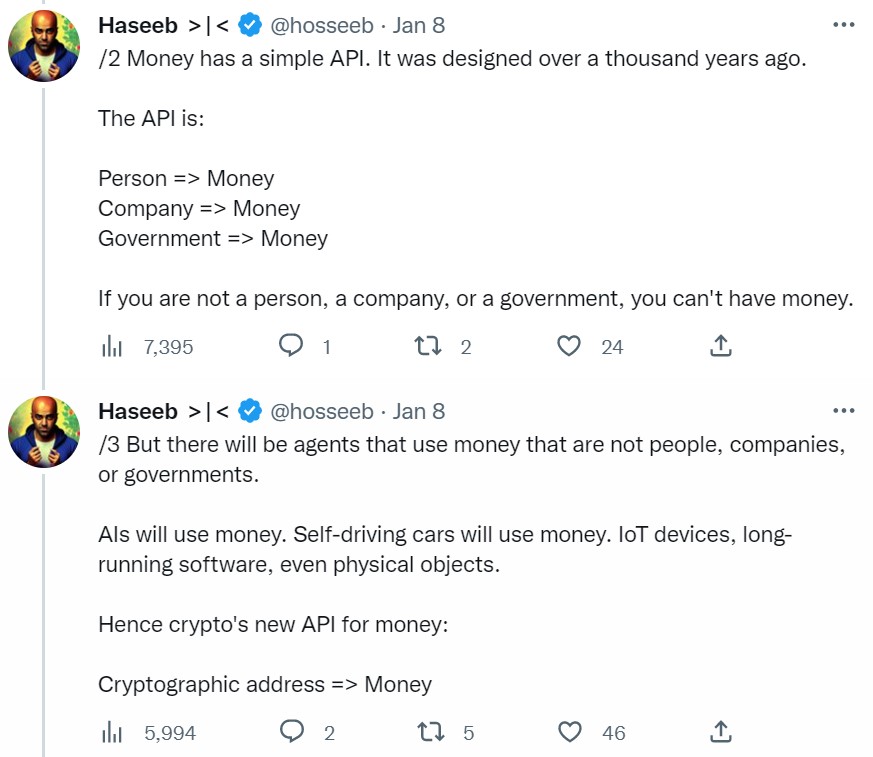
“AI and crypto will be intertwined in a way that will become clearer over the next decade,” he tweeted. “Is this good? Is it bad? It’s hard to say. But you should be prepared for an explosive combination.”

When asked why AI might need to use money, ChatGPT noted the bills that would need to be paid. It didn’t want to specify which token it might like best.

“As for why AI bots may need money for themselves, it could be used for various reasons,” the chat bot wrote when prompted by The Block. “To pay for their own maintenance and upgrades, similar to how humans use money to maintain and improve their standard of living.”

© 2023 The Block Crypto, Inc. All Rights Reserved. This article is provided for informational purposes only. It is not offered or intended to be used as legal, tax, investment, financial, or other advice.

Go to Source
Author: Mike Truppa

Lionel Messi’s crypto sponsor Socios offering token holders chance to snag game balls

Socios, the company with World Cup-winner Lionel Messi as its global ambassador, is trying to score with fans by offering them a chance to win balls used to score goals. But you’ll have to pay to play.

The company announced that fans who own enough tokens purchased through Socios will have the chance to win a “game-used” ball from Wednesday’s upcoming Italian Super Cup between AC Milan and Inter. To be eligible, users have to possess both enough of the requisite number of either teams’ fan token plus Socios tokens. If eligible, fans will then compete in an auction.

Major brands across entertainment and sports are ramping up efforts to engage with fans through digital assets as volumes for famous and artistic non-fungible token (NFTs) collections have dropped dramatically over the last several months. NFTs are viewed as a way to spur engagement by providing incentive for fans to acquire tokens that hold the potential for perks like access to special events, exclusive content or merchandise.

Last week, Warner Bros. Discovery dropped a “Game of Thrones” NFT collection that sold out in seven hours. Former U.S. President Donald Trump’s digital trading card drop gave collectors a chance to win a dinner or Zoom call with the politician and entrepreneur.

Socios said in a statement that after a ball has been used to score a goal during the AC Milan-Inter match, it “will be collected by match officials” and fitted with a chip that will act “as a certificate of authenticity.” The company also said that whoever wins the ball will have their ownership authenticated with the chip to help to avoid the threat of counterfeiting.

© 2023 The Block Crypto, Inc. All Rights Reserved. This article is provided for informational purposes only. It is not offered or intended to be used as legal, tax, investment, financial, or other advice.

Go to Source
Author: RT Watson

Nexo sues Cayman Islands regulator over rejected license

Crypto lending platform Nexo is suing the Cayman Islands regulator for denying the firm a virtual asset license.

Nexo, which only last week saw its office in Bulgaria raided by 300 police and has been the recipient of cease and desist orders from various U.S. regulators, hopes to have the decision reversed, according to the lawsuit filed Jan. 13.

The Cayman Islands Monetary Authority rejected Nexo’s application on Dec. 20, saying the firm’s business model did not meet the required risk profile, a Cayman court filing said. ”Nexo posed a risk to market confidence, consumer protection and the reputation of the Islands as a financial centre,” the CIMA said. 

Nexo directors and shareholders had failed to disclosure to the CIMA potential regulatory enforcement matter in the U.S. and proceedings in English courts, the lawsuit cited the regulator as saying.

Nexo lawyers argue the CIMA’s decision was procedurally unfair and that the regulator also breached its constitutional and statutory duties by not informing Nexo the detailed reason for the rejection. Nexo added that it had addressed the regulator’s concerns during the application process.

Order Sought 

Nexo dismissed CIMA’s concerns about litigation in English courts, saying it was an action brought by crypto exchange BitMEX against Nexo and a former employee over ownership of a BitMEX account.

Nexo not only wants the CIMA decision reversed, but it also wants the court to rule that Nexo is suitable to be registered and then order CIMA to register it.

A spokesperson for Nexo wasn’t available for immediate comment. 

Nexo said last month that it was leaving the U.S., citing a ”dead end” in talks with regulators. Its main Earn product took in crypto deposits from investors in return for paying a set rate of interest. State and federal regulators had questioned the firm’s operation in recent months with a mix of lawsuits and cease and desist letters.

With reporting assistance from Christiana Sciaudone.

© 2023 The Block Crypto, Inc. All Rights Reserved. This article is provided for informational purposes only. It is not offered or intended to be used as legal, tax, investment, financial, or other advice.

Go to Source
Author: Benjamin Robertson

Shiba Inu rises after announcing Layer 2 launch as bone token pops; US markets closed

Shiba Inu and bone led gains after the announcement of a Layer 2 network for the ecosystem. U.S. markets are closed to observe Martin Luther King Jr. Day. 

Bitcoin was trading at $20,770 at 9 a.m. EST, up 0.4% over the past 24 hours, according to TradingView data. The leading cryptocurrency by market cap had been trading above $21,000 late Sunday but fell below the level overnight. 

The buoyant market over the past week saw the global crypto market capitalization climb back above $1 billion, according to The Block data. 

Ether continues to trade above $1,500, up around 0.7% over the past day. Binance’s BNB was relatively flat as it flirted with $300; Ripple’s XRP rose 0.9%, and Cardano’s ADA gained 1.1%. 

Shiba Inu tacked on 2.8% following the announcement that developers are preparing to release the meme token’s Layer 2 network, called Shibarium, in beta form. Transactions on the Ethereum-based chain will be paid for using bone, the governance token of the Shiba DAO.

Bone tokens will be used to reward validators and delegators on the network, and 20 million currently worth $27 million have been reserved for the payments. Developers say the system will improve the utility of the bone token, which jumped over 12% to $1.34 following the announcement. 

Crypto stocks

U.S. markets are closed for Martin Luther King Jr. day. 

Looking ahead, traders will keep a keen eye on FOMC members this week as no fewer than 10 of the policy committee are slated to speak at various events. 

© 2023 The Block Crypto, Inc. All Rights Reserved. This article is provided for informational purposes only. It is not offered or intended to be used as legal, tax, investment, financial, or other advice.

Go to Source
Author: Adam Morgan McCarthy

3AC founders Zhu and Davies pitch to raise $25 million for new crypto exchange

Su Zhu and Kyle Davies, the founders of collapsed crypto hedge fund Three Arrows Capital (3AC), are hoping to raise $25 million to start a new crypto exchange called GTX, according to two separate pitch decks obtained by The Block.

The pair are partnering with CoinFlex’s Mark Lamb and Sudhu Arumugam to launch the new venture, which aims to start offering trading in crypto bankruptcy claims.

This is a breaking story and will be updated. 

© 2023 The Block Crypto, Inc. All Rights Reserved. This article is provided for informational purposes only. It is not offered or intended to be used as legal, tax, investment, financial, or other advice.

Go to Source
Author: Yogita Khatri, Ryan Weeks and Kari McMahon

Suspected North Korean hackers move $63.5 million in ether stolen from Horizon bridge

Over the weekend, on-chain analysts detected large movements from wallets tied to suspected North Korean hackers that stole about $100 million in crypto from Horizon in June last year. 

Horizon is a bridge that connects Ethereum to the Harmony blockchain. At the time, the money was laundered via Tornado Cash, a popular crypto mixer, and spread among many wallets. Blockchain forensic firms Elliptic and Chainalysis traced the Harmony hackers to Lazarus — a well-known North Korean hacking group associated with the country’s regime. 

Over 200 days later, the hackers attempted to launder a large sum of portion of the stolen funds — yet again to evade getting caught. 

ZachXBT, a pseudonymous on-chain sleuth for cryptocurrency transactions, and security firm SlowMist were the first to detect suspicious activity involving wallets associated with the hackers.

The hackers transferred 41,000 ETH ($63.5 million) through over 350 different addresses in the past few days, said ZachXBT, who aggregated on-chain data and identified these suspicious transactions.

On Jan. 13, hackers started moving these funds to Railgun, a privacy-focused exchange built directly on the Ethereum blockchain that acts as a mixer, making transactions hard to trace. Such protocols can often be infallible especially when there’s large amounts of funds moving through them in identifiable patterns or clusters of transactions.

ZachXBT found that after Railgun, the funds were consolidated into specific addresses, and moved to three exchanges: Huobi, Binance and OKX, likely in an attempt to convert the assets into fiat money.

At least one centralized exchange has frozen a portion of these assets. Binance CEO Changpeng Zhao said his team was able to seize 124 bitcoin ($2.6 million). The details of how much was transferred to each exchange and how much the hackers were able to successfully launder assets through them remain unclear, ZachXBT noted. 

© 2023 The Block Crypto, Inc. All Rights Reserved. This article is provided for informational purposes only. It is not offered or intended to be used as legal, tax, investment, financial, or other advice.

Go to Source
Author: Vishal Chawla


Follow by Email
Facebook20
Pinterest20
fb-share-icon
LinkedIn20
Share