FreeCryptoCurrency.Me

Free stocks and money too!

Category Archive : Crypto News

The WEF’s global village metaverse promises better world, and better meetings

The World Economic Forum launched a new working prototype of its own metaverse at its annual meeting, with the aptly dubbed Global Collaboration Village aiming to be a space where organizations can collaborate and take action on the world’s most pressing challenges.

Built using Microsoft Mesh, an immersive and as-yet-unreleased version of Teams, the platform has a partnership with Microsoft and Accenture, with 80 other organizations already signed up as partners. The digital space will feature a town hall for sessions, meetings and workshops, as well as virtual collaboration spaces.

Organizations will also be able to create their own hubs where they can showcase their projects. For example, participants could learn about how marine ecosystems must be protected to preserve both life on land and in water at a virtual ocean hub.

“Supported by a unique range of partners from the public and private sectors, the Village will use the frontier capabilities of the metaverse to find solutions for addressing the big issues of our time in a more open, inclusive and sustained way,” said Klaus Schwab, the WEF’s founder and executive chairman.

The WEF told The Block it wanted to create empathy around causes through immersive learning, build unique partnerships and different perspectives through new kinds of collaboration and expand its reach by leveraging co-presence to generate real-world impact.

Better world or better meetings?

While the idea of a metaverse for collaboration and problem-solving might sound promising, there are questions about the effectiveness of a souped-up metaverse version of Teams for solving global issues. On Twitter, the news was met with some incredulity ranging from branding the move a “desperate and dystopian pivot” to wishing participants “all fall into the Matrix and never return.”

The WEF’s claim that the Village will be a “true global village” quickly faced questions about inclusivity and access to decision-making forums. The first question during a Q&A following the announcement was about how its metaverse would be accessible to partners in developing countries who can’t access the required technology.

Brad Smith, vice-chair and president of Microsoft, responded that more connectivity needs to be brought to the developing world.

But not everyone is quite as critical. The Saudi Ministry of Foreign Affairs has already announced that Saudi Arabia is on board. 

“Saudi Arabia intends to build a house in the village opening a door to opportunities, investment, and collaboration between various national stakeholders and international entities … Saudi ARAMCO, as one of Saudi’s leading private sector entities, is the first company to build a house in the Global Collaboration Village,” the ministry said in a statement.

The Forum declined to share how much funding had been allocated to the project and who was financing it but said it was a tripartite collaboration between the Forum, in partnership with Accenture and Microsoft. Accenture is supporting the refinement of the strategy and design of the virtual world while Microsoft is providing the technical grounding through its Microsoft Mesh early adopter program.

© 2023 The Block Crypto, Inc. All Rights Reserved. This article is provided for informational purposes only. It is not offered or intended to be used as legal, tax, investment, financial, or other advice.

Go to Source
Author: Callan Quinn
FalconX, Bitmex founder Hayes invest in market maker Elixir amid dearth of providers

Decentralized finance protocol Elixir closed a $2.1 million seed round to allow anyone to participate in crypto market making. 

FalconX, Commonwealth, OP Crypto, ChapterOne and Bitmex founder Arthur Hayes are among those investors who participated in the round, the protocol said in a release.

Elixir is designed to enable anyone to participate in market making on both centralized and decentralized exchanges through a decentralized protocol. 

The protocol is raising money at a time when market making has faced scrutiny following the collapse of Alameda Research, once considered a leader in the space. Last year, FTX founder Sam Bankman-Fried was charged with fraud for allegedly misusing customer funds to prop up Alameda, which he also owned. In September, Bankman-Fried drafted an internal document exploring whether the market maker should be shut down, among the reasons was that Alameda wasn’t making enough money to justify its existence. 

Still, market makers have been attracting capital, with CyberX last week saying it raised $15 million in a Series A round to improve its proprietary risk management framework, which monitors on-chain and off-chain data in real-time. 

The round, which closed in the third quarter of 2022, will give Elixir around 24 months of runway, said Cole Petersen, head of operations at Elixir, in an email to The Block. The funds will be used to create a public testnet, which will enable anyone to spin up a validator, and to further build out its team of eight people, he added.

Bringing transparency to market making

Elixir is hoping to resolve the scrutiny facing market makers with a protocol that aligns incentives with projects and provides more transparency.

The lack of market makers following the collapse of FTX and high exchange costs have led to many projects holding off on launching tokens.

“Alameda was the go-to market maker for most projects, so founders now have to make a decision on who they trust, because a lot of them are still to announce they have been, or are close to being, wiped out,” said Oliver Blakey, partner and co-founder of Ascensive Assets, in a recent interview with The Block. His firm has made 89 investments across two different funds.

Elixir is working with top exchanges and projects to provide more transparent liquidity to central limit order book, said Philip Forte, Elixir’s founder and CEO, in a release.

“Projects will no longer be forced into paying predatory rates for crucial services, with Elixir helping build permanent and predictable liquidity bases for exchange pairs,” he said. 

The startup is also working on several integrations with decentralized exchanges and exchanges will also be able to directly integrate Elixir to enable retail participation in active algorithmic market making. The startup expects to launch its public mainnet later this year.

© 2023 The Block Crypto, Inc. All Rights Reserved. This article is provided for informational purposes only. It is not offered or intended to be used as legal, tax, investment, financial, or other advice.

Go to Source
Author: Kari McMahon

Fidelity-backed OSL latest crypto outfit to slash workforce: Bloomberg

Fidelity-backed OSL, a digital-assets platform, is the latest crypto firm to cut jobs, Bloomberg News reported.

The Hong Kong-based company is cutting costs by about 30%, including “headcount reduction” as a result of “current market conditions,” Hugh Madden, CEO of OSL’s parent company BC Technology Group, said in a statement on Tuesday. 

The exact number of positions eliminated was not disclosed. 

Last week, Crypto.com and Coinbase each cut 20% of staff. Genesis, Huobi and Silvergate have also announced layoffs this month. 

In 2022, OSL cut 15% of its workforce, between 40 and 60 people.

© 2023 The Block Crypto, Inc. All Rights Reserved. This article is provided for informational purposes only. It is not offered or intended to be used as legal, tax, investment, financial, or other advice.

Go to Source
Author: Christiana Loureiro

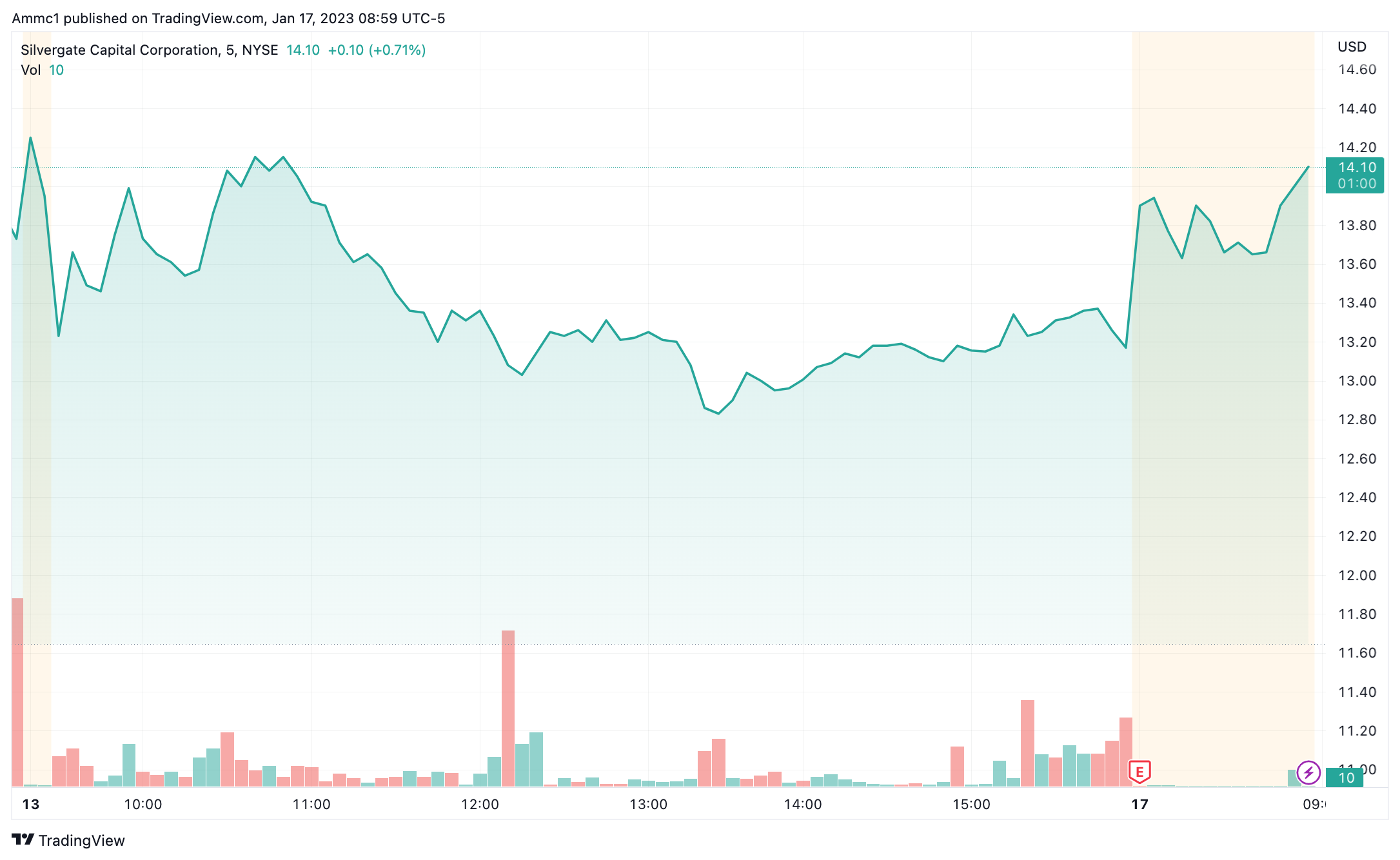
Silvergate shares jump in pre-market trading despite loss as bank well-capitalized

Silvergate Capital shares rallied despite the firm’s $1 billion fourth-quarter loss as business is intact, KBW analysts said.

Share’s in the La Jolla-based bank were trading around $16 by 9 a.m. EST, up 17% from the previous close, according to Nasdaq data. 

The bank shared preliminary metrics on Jan. 5, and there weren’t many surprises in the full earnings release relative to information disclosed then, KBW analysts wrote in a note following the release. 

“SI’s full Q4 release didn’t include many surprises, with the one (positive) exception being TBV/TCE, which were higher than most expected based on our conversations since SI’s pre-release. The business is intact and has battled through a historic shock to its system, with still plenty of capital and liquidity at hand,” KBW analysts wrote.

Silvergate’s tangible book value (TBV) was $12.93, versus KBW estimates of $11.27. The improved TBV was “likely due to either lower held-to-maturity (HTM) securities losses and/or a higher tax benefit,” said Michael Perito, Tim Switzer, and Andrew DeFrance.

© 2023 The Block Crypto, Inc. All Rights Reserved. This article is provided for informational purposes only. It is not offered or intended to be used as legal, tax, investment, financial, or other advice.

Go to Source
Author: Adam Morgan McCarthy

Crypto investor HashKey Capital closes third fund at $500 million

Crypto investment firm HashKey Capital has closed its third fund by raising $500 million. The fund comes as the industry is reeling under pressure from recent collapses and the bear market.

Dubbed HashKey Fintech Investment III, the fund targets investments across crypto areas, with a focus on infrastructure and application builders, the firm announced on Monday. HashKey began raising the fund over a year ago. By January 2022, the fund had $360 million in commitments and is now officially closed.

The fund had initially targeted closing at $600 million, but “timing matters more than the size,” Deng Chao, CEO of HashKey Capital and head of HashKey Group Singapore, told The Block in an interview. “We are now at the bottom of the next cycle. That’s why we closed the fund and launched it officially,” said Chao. “We closed our previous two funds too at the bottom of the next cycles in 2018 and 2020.”

HashKey’s first two funds raised a combined $100 million and its current assets under management stand at over $1 billion. HashKey Group, a spinoff of Chinese conglomerate Wanxiang Group, was one of the earliest investors in Ethereum in 2014. Chao said the new fund will continue investing for a longer term with a focus on value.

“We always hold a cyclical view towards the industry,” he said. “So when we evaluate a project, we look at it from a cyclical perspective — whether it would still be around after this cycle or would be able to survive the cycles to come.”

The current market situation is a good time to invest in projects focused on growing the crypto industry and bringing mass adoption, said Chao. Specifically, HashKey is interested in projects that have real use cases and are focused on building tooling for easily onboarding new users from web2 to web3 to 3, said Xiao Xiao, investment director at HashKey Capital, in the interview. Ethereum, Polygon and other Layer 2 networks are some ecosystems HashKey is focused on, Xiao added.

The HashKey Fintech Investment III has thus far deployed around $100 million, Michael Chen, investor relations director at HashKey, said in the interview. The firm looks to fully deploy the fund in the next 2 to 3 years by investing in projects that are in different stages, backing both equity and token deals, he added.

HashKey’s current portfolio includes some high-profile companies and projects, including Aztec, Blockdaemon, dYdX, Animoca Brands, Falcon X, Polkadot and Coinlist.

© 2023 The Block Crypto, Inc. All Rights Reserved. This article is provided for informational purposes only. It is not offered or intended to be used as legal, tax, investment, financial, or other advice.

Go to Source
Author: Yogita Khatri

Diva closes $3.5 million seed round for distributed liquid staking protocol

A handful of protocols and exchanges currently dominate the Ethereum staking scene. Diva recently closed a $3.5 million seed round led by A&T Capital to change that, with plans to build out a cooperative decentralizing staking pool.

“Diva is an ultra-light client connecting to existing Ethereum execution and consensus clients via standard APIs,” CEO Pablo Villalba told The Block in an interview.

“Stakers can stake any amount of ETH with no minimum, and don’t need to run any nodes. A standard web3 wallet is enough” said Villalba. Those who wish to operate a node on Diva and earn rewards may do so with as little as 1 ETH, and the protocol works with any system that meets the minimum requirements to run a full Ethereum node.

A collaborative network for passive rewards

In return for staking ETH on Diva, participants receive a one-to-one ratio of divETH, a freely tradable liquid asset. Any divETH rewards received by stakers accrue in wallets on a daily basis. DivETH can be unstaked and redeemed for ETH, again at a one-to-one ratio, at any time following the March 2023 Capella update, according to Diva.

The protocol is built to offer rewards to both passive stakers as well as full-time node operators, where “rewards will be socialized across the entire network to achieve smooth and predictable reward rates,” said Villalba.

Nodes on Diva collaborate together by posting a bond of 1 ETH to form groups. Each group of 16 nodes is matched up against 16 ETH from various stakers on the network, together forming a full validation node.

Lower thresholds to counter centralization

Eduard Antuña, founder of the open source Ethereum validator protocol Dappnode, first proposed the idea of Distributed Validator Technology (DVT) — which was to become the basis for Diva — at the ETHDenver conference, last year.

“He saw how the cost was prohibitive to many, and thought to make a ‘decentralized staking pool’ where nodes would validate for each other cooperatively, instead of in their own silos,” said Villalba.

The high threshold of 32 ETH to set up a validator node on Ethereum is a cost point that excludes many network participants operating nodes of their own. Given that, staking protocols remain largely presided over by organizations such as Lido, where validator keys are in the control of a minority group of whitelisted node operators, and centralized exchanges such as Binance, Kraken and Coinbase that fully control funds and validator keys.

The growth of such platforms erodes the values of decentralization that are core to the Ethereum blockchain, said Diva.

“We truly believe that we won’t see real decentralization until we solve the validator problem. Diva is our proposal to the community effort to solve that,” said Villalba.

Concerned by issues of censorship and the power of single parties over the custody of validator keys, and noting the rise of OFAC compliance-driven censorship on Ethereum, Diva’s team worked with Antuña to build a prototype at ETHLisbon’s hackathon, said Villalba.

Turned down by Lido

When presented with the opportunity to integrate the protocol, major staking provider Lido declined.

“Initially we offered Lido a deep partnership, offering our tech to power the heart of a Lido v2 built purely on DVT,” said Villalba. Lido, he pointed out, “has billions in TVL managed by only 30 trusted parties who could easily collude.”

The collaboration might have had “a significant impact on the ecosystem by dissolving Lido’s permissioned islands,” said Villalba.

But Villalba said that Lido’s team “remained skeptical” of Diva’s model, arguing instead that staking should be professionally managed at Devcon Bogotá. The announcement was to be met with criticism from some members of the community.

Inspired to compete

Spurred on by a passion to decentralize the staking ecosystem and with a solid MVP in hand, “we decided to compete face to face,” said Villalba.

“We had to come up with an economic system for a P2P network of nodes that would coordinate to act in the interest of the whole community,” said Villalba. “For this, we designed a rewards and penalties system in our own subnetwork of Ethereum nodes, where stakers can provide passive yield and node operators are rewarded for their work.”

Diva found backing with a $3.5 million seed round led by A&T Capital, with support from other investors including Gnosis, Bankless, OKX Ventures, Metaweb, DCV Capital, Alphemy Capital, Very Early Ventures and Stake.vc. Additional angel investors behind projects such as Metacartel, Aave, Staking Rewards, zkEVM, ZKValidator, EthGlobal, EigenLayer, Aragon, Stakely and many more also joined in.

Diva is set to go live late January 2023.

Lido did not immediately respond to The Block’s request for comment.

© 2023 The Block Crypto, Inc. All Rights Reserved. This article is provided for informational purposes only. It is not offered or intended to be used as legal, tax, investment, financial, or other advice.

Go to Source
Author: Jeremy Nation

TaxBit acquires rival crypto accounting platform Tactic

TaxBit, a crypto tax and accounting software provider, has acquired rival Tactic to expand its offerings.

The acquisition, TaxBit’s first, will help expand its existing corporate accounting offering, the company announced on Tuesday. Terms of the deal weren’t disclosed, but Tactic has raised over $13 million in total funding to date, its founder and CEO Ann Jaskiw told The Block. As part of the deal, Jaskiw will join TaxBit as a member of its leadership team, she added.

Crypto tax and accounting compliance are in the spotlight more than ever amid recent high-profile crypto collapses, including FTX and Celsius. “Enterprises and governments need robust software solutions,” TaxBit co-founder and CEO Austin Woodward told The Block. “We view 2023 as a time to build, and with the changing macro landscape, more opportunities for strategic acquisitions will come to light over the next 12+ months.”

TaxBit was founded in 2018 and provides a single system of record for crypto tax and accounting. Tactic, on the other hand, was launched in 2021 to help companies stay on top of their accounting practices. The full integration of Tactic’s software and team with TaxBit will take place over the coming months, said Woodward.

There are currently 13 people working for Tactic and all of them will be joining TaxBit as full-time employees, Jaskiw said. TaxBit’s current headcount, on the other hand, is over 250, according to Woodward. He said the deal will help TaxBit expand in New York as Tactic is based in the city.

TaxBit is backed by high-profile investors, including Paradigm and Coinbase Ventures, having raised over $235 million in total funding to date. It was valued at $1.33 billion in August 2021. Woodward said “we are fortunate to be in a strong cash position” and having “experienced exponential growth” since 2021. “We continue to see great demand and opportunity even during a bear market,” he added.

Looking ahead, TaxBit is planning for a global expansion across its enterprise and government verticals, said Woodward.

Law firms Goodwin Procter and Gunderson Dettmer helped with the deal, said Woodward.

© 2023 The Block Crypto, Inc. All Rights Reserved. This article is provided for informational purposes only. It is not offered or intended to be used as legal, tax, investment, financial, or other advice.

Go to Source
Author: Yogita Khatri

Framework Ventures leads Parfin’s $15 million raise to provide web3 rails in LatAm

Web3 infrastructure provider Parfin has raised $15 million in a bid to dominate the Latin America region.

The seed round, which closed at the end of November, is led by Framework Ventures. It also includes backers such as Alexia Ventures, Valor Capital Group and L4 Venture Builder, which is the Brazilian stock exchange’s investment fund, according to a company release. L4’s investment is still subject to approval. 

Founded in 2019, Parfin evolved from a company planning to develop a regulated stablecoin, into an infrastructure provider offering digital asset custody, trading, tokenization and management tools to some of Latin America’s largest financial institutions. 

“As a matter of fact, I initially invested in Parfin as an angel,” said Marcos Viriato, Parfin’s CEO. “There was this guy with a PowerPoint, trying to raise funds and I said, ‘Oh, I like the idea.’ But the idea back there was to do a regulated stablecoin.” 

A LatAm plan

The startup’s strategy has been to focus on the Latin America region because no other competitors were honing in on that area, Viriato said. 

“We said, ‘Let’s try to dominate the region and then use that as a springboard for the rest of the world,’” Viriato said. “And that played really well because we ended up getting big financial institutions, big players, including the Brazilian Stock Exchange, which is one of the largest exchanges in the world, in terms of volumes, so they are using our crypto-as-a-service platform to offer crypto-as-a-service for all the regulated broker dealers in Brazil.” 

Santander also recently put out a proposal to broaden the scope of the digital Real, Brazil’s central bank digital currency (CBDC), with plans to use Parfin’s technology. 

The startup now has around 70 people with more than half coming from the banking industry, Viriato said. The new raise will enable Parfin to build out existing products and launch new services. 

A permissioned public chain

Parfin is currently developing Parchain, a permissioned Ethereum Virtual Machine compatible blockchain that will enable regulated entities to participate in decentralized finance (DeFi) and asset tokenization. 

The startup makes its technology compatible with deploying on the server side, which means financial firms can deploy it within their firewall or security infrastructure, said Brandon Potts, a principal at Framework Ventures. 

“That’s huge because these institutions, they’re not going to want to deal with a mobile phone or have to call up multiple people on a Saturday morning to sign a transaction to move funds,” Potts said. “They want to bring it in and automate it and have it embedded within their entire security spend, their entire risk budget.” 

Several investment banking giants are building their own private blockchains such as JP Morgan’s Onyx blockchain or Goldman Sachs’ privacy enabled blockchain Canton. However not every bank will have that luxury, Viriato said. 

“Our goal is to build and allow mid-sized small banks to take and leverage this infrastructure in a unique way,” Viriato said. “And the beauty of what we built was we created some very sophisticated mechanisms for bridges where you can smoothly interoperate between different blockchains.” 

Parfin’s chain is also unique in that it’s a permissioned Layer 2 that’s attesting to a public chain, Framework’s Potts said. 

Staying lean

The new funds will provide the startup with a runway of between 25 to 30 months, Viriato said. The startup is used to operating in a lean way, after fundraising in early 2020 and then losing most of its committed investments when Covid-19 hit. It wasn’t until September 2020 when Parfin managed to raise a pre-seed round, he added. 

“That actually was one of the points that Framework liked a lot because we’re being very controlled,” Viriato said. 

While the most recent raise was an equity only round, the startup has provided investors with token warrants in the past. It has a view to launch a token for Parchain in the late second quarter or third quarter of this year, he added. 

© 2023 The Block Crypto, Inc. All Rights Reserved. This article is provided for informational purposes only. It is not offered or intended to be used as legal, tax, investment, financial, or other advice.

Go to Source
Author: Kari McMahon

Filecoin Foundation set to test IPFS-based communication in space

Filecoin Foundation, the governance entity that controls the Filecoin network, is moving forward with its plan to launch a decentralized file system in space this year, the foundation announced on Tuesday.

Filecoin Foundation will deploy the interplanetary file system (IPFS) in space aboard a Lockheed Martin satellite, the announcement stated. This follows on from an earlier partnership between Filecoin and the U.S. aerospace tech firm to design a decentralized file storage system for the space industry.

“With IPFS, data doesn’t need to go back and forth from Earth with every click,” said Filecoin Foundation President Marta Belcher in the announcement.”

The first launch will be a demonstration of the technology. Lockheed Martin’s spacecraft will perform the test once it is in orbit. This test will be used to evaluate use cases for decentralized storage in space. A particular focus will be on the viability of space-to-ground communication using IPFS.

IPFS is a peer-to-peer file storage and sharing system. The protocol uses unique identifiers for each piece of content. Nodes connect to their peers and can share these identifiers among themselves. Filecoin itself, a decentralized storage network, uses IPFS for its protocol.

IPFS differs from the centralized data storage of the internet. Instead of referencing content by unique identifies, it references content by its location on a server. IPFS data retrieval involves connecting to the closest node on the network that has the unique identifier of the required content.

© 2023 The Block Crypto, Inc. All Rights Reserved. This article is provided for informational purposes only. It is not offered or intended to be used as legal, tax, investment, financial, or other advice.

Go to Source
Author: Osato Avan-Nomayo

Silvergate posts $1 billion loss as crypto industry suffers a ‘crisis of confidence’

Crypto-focused bank operator Silvergate reported a more than $1 billion net loss for the fourth quarter as the sector suffered a “crisis of confidence.” 

Silvergate posted a net loss of $1.05 billion for the quarter, compared with an $18.4 million profit in the same period a year earlier, according to a statement. The company reported a $751 million loss on securities and a $135 million impairment charge related to the estimated $1.7 billion of securities it expects to sell in the first quarter of 2023 to reduce borrowings.

“The digital asset industry experienced a transformational shift, with significant over-leverage in the industry leading to several high-profile bankruptcies,” the company said in the statement. “These dynamics created a crisis of confidence across the ecosystem and led many industry participants to shift to a ‘risk off’ position across digital asset trading platforms.”

© 2023 The Block Crypto, Inc. All Rights Reserved. This article is provided for informational purposes only. It is not offered or intended to be used as legal, tax, investment, financial, or other advice.

Go to Source
Author: Andrew Rummer


Follow by Email
Facebook20
Pinterest20
fb-share-icon
LinkedIn20
Share