FreeCryptoCurrency.Me

Free stocks and money too!

Category Archive : Crypto News

Flashbots seeks up to $50 million at a billion-dollar valuation

Flashbots, an Ethereum infrastructure service, is in discussions with potential backers about raising up to $50 million at a billion-dollar valuation.

The startup hopes to raise between $30 million and $50 million in equity investment at a $1 billion pre-money valuation, according to two people with knowledge of the deal and an excerpt of the offering obtained by The Block. 

Unusually, rather than pitching prospective investors, Flashbots has invited investors to pitch for the chance to participate in the round. This reverse-pitching process, in theory, means investors must convince the company to take their money. The round is split into two tranches, with a portion of each earmarked for “ecosystem allocation.”

Crypto venture firm Paradigm has committed to leading the investment, the people briefed on the matter said. Crunchbase, the data site, lists Paradigm as the lead investor in Flashbots’ seed-stage fundraise in 2020. 

Flashbots and Paradigm did not immediately respond to requests for comment.

The fundraising effort is a rare example of a bigger-ticket venture deal in a crypto market that has become considerably quieter in the wake of a disastrous end to 2022, punctuated by the collapse of Sam Bankman-Fried’s FTX.

Running the block

Flashbots’ service effectively proposes blocks for validators running the Ethereum blockchain. In part because its blocks provide more value to validators, the service has become dominant within the ecosystem. Data available on its website suggest Flashbots currently accounts for 60% of all Ethereum blocks — a figure that has risen steadily from just 16% in September last year.  

Usage of the software has grown despite some criticism, late last year, that it was censoring transactions tied to sanctioned crypto mixing service Tornado Cash. Disagreements over the matter saw Stephane Gosselin, one of Flashbots’ co-founders, resign in September.

Concerns over the apparent censorship prompted a response from Flashbots Product Lead Robert Miller, who said the company was exploring ways to reduce dominance. Flashbots had said in August that it would open-source its MEV-Boost relay code, Miller added. 

MEV stands for maximum extractable value and refers to the premium — above the normal transaction fee — that block producers can charge for reordering or censoring transaction blocks. Flashbots’ MEV-Boost aims to deliver fair and transparent MEV extraction, hoping to mitigate the risk of nefarious MEV practices, such as frontrunning and sandwich attacks.

© 2023 The Block Crypto, Inc. All Rights Reserved. This article is provided for informational purposes only. It is not offered or intended to be used as legal, tax, investment, financial, or other advice.

Go to Source
Author: Ryan Weeks and Lucy Harley-McKeown

BitKeep wallet to refund victims of $8 million fake app hack in December

Multi-chain wallet BitKeep has announced it will issue full refunds to victims of a hacking incident which took place in December, costing the project around $8 million. 

Victims who were impacted by the incident are eligible for a full refund and can submit their claims, the team said. The process of reimbursement begins with users applying to BitKeep and the team will commence repaying them.

Half of the refunds are expected to be completed before the end of February, while the remaining funds should all have been returned by March, BitKeep said. The compensation will be converted to USDT stablecoin.

On Dec. 26, BitKeep reported that hackers had counterfeited its wallet app and distributed a malicious version to unsuspecting users. The project said that with the fake app hackers were able to extract wallet seed phrases of users in order to steal funds.

Security firm PeckShield estimated that many wallet users, who had downloaded and used the counterfeit version, lost a total of $8 million in crypto assets.

© 2023 The Block Crypto, Inc. All Rights Reserved. This article is provided for informational purposes only. It is not offered or intended to be used as legal, tax, investment, financial, or other advice.

Go to Source
Author: Vishal Chawla

National Australia Bank creates stablecoin called AUDN: AFR

National Australia Bank (NAB) is launching a fully backed stablecoin called AUDN.

The stablecoin will launch on the Ethereum network and Algorand blockchain, a smart contract platform similar to Ethereum. NAB plans to launch the stablecoin sometime mid-year.

The stablecoin will be backed one-to-one with Australian fiat, and the money will be held by the NAB.

The stablecoin will primarily be used as a settlement token between multiple transacting parties. For example, AUDN could be used for carbon credit trading, overseas money transfers and repurchase agreements, NAB’s Chief Innovation officer Howard Silby said. This is known as atomic settlement, something the NAB is attempting to transition to in some markets, according to the Australian Financial Review, which first reported the news.

This is not the first-time banks in Australia have tried to launch a stablecoin.

Four banks attempted to create a similar stablecoin product last year. The initiative failed due to competition concerns and the four separate banks being at different stages in their crypto strategies, according to AFR.

© 2023 The Block Crypto, Inc. All Rights Reserved. This article is provided for informational purposes only. It is not offered or intended to be used as legal, tax, investment, financial, or other advice.

Go to Source
Author: Mike Truppa

CoinDesk explores full or partial sale to attract growth capital, CEO says

Crypto media outlet CoinDesk may pursue a full or partial sale to fuel future growth, CoinDesk confirmed to The Block.

CoinDesk is seeking advisory services from Lazard, a firm specializing in mergers, restructuring and capital strategy, as the company explores a potential sale, The Wall Street Journal first reported.

“Over the last few months, we have received numerous inbound indications of interest in CoinDesk. As such, I have engaged Lazard as our financial advisor to assist. My goal in hiring Lazard is to explore various options to attract growth capital to the CoinDesk business, which may include a partial or full sale,” CEO Kevin Worth told The Block in a statement via email.

Coindesk was originally acquired by the Digital Currency Group in 2016 for around $500,000 to $600,000. The company did not disclose its current valuation.

Another DCG company, Genesis Global Capital, is in the midst of negotiating a prepackaged bankruptcy plan with creditors. Genesis laid off 30% of its staff earlier this month.

© 2023 The Block Crypto, Inc. All Rights Reserved. This article is provided for informational purposes only. It is not offered or intended to be used as legal, tax, investment, financial, or other advice.

Go to Source
Author: Jeremy Nation

zkSync integrating Espresso Systems technology to enable private transactions

Ethereum scaling platform zkSync is partnering with Espresso Systems, a crypto infrastructure company, to enable private transactions on its network.

This collaboration will integrate a new privacy technology Espresso Systems built on Ethereum called Configurable Asset Privacy, or CAPE. ZkSync said that anyone using its network will now be able to transact without exposing private data on the public blockchain, which could remove an obstacle for institutions that don’t want balances, on-chain activity and other private data publicly accessible.

CAPE is Espresso Systems first product, and it has been on testnet for six months. The ability to transact privately while still receiving all the benefits of Ethereum security will help grow the adoption of blockchains by global enterprises, a zkSync spokesperson told The Block.

“We’ve seen that private blockchain solutions have so far failed to gain any real traction with enterprises and financial institutions due to scalability and neutrality,” zkSync Head of Business Development and Partnerships Omar Azhar said. “This also lets us leapfrog our competitors from a technical capability standpoint.”

The collaboration is still in planning and hasn’t been deployed on zkSync’s testnet. Updates on tokenization of real world assets, supply chain, identity, payments and trade finance are expected later this year, Azhar told The Block.

zkSync is a new Ethereum scaling platform using zero-knowledge EVM technology for scalability. It is currently in its Baby Alpha mainnet phase, which means it is live, but not available for users or applications to launch yet.

Espresso Systems is a zero-knowledge infrastructure company with a suite of products for scalability and privacy. Besides CAPE, it’s also working on a new product that could decentralize Ethereum Layer 2 sequencers, which order transactions that are settled on Ethereum. As of now, all of the major Layer 2 networks, such as Arbitrum, Optimism, and zkSync, have yet to decentralize their sequencers, one of the critical components of their chains.

© 2023 The Block Crypto, Inc. All Rights Reserved. This article is provided for informational purposes only. It is not offered or intended to be used as legal, tax, investment, financial, or other advice.

Go to Source
Author: Mike Truppa

‘Wtf is Bitzlato?’ Crypto Twitter rolls eyes at DOJ’s big arrest

The U.S. Department of Justice got schooled in how not to manage expectations on Crypto Twitter Wednesday morning after it teased the announcement of an “international crypto enforcement action” in a move that immediately caused declines in the price of bitcoin and other cryptocurrencies.   

Speculation was rife about who might be targeted, with the industry on seemingly endless tenterhooks amid multiple investigations and bankruptcy filings in the wake of the collapse of the FTX crypto exchange. Hours later, the DOJ announced that it had arrested the Russian founder of “notorious” Hong Kong-based crypto exchange Bitzlato, lauding its move as “a significant blow to the cryptocrime ecosystem.” 

The crypto industry yawned. Bitcoin immediately reversed its price slide. And then came the memes. 

“Never heard of it,” tweeted Hailey Lennon, a partner at the law firm Brown Rudnick, who advises on crypto issues.

“Wtf is Bitzlato?” a Washington, D.C. source said in a text message.

“Bitzlato lol. Our tax dollars are wasted,” Messari founder Ryan Selkis wrote in a tweet. 

Arrested in Miami

Crypto watchers were underwhelmed by the DOJ’s takedown of Bitzlato, an exchange that allegedly partnered with the now-defunct dark net market Hydra to move more than $700 million in illicit funds. Founder Anatoly Legkodymov was arrested in Miami on Tuesday night for his alleged role in the “high-tech axis of cryptocrime.”

Hours before the Justice Department announced Legkodymov’s arrest, speculation had been mounting that law enforcement could be targeting a much bigger fish.

“It seemed like almost everyone on Crypto Twitter was certain that DOJ was going to announce an action against Binance,” Carol Van Kleef, a Washington lawyer and CEO of Luminous Group, said, referring to the exchange that aborted a surprise plan to take over FTX last year. 

Binance didn’t immediately respond to a request for comment about the speculation. CEO Changpeng “CZ” Zhao appeared upbeat on Wednesday in an interview at the World Economic Forum in Davos, Switzerland, where he discussed topics including his hair style and favorite travel destinations. 

“This just felt to me that today’s action was a mere stepping stone to the next thing that’s bigger, probably much bigger,” Van Cleef said.

‘Low-hanging fruit’

News that law enforcement had taken down a crypto exchange that hardly anyone had ever heard of — and not one of the largest exchanges on the globe — landed with a thud.

“It is far from a household crypto name,” said Timo Lehes, the co-founder of the decentralized finance platform Swarm Markets.

The DOJ’s move was particularly frustrating for those who think that American officials have failed to take action against much larger firms like FTX, Three Arrows Capital, Voyager and BlockFi before they filed for bankruptcy. The Treasury Department’s Financial Crimes Enforcement Network and French authorities are taking concurrent enforcement actions in the Bitzlato case, according to a press release. 

“Very low-hanging fruit treated as big catch. It is not,” said Joseph Collement, general counsel at Bitcoin.com. “The real crime is the DOJ not protecting Americans against the list of FTX, Voyager, 3AC, Genesis and the many more insolvent [centralized exchanges].”

Memes followed

Within minutes of the DOJ’s announcement, crypto watchers filled their Twitter feeds with jokes about the Bitzlato arrest.

One popular account posted a meme depicting Bitzlato as a feather aimed at a soldier, while knives and missiles labeled BlockFi, Voyager, Celsius and FTX pointed toward a sleeping civilian. Another dredged up a 2011 post seemingly written by Legkodymov on a bitcoin forum. Several others referenced espresso, calling the relatively unknown exchange “bitzlatte.”

Despite the jokes, others applauded law enforcement for tackling the illicit crypto exchange, even if they had never heard of it.

“I also heard about Bitzlato for the first time today, but (despite the funny memes) the DOJ’s action makes clear that they will prosecute those who exploit the crypto ecosystem to commit crypto crimes. That’s good policy,” Stuart Alderoty, general counsel at Ripple, said in a tweet. Gus Coldebella, a partner at the venture capital firm True Ventures, said he appreciated seeing the U.S. government and its international partners working to eliminate criminal actors from the crypto space. 

And some suggested the Bitzlato enforcement action could be a sign that the DOJ is quietly working on larger crypto enforcement cases that deal with similar legal issues.

“Disappointed by Bi … zlato? Don’t be,” Luminous Group’s Van Cleef tweeted. “A much broader message was delivered — the blueprint for future actions.”

© 2023 The Block Crypto, Inc. All Rights Reserved. This article is provided for informational purposes only. It is not offered or intended to be used as legal, tax, investment, financial, or other advice.

Go to Source
Author: Stephanie Murray

Yuga Labs blacklists Blur, SudoSwap and other marketplaces in Sewer Pass mint

Yuga Labs blacklisted at least four marketplaces that don’t mandate NFT royalties in its newest NFT drop, Sewer Pass.

Sewer Pass includes coding that blocks NFT transactions from wallets belonging to Blur, SudoSwapLooksRare and NFTX, according to Simon Cousaert, The Block Research’s Director of Data. LooksRare, SudoSwap and Blur have an optional royalty system, and NFTX also doesn’t honor royalty payments.

The move is the latest salvo in the ongoing war over NFT royalties. In blacklisting those marketplaces, Yuga Labs joins other NFT creators in blocking royalty-evading platforms from transacting with their NFTs.

In September, QQL blacklisted X2Y2, another NFT marketplace with optional royalties, from dealing with the QQL Mint Pass NFT drop. X2Y2 responded to the blacklisting by saying, “When someone else can decide where you can transfer your NFT, you are not the real owners anymore.”

Sewer Pass netted $1.3 million in trading volume one hour after its launch, and has amassed nearly $5 million worth of ETH four hours after the launch. 

© 2023 The Block Crypto, Inc. All Rights Reserved. This article is provided for informational purposes only. It is not offered or intended to be used as legal, tax, investment, financial, or other advice.

Go to Source
Author: MK Manoylov

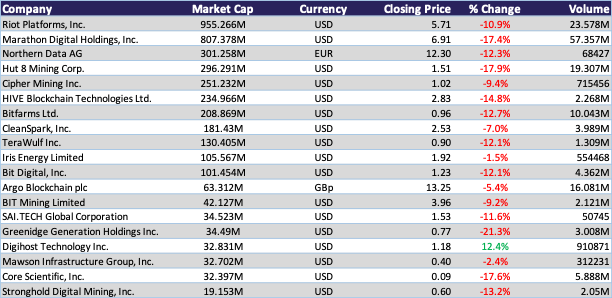
Bitcoin mining report: Jan. 18

Bitcoin mining stocks tracked by The Block were mostly lower on Wednesday, with one gaining and the other 18 declining.

Bitcoin fell 2.6% to $20,781 by market close.

Here is a look at how the individual miners performed today:

© 2023 The Block Crypto, Inc. All Rights Reserved. This article is provided for informational purposes only. It is not offered or intended to be used as legal, tax, investment, financial, or other advice.

Go to Source
Author: Catarina Moura

Binance, ether, bitcoin all lower as US economy slows

BNB, ether and bitcoin slid with traditional markets after U.S. economic data showed signs of an economy starting to take a breather.

Retail sales fell more than expected, tripping up what had been an improving market.

Bitcoin was trading at around $20,800 at 4:15 p.m. EST, according to TradingView data.

Ether was down 1.4%. Binance’s BNB fell 1.3%. Binance traded lower earlier in the day after the market reacted — erroneously — to an announcement of a pending enforcement action from the U.S. Department of Justice. That action was actually against a little known outfit named Bitzlato.

Crypto stocks

U.S. stock indices ended the day down. The S&P 500 and the Nasdaq 100 dropped 1.6% and 1.2%, respectively. 

Coinbase, which is shuttering operations in Japan, dropped by 7.3%, according to Nasdaq data. Despite the down day, the exchange has rallied since the beginning of the year.

Silvergate dropped 8.4%. The crypto-friendly bank disclosed a $1 billion loss on Tuesday as it shared fourth-quarter results. Shares rallied despite the fact as the core business is intact, according to KBW analysts.

MicroStrategy shares decreased 6.2%. The firm, which is expected to report fourth-quarter earnings this month, announced that its Brazilian unit is facing an investigation into anticompetitive conduct in the country dating back to 2018, but that it secured a leniency agreement with the country’s General Superintendence of the Administrative Council for Economic Defense.

© 2023 The Block Crypto, Inc. All Rights Reserved. This article is provided for informational purposes only. It is not offered or intended to be used as legal, tax, investment, financial, or other advice.

Go to Source
Author: Adam Morgan McCarthy and Christiana Loureiro

American CryptoFed argues it was shut out from dialogue with the SEC

A decentralized autonomous organization that the Securities and Exchange Commission is attempting to stop from registering and selling tokens argued at a hearing that the regulator isn’t making officials available to work through its complaints.

American CryptoFed DAO LLC said it sought dialogue with the SEC over the stop order the regulator issued in November, but its questions were left unanswered.

Zhou Xiaomeng, AmericanCryptoFed’s chief operating officer, said the organization had the right to talk with the chief accountant, among others at the SEC.

“The problem is we cannot talk even with the commission’s chief accountant,” Xiaomeng said on Wednesday during a hearing.

The SEC started the administrative proceedings against the Wyoming-based DAO over the offer and sale of its Ducat and Locke tokens. The agency’s enforcement arm said at the time that a Form S-1 registration statement filed by American CryptoFed failed to contain required information about its business management and financial condition. It also had materially misleading statements and omissions, including inconsistencies on whether the tokens are securities, the SEC said.

Securities, or not

Xiaomeng also told the judge that the SEC won’t allow the registration of potential securities while at the same time not proving whether or not the tokens are securities.

American CryptoFed is representing itself in the hearing. During an appearance in early December, the DAO argued that the SEC treated it unfairly by choosing to accelerate enforcement without providing it an opportunity to work through its filings and resolve issues with the agency’s Division of Corporation Finance, according to a post about the hearing from law firm Baker McKenzie.

The hearing will continue into Thursday after recessing today over disagreements over what the DAO could present to the judge.

© 2023 The Block Crypto, Inc. All Rights Reserved. This article is provided for informational purposes only. It is not offered or intended to be used as legal, tax, investment, financial, or other advice.

Go to Source
Author: Sarah Wynn


Follow by Email
Facebook20
Pinterest20
fb-share-icon
LinkedIn20
Share