FreeCryptoCurrency.Me

Free stocks and money too!

Category Archive : Crypto News

Law firm Sullivan & Cromwell to face scrutiny in FTX bankruptcy hearing Friday 

Sam Bankman-Fried used to work out of Sullivan & Cromwell’s office in New York City. Now, the law firm is facing scrutiny over whether it can investigate FTX, the disgraced former billionaire’s crypto empire.

A bankruptcy court judge will hear arguments on Friday about whether the white-shoe law firm was too close to the troubled crypto exchange before it imploded. 

The U.S. Trustee overseeing the FTX bankruptcy proceedings filed an objection to Sullivan & Cromwell — along with two other firms — serving as counsel to the FTX debtors. A pair of FTX customers with money stuck on the frozen exchange also have objected to the law firm’s role. Plus, a group of U.S. senators is raising their own questions. 

“In the most flagrant attempt by a fox to guard a henhouse in recent memory, Sullivan & Cromwell has applied to be appointed the FTX Group’s bankruptcy counsel,” Warren Winter, an FTX customer who has $350,000 on the platform, wrote in a court filing objecting to the appointment. Richard Brummond, another FTX customer, also objected. 

“Sullivan & Cromwell is not only an inappropriate candidate for appointment as the FTX Group’s bankruptcy counsel — it is a target for investigation with its own potential liability. Its appointment as counsel would endanger the estate and create a rigged game, undermining creditors’ and the public’s faith in the bankruptcy process,” Winter added.

But FTX CEO John Ray, who took the helm of the company in November, argued in court filings that knocking Sullivan & Cromwell off the case could “severely” or “irreparably” harm efforts to get money back to creditors and customers.

“The advisers working at my direction have worked tirelessly and nonstop for the last 70 days to take control over what can only be described as a ‘dumpster fire’ in order to stop assets from being depleted and to take action to realize value related to the debtors’ assets. The advisers are not the villains in these cases,” Ray said in a court declaration. 

The FTX debtors slammed Winter and Brummond’s objections as “baseless” and part of a “fishing expedition.” The official committee of unsecured creditors in the FTX case has filed its own statement supporting Sullivan & Cromwell’s role in the bankruptcy. 

Pre-bankruptcy, FTX paid Sullivan & Cromwell $8.5 million

FTX was never a regular Sullivan & Cromwell client, but the firm did advise FTX on 20 specific matters, court documents show. The crypto exchange paid Sullivan & Cromwell $8.5 million to work on issues including its acquisition of LedgerX, failed crypto lender Voyager’s bankruptcy and regulatory concerns surrounding the Terra Luna collapse. 

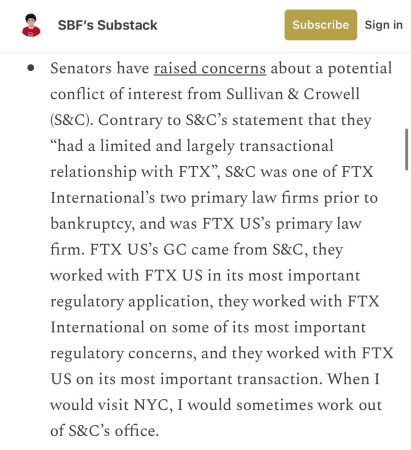
The law firm was also relatively close with Bankman-Fried, the former FTX chief executive said in a recent blog post. He called Sullivan & Cromwell “one of FTX International’s two primary law firms prior to bankruptcy” and “FTX US’s primary law firm.” Lawyers for Sullivan & Cromwell did not respond to requests for comment.

“When I would visit NYC, I would sometimes work out of S&C’s office,” Bankman-Fried said. The FTX founder is facing criminal fraud charges in a separate case, and has been critical of Ray in the press. He reposted a Twitter thread on Thursday that raised questions about Ray and Sullivan & Cromwell. 
Winter, the customer objecting to the law firm’s role in the case, noted links between FTX General Counsel Ryne Miller and Sullivan & Cromwell in his court filing. Miller was a partner at Sullivan & Cromwell from January 2019 to July 2021, and he worked as an associate at the firm for several years before being made a partner. 

Text messages from before FTX filed for bankruptcy, which appeared in Bankman-Fried’s leaked congressional testimony, show that Miller told other FTX leaders “I’m in charge now” and directed them to wire Sullivan & Cromwell a $4 million retainer. 

Objectors took issue with the fact that Sullivan & Cromwell did not initially disclose its relationships with Miller or Tim Wilson, an FTX lawyer and former Sullivan & Cromwell associate. Miller did not respond to a request for comment. He is still employed by West Realm Shires, the parent company of FTX’s U.S. operation, but “has no day-to-day responsibilities,” Ray said in a court filing.

Sullivan & Cromwell’s initial disclosures were “highly inadequate,” Juliet Sarkessian, the lawyer for the U.S. Trustee, wrote in an email to Sullivan & Cromwell lawyers. The email correspondence was included in a court filing this week. Sarkessian, who did not respond to a request for comment, has asked a judge to appoint an examiner in the case. The request will be considered at a hearing in February. 

Dan Friedberg, who previously served as chief compliance offer for FTX US and chief regulatory offer of FTX International, joined Warren’s objection in a court filing on Thursday afternoon. Friedberg claimed he had “several disturbing interactions” with Sullivan & Cromwell after FTX filed for bankruptcy protection.

Conflicts of interest 

At the heart of the Sullivan & Cromwell controversy is whether the law firm can adequately investigate the FTX collapse on behalf of the debtors since the firm was advising the exchange before it collapsed. 

“What the U.S. Trustee has criticized Sullivan & Cromwell for is failing to make adequate disclosures about the nature of previous work that Sullivan & Cromwell has done,” said Alex More, a partner at Carrington, Coleman, Sloman & Blumenthal who focuses on digital assets. “They’re alleging that Sullivan & Cromwell had a closer relationship with insiders at FTX, including SBF, than what they’ve disclosed … and that calls into question their impartiality when it comes to representing the bankruptcy estate.”

The connections between Sullivan & Cromwell and FTX caught the attention of a bipartisan group of lawmakers: Sens. John Hickenlooper, D-Colo., Thom Tillis, R-N.C., Elizabeth Warren, D-Mass., and Cynthia Lummis, R-Wyo.

“Will the firm’s lawyers be able to effectively investigate their current and former partners who were central in FTX’s conduct? Additionally, given their longstanding legal work for FTX, they may well bear a measure of responsibility for the damage wrecked on the company’s victims,” the senators wrote in a recent letter urging the bankruptcy court judge to appoint an examiner in the FTX case. 

“Put bluntly, the firm is simply not in a position to uncover the information needed to ensure confidence in any investigation or findings,” the lawmakers continued. Judge John Dorsey called the letter “an inappropriate ex-parte communication” during a recent hearing and said it would not impact his decision. 

The FTX debtors, meanwhile, say plans to prevent a conflict of interest are already in place. Sullivan & Cromwell has told Ray, the new CEO, that the law firm will not investigate claims against itself or its former employees. Instead, the law firm Quinn Emanuel Urquhart & Sullivan will handle those issues. 

“This case is now about the Debtors marshaling assets and prosecuting avoidance actions and other litigation to recover assets and monies for customers and stakeholders,” Ray said in his declaration. “Much work is to be done in this stage of the case and it is time to allow professionals to be properly retained to go about their work to repair the damage done.”

Disclaimer: Beginning in 2021, Michael McCaffrey, the former CEO and majority owner of The Block, took a series of loans from founder and former FTX and Alameda CEO Sam Bankman-Fried. McCaffrey resigned from the company in December 2022 after failing to disclose those transactions. 

© 2023 The Block Crypto, Inc. All Rights Reserved. This article is provided for informational purposes only. It is not offered or intended to be used as legal, tax, investment, financial, or other advice.

Go to Source
Author: Stephanie Murray

Nexo pays $45 million to settle SEC and state charges for failing to register lending product

Nexo agreed to pay $45 million to federal and state agencies after being charged by the Securities and Exchange Commission for failing to register the offer and sale of its retail crypto asset lending product, called the Earn Interest Product.

The lender will pay $22.5 million in penalties and agreed to cease the sale of the Earn Interest Product to U.S. investors, the agency said in a statement. Nexo also agreed to pay an additional $22.5 million to settle similar charges made by state regulatory authorities. 

“We are not concerned with the labels put on offerings, but on their economic realities,” said Gurbir S. Grewal, director of the SEC’s division of enforcement. “Crypto assets are not exempt from the federal securities laws.” 

In 2020, Nexo began to offer and sell the Earn Interest Product in the U.S. The product allowed investors to tender their crypto to Nexo in exchange for the firm’s promise to pay interest. Nexo marketed the product as a way for investors to earn interest and “Nexo exercised its discretion to use investors’ crypto assets in various ways to generate income for its own business and to fund interest payments to EIP investors,” the agency said. 

Without admitting or denying the agency’s findings, Nexo agreed to a cease-and-desist order to block it from violating registration provisions under the Securities Act of 1933. 

Nexo said it was leaving the U.S. market in December, citing a “dead end” in talks with U.S. regulators. 

The SEC charged Gemini and Genesis on Jan. 12 for the unregistered offer and sale of securities to retail investors through a Gemini crypto lending program. Experts said at the time that the charges were a warning signal for other exchanges and actors in the crypto space that also are offering yield bearing products.  


© 2023 The Block Crypto, Inc. All Rights Reserved. This article is provided for informational purposes only. It is not offered or intended to be used as legal, tax, investment, financial, or other advice.

Go to Source
Author: Sarah Wynn

Bitcoin mining report: Jan. 19

Bitcoin mining stocks tracked by The Block were mixed on Thursday, with 10 gaining and the other 9 declining.

Bitcoin rose 1.7% to $21,099 by market close.

Here is a look at how the individual miners performed today:

© 2023 The Block Crypto, Inc. All Rights Reserved. This article is provided for informational purposes only. It is not offered or intended to be used as legal, tax, investment, financial, or other advice.

Go to Source
Author: Catarina Moura

Looking to run a blockchain app in a US-regulated state? Maybe consider New Hampshire

New Hampshire is ramping up to play a leading role in blockchain technology following the release of a final report with recommendations to devote resources to establish legal regimes to attract innovators, entrepreneurs and businesses.  

The state should take strong proactive and public steps to build a better legal system for the development of blockchain technologies, the governor’s Commission on Cryptocurrencies and Digital Assets said in a 67-page report.

“This report is comprehensive and timely, providing specific recommendations that would establish New Hampshire as a leading jurisdiction for the development of sound and effective applications of blockchain technologies, including proposals to clarify current laws and to support law enforcement in its efforts to protect New Hampshire consumers and investors,” said Republican Governor Chris Sununu said in a statement.

States scattered across the U.S. have enacted their own laws to regulate blockchain and crypto as the federal government weighs how to regulate it at the federal level. States such as Arizona and Alaska require some entities to get money transmitter licenses, according to a post from Bloomberg Law. New Hampshire is looking to attract new businesses by offering clear regulations.

Sununu issued an executive order to create the state’s Commission on Cryptocurrencies and Digital Assets last year. The governor then tasked the commission with offering findings and recommendations on the role of the state’s legal system, blockchain technology and the impact on consumers. 

The commission did not gloss over major disruptions in the cryptocurrency industry in 2022 and said some aspects of the technology may render them to be “effective vehicles for fraud.” The industry is still reeling from the collapse of Three Arrow Capital and FTX last year, among other outfits.  

© 2023 The Block Crypto, Inc. All Rights Reserved. This article is provided for informational purposes only. It is not offered or intended to be used as legal, tax, investment, financial, or other advice.

Go to Source
Author: Sarah Wynn

FTT token price soars after FTX CEO floats exchange restart

FTT, the token tied to bankrupt crypto exchange FTX, shot up 30% after the exchange’s new CEO suggested that FTX.com might be restarted.

The token was trading at around $2.28 as of 11:20 a.m. ET, according to data from TradingView.

John Ray III, who is overseeing the bankruptcy and restructuring of the FTX business empire, said that he had put together a task force to explore restarting FTX.com, according to an interview with the Wall Street Journal.

“If there is a path forward on that, then we will not only explore that, we’ll do it,” he said. “There are stakeholders we’re working with who’ve identified what they see is a viable business.”

Disclaimer: Beginning in 2021, Michael McCaffrey, the former CEO and majority owner of The Block, took a series of loans from former FTX and Alameda founder Sam Bankman-Fried. McCaffrey resigned from the company in December 2022 after failing to disclose those transactions.

© 2023 The Block Crypto, Inc. All Rights Reserved. This article is provided for informational purposes only. It is not offered or intended to be used as legal, tax, investment, financial, or other advice.

Go to Source
Author: Catarina Moura

New FTX CEO says the crypto exchange could be restarted: WSJ 

The new leader of the failed cryptocurrency exchange FTX said he has set up a task force to explore restarting FTX.com, The Wall Street Journal reported.  

In an interview, FTX executive John Ray III said of the prospects of a restart: “Everything is on the table.”

The paper also reported that Ray would look into whether reviving FTX’s international exchange would recover more value for the company’s customers than his team could get from liquidating assets or selling the platform.  

Earlier this week, FTX identified $5.5 billion in liquid assets, part of what Ray called a “Herculean effort” to untangle the firm’s finances. FTX filed for bankruptcy in November, and U.S. authorities brought charges against its former CEO Sam Bankman-Fried soon after.  

Ray and Bankman-Fried are at odds over the exchange’s bankruptcy filing. Bankman-Fried has said it was a mistake for FTX to file for Chapter 11 bankruptcy protection and lambasted Ray’s process in handling it. Ray said that Bankman-Fried’s comments were “unhelpful and self-serving.” 

“We don’t need to be dialoguing with him,” Ray said in the interview. “He hasn’t told us anything that I don’t already know.”  

Bankman-Fried responded in a text message to the WSJ saying that the comment was shocking “from someone pretending to care about customers.”

The Justice Department has accused Bankman-Fried of using billions of dollars in customer funds of FTX customer funds for his personal use, to make political contributions and to repay billions of dollars in loans owed by the crypto hedge fund founded by Bankman-Fried called Alameda Research. The Securities and Exchange Commission and the Commodity Futures Trading Commission also brought their own charges

Disclaimer: Beginning in 2021, Michael McCaffrey, the former CEO and majority owner of The Block, took a series of loans from founder and former FTX and Alameda CEO Sam Bankman-Fried. McCaffrey resigned from the company in December 2022 after failing to disclose those transactions. 
 

© 2023 The Block Crypto, Inc. All Rights Reserved. This article is provided for informational purposes only. It is not offered or intended to be used as legal, tax, investment, financial, or other advice.

Go to Source
Author: Sarah Wynn

Bitcoin, ether in the red as altcoins experience sharp sell-off, crypto stocks open lower

Crypto prices were in the red, snapping a recent rally. Coinbase and MicroStrategy opened lower. 

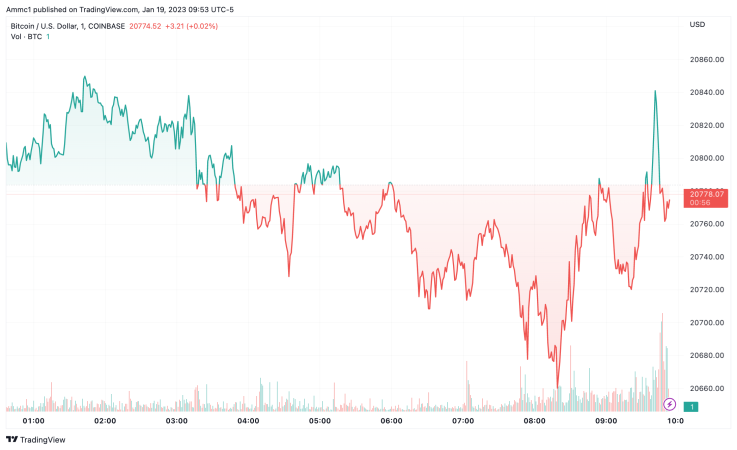
Bitcoin dropped 3% in the past 24 hours to trade below $20,800 by 9:30 a.m. EST, although it was trending upwards again, according to TradingView data. 

Ether slipped 4.4% to $1,525, and Binance’s BNB dropped 4.2%. Dog-themed memecoins had rallied over the past few days. However, dogecoin and shiba inu both pared recent gains, down 7.6% and 10%, respectively.

Crypto stocks

Crypto-related stocks traded lower at the open. Coinbase dipped below $50, down 2.4% by 9:35 a.m. EST, according to Nasdaq data. 

Silvergate slipped 2.6% to below $12, Block dropped 1.7% to about $70, and MicroStrategy traded at $217, down 1.2%. 

Markets contracted as hopes of a soft landing began to wane on the back of hawkish Fed comments, despite December retail figures being weaker than expected — reflecting a reduction in inflationary pressure. As Noelle Acheson, former head of market insights at Genesis, noted, it appears bad news is no longer good news. 

BNY Mellon’s Head of Equities and Capital Markets, Alicia Levine, told Bloomberg TV the market hasn’t priced in a soft landing and “the reaction is not going to be a pleasant one in equities.”

© 2023 The Block Crypto, Inc. All Rights Reserved. This article is provided for informational purposes only. It is not offered or intended to be used as legal, tax, investment, financial, or other advice.

Go to Source
Author: Adam Morgan McCarthy

Web3 credential protocol Gateway raises $4.2 million 

Gateway, a web3 credential protocol, raised $4.2 million in a seed funding round. 

Crypto-focused venture capital firm Reciprocal Ventures led the round, with 6th Man Ventures, Spartan Group, Figment and others participating. Angel investors, including Polygon’s Sandeep Nailwal and Messari’s Ryan Selkis, also backed the round.

Gateway began raising for the round early last year and closed it by the second quarter, but chose to announce it now due to the crypto collapses of the previous year, Gateway co-founder Ayyan Rahman told The Block. Rahman added that the funding was realized via an equity plus token warrant arrangement, declining to comment on when the token will launch.

Gateway was founded in 2021 by Rahman and Sanket Jain, aiming to decentralize credentials issuance and maintenance. Credentials are verifications that prove a person has a specific attribute or qualification. In a traditional world, credentials are often issued physically and maintained by centralized organizations — such as certificates from governments and universities. In a web3 world, credentials are stored on the blockchain and often issued as tokens, such as NFTs. 

Gateway says it has issued over 500,000 credentials since inception, with the majority, over 300,000, being minted as NFTs. “Credential minting as an NFT is in the user’s control to help ensure sovereignty and data privacy,” said Rahman. “The user, after earning a credential, can choose to mint it as an NFT, which we call a verifiable presentation. This is simply a token for greater social consumption and interoperability with applications.” 

Gateway stores its credentials on the blockchain-based data storage protocol Arweave. It currently supports credentials on the Ethereum blockchain with plans to integrate Solana in the near future.

Gateway offers a credential decentralized application. The dapp provides web3 organizations with a “no-code” platform to create and issue credentials for their communities. Gateway is also building an SDK and an API that will allow its clients to directly integrate the protocol into their projects to issue credentials natively. The SDK documentation and initial use cases are scheduled to release in the first quarter of this year.  

While Gateway currently serves web3 clients, Rahman said it has plans to onboard web2 companies in the future. 

“It’s been incredible to see the myriad of use cases forming around Gateway, with companies leveraging the technology for everything from brand development and loyalty programs to code audit certifications,” Craig Burel, partner at Reciprocal Ventures, told The Block. “All of these applications are underpinned by the Gateway protocol, which we believe will define a new technical standard for digital credentials.” 

With fresh capital in hand, Gateway plans to continue developing its protocol. To that end, it plans to increase its current team of around ten people by hiring engineering staff, said Rahman. 

© 2023 The Block Crypto, Inc. All Rights Reserved. This article is provided for informational purposes only. It is not offered or intended to be used as legal, tax, investment, financial, or other advice.

Go to Source
Author: Yogita Khatri

MoonPay acquires web3 creative studio Nightshift in its first deal

Web3 infrastructure firm MoonPay made its first acquisition, scooping up creative studio Nightshift for an undisclosed amount.

Nightshift, based in Toronto, will rebrand to Otherlife by MoonPay in the wake of the deal, according to a company release. 

Having first started as a fintech, offering a way to buy crypto products with fiat currency, MoonPay has made a play for the NFT space over the last year. In June, it launched Hypermint, a service that lets brands mint up to 100 million digital assets at once. 

The company partnered with entertainment giant Universal Pictures to roll out an NFT-based scavenger hunt for Universal Studios park goers in September. It also created a passport-like NFT project for exclusive access to web3 conferences during December’s Art Basel in Miami. 

CEO Ivan Soto-Wright has previously characterized the company’s journey as “becoming more like an American Express.”

“You have an obviously robust payments network and platform. But then you also have all the experiences. And so I think that’s kind of how we see us bridging both of these components of our business,” he told The Block in a previous interview. 

© 2023 The Block Crypto, Inc. All Rights Reserved. This article is provided for informational purposes only. It is not offered or intended to be used as legal, tax, investment, financial, or other advice.

Go to Source
Author: MK Manoylov

Stargate integrates with Metis in first blockchain expansion since launch

Cross-chain bridge protocol Stargate has integrated with the Layer 2 Ethereum scaling solution Metis in its first blockchain expansion since it was launched by LayerZero Labs in March last year.

Stargate’s integration with Metis aims to provide more flexibility for projects managing their funds, treasury, and yield strategies, according to an announcement.

“Web3 represents community and decentralization, both of which must begin at the infrastructural level. We firmly believe that, alongside the Stargate team, our partnership is a major step toward eliminating the barriers between blockchains and opening the doors to a more decentralized, multi-chain economy,” said Metis CEO and co-founder Elena Sinelnikova.

Multi-chain liquidity

Stargate went live in March 2022 on Ethereum, Avalanche, Polygon, BNB Chain, Fantom, Arbitrum and Optimism, shortly after raising $25 million in a public sale of its native stargate tokens (STG). The multi-chain bridge gained $4 billion of liquidity within two weeks of the launch, attracted by 20-25% yields, but that has since fallen to around $350 million alongside the general crypto market decline.

Metis’s $95 million of assets held make it the fourth largest Layer 2 network, behind Arbitrum, Optimism and Loopring, dropping from a high of $743 million.

The new partnership aims to bring Metis users greater cross-chain efficiency, with the ability to leverage the benefits of DeFi across multiple chains supported by LayerZero.

“The integration of Metis is another big step in LayerZero’s expansion into the Layer 2 ecosystem of Ethereum, allowing for a unified flow of messaging across the entire Ethereum ecosystem,” added LayerZero Labs co-founder and CTO Ryan Zarick.

Metis and Stargate intend to continue their collaboration on an ongoing basis. Initially, Stargate will enable USDT for Metis across Ethereum, Avalanche, and BNB Chain, with plans to expand interoperability further.

How Stargate works

The ability to transfer liquidity across blockchain networks is a key part of web3 interoperability. Yet, most existing cross-chain bridges are unable to send native assets between chains without relying on wrapped tokens for the bridging process.

Bridging with wrapped tokens relies on multi-step locked liquidity models — locking up a crypto asset on one chain with a corresponding wrapped token minted on another. Regardless of whether those locked funds are stored in a multi-sig, smart contract or with a third-party custodian, they can become a target, with over $2.5 billion stolen from such cross-chain bridges in the past two years. In fact, a recent study showed around 50% of all DeFi exploits occurred on cross-chain bridges.

Built on the interoperability protocol LayerZero, Stargate is designed to avoid the need for wrapped tokens, improving security, its team claims

Stargate’s fully composable native asset bridge enables the transfer of native tokens between different blockchains in a single transaction. It does this by building unified liquidity pools that are shared between chains with instant transaction finality. 

© 2023 The Block Crypto, Inc. All Rights Reserved. This article is provided for informational purposes only. It is not offered or intended to be used as legal, tax, investment, financial, or other advice.

Go to Source
Author: James Hunt


Follow by Email
Facebook20
Pinterest20
fb-share-icon
LinkedIn20
Share