FreeCryptoCurrency.Me

Free stocks and money too!

Category Archive : Crypto News

Arbitrum-based DEX Vest comes out of stealth with seed round from Jane Street, others

Vest Exchange came out of stealth and revealed plans to launch a decentralized perpetual futures exchange on the Arbitrum network.

The exchange has closed a seed round for an undisclosed amount from Jane Street, QCP Capital, Big Brain Holdings, Ascendex, Builder Capital, Infinity Ventures Crypto, Robert Chen (Ottersec), Pear VC, Cogitent, Moonshot Research, Fugazi Labs and other angel investors.

“We hope that Vest will elevate the standard of perpetual futures trading by democratizing access to unique trading opportunities in all markets,” Vest said in a blog post.

Vest will focus on providing low barriers for token listings, strong risk management and clear fees for liquidity providers. It said it will provide these elements through the design of its risk engine.

The exchange will soon announce a testnet.

© 2023 The Block Crypto, Inc. All Rights Reserved. This article is provided for informational purposes only. It is not offered or intended to be used as legal, tax, investment, financial, or other advice.
Go to Source
Author: Tim Copeland

Secret Labs and Secret Foundation battle it out openly

Guy Zyskind, founder and CEO of Secret Labs, raised a number of questions around the past operations of the Secret Foundation and its founder Tor Bair. Both entities support the Secret Network, a privacy-focused blockchain in the Cosmos ecosystem.

Zyskind raised allegations around a lack of transparency from the foundation, an alleged mishandling of an OTC sale that incurred a loss of about $250,000 and a potential open loan to collapsed trading firm Alameda. The concerns were raised in a post on the Secret Network governance forum.

He asserted that in 2021 the Secret Foundation sold a large amount of secret tokens and that Bair cashed out a significant part of them without disclosing this to the community. 

On the back of the claims, Zyskind called for the foundation to be restructured as a non-profit, return all of its current funds to the community and then be required to apply for grants to carry out activity supporting the ecosystem.

Secret Foundation responds to the claims

Bair confirmed that he sold $2.6 million of secret tokens in 2021, in a response posted to the same governance forum. He said that he received token compensation that was subject to vesting periods and sold the tokens once they had been vested.

He noted that the foundation regularly issued transparency reports that did not contain token compensations for any employee, including his own. He also noted that his token sales were disclosed in its 2021 tax filings, which he claimed had been reviewed by Labs.

Bair acknowledged that it’s time for the foundation to make changes. He suggested this could include restructuring the entity or establishing a global board. He also said there should be standards set for compensation and transparency going forward.

He did not address the alleged loan to Alameda.

As for the mishandled OTC sale, Bair had previously disclosed this on the governance forum. In December, he said the foundation attempted to make an OTC sale of $200,000 of secret tokens. It was scammed by a counterparty who impersonated a legitimate venture capitalist to arrange the sale and also impersonated Bair on Telegram to get the funds released from the escrow account.

Bair said that the foundation had chosen to not disclose this situation when it happened 18 months prior to his post.

Bair declined to comment for this story and The Block had not received a response from Secret Labs by time of publication.

© 2023 The Block Crypto, Inc. All Rights Reserved. This article is provided for informational purposes only. It is not offered or intended to be used as legal, tax, investment, financial, or other advice.
Go to Source
Author: Tim Copeland

This week in markets: Bitcoin clings to $23,000 as crypto stocks rally

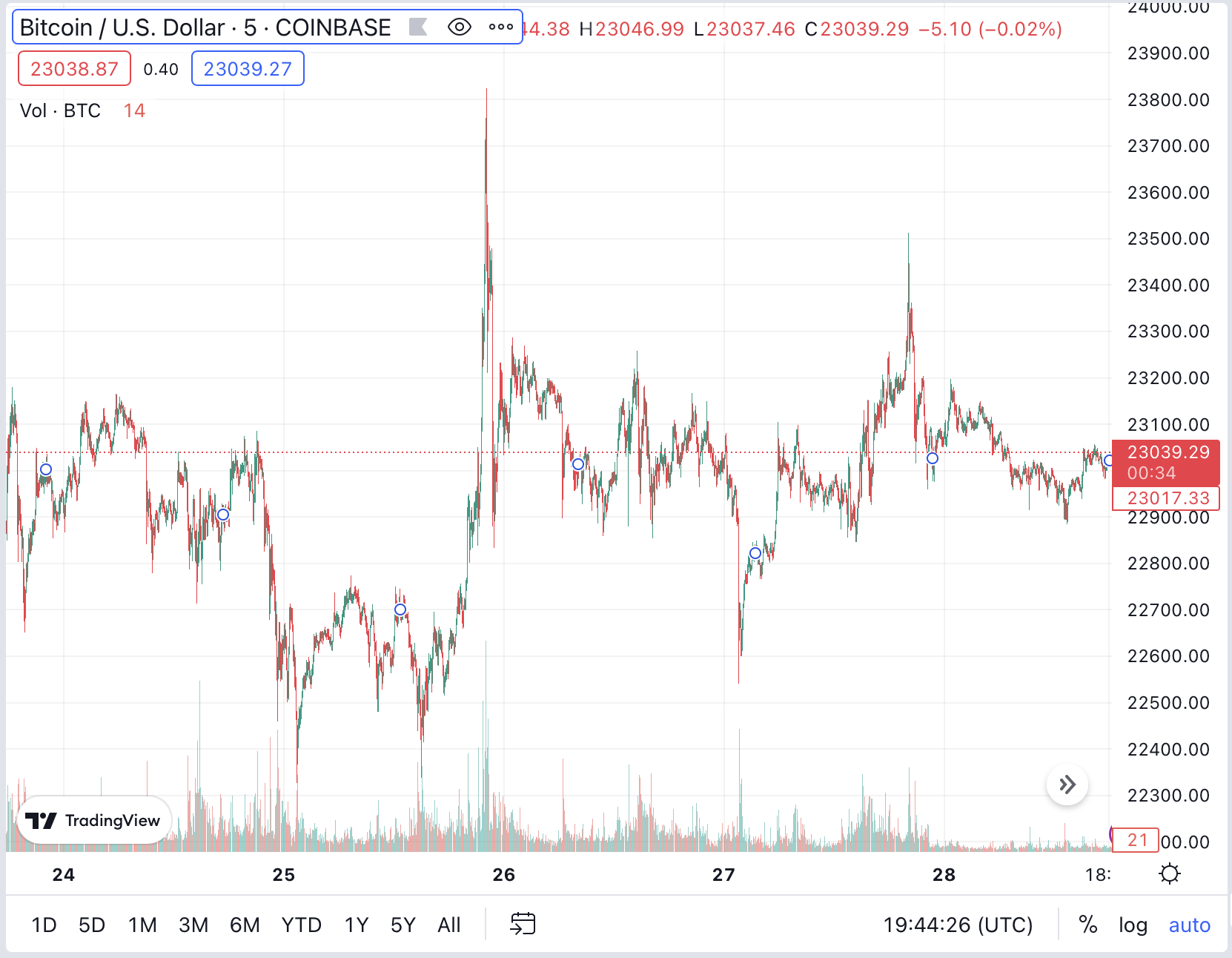
After a rally above $23,800, bitcoin bounced back from a temporary drop below $22,600 earlier in the week, to level out just over $23,000 today for a small 1.6% weekly gain. Ethereum dropped nearly 5.2% over the week, trading at $1,576.

Cryptocurrencies Floki Inu (FLOKI) and Aptos (APT) were in the green in recent days. APT surged with a 65.5% weekly gain. Meanwhile, the Floki Inu community approved a proposal to burn $55 million in FLOKI tokens resulting in a 67.36% weekly gain.

BNB and Polygon’s Matic, saw weekly gains of 0.5% and 11.23% respectively, while XRP fell by 1%.

TradingView BTC chart: Jan 28

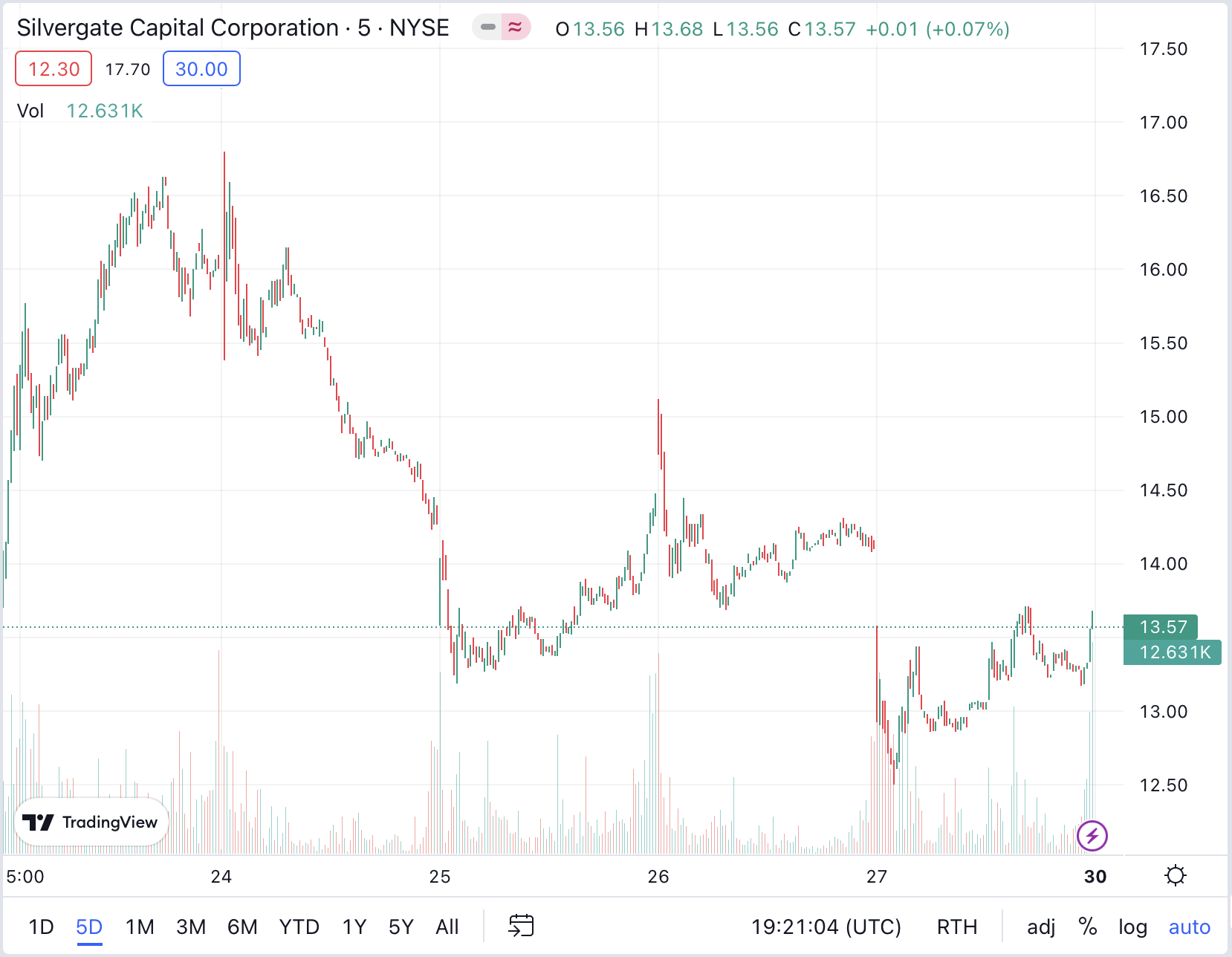
Chart from TradingView.

Crypto stocks and structured products

Silvergate shares slid from a momentary spike last Tuesday to $13.57 after the company shared Friday it had suspended a preferred stock dividend. Despite that drop, Silvergate shares still closed the week with a 10% gain.

Coinbase shares were up nearly 22%, while MicroStrategy rose just over 15% and Jack Dorsey’s Block gained 17%.

In structured products, GTBC gained 7.5%, while ETHE fell 0.67% over the week.

TradingView SI Chart: Jan 28Chart from TradingView.

Macro matters

The Federal Reserve is on deck this week, with an anticipated quarter-point interest rate hike coming on Wednesday. Officials in November increased the federal funds rate by 75 basis points to 3.75-4%, a 15-year high.

For the U.S. economy, growth narrowly surpassed a fourth-quarter estimate of 2.8%, with a 2.9% expansion in the final months of 2022, driven by consumer and federal spending.

© 2023 The Block Crypto, Inc. All Rights Reserved. This article is provided for informational purposes only. It is not offered or intended to be used as legal, tax, investment, financial, or other advice.

Go to Source
Author: Jeremy Nation

Yuga Labs co-founder takes leave of absence over health concerns

Yuga Labs co-founder Wylie Aronow disclosed on Twitter that he was diagnosed with congestive heart failure and is taking a leave of absence.

“Some heavy news: a few days ago I was told by my doctor I have congestive heart failure. Symptoms started last year out of the blue and I put off seeking help (like an idiot) so I could keep working. But after testing, my doctor called and asked me to radically change my life,” Aronow wrote.

“The condition is progressing pretty fast and that means I need to make some serious changes,” Aronow said.

Aronow said he will remain as a board member and strategic advisor, to Yuga Labs. 

His exit comes as NFTs have lost value alongside the slump in cryptocurrencies prices and the fallout of the collapse of FTX and 3AC.

Yuga recently kicked off its well-received Dookie Dash game, a token gated mini-game that allows pass holders with access to confer their rights to play to others in a bid to net a high score and win prizes for the game’s next phase.

Aronow said that had pushed himself way past his limits on the project, working back-to-back 12-hour days in an effort to seize a second chance at life after spending most of his twenties battling a chronic illness.

“Our incredibly talented friend and cofounder Wylie (@gordongoner) has the full support of the whole Yuga family as he embarks on his journey to get back to health. He will be staying on as a strategic advisor and board member,” said Yuga Labs in a tweet.

Yuga Labs did not immediately respond to a request for comment from The Block.

Disclaimer: Beginning in 2021, Michael McCaffrey, the former CEO and majority owner of The Block, took a series of loans from founder and former FTX and Alameda CEO Sam Bankman-Fried. McCaffrey resigned from the company in December 2022 after failing to disclose those transactions.

© 2023 The Block Crypto, Inc. All Rights Reserved. This article is provided for informational purposes only. It is not offered or intended to be used as legal, tax, investment, financial, or other advice.

Go to Source
Author: Jeremy Nation

What the FTX creditor matrix does — and doesn’t — tell us about the exchange’s bankruptcy

FTX filed a massive creditor matrix in bankruptcy court this week, naming law firms, luxury restaurants, media outlets and state government agencies as creditors that may be owed money by the troubled crypto exchange. 

But the 115-page creditor matrix doesn’t tell the whole story.

Not every entity on the procedural document is a confirmed FTX creditor, lawyers say. Millions of customer names remain under seal.

“Inclusion of a name on the matrix does not necessarily indicate that the party is a creditor of any of the debtors,” FTX lawyers wrote in a court filing on Friday. “The matrix is intended to be very broad for service purposes and includes parties who may appear in the debtors’ books and records for any number of reasons.”

In other words, the new FTX creditor matrix serves as a large collection of addresses that the court can use for mailing notices in the future. 

It is a purely ministerial document that all debtors in all bankruptcy cases are required to prepare and file with the court and the office of the United States Trustee,” said Joseph Moldovan, a partner at the law firm Morrison Cohen.

A wide net

Lawyers compiling this type of creditor list typically note every entity on a firm’s account payable list, its investors and “every government agency that could conceivably have an interest in the case,” Moldovan said.

Complicating matters, new FTX CEO John Ray III has said that the exchange did not keep reliable business records, making the process of piecing together FTX’s financial dealings more difficult. 

Government agencies could be listed in the matrix for a number of reasons. FTX may owe taxes in certain jurisdictions, or the crypto giant may have been paying remote employees in a particular state.

FTX filed for bankruptcy protection in November, and its former CEO, Sam Bankman-Fried, is facing criminal fraud charges in a separate case.

The list of possible FTX creditors ranges from the Alaska Department of Revenue and the Colorado Secretary of State’s office to the Miami Beach location of the exclusive Carbone restaurant. The matrix lists a host of legal and lobbying firms, including the Buckley law firm and government affairs firm Rich Feuer Anderson. 

Media outlets including CoinDesk and The Wall Street Journal also appear on the matrix, which could be due to subscriptions the company held or advertising deals. 

“The list merely provides names and addresses and does not really tell us what type of claims or amount of claims the listed creditors may hold,” said Stephanie Assi, a lawyer at Carrington Coleman in Dallas whose practice includes bankruptcy and digital assets.

The creditor matrix shows the wide web of crypto-linked firms that may make claims in the FTX bankruptcy case, including Kraken Ventures, Binance Capital Management, Coinbase Global and the now-bankrupt Genesis, BlockFi and Voyager. Venture capital firm Sequoia Capital, which has said it lost $150 million on FTX, appears on the list, as does the investment firm Willoughby Capital.

Dozens of banks are listed on the creditor matrix, including Wells Fargo, the Central Bank of Dubai, the Bank of Cyprus, the Central Bank of the Bahamas, BCB Bank, Deutsche Bank AG, HSBC Bank, and the Royal Bank of Canada. 

Tampa Bay Buccaneers quarterback Tom Brady and former Boston Red Sox designated hitter David Ortiz – who have been targeted by a separate FTX-related class action lawsuit – are named in the new filing. The matrix also includes luxury hotels, meal delivery services and streaming platforms. The Coachella music festival, Blue Bottle Coffee, Airbnb, Uber Eats, Netflix, Doordash, Nobu Hotel and the W Miami hotel appear on the list, as do several resorts in the Bahamas including the Margaritaville Resort. 

“We knew that they were living the good life, so there’s Nobu and Coachella,” said Jeffrey Blockinger, general counsel at the Web3 firm Quadrata, Inc. “We knew that they had deals with celebrities.”

The names we don’t know

Although the creditor matrix offers a glimpse at the various companies and individuals who might make claims in the bankruptcy case, millions of FTX customers are still unknown to the public.

“What’s ultimately going to be the more interesting bucket is the actual people who had accounts at FTX,” Blockinger said. “That’s all of the redacted names.”

Nearly 9.7 million FTX customer names are redacted in the case, according to court documents. A Delaware bankruptcy court judge ruled earlier in January that the names would stay redacted for three more months, despite objections from the U.S. Trustee overseeing the bankruptcy and a group of news organizations. Judge John Dorsey is expected to reconsider the redaction issue in a court hearing sometime in March. 

Even the names of some of FTX’s top creditors are still redacted, Assi noted.

“Given the circumstances that led to the FTX bankruptcy filing, information that normally would have been previously gathered is being investigated and uncovered as the bankruptcy unfolds. We can expect to learn more in the upcoming months as John Ray and his team continue to move through this process,” Assi said. 

Disclaimer: Beginning in 2021, Michael McCaffrey, the former CEO and majority owner of The Block, took a series of loans from founder and former FTX and Alameda CEO Sam Bankman-Fried. McCaffrey resigned from the company in December 2022 after failing to disclose those transactions.

© 2023 The Block Crypto, Inc. All Rights Reserved. This article is provided for informational purposes only. It is not offered or intended to be used as legal, tax, investment, financial, or other advice.

Go to Source
Author: Stephanie Murray

A load of crap: Bored Ape NFT game attracts pros angling for a piece of the Dookey

Thousands of people are following the money. Right down the drain. 

Billion-dollar NFT collection Bored Ape Yacht Club’s new sewer-centric video game Dookey Dash has generated more than $40 million in trading in the ten days since its debut, according to the NFT marketplace OpenSea. 

Now some experienced gamers want in, offering up their expert skills in an effort to take part in what could be the biggest web3 gaming gold rush since Axie Infinity. 

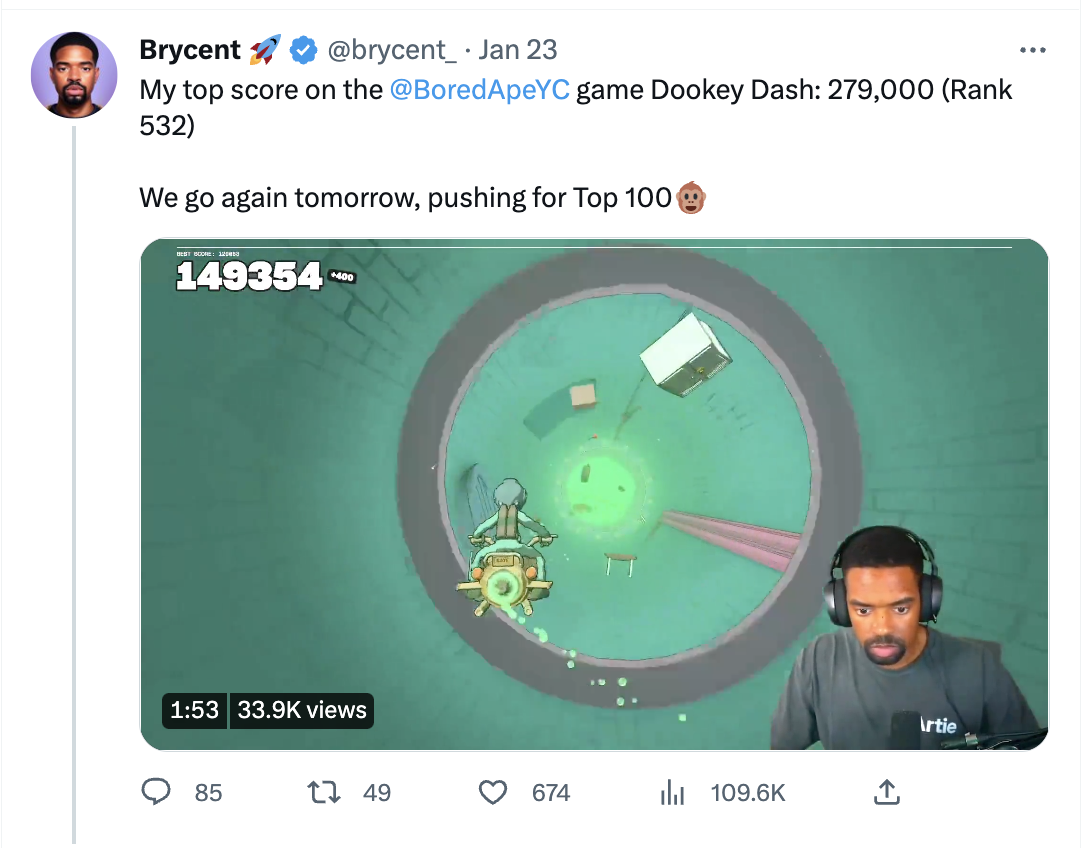
“I’ve had folks reach out to me and want me to play on their accounts,” said the Twitch gaming streamer who goes by Brycent. “I took one holder up on his offer. He has six Bored Apes.” 

Why would holders of Bored Ape NFTs — and their Mutant Ape Yacht Club brethren — be interested in hiring gamers? Because a little over a week ago the prolific digital asset shop Yuga Labs had more than 23,700 “Sewer Pass” NFTs claimed by holders of its BAYC and MAYC collections, according to OpenSea data. A total of 30,000 Sewer Passes were made available while non-BAYC and MAYC holders are allowed to purchase them on the secondary market.
 
 
Whomever owns a pass, whether they possess a BAYC or MAYC token or not, has the right to play Dookey Dash. The highest-scoring player will be awarded the “ultimate” prize, one that’s not only crucial to the next chapter of BAYC’s story saga “The Trial of Jimmy the Monkey” but will also likely hold significant monetary value on the open market. The rest of the Sewer Passes will be given an award based on the highest score attributed to each pass.

Unless that score is a zero.

Although the game parameters verge on complicated, Yuga Labs’s hype-heavy gambit speaks to a broader trend of top-tier NFT collections exploring new promotional strategies aimed at both expanding the reach of their brands while simultaneously stirring engagement among their existing holders. Other marquee collections such as Doodles, Pudgy Penguins and Azuki have also taken measures to stay relevant despite the major price deterioration that rocked the world of NFTs through most of last year.

Pushing boundaries

“We want these things to be fun and weird, while also continuing to push the boundaries of what people perceive of the NFT industry,” said Yuga Labs Gaming Director Spencer Tucker. 

So far the most successful NFT shop’s plans to spur engagement appears to be paying off. Since Dookey Dash launched on Jan. 18, the game has been played over 4 million times, according to Harry Siu, CEO of the metaverse firm and Animoca Brands subsidiary Forj.  

The game itself is fairly straightforward. Players control a jet ski-riding primate – who may or may not be bored or a mutant – as it dodges obstacles and collect items while picking its way through sewer pipes. Using $APE, the native currency of Yuga Labs, players can buy power ups to aid gameplay and boost their score. 

Or, if you have coin to spare, and suffer from both a lack of time and confidence in your video game skills, you can outsource the gameplay.  

Some holders are tapping gamers to help increase their final score. By renting out their NFTs, holders can hand over the controls to more seasoned professionals. Gaming guilds and freelance gamers alike are jumping into the mix in a scene akin to the guilds that cropped up during the heyday of Axie Infinity; the play-to-earn game which generated billions of dollars in NFT transactions. 

The Gamer-to-Sewer Pipeline

While Brycent, the Twitch streamer, had some of his 50,000-strong following tuning in to watch him play Dookey Dash this week, other gamers are organizing to help Sewer Pass holders succeed. Neon Ape, another gamer who prefers to remain pseudonymous, formed a collective of 33 gamers who are compensated by performance. If one brings a Pass over 300,000 points, they earn 0.5 ETH ($767). 

“The gamers have been very dedicated, most playing over six hours daily,” Neon Ape told The Block.

It’s not just the gamers taking initiative. One MAYC holder has taken to Twitter to try and promote an ad hoc service they believe could capitalize on the fervor: matching top-tier gamers with Sewer Pass owners who are not top-tier at playing video games. 

“As someone who is relatively average or trash at gaming, I was actually looking to hire a better gamer to play my passes,” said the MAYC holder going by Dookey Boosters on Twitter. “Since I know other Apes in the same boat who are willing to pay, and met god-tier gamers who are killing it, I figured I’d create a service.” 

Dookey Boosters said he’s initially working with a fee structure that would pay gamers anywhere from $200 to $5,000 (in ETH), depending on how high they score. 

Mystery rewards

The rush to pile up Dookey Dash points will continue until Feb. 8, when high scores become permanently bound to each Sewer Pass NFT. Whatever is awarded to the top scorers, Yuga Labs isn’t saying how valuable those rewards might be. But Dookey Boosters speculated it could be either a new NFT from a new collection or instead some type of enhancement or “rarer trait” that will allow holders to increase the value of existing Yuga Labs’s tokens.
 
Again, the top overall score will receive the ultimate prize, or what Yuga is calling the “key.” While what exactly the key is, or will be, remains a mystery, community members like Dookey Boosters only need to look at the high overall value of Yuga digital assets before drawing the conclusion that whatever rewards are given, they could carry tremendous value, if not grant special privileges.

After all, the floor price on a BAYC token is currently about $115,000. And at least at one time celebrities like Justin Bieber, Mark Cuban, and Snoop Dogg all owned one, according to Yuga Labs.

While the trading volume for Sewer Passes is already through the roof, the market for passes might receive another massive boost after gameplay halts on Feb. 8, according to Dookey Boosters. 

“We may see a big uptick in volume,” they said, highlighting the fact that in the week after scores are frozen and become bound to corresponding passes a lot of people might be looking to pay for a top score and ensure they aren’t left out of whatever Yuga Labs has planned.  

On Feb. 15 the highest scoring passes are slated to receive their award in an event Yuga has dubbed “The Summoning.” 

© 2023 The Block Crypto, Inc. All Rights Reserved. This article is provided for informational purposes only. It is not offered or intended to be used as legal, tax, investment, financial, or other advice.

Go to Source
Author: MK Manoylov and RT Watson

Weekly wrap-up: Big funding rounds, layoffs and FTX developments

The past week saw an interesting set of big funding announcements, although the overall market sentiment remains bearish. Several companies announced job cuts as they struggled to stay afloat with the repercussions of FTX’s collapse and the so-called crypto winter. Speaking of FTX, its new creditors were revealed last week, and the company’s lawyers sought answers from disgraced founder Sam Bankman Fried’s immediate family.

Big funding rounds

Long-term investors continue to see value in the bear market. A number of companies announced significant funding rounds, including Blockstream and QuickNode.

QuickNode, a web3 infrastructure firm that provides blockchain development tools, raised $60 million in a Series B round and reached a valuation of $800 million. The lead investor was Dan Tapiero’s 10T Holdings and participants included Alexis Ohanian’s Seven Seven Six, Tiger Global, Protocol Labs and QED Investors.

Crypto infrastructure company Blockstream raised $125 million in convertible note and secured loan financing to expand its bitcoin mining hosting services. Kingsway Capital led the convertible note, with other investors including Fulgur Ventures.

Spatial Labs, a web3 infrastructure firm focused on improving metaverse and commerce, also raised a notable round — $10 million in seed funding. It was a rare slice of cash for a Black founder in the U.S., where only about 1% of venture capital funding went to startups with Black founders in 2022, according to Crunchbase data. Spatial Labs’ 25-year-old founder and CEO, Iddris Sandu, says he may be the first Black founder under 30 to raise a double-digit million seed round.

Layoffs continue

Several businesses announced job cuts last week as crypto continues to grapple with challenging market conditions.

Digital Currency Group (DCG)-owned crypto exchange Luno cut 35% of its workforce, citing the “incredibly tough year” affecting the crypto market. Luno reportedly had a total headcount of 960, meaning more than 330 jobs were lost. DCG has come under increasing pressure over the past year as the crypto downturn intensified amid a turbulent macroeconomic backdrop. The collapse of crypto hedge fund Three Arrows Capital in June and the failure of FTX in November exacerbated the firm’s underperformance.

Crypto exchange Gemini shed 10% of its staff in a third round since June. Gemini cut 10% of its workforce in June, followed by more layoffs the following month. As a result, its overall headcount slipped from 1,100 at the start of 2022 to about 700 people near the end of the year. Gemini halted client withdrawals for its Earn product in November as its lending partner, Genesis Global Capital (a DCG unit), paused withdrawals amid severe liquidity issues. Genesis filed for bankruptcy protection and owes more than $765 million to some 340,000 Gemini Earn customers.

Crypto services provider Matrixport, owned by billionaire entrepreneur Jihan Wu, cut 10% of its workforce, or about 30 employees. Matrixport had more than 290 employees.

Crypto tax unicorn CoinTracker cut about 20% of its staff, or 19 employees, citing market headwinds and “over-hiring.”

FTX developments

The FTX case continued to see developments after its bankruptcy protection filing in November. Last week, a new, extensive list of FTX’s creditors was revealed, which includes tech giants, athletes and governments. Amazon Web Services, Apple, Meta Platforms, Twitter, Netflix, Adobe, Tom Brady, U.S. state tax, consumer affairs, and attorneys general offices are all listed as FTX creditors.

FTX bankruptcy lawyers are seeking permission to subpoena former CEO Bankman-Fried, his family and top lieutenants at the collapsed crypto exchange, new court documents showed.

Lawyers are targeting Bankman-Fried’s parents, Joseph Bankman and Barbara Fried, and his brother, Gabriel Bankman-Fried, saying the trio acted as his advisers. They also named FTX co-founders Gary Wang and Nishad Singh, former Alameda Research CEO Caroline Ellison and Constance Wang, the former chief operating officer of FTX Trading Ltd. and co-CEO of FTX Digital Markets Ltd, in the documents. Lawyers are seeking information and documents regarding FTX’s assets and business operations and the personal assets of FTX insiders, among other things.

Lawyers for Bankman-Fried, on the other hand, argued that he should be allowed access to assets and crypto held by FTX, saying there’s no evidence he’s responsible for previous alleged unauthorized transactions.

“Nearly three weeks have passed since the initial pretrial conference and we assume that the Government’s investigation has confirmed what Mr. Bankman-Fried has said all along; namely, that he did not access and transfer these assets,” Bankman-Fried’s lawyer, Mark Cohen, said in a letter. “Given that the sole basis advanced for seeking that condition has not been supported, we believe that the bail condition imposed at the conference should be removed.”

Finally, the Justice Department asked a federal judge to bar Bankman-Fried from communicating with current and former employees of FTX without a lawyer present, after prosecutors alleged that he recently contacted a potential witness in his criminal case.

Disclaimer: Beginning in 2021, Michael McCaffrey, the former CEO and majority owner of The Block, took a series of loans from founder and former FTX and Alameda CEO Sam Bankman-Fried. McCaffrey resigned from the company in December 2022 after failing to disclose those transactions.

© 2023 The Block Crypto, Inc. All Rights Reserved. This article is provided for informational purposes only. It is not offered or intended to be used as legal, tax, investment, financial, or other advice.

Go to Source
Author: Yogita Khatri

Prosecutor seek to restrict Bankman-Fried’s bail terms after apparent attempts to influence witnesses

U.S. Attorneys want to restrict FTX founder and ex-CEO Sam Bankman-Fried’s access to encrypted messaging services and bar communication with former FTX and Alameda employees, after prosecutors suggested he was trying to influence witnesses, according to court documents.

U.S. prosecutors contend Bankman-Fried’s messages were “suggestive of an effort to influence” the testimony of a witness. The witness is said to have received instructions via encryption messaging app Signal for “liquidating Alameda’s investments to satisfy FTX customer withdrawals” to cover a $45 million hole in FTX US’s balance sheet in November.

“I would really love to reconnect and see if there’s a way for us to have a constructive relationship, use each other as resources when possible, or at least vet things with each other,” SBF wrote to “Witness-1” on Jan. 15. 

“This is particularly concerning given that the defendant is aware that Witness-1 has information that would tend to inculpate the defendant,” the document said. “The appeal for a ‘constructive relationship’ likewise
implies that Witness-1 should align with the defendant. This is particularly concerning given that the defendant is aware that Witness-1 has information that would tend to inculpate the defendant.”

He also communicated directly with the current general counsel of FTX US, who officials contend may be a trial witness.

Bankman-Fried made contact with other current and former FTX employees over email and via Signal, which is consistent with “a history of using the application for obstructive purposes,” the document said.

The disgraced CEO’s current bond imposes no limitations in terms of contacting prospective witnesses in the ongoing case.

© 2023 The Block Crypto, Inc. All Rights Reserved. This article is provided for informational purposes only. It is not offered or intended to be used as legal, tax, investment, financial, or other advice.

Go to Source
Author: Jeremy Nation

Crypto tax unicorn CoinTracker lays off 19 employees, citing industry gloom, ‘over-hiring’

Crypto tax unicorn CoinTracker laid off about a fifth of its staff due to market conditions.

A total of 19 employees were let go from the San Francisco-headquartered crypto tax company as its leadership cited headwinds from crypto winter alongside bringing on too many people, according to an email sent to workers that was seen by The Block.

“Today we are confronted by the crypto winter, an unstable economy with high inflation and rising interest rates, and additional headwinds with crypto tax regulations,” co-founder and CEO Jon Lerner said in the Jan. 26 letter. “This is a very different environment than we experienced from mid-2020 to mid-2022. Our expectations for 2023 are different than anticipated in the past year.”

A company spokesperson confirmed the layoffs in an email and said that 15 of the 19 who were let go were in the customer support team. 

“Before considering letting go of team members, we had systematically optimized all other costs,” the company said. 

Figures from LinkedIn and DealRoom suggest CoinTracker had roughly 100 employees before the cuts. 

Equity Cliff

CoinTracker offered affected employees 12 weeks of pay, three months healthcare coverage for U.S.-based employees and a removal of the equity cliff meaning that anyone departing can remain a shareholder. They’ll also be allowed to keep their laptops

“Today is a difficult day, but we continue to believe we have the right foundation and assets to make a foundational product in crypto,” Lerner said in the letter. 

CoinTracker had been valued at $1.3 billion this time last year after it raised an $100 million Series A round backed by Accel, Y Combinator, Coinbase Ventures, Seven Seven Six and Kraken Ventures, among others. 

Although not on the same scale as layoffs at Coinbase, the sentiment echoes that of CEO and co-founder Brian Armstrong in a letter to employees sent in June. “While we tried our best to get this just right, in this case it is now clear to me that we over-hired,” wrote Armstrong. 

Earlier this week it was revealed DCG-owned crypto exchange Luno would cut 35% of its staff. Coinbase also announced another round of layoffs earlier in January, cutting 950 jobs, or 20% of its headcount. Crypto.com also said it would undertake a 20% headcount cut the same week.

© 2023 The Block Crypto, Inc. All Rights Reserved. This article is provided for informational purposes only. It is not offered or intended to be used as legal, tax, investment, financial, or other advice.

Go to Source
Author: Lucy Harley-McKeown

BH Digital didn’t just get Dragonfly’s head of liquid strategies, it got the whole team

Brevan Howard Digital didn’t just hire Dragonfly’s head of liquid strategies — it scooped up the whole team. 

The firm said on Thursday that Dragonfly’s Kevin Hu, a former general partner and head of the liquid strategies, had joined Brevan Howard’s crypto arm and would focus on listed digital assets. But BH Digital also acquired Hu’s former liquid group at Dragonfly, according to two sources familiar. 

BH Digital and Dragonfly both declined to comment. 

BH Digital is expanding amid a difficult market for the industry. While cryptocurrencies have seen prices rally in recent weeks, they are still far from their 2021 peak. The collapses of 3AC and FTX triggered ripple effects, sending companies scrambling to survive.

Dragonfly launched its inaugural liquid crypto fund in 2021, which was managed by Hu, Ashwin Ramachandran and Lawrence Diao. As of April, the liquid investment platform had raised more than $450 million. It announced the launch of a new “liquid platform” in July, without explaining what exactly it was.

Brevan Howard manages over $30 billion in assets for institutional investors, such as sovereign wealth funds and corporate and public pension plans.

© 2023 The Block Crypto, Inc. All Rights Reserved. This article is provided for informational purposes only. It is not offered or intended to be used as legal, tax, investment, financial, or other advice.

Go to Source
Author: Sarah Wynn


Follow by Email
Facebook20
Pinterest20
fb-share-icon
LinkedIn20
Share