FreeCryptoCurrency.Me

Free stocks and money too!

Category Archive : Crypto News

Aave’s GHO stablecoin goes live on Ethereum’s Goerli testnet

Aave Companies, the developer behind the Aave DeFi project, has launched the protocol’s native stablecoin called GHO on Goerli, an Ethereum testnet network, the team said on Thursday.

Users wishing to test out GHO on Goerli can now access the stablecoin’s codebase on GitHub, according to the announcement. Today’s deployment on Goerli is part of the planned rollout of the stablecoin on the Ethereum mainnet.

Aave DAO, the community that oversees the Aave protocol, will vote to approve GHO’s official mainnet launch. This will happen at a later date.

GHO, when launched, will be Aave’s native stablecoin pegged to the U.S. dollar. The token will be similar to MakerDAO’s DAI stablecoin in that it will be overcollateralized. This means that users will have to supply collateral in amounts exceeding the value of GHO they wish to mint.

Collateral assets for GHO will also generate yield, according to previously released details about the planned stablecoin. Aave DAO will earn interest payments from borrowers of the stablecoin. All repaid interest will be directed to the Aave DAO treasury, according to Thursday’s update.

The Aave DAO will also control the facilitator set for the GHO stablecoin. Facilitators are those who can mint and burn GHO tokens. Aave Companies recently recommended that the Ethereum V3 pool be the first facilitator upon the GHO mainnet launch.

GHO is among a set of stablecoin projects being released by DeFi-native protocols. Curve Finance also reportedly has plans to release its own stablecoin.

© 2023 The Block Crypto, Inc. All Rights Reserved. This article is provided for informational purposes only. It is not offered or intended to be used as legal, tax, investment, financial, or other advice.

Go to Source
Author: Osato Avan-Nomayo

Crypto protection startup Coincover raises $30 million

Crypto protection startup Coincover has secured $30 million in funding in a round led by Foundation Capital.

Coincover provides  protection and insurance-backed guarantees to crypto investors and companies through its technology platform. The insurance protection is underwritten by Lloyds of London insurers.

The UK-based startup raised a $9.2 million Series A back in July 2021 with backing from investors such as Valor Equity Partners, Susquehanna Private Equity Investments, LLLP and DRW Venture Capital.

Coincover’s CEO and co-founder David Janczewski declined to disclose the names of other investors for this round. However, he said they were “a real mixture” of investors with some being crypto native VCs as well as the more traditional venture firms and corporate venture funds.

“I think it’s the next round of logical fundraising,” said Janczewski in an interview with The Block. “There are certain people who will put a letter on that. So it’s logical if the last one was A that this was B, but I guess it’s just the next logical step for us in terms of raising the right amount of capital, more importantly from the right venture building partners to scale the business to the next stage.”

What is Coincover?

Founded in 2018, Coincover offers two core digital assets protection services: disaster recovery and transaction protection. Clients run the gamut from early stage companies to exchanges and hedge funds, Janczewski said.

Over the years, Coincover has seen a greater awareness and appreciation for the types of products the company offers as the market has matured, Janczewski said. Most clients start their journey with the company for its disaster recovery product. Whereas transaction protection product is more popular with companies that have an installed user base.

“I would say that we’ve seen a a substantial increase in demand by a wide variety of customers who when I speak with any of them are eager and keen to be proactive when they think about protecting client assets,” said Janczewski describing the impact of the bear market on market appetite.

Challenges in crypto insurance

The digital assets sector is underserved by the broader insurance market, in part because it is so young but also due to its volatility. Broker Aon estimates the crypto market insurance rate is below 2%, according to Bloomberg Law. 

At the height of the bull market, insurance and protection services for digital asset firms could be a hard sell, said Dave Roque, head of digital assets insurance at USI, in an  interview with The Block. That mentality shifted dramatically as the market soured, with his company witnessing  a 350% increase in client acquisition from fintech and crypto companies within the last year.

Coincover operates as a bridge between customer and insurer. It’s about providing high quality risk data that can get everyone comfortable with risks and therefore offer increased numbers of coverage to customers, Janczewski said.

The nitty gritty

The new funding will be used to accelerate hiring, make product updates and secure more partnerships, Janczewski said.

“We select our partners and I think they select us very carefully and I think that’s good for the market in general,” he added. “Our ability to onboard more partners throughout this year is now increased, which is fantastic.”

The fundraising efforts kicked off toward the end of the first quarter in 2022 and closed towards the middle of the fourth quarter. He wouldn’t disclose whether the funding followed the popular industry structure of equity plus token warrants but said it was “nothing particularly special” in terms of structuring. The startup also did not disclose its valuation.

“After a tumultuous year for digital assets, investing in Coincover was a no-brainer,” said Charles Moldow, general partner at Foundation Capital, in the release. “The brand offers assurance in a fast-paced market.”

© 2023 The Block Crypto, Inc. All Rights Reserved. This article is provided for informational purposes only. It is not offered or intended to be used as legal, tax, investment, financial, or other advice.

Go to Source
Author: Kari McMahon

LocalBitcoins shuts down after a decade in operation

Peer-to-peer bitcoin trading service LocalBitcoins is closing down after a decade in operation.

“Regardless of our efforts to overcome challenges during the ongoing very cold crypto-winter, we have regretfully concluded that LocalBitcoins can no longer provide its Bitcoin trading service,” the platform said today in a statement.

The platform offered users the ability to buy and sell bitcoin directly with other users, whether in person or online. Originally it didn’t require KYC information, but this was later introduced in light of regulations.

LocalBitcoins has suspended new sign ups today and will suspend trading and using its wallet — except for making withdrawals — on Feb. 16. Customers will have 12 months to withdraw their funds from the platform.

© 2023 The Block Crypto, Inc. All Rights Reserved. This article is provided for informational purposes only. It is not offered or intended to be used as legal, tax, investment, financial, or other advice.

Go to Source
Author: Tim Copeland

MetaMask adds Onramp.money to streamline crypto purchases in India

MetaMask has integrated with Onramp.money, an Indian provider of crypto-to-fiat on-ramp services.

The integration will allow Indian users to purchase cryptocurrency directly within the MetaMask wallet app through Onramp.money’s API, which supports local payment methods such as UPI and IMPS.

“We are excited to partner with Onramp.money to bring instant transaction services to our users in India,” said Lorenzo Santos, product manager at MetaMask. “We believe this will help drive the adoption of blockchain technology in India.”

Despite a challenging regulatory environment for cryptocurrency assets in India, with a 30% tax on crypto gains and a 1% tax deducted at source, this integration will make it easier for Indian users to acquire assets on the Ethereum, Polygon, and BNB Chain and use them within decentralized applications. The lack of regulatory clarity from the government and the difficulty of finding banking channels for on-ramping remain challenges in the crypto market in India.

In the recent budget speech for the 2023-24 financial year given by Nirmala Sitharaman, the Indian Finance Minister did not mention any reforms or policies for cryptocurrency assets. Nevertheless, both Sitharaman and other government officials have emphasized the requirement for a uniform approach to regulating cryptocurrency, in accordance with worldwide policies, in order to provide clear guidelines for crypto users in the country.

© 2023 The Block Crypto, Inc. All Rights Reserved. This article is provided for informational purposes only. It is not offered or intended to be used as legal, tax, investment, financial, or other advice.

Go to Source
Author: Vishal Chawla

Tether reports $700 million Q4 net profit in latest attestation report

Stablecoin issuer Tether released its latest attestation report on Thursday, reporting a profit of $700 million in the fourth quarter of 2022, which it reinvested into its reserves.

“Tether’s reserves remain extremely liquid, with the majority of its investments being held in cash, cash equivalents, and other short-term deposits,” the company said in a statement while releasing its December report attested by accounting firm BDO. The report notes Tether’s consolidated assets exceeded its liabilities as of Dec. 31, 2022.

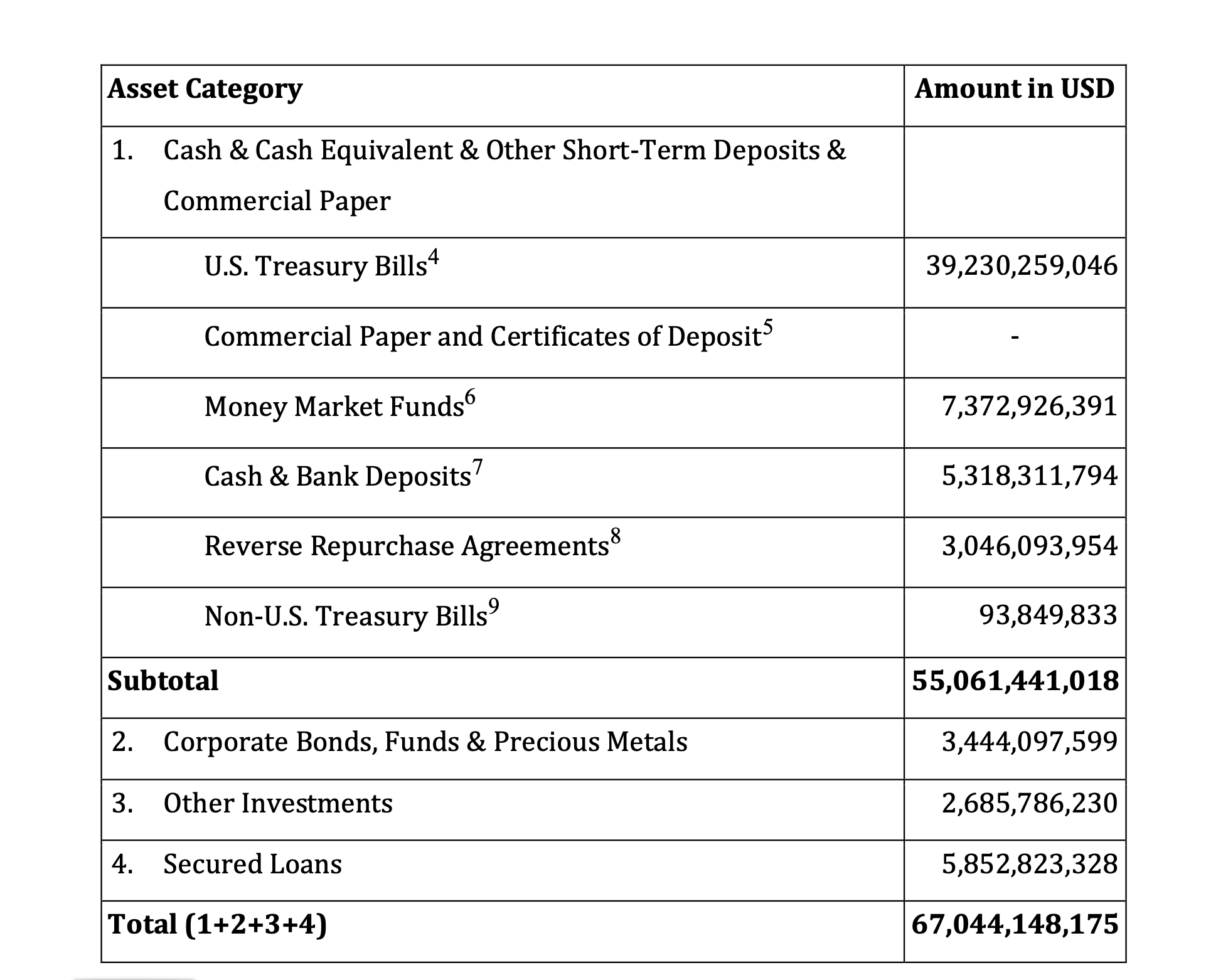
Tether’s consolidated total assets amounted to at least $67.04 billion as of the date, while its consolidated total liabilities amounted to $66.08 billion, per the statement, reflecting excess reserves of at least $960 million.

Source: Tether’s attestation report dated Feb. 8, 2023

Last December, Tether said it will remove all secured loans from its backing in 2023 after The Wall Street Journal said the company’s increasing roster of loans might make it unable to pay back redemptions in the event of a crisis. Per today’s report, Tether has reduced its secured loans by $300 million.

Tether CTO Paolo Ardoino said in the statement that the company “once again proved its stability” in the troubled year of 2022. “Not only were we able to smoothly execute over $21 billion dollars in redemptions during the chaotic events of the year, but Tether has on the other side issued over $10 billion of USDT, an indication of continued organic growth and adoption of Tether,” he said.

Tether eliminated commercial paper from its reserves last October. Its other assets include corporate bonds, funds and precious metals. Tether’s USDT is the largest stablecoin in the market, with a supply of over 68 billion tokens, according to The Block’s Data Dashboard.

© 2023 The Block Crypto, Inc. All Rights Reserved. This article is provided for informational purposes only. It is not offered or intended to be used as legal, tax, investment, financial, or other advice.

Go to Source
Author: Yogita Khatri

Celsius’ extension request denied by US trustee and creditors as cash burn continues

Several parties have objected to bankrupt crypto lender Celsius’s motion to extend its timeline for filing a Chapter 11 restructuring plan once again.

The crypto lender, which filed for Chapter 11 bankruptcy protection in July 2022, filed a motion on Jan. 25 to extend its exclusivity period — the time when it maintains the exclusive right to submit a Chapter 11 reorganization plan – by 44 days on March 31 and to solicit votes on the plan through to June 30.

The unsecured committee of creditors, Celsius borrowers and the U.S. trustee have all pushed back on this request.

Burning cash

“Given the rate at which professionals are consuming debtors’ assets, a further extension through June 31st without a proper basis is inappropriate,” said William Harrington, the U.S. trustee, a Department of Justice official responsible for overseeing the administration of the bankruptcy case, in a filing.

“Notwithstanding the debtors’ lip service to the volume of creditors in this case needing to be sent the plan and disclosure statement, it cites to no other case being granted such a long extension for solicitation during one motion for exclusivity,” he added.

Celsius borrowers echoed these concerns in their own objection citing that Celsius was “consuming enormous amounts of professional fees and the outcome remains highly uncertain.”

Another extension

The Chapter 11 bankruptcy process allows for the debtor to file a plan of reorganization. It is typically expected to be filed within four months. The lender already received court approval to extend its exclusivity period to Feb. 15 after filing a motion in November 2022.

“This extension is critical to allow the debtors to reach the finish line of these Chapter 11 cases swiftly and efficiently, unobstructed by the disruption of competing plans,” said Celsius’s lawyers in the motion filing. “The debtors are well on their way to a value-maximizing conclusion to these Chapter 11 cases with the imminent filing of the plan.”

There will be a hearing on the motion on Feb. 15.

© 2023 The Block Crypto, Inc. All Rights Reserved. This article is provided for informational purposes only. It is not offered or intended to be used as legal, tax, investment, financial, or other advice.

Go to Source
Author: Kari McMahon

Venture capital expected to see more regulatory scrutiny after FTX

Throughout 2022 multiple crypto firms filed for bankruptcy. Then came FTX. 


Experts say the Securities and Exchange Commission is homing in on venture capital funds investing in digital assets following market fallout that’s turned a crypto fundraising boom to a bust. 

The SEC’s Division of Examinations named “crypto-assets” and other emerging tech as a top priority for 2023 on Tuesday. The agency said it would examine broker dealers and registered investment advisers following “disruptions caused by recent financial distress.” 

“The FTX issue amplified in the minds of the SEC the risks posed by investment advisers investing in crypto assets, so they are particularly motivated now to take a real look because there is actual harm that has befallen investors in these assets,” said Justin Browder, partner at Willkie Farr & Gallagher LLP. 

The SEC is interested in two areas, Browder said — how investment advisers, including venture capital firms, are looking out for the best interest for their clients and how advisers are holding crypto for those clients. 

Zachary Fallon, a former SEC attorney agreed that there have been “murmurs of the SEC probing investment advisers” regarding the custody rule. Fallon is now a partner at the law firm,  Ketsal, which specializes in legal work for investment advisers. 

Zooming in  

Crypto companies raised $33.11 billion in 2022 from investors, and $631 million from January 2023 to now, while investors raised $99.297 billion in 2022 for crypto-related investment funds, data from The Block Pro Deals Dashboard show. Through that explosion in interest, followed by earlier high-profile firm collapses, the way crypto-related investment advisers follow fiduciary duty and perform custody of digital assets has been on the SEC’s radar.

But FTX has amplified the risks investment advisers face, Browder said. 

Investment advisers at a venture capital fund have a duty of loyalty, which includes mitigating or eliminating conflicts of interest, as well as a duty of care to make sure they are investing clients’ assets in areas that make sense for them.  

When the market was doing well, there was less concern, so it was “no harm, no foul when people are making money,” Browder said.  

“But as a result of the FTX fallout, you see what happens when the music stops, and it highlights all the risks associated with making investments in crypto and crypto related companies,” Browder said.  

Registered investment advisers also are subject to a custody rule, which requires them to maintain those assets with a qualified custodian such as a bank or broker-dealer.  

There is speculation that the SEC will look more closely to see if those registered investment advisers fulfill those obligations, Browder said. 

More conservative advisers are holding clients’ assets with qualified custodians, such as banks, while others take a more aggressive approach and say the crypto they hold are not securities and so hold onto it themselves, Fallon said.  

“Those folks may find themselves having some issues with respect to their compliance under the SEC requirements,” Fallon said. “So that type of scrutiny is certainly happening.” 

Venture capital funds investing in tokens themselves, rather than a company, would fall under the same, Fallon said.  

‘Groupthink’

There is a certain degree of groupthink among venture capital firms, said John Reed Stark, a crypto critic and former chief of the SEC’s Office of Internet Enforcement.  

“They are a big guy, they got in on it, we don’t need to do any due diligence, they did it for us,” Stark said.  

Fallon also spoke about this kind of “piggybacking” among investment advisers. It is not uncommon, and not usually problematic, to have a lead investor that does the “grunt work” of negotiating the main terms and doing diligence, he said. 

“Then everyone else that comes behind that lead usually gets the benefit of some comfort that the investor has kind of done the hard work,” Fallon said. That also is not crypto-specific.  

Charlotte Savercool, vice president of government affairs at the National Venture Capital Association, said that rule change is the “most impactful proposal that the SEC is considering,” for all of venture capital, she said, not just crypto-focused funds. 

Lisa Braganca, a former SEC enforcement branch chief, said she felt it was strange to hold venture capital funds liable for failing to do due diligence. Venture capital funds are set up to invest in early stage companies that are high risk, and those young companies don’t have some types of control, she argued. 

Possible rule change in the pipeline 

The SEC proposed new rules and changes under the Investment Advisers Act a year ago that would bring added transparency standards to private funds.  

Some investors get preferential terms from those coming after them. All investors get standardized documents, but that first investor may get a side letter that says there will be a few other “sweeteners.” Those sweeteners may not be available to the other investors.

“So what the SEC is basically saying is, to the extent you have side letters, you need to tell people about those,” Fallon said.  

“We’re concerned about the way the private funds proposal could change VC investment activity and willingness to take risks on new companies,” Savercool said.  

Disclaimer: Beginning in 2021, Michael McCaffrey, the former CEO and majority owner of The Block, took a series of loans from founder and former FTX and Alameda CEO Sam Bankman-Fried. McCaffrey resigned from the company in December 2022 after failing to disclose those transactions.

© 2023 The Block Crypto, Inc. All Rights Reserved. This article is provided for informational purposes only. It is not offered or intended to be used as legal, tax, investment, financial, or other advice.

Go to Source
Author: Sarah Wynn

Value locked in Rocketpool doubles in two months, rises to $1 billion

The value locked in Ethereum liquid staking protocol Rocketpool reached $1 billion, as it seeks to capture more of the liquid staking market.

The majority of this value, $641 million, is in staked ether, while the remaining $359 million is in the project’s native token RPL.

The project now has a 5.64% share of the Ethereum liquid staking market. That puts it third behind Lido — which makes up the lion’s share of the market, at 74% — and Coinbase, which has a 16% share.

“It’s a big milestone. And we’re really proud of the growth that we’ve kind of managed to achieve,” said Darren Langley, general manager at Rocketpool. “In terms of the TVL, I think we just want to build the best product that we can and serve the community. In terms of our node operators, yes, we’re just very intent on building and making sure that we produce the best and safest product we can.”

Rocketpool is a decentralized liquid staking protocol. It matches stakers with node operators under one system that supports a shared liquid staking token. Node operators have to pony up 16 ether (half of a validator requirement) per validator and a small amount of RPL. In return they receive yield on their ether, the RPL tokens and a cut of the yield on the other 16 ether that an external party stakes through their validator.

© 2023 The Block Crypto, Inc. All Rights Reserved. This article is provided for informational purposes only. It is not offered or intended to be used as legal, tax, investment, financial, or other advice.

Go to Source
Author: Tim Copeland

Paxos attempts to quash speculation of trouble with the OCC

Stablecoin issuer Paxos attempted to clear up rumors of trouble with the U.S. Office of the Comptroller of the Currency (OCC) late Wednesday, insisting its application for a national trust bank charter remains in progress. 

“To clarify speculation: Paxos has not been asked to withdraw its application for a national trust bank charter from the OCC, nor has it been denied the charter,” the company wrote on Twitter. “Paxos continues to work constructively with the OCC.”

Speculation had swirled in the press and on Twitter earlier that day that Paxos and other crypto firms are staring down the barrel of a crypto banking crackdown. Fortune reported that the status of Protego’s application is also uncertain.

The company received conditional approval from the OCC in April 2021, giving it the green light to split its operations between two entities: one regulated on a national level and one maintaining its current regulatory structure.

At the time, it was given 18 months to execute its business plan, however that deadline has passed. The nod meant freedom to custody dollars and crypto alike, offer its stablecoin services across the country and run an exchange on the national level if it so chooses.

The OCC did not immediately respond to a request for comment. 

© 2023 The Block Crypto, Inc. All Rights Reserved. This article is provided for informational purposes only. It is not offered or intended to be used as legal, tax, investment, financial, or other advice.

Go to Source
Author: Lucy Harley-McKeown

Bitcoin miner Argo Blockchain’s CEO Peter Wall steps down

Peter Wall is stepping down as CEO and interim chairman of Argo Blockchain to “pursue other opportunities.”  

He will hand over the reins to COO Seif El-Bakly in the interim, according to a company release. Wall has agreed to remain as an advisor to Argo over the next three months to support the transition. Matthew Shaw has been appointed chairman of the board.

The publicly listed miner will use an executive search firm to help find a long-term replacement for Wall. 

In addition to Wall’s departure, non-executive director to the board Sarah Gow has resigned due to health reasons. She had been on the board since July 2021. 

These departures follow the exit of the company’s CFO, Alex Appleton, who left at the beginning of February. Appleton also said he is leaving to “pursue other opportunities,” a filing shows

In December, Argo panicked the market by accidentally publishing drafts of posts which said it would file for Chapter 11 bankruptcy protection. 

The troubled miner has been looking for extra capital to avoid that fate. It sold its Helios mining facility to Galaxy Digital for $65 million in December and took a $35 million loan from the company. It also ramped up its bitcoin mining in January. 

© 2023 The Block Crypto, Inc. All Rights Reserved. This article is provided for informational purposes only. It is not offered or intended to be used as legal, tax, investment, financial, or other advice.

Go to Source
Author: Lucy Harley-McKeown


Follow by Email
Facebook20
Pinterest20
fb-share-icon
LinkedIn20
Share