FreeCryptoCurrency.Me

Free stocks and money too!

Category Archive : Crypto News

DForce protocol drained of $3.6 million in reentrancy attack

A hacker siphoned more than $3.6 million from the decentralized finance (DeFi) protocol dForce in what appears to be a reentrancy attack on a Curve vault it operated on the Arbitrum and Optimism blockchains.

The DeFi project confirmed the incident in a Twitter post, adding that it has paused its contracts to prevent further damage.

The attack was seemingly enabled by a reentrancy vulnerability, which can occur when an attacker repeatedly invokes a smart contract function and extracts assets from it before the contract updates its internal state. This can happen when there is a bug in the smart contract code or a lack of proper security measures.

“On Feb. 10, our wstETH/ETH Curve vaults on Arbitrum and Optimism were exploited and we immediately paused all vaults. The vulnerability is identified, and the exploit was specific to dForce’s wstETH/ETH-Curve vault,” the team noted.

According to two leading crypto security firms, BlockSec and PeckShield, total losses from the attack were about $3.6 million. The reentrancy bug was present in a smart contract function used by dForce to calculate oracle prices on the Arbitrum and Optimism chains when connected to Curve Finance. The specific function, known as “get_virtual_price,” is a command that gives an estimated oracle price and can be invoked by any protocol when connected to Curve. It is used to calculate the price of the liquidity pool token.

Matthew Jiang, director of security services at BlockSec, told The Block that any protocol using the “get_virtual_price” function to calculate the price oracle is vulnerable, including dForce. He added that the issue is publicly known and does not impact Curve itself. Still, projects need to be more cautious and take additional steps while estimating oracle prices, as they can be manipulated by malicious actors to carry out reentrancy attacks.

© 2023 The Block Crypto, Inc. All Rights Reserved. This article is provided for informational purposes only. It is not offered or intended to be used as legal, tax, investment, financial, or other advice.
Go to Source
Author: Vishal Chawla

Binance deploys zk-SNARKs on proof-of-reserves system

Binance, the biggest centralized cryptocurrency exchange by volume, has added zk-SNARKs’ zero-knowledge proof system to its proof-of-reserves (PoR) verification system to attest that funds held on the platform are backed 1:1.

Currently, the PoR system supports verifying the exchange’s reserves for 13 different crypto assets.

The exchange made this addition in response to growing concerns from investors about the safety of their funds on cryptocurrency exchanges. Binance had previously released a PoR system solely based on Merkle Tree — a data structure used in cryptography that can be used for verification.

The Binance team found the Merkle Tree-based system alone was not ideal for user privacy, so it added support for zero-knowledge proofs.

“Continuing the efforts in providing transparency on user funds, Binance is excited to introduce zk-SNARKs, a zero-knowledge verification method that keeps sensitive information private and more secure, to its proof-of-reserves (PoR) verification system,” the exchange said.

Zk-SNARK is a cryptographic tool for verifying or proving certain information without actually showing or revealing what that information is. Binance has also decided to make the zk-SNARK system open-source, allowing anyone to review the code. The team maintains that by making the system open-source, it can build greater trust on the platform. 

© 2023 The Block Crypto, Inc. All Rights Reserved. This article is provided for informational purposes only. It is not offered or intended to be used as legal, tax, investment, financial, or other advice.

Go to Source
Author: Vishal Chawla

Demand for NFT tech nabbed this crypto startup a $800m valuation

Episode 8 of Season 5 of The Scoop was recorded remotely with The Block’s Frank Chaparro and QuickNode Co-Founder and CEO Alex Nabutovsky.

Listen below, and subscribe to The Scoop on AppleSpotifyGoogle PodcastsStitcher, or wherever you listen to podcasts. Feedback and revision requests can be sent to podcast@theblockcrypto.com.


For web3 developers looking for alternatives to tools like Amazon Web Services or Google Cloud Platform, QuickNode’s development environment allows teams to easily build and deploy on over 16 blockchains.

According to QuickNode Co-Founder and CEO Alex Nabutovsky, a recent surge in demand for NFT data has played a large part in QuickNode’s recent success. “The amount of need for the NFT technology and NFT API, and NFT data is growing on our platform by a factor of let’s just say 5x every quarter,” Nabutovsky said. 

In this episode of The Scoop, Nabutovsky discusses how QuickNode’s $60 million Series B — which valued the startup at $800 million — will be used to expand the business, and why he believes NFTs will continue to be a driver of growth for the web3 industry in the years to come.


This episode is brought to you by our sponsors Circle, Railgun, Flare Network, NordVPN

About Circle
Circle is a global financial technology company helping money move at internet speed. Our mission is to raise global economic prosperity through the frictionless exchange of value. Visit Circle.com to learn more.

About Railgun
RAILGUN is a private DeFi solution on Ethereum, BSC, Arbitrum, and Polygon. Shield any ERC-20 token and any NFT into a Private Balance and let RAILGUN’s Zero-Knowledge cryptography encrypt your address, balance, and transaction history. You can also bring privacy to your project with RAILGUN SDK and be sure to check out RAILGUN with partner project Railway Wallet, also available on iOS and Android. Visit Railgun.org to find out more.

About Flare
Flare is an EVM-based Layer 1 blockchain designed to allow developers to build applications that can use data from other blockchains and the internet. By providing decentralized access to a wide variety of high-integrity data from other blockchains and the internet, Flare enables new use cases and monetization models. Build better and connect everything at Flare.Network

About NordVPN
NordVPN is essential for keeping crypto transactions secure, hiding your IP address, and protecting your devices from hackers and data theft. Get premium cyber-security on up to 6 devices for the price of a cup of coffee a month. Get your exclusive NordVPN Deal and try it risk-free now with a 30-day money-back guarantee: Visit https://nordvpn.com/thescoop

© 2023 The Block Crypto, Inc. All Rights Reserved. This article is provided for informational purposes only. It is not offered or intended to be used as legal, tax, investment, financial, or other advice.

Go to Source
Author: Davis Quinton and Frank Chaparro

More than 100,000 ETH has gone through MEV-Boost since The Merge

The amount of ETH distributed via the maximal extracted value (MEV) tool from Flashbots, MEV-Boost, recently surpassed 100,000 ETH ($162 million) since the Ethereum Merge last September, according to the MEV-Boost Dashboard.

The milestone is a “success story if you compare it to the state of block building before The Merge,” Flashbots strategy lead Hasu told The Block

When Ethereum relied on a proof-of-work governance model, Flashbots was one of the only builders innovating in the MEV space, Hasu said. “There’s now 8-10 builders who are all competitive, so I think MEV-Boost is doing its job well.”

Flashbots dominance

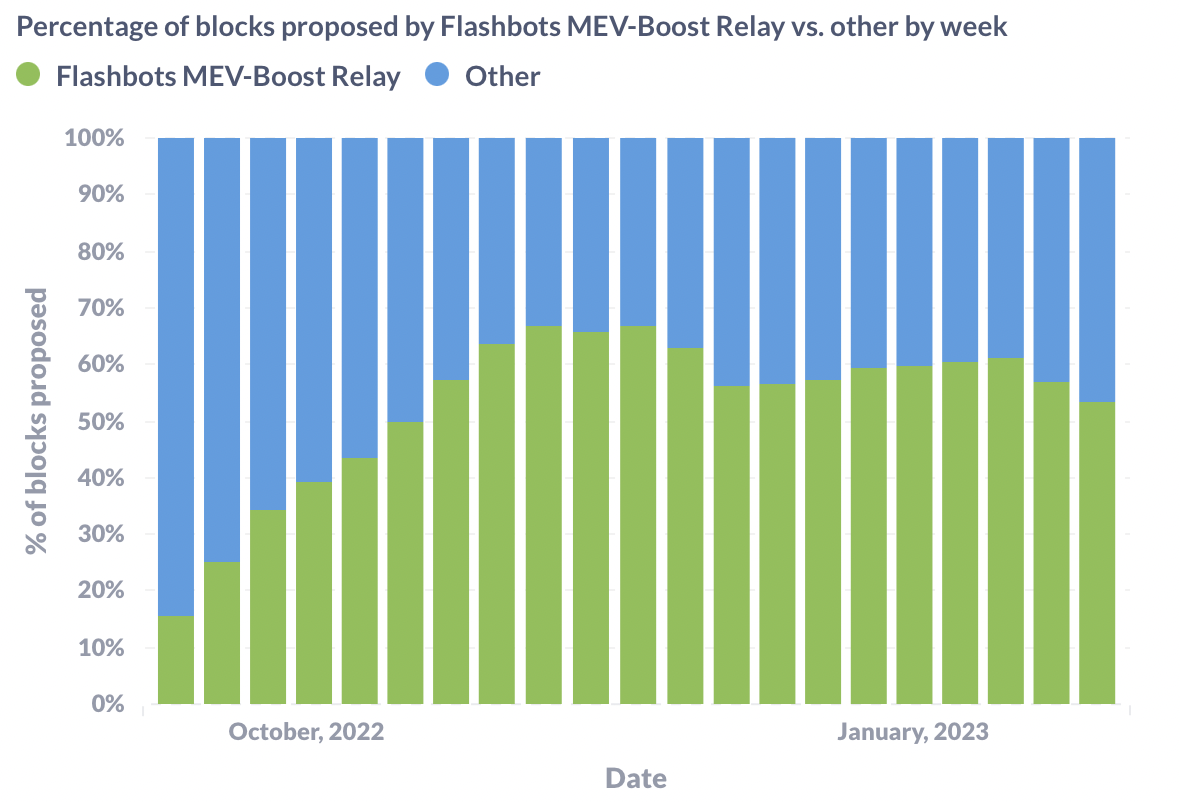
A majority of all blocks on Ethereum passed through Flashbots in the months since 2023 began, data from the Flashbots dashboard show. Despite its prevalence, some controversy exists stemming from Flashbots censoring transactions routed through a sanctioned privacy service known as Tornado Cash. 

Flashbots Chart Data

Chart from Flashbots transparency dashboard.

In light of that, efforts have been made to mitigate centralization with MEV-Boost, which “has done a lot to decentralize the MEV space,” according to Hasu.

Building towards decentralization 

The efforts of Flashbots to open-source the code behind MEV-Boost gives sophisticated companies a chance to “compete for extracting MEV to eventually forward it to the validator,” Ethereum researcher and MEV-Boost Dashboard builder Toni Wahrstätte told The Block. 

“This is great for decentralization because it doesn’t force validators to join specialized (but centralized) pools for successful MEV extraction and ultimately benefits the whole protocol,” Wahrstätte said.

Still, “more innovation is needed in order to remove the relays as [a] trusted party,” Hasu noted, adding that techniques are needed “that give validators the ability to build part of the block themselves if they want to without giving up MEV.”

A potential means by which censorship could be addressed in the MEV ecosystem is known as proposer-builder separation (PBS), which would detach building and assignment of blocks from one another and assign the tasks to different roles on the network, according to Alchemy.

For MEV-Boost, PBS is a partially realized integration, according to Hasu.

“MEV-Boost is a form of “proto-PBS” in the sense that it’s not part of the Ethereum protocol but rather an external piece of software, and it also relies on some additional trust assumptions,” said Hasu.

“But the upside is that we could get it much faster this way, and are able to iterate on the market design before enshrining anything in the protocol,” said Hasu.

© 2023 The Block Crypto, Inc. All Rights Reserved. This article is provided for informational purposes only. It is not offered or intended to be used as legal, tax, investment, financial, or other advice.

Go to Source
Author: Jeremy Nation

SEC’s targeting of Kraken staking program sends shockwaves through industry

The Securities and Exchange Commission’s move to charge crypto exchange Kraken with failing to register the offer and sale of its “crypto asset staking-as-a-service program” signals an aggressive new posture by the markets regulator over a key revenue stream for exchanges. 

Kraken settled with the agency on Thursday afternoon, ending its staking program and agreeing to pay $30 million in disgorgement, prejudgment interest and civil penalties. But the move likely signals more headaches for crypto companies in the U.S. as the SEC looks to further crack down on the passive investment offering after several high-profile failures have left customers in court seeking pennies on the dollar — or satoshis on the bitcoin. 

Industry blowback

The settlement came a day after Coinbase CEO Brian Armstrong tweeted that he heard “rumors that the SEC would like to get rid of crypto staking in the U.S. for retail customers.” Coinbase has its own staking program. 

Coinbase’s staking program was not affected by Thursday’s news, Coinbase Chief Legal Officer Paul Grewal said. Kraken was offering a yield product, Grewal said, defending Coinbase’s staking services as “fundamentally different” and not securities. 

“For example, our customers’ rewards depend on the rewards paid by the protocol, and commissions we disclose,” Grewal told The Block. “Rules making clear these distinctions would provide real clarity to consumers, investors, and the industry. 

Aaron Kaplan, founder and co-CEO of Prometheum, Inc., a fintech company, called the news on Thursday a “bad sign for ‘staking as a service’ as it’s currently offered in the United States.” 

“It appears that staking as a service is a regulated financial activity, and that the intermediaries providing such services have to register under the federal securities laws,” Kaplan said.  

“Validators are not financial intermediaries; they provide technology services, not financial services,” said  Alison Mangiero, executive director of industry group Proof of Stake Alliance.

Kristin Smith, CEO of the Blockchain Association, an industry advocacy group, also weighed in, criticizing the agency over its “regulating by enforcement.” 

“Staking is an important part of the crypto ecosystem, allowing individuals to participate in decentralized networks and giving investors more options to earn passive income,” said Kristin Smith, CEO of the Blockchain Association.  

Smith said the settlement was “another example” highlighting the need for Congress to introduce legislation.

Rep. Tom Emmer, R- Minn., one of the more vocal supporters of digital assets in Congress, previewed the likely reaction from other industry supporters on Capitol Hill. 

“@GaryGensler’s regulatory purgatory strategy hurts everyday Americans the most — leaving them in the dust while these opportunities are accessible offshore,” Emmer tweeted.  

Staking but not Proof-of-Stake

Though Gensler has raised questions about whether proof-of-stake might look like a common enterprise, which would require registration of tokens as securities, experts saw the consensus method that Ethereum and other projects rely on as safe, at least for now. 

But opinions differed as to whether it might more broadly put exchange staking programs into question. 

The SEC’s action is not a “ not a condemnation of staking writ large,” said Zachary Fallon, partner at the law firm Ketsal and a former SEC attorney. “This is regulatory condemnation of Kraken’s staking program specifically.”

Jennifer Schulp, director of financial regulation studies at the Cato Institute, saw the action as muddying the waters for other companies offering their own staking programs. 

“Piecemeal enforcement actions, like the one brought by the SEC against Kraken, are a poor substitute for providing guidance as to what characteristics of a program will trigger regulation by the securities laws,” said Schulp, who is the director of financial regulation studies at the libertarian think tank. 

Agnes Gambill West, a visiting senior research fellow at the Mercatus Center, was also less than impressed with the SEC.  

“The bigger loss is that U.S.-based crypto businesses are being compelled to shutter or move offshore rather than operate compliantly within the U.S. or find market-based solutions that mitigate potential harms to investors, which is a huge loss for U.S.-based innovation and competition,” she said.  

She also noted that the $30 million fine was a “drop in the bucket for Kraken.” 

Effect on markets 

Despite Grewal’s claim that Coinbase’s program would be unaffected, shares fell over 14% to below $60 at market close on Thursday. Coinbase reported nearly $63 million in “blockchain rewards” revenue in the third quarter of 2022. 

 “Investors now have to start pricing in the possibility that this future revenue vertical gets removed if regulation comes down strict enough to shut the product down,” said John Todaro analyst at Needham Co. “While staking revenue is still a relatively small contributor today, there is high growth potential in this vertical,” Todaro wrote in a note today.  

The investment bank estimated hundreds of millions in industrywide revenue from staking-related programs. 

With additional reporting from Frank Chaparro, Adam Morgan McCarthy, Stephanie Murray and Jeremy Nation. 

© 2023 The Block Crypto, Inc. All Rights Reserved. This article is provided for informational purposes only. It is not offered or intended to be used as legal, tax, investment, financial, or other advice.

Go to Source
Author: Sarah Wynn

CleanSpark 2023 buying spree continues as company seeks to add 50-75MW

CleanSpark is looking to acquire between 50-75 megawatts of  either greenfield sites or acquisitions in order to meet its growth target of 16 EH/s by the end of 2023.

The company expects to keep buying machines by leveraging current spot market prices, adding to the thousands of miners it scooped up last year, it said during its most recent quarterly earnings call Thursday.

“We also expect to shift our strategy when the time is right and look towards future contracts,” CEO Zach Bradford said. “We believe the tides are starting to shift and locking in prices for large orders will begin to be part of our strategy in the coming months.”

CleanSpark adjusted its hashrate guidance for the end of 2023 in December, down from 22.4 EH/s due to build-out delays from its infrastructure partner.

The planned expansion at the two facilities CleanSpark recently acquired in Georgia will bring the company’s hashrate to 14 EH/s, with 2 EH/s left to fill.

Bradford said that it is “looking at a lot of opportunities in a lot of regions,” but has a strict set of criteria that includes access to low-cost power in the long term. The spike in energy prices last year was a major pain point for miners without locked-price power contracts, combined with the decline in bitcoin’s value.

In order to help pay for these plans, Bradford said the company will propose to increase the number of shares authorized for issuance from 100 million to 300 million.

“It is not required that we ever issue them. Rather, this proposal gives us the flexibility to use equity for targeted growth,” Bradford said.

And although the company also expects to keep using some of its bitcoin mined to fund growth and operations, Bradford said he intends to see the balance of bitcoin grow in the near term.

CleanSpark beat expectations of a $31.3 million loss with a net loss of $29 million and narrowly missed its revenue estimates. 

© 2023 The Block Crypto, Inc. All Rights Reserved. This article is provided for informational purposes only. It is not offered or intended to be used as legal, tax, investment, financial, or other advice.

Go to Source
Author: Catarina Moura

Bitcoin drops, crypto stocks down across the board as Coinbase slides 14%

Cryptocurrency prices dropped across the board as the market adjusts to speculation that the U.S. may restrict crypto staking. 

Bitcoin was trading at $21,890 by 5:10 p.m. EST, down almost 5% over the past day, according to TradingView data. 

Ether fell 6.4% over the past 24 hours, trading at about $1,544. Binance’s BNB dropped 6.5%, while Cardano’s ADA fell 6.7%. Dog-themed memecoins experienced sharp sell-offs, with dogecoin down 8.4% and shiba inu losing 10.7%.

Crypto Stocks

Crypto stocks plunged heavily today in response to speculation that the U.S. may restrict crypto staking. Last night, Coinbase CEO Brian Armstrong said it would be a “terrible path” for the U.S. if it were to restrict crypto staking.

Coinbase was down more than 14% on the day, to under $60 per share. 

The drop is primarily a result of Armstrong’s comments, John Todaro of Needham told The Block. “While staking is still a small portion of COIN’s overall revenue today, it is an important piece to diversify revenue away from trading and is seen as a potentially high-growth vertical,” he said.

Staking could be worth up to $414 million this year, Needham said in a report. “Investors now have to start pricing in the possibility that this future revenue vertical gets removed if regulation comes down strict enough to shut the product down,” the report said.

Crypto-friendly bank Silvergate was down, too, dropping 9.3% to $15.70. Jack Dorsey’s Block shed 6.1% as it traded down to below $77. MicroStrategy dipped 9.7% to $249.
Argo Blockchain shed 12%. CEO Peter Wall announced his resignation earlier in the day. 

© 2023 The Block Crypto, Inc. All Rights Reserved. This article is provided for informational purposes only. It is not offered or intended to be used as legal, tax, investment, financial, or other advice.

Go to Source
Author: Sam Venis

Paxos facing probe by New York regulator: CoinDesk

Stablecoin issuer Paxos is being investigated by the New York Department of Financial Services, according to a CoinDesk report.

The news comes after rumors that Paxos was asked to withdraw an application with the U.S. Office of the Comptroller of the Currency, something the stablecoin issuer denies. 

Paxos holds a virtual currency license that was issued by the New York Department of Financial Services. The regulator issued stablecoin guidance in June, following the Terra collapse, and told issuers that stablecoins must be backed by assets that are kept separate from the issuers’ funds. 

© 2023 The Block Crypto, Inc. All Rights Reserved. This article is provided for informational purposes only. It is not offered or intended to be used as legal, tax, investment, financial, or other advice.

Go to Source
Author: Stephanie Murray

Bitcoin miner CleanSpark beats estimates, posts $29 million loss

Bitcoin miner CleanSpark reported a net loss of $29 million for the quarter ending in December, beating analyst estimates of a $31.3 million loss.

It narrowly missed revenue estimates, posting $27.8 million, compared to the $29.5 million expected, according to analyst estimates compiled by FactSet.

“While we faced headwinds due to depressed bitcoin prices during most of our fiscal first quarter, we persisted and grew,” said CEO Zach Bradford. “Our average hashrate rapidly increased, outpacing global hashrate, and we mined the most bitcoin ever in a single quarter.”

The company had total assets of $487 million and liabilities of $59.8 million as of Dec. 31.

CleanSpark was up about 1.9% in after-hours trading as of 4:15 pm ET.

While many miners struggled with liquidity during the second half of the year, the company was able to take advantage of the down market and acquire thousands of discounted machines as well as two mining sites in Georgia.

The last quarter culminated in Core’s Scientific bankruptcy filing and Argo Blockchain’s sale of its flagship facility.

“We have been thoughtful and calculated buyers in this market, seeking out accretive acquisitions and efficiently deploying capital,” CFO Gary A. Vecchiarelli said. “We have been successful in sourcing and closing transactions which not only grow our percentage of the total global hash rate, but also produce meaningful bitcoin and cash flow while still paying down what little debt we have.”

© 2023 The Block Crypto, Inc. All Rights Reserved. This article is provided for informational purposes only. It is not offered or intended to be used as legal, tax, investment, financial, or other advice.

Go to Source
Author: Catarina Moura

OP token trades down after second airdrop reward from Optimism

Optimism users who delegated their voting power or spent gas transacting on the Layer 2 network received a portion of an OP token airdrop today as part of the network’s plan to power its mainnet.

A total of 11,742,277.10 OP tokens ($28.5 million) were airdropped to 307,965 unique addresses, according to Optimism. The OP token allocations were designed to reward users based on the amount of OP delegated, and to serve as a partial gas fee rebate, Optimism said.

Additional multipliers applied to certain accounts that delegated more than 20 OP at the time of the snapshot or had 54,367 OP delegated for a certain number of days. Those who made app transactions on the network over six months or spent over $20 in gas fees were also eligible for multipliers.

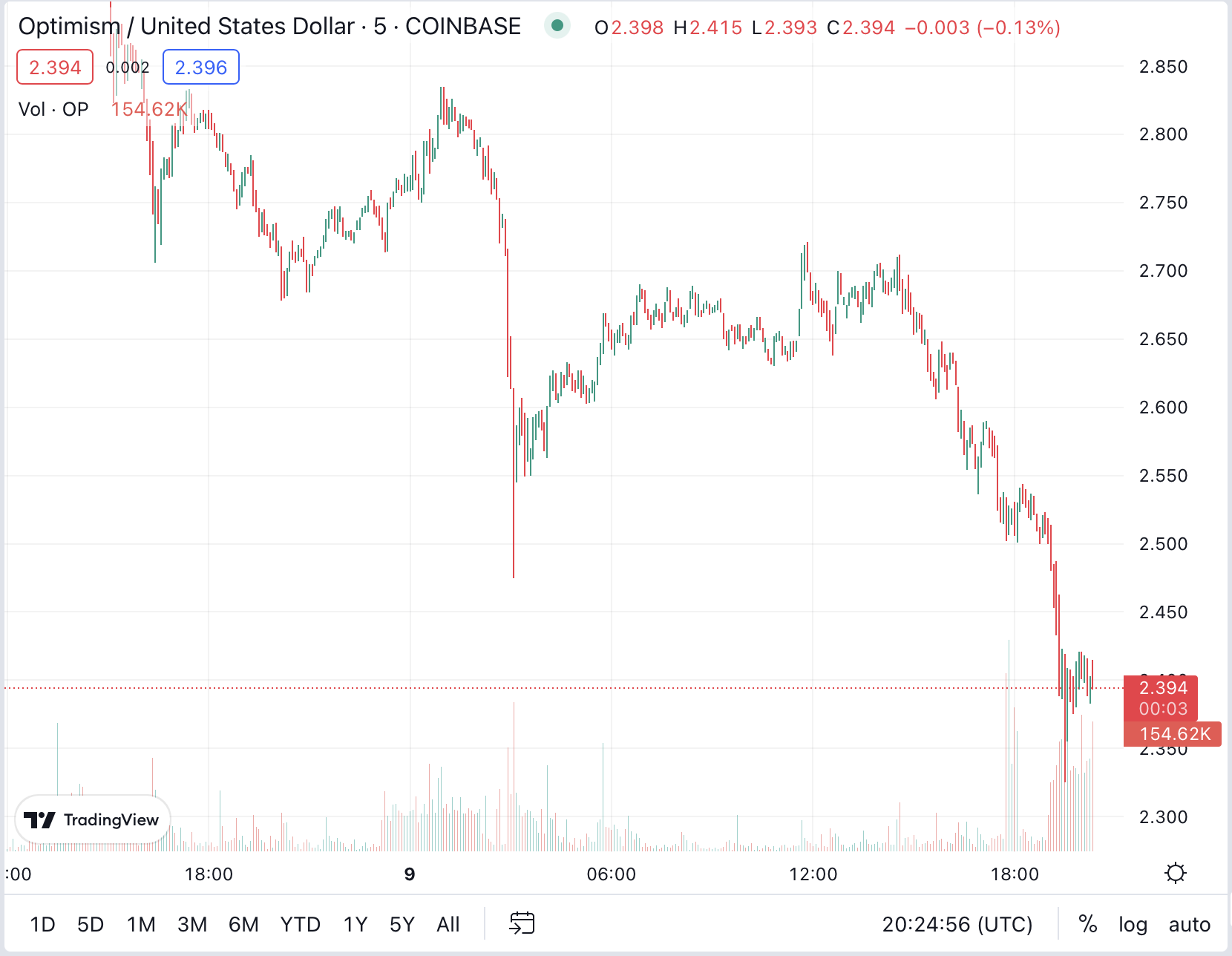
Traders with a sudden windfall of OP tokens hit the markets with their bounty, and OP took dip in the charts, trading down just over 13%, TradingView data show.

TradingView OP ChartChart from TradingView.

Optimism introduced the OP token to fuel its bicameral governance system via a 214 million token claim eligible to a total of 231,000 addresses in May 2022.

© 2023 The Block Crypto, Inc. All Rights Reserved. This article is provided for informational purposes only. It is not offered or intended to be used as legal, tax, investment, financial, or other advice.

Go to Source
Author: Jeremy Nation


Follow by Email
Facebook20
Pinterest20
fb-share-icon
LinkedIn20
Share