FreeCryptoCurrency.Me

Free stocks and money too!

Category Archive : Crypto News

Bain Capital Crypto leads Orb Labs’ $4.5 million raise

Cross-chain tooling and protocol developer Orb Labs has closed a $4.5 million seed round led by Bain Capital Crypto.

Other investors in the round include Shima Capital, 6th Man Ventures, Modular Capital and SevenX Ventures, said the company in a release.

Founded in 2022, Orb Labs is blockchain interoperability startup, which develops tooling and protocols that enable blockchains to communicate with one and other. It has built two products Earlybird, a cross-chain messaging protocol, and MagicLane, an omnichain token and messaging platform built on top of Earlybird. Both products will be released in the coming months.

“There currently exist a number of challenges facing crosschain developers, and our goal is to provide the tools and resources so that developers can focus their energy on creating incredible applications that generate value for both themselves and their customers,” said Felix Madutsa, co-founder of Orb Labs, in the release.

Many developers still struggle to find messaging protocols that “push the limits of both usability and security,” said Richard Adjei, co-founder of Orb Labs. The startup is hoping to solve this problem with fast, gas-efficient messaging protocols, he said.

The funds from the recent raise will be used to expand the team, accelerate product development and perform security audits ahead of the launch, the company said.

“We are thrilled to partner Orb Labs on their mission to enable a multi-chain future that is cheaper, more secure, and significantly more gas and capital efficient” said Carl Vogel, partner and head of research at 6th Man ventures. “Crypto needs cross-chain infrastructure that can support mass market adoption, and we believe Richard and Felix possess the right engineering experience, ingenuity and perseverance to unlock 10x+ improvements in scalability and interoperability.”

© 2023 The Block Crypto, Inc. All Rights Reserved. This article is provided for informational purposes only. It is not offered or intended to be used as legal, tax, investment, financial, or other advice.

Go to Source
Author: Kari McMahon

Former Jump Trading developers raise $19 million to build Monad blockchain

Monad Labs, a Layer 1 blockchain project co-founded by former Jump Trading developers, raised $19 million in funding led by Dragonfly Capital.

Other investors included Placeholder Capital, Lemniscap and Shima Capital, as well as angel investors, including Naval Ravikant, Cobie and Hasu, according to a Tuesday announcement. Overall, more than 70 investors backed the project.

The funding is a combination of two rounds — pre-seed worth $9 million raised in May 2022 and seed worth $10 million raised in December — Monad Labs co-founder and CEO Keone Hon told The Block in an interview. The funding effort was “really smooth” despite the bear market because investors are excited about Monad’s vision of building an “extremely performant” blockchain, Hon said.

Building on HFT experience 

Hon co-founded Monad Labs last year with his former Jump Trading colleague James Hunsaker as CTO. Each worked for the propriety trading firm for eight years, building its low-latency, high-frequency trading (HFT) systems. The duo also had a brief stint at Jump Crypto. Monad Labs has a third co-founder, Eunice Giarta, who is also the project’s chief operating officer.

Monad is building an Ethereum virtual machine (EVM)-compatible Layer 1 blockchain designed to improve the overall Ethereum ecosystem. When asked why they made a new blockchain in an already crowded sector, Hunsaker said that there is still an opportunity to increase the performance of Ethereum and expand the entire crypto ecosystem.

“Almost all existing EVM chains are just using [the] Ethereum codebase, so they are clones or Ethereum,” Hunsaker said. “They have not done any architectural work on the Ethereum side of things, on the execution side of things. We’re building a new EVM from the ground up. That will be very high performant.”

Aiming for mass adoption

The Monad blockchain will operate on a proof-of-stake consensus mechanism and, by design, is set to process a total of 10,000 transactions per second, according to the project. The blockchain’s testnet and mainnet are scheduled to launch later this year, Hon said, without specifying timelines.

As for how Monad plans to bring developers and apps on its network, Hon said the project’s long-term vision is to be both a technology company and an incubation company. “We will cultivate an ecosystem of applications that will have solid business models for providing value to users that the users are willing to pay for,” he said.

He acknowledged that it’s not going to be an easy journey but said Monad is solving “really fundamental technological problems right now,” which will help bring mass adoption of crypto.

There are currently 12 people working for Monad Labs, and the project plans to double its headcount in the next six months by hiring across functions, Hon said.

He declined to comment on whether the funding was secured via an equity or a token or an equity plus token warrant deal. He also declined to comment on valuation and board seats.

Projects building new blockchains and scaling networks continue to gain traction from investors. In recent weeks and months, several such projects, including Dymension, VRRB Labs and Sovereign Labs, have raised funds.

© 2023 The Block Crypto, Inc. All Rights Reserved. This article is provided for informational purposes only. It is not offered or intended to be used as legal, tax, investment, financial, or other advice.

Go to Source
Author: Yogita Khatri

Court approves sale of certain FTX investments, tokens and equity shares

FTX has received court approval to sell certain investment assets and subsidiaries.

Collectively, via various subsidiaries, FTX and Alameda spent around $5.3 billion across 473 investments, according to a report from The Block Research. Investments ranged from huge checks — such as $100 million into Mysten Labs, the developer of the Sui blockchain — to many smaller investments, such as $1 million checks into startups Limit Break and Messari.

Liquidators for the exchange filed a motion on Jan. 18, which said that some investees had expressed a strong motivation to repurchase FTX’s interests to facilitate raising additional capital from other investors.

The U.S. bankruptcy court for the district of Delaware approved the motion on Feb. 13, authorizing the sale or transfer of certain assets of “relatively de minimis value” compared to  FTX’s total asset base. The initial motion from FTX said that around 185 investments were made for $1 million or less.

“De minimis” assets

The order authorizes and approves the sale or transfer of investments in privately or publicly held companies — including warrants, tokens and token warrants, shares, promissory notes, future equity interests and future token interests. It also allows for the sale or transfer of subsidiaries and other related interests, including limited partnership interest in venture capital and other investment funds.

Alameda and FTX invested around $837 million into 32 unique investment funds — including Sequoia, Multicoin and Kraken Ventures.

“The Debtors shall at least on a weekly basis notify the firms serving as legal counsel and lead financial advisor to the Official Committee (the “Consulting Professionals”) and the U.S. Trustee of the status of any potential sales or transfers of De Minimis Assets or Fund Assets, including the receipt by the Debtors of any offers and entry into or consummation of any Sales with respect thereto,” the filing said.

The approved sale procedures require that the aggregate selling price of each asset is less than or equal to $1 million and that the “confirmed investment value” — which refers to the initial amount paid by FTX to acquire or invest in the asset — is less than or equal to $5 million. For the sale of fund assets, the initial capital committed and aggregate selling price must equal or be less than $1 million.

Investee entities will have five days to file an objection to the sale, the filing said. If no objection is received, FTX liquidators will proceed with the transaction without further order from the court.

U.S. bankruptcy judge John Dorsey signed the court order on Feb. 13.

Disclaimer: Beginning in 2021, Michael McCaffrey, the former CEO and majority owner of The Block, took a series of loans from founder and former FTX and Alameda CEO Sam Bankman-Fried. McCaffrey resigned from the company in December 2022 after failing to disclose those transactions. 

© 2023 The Block Crypto, Inc. All Rights Reserved. This article is provided for informational purposes only. It is not offered or intended to be used as legal, tax, investment, financial, or other advice.

Go to Source
Author: Kari McMahon

Cathie Wood’s Ark Invest purchased another $6.7 million Coinbase shares

Cathie Wood’s Ark Invest is keen on Coinbase right now, following up last week’s purchase with another estimated $6.7 million yesterday.  

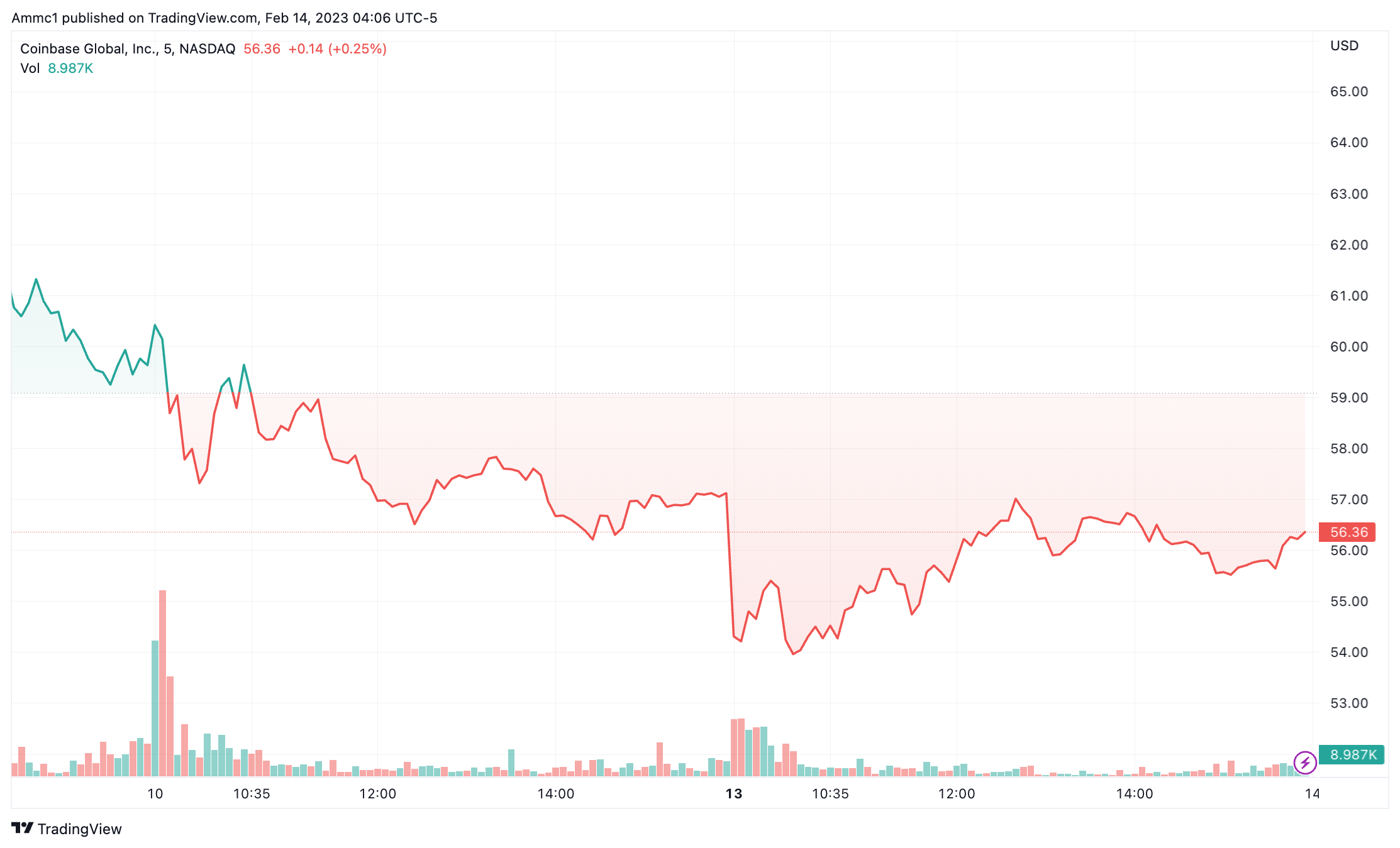
Ark added 102,281 Coinbase shares to its Ark Innovation ETF and 16,414 shares to Ark Next Generation Internet, according to its latest trade filing. Shares in the crypto exchange closed down 1.2% to $56.40 Monday. Based on the price at the close, Ark’s most recent purchase cost around $6.7 million.

Wood has purchased over $15 million worth of shares in the past two days of trading, despite COIN’s dwindling price and the considerable headwinds facing the exchange.

Shares in Coinbase extended losses on Monday as the regulatory risk to staking revenue remains heightened. Last week, the exchange shed 22% as the SEC clamped down on Kraken’s staking services. Furthermore, a lack of retail investors returning to the platform could be cause for concern, according to Mizuho Analyst Ryan Coyne.  

Coinbase will share its fourth-quarter earnings next week. Trading volumes and monthly transacting users are expected to be down significantly, year-on-year, according to FactSet estimates. 

© 2023 The Block Crypto, Inc. All Rights Reserved. This article is provided for informational purposes only. It is not offered or intended to be used as legal, tax, investment, financial, or other advice.

Go to Source
Author: Adam Morgan McCarthy

Credit Suisse leads $65 million Series B in digital asset firm Taurus

Taurus SA, a Switzerland-based digital asset infrastructure company focused on servicing financial institutions in Europe, raised $65 million in a Series B funding round.

Credit Suisse, Switzerland’s second-largest bank by assets, led the round, with Deutsche Bank, Germany’s largest bank by assets, Pictet Group, a 218-year-old Swiss private bank, and Cedar Mundi Ventures, a tech-focused Lebanese investment firm, participating, Taurus announced Tuesday.

The company’s existing investors, Arab Bank Switzerland and Investis, a publicly listed Swiss real-estate group, also joined the round.

Swiss financial regulator FINMA approved the transaction, according to Taurus. The company’s four co-founders — Lamine Brahimi, Sebastien Dessimoz, Oren-Olivier Puder and Jean-Philippe Aumasson — remain the largest shareholders after the new investment.

“It was a minority equity round,” Dessimoz told The Block in an interview.

The Series B round comes nearly three years after the company raised $11 million in Series A funding in April 2020. The new round began last May and closed earlier this month, Dessimoz said.

Credit Suisse

Credit Suisse’s leading role in the investment is notable, as the bank has not invested much in the crypto or digital assets spaces yet. Its only investments in the sector are Fnality, AlgoTrader and FundsDLT, according to The Block’s deals database.

When asked why Credit Suisse invested in Taurus, a spokesperson of the bank told The Block that Taurus is “well positioned” to provide digital asset services such as custody and tokenization, which will help the bank and its clients.

“We see great potential in the digital asset space, that means tokenization of regulated securities,” the spokesperson said. “Furthermore we believe that by using the DLT [distributed ledger technology] new features can be brought to financial products which in the past were not possible or very expensive. When we speak to some of our clients, we see continued interest in the technology and its possibilities.”

Credit Suisse has been Taurus’s client for around two years, according to the spokesperson. The bank has run multiple projects with it, including tokenization and issuance of a structured product. “We currently have a pipeline of initiatives we are working on in a variety of different asset classes,” the spokesperson added.

Institutional clients

Taurus’s Dessimoz said the world of traditional finance will converge with the world of digital assets, meaning more financial institutions will enter the digital assets space. Taurus currently has over 25 institutional clients and is seeing “significant” growth, according to Dessimoz.

The company has a market share of 50% to 60% in the Swiss market, he said. As for its expansion plans with the new funding in place, Taurus is looking to open offices in Paris and Dubai in the coming months and then plans to spread its wings in Southeast Asia and the Americas, Dessimoz said.

To that end, Taurus also plans to increase its headcount from the current 60 people to around 100 people this year, Dessimoz added.

© 2023 The Block Crypto, Inc. All Rights Reserved. This article is provided for informational purposes only. It is not offered or intended to be used as legal, tax, investment, financial, or other advice.

Go to Source
Author: Yogita Khatri

Magic Eden lays off 22, about 15% of staff in latests workforce cuts

Magic Eden laid off 22 people as companies across the industry cut staff amid industry-wide cuts.

That amounts to about 15% based upon the 141 employees listed on LinkedIn. Magic Eden is the latest crypto company to cut back on its workforce. Last month, Coinbase cut 20% of staff, Digital Currency Group’s Luno trimmed 35% and Genesis slashed 30%.

“Magic Eden has made the difficult decision to part ways with 22 teammates as part of a company-wide restructuring effort,” CEO Jack Lu said in a statement. “As we established our priorities for 2023, we took an in-depth look at what structures and roles are needed internally, and had to make hard decisions to find the right mix of roles for us to pursue the next stage of scaling across chains.”

“We have expressed to our broader team that the company remains very well capitalized with a long runway even during today’s bear market and we remain confident in the trajectory of Magic Eden in 2023 and beyond.”

© 2023 The Block Crypto, Inc. All Rights Reserved. This article is provided for informational purposes only. It is not offered or intended to be used as legal, tax, investment, financial, or other advice.

Go to Source
Author: Christiana Loureiro

As bitcoin miners prep for earnings season, all eyes are on treasuries and deployments

With fourth-quarter earnings for bitcoin miners starting, industry experts are closely watching how companies plan to deploy hardware and manage their treasury going forward.

2022 was a lesson in frenzied growth and even in the face of bitcoin’s recent rally, combined with a dip in energy prices in January, healthy balance sheets and access to low-cost power will still be a winning combination.

CleanSpark set the tone for earnings season Thursday when the firm laid out plans to keep acquiring machines and new sites as it works to meet its end-of-year hashrate guidance. And while CleanSpark plans to keep leveraging discounted prices on the spot market, the possibility of future contracts is also on the table for the coming months.

“We believe the tides are starting to shift,” CEO Zach Bradford said in the company’s earnings call for the last quarter.

CleanSpark saw its average power cost across all sites rise from $0.05 per kilowatt-hour between July and September to $0.06 in the following quarter, according to Bradford, but more recently they’ve consistently been in the $0.02 range.

As the company looks at acquiring an additional 50 to 75 megawatts, any new site will still have to meet “very strict criteria” when it comes to power cost, Bradford underlined.

Even combined with the recent rise in bitcoin prices, analysts said that as hashrate that previously dropped off comes back online — increasing mining difficulty in the process — it might offset any of those tailwinds.

“We remain cautious here as the increase in competition is likely to continue due to the recent drop in energy prices. As a result, we continue to lean on miners with low-cost power, funded growth plans, and ample liquidity to capitalize on the impending shakeout,” said a note from investment firm D.A. Davidson published on Jan. 30, once again highlighting Riot and Marathon.

D.A. Davidson went as far as to say that well-positioned miners could very well benefit bitcoin trading at a lower value because of the “competitive dynamic” of the industry.

“Given sustained headwinds in the road ahead, we continue to favor public miners with access to low-cost power, an efficient mining fleet, and a healthy balance sheet to withstand unforeseen market volatility,” said another note from investment firm Stifel.

Stifel also highlighted miners Hive and Hut 8 as well positioned, with the latter last week announcing a merger with US Bitcoin.

Sustained growth

December was a tough month for miners, with low temperatures driving up energy prices further. The last quarter culminated in the bankruptcy of the largest company in the space, Core Scientific, and many others struggled as well after months of operating at depressed margins.

Companies in the mining sector found themselves in a serious liquidity crunch last year, having taken on large amounts of debt while holding on to all or most of the bitcoin they mined, only to them sell them at depressed prices around the summer in order to reduce debt loads.

“I’m insanely curious about how people are going to portray their treasury management strategies because we saw a lot of miners sell-off over the course of the last six months,” Galaxy Digital’s Head of Mining Amanda Fabiano told The Block. The company recently acquired a 180-megawatt expandable site from Argo Blockchain, which was exposed to power spikes over the summer as it struggled to close a fixed-price power purchase agreement.

In a recent report, Galaxy estimated that in 2022, miners defaulted on about 11.59 EH/s worth of hardware-backed loans. Fabiano also highlighted how companies are thinking about growth plans.

“Those are the things that are really going to distinguish the people who win and the people who lose this year,” she said.

Kevin Dede, an analyst with H.C. Wainwright, is also zeroing in on how different companies are looking to execute their hashrate deployment plans.

“Whether or not they have changed, whether or not they’ve got the machines and whether or not they have the plugs to support those plans and then the power cost,” he added.

A snapshot in time

“In the next cycle, I’d love to see people get a little bit more in-depth on the operational differences between one miner to the next,” Fabiano also said.

Even though some investors view mining stocks as an alternative to investing in bitcoin, it doesn’t mean one miner is equal to another, she argued.

“We saw a lot of miners that focused the majority of their capital and their time on building the future versus by focusing on ‘how do I make this 100 megawatts the best that I could ever make it.’ It was ‘how do I get to 500 megawatts,'” she said. “And the rationale for that was because that’s what the market was rewarding.”

In other words, they built up their businesses based on a snapshot in time, rather than accounting for all the variability of power costs, mining difficulty and bitcoin price, said CleanSpark’s executive chairman Matthew Schultz.

“I don’t think a thorough analysis went into energy cost, which is the biggest cost of doing business,” he said.

While some companies focused their energy on scaling up as fast as possible when money was flowing into the sector, others prioritized nailing down infrastructure and low cost of power.

Meanwhile, hosting providers who offered fixed costs while taking on real-time power prices were the hardest hit in the sector and they probably won’t offer the same fixed-rate contracts going forward, the Galaxy report also pointed out.

© 2023 The Block Crypto, Inc. All Rights Reserved. This article is provided for informational purposes only. It is not offered or intended to be used as legal, tax, investment, financial, or other advice.

Go to Source
Author: Catarina Moura

CFTC, SEC cases against Bankman-Fried to be pushed back until criminal case ends

Civil cases brought by U.S. regulators against former FTX CEO Sam Bankman-Fried can be pushed back until after a criminal case concludes, a judge decided Monday. 

Damian Williams, U.S. Attorney for the Southern District of New York, submitted a motion to stay last week to hold off on civil proceedings until the Justice Department’s case against the former CEO is complete. 

Bankman-Fried faces criminal charges such as defrauding customers and violating campaign finance laws. The Commodity Futures Trading Commission also charged him with civil charges for fraud and said Bankman-Fried, FTX and Alameda Research caused the loss of over $8 billion in customer deposits. The Securities and Exchange Commission brought similar charges. 

Both the CFTC and SEC cases will now be pushed back until the criminal case’s conclusion. 

FTX collapsed in November and subsequently filed for bankruptcy protection. Bankruptcy proceedings remain ongoing. 

Disclaimer: Beginning in 2021, Michael McCaffrey, the former CEO and majority owner of The Block, took a series of loans from founder and former FTX and Alameda CEO Sam Bankman-Fried. McCaffrey resigned from the company in December 2022 after failing to disclose those transactions.  
 

© 2023 The Block Crypto, Inc. All Rights Reserved. This article is provided for informational purposes only. It is not offered or intended to be used as legal, tax, investment, financial, or other advice.

Go to Source
Author: Sarah Wynn

Tether dominates Brazil as bitcoin, ether fall out of favor

In a country where economic instability is as common as coconuts, Brazilians appear to favor the stablecoin tether as their cryptocurrency of choice.

The federal tax authority, which compiles data from foreign and local exchanges on cryptocurrency usage, said that the value of all transactions for tether jumped 58% last year compared to a year earlier. Bitcoin and ether, also widely used, saw decreases of more than 60% from 2021. 

Last year, Brazil approved a law regulating cryptocurrencies, a major step forward as the country embraces digital assets. 

The main use case for Brazilians is as a speculative investment, Chainalysis reported Thomaz Fortes, the crypto lead at Brazil’s Nubank, as saying.

“Customers want a way to expand their earnings,” he said in October. “The retail growth in the number of users in crypto has been much faster than in the equities market.”

Nubank reached 1.8 million crypto customers about four months after launching the service.   

Cryptocurrency-related revenue in the country is expected to show an annual growth rate of 15.25% between 2023 and 2027, Statista reported.

© 2023 The Block Crypto, Inc. All Rights Reserved. This article is provided for informational purposes only. It is not offered or intended to be used as legal, tax, investment, financial, or other advice.

Go to Source
Author: Christiana Loureiro

SEC action against Paxos paints regulatory target on stablecoins

Stablecoins look to be the next part of the crypto ecosystem facing a regulatory crackdown. 

The U.S. Securities and Exchange Commission has issued notice to crypto infrastructure provider Paxos over its involvement in Binance USD stablecoin, alleging that the stablecoin is an unregistered security.

The New York Department of Financial Services also issued a consumer alert Monday morning saying that the state financial regulator, “ordered Paxos to cease minting Paxos-issued BUSD as a result of several unresolved issues related to Paxos’ oversight of its relationship with Binance in regard to Paxos-issued BUSD”. 

According to a statement from Paxos, the notice it received a likely enforcement action from the SEC was only related to BUSD, which is the third largest stablecoin by total supply. The company “categorically disagrees” with the SEC. An SEC spokesperson reiterated the agency’s policy of not commenting on “the existence or nonexistence of a possible investigation.” The Wall Street Journal first reported the SEC’s investigation into Paxos on Sunday evening.

The moves follow through on months of concerned rhetoric from regulators over stablecoins, which led to multiple high-profile crypto market crashes last year – first the Terra/Luna collapse, then FTT’s wobble, which led to FTX’s demise. Regulators in the U.S. and elsewhere have sounded skeptical about the ‘stable‘ in stablecoins. 

“Stablecoins have features similar to, and potentially competing with, money market funds, other securities, and bank deposits, and raise important policy issues,” SEC Chair Gary Gensler told a legal conference in Washington last September. “Depending on their attributes, such as whether these instruments pay interest, directly or indirectly, through affiliates or otherwise; what mechanisms are used to maintain value; or how the tokens are offered, sold, and used within the crypto ecosystem, they may be shares of a money market fund or another kind of security.”

‘Legitimate reason to be concerned’ 

“We welcome the commissions’ vigorous enforcement of existing statutes, rules and court decisions that apply to cryptocurrency,” said Bartlett Naylor, financial policy advocate at consumer advocacy group Public Citizen, in an email. 

The U.S. government has a “legitimate reason to be concerned,” said Aaron Kaplan, co-CEO of Prometheum Inc., a fintech company, arguing that stablecoins, if not managed properly, can pose a systemic risk to the financial system.  

The Financial Stability Oversight Council, a supercommittee of U.S. regulators, chaired by Treasury Secretary Janet Yellen and tasked with preventing another 2008-style financial crisis, included stablecoins in a comprehensive report on digital assets issued last October. 

That report included a warning that, “if stablecoins were to grow rapidly without adherence to and being paired with appropriate regulation, financial stability risks could result.” Those included runs on stablecoins, like what happened to FTT a month later, resulting in FTX’s collapse. 

“If BUSD is deemed a security, then it stands to reason that other fully reserved stablecoins – including Circle’s USDC – might be as well,” Kaplan said. Circle’s USDC is the second-largest stablecoin by market capitalization, according to CoinMarketCap.  

Richard Mico, CEO and chief legal officer at fintech platform Banxa, saw Circle’s USDC as the potential next regulatory target but thought that both Paxos and Circle could win in court against the SEC.  

A spokesperson for Circle did not respond to multiple requests for comment. 

All stick, no carrot

The move against Paxos holds significance in that the company embraced regulation, marketing itself as “the first regulated blockchain company,” and putting former FDIC Chair Sheila Bair and retired Sen. Bill Bradley, D-N.J., on its board. Given the firm’s profile, it’s likely other stablecoin issuers could face similar scrutiny from the SEC. 

Mico saw the agency’s move as another example of “how the regulatory body appears to have escalated its regulation-by-enforcement campaign.”

Stablecoin legislation that would have created a framework for issuers in the U.S. stalled out, due in part to disagreement between congressional authors and the Treasury Department, leaving the SEC with continued leeway to approach digital assets as it sees fit. 

Paxos is another example of how “the regulatory status quo” is challenging for crypto projects, said Jack Solowey, a policy analyst at the libertarian think tank Cato Institute’s Center for Monetary and Financial Alternatives. 

“One of the reasons for that concern is that there has not been adequate guidance,” Solowey said. “It does contribute more evidence and more data points for why we need regulatory clarity in the U.S. and that could come and frankly should come through Congress acting through legislation.”


© 2023 The Block Crypto, Inc. All Rights Reserved. This article is provided for informational purposes only. It is not offered or intended to be used as legal, tax, investment, financial, or other advice.

Go to Source
Author: Sarah Wynn


Follow by Email
Facebook20
Pinterest20
fb-share-icon
LinkedIn20
Share