FreeCryptoCurrency.Me

Free stocks and money too!

Category Archive : Crypto News

Deal Room: here’s what top crypto VCs anticipate for 2023

Episode 10 of Season 5 of The Scoop was recorded remotely with The Block’s Frank Chaparro, CoinShares CSO Meltem Demirors, and Aglaé Ventures’ Managing Partner Vanessa Grellet.

Listen below, and subscribe to The Scoop on AppleSpotifyGoogle PodcastsStitcher, or wherever you listen to podcasts. Feedback and revision requests can be sent to podcast@theblockcrypto.com.


In this venture-focused segment of The Scoop, veteran crypto VCs Meltem Demirors and Vanessa Grellet unpack the trends shaping crypto’s venture landscape in 2023.

According to Demirors, crypto companies must follow the flow of funds:

“The name of the game is ‘interchange,'” Demirors said. “The closer you migrate to where the actual interchange happens, the more likely you are to earn consistent revenues, which then results in you being able to raise capital.”

Although crypto venture funding hit a two-year low last quarter amidst the chaos caused by FTX’s collapse, Grellet is seeing “a lot of excitement in the early stage,” with infrastructure and scaling plays among the most popular with investors. 


This episode is brought to you by our sponsors Circle, Railgun, Flare Network, NordVPN

About Circle
Circle is a global financial technology company helping money move at internet speed. Our mission is to raise global economic prosperity through the frictionless exchange of value. Visit Circle.com to learn more.

About Railgun
RAILGUN is a private DeFi solution on Ethereum, BSC, Arbitrum, and Polygon. Shield any ERC-20 token and any NFT into a Private Balance and let RAILGUN’s Zero-Knowledge cryptography encrypt your address, balance, and transaction history. You can also bring privacy to your project with RAILGUN SDK and be sure to check out RAILGUN with partner project Railway Wallet, also available on iOS and Android. Visit Railgun.org to find out more.

About Flare
Flare is an EVM-based Layer 1 blockchain designed to allow developers to build applications that can use data from other blockchains and the internet. By providing decentralized access to a wide variety of high-integrity data from other blockchains and the internet, Flare enables new use cases and monetization models. Build better and connect everything at Flare.Network

About NordVPN
NordVPN is essential for keeping crypto transactions secure, hiding your IP address, and protecting your devices from hackers and data theft. Get premium cyber-security on up to 6 devices for the price of a cup of coffee a month. Get your exclusive NordVPN Deal and try it risk-free now with a 30-day money-back guarantee: Visit https://nordvpn.com/thescoop

© 2023 The Block Crypto, Inc. All Rights Reserved. This article is provided for informational purposes only. It is not offered or intended to be used as legal, tax, investment, financial, or other advice.

Go to Source
Author: Davis Quinton and Frank Chaparro

Eton: The men’s-only pipeline for UK prime ministers, royalty and now crypto enthusiasts

Meet the Old Etonian Blockchain Association: an all-male, nearly four-year-old club which emerged from one of the most elite private schools in the UK.  

The pricey boarding school, which is more than 500-years-old, is probably best-known for producing a seemingly never-ending pipeline of future prime ministers and top politicians. It has also educated writers including George Orwell and Aldous Huxley; actors such as Eddie Redmayne and Hugh Laurie; and the future king of England. The list goes on.  

More recently, though, its alumni have turned to creating something less familiar: soulbound tokens.  

Sam Chamberlain, OEBA president and UK General Manager of exchange group OKX, is spearheading the effort. He wants the crypto-backed tokens to represent membership for the now 150-strong club which has emerged from the gatekept institution. 

“We were working on an Eton NFT — the only problem is having it openly tradable,” said Chamberlain. 

The membership tokens for a group of elite men comes as men already dominate technology in general, and crypto in particular. A 2021 CNBC/Acorn survey found that twice as many men as women invest in crypto and in general Black and Hispanic women have lower rates of investing relative to white women. 

Chamberlain hopes the club will have a positive influence with its elite membership. The mandate to entertain the club with tidbits about crypto comes alongside a directive to try to make sure digital currency has a “genuine positive impact on society.”

To that end, despite being all-male, the leaders hope to give a platform to women in the space. Time at each quarterly meeting is dedicated to showcasing businesses led by people with diverse backgrounds that are in need of support or investment. 

“It’s not just a load of old white men dealing each other in,” he said. “We’re looking to go in a direction where we’re looking outwards not inwards.” 

Age is a kind of diversity

Despite the slightly homogenous nature of the most expensive private education in the UK, Chamberlain assures that the membership is diverse — in age, anyway — with recent grads of 18 rubbing shoulders with 80-year-olds at meetings. “High profile” politicians, people who formerly owned mines (the old-fashioned kind), and reality TV stars are in the mix, said Chamberlain, but declined to comment on specifics.  

One can only speculate as to which bigwigs might be involved; not mentioning, of course, former Prime Minister Boris Johnson’s speech touting the possibilities of crypto at a blockchain conference in Singapore, or David Cameron’s appearance at the opening of a bitcoin wallet’s offices, as noted by the FT back in 2017. 

Future pupils of the £46,200 ($55,800)-a-year school can also hope to benefit from the expertise within the club, as it works to implement an educational program. Eton sixth formers – typically aged 16 to 18 – will now have the option to take a blockchain module as part of their studies, with former pupils as consultants.  

The club’s emergence comes at a time when governments around the world are tightening the screws on crypto regulation. From the UK’s recent directive on CBDC to the U.S. Securities and Exchange Commission’s crackdown on exchanges and stablecoins, the world and its leaders are watching. 

Raised eyebrows 

Despite its growth, bedding in the club hasn’t all been plain sailing for Chamberlain.  

“There were a few raised eyebrows at school where people were asking ‘What is this’? People were worried about crime and underground activities,” he said. 

Despite this, it’s come a long way from five guys led by a solitary bitcoin bull roughly four years ago from whom Chamberlain took the reins. The club’s previous leader now lives off the spoils of his crypto takings in a monastery somewhere in the South of France, Chamberlain said. 

It’s no wonder the corridors of power are taking a bit more notice of blockchain: Britain’s elite certainly is.  

© 2023 The Block Crypto, Inc. All Rights Reserved. This article is provided for informational purposes only. It is not offered or intended to be used as legal, tax, investment, financial, or other advice.

Go to Source
Author: Lucy Harley-McKeown

Nomura’s Laser Digital invests in DeFi protocol Infinity Exchange

Laser Digital, the crypto subsidiary of Japanese financial services giant Nomura, invested in Infinity Exchange, a decentralized finance (DeFi) protocol for institutional lending and borrowing.

Laser’s investment is additional to the $4.2 million seed round Infinity raised last September from several backers, including GSR and Flow Traders, Infinity founder and CEO Kevin Lepsoe told The Block. He declined to comment on valuation and whether the fundings were secured via equity or token rounds.

Lepsoe, a former head of structuring and financial engineering at Morgan Stanley in Hong Kong, founded Infinity last year, aiming to increase institutional adoption of DeFi. Infinity is built on Ethereum and providers users access to both floating and fixed interest rates, as well as the trading of interest rates, Lepsoe said.

Explaining how Infinity differs from existing DeFi protocols, Lepsoe said its interest rate mechanism and risk management system are key competitive advantages.

“For example, on Compound, a lender would receive 0.03%, while a borrower would pay 2.86% on WBTC. As compared, on Infinity, lenders and borrowers would pay and receive the same interest rate (1.5%, as an example), excluding fees, whereby the lender would receive 1.47% ‘more’ and the borrower would pay 1.36% ‘less’ by using Infinity, as compared with the Compound (current) rates mentioned above,” he said.

Risk management

As for Infinity’s risk management system, Lepsoe said the protocol manages both ERC20 and ERC721 tokens as collateral.

“A user could deposit USDC with Aave and receive aUSDC, transfer this aUSDC to Infinity, and borrow against this as collateral,” he said. “In effect, Infinity’s risk management system provides a venue of external liquidity in deposit and LP [liquidity provider] tokens, which otherwise would have a limited (if any) external avenue of liquidity.”

The Infinity protocol is currently live on the Goerli testnet and the mainnet is expected to launch by the end of the second quarter, according to Lepsoe. To that end, Infinity plans to continue building and is looking to increase its current team of 12 people.

Olivier Dang, head of ventures at Laser Digital, told The Block that Infinity is building infrastructure for institutional adoption of web3, and that’s a key reason why Laser backed the project.

Besides Infinity, Nomura and Laser have invested in four crypto firms: Komainu, Bullish, Allinfra and Orderly Network. “We have three more investments in crypto companies that will be made public in the near term,” Dang said.

© 2023 The Block Crypto, Inc. All Rights Reserved. This article is provided for informational purposes only. It is not offered or intended to be used as legal, tax, investment, financial, or other advice.

Go to Source
Author: Yogita Khatri

Bankrupt crypto lender Celsius proposes sale plan to NovaWulf

Bankrupt crypto lender Celsius Network put forward plans for a sale to NovaWulf  Digital Management.

Smaller Celsius creditors with less than $5,000 in their lending accounts would receive the majority of their funds back, documents filed with the bankruptcy court on Wednesday said. Larger creditors will become shareholders in a new company that would aim to go public on the stock exchange.

The long awaited restructuring plan would see NovaWulf, an investment firm founded in 2021 by former Wall Street dealmakers, manage the new entity. Managing partner Jason New helped run distressed and special situations teams at Blackstone’s GSO Capital Partners unit. Others worked at King Street and Beowulf Energy.

Celsius filed for bankruptcy in July owing billions of dollars and leaving investors fearful for their savings. A damning court appointed examiner report last month detailed multiple operational failures, dishonest public statements, market manipulation and Ponzi-like recycling of client assets.

Nine takeover bids

The firm attracted 40 expressions of interest and nine bids, the court document said. The new owners will inject $45 million to $55 million into the business and plan to add new divisions including debt cards, factoring, trade finance and private wealth services.

In a separate action, the official committee of Celsius’s unsecured creditors filed court documents seeking to recover millions of dollars it says were fraudulently transferred from the company’s founder and former CEO Alex Mashinsky, his wife and other former senior executives.

© 2023 The Block Crypto, Inc. All Rights Reserved. This article is provided for informational purposes only. It is not offered or intended to be used as legal, tax, investment, financial, or other advice.

Go to Source
Author: Benjamin Robertson

Warren pledges to reintroduce crypto anti-money laundering bill

Sen. Elizabeth Warren, D-Mass., said she plans to reintroduce legislation with Sen. Roger Marshall, R-Kan., that would extend anti-money laundering laws to a broad array of the cryptocurrency ecosystem. That would include digital asset wallet providers, miners, validators and other blockchain network participants.

“Sen. Roger Marshall and I are reintroducing our anti-money laundering bill to clamp down on crypto crime and give regulators the tools they need to stop the flow of crypto to drug traffickers and places like North Korea,” Warren said during a Senate Banking Committee hearing on crypto guardrails on Tuesday. During the hearing Warren used her time to claim that anti-money laundering rules do not adequately apply to crypto companies. 

The original version of the bill she and Marshall introduced last December also would have prohibited banks and other financial institutions from transactions with digital asset mixers, which are meant to mask transactions made on public blockchains. 

If introduced in the same form as last December, the bill would also extend anti-money laundering reporting requirements to include U.S. persons who transact in $10,000 or more in digital assets using an offshore account and require the Treasury Department to do anti-money laundering compliance examinations for money service businesses, the registration that large U.S. crypto companies fall under. 

“Just last year year, just in one year, crypto was the payment method of choice for international drug traffickers who raked in over a billion dollars through crypto, North Korean hackers who stole $1.7 billion in funding that outfitted their nuclear program, and ransomware attackers who took in almost $500 million,” Warren said at Tuesday’s hearing, as the basis of her rationale for more stringent anti-money laundering rules around digital assets. 

© 2023 The Block Crypto, Inc. All Rights Reserved. This article is provided for informational purposes only. It is not offered or intended to be used as legal, tax, investment, financial, or other advice.

Go to Source
Author: Colin Wilhelm

Bitcoin mining report: Feb. 14

Bitcoin mining stocks tracked by The Block were higher on Tuesday, with 16 gaining and three declining.

Bitcoin rose 2.7% to $22,232 by market close.

Here is a look at how the individual miners performed today:

© 2023 The Block Crypto, Inc. All Rights Reserved. This article is provided for informational purposes only. It is not offered or intended to be used as legal, tax, investment, financial, or other advice.

Go to Source
Author: Catarina Moura

Bankruptcy court restricts KeyFi founder Jason Stone in Celsius case

KeyFi founder Jason Stone and others involved with the staking firm are barred from transferring or disposing of most property tied to the Celsius bankruptcy case, according to a temporary restraining order filed in court on Tuesday.

The restraining order against Stone and KeyFi restricts the parties from transferring or disposing of property, and notes the firm may not use “Tornado Cash or other means to conceal the location of any property that could otherwise be available to satisfy a judgment in this case.” 

The temporary restraining order does make note of dozens of NFTs that are deployed in decentralized finance activities, including 13 Cryptopunk NFTs and one Bored Ape Yacht Club NFT. Stone and KeyFi may “continue to deploy” the NFTs, according to the order.

If Stone or others at KeyFi believe “in good faith” that transactions unrelated to the listed NFTs need to be performed to avoid liquidation or other financial issues, the parties should send a request to Celsius and the Celsius Official Committee of Unsecured Creditors in the bankruptcy case.

Stone and KeyFi are also required to send Celsius and the creditors committee a statement of profits and losses associated with activities permitted by the temporary restraining order. The statements will be sent every two weeks beginning on Friday. 

Celsius and KeyFi have been engaged in a legal battle for months, after Celsius acquired part of KeyFi in 2020. Stone sued Celsius in July, accusing the firm of mismanagement and fraud. Six weeks later, Celsius sued KeyFi and its founder, alleging the firm engaged in stealing, losing and laundering millions of dollars worth of cryptocurrency.

© 2023 The Block Crypto, Inc. All Rights Reserved. This article is provided for informational purposes only. It is not offered or intended to be used as legal, tax, investment, financial, or other advice.

Go to Source
Author: Stephanie Murray

Crypto markets rebound as Silvergate soars 16% on Citadel Securities, Susquehanna stakes

Cryptocurrency prices rebounded after yesterday’s decline, when the New York Department of Financial Services announced it will pursue regulatory action against stablecoin provider Paxos.

Bitcoin was up 1.8% over the past day, trading around $22,190 by 3:15 p.m. EST, according to TradingView data. The leading crypto by market cap fell on the news that Paxos was ordered to stop issuing the BUSD stablecoin.

Today, it began to climb, reaching a high around $22,300.

Ether also rose, increasing around 3.3%. Ripple’s XRP rose 2% in the past day, Cardano’s ADA soared 10%, and Polygon’s MATIC jumped 7.2%. Binance’s BNB remained below $300, down another 3%.

Crypto stocks

Silvergate shares soared 17% to $17.16 by 3:15 p.m. EST, according to Nasdaq data, following the announcement of multiple investments in the beleaguered bank.

Susquehanna Advisors Group reported a 7.5% stake in the bank after Citadel Securities said it owned 5.5%.

The crypto-friendly bank has faced increasing scrutiny over the past few months following the collapse of FTX.  According to a recent report from MarketWatch, SI is currently the most shorted stock on Wall Street.

MicroStrategy was also up by 8.9% to $22.29, at 3:15 p.m EST. 

Coinbase was also trading up around 3.3%, reversing course after declining more than 20% last week. The exchange faced a steep selloff after the Securities and Exchange Commission said the Kraken exchange agreed to pay a $30 million penalty and cease its staking products for U.S. customers.  

Jack Dorsey’s Block was also trading higher, gaining 1.9%.

© 2023 The Block Crypto, Inc. All Rights Reserved. This article is provided for informational purposes only. It is not offered or intended to be used as legal, tax, investment, financial, or other advice.

Go to Source
Author: Sam Venis

Why Morgan Stanley says you should be paying attention to stablecoins

With U.S. regulators moving to limit stablecoin products, strategists at Morgan Stanley think the broader crypto economy should be paying attention.

“Falling stablecoin market capitalization means falling crypto liquidity and leverage,” Sheena Shah and Kinji  Steimetz wrote in a note dated Feb. 13. “Stablecoins play a vital role in crypto trading and their products potentially compete with the fiat banking system.”

The New York Department of Financial Services earlier this week ordered Paxos to stop issuing the Binance USD stablecoin, and the Morgan Stanley strategists expect upcoming regulatory efforts in the U.S. Congress to focus on stablecoins.

 “We think stablecoin issuers will likely have to register and show they hold sufficient liquid assets to back the issued stablecoins,” they wrote, citing an analysis by DataFinnovation which showed that “BUSD wasn’t always fully backed in the past.”

The availability of stablecoins can serve as a “simple indicator of institutional demand for leverage, which influences prices,” the report stated. 

Without new BUSD being created by Paxos, its still unclear whether current holders of BUSD will transfer their funds to other stablecoins, with a neutral impact to liquidity, or whether the risk of further regulatory actions will reduce the overall market demand for stablecoins, according to the report.

© 2023 The Block Crypto, Inc. All Rights Reserved. This article is provided for informational purposes only. It is not offered or intended to be used as legal, tax, investment, financial, or other advice.

Go to Source
Author: Sam Venis

684 million BUSD burned for redemptions amid US regulatory scrutiny

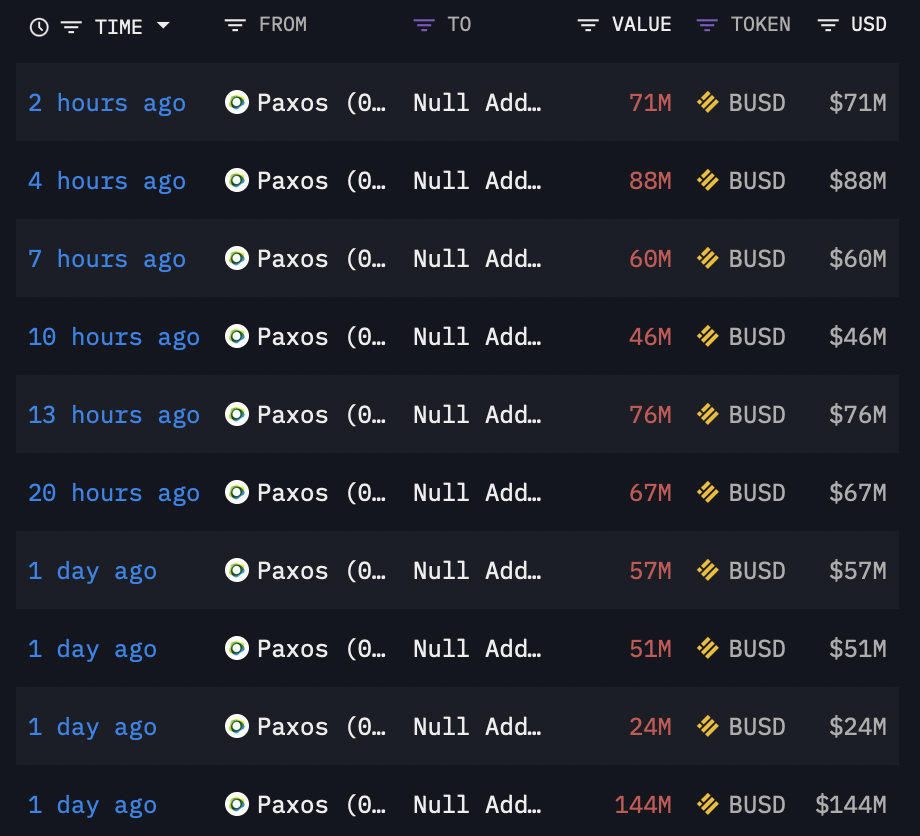
Just over a day after it categorically denied regulator claims Binance USD (BUSD) is a security, Paxos has burned some 684 million of the stablecoin for U.S. dollar redemptions, on-chain data show.

Formerly an issuer of BUSD, Paxos ceased distributing the stablecoin after the company received a Wells notice from the Securities and Exchange Commission.

Dollar parity redemptions for BUSD will be supported through at least February 2024, Paxos said.

To facilitate redemptions, Paxos sends BUSD to a burner address, destroying the tokens, which initiates a smart contract-driven process that refunds U.S. dollars to users from the reserve underpinning the stablecoin.

Arkham Paxos BUSD burn

Transaction data from Arkham

An initial Paxos redemption to the tune of roughly $144 million in tokens a day ago was followed by additional tens of millions in redemptions, data from Arkham show.

Amid the redemptions the total supply of BUSD dipped below $16 billion to $15.81 billion.


© 2023 The Block Crypto, Inc. All Rights Reserved. This article is provided for informational purposes only. It is not offered or intended to be used as legal, tax, investment, financial, or other advice.

Go to Source
Author: Jeremy Nation


Follow by Email
Facebook20
Pinterest20
fb-share-icon
LinkedIn20
Share