FreeCryptoCurrency.Me

Free stocks and money too!

Category Archive : Crypto News

Discord scam sees The Block come knocking with fake ‘Article Writer’ promises

“Hello there, I am Rummer. from theblock.co where I work as a Article Writer. Our team is intrigued by your NFT project and we would like to request permission to write an article about your project.”

That’s the Discord message that greeted Elton Penguin, a pseudonymous project lead for the Noundles NFT collection, on Sunday, purporting to come from, well, me.

Unfortunately for Elton, however, that beautifully crafted missive hadn’t been penned by me at all. Someone had set up a fake Discord server for The Block and fake profiles for several of our staff, including Frank Chaparro, Lucy Harley-McKeown and Editor-in-Chief Sarah Kopit.

Fake accounts

Elton wasn’t alone. Dozens of people had been contacted by fake accounts purporting to be employees of The Block.

Exactly what these imposters were after wasn’t immediately clear, though the consensus from those targeted was that the efforts at chumminess would result in an eventual phishing attempt.

“My take is they want to get me to feel good and tell them about the project. And then social engineer me for a bit to feel like it’s safe to click links. Then hack my stuff,” said Jake Baker, another victim, who runs the Twitter account behind the Shaq Gives Back NFT collection.

For the record: The Block has no official presence on Discord.

‘Malicious site’

“The attackers are likely attempting to compromise existing Discord accounts,” said Sacha Tememe, a security engineer at The Block. “The verification link to join their server leads to a malicious site which may try and steal a user’s authorization token, essentially granting the attackers full access to the user’s account.”

A Discord spokesperson said it “takes the safety of all users seriously” and the account impersonating me has now been deleted.

“Our community guidelines prohibit users from coordinating or participating in malicious impersonation of an individual or an organization, and our Trust & Safety team takes action when we become aware of this kind of behavior,” they added. 

Discord is a messaging and chat tool founded in 2015, where users can build communities — called servers — around a specific activity. After first finding an audience among video gamers, the app has more recently become one of crypto’s social networks of choice. It’s rare to find a DAO or NFT project that doesn’t have an affiliated Discord server.

There is an irony here, of course. In targeting projects like Noundles and Shaq Gives Back with the promise of coverage in The Block, the hackers have inadvertently given them coverage in The Block. In this article.

More irony

The second irony is that in attempting to report out this story, I found myself sending Twitter DMs that — on reflection — sounded distinctly scammy.

“How should I refer to you? Do you go by Elton Penguin or do you prefer to be called by your real name in the article?” I found myself typing, just an imagined step or two away from asking for his private keys.

Elton had some advice for me on that front.

“Just work on making your grammar worse, then you’ll have it nailed.”

© 2023 The Block Crypto, Inc. All Rights Reserved. This article is provided for informational purposes only. It is not offered or intended to be used as legal, tax, investment, financial, or other advice.

Go to Source
Author: Andrew Rummer

Bitcoin mining report: Feb. 22

Bitcoin mining stocks were mostly lower on Wednesday.

Bitcoin mining stocks tracked by The Block were mostly lower on Wednesday, with three gaining and 15 declining in share price.

Bitcoin fell 2.8% to $23,801 by market close.

© 2023 The Block Crypto, Inc. All Rights Reserved. This article is provided for informational purposes only. It is not offered or intended to be used as legal, tax, investment, financial, or other advice.
Go to Source
Author: Catarina Moura

Blur’s Pacman doxxes himself and outlines plan to become the Binance of NFTs

Pacman, the formerly pseudonymous CEO of the fast-growing NFT marketplace Blur, beat the engagement farmers to it.  

“Web2 me vs. web3 me,” he posted on Twitter late last night, revealing his previously unknown identity in a thread. 

The move came in a world where online personas are the shopfront of valuable brands and multi-billion-dollar tokens, and outing someone’s true identity still can be a controversial topic. Previous identity revelations, such as that of the Bored Ape Yacht Club founders, have sparked rage in the crypto community. The identity of other founders, such as Chef Nomi of Sushiswap and, most famously, Bitcoin’s Satoshi Nakamoto, remain a mystery.  

The 24-year-old entrepreneur, whose legal name is Tieshun Roquerre, had been working under the retro game-inspired pseudonym for 401 days, while he and a team set out to build an NFT marketplace for pro traders, fit to challenge industry heavyweight OpenSea. 

He had previously asked if he could be interviewed pseudonymously. But now, he is stepping into the light. 

“It’s not like I’m hard core anonymous or anything like that,” Pacman said in an interview with The Block hours before the identity reveal. “Since we started Blur, I’ve just liked having that choice.” 

“I like how having Pacman as a character can only represent the brand, so it doesn’t really exist outside of Blur, from a branding perspective,” he added, conceding that it was only a “matter of time” before someone wrote a thread about his identity to a captive audience on Twitter.  

Blur has captured the imagination of the NFT community since its launch in October 2022. A schedule of airdropped tokens to frequent traders and loyal users kept people returning. It finally launched its long-awaited token last week, with a fully diluted market cap sitting at around $3 billion, according to CoinMarketCap data. The company recently completed a second fundraise after its $11 million seed, which earned it a billion-dollar valuation. 

The person behind the curtain 

Tieshun Roquerre dropped out of high school in 2016 at the age of 17 to join Y Combinator’s accelerator program. This led him down the path to MIT where he studied math and computer science. He was awarded the Thiel Fellowship – a prize created by billionaire Peter Thiel, which grants gifted students $100,000 to drop out and pursue things such as research or building a business. Roguerre founded Namebase in 2018, a decentralized domain name tracker that was later sold to Namecheap in 2021.  

It was around this time he started trading NFTs. “As we sold the business, I minted a Blitmap and held it up to its all-time high, which was around 30 ETH, and sold it. I was completely hooked afterwards,” he said. Blitmaps are an NFT collection featuring 8-bit drawings of a “sci-fi fantasy universe” which launched in 2021. 

Fast forward to October 2022, and he — alongside his co-founder — launched the first iteration of Blur. 

Blur’s Binance plan 

Since then, Blur has snatched market share of trading volume from bigger players, overtaking OpenSea in December 2022 and extending its lead each month since then. This is partially due to its play for the fastest growing segment of the market — which is pro trading.  

Further growth will come from using the Binance playbook, says Pacman. 

“We focus on the NFT natives first and from there we can expand, similar to how Binance expanded downmarket and broadened the offering,” he said.  

Along with this, Pacman expects growth to come from products which spring out of the community as more contributors build on the protocol. The eventual aim would be to mirror what MakerDAO did with targeted sub-communities, which build out specific parts of the larger project. 

“I think a model like that would be very beautiful, because the goal is to build infrastructure that can be controlled by the community,” he added. 

What remains to be seen is whether the token will stick, and if Blur’s play for the hearts and minds of the NFT community through decentralization will pan out. Pacman thinks that to own a stake and decision-making power in the future of the business will be a big enough differentiator to challenge incumbent, and crucially tokenless, heavyweight OpenSea long-term.  

For now, what worries him most is not moving fast enough.  

“You know that if you don’t build something you want to ship, someone else will,” he said. “We have a lot of ideas and a high level of confidence that those will be well-received.” 

© 2023 The Block Crypto, Inc. All Rights Reserved. This article is provided for informational purposes only. It is not offered or intended to be used as legal, tax, investment, financial, or other advice.

Go to Source
Author: Lucy Harley-McKeown

Dapper Labs’ NBA Top Shot Moments NFTs are securities, federal judge rules

NBA Top Shot Moments NFTs meet the requirements to be considered a security, a federal judge said in a court filing on Wednesday, giving the green light to a class-action lawsuit against Dapper Labs. 

The judge denied a motion by Dapper Labs CEO Roham Gharegozlou to dismiss a lawsuit that alleges his firm violated securities laws by selling NBA Top Shot Moments NFTs without standard registration and disclosure applied to other investment contracts. 

Judge Victor Marrero’s decision is narrow, he noted in a court filing, and may not apply to other NFTs. 

“Not all NFTs offered or sold by any company will constitute a security, and each scheme must be assessed on a case-by-case basis,” Marrero wrote.

The judge applied the Howey Test, a legal tool for determining whether a transaction counts as an investment contract, as well as more recent case law around initial coin offerings to determine whether the NFTs count as securities. The judge cited the company’s control over Top Shots after they are sold, as well as specific tweets promoting the NFTs in his court filing that used emojis to suggest the assets would gain value.

“Although the literal word ‘profit’ is not included in any of the tweets, the ‘rocket ship’ emoji, ‘stock chart’ emoji, and ‘money bags’ emoji objectively mean one thing: a financial return on investment,” Marrero wrote.

Dapper Labs did not immediately respond to a request for comment. The ruling is not a final judgment against Dapper or Gharegozlou, but allows the lawsuit, originally filed in 2021 in the U.S. District Court for the Southern District of New York, to move forward. 

© 2023 The Block Crypto, Inc. All Rights Reserved. This article is provided for informational purposes only. It is not offered or intended to be used as legal, tax, investment, financial, or other advice.

Go to Source
Author: Stephanie Murray

Luxor buys OrdinalHub as it looks for ‘new monetization strategies’

Bitcoin mining firm Luxor acquired OrdinalHub, a platform for trading the Bitcoin-based NFTs that have recently surged in popularity.

The company said it is looking to be a “central player” in the “burgeoning movement,” also pointing out that the nascent market still lacks “robust, enterprise-grade solutions for indexing collections, escrowing trades, and facilitating price discovery.”

“Minting and trading for all of these collections take place OTC on disparate Discord servers, making it difficult for collectors and creators to keep track of all of the projects in this fast moving sector,” the company said in a statement. “OrdinalHub will tackle these issues by providing a central hub for the Ordinal community.”

Luxor has no plans to make additional acquisitions in the ordinals space beyond OrdinalHub, COO Ethan Vera told The Block. The two will continue operating as separate brands.

Critics of ordinals have said it’s not the best used for the blockchain, and some have been skeptical of how long the hype will last. Data from Dune Analytics show ordinals hitting a peak in fees spent on Feb. 15 (at $170,579) and then falling back down since. 

‘Magic internet money’

“It’s hard to predict what will happen with inscriptions moving forward,” Vera said. “So far inscriptions have mainly been focused on art, but that use case might expand.”

Luxor recently mined the largest ever Bitcoin block at 3.96 MB which contained an NFT based on the original “magic internet money” that cost $209 in transaction fees.

“Ordinals have opened the door for exciting new monetization strategies for Bitcoin miners. There are natural synergies between Luxor’s mining pool and OrdinalHub, synergies that will uniquely position Luxor to build critical infrastructure for the industry to foster growth,” said Luxor CEO Nick Hansen.

The firm has been gradually expanding its product offering in bitcoin mining, launching an auction-style platform for mining machines earlier this month and a derivatives product based on bitcoin mining revenue back in October. 

© 2023 The Block Crypto, Inc. All Rights Reserved. This article is provided for informational purposes only. It is not offered or intended to be used as legal, tax, investment, financial, or other advice.

Go to Source
Author: Catarina Moura

Asiff Hirji steps in as MoonPay president and COO amid top-level reshuffle

Asiff Hirji, the former president and COO of crypto exchange Coinbase, is joining the ranks of top execs at MoonPay as its president and COO, a spokesperson told The Block.

Hirji left Coinbase in 2019 after about a year and a half on the job. During his time there, he helped drive the firm’s entrance into new markets, including Coinbase Custody. He was also, more recently, the president of blockchain-based lender Figure, which he left after three years in December 2022.

MoonPay had said in July last year that Hirji was set to join as advisor to Ivan Soto-Wright, the company’s CEO. The company announced a slew of other executive hires at the same time. 

It’s unclear what role the company’s current COO, Jim Esposito, who joined in July, will now take. Esposito did not respond to a request for comment. Akash Garg, also brought in in July as CTO, appears to have left the firm in January, according to his LinkedIn profile. 

Earlier this month, MoonPay said it had hired in Lindsey Haswell from Blockchain.com as its first chief legal officer.

© 2023 The Block Crypto, Inc. All Rights Reserved. This article is provided for informational purposes only. It is not offered or intended to be used as legal, tax, investment, financial, or other advice.

Go to Source
Author: Lucy Harley-McKeown

Bitcoin, crypto prices sink for second day; Coinbase down as markets look to Fed minutes

Cryptocurrency and stocks dipped as the focus turned to the release of the U.S. Federal Reserve’s January meeting minutes later today. 

Bitcoin was trading at $23,700 by 11.20 a.m. EST, down 3.8% over the past day, according to TradingView data. Levels above $24,000 have been challenging to maintain. Bitcoin slipped below $24,000 at the tail end of last week before regaining the level Friday. 

Ether was trading around $1,600, having slipped 3.7%. Binance’s BNB fell 2.7%, Cardano’s ADA dipped 3.6%, and Solana’s SOL was down 6.5%. 

Memecoins fell in tandem with altcoins. Dogecoin and shiba inu dropped by 3.2% and 4.3%, respectively. 

Markets have contracted ahead of the Fed’s latest meeting minutes as they take on extra significance given recent inflation and jobs data. 

“Investors will focus on dissecting the Fed’s meeting minutes this afternoon, looking for any additional insights behind the Fed’s unanimous 25 basis point hike at the last FOMC meeting,” GSR wrote in a market report. 

Crypto Stocks

The Nasdaq 100 and the S&P 500 were up marginally by 11:20 a.m. EST. 

Coinbase was down 2.2% to $60.75, according to Nasdaq data. The exchange delivered its fourth-quarter earnings last night, beating revenue estimates, which analysts attributed to interest income from USDC. 

Crypto-friendly bank Silvergate slipped 3.5% to $15.75. The La Jolla-based bank was downgraded on Tuesday by Moody’s amid increased regulatory scrutiny in the U.S. following the collapse of FTX. 

MicroStrategy dropped 1.4% to $266, while Jack Dorsey’s Block bucked the downtrend to add 1.3%.  

© 2023 The Block Crypto, Inc. All Rights Reserved. This article is provided for informational purposes only. It is not offered or intended to be used as legal, tax, investment, financial, or other advice.

Go to Source
Author: Adam Morgan McCarthy

Solana Spaces gives fans final week to snag free merch ahead of shut down in Miami, NYC

Solana Spaces is giving fans a final week to snag free merchandise before it shuts down stores after hosting more than 75,000 people and nearly 50 events.

“We’ve made the difficult decision to sunset our stores in NYC and Miami by the end of February, and to pivot our Solana onboarding efforts into digital products like DRiP, our free NFT product with more than 100k sign-ups,” founder and CEO Vibhu Norby said on Twitter

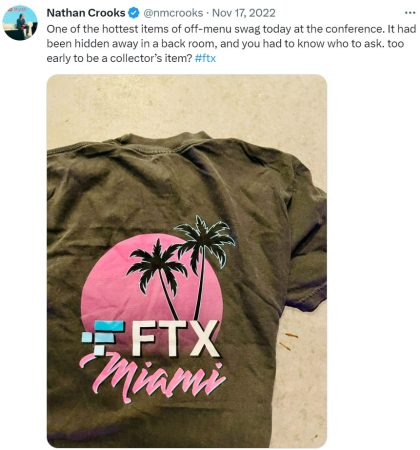
Promoting a vision of “web3, in real life,” Solana Spaces operated stores and event spaces in New York’s Hudson Yards district and Miami’s trendy Wynwood neighborhood, where in-the-know fans somewhat sardonically sought out FTX-related merchandise after the exchange collapsed last year.

Initially funded by the Solana Foundation, its closing mirrors tougher, post-FTX times on the Solana network with the native SOL token losing 72% of its value over the past year. 

“This week is your last week to come by our stores, take one last picture, and pick up your Solana merch.” Norby wrote. “I’ve instructed our retail team to be ultra generous.”

© 2023 The Block Crypto, Inc. All Rights Reserved. This article is provided for informational purposes only. It is not offered or intended to be used as legal, tax, investment, financial, or other advice.

Go to Source
Author: Nathan Crooks

Federal Trade Commission investigates Voyager’s ‘deceptive and unfair’ crypto marketing

The Federal Trade Commission is investigating crypto broker Voyager Digital, the agency said in a bankruptcy court filing.

The FTC is investigating Voyager and its employees “for their deceptive and unfair marketing of cryptocurrency to the public,” according to the document. The crypto firm filed for bankruptcy protection in July, after the collapse of the Terra blockchain torched the crypto markets. 

Binance.US agreed to buy Voyager’s assets in December, and plans to complete the sale are “on track,” a lawyer for Voyager said on Wednesday. Several regulators have objected to the sale, however. Voyager said it had $1.3 billion of crypto assets on its platform when it filed for bankruptcy over the summer. 

The FTC objected to a proposed sale of Voyager assets to Binance.US, saying the sale may interfere with the commission’s work because it could release Voyager and its employees from financial claims linked to possible fraud. The Securities and Exchange Commission has objected to Binance’s acquisition of Voyager’s assets, along with other state and federal agencies. 

Meanwhile, Voyager Digital is also tied up in another crypto bankruptcy case. Alameda Research, the crypto trading firm that filed for bankruptcy protection with crypto exchange FTX, is suing Voyager for more than $445 million in loan repayments. 

Disclosure: The former CEO and majority shareholder of The Block has disclosed a series of loans from former FTX and Alameda founder Sam Bankman-Fried

© 2023 The Block Crypto, Inc. All Rights Reserved. This article is provided for informational purposes only. It is not offered or intended to be used as legal, tax, investment, financial, or other advice.

Go to Source
Author: Stephanie Murray

Obol to bring distributed validators to Ethereum this year

Obol Technologies has brought its distributed validator technology to the Ethereum mainnet for the first time in an internal alpha testing phase. If successful, the project aims to make Ethereum more secure and resilient, while increasing the number of people running validators at home.

The validator comprises four nodes spread across three countries. It’s the first step in the project’s testing and audit plan, expected to culminate in an eventual public release toward the end of this year. 

The infrastructure project has a lot of support from the community. Obol raised $19 million in two funding rounds with a total of 107 backers that include big VC investors Coinbase Ventures, ConsenSys Ventures and Pantera Capital, alongside staking businesses Figment, Blockdaemon, Chorus One and angel investors.

But it wasn’t always like this.

“For like a solid two years no one gave a shit about it at all; no one cared about it at all. Everyone was skeptical. The Ethereum Foundation didn’t even want to fund it,” Obol co-founder and CEO Collin Myers said in an interview, referring to support for distributed validator technology in general. 

Myers had been interested in the idea of distributed validators since 2019 and had discussed potentially building a project around it but was dismayed by the lack of funding available.

But that began to change in February 2021, shortly after Ethereum had launched its Beacon Chain — the start of its proof-of-stake journey — when staking provider Staked had a big slip up. In one day, 75 of its validators were slashed, losing some of their staked ether as a penalty for accidentally attesting blocks with the same keys twice. It showed how easily centralized validators could lose their clients’ funds.

This proved to be a turning point. Suddenly those running validators and liquid staking pools were saying someone has to build this technology and were willing to stump up cash to support it. But no one wanted to raise their hand and do it. Seeing this, Myers left ConsenSys, and Obol co-founder and CTO Oisin Kyne quit his role at Blockdaemon. They joined forces.

While funding was now more available, the next challenge was to bring these entities together to work toward a common goal — even though many of them were competing projects.

“Getting it funded has taken us a very long time, multiple years of education and convincing competitors to play nicely with each other,” Myers said. “It’s been a lot of human coordination right in this element of getting people to all invest in Obol who kind of hate each other.”

Getting the Obol rolling

The idea behind Obol is to enable distributed validators on the Ethereum blockchain.

What is a validator? There are a few thousand nodes running the Ethereum blockchain. Each of these nodes can run multiple validators, which essentially approve blocks to go into its blockchain. There are currently 522,000 validators on the network, according to Beaconscan. Each validator locks up 32 ether ($55,000) as a stake and these coins can be slashed if the validator misbehaves. 

Obol’s goal in a nutshell is to take a single validator and run it across multiple nodes, which could each be run by multiple people or entities. A company in one country might look after half of a validator on its nodes, and an individual node operator in another running the other half. In this instance, each would pony up half of the staked ether. 

To test out its technology, Obol set up four nodes running out of Ireland, Estonia and Canada that are all working together as one distributed validator. The validator is running on the Ethereum mainnet, although Obol doesn’t recommend that anybody else use the code yet  since it hasn’t gone through an audit yet. 

Currently the initial live test is showing decent results. The validator has performed 10,182 attestations with a 99.84% participation rate as of Feb. 13, which is above average per Beaconscan. Additionally, even though distributed validators were expected to perform more slowly, the current test is showing slightly faster speeds than the network average.

What does Obol help with?

Obol brings a couple of different benefits to the Ethereum network and to those running validators at home, if they choose to use its technology.

In terms of the network, Obol aims to add security and resiliency. When multiple entities are running a single validator, it’s much harder for one of those entities to cause downtime because the other entities can keep the validator running. This helps to prevent malicious attacks on the network and plain old accidents. 

As a result, Obol may also prevent validators from getting slashed and paying penalties. 

When it comes to at-home validators, Obol can lower the ether requirements for each operator. This means someone who wants to run their own validator at home but doesn’t have the 32 ETH required can team up with other operators to run one together. This could help to increase the number of people running validators, boosting the network’s level of decentralization.

Obol also plans to get heavily involved with liquid staking protocols. These protocols typically assign a large amount of stake to a number of centralized staking providers. But were these providers using distributed validators, it would be harder for one of them to turn malicious and try to slash the stake that they have been assigned. In this sense, it should help to reduce single points of failure.

“If I’m a large validator I can self-slash and take all the pool down. With distributed validator technology you can’t do that,” said Myers.

The plan forward

Now that Obol has entered its first testing phase, it’s getting ready for many more rounds of testing before the team will be ready to say it’s live for anyone to use. 

In the short term, Obol will start going through audits on Feb. 27 for three weeks, after which the team will make some fixes and go for a second run. This should be finished by April or May, the team said.

Afterward, Obol has retained the research team at the Barcelona Supercomputing Center to do a performance test. It will go up to 1,000 validators on each supercomputer. This will take place in Q2 this year.

Separately, Obol will be doing an attacknet with Code Arena. This will be a hacking bounty competition for a few weeks open to anyone. The goal will be to reward people who find issues in the project’s code, helping to protect it for when it goes live.

As this progresses, Obol will also be trialed with a few entities that it’s already working with. It will be bringing Obol live with them in a closed beta. Around this time, the project will also be brought to liquid staking protocols. Once integrated with these, in the second half of 2023, it will be ready for at-home validators and network adoption.

Beyond this, Obol is also working on a multi-client implementation. It’s working with other developer teams to bring this together in what will likely be called Obol v2. This has no clear release date, but it would follow the main launch of the first version. Supporting multiple clients is designed to add further security and resilience to the network.

As a result, Myers doesn’t see this like the team is building just one big thing. It’s more like multiple versions of a similar idea — with different client implementations and unique implementations for each liquid staking protocol. 

“We’re not cathedral builders here, we’re more bazaar builders,” he said.

© 2023 The Block Crypto, Inc. All Rights Reserved. This article is provided for informational purposes only. It is not offered or intended to be used as legal, tax, investment, financial, or other advice.

Go to Source
Author: Tim Copeland


Follow by Email
Facebook20
Pinterest20
fb-share-icon
LinkedIn20
Share