FreeCryptoCurrency.Me

Free stocks and money too!

Category Archive : Crypto News

Bitcoin flirts with $24,000; Coinbase pares gains following Layer 2 announcement

Cryptocurrency prices were up over the past day, relatively unaffected by the release of the Fed’s latest meeting minutes on Wednesday. Crypto-related stocks dipped across the board, with Coinbase briefly higher on news of its Layer 2 plans before it pared gains. 

Bitcoin was trading just above $23,900 by 11:20 a.m. EST, down 1% today, according to Binance data. The leading cryptocurrency by market cap has failed to consistently trade above $24,000 over the past week.
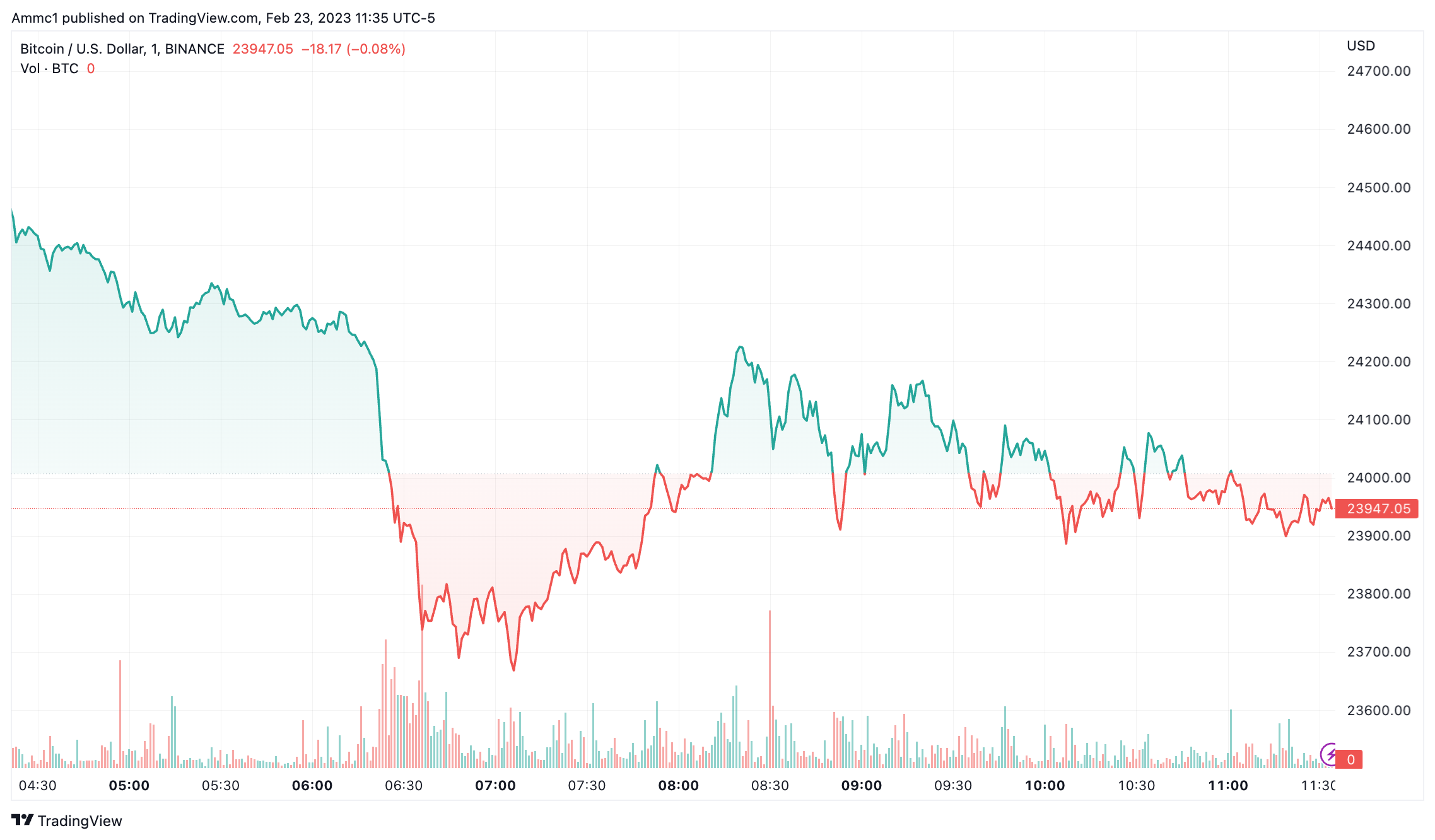
BTCUSD chart by TradingView

Ether was trading up 0.5% to $1,650. Binance’s BNB dipped about 1.2%, while Cardano’s ADA and Polygon’s MATIC added 0.5% and 0.3%, respectively. Dogecoin was up 1.4%, while shiba inu added 3.5%.

Optimism’s token price jumped following Coinbase’s announcement that it would build its Layer 2 network on the OP Stack and become a core developer of the software stack. OP briefly traded up 7%, above $3. It was trading around $2.91 by 11:40 a.m. EST, still above its pre-announcement price.

The Fed’s meeting minutes yesterday revealed some members of the FOMC were inclined to increase rates by 50 basis points at the beginning of the month. Markets briefly moved higher following the release.

Crypto stocks and structured products

Coinbase briefly traded above $64 following the news of its impending Layer 2 release. Shares in the exchange retreated to $60.47 by 11:30 a.m. EST, according to Nasdaq data. Cathie Wood’s Ark Invest added $13 million worth of COIN shares across two funds on Wednesday.

Silvergate continues to trade down, trading below $15 as it shed almost 5%. The crypto-friendly bank has come under renewed scrutiny despite institutional interest from Citadel Securities and BlackRock. 

MicroStrategy dipped 1.1%, and Jack Dorsey’s Block was down 0.8%.

Grayscale’s bitcoin trust has soared over 40% so far this year. The fund’s discount to net asset value (NAV) has widened periodically since January. Shares in the fund are currently trading at a discount of 46.5% to the value of the bitcoin in the fund, according to The Block data.

© 2023 The Block Crypto, Inc. All Rights Reserved. This article is provided for informational purposes only. It is not offered or intended to be used as legal, tax, investment, financial, or other advice.

Go to Source
Author: Adam Morgan McCarthy

Sushi plans derivatives exchange on Sei blockchain for second quarter

Sushi, the developer of the SushiSwap decentralized exchange, plans to release a decentralized derivatives exchange called Vortex on the Sei blockchain in the Cosmos ecosystem.

The release is scheduled for the second quarter of 2023, which coincides with the expected mainnet launch of Sei, and follows Sushi’s recent acquisition of Vortex.

Vortex is expected to be among the first applications on Sei, a Layer 1 blockchain designed for on-chain trading for the Cosmos ecosystem. The exchange will support peer-to-peer order matching and use of cross-collateral, done fully on-chain. 

Sushi’s cross-chain ambitions

While Sushi is one of the largest decentralized exchanges, it has historically focused on spot trading and lagged behind other protocols in derivatives. The move to Sei presents an opportunity for Sushi to expand its offerings in this area, and its CEO, Jared Grey, stated that expanding cross-chain from Ethereum to the Sei network is central to that plan.

“Ultimately, the goal is to increase horizontal product offerings holistically, providing value to all stakeholders within the Sushi ecosystem, with product launches like Vortex on Sei. Sei is the best infrastructure to launch this specific product, with time to finality and a cross-chain thesis that we resonated with,” Grey said.

Sushi is among the first DeFi protocols to announce an expansion to Cosmos. Last year, dYdX, currently the largest decentralized derivatives exchange, revealed a plan to move to Cosmos, which is also expected to occur in 2023.

Sei Labs, the core developer of the blockchain, is raising Series A funding at a $400 million token valuation, The Block recently reported.

© 2023 The Block Crypto, Inc. All Rights Reserved. This article is provided for informational purposes only. It is not offered or intended to be used as legal, tax, investment, financial, or other advice.

Go to Source
Author: Vishal Chawla

Hack VC and Jump Crypto back DeFi yield startup Affine Protocol

Affine Protocol closed a $5.1 million seed round to build a decentralized protocol and app that offers users access to sustainable and diversified yields.

Hack VC and Jump Crypto co-led the round. Other investors in the round included Spartan Group, Coinbase Ventures, Circle Ventures and AlphaLab Capital, the company said in a statement.

“DeFi today is incredibly difficult for the average investor to access,” said Alex Pack, managing partner at Hack VC. “Affine provides the tools that investors need to easily participate in the DeFi economy.”

Affine uses automated bots to adjust liquidity positions so user funds are being leveraged productively, the company said. The protocol offers two core basket types, which are diversified and dynamically rebalancing vaults that provide exposure to Affine’s strategies.

The new funding will be used to expand investment strategies and branch out on to new chains. Affine protocol is currently on Ethereum and Polygon.

“The market downturn and fraud in centralized crypto has motivated us to redouble our efforts to build in this space, but we know that particularly in DeFi, earning sustainable yield is still difficult,” said Tarik Moon, the CEO of Multiplyr Inc., which is a core contributor to the Affine DAO.

© 2023 The Block Crypto, Inc. All Rights Reserved. This article is provided for informational purposes only. It is not offered or intended to be used as legal, tax, investment, financial, or other advice.

Go to Source
Author: Kari McMahon

OP token pops 7% following Coinbase Layer 2 announcement

Optimism’s token price soared following Coinbase’s announcement that it would build its Layer 2 network on the OP Stack and become a core developer of the software stack.

OP was trading above $3 by 9:55 a.m. EST, up 6.7% since the announcement, according to CoinGecko data. The token price is now up around 22% in the past 24 hours. 

The Layer 2 protocol’s token had jumped about 15% in the 24 hours before the announcement, as rumors swirled online over the protocol’s involvement with Coinbase’s latest announcement — spurred on by a tweet from Optimism’s official account. 

Coinbase today unveiled Base, a testnet version of its new Ethereum Layer 2 network. It’s designed to be running on the main Ethereum network eventually. Base is built on Optimism’s open-source OP Stack. Coinbase will also join Optimism as a core developer of the OP Stack.

Through collaboration with Optimism and building the OP Stack, Coinbase plans to make Base and other chains running on the OP stack cheap, decentralized and secure, said Jesse Pollack, a senior director of engineering at Coinbase. 

Optimism echoed this sentiment, adding that it wants to bring many chains into a unified network, or the “Superchain.”

© 2023 The Block Crypto, Inc. All Rights Reserved. This article is provided for informational purposes only. It is not offered or intended to be used as legal, tax, investment, financial, or other advice.

Go to Source
Author: Adam Morgan McCarthy

Sam Bankman-Fried faces new criminal charges including conspiracy to commit bank fraud

FTX founder Sam Bankman-Fried is facing new criminal charges after a judge unsealed a new 12-count indictment against him on Thursday, months after the former crypto exchange head was first indicted on eight counts last year. 

Bankman-Fried is currently under house arrest on a $250 million bond. He has pleaded not guilty to criminal charges and is awaiting an October trial. A Bankman-Fried spokesperson declined to comment. 

The new indictment charges Bankman-Fried with conspiracy to commit bank fraud and conspiracy to operate an unlicensed money transfer business. Bankman-Fried is also accused of committing wire fraud on FTX customers, securities fraud on FTX investors and conspiracy to make unlawful political contributions and defraud the Federal Election Commission, among other crimes. 

Bankman-Fried could spend decades in jail if he is convicted on all counts. 

The former CEO and majority shareholder of The Block has disclosed a series of loans from former FTX and Alameda founder Sam Bankman-Fried.

© 2023 The Block Crypto, Inc. All Rights Reserved. This article is provided for informational purposes only. It is not offered or intended to be used as legal, tax, investment, financial, or other advice.

Go to Source
Author: Stephanie Murray

Houseparty co-founder raises $25.5 million for Ethereum ‘town square’ protocol

Here Not There (HNT) Lab’s latest offering Towns closed a $25.5 million round to help online communities build better digital town squares.

“Over the past decade, the digital town squares where we’ve gathered online — to communicate, create, and share — have been stuck in walled gardens owned by landlords who are not us,” said the company in a blog post.

A16z crypto led the Series A round for the group chat protocol and app. Previous investors in Towns include Benchmark and Framework, said the company in the post.

Towns is the brainchild of HNT Labs, which is co-founded by two startup veterans Ben Rubin, who co-founded Houseparty and Meerkat, and Brian Meek, who was the chief technology officer at Strivr Labs and a former GM of engineering at Skype.

How do you decentralize the town square?

The protocol is Ethereum-based and uses programmable smart contracts to control administration, privacy and roles within each town square, the company said. Communities can build new clients and APIs on top of the protocol and will be in charge of writing their own rules for moderation and monetization.

“Any group can use Towns to assemble and chat freely in a space designed to their needs— without ever having to worry that some organization will change the rules, profit off their activity, or take away their rights,” said the company in the blog post.

The  Towns network itself is an end-to-end encrypted near real-time communication system powered by a distributed proof-of-stake network of nodes, the company said.

Alongside the protocol, an app will launch that offers the encrypted chat experience without the complexities of dealing with the protocol and network.

“While this will be the first Towns app, it will be one of many as anyone can build clients against the Towns protocol to fit their specific needs,” the company said.

HNT Labs will first steward the governance of Towns. The plan is to eventually transition this to Towns DAO as the network decentralizes.

A16z crypto’s latest bets

“The team’s vision for creating a digital town square where members can define the borders, set the rules, and build the world they want is an ambitious goal that is uniquely achievable through the promise of decentralization and web3,” said Sriram Krishnan, a partner at a16z, in a blog post.

A16z crypto have led several raises in the web3 space in recent weeks including Azra Games’ $10 million extension round and Stelo Labs’ $6 million seed raise.

The majority of a16z’s most recent crypto fund is still to be deployed, said general partner and crypto fund founder Chris Dixon in a recent interview on The Block’s podcast The Scoop.

© 2023 The Block Crypto, Inc. All Rights Reserved. This article is provided for informational purposes only. It is not offered or intended to be used as legal, tax, investment, financial, or other advice.

Go to Source
Author: Kari McMahon

Coinbase unveils its Ethereum Layer 2 network that won’t have a token

Coinbase is officially jumping into the Layer 2 game.

The crypto exchange giant unveiled Base, a testnet version of its new Ethereum Layer 2 network, at ETHDenver. Modeled on Ethereum’s Goerli testnet, it is designed to eventually connect to the main Ethereum network, according to Jesse Pollack, Coinbase’s senior director of engineering.

“Our goal with Base is to launch a platform that makes it really easy for developers to build apps that users actually want to use and then plug that into the Coinbase product suite to make it really easy for users to use those apps,”  Pollack said.

Notably, Pollack told The Block that Base won’t sport its own dedicated token.

“These networks don’t need tokens to be successful,” said Pollack, adding that in some cases native tokens may obscure whether the networks are finding a product market fit with customers, users, and developers alike.

Base is built on the open-source OP Stack, a blueprint for compatible blockchain Layer 2 networks that was created by the Ethereum Layer 2 network Optimism. Coinbase will also be joining Optimism as a core developer for the OP Stack.

Drawing in developers

The existing suite of Coinbase developer tools will be integrated with Base, said Pollack, noting that “in collaboration with Optimism [OP] and building the OP Stack, we’re going to make it so Base and other chains running on the OP stack are incredibly low cost, decentralized and secure.”

Base will also mesh with consumer products from the company, such as Coinbase and Coinbase Wallet, and in so doing “give developers access to the 100 million plus users in the Coinbase ecosystem, 100 billion plus assets,” and “enable the scale that developers who are building web2 apps are used to in this new web3 economy,” said Pollack.

To further spur development on Base, Coinbase and its venture arm, Coinbase Ventures, will launch the Base Ecosystem Fund to make “a bunch of investments … at the pre-seed stage in companies and organizations that are building on Base,” according to Pollack.

“We expect that lots of those developers will eventually go multichain or folks may start on another chain and then come to Base,” Pollack said.

Many specialized Layer 2 chains

For the last year, Coinbase has been working on proto-dank sharding, an upgrade to Ethereum that will reduce fees on Layer 2 networks between 10-100 times current levels, Pollack said.

Layer 2 networks reduce the computation strain on Ethereum but require a certain amount of data availability to publish data to the main Ethereum chain.

Proto-dank sharding will scale data availability at Layer 1, and scale execution at Layer 2 in the rollups, according to Pollack.

“We expect there’s going to be many of these Layer 2s, and that’s why we’re building based on the OpenStack, that’s open source that anyone can use to run one of these L2s or roll-ups,” said Pollack, adding: “And then we can work to drive interoperability between all of them so that they increasingly work together, almost like that original Ethereum sharding at the execution layer vision, but in this new Layer 2 world.”

© 2023 The Block Crypto, Inc. All Rights Reserved. This article is provided for informational purposes only. It is not offered or intended to be used as legal, tax, investment, financial, or other advice.

Go to Source
Author: Jeremy Nation

Web3 game Worldwide Webb raises $10 million from Pantera Capital

Crypto investment firm Pantera Capital invested $10 million in Worldwide Webb, a web3 massively multiplayer online role-playing game (MMORPG), for its Series A round. 

Previously bootstrapped, the project began raising funding in the second quarter of last year and closed the deal by the end of December, said founder and CEO Thomas Webb in an interview with The Block. 

Partly inspired by virtual worlds such as Runescape and World of Warcraft, players can participate in quests, raids and interact with a virtual economy in an in-browser game. Users can also purchase virtual land and in-game apartments on-chain. 

“What I think is so powerful about Worldwide Webb is that you can just dive straight into the game with your wallet — you don’t have to download anything,” said Webb. 

In the next few weeks, the project will also release an upcoming game, titled Blockbusterz, where users holding NFTs from different collections such as CryptoPunks, BAYC or Doodles can face off against each other in battles tournaments — Webb is personally vouching for CryptoPunks to win out. 

Connecting brands

Webb made his name as a multimedia artist producing artwork that relies on social media APIs and other real-time data sources. As an artist, he’s worked with Hello Kitty creator Sanrio, fashion brand Valentino and luxury car maker Mercedes Benz. 

Webb is hoping to use those connections he’s made to create bespoke gaming experiences in Worldwide Webb that offer an alternative to the simple branded NFT drop, which has varying degrees of success

“People aren’t just buying into the brand with an NFT but they’re actually engaging in a branded game which is an experience within Worldwide Webb that they can earn a [branded] NFT from,” he explained. “It’s less about trying to create things for people and more about creating and rewarding loyalty.”

Aside from involving brands in Worldwide Webb, the funding will also be funneled into expanding its team and integrating other chains in addition to Ethereum. Webb said that it’s also in the early stages of creating its own standard for ERC-1155 and 721 token standards that it hopes can help solve the issue of who is entitled to royalties of NFT secondary sales. 

Investors play games

Ajuna’s backing follows a flurry of funding for projects in the NFTs and gaming subsector — the most popular subsector in terms of percentage of total funding since August 2021, according to The Block Research. Last month, crypto gaming platform Oh Baby Games raised a $6 million seed round as it emerged from stealth. In the same month, Neopets Meta, the web3 version of the popular virtual pet game, also raised a $4 million round.

Breakdown of blockchain venture spend

Breakdown of blockchain venture spend from The Block Research

Still, January saw the number of deals in the subsector decline from 40% of total deals in December to 26% but as The Block Research’s John Dantoni points out, it’s still premature to suggest that it’s lost its appeal to crypto investors, citing previous lulls that led the way to pickups in funding.

© 2023 The Block Crypto, Inc. All Rights Reserved. This article is provided for informational purposes only. It is not offered or intended to be used as legal, tax, investment, financial, or other advice.

Go to Source
Author: Tom Matsuda

Binance Australia shuts down derivative trading accounts of retail users

Binance shut down the derivative trading accounts of retail users in Australia after it mistakenly classified such customers as wholesale investors.

For Australians, Binance only offers crypto derivatives trading to wholesale investors. A spokesperson for Binance told The Block that the exchange giant discovered the discrepancy during a review of its onboarding process. These incorrectly labelled accounts have since been liquidated. The owners of these accounts will also not be able to access the derivatives market on Binance anymore.

Binance stated that it had informed affected customers of the restrictions on their accounts. “Binance Australia Derivatives are working on a remediation and compensation plan,” said the spokesperson.

The news has sparked some volatility in the crypto market, with bitcoin dropping below $24,000 temporarily.  

© 2023 The Block Crypto, Inc. All Rights Reserved. This article is provided for informational purposes only. It is not offered or intended to be used as legal, tax, investment, financial, or other advice.

Go to Source
Author: Osato Avan-Nomayo

Luxor partners with Southeast Asia mining firm, seeks to attract capital

Bitcoin mining firm Luxor wants to expand its presence in Southeast Asia by partnering with local mining service provider Cryptodrilling.

The company will be integrating Luxor’s software, firmware, and derivatives into its own platform called hashOS.app, the firm told The Block, adding it will also receive mining advisory. Thailand-based Cryptodrilling helps mining companies set up critical infrastructure like repair shops and software systems and advises on how to negotiate power contracts, build facilities and acquire machines. 

“We’re directly going to be pushing capital providers towards Southeast Asia to help the development there,” Luxor COO Ethan Vera told The Block. “This is one of the more exciting areas of mining moving forward. Not to downplay Latin America and potentially the Middle East, but we also think that it’s going to be, from a growth perspective, very, very high growth in Southeast Asia.”

Cryptodrilling operates across different areas in Southeast Asia with a focus on Laos, where the government has allowed bitcoin miners to operate and set specific fees.

Chinese capital

Cryptodrilling CEO Chayoot (Jay) Anukoolkarn said licensed miners pay a yearly fee of $100,000 per megawatt and that the government has allowed more than 10 companies to operate over 1.2 gigawatts, although currently there are only plans for about 400 megawatts to be used.

“I see Laos as my #1 priority as they have the most abundant renewable energy and they are building a lot more dams, so I know that there will be a lot of surplus energy,” Anukoolkarn said over Telegram, adding that “a lot of Chinese miners are already entering Laos.”

Chinese capital providers are interested due to proximity and similarities in business culture, Vera said.

“Given that China banned mining, we think that’s going to be a great path forward for them, especially with some of the uncertainty in power markets in Kazakhstan and political uncertainty in Russia,” he said.

© 2023 The Block Crypto, Inc. All Rights Reserved. This article is provided for informational purposes only. It is not offered or intended to be used as legal, tax, investment, financial, or other advice.

Go to Source
Author: Catarina Moura


Follow by Email
Facebook20
Pinterest20
fb-share-icon
LinkedIn20
Share