FreeCryptoCurrency.Me

Free stocks and money too!

Category Archive : Crypto News

Blur bid incentives skew market, lead to offers on NFTs above ‘buy now’ prices

Blur’s bidding-incentive model appears to be leading to an environment where buyers on the NFT marketplace are offering more than the asking price for items in collections. 

The rise of Blur — which has eclipsed other marketplaces’ trading volume since its launch in October of last year — came on the back of its capitalizing on the activity of pro traders, which is the fastest-growing segment of the NFT market. It rolled out an incentive model where traders are rewarded in tokens for providing market liquidity. In each collection, the bids that take the highest “risk” earn most reward points.

As of the time of writing, if you wanted to buy a Doodles NFT, the top bid for more than ten items in that collection sits at 5.07 ETH (about $7,900), whereas the ‘buy now’ price is 5.03 ETH. It’s the same story for other collections, including Bored Ape Yacht Club, Azuki and Moonbird NFTs.

Moonbird offers on Blur outstrip the asking price.

When a bid is made on a listed item, the seller has to accept it before the transaction goes through — whereas a buyer would trigger the transaction for the ‘buy now’ items. 

The Block contacted Blur for comment but had not heard back before publication time. 

Blur’s fee structure vs. the rewards

Of course, the fees tacked onto a transaction set against the rewards for listing and bidding may mean the reverse arbitrage of the current market might not be as bad as it looks. For example, you might pay $20 in transaction fees on Ethereum and a $70 royalty fee back to the artist when a sale goes through.

“Most traders currently bidding on NFTs on Blur probably just assume that the rewards they’ll receive will outweigh the costs incurred,” said Thomas Bialek, research analyst at The Block Research.

© 2023 The Block Crypto, Inc. All Rights Reserved. This article is provided for informational purposes only. It is not offered or intended to be used as legal, tax, investment, financial, or other advice.

Go to Source
Author: Lucy Harley-McKeown

Delegate Cash: the protocol trying to save Bored Ape owners from themselves

Episode 19 of Season 5 of The Scoop was recorded remotely with The Block’s Frank Chaparro and the Delegate Cash team.

Listen below, and subscribe to The Scoop on AppleSpotifyGoogle PodcastsStitcher, or wherever you listen to podcasts. Feedback and revision requests can be sent to podcast@theblockcrypto.com.


The Delegate Cash protocol significantly reduces the risk of theft for NFTs and other tokens by allowing users to safely store valuable assets in one wallet and delegate the rights to those assets to another. 

In this episode, the Delegate Cash team breaks down how their protocol is making web3 safer and more secure for users, and the far-reaching implications delegation has for crypto gaming and NFT financialization.

During this episode, Chaparro, Copeland, and the Delegate Cash team also discuss:

  • Why BAYC whales and professional gamers recently joined forces
  • How Liquid Delegates have created a new financial primitive
  • Why the team released Delegate Cash for free

This episode is brought to you by our sponsors Circle, Railgun, Flare Network

About Circle
Circle is a global financial technology company helping money move at internet speed. Our mission is to raise global economic prosperity through the frictionless exchange of value. Visit Circle.com to learn more.

About Railgun
Railgun is a private DeFi solution on Ethereum, BSC, Arbitrum and Polygon. Shield any ERC-20 token and any NFT into a Private Balance and let Railgun’s zero-knowledge cryptography encrypt your address, balance and transaction history. You can also bring privacy to your project with Railgun SDK, and be sure to check out Railgun with partner project Railway Wallet, also available on iOS and Android. Visit Railgun.org to find out more.

About Flare
Flare is an EVM-based Layer 1 blockchain designed to allow developers to build applications that can use data from other blockchains and the internet. By providing decentralized access to a wide variety of high-integrity data from other blockchains and the internet, Flare enables new use cases and monetization models. Build better and connect everything at Flare.Network.

© 2023 The Block Crypto, Inc. All Rights Reserved. This article is provided for informational purposes only. It is not offered or intended to be used as legal, tax, investment, financial, or other advice.

Go to Source
Author: Davis Quinton, Frank Chaparro and Tim Copeland

Nansen officially releases Query product for on-chain analytics

Blockchain data platform Nansen officially launched Query, a product that provides programmable access to blockchain datasets for crypto teams to perform data analytics. Query is built on the Google Cloud platform and can be integrated into existing technology stacks and web applications.

Nansen has labeled over 250 million blockchain addresses to offer on-chain insights for Query, the company said in a press release. The product also tracks 95% of all on-chain total value locked (TVL) across 17 of the world’s most popular blockchain layers, including Ethereum, Polygon, Arbitrum, Fantom, Celo, BNB Chain, Avalanche, Ronin, Optimism, and Solana.

Nansen Query’s curated datasets can decode complex blockchain events, providing data on entities and addresses, pricing, transaction history, and other details enhanced by Nansen’s proprietary market and trading indicators. 

“[Query] is now the platform that Nansen analysts use to perform on-chain analysis, build dashboards, and share their work with others,” said Nansen CEO Alex Svanevik.

Nansen noted that Query is already being used by well-known crypto teams and investors, such as OpenSea, Google, MakerDAO, a16z, and others. The previous launch was more of a soft release, while this official launch represents a wider release to the public and an effort to increase its visibility and market reach.

© 2023 The Block Crypto, Inc. All Rights Reserved. This article is provided for informational purposes only. It is not offered or intended to be used as legal, tax, investment, financial, or other advice.

Go to Source
Author: Vishal Chawla

Cathie Wood’s Ark Invest buys more Coinbase and Robinhood

Ark Invest added to its stockpile of shares in exchanges Coinbase and Robinhood yesterday.

According to an emailed trade notification, 47,568 shares in Coinbase were added to the flagship Ark Innovation ETF. In comparison, 8,031 shares were added to the Ark Next Generation Internet ETF — which also saw 1.06 million Robinhood shares purchased.

Coinbase shares closed at $61.89 yesterday, while Robinhood fell to $9.42 — down more than 3%.

At the current price, Ark’s Coinbase purchase yesterday totals roughly $3.44 million. Its Robinhood purchase, meanwhile, totals approximately $9.97 million.

© 2023 The Block Crypto, Inc. All Rights Reserved. This article is provided for informational purposes only. It is not offered or intended to be used as legal, tax, investment, financial, or other advice.

Go to Source
Author: Adam James

Block solicits feedback for bitcoin ‘mining development kit’

Jack Dorsey’s Block is soliciting developer feedback for what it calls a bitcoin “mining development kit,” which it says could unleash further innovation in the Bitcoin mining space and increase innovation, with a goal to reduce energy consumption.

The mining development kit, as so far envisioned in a blog post, would be comprised of four parts: A Bitcoin mining hashboard, which would work with a controller board, and run on open-source firmware and software, and “extensive reference materials and support documentation.” Block has asked developers to weigh in on what they would like included in the first three components. 

“The intention behind the [mining development kit] is to provide developers with a suite of tools to help unlock creativity and innovation in bitcoin mining hardware,” the company said in its blog post. “We anticipate the [kit] being useful development projects focused on integrating bitcoin mining into various novel use cases — such as heating solutions, off-grid mining, home mining or intermittent power applications — as well as optimization of bitcoin mining hardware for traditional commercial mining operations.”

Block did not specify when the suite would launch, but told developers to “stay tuned.” The company said it got “overwhelmingly positive” responses to CEO Jack Dorsey’s 2021 tweet that the company was considering building an open source mining suite and has been “heads down building a team ever since.”

© 2023 The Block Crypto, Inc. All Rights Reserved. This article is provided for informational purposes only. It is not offered or intended to be used as legal, tax, investment, financial, or other advice.

Go to Source
Author: Madhu Unnikrishnan

Binance.US gets green light to buy Voyager Digital assets 

Binance.US can buy failed crypto lender Voyager Digital’s assets, a federal judge confirmed after a four-day marathon hearing that stretched from last week to this one. 

Judge Michael Wiles confirmed Voyager’s modified restructuring plan on Tuesday, which includes the $1 billion deal with Binance.US.

The plan faced objections from the Securities and Exchange Commission, other regulators and some individual creditors who raised issues about Binance.US. Wiles acknowledged the concerns but said he had not seen actual evidence that suggested Binance.US should be denied. 

“I am in the absolutely unenviable position of having to make a ruling about the proposed transaction in the face of hearsay accusations of potential wrongdoing in an industry where other firms have apparently engaged in real wrongdoing,” Wiles said. “I have been given no evidence … that Binance.US will misuse customer assets, or that it cannot be trusted.” 

The judge’s decision is subject to changes he proposed to the final restructuring plan, he noted, including tweaks to an exculpation provision for parties who carry out the transaction and details about how Binance.US will handle customer data.

A spokesperson for the company called the SEC lawyer’s allegations “regrettable” but praised the Wiles’ approval of the sale. 

“Our goal has always been to return customers their cryptocurrency on the fastest timeline possible and empower users to make their own decisions about their own assets. We look forward to completing the transaction and welcoming Voyager customers to Binance.US where they can expect the highest levels of service and support,” a Binance.US spokesperson said via email. 

The plan, which could still be derailed by the inter-agency Committee on Foreign Investment in the United States, includes a “toggle” option to allow Voyager to self-liquidate assets if the sale is unsuccessful. CFIUS, which can reject foreign purchases of U.S. companies, has said in court filings that the transaction between Binance.US and Voyager could come under review.

In issuing his ruling, Wiles acknowledged the unusual nature of the bankruptcy case and the shifting regulatory environment.

“The current regulatory environment can only be characterized as uncertain, but the future regulatory environment can only be characterized as, in my mind, virtually unknowable,” Wiles said. He also nodded to other collapsed crypto firms, including FTX, which tried to buy Voyager’s assets before filing for bankruptcy last year.

Of the 6% of creditors who voted on the proposed Voyager plan, 97% voted in favor. Customers could see a 73% recovery under the proposal, Voyager lawyers say, although that percentage would drop to 48% if claims from bankrupt crypto exchange FTX and its sibling company Alameda Research are successful. More than 167,000 customers have already signed up for the Binance.US platform. 

Wiles tussled with several government agencies during the hearing. He admonished the SEC for telling the court that its staff believes Binance.US is operating an unregistered securities exchange in the U.S., but not taking an official position on the matter or providing evidence to prove it. 

Wiles also had sharp words for the lawyer representing the U.S. Attorney’s Office for the Southern District of New York, who objected to providing a criminal exculpation for parties who carry out pieces of the Voyager plan.

J.D. Barnea, the co-chief of the office’s tax and bankruptcy unit, said it was inappropriate for a bankruptcy court to enjoin criminal prosecution for anyone. Wiles responded by saying that the attorney’s office did not provide evidence that anything in the deal was illegal and called Barnea’s suggestion “preposterous.” 

“The very suggestion offends me to no end. I can’t believe you would even take the position in front of me,” Wiles said “People who have to do what my order will compel them to do are entitled to know, okay? And they’re entitled to clarity.” 

Wiles came to his decision on the restructuring plan after hearing well over 20 hours of testimony during a lengthy hearing in the U.S. Bankruptcy Court for the Southern District of New York. The judge thanked creditors for the “unusual amount of work and energy that they have put into following this case.”

“This bankruptcy case has been pending since July 2022. Customers and creditors have been denied access to their assets for many months and they deserve to have a resolution of this case,” Wiles said. 

Update: Story updated with new comment from Binance.US on sale approval. 

© 2023 The Block Crypto, Inc. All Rights Reserved. This article is provided for informational purposes only. It is not offered or intended to be used as legal, tax, investment, financial, or other advice.

Go to Source
Author: Stephanie Murray

Bitcoin mining report: March 7

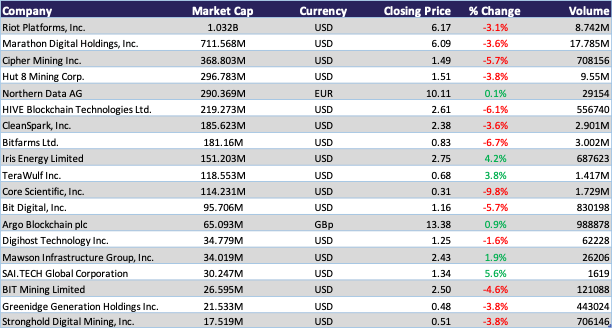
Bitcoin mining stocks tracked by The Block were mostly lower on Tuesday, with six gaining and the other 13 declining.

Bitcoin fell 1.8% to $22,046 by market close.

Here is a look at how the individual miners performed today:

© 2023 The Block Crypto, Inc. All Rights Reserved. This article is provided for informational purposes only. It is not offered or intended to be used as legal, tax, investment, financial, or other advice.

Go to Source
Author: Larry DiTore

Markets trade down after Fed chair’s comments, Grayscale recovers amid hearing

Crypto markets whipsawed throughout the day after U.S. Federal Reserve Chair Jerome Powell’s delivered testimony to Congress.

Bitcoin was trading around $22,070 by 4:55 p.m. EST, down about 1.5%, according to TradingView data. Earlier in the day, it fell as low as $21,900.

The U.S. central bank is “prepared to increase the pace of rate hikes,” Powell said during his testimony, adding that because the latest economic data had come in stronger than expected, the ultimate level of interest rates is “likely to be higher than previously anticipated.”

Markets dropped immediately following the comments, recovering slightly throughout the day.

Ether was trading at $1,550 by 4:55 p.m. EST, down 0.9% on the day, while altcoins fell slightly. Binance’s BNB fell 0.3%, Ripple’s XRP was up 3% and Cardano’s ADA down 1.1%.

CoinFLEX’s token was up 8.7%, after the company released a statement saying a court in the Seychelles had approved its restructuring plans.

Crypto stocks and structured products

After months of delay, Grayscale finally had its day in court, bringing a case against the U.S. Securities and Exchange Commission for rejecting its proposal to convert its flagship fund, GBTC, into a spot bitcoin ETF in June. 

As GoldenTree’s head of digital asset trading Avi Felman noted on Twitter, oral arguments were “going well,” and the judges were “questioning the validity of the SEC’s arguments against spot ETF.” 

GBTC traded up throughout the day, gaining around 9.6% to $12.90 at the close, according to TradingView data. The asset manager’s ether product, ETHE, jumped about 2.8% to about $7.12.

Other crypto stocks traded relatively flat, with slight declines. Silvergate was down 3.7% to $5.20, Coinbase was down 1.4% to around $62. Block lost 3.4% to trade around $78 and MicroStrategy declined by 6% to $231.44.

© 2023 The Block Crypto, Inc. All Rights Reserved. This article is provided for informational purposes only. It is not offered or intended to be used as legal, tax, investment, financial, or other advice.

Go to Source
Author: Sam Venis

OpenChat to transfer control to community after $5.5 million ‘decentralization sale’

OpenChat, an on-chain messaging platform based on the Internet Computer blockchain, will soon transfer control of the messaging app to a decentralized, token-based governance system via the Service Nervous System (SNS), its team said.

This comes shortly after the project raised more than $5.5 million in a crowdfunding sale conducted last week.

Its recent token sale, which had 2,375 participants, allowed it to buy OpenChat’s native governance tokens to form a decentralized autonomous organization (DAO). After the sale, the OpenChat team said that the on-chain messaging platform will be owned and controlled by its community of chat token holders, not a centralized tech firm.

“OpenChat users can become consumers, shareholders, and decision-makers and actively decide the platform’s future. For example, if the community accepts a proposal, including a code update, it will be implemented by the SNS automatically instead of a single entity making a unilateral decision,” Matt Grogan, co-founder of OpenChat, said in an interview with The Block.

The newly raised funds from the token “decentralization sale” will be held in OpenChat’s DAO treasury, and chat holders will decide how best to utilize them, the team said. The platform will allow users to vote directly on new proposals for upgrades, features, and treasury allocations via the Service Nervous System (SNS), a governance system model used on the Internet Computer.

“From now on, OpenChat will be owned and controlled by its community of chat token holders. The platform allows users to vote directly on new proposals for upgrades, features, and treasury allocations via a Service Nervous System (SNS) which provides an algorithmic DAO-like model,” Grogan said.

OpenChat is a decentralized messaging platform that runs fully on-chain, including both the front- and back-end of the platform. In addition to typical social media messaging features, the platform is bundled with crypto-native add-ons, such as the ability to send and swap crypto tokens on Internet Computer.

Instead of traditional social media accounts that rely on email IDs and a unique username, OpenChat makes use of crypto addresses and NFTs for authentication and monetization purposes. This setup puts users, rather than a centralized company, in control of the content and personal data associated with accounts.

Scalability is a big issue for decentralized social media since such products are both data-intensive and involve a high throughput of transactions. Blockchains usually struggle with both of these issues. In response to the scalability matter, the OpenChat team said Internet Computer’s architecture and its own governance model might be enough to meet any scaling challenges.

“The Internet Computer’s architecture enables OpenChat to accommodate a large number of users without harvesting user data, or pushing an ad revenue model,” Grogan added. “This network also allows OpenChat to remain 100% on-chain, so it doesn’t have to rely on third-party cloud computing services.”

© 2023 The Block Crypto, Inc. All Rights Reserved. This article is provided for informational purposes only. It is not offered or intended to be used as legal, tax, investment, financial, or other advice.

Go to Source
Author: Vishal Chawla

Tender.fi hacker returns stolen funds, gets bounty reward

In a surprising turn of events, a hacker responsible for a $1.59 million exploit on Tender.fi, an Arbitrum-based lending platform, has now returned funds, on-chain data show.

Earlier today, the hacker took advantage of a misconfigured data oracle that allowed them to borrow $1.59 million in crypto assets with just a single GMX token worth $70 as collateral, a costly error for the protocol. 

Security firms PeckShield and BlockSec were quick to investigate the matter and discovered that the unusual loan could happen by a misconfigured oracle used by Tender.fi, an Arbitrum-based lending platform.

At 1:30 pm EST, the hacker began paying back the loans after the two parties agreed on a negotiated deal done via on-chain messages. The Tender.fi team had agreed to pay 62 ETH ($96,500) as a bounty reward to the hacker.

Tender.fi issued a statement regarding the return of the funds and promised a post-mortem report would be provided. “The hacker has completed the loan repayments. Funds are officially SaFu, post mortem on the way,” it said.

© 2023 The Block Crypto, Inc. All Rights Reserved. This article is provided for informational purposes only. It is not offered or intended to be used as legal, tax, investment, financial, or other advice.

Go to Source
Author: Vishal Chawla


Follow by Email
Facebook20
Pinterest20
fb-share-icon
LinkedIn20
Share