FreeCryptoCurrency.Me

Free stocks and money too!

Category Archive : Crypto News

Digital asset funds experience biggest weekly outflows on record

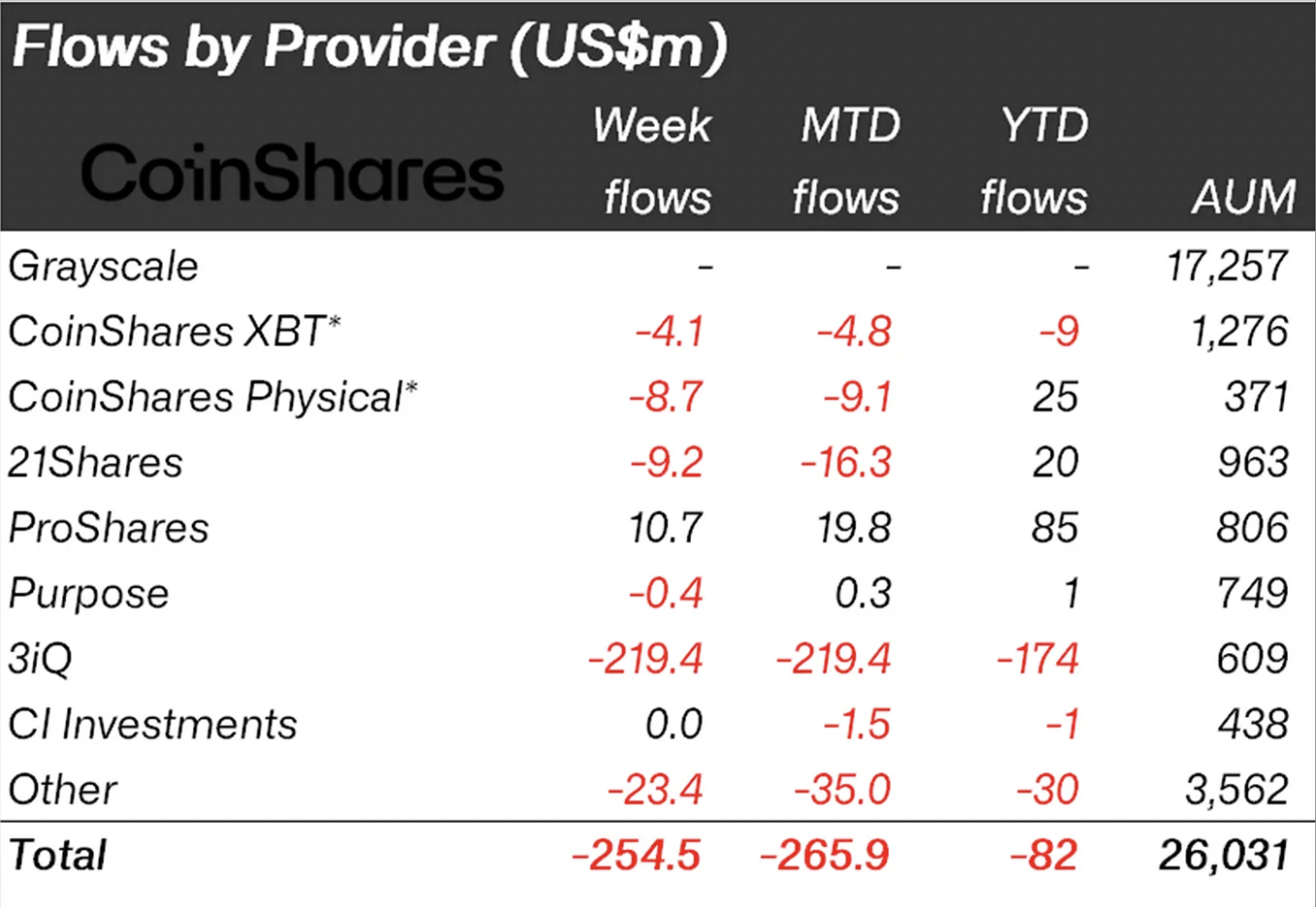
Digital asset investment products experienced outflows of $255 million last week, the largest dollar-figure outflows on record, according to asset manager CoinShares.

For the fifth consecutive week, digital asset funds saw net outflows, with the figure accounting for 1% of total assets under management (AUM).

“Regionally, the negative sentiment was broad, with negative sentiment seen in both North America and Europe,” CoinShares Head of Research James Butterfill wrote on Medium.

The outflows are the largest on record in dollar terms. However, it was not the record when expressed as a percentage of the total AUM, which occurred in May 2019 after $51 million of outflows were seen. “It highlights just how much total AUM has risen since May 2019,” Butterfill noted, adding that AUM has fallen by 10% over the week, back to levels seen at the beginning of the year.

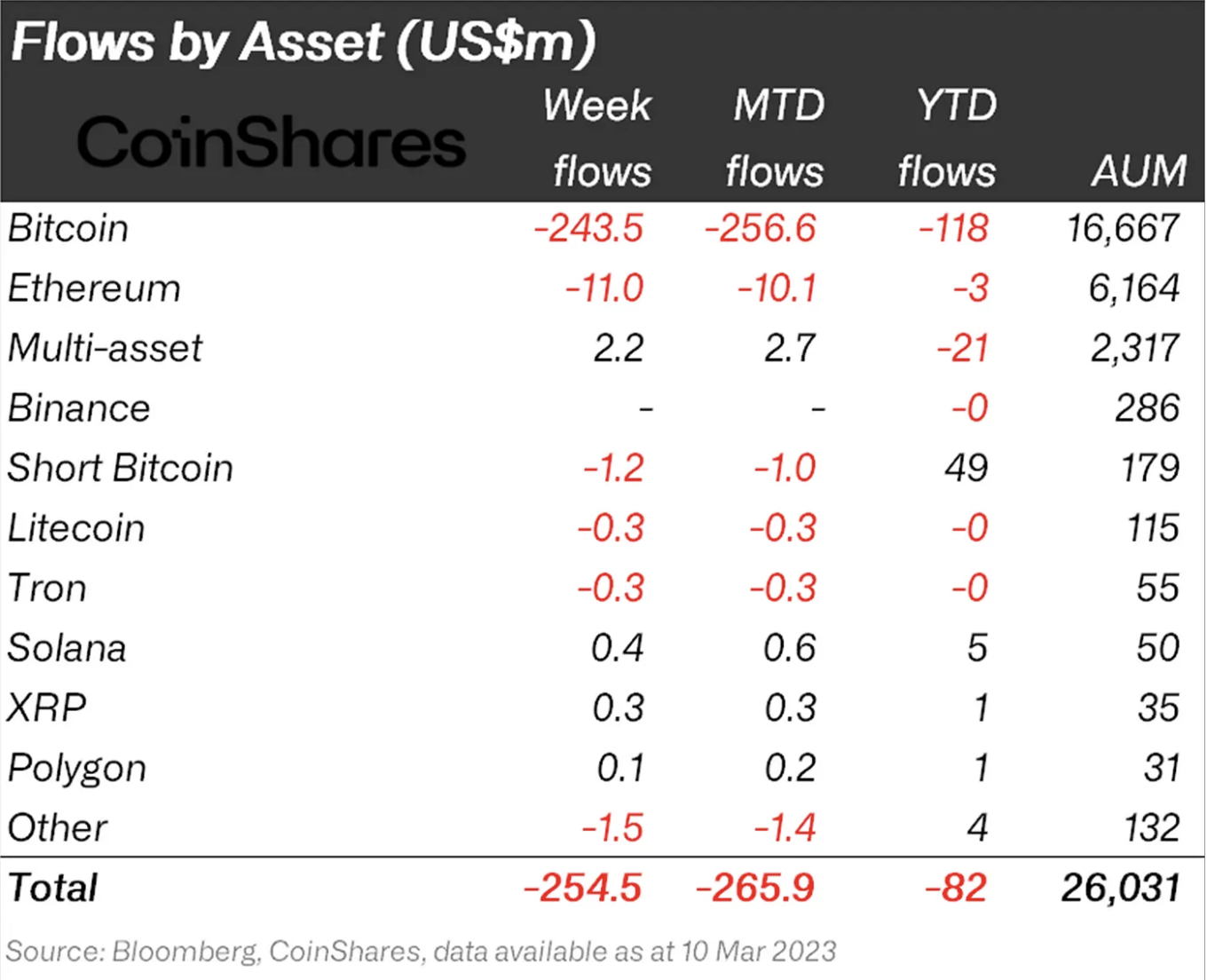
“The outflows have also wiped out all the inflows seen this year, with outflows now standing at $82 million year-to-date,” he said.

3iQ experienced the largest outflows, with $219.4 million leaving funds throughout the week. BlackRock’s ProShares experienced net inflows of $10.7 million. 

Bitcoin saw the largest outflows during the week, totaling $244 million. Short-bitcoin products experienced outflows of $1.2 million. Bitcoin products accounted for over 96% of the outflows last week. 

© 2023 The Block Crypto, Inc. All Rights Reserved. This article is provided for informational purposes only. It is not offered or intended to be used as legal, tax, investment, financial, or other advice.
Go to Source
Author: Adam Morgan McCarthy

Aztec to sunset private ZK-Rollup Connect and focus on next-gen Layer 2 chain

Layer 2 privacy project Aztec Network will sunset its existing version of its ZK-Rollup network called Connect to focus on a third iteration of its core technology.

Aztec’s first attempt to build a privacy network was called Aztec 1 and its second attempt was Connect. Now that Connect is being depreciated, Aztec will focus on building a general-purpose smart contract blockchain for privacy apps with its own programming language called Noir, the team said in a blog post.

“Our mid- and long-term focus will be solely directed towards the development of two major products, which are mutually compatible and interlinked: Noir, the universal language of zero knowledge, and our next-generation encrypted blockchain,” the team said.

Aztec also noted that Connect remains open-sourced and encouraged the community to fork it and deploy it independently if they wish. As part of the discontinuation of Connect, Aztec said deposits into the Aztec Connect bridge contract will be disabled from March 21, 2023. However, users will still be able to withdraw their assets for up to a year.

A year for withdrawals

Withdrawals will be available until Connect’s sequencer stops publishing Rollup blocks from March 21, 2024. A sequencer is a component on Aztec that helps to order and bundle transactions before they are submitted to the Ethereum blockchain.

“While withdrawals will always be possible, they will become significantly more burdensome after March 21, 2024,” Aztec stated. The company expects to completely stop maintaining the Connect contract and sequencer after one year.

Aztec is a zero-knowledge proof project that focuses on achieving application privacy. This is different from other solutions in the Layer 2 and zero-knowledge areas that are focused on scaling instead.

© 2023 The Block Crypto, Inc. All Rights Reserved. This article is provided for informational purposes only. It is not offered or intended to be used as legal, tax, investment, financial, or other advice.

Go to Source
Author: Vishal Chawla

PeopleDAO hacked via Google Sheets, $120,000 worth of ether stolen

PeopleDAO, a group formed to buy a copy of the U.S. Constitution, has lost 76.5 ETH ($120,000) to a social engineering hack on March 6 that targeted the project’s monthly contributor payout form on Google Sheets.

A combination of errors led to the theft, according to the project team. First, the accounting lead mistakenly shared a link to the payout form with edit access to a public channel on the project’s Discord Server. The hacker was able to use this edit access on the form to insert their address and a 76.5 ETH payment. The hacker then made this row invisible on the form.

This hidden row on the form escaped the team’s notice during rechecks. It also was not picked up by the multi-signature signers who executed the transfers after data from the form had been sent to the airdrop tool on Safe. As such, the attacker’s wallet received the 76.5 ETH payment. The hacker subsequently transferred the ether to two centralized exchanges — HitBTC and Binance — with 69.2 ETH ($110,000) going to the former and 7.3 ETH to the latter.

PeopleDAO says it is working with blockchain security experts like ZachXBT and SlowMist to track the hacker. The team says it also reported the matter to U.S. law enforcement agencies as well as the exchanges used by the hacker. PeopleDAO offered a 10% white hat bounty to the hacker should they return the funds. The hacker has not responded to this offer as of the time of reporting.

The team said it’s taking steps to avoid similar mishaps in the future. “We are improving our accounting and multisig education,” the team told The Block. “We are embracing tools built on Safe that improve signer experience.”

PeopleDAO says it is planning to host demo sessions with team members about how to use these tools to prevent a repeat occurrence.

© 2023 The Block Crypto, Inc. All Rights Reserved. This article is provided for informational purposes only. It is not offered or intended to be used as legal, tax, investment, financial, or other advice.

Go to Source
Author: Osato Avan-Nomayo

OKCoin pauses dollar deposits, OTC services after ‘managing’ Silvergate situation

OKCoin, a U.S.-based crypto exchange affiliated with the much larger OKX, temporarily paused deposits of U.S. dollars following Sunday’s failure of Signature Bank. 

OKCoin CEO and OKX President Hong Fang — who commonly goes by Hong — announced the news on Twitter, saying Signature was OKCoin’s primary U.S. dollar bank. It also paused over-the-counter services, such as quick and recurring buys.

U.S. authorities seized Signature yesterday to protect depositors, following last week’s demise of Silvergate Bank. Both were key providers of banking services to the crypto industry. 

Hong tweeted that OKCoin had no exposure to the Silvergate — the second-largest bank collapse in U.S. history — but said “we managed [the] Silvergate situation.”

“Our team are working very hard on alternative channels and solutions in real time,” Hong said, adding: “We’ve been through much worse times since our inception.”

© 2023 The Block Crypto, Inc. All Rights Reserved. This article is provided for informational purposes only. It is not offered or intended to be used as legal, tax, investment, financial, or other advice.

Go to Source
Author: Adam James

Euler Finance flash-loan attacked for an estimated $197 million

Lending protocol Euler Finance was hit by a flash-loan attack, resulting in a loss of $197 million, according to security firms BlockSec and PeckShield.

The attack occurred at 4:50 am ET, allowing the perpetrator to borrow large amounts of funds and drain them from the protocol. They drained $136 million of staked ether (stETH), $34 million of USDC, $19 million of wrapped bitcoin (WBTC) and $8.7 million of DAI, BlockSec noted in a document.

It is unclear how the attack was carried out or who was responsible. Euler Finance’s team is working with security professionals and law enforcement and will release more information later.

Flash loans are a popular tool for attackers looking to exploit vulnerabilities in DeFi protocols, as they allow borrowers to access large amounts of funds without providing collateral. However, they come with a high level of risk since the borrower must repay the loan within a short time frame.

Euler is a non-custodial protocol that allows users to lend and borrow crypto assets and is run by a decentralized autonomous organization (DAO). It raised a $32 million fundraising round led by Haun Ventures in June 2022.

The attack caused the price of the Euler (EUL) token to drop more than 45% — coming down to $3.30 from $6.10.

© 2023 The Block Crypto, Inc. All Rights Reserved. This article is provided for informational purposes only. It is not offered or intended to be used as legal, tax, investment, financial, or other advice.

Go to Source
Author: Vishal Chawla

How this user-owned talent network is disrupting the staffing industry

Episode 22 of Season 5 of The Scoop was recorded remotely with The Block’s Frank Chaparro and Freelance Labs Founder & CEO Adam Jackson.

Listen below, and subscribe to The Scoop on AppleSpotifyGoogle PodcastsStitcher, or wherever you listen to podcasts. Feedback and revision requests can be sent to podcast@theblockcrypto.com.


Adam Jackson is the Founder and CEO of Freelance Labs — the development company behind the user-owned talent network, BrainTrust.

In this episode, Jackson explains how decentralization helps BrainTrust operate more efficiently than traditional staffing firms and how recent tech layoffs have impacted the crypto job market.

During this episode, Chaparro and Jackson also discuss:

  • Why contractors are in high demand
  • How token models bootstrap growth
  • The role of VCs in web3

This episode is brought to you by our sponsors Circle, Railgun, Flare Network

About Circle
Circle is a global financial technology company helping money move at internet speed. Our mission is to raise global economic prosperity through the frictionless exchange of value. Visit Circle.com to learn more.

About Railgun
Railgun is a private DeFi solution on Ethereum, BSC, Arbitrum and Polygon. Shield any ERC-20 token and any NFT into a Private Balance and let Railgun’s zero-knowledge cryptography encrypt your address, balance and transaction history. You can also bring privacy to your project with Railgun SDK, and be sure to check out Railgun with partner project Railway Wallet, also available on iOS and Android. Visit Railgun.org to find out more.

About Flare
Flare is an EVM-based Layer 1 blockchain designed to allow developers to build applications that can use data from other blockchains and the internet. By providing decentralized access to a wide variety of high-integrity data from other blockchains and the internet, Flare enables new use cases and monetization models. Build better and connect everything at Flare.Network.

© 2023 The Block Crypto, Inc. All Rights Reserved. This article is provided for informational purposes only. It is not offered or intended to be used as legal, tax, investment, financial, or other advice.

Go to Source
Author: Davis Quinton and Frank Chaparro

Binance converting $1 billion in BUSD to bitcoin, ether and BNB

Binance CEO Changpeng Zhao announced on Twitter that the foremost crypto exchange would convert the approximately $1 billion remaining from its Industry Recovery Initiative funds to native crypto assets — precisely, bitcoin, ether and BNB.

The cryptocurrencies will be purchased using the exchange’s dollar-pegged stablecoin, BUSD.

Zhao — who is widely known by his initials, CZ — shared that, for transparency, some of the transactions will occur on-chain.

Crypto unbanked

The $1 billion conversions to native crypto assets come amid a banking crisis that captured the United States’ attention over the weekend.

Last night, the New York Department of Financial Services seized what was widely considered the last crypto-friendly bank, Signature Bank, citing systematic risks — effectively cutting the crypto industry off from banks in the country. 

The move coincides with the Federal Reserve’s creation of a Bank Term Funding Program, which — on fears of a broader economic impact — will lend money to Silicon Valley Bank and ensure deposits beyond $250,000 are accessible. Silicon Valley Bank’s collapse is the second-largest in the country’s history.

“Took 15 seconds and costs $1.29,” CZ tweeted, citing a movement of funds worth over $980 million. “Imagine moving $980 million through a bank before banking hours on a Monday.”

© 2023 The Block Crypto, Inc. All Rights Reserved. This article is provided for informational purposes only. It is not offered or intended to be used as legal, tax, investment, financial, or other advice.

Go to Source
Author: Adam James

BCB Group pauses US dollar payments pilot after Signature Bank closure

BCB Group, a London-based provider of payment services and business accounts for crypto firms, halted a planned U.S. dollar payments program after regulators shut down Signature Bank earlier today.

Shortly after the suspension of Silvergate Bank’s Silvergate Exchange Network on March 3, BCB Group founder and CEO Oliver von Landsberg-Sadie told CoinDesk that the company would roll out U.S. dollar payments tools to help plug the gap. 

Von Landsberg-Sadie told The Block today that BCB Group already had 6 existing clients ready to test that system as part of a limited pilot program, and said the firm executed its first U.S. dollar transaction on March 10. 

But BCB Group had relied on Signature Bank — which was seized by state regulators on March 12 — to power the program. 

BCB Group used Signature Bank for “trade settlement and for U.S. dollar payment accounts,” von Landsberg-Sadie told The Block, meaning those services must now be paused until new partnerships are in place. BCB Group’s payments products in other currencies continue as usual.

“It’s sad to see [Signature Bank] go, but hopefully we can provide continuity for our clients through three new U.S. bank relationships going live soon. We’ll just have to accelerate those, mindful of how sustainable they’ll be under the Fed’s crypto-sceptic views,” von Landsberg-Sadie said.

Banks in turmoil

The interruption comes after a chaotic weekend in the U.S. banking sector that saw regulators step in to close down both Silicon Valley Bank and Signature Bank. The former was first shut down by the California Department of Financial Protection and Innovation, with the Federal Deposit Insurance Corporation appointed as the receiver, on March 10. The New York Department of Financial Services then seized crypto-friendly Signature Bank in order “to protect depositors,” the state banking regulator said in a Sunday night announcement.

In a joint statement after taking over Signature Bank, the Federal Reserve Board, Treasury Department and FDIC said, “All depositors of this institution will be made whole. As with the resolution of Silicon Valley Bank, no losses will be borne by the taxpayer.”

Some BCB Group customers hold deposits with Signature Bank, von Landsberg-Sadie said, but he added that he has a “reasonable expectation” that they could be paid out as early as tomorrow, thanks to the regulator’s intervention.

As to how likely it is, in the current climate, that BCB Group will locate not one but three new crypto-friendly banking partners in the U.S., von Landsberg-Sadie was optimistic — estimating the partnerships could be live within 4 to 12 weeks. 

“As long as they have a solid capital structure, well hedged for interest rate volatility and as long as their AML control are rigorous enough to avoid FTX/Alameda-type entity conflation, they should be OK,” he said. He declined to disclose the names of potential partners.

BCB Group secured what it proclaimed as the UK crypto sector’s largest ever Series A funding round in Jan. 2022, when it netted $60 million from investors including Foundation Capital, PayU and a host of crypto-native investors.

The Block revealed in February that it was raising fresh funds through convertible notes with a pre-money valuation capped at $200 million. The startup’s crypto-focused instant settlement network, BLINC, is effectively a European version of the Silvergate Exchange Network, a tool pioneered by Silvergate Bank — the first of three crypto-friendly U.S. banks to topple last week.

© 2023 The Block Crypto, Inc. All Rights Reserved. This article is provided for informational purposes only. It is not offered or intended to be used as legal, tax, investment, financial, or other advice.

Go to Source
Author: Ryan Weeks

USDC, crypto rallies on news that SVB, Signature Bank deposits are safe

USDC nearly regained its peg and cryptocurrencies rallied on the news that all Silicon Valley Bank and Signature Bank deposits will be fully returned to customers.

The stablecoin was trading at $0.99 as of 7:37 pm ET on Sunday after losing its peg on Friday after its issuer Circle announced that it had $3.3 billion of USDC reserves stuck at SVB.

Circle Chief executive Jeremy Allaire said on Twitter that “100% of deposits from SVB are secure and will be available at banking open tomorrow.”

USDC/USD Chart by TradingView

Bitcoin, which has been trading under $21,000 since Thursday, was up 7.7% today and rose to just over $22,000 as regulators announced they would also be shutting down Signature Bank.

Meanwhile, Ether rose to $1,590 and was up 7.9% in the last day.


BTC/USD Chart by TradingView

© 2023 The Block Crypto, Inc. All Rights Reserved. This article is provided for informational purposes only. It is not offered or intended to be used as legal, tax, investment, financial, or other advice.

Go to Source
Author: Catarina Moura

Circle USDC operations will resume at open Monday: Allaire

Circle USDC reserves are “safe and secure” and liquidity operations will resume at banking open tomorrow, CEO Jeremy Allaire said on Twitter.  

© 2023 The Block Crypto, Inc. All Rights Reserved. This article is provided for informational purposes only. It is not offered or intended to be used as legal, tax, investment, financial, or other advice.

Go to Source
Author: Christiana Loureiro


Follow by Email
Facebook20
Pinterest20
fb-share-icon
LinkedIn20
Share