FreeCryptoCurrency.Me

Free stocks and money too!

Category Archive : Crypto News

MakerDAO voting to limit dai volatility during market emergencies

MakerDAO delegates are voting on a proposal to introduce a debt ceiling breaker for collateral assets used to mint dai — to prevent situations where the protocol’s stablecoin is adversely impacted by market turbulence.

The emergency vote, if passed, will enable the DAO’s governance to set the debt ceiling for any collateral type to zero. Debt ceiling in this context refers to the maximum amount of dai tokens that can be minted in exchange for a collateral asset on the Maker protocol. By setting the debt ceiling to zero, MakerDAO will be able to handle situations where the underlying collateral asset is experiencing significant market turbulence.

Such a situation happened last week when USDC lost parity with the U.S. dollar amid revelations that issuer Circle held deposits at collapsing Silicon Valley Bank. Since USDC is a major collateral backing for dai, its de-pegging caused dai to also lose its dollar parity temporarily.

For MakerDAO, speed is of the essence in these situations. As such, the proposal includes a stipulation that would exclude it from the protocol’s GSM delay. GSM stands for governance security module and is a protocol that prescribes a minimum length of time that must pass after an executive vote before any changes can be applied to the Maker protocol. This delay prevents governance attacks as it provides a means to trigger an emergency shutdown.

MakerDAO delegates have already begun showing support for the proposal. Seven delegates have voted in favor of the emergency protocol, casting over 35,000 votes in the process. The proposal will need an additional 37,069 votes to pass as of the time of reporting.

© 2023 The Block Crypto, Inc. All Rights Reserved. This article is provided for informational purposes only. It is not offered or intended to be used as legal, tax, investment, financial, or other advice.

Go to Source
Author: Osato Avan-Nomayo

Bankruptcy lawyers could agree to stall litigation over Bankman-Fried’s Robinhood shares 

Bankruptcy lawyers battling over Sam Bankman-Fried’s $465 million of Robinhood shares are hashing out a deal to shut down litigation on the matter until the FTX founder’s criminal case is resolved.

Bankrupt crypto firms FTX and BlockFi have each tried to claim the shares, which were held in Bankman-Fried’s Emergent Fidelity Technologies entity and seized by the Justice Department in January.

Prosecutors are worried that litigation over the Robinhood shares could interfere with Bankman-Fried’s ongoing criminal case. The shares are expected to eventually go through a criminal forfeiture proceeding, according to a lawyer for the Justice Department. 

“I can guarantee you I’m doing nothing that’s going to affect the ownership of those shares. I’m not going to make any rulings one way or the other on who owns those shares. That’s not my decision at this point,” Judge John Dorsey said during a tense hearing in the U.S. Bankruptcy Court for the District of Delaware.

Lawyers for Emergent Fidelity Technologies, FTX and BlockFi said they will work on a stipulation that would shut down litigation related to the Robinhood shares until Bankman-Fried’s case is finished. They will update Dorsey, who also oversees the sprawling FTX bankruptcy case, on their progress at an April 12 hearing.

Criminal charges

Bankman-Fried is facing a litany of criminal charges over his alleged wrongdoing at FTX and could spend the rest of his life in jail if he is convicted. The former FTX CEO has argued that he needs the Robinhood shares to fund his legal defense.

During the hearing, BlockFi agreed to withdraw its motion to dismiss the Emergent Fidelity Technologies bankruptcy case. The defunct crypto lender had also filed a motion challenging FTX’s standing to object to its motion to dismiss the Emergent bankruptcy case, which the judge dismissed.

Disclaimer: The former CEO and majority shareholder of The Block has disclosed a series of loans from former FTX and Alameda founder Sam Bankman-Fried.

© 2023 The Block Crypto, Inc. All Rights Reserved. This article is provided for informational purposes only. It is not offered or intended to be used as legal, tax, investment, financial, or other advice.

Go to Source
Author: Stephanie Murray

‘Game changer’: Amazon’s rumored NFT platform embraced by Blur, OpenSea and Orange Comet

When the biggest retailer in the world hints that it might get into the NFT game, tongues naturally start wagging.

From the looks of it, many of the NFT space’s top players are on board with Amazon joining the fray, curious to see how one of web2’s biggest success stories fares with its expansion into web3 and blockchain technology.

“This will be a game-changer in the NFT, digital collectibles space,” said Dave Broome, CEO of Orange Comet, the prolific NFT studio behind collections tied to high-profile individuals and intellectual property like Academy-award winning actor Anthony Hopkins, NBA legend Scottie Pippen and AMC’s “The Walking Dead” television series.

“Having a company like Amazon enter with a marketplace not only helps to legitimize NFTs … it offers an opportunity to onboard the masses into web3,” he said.

While much of the early hype surrounding the digital-asset market emerged during a frothy bull run in which traders bought and sold pricey, artistic NFTs from collections like CryptoPunks, Bored Ape Yacht Club and Doodles, it has been more established companies like Starbucks and Reddit that appear to be leading the way in luring first-time blockchain adopters over to web3. With Amazon possessing more than 300 million active users worldwide, few companies, if any, have the potential to onboard more people new to blockchain.

Speculation about Amazon’s plans began as early as last year, after Amazon CEO Andy Jassy said the company might consider selling NFTs. Since then, separate reports have outlined how the company’s NFT platform could work, where it might initially be available, and what type of digital assets it might offer.

Part of Anthony Hopkins NFT collection.

Amazon, however, has not officially confirmed the speculation. The company also declined to comment when asked about one report which stated Amazon was prepared to launch the NFT platform by next month.

For many NFT industry leaders, it’s only a matter of time before Amazon — a commercial behemoth where consumers can buy practically anything — formally begins dealing in NFTs. Tens of billions of dollars in trading has already been created in recent years. OpenSea, the world’s largest NFT marketplace by dollar volume, has transacted almost 12.8 million ETH (currently more than $20 billion) since being founded in 2017, according to The Block Research.


Positive feedback

Blur CEO Pacman said he views Amazon joining the NFT space as “positive” although demurred when asked about what the impact might be.

Whenever new paradigms develop, it’s rare for established institutions to navigate them effectively,” the executive, whose legal name is Tieshun Roquerre, said. “Non-tech companies did not win as the web gained traction … I would be surprised if web2 companies make something compelling in web3.”

Blur’s NFT marketplace has been gaining ground on market leader OpenSea. Based on current ETH conversion rates, Blur has handled more than $3 billion in trading since launching in October, according to The Block Research.

At OpenSea, the company’s chief business officer Shiva Rajaraman, is upbeat about Amazon’s foray into blockchain and web3.

“We’re excited about the momentum with leaders like Amazon, and look forward to seeing what use cases they focus on, “ he said. “More experimentation to learn what works and can scale, is beneficial to all of us.”

As the NFT market has matured, the use cases are multiplying rapidly, including functioning as access to customer rewards programs, like with Starbucks, or offering concertgoersdigital keepsakes,” like Ticketmaster allows event organizers to issue.

For many leaders in digital assets, however, gaming has the greatest potential for unlocking revenue, more than any other vertical. Gamers buying and selling digital artifacts they can use when playing their favorite titles could be worth several billions of dollars each year given the size of the video game market.

Amazon could be well positioned to take advantage of any NFT-gaming boom. The company owns Twitch, a streaming platform wildly popular among video game lovers.

Given [Amazon’s] deep connection with games through Twitch, we could see a big win for web3 gaming,” said Magic Eden’s Chief Gaming Officer Chris Akhavan. Magic Eden is an NFT marketplace that currently plays a key role in web3 gaming, helping to facilitate the trading of in-game NFTs.

Credibility

Use cases aside, Amazon’s biggest contribution might end up being the lending of credibility to an area dominated by first-time CEOs running fledgling companies, some of which, like FTX, have failed spectacularly and thus tarnished blockchain’s reputation.

Additionally, Amazon’s approach could also help to distinguish NFTs from cryptocurrency, argues Orange Comet’s Broome, who worked as a successful Hollywood producer before co-founding a blockchain startup in 2021.

The only way to grow the web3 gaming and NFT, digital collectibles space is to bring the masses in,” Broome said. “Amazon’s rumored marketplace … will help to differentiate a crypto exchange like FTX, from a blockchain web3 project.”
 

© 2023 The Block Crypto, Inc. All Rights Reserved. This article is provided for informational purposes only. It is not offered or intended to be used as legal, tax, investment, financial, or other advice.
Go to Source
Author: RT Watson

A16z invests in crypto wallet infrastructure startup Capsule

Capsule, a crypto wallet infrastructure startup, emerged from stealth with funding.

Andreessen Horowitz (via its accelerator Crypto Startup School) and Geometry co-led the funding, Capsule said Tuesday, without disclosing the raised amount. A16z’s CSS accelerator program typically invests $500,000 in participating startups in exchange for 7% equity, according to its website. Other backers include Spice Capital, Anchorage co-founders Diogo Monica and Nathan McCauley, Celo co-founders Rene Reinsberg and Marek Olszewski and Sommelier Finance co-founder Zaki Manian.

Capsule was founded last year by Nitya Subramanian, a former head of product at the Layer 1 blockchain Celo, to help developers create wallets with interoperable transacting. Rivals include Web3Auth and Coinbase’s recently announced Wallet as a Service product.

“Capsule’s closest competitors build embedded wallets that are limited to specific applications and onboarding,” Subramanian told The Block. “Capsule’s main difference is the ability to create wallets that interact with every app to maximize the benefits developers gain by building on crypto rails.”

Native crypto wallets

Wallet infrastructure startups allow companies to build native wallets into their applications without redirecting users to an external app or spending significant resources developing their own solution. Such startups often use multi-party computation (MPC) technology, which enables several groups to come together to complete a computation without revealing the private data each holds.

Subramanian said Capsule “takes this a step further with programmable MPC, which enables developers to be expressive about the kinds of inputs and outputs they’d like to see on-chain.”

Capsule joined the a16z CSS program last week and it will run until May. CSS is a 12-week accelerator course providing mentorship from industry experts. Participants also get access to a16z’s network for potential customers, advisers and investors to help them develop and scale their startups.

There are currently four people working for U.S.-based Capsule and Subramanian is looking to add a few engineers.

© 2023 The Block Crypto, Inc. All Rights Reserved. This article is provided for informational purposes only. It is not offered or intended to be used as legal, tax, investment, financial, or other advice.

Go to Source
Author: Yogita Khatri

Trust Machines backs bitcoin decentralized exchange Alex

Decentralized exchange startup Alex has raised $2.5 million to build out decentralized finance on Bitcoin’s rails.

The strategic round was backed by Trust Machines, Gossamer Capital and other investors, the company said in a release. Alex raised a $5.8 million seed round in 2021, which was led by White Star Capital. Other backers included Cultur3 and SeaX.

“There are more eyes watching Bitcoin right now than any other blockchain because of what is happening with Bitcoin NFTs and the excitement around Bitcoin’s use case potential,” Muneeb Ali, CEO and co-founder of Trust Machines, said. “The Alex team has been leading the movement towards Bitcoin DeFi, and I believe they are best positioned to capture the recent attention and introduce new users to the Bitcoin economy.”  

Female-founded team

The startup is co-founded by two former Wall Street quants, Chiente Hsu and Rachel Yu. Female-founded teams remain a rarity in the tech industry, let alone in crypto. Last year, U.S. startups with all-women teams received only 1.9% of the $238.3 billion in venture capital allocated, according to a report from TechCrunch and PitchBook data.

The funds from the raise will be used to continue building out decentralized finance within the bitcoin ecosystem and expand the user community, the company said.

“We are playing the long game, we are creating the building blocks so that when $360 trillion in global wealth starts becoming tokenized, we’ll be ready,” Hsu said.

Bitcoin settlement layer

The fundraising announcement comes as bitcoin broke past $26,000 with U.S. inflation data meeting expectations and amid concerns about contagion effects from the collapse of Silicon Valley Bank within the centralized banking system.

“Bitcoin is singular in its decentralization and immutability; its performance history, network uptime, market cap and recognition as a store of value are unmatched,” the company said. “With over $0.5T in potential capital to deploy in Bitcoin DeFi apps, achieving mass adoption by building fairer, more secure, and more efficient financial services can be done through Bitcoin.”

In addition to the decentralized exchange, Alex also offers staking, yield farming and a launchpad service.

© 2023 The Block Crypto, Inc. All Rights Reserved. This article is provided for informational purposes only. It is not offered or intended to be used as legal, tax, investment, financial, or other advice.

Go to Source
Author: Kari McMahon

MetaMask fixes privacy issue that linked accounts together

Crypto wallet MetaMask has made a few key fixes relating to the privacy of its users in its latest update.

Before, when MetaMask users connected to crypto applications, it would link all of their accounts together even if they intended to keep them separate. Now, it will keep accounts separate when connecting to applications and these connections will even be maintained in separate browser tabs.

“For example, you may want to use Account 1 as your ‘public facing’ account associated with your ENS, while using Account 2 for your DeFi degen activities that you want to keep private,” said MetaMask in a blog post. “Now you can as they won’t be linked to each other.”

The update also limits the amount of data that is sent to third-party services used to run the wallet extension.

The blog post noted that when someone sets up a wallet, they’re able to choose any RPC provider — the service used to connect to the blockchain — instead of automatically using Infura (a provider owned by ConenSys, which also owns MetaMask). It’s also possible to opt-out of using Infura.

This comes after some privacy settings were changed in February that made it easier to change RPC providers.

© 2023 The Block Crypto, Inc. All Rights Reserved. This article is provided for informational purposes only. It is not offered or intended to be used as legal, tax, investment, financial, or other advice.

Go to Source
Author: Tim Copeland

Digital fashion firm DressX raises $15 million in Series A funding

Will digital fashion ever be in vogue? That’s what fashion tech firm DressX is betting on as it raises a $15 million Series A led by Berlin-based crypto venture capital firm Greenfield.

The round, which closed at the end of February, also featured participation from Slow Ventures, The Artemis Fund, Red Dao and Warner Music. 

Co-founders Daria Shapovalova and Natalia Modenova declined to share the valuation in an interview with The Block but said it was an uplift from its previous $10 million valuation at seed. 

Web3 beginnings

At its founding in 2020, DressX looked at ways to incorporate on-chain fashion but decided it was far too early. 

“The concept of digital fashion was already ground-breaking and not easy for everyone,” said Modenova. “Adding another layer of difficulty and complexity here would definitely not help it take off.” 

In the meantime, it focused on off-chain digital fashion pieces that can be showcased on platforms like Roblox and Instagram. In the process, it racked up over 250,000 users on its app, where users can access a digital closet of bought items. 

As the popularity of digital fashion picked up, DressX saw an audience emerge that understood web3 and began to dive deeper into NFTs, launching its marketplace in March last year and forging a partnership with exchange Crypto.com — which included an NFT drop of the Super Bowl outfits designed by fashion label Dundas for singer Mary J. Blige. 

NFTs sold on its marketplace can be worn digitally in augmented reality via the DressX app or used as skins in metaverse games Ready Player Me or Decentraland. 

Despite the focus on web3, the founders admit that their off-chain items are primarily the firm’s bread and butter, with its NFT fashion essentially locked toward those who know their way around a seed phrase and a MetaMask wallet. 

Moreover, digital fashion — let alone NFT fashion — is still very nascent. The industry’s size was valued at around $342 million last year, a small cut of the couture pie compared to the trillions that its physical counterpart is worth. 

The funding will be used partly to improve the interoperability of its digital fashion assets and improve the performance of its app and NFT marketplace. 

Return of the early stage?

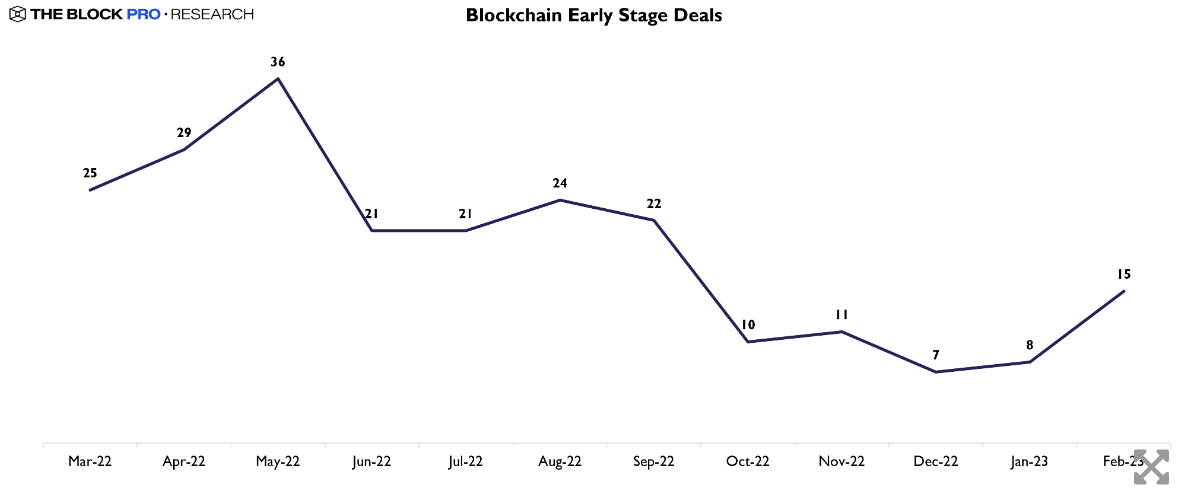
Last month, early stages deals such as FashionX’s Series A showed an uptick since a sharp decline last October. The number of early-stage deals doubled from last month’s eight to 15 in February, per The Block Research. Still, in terms of dollar amount, the average size of such deals declined.

 “One contributor to the rise in early-stage rounds may be that financing terms have come down, resulting in investors being more willing to invest in companies at this stage,” explained The Block’s Deals research director John Dantoni. “Six of the fifteen raises in our dataset had a valuation that averaged $103.5 million, and the median valuation equated to $92.5 million.” 

© 2023 The Block Crypto, Inc. All Rights Reserved. This article is provided for informational purposes only. It is not offered or intended to be used as legal, tax, investment, financial, or other advice.

Go to Source
Author: Tom Matsuda

Blockchain infrastructure developer Smooth raises $2 million in seed funding

Smooth Labs, a blockchain infrastructure startup, raised $2 million in a seed funding round.

NGC Ventures, one of the most active crypto investment firms, led the round, Smooth said. Other investors included Cogitent Ventures, ArkStream Capital and Ian Balina’s Token Metrics.

Smooth began raising for the round in November when FTX collapsed and closed it in January, co-founder Wiger Wei told The Block. He declined to comment on the structure of the round, i.e., whether it was an equity, token, or equity-plus-token-warrants round, and on valuation.

Smooth Labs was founded in July in Singapore by Wei, a former early researcher at Celestia, and Lucie Chen, a former founding partner at crypto investment firm LCC Ventures. Smooth is building blockchain infrastructure focused on the parallel execution of transactions. Parallel execution allows transactions to be processed simultaneously, significantly increasing transaction speeds and reduce wait times.

“Smooth is a high-performance module that enhances the transactions per second or TPS of Layer 2 networks and application-specific blockchains or appchains by up to five times,” Wei said. While the concept of parallel transactions is not new, Smooth is the “first” project to leverage the concept for Layer 2s and Appchains, he said. Smooth is also compatible with Ethereum virtual machine.

Zi Chen, partner at NGC, said the Smooth team predicted in 2021 that Ethereum Layer 2 networks wouldn’t be sufficient to resolve the blockchain’s scalability issues and had already proposed a general parallel transaction middleware idea and continued to refine it throughout 2022. “The team behind Smooth are some of the youngest and most innovative entrepreneurs we’ve ever met,” said Chen.

The Smooth network is currently under development. It will launch a testnet in the third quarter, said Wei. Smooth is looking to expanding its team of 12 members by hiring in the engineering and business development functions, according to Wei.

© 2023 The Block Crypto, Inc. All Rights Reserved. This article is provided for informational purposes only. It is not offered or intended to be used as legal, tax, investment, financial, or other advice.

Go to Source
Author: Yogita Khatri

Unstoppable Domains releases web3 domain names for Polygon blockchain

Unstoppable Domains released the domain ending .polygon in partnership with Polygon Labs. This will make it easier for anyone to send money over the Polygon blockchain through applications that support this service.

Crypto domain names are used to replace the long alphanumeric strings that are used to identify wallets publicly. The idea is that they’re easy to type and remember. While such domain services need to be integrated by crypto wallets and applications, Unstoppable Domains says it will be possible to use .polygon domains across 750 applications, games and metaverses.

“Web3 domains will give our community a digital identity that they fully own, so they can log into dapps without giving away their personal information and transact crypto without lengthy wallet addresses,” said Sanket Shah, vice president of business development at Polygon Labs, in a press release.

Those wanting to use the service must buy the domains from Unstoppable Domains, with the sale starting March 16. After the sale, the company will put premium domains, like gamer.polygon, up for sale.

© 2023 The Block Crypto, Inc. All Rights Reserved. This article is provided for informational purposes only. It is not offered or intended to be used as legal, tax, investment, financial, or other advice.

Go to Source
Author: Tim Copeland

Filecoin becomes a blockchain platform compatible with Ethereum apps

Decentralized storage platform Filecoin has implemented its own virtual machine, enabling it to support smart contracts — opening it up to the world of decentralized applications, NFTs, liquid staking and more.

The network has always been designed to provide file storage in a decentralized manner — but now that it has launched its Filecoin Virtual Machine (FVM), it can support applications built on it. The goal is that this should encourage more tools built on the network, enable easier trading of tokens, support the creation of decentralized social media and, ultimately, become its own thriving ecosystem.

“The [FVM] augments the utility of Filecoin, and I think it also positions Filecoin as the Layer-1 blockchain that is uniquely positioned to power an open data economy,” said Lukkas Bresser, ecosystem growth at Protocol Labs. “It’s a really critical step in this broader roadmap of turning the services of the cloud into open markets. That’s what’s exciting here.”

Enhancing Filecoin’s main purpose

Filecoin’s virtual machine will give it the same capabilities as Ethereum, enabling anyone to build any kind of decentralized application on the network. It will also be able to support bridges to other blockchains and connect more closely to the rest of the crypto ecosystem. Bresser noted that SushiSwap, Axelar and Celer are all integrating with Filecoin.

Applications built on Filecoin will enhance its primary purpose of providing decentralized file storage. Files stored on the network are typically stored for around 18 months before someone needs to manually request the network to store them for another period of time — but applications can now be built that provide many more custom options, including the ability to pay for the data to be stored for much longer periods of time.

Filecoin applications will also be able to monetize data sets. Bresser said that, for example, multiple parties could generate training data on an AI model and upload this to Filecoin. Then anyone who wanted to access the data would pay these parties to do so. In this instance, “everybody who contributed to the data model is rewarded in direct contribution to their training data.”

Bresser added that this could expand to other products like decentralized social media. He suggested users could own their social graphs (the data around their connections and social media usage), control access to this data and monetize it in more ways than just advertising. This would also be possible because data on Filecoin is not stored unencrypted on the actual chain itself.

“I believe some of the things critical for social networks will be powered by Filecoin infrastructure. We are in conversation with a few of the web3 experiments that are trying to do things around social,” he said.

With the FVM, Filecoin will be able to support liquid staking, unlocking the value of tokens that are staked. Bresser said that there is a range of liquid staking providers that will add support for Filecoin, set to be announced in a few days.

NFTs that are closer to their images

There’s always been one significant criticism of NFTs: that they tend to link to images that aren’t stored on-chain. Bresser said that applications could be built on Filecoin that address this issue and provide a stronger guarantee that the image will be available.

Bresser said that you could have the image data stored on IPFS — like most are — for easy access to the image, but a backup version of the image could be stored on Filecoin. Now with data stored on Filecoin, the provider proves to the chain every 24 hours that it still exists. So this could be applied to NFTs, with the NFT getting a daily confirmation that the image is still being stored on its behalf. 

“I believe that the FVM has a lot of potential to allow the creation of NFTs that don’t only certify ownership, but also provably, verifiably show that the file is stored in a way that it persists over many hundreds of years,” said Breser.

While this is still a hypothetical use case, if it does get built, it could help prevent NFTs from having their images changed — or even removed entirely.

© 2023 The Block Crypto, Inc. All Rights Reserved. This article is provided for informational purposes only. It is not offered or intended to be used as legal, tax, investment, financial, or other advice.

Go to Source
Author: Tim Copeland


Follow by Email
Facebook20
Pinterest20
fb-share-icon
LinkedIn20
Share