FreeCryptoCurrency.Me

Free stocks and money too!

Category Archive : Crypto News

Number of traders hits lowest since 2021 amid US banking crisis: The week in NFTs

With only about 12,000 ethereum NFT traders active this Saturday, the industry clocked its slowest day in terms of active traders since the fourth quarter of 2021, according to data from DappRadar. The number of traders was down from around 30,000 to 40,000, where it remained for most of February.

The volume of total NFT trades also reached its lowest day so far this year, DappRadar said.

The drop came on the heels of last week’s announcements that Silicon Valley Bank had collapsed while crypto-friendly bank Silvergate said it would “wind down” operations.

Other highlights:

  • Trading wasn’t down across the board, however. During the last week Polygon sales volumes spiked by more than 60%, according to CryptoSlam!. Mid-month Polygon trading is on pace to equal February’s strong showing of more than $30 million in trading volume. It has been eight months since Polygon’s scored a higher month of trading in dollar terms.
  • The largest NFT sale of the week was a set of nine Qing Dynasty plates, which sold for 366,000, according to CryptoSlam!.
  • Blue chip collections nabbed the highest sales volumes with Yuga Labs’ Bored Ape, Sewer Pass and Mutant Ape NFT collections making up the top-three best-selling collections after racking up more than $20 million in combined trading volume.

© 2023 The Block Crypto, Inc. All Rights Reserved. This article is provided for informational purposes only. It is not offered or intended to be used as legal, tax, investment, financial, or other advice.

Go to Source
Author: Sam Venis and RT Watson

Bitcoin mining report: March 15

Bitcoin mining stocks tracked by The Block were mostly lower on Wednesday, with two gaining and 16 declining.

Bitcoin fell 2.2% to $24,330 by market close.

© 2023 The Block Crypto, Inc. All Rights Reserved. This article is provided for informational purposes only. It is not offered or intended to be used as legal, tax, investment, financial, or other advice.

Go to Source
Author: Catarina Moura

Inside the chaos at Umami Labs: The challenge of breaking into the mainstream

Umami Labs was set to launch its new decentralized finance product this month, but employees of the DeFi project quit en masse, and now the CEO is embroiled in a bitter fight with former employees.

The internal battle at Umami Labs underscores the tension DeFi projects face as they try to break into the institutional mainstream while staying true to their decentralized ethos. The fight has also left Umami token holders caught in the middle. They are bracing for a legal battle, watching the Umami token price fall and tracking the drama on social platforms like Discord and Twitter.

“In a lot of ways, DAOs work great until there’s a conflict and a dispute,” said Nelson Rosario, a partner at Rosario Tech Law who focuses on blockchain and crypto issues. “In situations when conflict arises, it can be problematic for participants in the DAO, because either an explicit or kind of natural hierarchy usually emerges in moments of conflict, and what the exact kind of boundaries are with respect to who does or doesn’t have legal rights is not always clear.”

Umami Labs bills itself as a project that is “pioneering institutional DeFi” by creating “regulatory-compliant, non-custodial DeFi strategies for financial institutions in the U.S. and beyond.”

The company acts as the legal entity that runs operations and develops products for Umami DAO. It is helmed by CEO Alex O’Donnell, an early Umami DAO contributor and former Reuters News journalist. 

Umami Labs had planned to launch its first DeFi product last week, a “non-custodial, institutional-grade strategy for generating competitive risk-adjusted returns on assets including $USDC, $ETH and $BTC.” 

The project never got that far.

Employees quit, accusations fly

Last month, nearly all of Umami Lab’s employees quit their jobs, accusing O’Donnell of trying to take control of Umami’s $5.9 million treasury. O’Donnell, meanwhile, says the former Umami Labs employees are actually the ones who seized Umami’s treasury and intellectual property — and violated their employment contracts.

“I have an obligation to restore the assets to their legal entity home on behalf of token holders,” O’Donnell said in an exclusive interview with The Block. “We’re going to get them back. There’s no real question about that.” 

O’Donnell retained the law firm Jenner & Block to represent himself and Ievgeniia Vatrenko to represent Umami Labs. But the CEO and Umami’s former employees are hoping to come to an agreement outside of a courtroom instead. 

Lawyers for O’Donnell and former Umami Labs executives had a two-hour meeting earlier this month to lay out how negotiations can proceed. They later initiated arbitration proceedings.

The parties “established a framework in principle within which the parties are hopeful they will be able to negotiate an amicable resolution to the ongoing dispute. The attorneys are still working out the details,” O’Donnell said in a statement.

A community manager for Umami DAO confirmed that some DAO contributors have hired lawyers, and that the individuals are paying for their own legal counsel. 

Competing visions

The conflict at Umami Labs boiled over in January, weeks before Umami’s new product was set to launch. By mid-February, all of the project’s 11 employees had quit.

“The entire team gradually lost faith in his leadership and vision, including the community managers and developers. They felt that the token holders’ wishes were not being considered and that Mr. O’Donnell’s vision was far from being in their best interests,” Alex Golubitsky, the former chief legal officer at Umami Labs, said in an email to The Block. Golubitsky was suspended from his role in January and later terminated.

O’Donnell disputes accusations that he was trying to take control of the treasury. Instead, O’Donnell says the conflict at the heart of the Umami breakup were his and Golubitsky’s conflicting visions for the future structure of the project. 

Internal Umami Labs Slack messages shared with The Block show O’Donnell and Golubitsky butted heads on whether to make changes to Umami’s offerings and whether to bring in outside counsel.

“I had these concerns about our overall legal entity structure and our strategy. I wanted to take a second look at things to see where we could have to improve. We had a product launch scheduled in March, so the clock was ticking to make any revisions before we launched our product. And it was in that context we had that conflict with the chief legal officer,” O’Donnell said, adding that Golubitsky tried to block him from bringing in an outside lawyer to review Umami’s legal structure. 

It would be legally impossible to seize the Umami treasury, O’Donnell says, because of multi-signature agreements needed to take action at the company. The multi-sig contracts, along with other employment contracts, have been reviewed by The Block.

“I couldn’t have stolen the treasury assets even if I wanted to, because you need those three sign-offs,” O’Donnell said. 

Around the same time, the Umami Labs employees quit their jobs and O’Donnell sold his tokens, cashing them out for approximately half a million dollars and sending the token price down to $8.29. O’Donnell told The Block he sold the tokens to gear up for what might be a costly legal battle.

“I was told that there was going to be no coverage for legal fees, which of course, was going to be really important to try to remedy this,” O’Donnell said. “I took my personal allocation of tokens that had already been invested to my wallet … and I sold it, you know, ultimately at a pretty steep discount so that I could raise the funds as quickly as possible for the legal defense that was going to be needed for Umami.”

Golubitsky called the move “an unforgivable betrayal.” The Umami token has since recovered to $12.52 as of Wednesday afternoon.

“Simply put, Mr. O’Donnell wished to take control over the Umami treasury for his personal ends. When it became clear to Mr. O’Donnell that he would be unable to use Umami Labs as a vehicle to gain control over the treasury of Umami DAO, he liquidated his large holdings of $Umami tokens,” Golubitsky said. “This was an unforgivable betrayal of the trust of the Umami community and of the policies of Umami Labs.”

Token holders in the middle

In the weeks since the Umami Labs fiasco came to a head, the Umami DAO voted in nine former Umami Labs employees to continue the project. Developers are still working on bringing the new product to fruition, but some token holders say they are stuck in limbo.

“The token holders are kind of in the middle of this and they just want it to end in a way that benefits them. So that would mean that the product can still launch and the token holders are able to also have a say in, ‘Okay, what is the solution?’” said Stan Colenbrander, a cryptocurrency researcher and Umami token holder.

O’Donnell, who is still negotiating with his former employees, says he is doubtful that the project will meet its goal of attracting institutional users in the U.S. and other big markets, and may only appeal to DeFi-native users. 

“Without the legal structure put in place under Umami Labs, LLC, it’s less likely to reach institutional users, as had been originally intended,” O’Donnell said. 

The conflict at Umami Labs also underscores the limits of decentralization and smart contracts when human beings are involved, noted Rosario, the crypto lawyer who is not involved in the conflict. It is hard for DAOs to “be flexible enough to deal with the infinite dispute universe.”

“Smart contracts are great for the things that you can code in that are regular and kind of expected. It’s when you have to get into the flexibility of human insanity. Good luck,” Rosario said.

© 2023 The Block Crypto, Inc. All Rights Reserved. This article is provided for informational purposes only. It is not offered or intended to be used as legal, tax, investment, financial, or other advice.
Go to Source
Author: Stephanie Murray

Fidelity Crypto quietly went live, giving millions of retail customers access to bitcoin, ether

Fidelity Digital Assets quietly opened access to Fidelity Crypto for the masses recently.

Millions of users can now trade bitcoin and ether commission-free on the platform. The app was previously restricted to a waitlist, with users given access on a rolling basis. Fidelity Crypto is open to new and existing customers — first-time customers must create a Fidelity Brokerage account during the setup process.

Bitcoin and ether are the two assets users can trade right now, and trading is commission-free. The firm will charge a spread of no more than 1%. Withdrawals haven’t yet been enabled on the platform. 

Fidelity has acted sooner than most of its peers in the U.S. in offering crypto to retail clients. The full launch happened over the past few weeks, according to sources with knowledge of the matter.

The launch coincided with an increasingly hot regulatory environment in the U.S. and the collapse of two of crypto’s biggest banking partners, Silvergate and Signature Bank. 

The investment manager filed three U.S. trademark applications at the end of 2022. The applications included providing services in the metaverse and other virtual worlds. 

© 2023 The Block Crypto, Inc. All Rights Reserved. This article is provided for informational purposes only. It is not offered or intended to be used as legal, tax, investment, financial, or other advice.

Go to Source
Author: Adam Morgan McCarthy and Frank Chaparro

Gensler suggests proof-of-stake tokens are securities

Securities and Exchange Commission Chair Gary Gensler suggested to reporters on Wednesday that tokens using staking protocols could be considered securities under U.S. law. 

“The investing public is investing anticipating a return, anticipating something on these tokens, whether they’re proof-of-stake tokens, where they’re also looking to get returns on those proof-of-stake tokens and getting 2%, 4%, 18% returns,”  Gensler said. “Whatever they’re promoting and putting into a protocol, and locking up their tokens in a protocol, a protocol that’s often a small group of entrepreneurs and developers are developing, I would just suggest that each of these token operators … seek to come into compliance, and the same with the intermediaries.” 

Gensler made the remarks after being asked for his reaction to statements made last week by Commodity Futures Trading Commission Chair Rostin Behnam, who reiterated his own belief, and that of his agency, that ether is a commodity.

Gensler spoke to reporters after a commission vote advancing three proposed rules aimed at tightening cybersecurity, consumer privacy, and system standards for the securities industry, including at some firms involved in digital assets. 

Gensler has previously said that proof-of-stake protocols could fall under U.S. securities laws, but he elaborated in more detail during Wednesday’s remarks. The SEC also recently undertook it first staking-as-a-service enforcement action and settled with Kraken last month. 

New York Attorney General Letitia James has separately argued that ether is an unregistered security and that its creators, including Vitalik Buterin, are not in compliance with U.S. securities law as part of an enforcement lawsuit filed against crypto firm KuCoin. 

© 2023 The Block Crypto, Inc. All Rights Reserved. This article is provided for informational purposes only. It is not offered or intended to be used as legal, tax, investment, financial, or other advice.

Go to Source
Author: Colin Wilhelm

Coinbase to process ETH unstaking requests 24 hours after Shanghai update

Coinbase will begin to take unstaking requests around 24 hours after the Shanghai-Capella upgrade to the Ethereum network that will allow users to unstake ETH goes live, the exchange said on Twitter.

However, that doesn’t mean users will be able to unstake their ETH right away because “the Ethereum protocol controls the unstaking process and we’re simply the conduit,” Coinbase, said, adding “we can’t share an exact waiting period when you request to unstake.”

Coinbase currently provides a 6.0% APY return on staked ETH.

Once unstaking requests are processed on-chain and released by the Ethereum protocol, Coinbase confirmed users will receive all their staked ETH, in addition to staking rewards accrued.

While Coinbase will process withdrawal requests just a day after the Ethereum Shanghai-Capella update, staking platform Lido said it will wait until mid-May to initiate staked ETH withdrawals following the completion of on-chain code audits to ensure user safety.

© 2023 The Block Crypto, Inc. All Rights Reserved. This article is provided for informational purposes only. It is not offered or intended to be used as legal, tax, investment, financial, or other advice.

Go to Source
Author: Jeremy Nation

SEC, DOJ charge businessman connected to Steve Bannon with fraud involving crypto

Miles Guo, an exiled businessman, was arrested this morning in New York over a $1 billion fraud conspiracy involving cryptocurrency. 

Guo, who goes by multiple names, defrauded thousands of online followers and bought himself and people close to him “a 50,000 square-foot mansion, a $3.5 million Ferrari, and even two $36,000 mattresses,” U.S. Attorney Damian Williams said in a statement.  

Guo is also reportedly linked to Steve Bannon, former White House chief strategist to former President Donald Trump. In 2020 Bannon was charged with fraud and arrested on Guo’s yacht, before Trump pardoned him as one of his last acts in office. 

Kin Ming Je, also known as William Je, and Guo “fraudulently induced” followers to fund an online membership club called G|CLUBS, the U.S. Attorney’s Office in the Southern District of New York said.

‘Himalaya Exchange’

Guo and Je also “fraudulently obtained” more than $262 million through the so-called Himalaya Exchange, a crypto “ecosystem” that said it had a stablecoin called the Himalaya Dollar and a trading coin called the Himalaya Coin, the department said. Guo and Je face 11 counts together, amounting to decades in possible prison time. Je is still at large, the DOJ said.  

The Securities and Exchange Commission also brought its own charges against the pair on Wednesday for raising more than $850 million in “unregistered and fraudulent offerings.” Guo was charged solely for raising hundreds of millions of dollars through the Himalaya Coin and the related stablecoin, the SEC said.  

“Guo allegedly has made material misrepresentations to prospective investors in H-Coin, falsely stating that 20 percent of H-Coin’s value was backed by gold and that he would personally compensate investors for any potential losses,” the SEC said.  

The SEC said the H-Coins were unregistered securities. 

© 2023 The Block Crypto, Inc. All Rights Reserved. This article is provided for informational purposes only. It is not offered or intended to be used as legal, tax, investment, financial, or other advice.

Go to Source
Author: Sarah Wynn

‘We’re trying to save crypto from the banks’: Circle CEO Allaire

Circle CEO Jeremy Allaire isn’t buying any narratives which suggests the traditional banking system needs to be protected from crypto. Instead, he believes the opposite to be true.

“Everybody’s talking about how we need to save the banks from crypto and right now we’re trying to save crypto from the banks,”  said Allaire during an interview with the hosts of the Bankless podcast.

The scrutiny of how traditional banks manage deposits they hold on behalf of crypto companies has intensified in recent days after a run of prominent financial institutions like Silvergate, Silicon Valley Bank and Signature Bank all shuttered.

Circle is currently in the process of moving $3.3 billion from Silicon Valley Bank to BNY Mellon, said Allaire.

“We’ve got $3.3 billion in transit and we can see in the fed wire system that the receiving bank is acknowledging ‘yes, this is incoming,’” said Allaire. “It hasn’t settled on the fed wire ledger.”

Circle operates the USDC stablecoin, which depegged on news that the company had money held at Silicon Valley Bank. 

© 2023 The Block Crypto, Inc. All Rights Reserved. This article is provided for informational purposes only. It is not offered or intended to be used as legal, tax, investment, financial, or other advice.

Go to Source
Author: RT Watson

Sam Bankman-Fried wants FTX to prioritize covering his legal bills

Former FTX CEO Sam Bankman-Fried wants to use the crypto exchange’s director and officer liability insurance to pay his legal bills, his lawyers said in a court filing on Wednesday.

If the court approves Bankman-Fried’s request, it would effectively put the former billionaire at the front of the line for an FTX payout — ahead of the FTX creditors, a move that his company’s new leadership has so far resisted. 

Bankman-Fried is facing a litany of criminal charges for his alleged wrongdoing at FTX, the crypto exchange he founded. The former billionaire is awaiting an October trial and could spend the rest of his life in jail if he’s convicted on all charges. 

Experts have said Bankman-Fried’s legal defense could cost millions of dollars. 

Bankman-Fried seeks a court order in the FTX bankruptcy case that would allow him to access funds through the company’s director and officer insurance plan for “the reimbursement and payment of his defense costs.” 

Director and officer liability insurance typically protects the executives of a company in the event that they are the target of a lawsuit. Bankman-Fried wants to access corporate insurance policies FTX held with Relm Insurance and Beazley Insurance. 

Bankman-Fried asked FTX to agree that the insurance policy “provides priority of payment to individual insureds with un-indemnified loss like Mr. Bankman-Fried.” FTX’s new leadership has not agreed to Bankman-Fried’s request, prompting him to request a judge make them do so.  

Disclaimer: The former CEO and majority shareholder of The Block has disclosed a series of loans from former FTX and Alameda founder Sam Bankman-Fried.

© 2023 The Block Crypto, Inc. All Rights Reserved. This article is provided for informational purposes only. It is not offered or intended to be used as legal, tax, investment, financial, or other advice.

Go to Source
Author: Stephanie Murray

Bitcoin, crypto prices trade lower, while some suggest stocks might be overvalued

Crypto prices slipped on Wednesday as banking worries persisted and some analysts suggested stocks could be overvalued. 

Bitcoin was trading at around $24,400 by 12:30 p.m. EDT, down about 1.3% over the past few hours, according to TradingView data. Ether dipped about 2% to $1,650. 

Taking a beat?

“U.S. markets are beginning to price a higher probability of a Fed pause as sentiment deteriorates,” the GSR analysts said, adding that “lower-than-expected retail sales and PPI releases provide increased flexibility for the Fed to potentially pause at next week’s FOMC.”

The Fed will announce its latest interest rate decision a week from today, with the market now pricing in a near 58% probability of a pause. 

FedWatch, the CME’s tool, analyzes the probability of changes to the Fed rate using 30-Day Fed Funds futures pricing data, now shows a 57.9% probability of a pause — up from about 30% yesterday. 

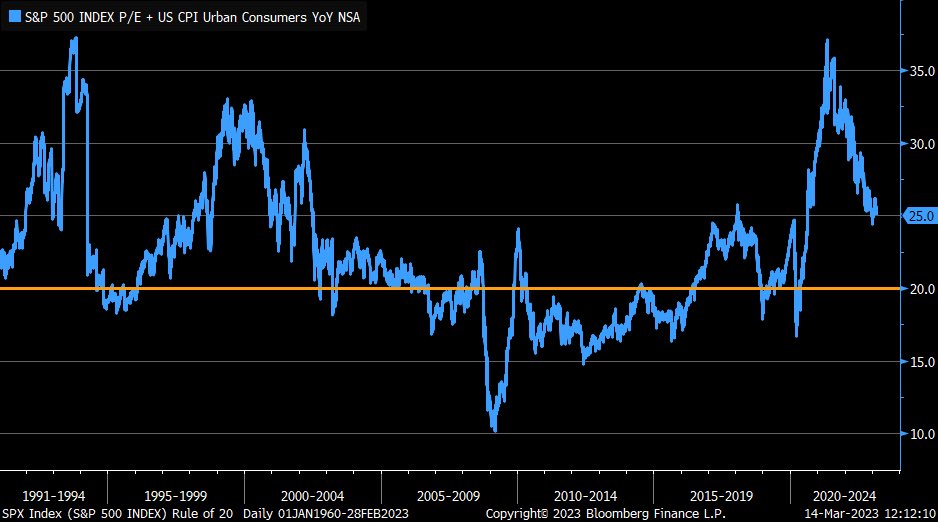
Rule of 20

Charles Schwab’s chief investment strategist, Liz Ann Sonders, says the Rule of 20 suggests stocks might be overvalued.

The rule says if the S&P 500 price-earnings ratio and CPI year-on-year equal 20, markets may be fairly valued.

The S&P 500 P/E is currently around 20.65, according to Multpl data, while year-on-year inflation came in at 6% in February — suggesting markets are overvalued.

© 2023 The Block Crypto, Inc. All Rights Reserved. This article is provided for informational purposes only. It is not offered or intended to be used as legal, tax, investment, financial, or other advice.

Go to Source
Author: Adam Morgan McCarthy


Follow by Email
Facebook20
Pinterest20
fb-share-icon
LinkedIn20
Share