FreeCryptoCurrency.Me

Free stocks and money too!

Category Archive : Crypto News

How shareholders are selling OpenSea stock despite restrictions

NFT marketplace OpenSea is a privately held startup that was last valued at $13.3 billion when it raised $300 million in early 2022. Like many prized startups, OpenSea does not permit sales of its shares by staff or investors without sign-off from the board.

And yet in one obscure corner of the startup investment space, OpenSea stock can be found on offer at steep discounts. So too are the shares of many of the crypto sector’s blue-chip companies, as The Block reported in March.

How is this possible? The answer is that brokerage platforms are skirting restrictions on stock trading through the use of Special Purpose Vehicles (SPVs) — bespoke legal entities set up purely to facilitate secondary market transactions.

“Even where a private company restricts trading in its stock, it may still be possible for investors to buy and sell indirect interests in that company’s stock by trading the ownership interest of an SPV that, in turn, owns the private company’s stock,” said Nick Fusco, founder and CEO of ApeVue, a data provider focused on pre-IPO companies.

An awkward fix

The workaround is the source of some tension between startups and their shareholders.

The beleaguered state of the crypto and indeed global markets over the past year has weighed heavily on startup valuations. In Oct. 2022, Blockchain.com was reportedly in talks about raising money at a valuation of $3-4 billion, down from $14 billion just six months earlier. Beyond crypto, Swedish buy-now-pay-later giant Klarna saw its valuation fall 85% when it raised $800 million in July last year.

Some well-capitalized startups, however, have weathered the market downturn without needing to raise more money, avoiding the dreaded “down round” — which involves raising money at a valuation lower than in previous rounds. Down rounds can hurt startups both in terms of optics and because they’re demoralizing for staff, whose share options are suddenly worth less.

But secondary market platforms like Forge Global offer another barometer for the value of startup equity. Through them, investors and employees have a means to mark-to-market their shares.

OpenSea is a prime example. The category-defining NFT company has so far managed to avoid raising money in the bear market. Yet as of March 5, OpenSea shares were trading at a 51% discount on Birel, a secondary market platform for startup shares.

The chart below, based on data collected by ApeVue, paints a picture of how the secondary market for OpenSea shares has evolved since Jan. 2022. It’s based on data taken from institution-focused brokers of unlisted equity.
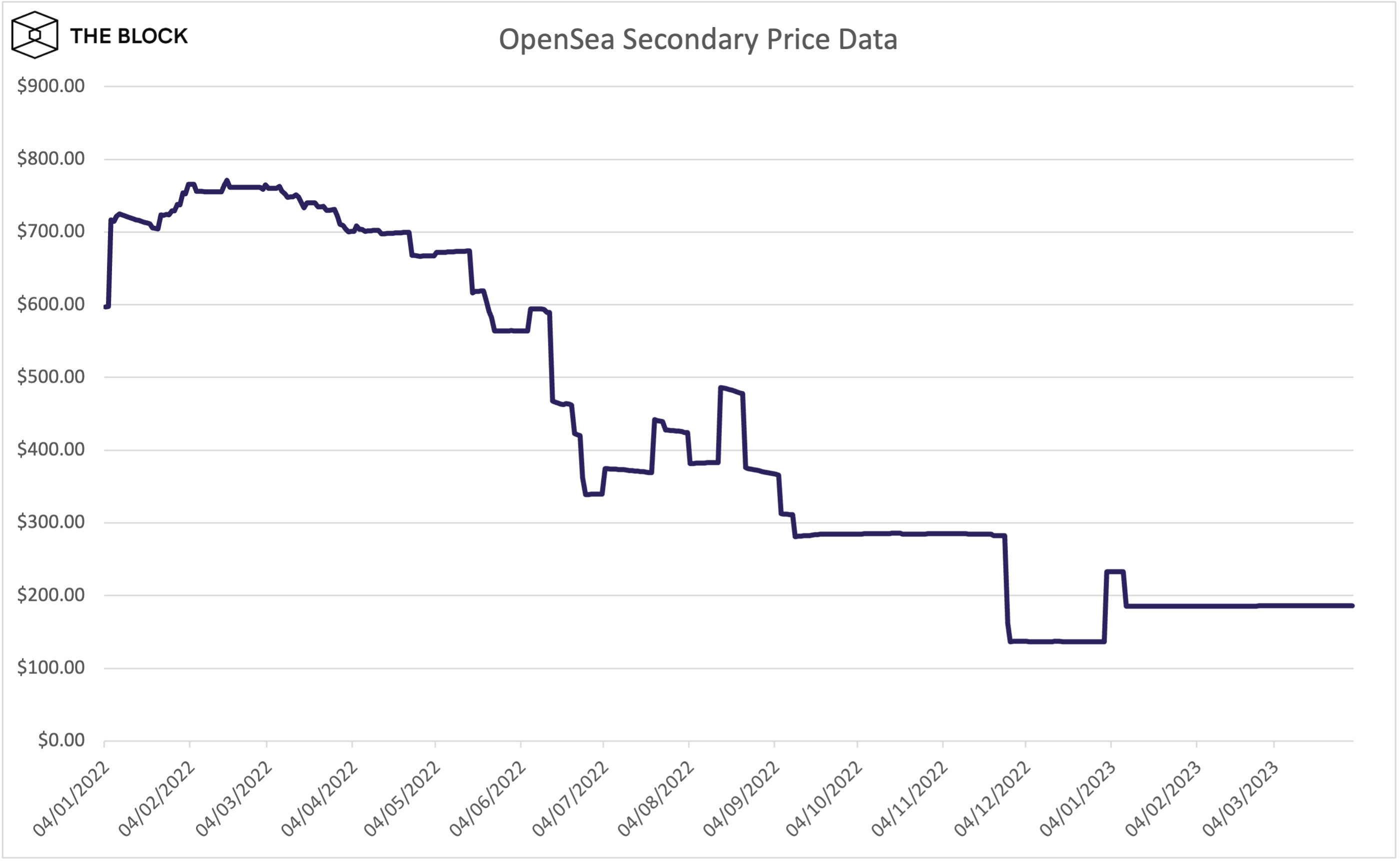
source: ApeVue

Dodging the block

OpenSea has forbidden unsanctioned secondary sales since March 2021. An excerpt of the bylaws of the corporate entity behind OpenSea, Ozone Networks, Inc., obtained by The Block, states, “A stockholder shall not transfer (as such term is defined below) any shares of the corporation’s stock (or any rights of or interest in such shares) to any person unless such transfer is approved by the board of directors prior to such transfer, which approval may be granted or withheld in the board of directors’ sole and absolute discretion.”

Such restrictions are by no means unusual. “This is already the norm. Many companies do not want deals in the secondary market, so they prohibit it,” said Birel’s CEO Richard Freemanson. 

“We have OpenSea holders who are interested in an exit. In order to make sure the deal won’t be blocked by the company, sellers offer allocations via SPV, and rarely through forward contracts. It’s common practice in secondary market,” Freemanson added.

It is not exactly clear how OpenSea or other startups in the same position feel about the state of play. OpenSea did not immediately respond to a request for comment.

At least some investors, however, see it as far from ideal. One person, who spoke on condition of anonymity, said that 95% of OpenSea shares trading on secondary markets take the form of SPVs, with each lot attached to its own entity. This fragments liquidity and hinders trading, they said. 

Another investor, a founder and angel investor in fintech firms, said investors would prefer to buy shares directly, as SPVs come with additional fees and less control. “You’re one step removed from the actual investment, which just really isn’t ideal,” they added. 

© 2023 The Block Crypto, Inc. All Rights Reserved. This article is provided for informational purposes only. It is not offered or intended to be used as legal, tax, investment, financial, or other advice.

Go to Source
Author: Ryan Weeks and Adam Morgan McCarthy

OpenSea Pro overtakes rival Blur in key metric as volumes and addresses surge

NFT aggregator OpenSea Pro has seen significant increases in active addresses and transaction volumes this week following its launch. It also managed to take and maintain the top share of transactions in a competitive market.

Both new and active daily addresses surged following OpenSea’s announcement of its new offering — geared toward professional traders and meant to rival upstart NFT marketplace Blur.

Dune Analytics chart of new daily addresses for OpenSea Pro

New daily addresses on OpenSea Pro surged following its launch. Source: Dune/@onures

According to data from Dune, new addresses on OpenSea Pro spiked to above 1,800 daily before falling back toward 1,000.

Active addresses also surged above 3,500 daily and have been hovering below 3,000 since.

Dune Analytics chart of active daily addresses for OpenSea Pro

Active daily addresses on OpenSea Pro have also spiked. Source: Dune/@onures

Daily volume on the rebranded platform has similarly surged, surpassing $3 million. It has since hovered above $2.5 million.

Dune chart showing daily volume in USD on OpenSea Pro

Daily volume in USD on OpenSea Pro has increased significantly since its launch. Source: Dune/@onures

OpenSea Pro vs. Blur

Blur has long dominated daily volume among NFT aggregators since arriving on the scene with its high-profile airdrops, meant to incentive activity on the platform. Now, it has some competition.

OpenSea Pro has been battling Blur for most daily volume among NFT aggregators. The former took the lead on April 5 and April 6 but lost the lead to Blur yesterday.

Dune chart showing daily volume among NFT aggregators.

OpenSea Pro has made volumes among NFT aggregators more competitive. Source: Dune/@onures

Similarly, OpenSea Pro garnered the most-significant percentage share of the market among NFT aggregators on April 5 and April 6 — but, again, lost the lead to Blur yesterday.

Dune chart showing NFT aggregators' daily volume share

OpenSea Pro has also made the landscape of NFT aggregators’ daily volume share more competitive. Source: Dune/@onures

OpenSea Pro dominating transactions share

One metric which has seen OpenSea Pro take and maintain the lead over rival Blur is daily transactions share among NFT aggregators.

OpenSea’s new offering saw the most daily transactions on April 5, garnering 55.1% of the market against Blur’s 29.5%. It took an even larger share of overall transactions the following day, with 58.4% occurring on OpenSea Pro.

Yesterday — and so far today — OpenSea Pro is maintaining more than 50% of transactions among NFT aggregators.

Dune chart showing transactions share among NFT aggregators on a daily time frame

OpenSea Pro is dominating daily transactions share among NFT aggregators. Source: Dune/@onures

The NFT aggregator formerly known as Gem

OpenSea Pro is — at least in some ways — a rebranding of NFT aggregator Gem, which OpenSea acquired in April of last year.

At the time, Gem said the acquisition offer was “unexpected” but would accelerate its next growth stage. Meanwhile, OpenSea said that it would be able to “learn from Gem’s expertise and intuition about the advanced NFT community.”

Gem has since been integrated into OpenSea Pro.

“Building on previous Gem designs, we’re excited to roll out a vastly improved suite of features that will allow collectors to discover the best deals and insights across 170 marketplaces and access sophisticated tools that meet their need for automation,” OpenSea said.

© 2023 The Block Crypto, Inc. All Rights Reserved. This article is provided for informational purposes only. It is not offered or intended to be used as legal, tax, investment, financial, or other advice.

Go to Source
Author: Adam James

Bitcoin Miner Sphere 3D Sues Partner Gryphon Digital

Gryphon sent $500,000 of Sphere 3D’s bitcoin to an address pretending to be its CFO.

Go to Source
Author: Eliza Gkritsi

dYdX to end support for Canadian users, cites regulatory environment

dYdX said its decentralized derivatives exchange will no longer be accessible to Canadian customers.

New users won’t be able to join the exchange beginning today, and trading support for existing Canadian customers will end in a week. 

“On April 14th at 17:00 UTC, dYdX will move all existing users in Canada to close-only mode, and users will maintain the ability to withdraw funds from the protocol at any time,” the dYdX team said in a blog post.

The exchange nodded to the current regulatory environment in Canada in announcing the move. Canada has adopted a more restrictive stance toward exchanges in the country in recent months, a process that accelerated following the collapse of FTX. Regulators are expected to release updated guidance in the near future. 

“We hope that the regulatory climate in Canada will change over time to allow us to resume services in the country,” the dYdX team wrote. 

The former CEO and majority shareholder of The Block has disclosed a series of loans from former FTX and Alameda founder Sam Bankman-Fried.


© 2023 The Block Crypto, Inc. All Rights Reserved. This article is provided for informational purposes only. It is not offered or intended to be used as legal, tax, investment, financial, or other advice.

Go to Source
Author: Michael McSweeney

The Rolling Stones one-of-one NFTs that aren’t NFTs

Later this month, fans of The Rolling Stones will be able to purchase one of 40 unique and vintage photos. Each photo will have a non-fungible token, or NFT, linked to the physical collectible which serves as a certificate of ownership.

Just don’t call them NFTs.

The companies managing the drop, OneOf and Globe Entertainment, are using the term Digital Certificate of Authenticity, or DCOA, as their preferred nomenclature. The collection of photos, which come in slide form and are “encased” in transparent plastic frames, will feature “historical moments captured from various tours over the 1960s-1990s,” including some images of Mick Jagger and Tina Turner.

The trend of companies shying away from calling digital assets or tokens with utility NFTs in favor of more generic terminology like digital collectibles appears to be gaining momentum, especially when geared towards mainstream consumers. A recent promotion for a Nicolas Cage vampire movie, Fox Entertainment using tokens as loyalty passes for fans of its show “Masked Singer,” and Reddit’s avatars are all examples of NFTs being issued without using the term itself.

NFTs have come to carry a negative connotation for many as scandal and major price deterioration have plagued the digital-assets market, causing some people to sour on the once hot space.

The limited edition The Rolling Stones photo slides and NFTs collection will be available next week and cost anywhere from $199 to $300. Each slide and photo are considered one of one collectors’ items.

© 2023 The Block Crypto, Inc. All Rights Reserved. This article is provided for informational purposes only. It is not offered or intended to be used as legal, tax, investment, financial, or other advice.

Go to Source
Author: RT Watson

Paxos’s national banking charter application expired, but it may try again

Paxos’s dreams of a national banking charter died last week of extreme old age.

The stablecoin issuer’s application for a new bank charter, originally filed in December 2020, expired on March 31, records from the Office of the Comptroller of the Currency show. 

The development comes nearly two years after the OCC granted “preliminary conditional approval” of the company’s application to charter Paxos National Trust, New York. The approval allowed Paxos to split its operations between two entities, one being regulated on the national level and the other maintaining its existing regulatory structure.

The OCC gave Paxos 18 months to execute the business plan. The nod meant freedom to custody dollars and crypto alike, offer its stablecoin services across the country and run an exchange on the national level.

The now-expired application does not impact Paxos’s existing business, which is registered in New York, and the blockchain tech company could file another OCC application, a spokesperson told The Block.

“Paxos will determine its next steps in the near term, which could include reapplying for OCC oversight,” a spokesperson said in an email. 

Paxos’s ambitions

The OCC, the bureau within the U.S. Treasury Department that charters, regulates and supervises national banks, did not respond to a request for comment. 

The status of Paxos’s banking ambitions has been under scrutiny in recent months. Paxos battled rumors in February that it had been asked to withdraw its application for a national trust bank charter by the OCC.

The company is also facing actions from state and federal regulators. The Securities and Exchange Commission sent Paxos a letter in February informing the company that the commission was investigating its joint stablecoin project with Binance, BUSD. The New York Department of Financial Services also ordered Paxos to stop issuing BUSD. Paxos says it has stopped minting the token.

© 2023 The Block Crypto, Inc. All Rights Reserved. This article is provided for informational purposes only. It is not offered or intended to be used as legal, tax, investment, financial, or other advice.

Go to Source
Author: Stephanie Murray

Arbitrum-Based Camelot Crypto Exchange to Deploy V2 Upgrade Saturday

The v2 upgrade will include a new concentrated liquidity automated market maker aimed at making trading for the Camelot ecosystem more efficient.

Go to Source
Author: Sage D. Young

Crypto Derivatives Exchange dYdX Ices Canadian Market

The dYdX token, currently trading for $2.45 has slid over 5.4% in the last 24 hours.

Go to Source
Author: Sage D. Young

Coinbase Canada head, Algorand CFO highlight March crypto hires, exits and moves 

Crypto companies hired several high-level executives in March, more than the previous month, as the market rebounded. Big names, including Coinbase, Immutable and Anchorage Digital Bank, each added leadership roles to their teams.

Some crypto firms turned their attention to non-U.S. markets for growth, largely due to the increasing regulatory scrutiny and uncertainty in the U.S. Coinbase hired a country director in Canada. Avalanche developer Ava Labs hired heads of business in South Korea and Japan. 

Hires

  1. Layer 1 blockchain developer Algorand hired Matthew Commons as its first chief financial officer.

  2. Coinbase hired Lucas Matheson as country director in Canada. He joined the crypto exchange after spending over five years at Shopify.

  3. Crypto infrastructure provider Zero Hash hired Cyril Mathew as its new president and chief operating officer. Mathew previously led business development teams at Stripe and Coinbase.

  4. Zero Hash also hired Araba Eshun as U.K. head of compliance and MLRO (money laundering reporting officer) and deputy head of international compliance. Eshun joined the company from Gemini, where she was its U.K. head of compliance. 

  5. Pixelcraft Studios, the web3 gaming studio behind the popular NFT gaming protocol Aavegotchi, hired Jason Slama as its new Game Director. Slama has had stints at Ubisoft and CD Projekt Red.

  6. Ava Labs, the main developer behind blockchain project Avalanche, hired Justin Kim, a former investment banker at the Korea Development Bank, and startup veteran Roi Hirata as the heads of its business in South Korea and Japan, respectively. 

  7. Brazilian crypto-friendly bank Nubank appointed David Marcus to its board of directors. Marcus is the CEO and co-founder of Lightspark, a startup focused on building infrastructure for the Lightning Network. He previously led all payments and crypto efforts at Meta (formerly Facebook).

  8. Web3 investment firm CoinFund hired Julie Mossler as its head of marketing and communications. Mossler most recently served as chief marketing officer (CMO) at Metaplex, a Solana-based NFT infrastructure protocol.

  9. CoinFund also hired Jenna Pilgrim as head of portfolio growth.

  10. Decentralized cybersecurity protocol Naoris hired David Holtzman as chief strategy officer. Holtzman is the former IBM chief scientist and designer of the global DNS System used by ICANN. 

  11. Crypto investment firm Decasonic hired Danny Pantuso and Lauren Tierney as venture investors in its Chicago office.  

  12. Brian Brooks, former acting Comptroller of the Currency and former chief legal officer at Coinbase, joined the board of the HBAR Foundation, the organization helping drive the adoption of the Hedera network. Brooks also had brief stints as CEO at both Binance US and Bitfury.

  13. Square Enix, the web3-friendly Tokyo-based video game giant behind popular franchises such as Final Fantasy and Kingdom Hearts, said Takashi Kiryu would replace Yosuke Matsuda as the company’s president and representative director, pending shareholder approval. Matsuda will retire from the company. 

  14.  Hashed co-founder Alex Shin and veteran hedge fund investor Sandeep Ramesh are set to join Mysten Labs CEO Evan Cheng’s new venture fund as general partners.

  15. Web3 Foundation, whose flagship project is the Polkadot blockchain protocol, hired Thomas Fecker Boxler as CFO and member of the executive management team. Boxler joined from the Swiss VC fund Serpentine Ventures AG, where he was COO.

  16. Web3 gaming company Immutable hired David Bicknell as CFO and Devon Ferreira as CMO. The Australia-based company also promoted its senior vice president Jason Suen to chief commercial officer.  

  17. Leslie Lamb, formerly CMO at Coinflex, joined OPNX as its CEO. OPNX is co-founded by Lamb’s husband, Mark Lamb, along with disgraced Three Arrows Capital founders Su Zhu and Kyle Davies.

  18. Elad Gil (former VP at Twitter), Akash Garg (former CTO of Moonpay), and Rebecca Rettig (chief policy officer at Polygon) joined Electric Capital as advisors to support crypto founders.

  19. Casey Lewis, a former senior editor at New York Magazine, joined crypto investment firm Seven Seven Six as its head of content and communications.

  20. Cameron Dickie, former head of EMEA sales at B2C2, joined Nomura’s Laser Digital as head of distribution in Dubai.

  21. The Stellar Development Foundation hired Asiff Hirji, president of MoonPay, to its board of directors. 

  22. Binance Australia CEO Leigh Travers stepped down from his role. Ben Rose, general manager of Binance New Zealand, replaced Travers.  

  23. Crypto infrastructure firm PolySign hired Charles “Chuck” Ocheret as its new CTO. Ocheret has presented on Distributed Ledger Technologies (DLT) and Cryptocurrencies in Financial Services to the United States House Committee on Agriculture and has served on the US Commodity Futures Trading Commission’s Technical Advisory Committee (CFTC TAC). He has also served on the CFTC TAC Subcommittee on DLT and Market Infrastructure.

  24. Matthias Bauer-Langgartner, formerly managing director of U.K. and Ireland at crypto broker Bitpanda, joined the European Central Bank as senior supervisor focusing on crypto assets and DLT.

  25. Rahul Kothari, formerly of Reddit’s crypto team, joined Aztec Network, a startup focused on privacy for transactions on the Ethereum blockchain, as a software engineer.

  26. Samantha Bohbot, former vice president and head of growth at Digital Currency Group, joined crypto investment firm Rockaway X as chief growth officer and investor.

  27. Roshun Patel, former vice president at Genesis, joined Hack VC as a partner. 

  28. Alchemy Pay added Andy Ng to its management and advisory board. Ng previously held the position of senior vice president at Lazada and served as chief product officer for innovative products at Grab.

  29. Alchemy Pay also hired former White House senior advisor David Plouffe as its global strategic advisor.

  30. Komainu, the crypto custody joint venture of Nomura, Ledger and CoinShares, hired added three members to its leadership team. Pippa Wiskin joined the firm as head of marketing, Evelien van den Arend as head of compliance and regulation and Kalifa Figaro as head of finance.

  31. Blockchain analytics firm TRM Labs appointed Chris Brummer as a senior advisor to the company’s leadership team. Brummer is the Agnes Williams Sesquicentennial Professor of Financial Technology and Faculty Director of the Institute of International Economic Law, where he has been teaching since 2009. He is the founder of DC Fintech Week, a global public policy conference on finance and technology. He is also an advisor to the Digital Dollar Project and the Alliance for Innovative Regulation, and a visiting fellow at the Atlantic Council’s GeoEconomics Center.

  32. TRM Labs named its head of legal and government affairs Ari Redbord as Vice Chair of the Commodity Futures Trading Commission’s (CFTC’s) Technology Advisory Committee. 

  33. TON Foundation, a non-profit association of developers that exists to advance The Open Network (TON), hired Anthony Tsivarev as director of developer relations. Tsivarev previously served as a senior partner at First Stage Labs, a TON ecosystem venture builder.

  34. Anchorage Digital Bank appointed Julie L. Williams, former First Senior Deputy Comptroller and Chief Counsel and twice Acting Comptroller of the Currency at the OCC, as a new member of its board of directors.

  35. Shaun Heng, former head of Spartan Labs, joined Hustle Fund as a venture partner.

  36. The DeFi Education Fund (DEF) hired Michael Mosier of Espresso Systems and Arktouros for its steering committee. He’s expected to contribute to DEF’s “mission of advancing informed appreciation for democratization, resilience, and accessibility of the financial system.” 

  37. Meta re-hired a veteran manager Nick Grudin to oversee its relationships with media companies and other creators, seven months after Grudin quit to join Dapper Labs, an NFT startup.

    Exits

  38. Yoann Caujolle, managing director of funds investments at Bpifrance, left the French sovereign fund. Caujolle founded Rockby, an independent European secondary investment firm providing liquidity solutions for tech portfolios.

  39. Teresa Cascino, a policy analyst at the Bank of England, left to join Citi as its Digital Asset Risk Management Regulatory Lead within their Enterprise Risk Management Department.

  40. Crypto venture fund A&T Capital‘s founding partner Yu Jun reportedly resigned after sexual harassment allegations against him emerged online. A&T is said to have started an investigation into Yu’s behavior in the workplace.  

  41. Tal Broda, vice president of engineering at crypto investment firm Paradigm, reportedly left the company. Before joining Paradigm, Broda was head of platform at Citadel Securities, managing large engineering teams. 

  42. XanPool, a Hong Kong-based crypto-to-fiat gateway infrastructure provider, reportedly laid off around 40 people while closing its offices in Singapore and Malaysia.

    Internal moves

  43. Decentralized music platform Audius named Shamal Ranasinghe as chief business officer. Ranasinghe was an advisor to the company for several years and previously worked as an executive at Sirius XM/Pandora. 

  44. Crypto investment firm Multicoin Capital promoted two members of its investment team — Spencer Applebaum and Shayon Sengupta — to investment partners.

  45. Japanese crypto exchange BitFlyer‘s board reportedly reappointed co-founder Yuzo Kano as CEO. Kano, who owns 40% of BitFlyer, stepped aside from the top role in 2019 after a regulatory crackdown.

  46. Justin Schmidt, the former head of digital asset markets at Goldman Sachs, joined the decentralized investment platform Ondo Finance. Schmidt has been an investor and adviser to Ondo since the beginning of the platform. 

  47. The U.K. Financial Conduct Authority (FCA) appointed Therese Chambers, the watchdog’s director of consumer investments, and Steve Smart, the National Crime Agency’s director of intelligence, as joint Executive Directors of Enforcement and Market Oversight.

  48. DCG-owned crypto exchange Luno promoted its top two executives. Luno CEO Marcus Swanepoel took on a new role as executive chairman, and COO James Lanigan was promoted to CEO.

Open roles

  • The European Banking Authority is hiring crypto-skilled staff as it seeks to prepare for its duties under the European Union’s forthcoming Markets in Crypto Assets (MiCA) regulation.

  • The U.S. Securities and Exchange Commission (SEC) is hiring “student trainees” for its business and legal programs. 

  • Banking giant Goldman Sachs is said to be open to hiring additional employees in its digital asset group, which currently has about 70 people.

  • Nomura’s crypto unit Laser Digital is hiring a strategy lead to help develop the firm’s strategic roadmap and articulate it into executable business plans. 

  • S&P Global is seeking a DeFi director to “enable the successful build-out and execution of a DeFi team strategy.”

  • Crypto trading and lending firm Genesis is hiring a Governance Risk and Compliance (GRC) Lead to develop and refine the firm’s policies, standards and procedures alongside the security risk management program.

  • Gaming giant Pokemon is hiring a web3 corporate development principal with deep knowledge and understanding of blockchain technologies, NFTs and the metaverse.

© 2023 The Block Crypto, Inc. All Rights Reserved. This article is provided for informational purposes only. It is not offered or intended to be used as legal, tax, investment, financial, or other advice.

Go to Source
Author: Yogita Khatri

OpenSea Goes Pro, Ralph Lauren Takes Crypto

Plus, investments in blockchain games and metaverse projects totaled $739 million for the quarter.

Go to Source
Author: Rosie Perper


Follow by Email
Facebook20
Pinterest20
fb-share-icon
LinkedIn20
Share