FreeCryptoCurrency.Me

Free stocks and money too!

Category Archive : Crypto News

Shaquille O’Neal finally served in FTX class action after three-month chase

Shaq has been served. After three months of chasing basketball great Shaquille O’Neal, lawyers handling a class action lawsuit served the basketball star and one-time FTX promoter outside his Atlanta home on Sunday.

O’Neal is among more than a dozen celebrities and sports teams who are being sued for promoting FTX, the now-bankrupt crypto exchange. He had at one point been so supportive of FTX that the company dubbed him “Shaqtoshi,” referencing Satoshi Nakamoto, the name of the person who apparently wrote the white paper on Bitcoin.

Lawyers have been hunting him down for three months. O’Neal has been hiding in plain sight. He appears regularly on TV, has his own podcast and is a touring DJ under the name “DJ Diesel.” Still, process servers struggled to give O’Neal official notice that he is the target of a lawsuit. 

Lawyers finally served O’Neal at his home on Sunday afternoon, and say the exchange was captured on video. The case was filed by Oklahoma man Edwin Garrison, an FTX customer, and is being handled by attorneys Adam Moskowitz and David Boies. The news was first shared with The Block.

“We just served personally Shaquille O’Neal outside his house with a copy of our complaint at 4pm,” Moskowitz said in an email. “We took Judge Moore’s instructions very seriously and are glad to finally end this silly sideshow.”

Desperation in the hunt for O’Neal

Lawyers had been so desperate to find O’Neal ahead of a Monday deadline that they asked a judge to allow them to serve O’Neal via Twitter, Instagram and email. After that request was denied, Moskowitz’s firm resorted to tweeting at him from outside the TNT studios in Atlanta, where O’Neal is a fixture on “The NBA on TNT.” 

The exchange between O’Neal and a process server was captured on video, lawyers say, though it has yet to be released. O’Neal did not respond to a request for comment. 

“His home video cameras recorded our service and we have made it very clear, he is not to destroy and/or erase any of these security tapes, because they must be preserved for our lawsuit,” Moskowitz said. “Mr. O’Neal will now be required to appear in federal court and explain to his millions of followers his ‘FTX: I Am All In’ false advertising campaign.”

Other celebrities targeted in the lawsuit include football star Tom Brady and “Seinfeld” creator Larry David. O’Neal, who Moskowitz said had “been hiding and driving away from our process servers for the past three months,” was the final figure to be served on Sunday.

The case was filed in the U.S. District Court for the Southern District of Florida.

Threats & tough times serving celebs

The lengthy struggle to serve O’Neal was so dramatic that lawyers claim one process server gave up after he received a text message that seemingly threatened his wife, Beth Shaw. 

“Shaq lives in the Bahamas u stupid fuck give Beth Shaw my regards,” the text message said, according to court filings. It is not clear who sent the message.

The case illustrates how difficult it can be to serve a celebrity, even one who often appears in public. O’Neal has homes in Florida, Georgia, Nevada, California and the Bahamas, according to court filings. Lawyers had focused on his Texas residence because O’Neal is expanding his Big Chicken restaurant franchise there. 

O’Neal has sought to distance himself from FTX in the wake of the company’s collapse. I was just a paid spokesperson for a commercial,” O’Neal said after the company went bankrupt.

Former FTX CEO Sam Bankman-Fried has pleaded not guilty to criminal fraud charges, while three other executives from the company pleaded guilty in federal court. 

© 2023 The Block Crypto, Inc. All Rights Reserved. This article is provided for informational purposes only. It is not offered or intended to be used as legal, tax, investment, financial, or other advice.

Go to Source
Author: Stephanie Murray

US House Committee Publishes Draft Stablecoin Bill

The stablecoin is the first major piece of crypto legislation in 2023.

Go to Source
Author: Nikhilesh De

New stablecoin bill draft introduced in US House of Representatives

Members of the U.S. House of Representatives are taking another crack at creating a comprehensive regulatory framework for stablecoins, like USDC and Tether, digital assets intended for payments whose price is supposed to remain the same at all times. 

The House Financial Services Committee released a new discussion draft bill with no official notice on Saturday, in apparent anticipation of a hearing on the topic on Wednesday by the committee’s new panel focused on digital assets and financial technology. 

The draft may not be the final version of the bill as debate and talks will continue in Washington over coming weeks and months. Negotiations picked back up after stalling shortly before midterm elections — and the FTX collapse — last year due to differences between congressional Republicans, Democrats and the Biden administration. There was additional finger-pointing at the Securities and Exchange Commission, which provided technical advice on the topic and recently began investigating stablecoins as securities offerings

Here are highlights of what the draft bill would do if it becomes law: 

  • Put the Federal Reserve in charge of nonbank stablecoins

The U.S. central bank would approve and regulate non-bank companies like Circle and Tether that currently issue or want to issue their own stablecoins in the U.S. Credit unions and banks that want to issue their own stablecoins could do so with approval from the main financial regulator they fall under, the National Credit Union Administration, Federal Deposit Insurance Corp. or Office of the Comptroller of the Currency. Failure to register would be punishable by up to five years in prison and a $1 million fine. Any issuer that wants to do business in the U.S., regardless of where the company is based, would need to register. 

  • A (temporary) ban on new stablecoins without fiat backing

The new draft bill includes a two-year ban on stablecoins that aren’t backed by a hard asset, and it directs the Treasury Department to lead a study on the topic of such “endogenously backed” stablecoins. Tokens already in existence before the bill passes into law would be grandfathered in.

  • Allow the government to set interoperability standards

Banking regulators and the National Institute of Standards and Technology would have the ability to set standards for interoperability between stablecoins to allow for ease of use, including mandatory technical and legal specifications to allow users to clear and settle across different payment systems without buying native stablecoins for each. 

  • Direct the Fed to study a digital dollar

If the bill becomes law, Congress and the president would direct the Federal Reserve to study the effects of a digital dollar issued by the central bank. The Fed has already begun studying whether to issue a digital dollar, but the bill would mandate certain areas of focus, like the potential impacts on monetary policy, financial stability and privacy for individuals. Fed leaders have expressed mixed views on a digital dollar, with the long-awaited FedNow real-time payments system due to launch in July and provide similar faster payments to a digital currency, but using more traditional financial infrastructure than a central bank digital currency. 

© 2023 The Block Crypto, Inc. All Rights Reserved. This article is provided for informational purposes only. It is not offered or intended to be used as legal, tax, investment, financial, or other advice.

Go to Source
Author: Colin Wilhelm

Ethereum after Shapella: The Block breaks down what comes next

Episode 36 of Season 5 of The Scoop was recorded with The Block’s Frank Chaparro and Tim Copeland.

Listen below, and subscribe to The Scoop on AppleSpotifyGoogle PodcastsStitcher, or wherever you listen to podcasts. Feedback and revision requests can be sent to podcast@theblockcrypto.com.


In this episode, The Block’s Tim Copeland explains how protocol changes introduced during Ethereum’s recent Shapella upgrade are leading to a more liquid and harmonious Ethereum.

During this episode, Chaparro and Copeland also discuss:

  • What’s next for Ethereum
  • The convergence of AI and journalism
  • Rethinking DeFi bug bounties

This episode is brought to you by our sponsors Circle and CleanSpark.

About Circle

Circle is a global financial technology company helping money move at internet speed. Our mission is to raise global economic prosperity through the frictionless exchange of value. Visit circle.com/Scoop to learn more.

About CleanSpark

CleanSpark (NASDAQ: CLSK) is America’s Bitcoin Miner™. Visit cleanspark.com/theblock to learn more about the CleanSpark way.

© 2023 The Block Crypto, Inc. All Rights Reserved. This article is provided for informational purposes only. It is not offered or intended to be used as legal, tax, investment, financial, or other advice.

Go to Source
Author: Davis Quinton and Frank Chaparro

Shaquille O’Neal hides in plain sight as lawyers try (and fail) to serve him in FTX lawsuit

How can a man who is over 7 feet tall — and regularly appears on television — be so hard to find?

Lawyers trying to sue basketball star Shaquille O’Neal for promoting the now-bankrupt FTX crypto exchange have tried to serve him at least 20 times. The NBA champion-turned-DJ has eluded every attempt.

O’Neal, who was once dubbed “Shaqtoshi” in an FTX commercial, is one of more than a dozen celebrities and sports teams named in a class action suit against FTX promoters, which alleges he and others like football star Tom Brady and “Seinfeld” creator Larry David promoted a “fraudulent scheme.”

Despite being a fixture on “The NBA on TNT,” a podcast host and a touring DJ under the stage name “DJ Diesel,” O’Neal has avoided process servers at his office and multiple homes. 

“If you really wanted to, you could figure out where is Shaq gonna DJ next, or whatever, and have a process server there to serve him,” said Alex More, a partner at Carrington, Coleman, Sloman & Blumenthal. “By the same token, as a celebrity and as a public figure, he’s also probably someone who is hard to access.” 

Shaq podcast

A screenshot from Shaquille O’Neal’s podcast

Lawyers have until Monday to give him official notice of the lawsuit. Shaq has been so difficult to serve in person that lawyers asked a judge to let them serve him through Instagram, Twitter and email. The judge denied their request. 

“Mr. O’Neal’s conduct over the last 5 months in evading service in this action is unprecedented, and frankly shocking, based upon on the extent of his public appearances, persona, and presence,” lawyers said in a court filing earlier this month. “Mr. O’Neal is the sole remaining defendant in this matter who has still not been served.”

O’Neal sued for promoting FTX

The class action lawsuit against FTX promoters was brought by Edwin Garrison, an Oklahoma man who says he bought an unregistered security from FTX after seeing advertising from the company. Garrison, who filed the lawsuit on behalf of others impacted by the exchange, claims that promoters named in the suit failed to do due diligence before marketing the company to the public and did not disclose the nature, scope or amount they were paid to do so.  

“The deceptive and failed FTX platform was based upon false representations and deceptive conduct,” Garrison’s lawyers wrote in the lawsuit. “This action seeks to hold defendants responsible for the many billions of dollars in damages they caused plaintiff and the classes and to force defendants to make them whole.”

The case was filed by attorneys Adam Moskowitz and David Boies. Neither lawyer responded to requests for comment. 

Crypto class action lawsuits have become more common in recent months, as major digital asset firms file for bankruptcy protection. Moskowitz is also handling a class action lawsuit against endorsers of the failed crypto lender Voyager Digital, targeting “Shark Tank” TV personality and Dallas Mavericks owner Mark Cuban for promoting the company. 

Sidestepping being served is hardly unheard of in the world of crypto. Three Arrows Capital co-founders Su Zhu and Kyle Davies have been subpoenaed via Twitter, for example.

Sam Bankman-Fried also a defendant

But in the FTX class action suit, O’Neal stands out. The lawsuit names 13 defendants, including former FTX CEO Sam Bankman-Fried, who is facing criminal fraud charges for his role at the company. O’Neal, who is tangentially a part of law enforcement after being named director of community relations by the Henry County Sheriff’s Office in Georgia two years ago, is the only defendant who has not been served. 

“Twenty attempts is a bit much,” said Michael Popok, a lawyer and co-host of the “Legal AF” podcast. “He will get served eventually, and it’s just annoying the judge before he even steps into the courtroom. Bad form.”

Lawyers claim that after a process server tried to deliver papers to O’Neal at his Texas home for an eighth time, the server received a “threatening text message” that named the server’s wife.

“Shaq lives in the Bahamas u stupid fuck give Beth Shaw my regards,” the text message said, according to court filings.

Shaquille O'Neal court filing

An excerpt from the court filing

O’Neal did not respond to a request for comment.

‘No longer comfortable’

“Believing the text to have originated from O’Neal or someone acting on his behalf, Mr. Shaw was no longer comfortable attempting to personally serve Mr. O’Neal with process, fearing for his and his wife’s safety,” the court filing said. 

Even O’Neal’s own lawyer has apparently been difficult to pin down in the class action suit. When lawyers handling the class action lawsuit contacted attorney Dennis Roach, he confirmed he represents O’Neal but would not say whether he was handling the class action lawsuit and would need to “speak to the powers that be.” 

The Moskowitz Law Firm resorted earlier this week to tweeting at O’Neal’s @SHAQ and @djdiesel accounts, saying “we have been standing outside your TNT studios in Atlanta all week, but your security guards will not let us in.”

Although he hasn’t formally responded to the suit, O’Neal has said he’s avoiding cryptocurrency in the wake of the FTX collapse. “I was just a paid spokesperson for a commercial,” O’Neal said after the company went bankrupt. 

What happens next 

If O’Neal isn’t served by next week, the judge could allow the class action suit to move on without him. The judge could also dismiss the case without prejudice, allowing the plaintiff to refile and try again, said Carrington, Coleman, Sloman & Blumenthal partner More. But there’s a catch.

“It’s a big red flag,” More said. “Like, ‘Hey, look, if you’re gonna refile this, you better make sure you can actually serve him first.’” 

The judge could also extend the deadline to serve O’Neal. It had initially been set for December, a month after the case was filed in November. Another option could entail roping in the Texas Secretary of State, where lawyers say O’Neal lives, to prove he is avoiding being served.

The case was filed in the U.S. District Court for the Southern District of Florida.

Big Chicken in the Lone Star State

O’Neal has homes in Florida, Georgia, Nevada, California and the Bahamas, according to court filings. Lawyers said they have focused on serving him in Texas because they believe O’Neal spends much of his time there because he is expanding his Big Chicken restaurant franchise to the Lone Star State.

The months long effort to find O’Neal and give him notice of the class action suit illustrates how challenging the logistics of serving someone can be, even a highly public figure such as Shaq, or DJ Diesel.

There’s a “practical aspect that I think can get lost,” More said. “Is a process server gonna buy a ticket to the show, and then pile their way through to the front, jump up on stage and serve Shaq while he’s spinning records?”

© 2023 The Block Crypto, Inc. All Rights Reserved. This article is provided for informational purposes only. It is not offered or intended to be used as legal, tax, investment, financial, or other advice.

Go to Source
Author: Stephanie Murray

True Consumer Protection in Crypto Lies Between Centralization and Decentralization

Go to Source
Author: Timothy Cradle

Arbitrum proposal to return 700 million ARB fails by overwhelming majority

A controversial Arbitrum Improvement Proposal aiming to return 700 million ARB governance tokens, AIP 1.05, has failed by an overwhelming majority.

118 million ARB voted against the proposal, comprising 84.01% of the total vote. Conversely, 21 million ARB voted for the proposal, comprising 14.57% of the total vote. 2 million ARB abstained.

The Block previously reported that AIP 1.05 was slated to fail. Yesterday, 83% of the total vote was against its passing.

The price of Arbitrum’s governance token has increased more than 8% over the past 24 hours. It is currently trading at around $1.66.

tradingview chart showing the price of Arbitrum's governance token

The price of Arbitrum’s governance token has increased this week. Source: TradingView

What was Arbitrum Improvement Proposal 1.05?

Entitled “AIP 1.05: Return 700M $ARB to the DAO Treasury [REAL],” the Arbitrum governance proposal asserted that the unauthorized and premature allocation of 700 million ARB tokens, valued at over $1 billion, constituted a significant overstepping of authority — and not indicative of truly decentralized governance.

The situation began in early April when the Arbitrum Foundation reversed course on a pivotal governance proposal, AIP-1. This controversial proposal aimed to transfer 750 million ARB tokens to the Foundation, claiming that these tokens would finance investment projects leveraging Arbitrum’s technology.

The action had already occurred despite not receiving approval from token holders — the decentralized autonomous organization that is, in theory, responsible for governing Arbitrum. Token holders had voted resoundingly against it.

AIP 1.05 maintained that it “serves as a symbolic action to show that the governance holders ultimately possess authority over the DAO, rather than the Arbitrum service provider or the Foundation.”

Why did AIP 1.05 fail?

Notable token holders who voted against AIP-1.05 encompass “0x0eB5,” olimpio.eth, 0xBbE9, galxe.arb, chainlinkgod.eth, and blockworksres.eth, all of whom cast their votes with millions of ARB tokens.

Reasons behind voting against the proposal could involve the perception that more-minor voters are primarily concerned with increasing the value of Arbitrum’s governance token, while larger holders — mainly delegates — prioritize the platform’s long-term viability and the Arbitrum Foundation’s capacity to distribute tokens.

Furthermore, some individuals might have considered the suggested forced buyback a radical measure intended more as an attention-seeking tactic than a practical solution.

Additionally, certain parties argue that AIP-1.1 already tackles the issue of the contentious funds since the Arbitrum Foundation intends to transfer the tokens to a smart contract featuring vesting, which the DAO can adjust. As a result, AIP-1.05 might have potentially made the matter more complex.

© 2023 The Block Crypto, Inc. All Rights Reserved. This article is provided for informational purposes only. It is not offered or intended to be used as legal, tax, investment, financial, or other advice.

Go to Source
Author: Adam James

Trump Earned Up To $1M From NFT Sales: Filings

Trump’s income from NFTs comes via a licensing agreement between his company CIC Digital LLC and the collection’s creator NFT INT LLC.

Go to Source
Author: Sam Reynolds

Ethereum’s pending withdrawals top $3 billion after ‘bullish event,’ Shapella

Ethereum’s total pending withdrawals — the amount of ether confirmed to withdraw, including rewards — has surpassed $3 billion following the network’s high-profile Shapella upgrade.

1.48 million ether, worth $3.10 billion, is currently pending withdrawal, according to data-tracking website token.unlocks.

The estimated amount of ether dollar value available to users daily is $1.07 billion, with an estimated 257,340 ether ($536.95 million) estimated to be withdrawn over the next 11 hours.

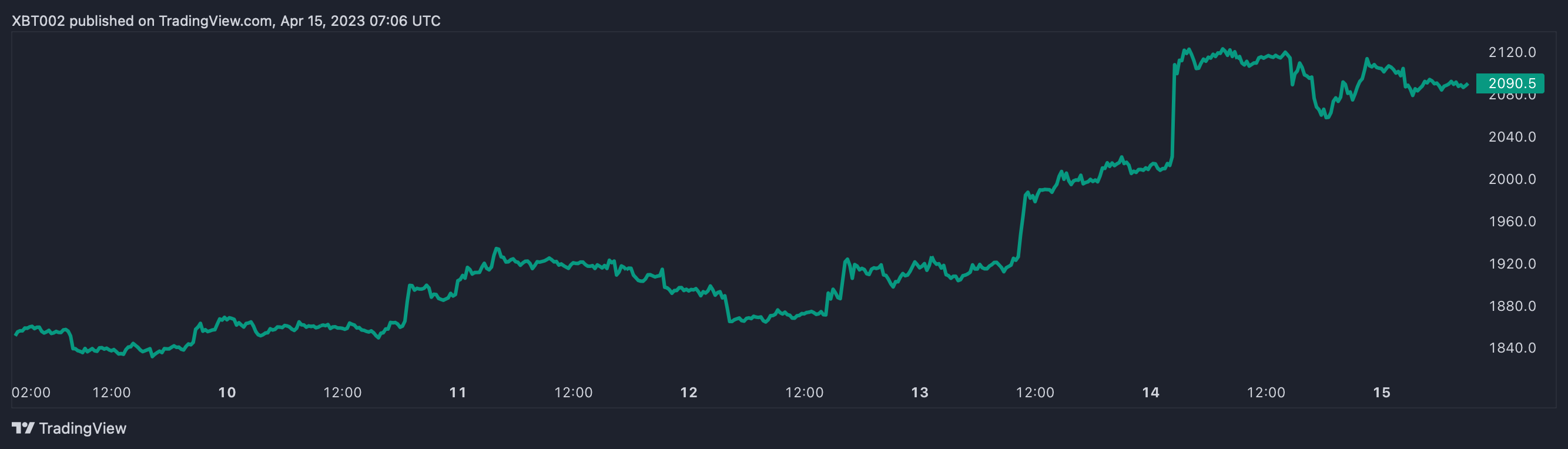
Alongside a growing withdrawal queue, the price of ether has — against the expectations of some analysts and short sellers — increased following Shapella’s implementation. Ethereum’s native coin is currently changing hands just below $2100.

TradingView price chart showing the price of ETH increasing over the past week following Shanghai.

The price of ether has increased over the past week. Source: TradingView

How much ether is still staked?

The total amount of ether currently staked, excluding earned rewards, amounts to 17.23 million coins — worth $35.95 billion — and accounts for 15.34% of the total supply.

The net staking balance from yesterday — calculated by subtracting the total amount of ether withdrawn from the amount of ether deposited — is roughly -103,600 ETH (-$204.04 million). Approximately 201,840 ether has been withdrawn, while roughly 98,240 ether has been deposited.

The net staking balance since the Shanghai hard fork is a similar -112,110 ETH (-$228.72 million) — with 325,900 coins withdrawn and 213,790 coins deposited.

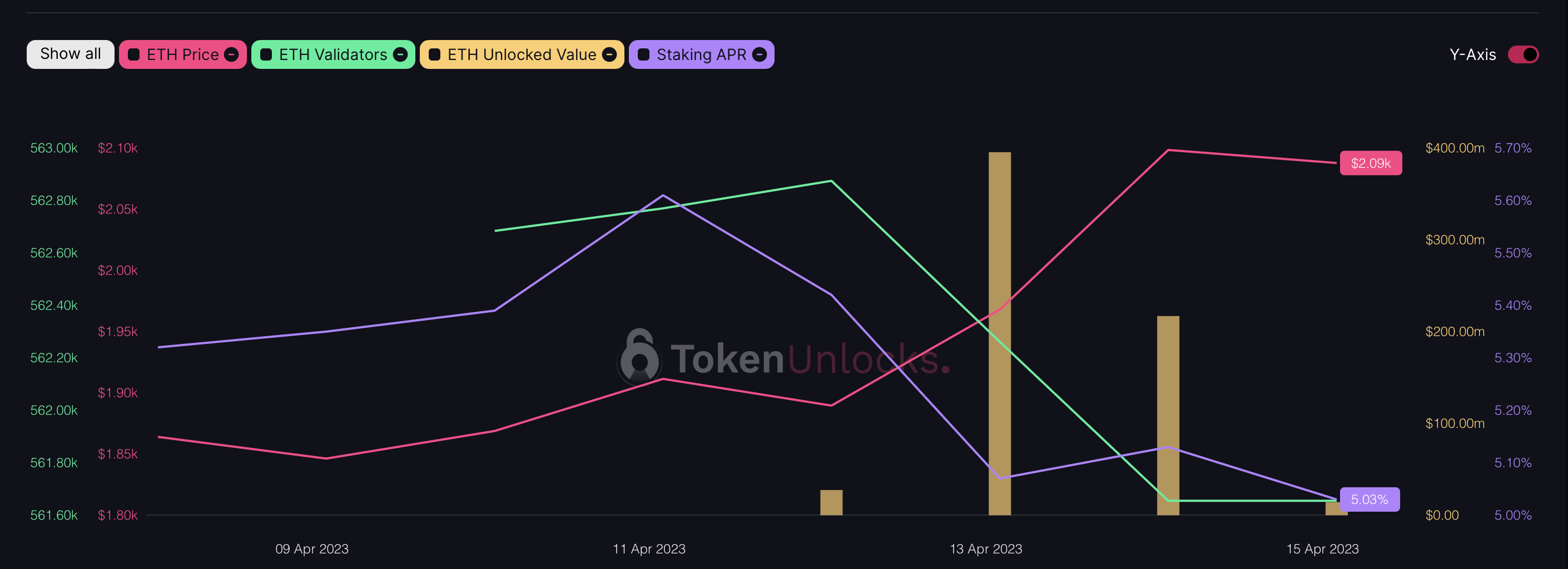
TokenUnlocks chart showing historical ETH statistics.

The price of ether increased while ETH validators and staking APR decreased. Source: token.unlocks.app

Kraken leading ether withdrawals

The most prominent withdrawal of staked ether may be attributed to the centralized exchange Kraken, which initiated withdrawals exceeding 551,000 ETH (valued at more than $1 billion).

Kraken’s unstaking activities were motivated by the resolution of charges imposed by the U.S. Securities and Exchange Commission, accusing Kraken of not registering its staking program in the United States. Kraken consented to pay a $30 million penalty to settle these charges.

Other centralized exchanges, such as Coinbase and Binance, have also opened up Ethereum unstaking withdrawals. 

Conversely, a peer-to-peer staking pool recently deposited close to 50,200 ether.

‘A bullish event for Ethereum’

The withdrawal of staked ether has, so far, been slower than expected, according to Grayscale’s Matt Maximo and Michael Zhao. 

“Although withdrawals might continue to grow in the near term, withdrawals do not necessarily signal selling, as users could be rotating validators or switching to staking providers that offer higher yields,” the analysts wrote.

“We believe that the short-term price impact from the Shanghai upgrade will be less severe than initially anticipated, attributable to the lower number of ETH withdrawals and full exits,” they added, while concluding: “Looking ahead, we think this is a bullish event for Ethereum, as reducing staking risks could boost the baseline demand for ETH.”

What is Ethereum’s Shapella?

The Shapella update for Ethereum, which is the first significant modification since the protocol shifted to a proof-of-stake consensus mechanism with last year’s Merge, was activated shortly before 6:30 p.m. EDT on April 12 at block height 6209536.

By implementing Ethereum Improvement Proposal 4895, the Shapella hard fork enables users and validators to withdraw their staked ether.

Furthermore, the Shapella update enhances the efficiency of Ethereum gas fees for specific transactions.

© 2023 The Block Crypto, Inc. All Rights Reserved. This article is provided for informational purposes only. It is not offered or intended to be used as legal, tax, investment, financial, or other advice.

Go to Source
Author: Adam James

TrueUSD’s Bitcoin Trading Volume Nears Tether’s on Binance but Traders Hesitate to Use the Token

Go to Source
Author: Krisztian Sandor


Follow by Email
Facebook20
Pinterest20
fb-share-icon
LinkedIn20
Share