FreeCryptoCurrency.Me

Free stocks and money too!

Author: samwsimpson_lyjt8578

Stablecoin supply grew by 388% this year, driven by DeFi and derivatives

The market for stablecoins experienced breakneck growth in 2021, with the supply for dollar-backed cryptocurrencies surging by 388%, according to data compiled by The Block Research. 

As indicated by The Block Research’s 2022 Digital Asset Outlook report, the aggregate supply of stablecoins has increased from $29 billion at the start of 2021 to more than $140 billion. That growth benefited a swathe of stablecoins, including tether (USDT) and USD coin (USDC), which is managed by a consortium that includes Circle and Coinbase. 

Several factors contributed to the surge in the outstanding supply of stablecoins, which historically have been used by high-speed crypto trading firms as a way to dampen volatility when trading between different cryptocurrencies. Over the course of 2021, retail traders parked stablecoins on decentralized finance protocols as a way to tap into juicy yields. 

The growth of the derivatives market was another tailwind. Most derivatives venues settle futures contracts in stablecoins, noted Tether’s Paolo Ardoino. 

Still, the market faced added scrutiny in 2021, as noted by The Block Research. While legal headaches have long hung over Tether, the entire market came under focus with regulators questioning the possible systemic risk such coins might poise to the market and whether they should come under a more direct regulatory framework. A report by President Biden’s Working Group on Financial Markets along with other agencies suggested introducing new legislation to require stablecoin issuers to be regulated similarly to banks. 

Looking to the future, Circle’s CEO Jeremy Allaire said that 2022 will mark the year in which companies turn to stablecoins to improve payments. He said that more people and companies are wanting to hold stablecoins, which is generating demand for them around the world.

“We are seeing demand across many fronts simultaneously…DeFi, CeFi, but also increasing amounts of general usage for payments,” he said.

Read the full report here

© 2021 The Block Crypto, Inc. All Rights Reserved. This article is provided for informational purposes only. It is not offered or intended to be used as legal, tax, investment, financial, or other advice.

Go to Source
Author: Frank Chaparro

The Bank of England will push for tighter rules as institutions embrace crypto, official says

The Bank of England wants stronger rules for crypto assets on an international scale as banks and institutional investors deepen their involvement, according to an official at the UK central bank.

Sarah Breeden, who works as Executive Director for Financial Stability Strategy and Risk, told The Times in an interview that the focus on international coordination among central bank is a reflection of the difficulty in obtaining data on institutional crypto holdings. 

“This is not something the UK can solve all on its own,” Breeden told the Times. 

Breeden’s comments are perhaps unsurprising, given that other central bank officials have, in recent months, called for closer international cooperation among regulators, including those focused on the banking sector. Indeed, Breeden’s comments echoed those included in a financial stability report released by the BoE last week. 

Tighter rules would “manage risks, encourage sustainable innovation and maintain broader trust and integrity in the financial system,” the central bank said at the time.

Breeden reportedly highlighted work being done at the Financial Stability Board in this area. The FSB, formed in the wake of the financial crisis of the late 2000s, has spent several years developing a framework for crypto regulation and has similarly advocated for coordination among the world’s regulatory bodies.

The BoE’s plans also dovetail with efforts to more closely regulate the crypto industry within the UK as well.

“We don’t have a regulatory framework that’s fit for crypto-coins yet, but what we are doing is rolling our sleeves up and getting ready to build it,” Breeden told The Times.

© 2021 The Block Crypto, Inc. All Rights Reserved. This article is provided for informational purposes only. It is not offered or intended to be used as legal, tax, investment, financial, or other advice.

Go to Source
Author: Michael McSweeney

Parachains officially launch on Polkadot network

The long-in-the-making process of bringing multiple blockchains to the Polkadot network culminated this weekend with the official kick-off of five parachains.

The five parachains that went live this weekend — Acala, Astar, Clover, Moonbeam, and Parallel Finance — were chosen following successful parachain auctions. All told, nearly 99 million DOT, worth approximately $2.4 billion, was garnered by the five projects during the auction period. Winning projects effectively lease their parachain slots, which last for 96 weeks.

“The launch of parachains on Polkadot represents the culmination of the original vision outlined in the Polkadot Whitepaper (aka the Polkadot Paper) in 2016,” the Polkadot team said in a statement. “The Polkadot Paper outlined Polkadot’s core features and sketched out the network’s sharded multichain design. Parachains are the final piece of core functionality, as outlined in the paper, to be fully launched. How Polkadot evolves from here is up to its community of DOT holders, who will approve any future upgrades via the network’s on-chain governance system.”

The winning projects are focused on a number of use cases, including decentralized finance and lending, among others. The idea of parachains is that each individual network can support different use profiles, all tethered to Polkadot’s Relay Chain. 

As noted by The Block Research’s John Dantoni in a recent ecosystem map, there are more than 200 projects focused on Polkadot across 19 verticals. 

A series of additional parachain auctions are currently live, according to a website that tracks auction performance. 

© 2021 The Block Crypto, Inc. All Rights Reserved. This article is provided for informational purposes only. It is not offered or intended to be used as legal, tax, investment, financial, or other advice.

Go to Source
Author: Michael McSweeney

BinanceUS taps Intel’s top compliance exec to serve as chief risk officer

BinanceUS said this week that Sidney Majalya, formerly chief compliance officer at Intel, will serve as the crypto exchange’s chief risk officer.

According to a blog post, Majalya will report to CEO Brian Shroder, who was promoted to that position in October. Shroder ultimately took the helm after the exit of Brian Brooks, the former OCC chief whose several-month stint drew headlines and attention to the Binance-linked, US-based exchange. 

“Binance.US is deeply committed to compliance, and our priority is to maintain and grow a world-class compliance and risk organization that earns the utmost confidence and trust of our customers, investors, and regulators,” Majalya said in a statement.

Majalya’s hire comes as Binance, facing pressure from regulators worldwide, has sought to beef up its compliance and regulatory bonafides. “We want to be regulated,” Binance CEO Changpeng Zhao said during an interview last month.

BinanceUS is also seeking to raise outside capital at a multibillion-dollar valuation, as The Block reported in September.

© 2021 The Block Crypto, Inc. All Rights Reserved. This article is provided for informational purposes only. It is not offered or intended to be used as legal, tax, investment, financial, or other advice.

Go to Source
Author: Michael McSweeney

MicroStrategy CEO outlines potential ways to ‘generate yield’ from the company’s Bitcoin holdings

To date, MicroStrategy has acquired more than 122,000 BTC — and now the company is looking at potential ways to “generate yield” from those holdings, according to CEO Michael Saylor.

While Saylor stressed that “we have not taken any formal step here yet,” he nonetheless explained that the company is “really enthusiastic about the opportunities to generate yield off of our bitcoin.”

He went on to say:

“We think that [in] the future, there may be opportunities to either put a mortgage against it and generate long-term debt under favorable circumstances, which we could leverage up against the bitcoin. Or we think that we could lend it to a trustworthy counterparty. And when we find the counterparty that we trust and the circumstance w e trust, we might lend it out and generate yield. Or the third possibility would be to put it in some kind of partnership. You can think of it as putting a lien on it. If we did a partnership with a big tech company or a big bank or some other player that really wanted that access to that bitcoin, that could become a good source of income for us.”

Saylor added that “[o]r we could develop it, with some kind of interesting application.”

The potential options for such a strategy were outlined during an investor day presentation on Friday, during which Saylor elaborated on the firm’s overall business strategy. 

As might be expected, Saylor stated that the company is  “going to keep acquiring bitcoin, that’s the plan, that’s the strategy.”

© 2021 The Block Crypto, Inc. All Rights Reserved. This article is provided for informational purposes only. It is not offered or intended to be used as legal, tax, investment, financial, or other advice.

Go to Source
Author: Michael McSweeney

[SPONSORED] More than 75 million ADA already delegated in Genius Yield’s stake pools 24h after ISPO launch

After successfully raising $4.2 million in its seed round, Genius Yield is now launching its Initial Stake Pool Offering (ISPO).

Zug, Switzerland – December 16, 2021. After successfully raising $4.2 million in its seed round, Genius Yield is now launching its Initial Stake Pool Offering (ISPO). More than 75 million ADA (worth almost $100 million at the time of writing) have already been delegated into the now four dedicated stake pools, a record number when it comes to similar projects on Cardano.

“We launched 2 pools 2 weeks ahead of the start of our ISPO and started seeing incredible numbers really fast. We added 2 more as we were nearing the launch to avoid saturation. While we’re confident in our team and what we’re building, seeing our community rising to the occasion by delegating so much so early is encouraging. It means that what we’re trying to achieve really resonates with people.”

Dr Lars Brünjes, Genius Yield’s CTO and Director of Education at IOHK – the company building Cardano.

For people who are new to the ecosystem, here’s how you can participate to the ISPO:
1. Buy ADA on your favourite exchange
2. Create a Cardano wallet – we recommend Yoroi
3. Transfer your ADA from your exchange to your Yoroi wallet address
4. Delegate your ADA to a GENS stake pool:
– Open up your Yoroi wallet
– Select ‘Delegation List’
– Type ‘GENS’ in the search bar
– Pick a GENS pool and delegate

Genius Yield has opened two new 100% GENS rewards pools: GENS3 and GENS4! New investors should not delegate to GENS1 anymore as it’s already fully saturated: new delegators will not earn GENS rewards while earlier delegators will not be affected.
GENS1, GENS3, and GENS4 pools reward 100% in GENS, while GENS2 rewards 50% in GENS and 50% in ADA. The maximum capacity of each pool is 64 million ADA.


Genius Yield ISPO

While the world of DeFi provides many investment opportunities, managing capital is both complex and time-consuming for most users. That is why Genius Yield is building an all-in-one solution that enables users to benefit from advanced algorithmic trading strategies within an intuitive, hassle-free, and secure platform.

Users will be able to deposit the tokens of their choice and customize their investment strategy based on a number of factors: expected returns, fees they’re willing to pay, risk tolerance, when to take profits, and so on. Genius Yield’s AI-powered Smart Liquidity Management protocol will then maximize their yields while minimizing risk exposure.

In addition to that, the team is also working on launching its Genius Yield Academy in the coming weeks.

“We believe knowledge is power, hence why we’re building a community-driven educational and mentorship platform that teaches DeFi concepts and supports everyone in their journey towards financial freedom.”
-Dr. Sothy Kol-Men, co-founder.

Genius Yield ISPO basics:
Start date: December 15th, 2021
End date: June 15th, 2022
GENS Rewards: 10 Million GENS
Running for 36 Epoch (1 epoch = 5 days)  

Accumulated GENS rewards will be airdropped to the delegator’s wallet after the Token Genesis Event (time of minting). ADA holders will be able to delegate their funds to a stake pool in exchange for staking rewards. To participate in the ISPO you will simply need to delegate to Genius Yield’s’ stake pools. In return, you will be rewarded with GENS tokens based on the amount of ADA staked and the length of staking.

For more details see Genius Yield’s ISPO documentation.

About Genius Yield

While DeFi provides many investment opportunities, managing capital is both complex and time-consuming. Genius Yield is your all-in-one solution to benefit from advanced algorithmic trading strategies and yield optimization opportunities. Our Smart Liquidity Management protocol is intuitive, hassle-free, and secure. Genius Yield minimizes risk and maximizes profits.

Website: https://www.geniusyield.co  
Telegram: https://t.me/geniusyield_official
Discord: https://discord.gg/aRxX8YEe
Medium: https://geniusyield.medium.com/
Twitter: https://twitter.com/GeniusyieldO

© 2021 The Block Crypto, Inc. All Rights Reserved. This article is provided for informational purposes only. It is not offered or intended to be used as legal, tax, investment, financial, or other advice.

Go to Source
Author: Sponsored

Adidas Originals nets $23 million after closing its first NFT drop

The German sportswear brand Adidas Originals earned 5924 ETH, or $23.5 million, from its collaborative “Into the Metaverse” drop with Bored Ape Yacht Club (BAYC), the non-fungible token (NFT) collector gmoney and the crypto-focused media group PUNKS Comic.

Adidas Originals began its Early Access minting stage on December 17, in which holders of an Adidas Originals proof-of-attendance protocol (“POAP,” which are given to attendees of virtual or physical events), gmoney POAP, a BAYC or Mutant Ape Yacht Club NFT or a Pixel Wallet NFT gained entry. The Early Access stage minted 20,000 NFTs for 0.2 ETH — $15.5 million — and finished a little after 5pm ET. 

Those without these assets could still mint one of the 9,620 “Into the Metaverse” NFTs in a general sale beginning at 6pm ET. Upon completion, that added about $7.5 million to the total mint earnings. Adidas Originals and its partners are holding 380 NFTs for future events. 

As The Block previously reported, Adidas Originals paused its Early Access mint soon after its launch due to an issue with Mutant Ape Yacht Club. The brand assured users that those with failed transactions will be able to mint once the sale resumes and that they’ll cover the cost of lost gas fees.

© 2021 The Block Crypto, Inc. All Rights Reserved. This article is provided for informational purposes only. It is not offered or intended to be used as legal, tax, investment, financial, or other advice.

Go to Source
Author: MK Manoylov

FSOC says it will seek to mitigate stablecoin risks if Congress doesn’t

The Financial Stability Oversight Committee finalized its 2021 report at today’s meeting.

The annual report recommends that federal and state regulators continue to scrutinize digital assets for potential risks to the financial system.

The Committee reviewed the recently released President’s Working Group report on stablecoins, which elaborated on possible risks the tokens could pose to the financial system. That included concerns of runs on stablecoin reserves and the lack of clarity surrounding issuers’ reserves. The PWG called on Congress to limit stablecoin issuance to insured depository institutions, basically banks. 

FSOC recommended that its member agencies, which encompass major financial regulators chaired by Treasury Secretary Janet Yellen, consider the PWG recommendations. If Congress fails to act, FSOC said it’s prepared to take steps to mitigate the risks of stablecoins.

“The Council will also be prepared to consider steps available to it to address risks outlined in the PWG Report on Stablecoins in the event comprehensive
legislation is not enacted,” said the report. 

More broadly, it recommended regulators collaborate and coordinate where their mandates intersect when it comes to issues related to digital assets, and both state and federal regulators use current tools at their disposal to oversee digital assets.

As for the use of other digital assets, FSOC said their use as an investment instrument remains “limited.” The Committee said digital assets may not be appropriate for many investors due to their volatile price action.

“It appears that speculation continues to drive the majority of digital asset activity, though it is unclear what percentage of transactions may directly tie to economic activity given the pseudonymous nature of many transactions,” said the report.

The report also turned its attention to the decentralized finance (DeFi) space, which has been a growing area of concern as regulators contend with varying levels of decentralization in protocols. The report outlined a variety of risks, including market value fluctuation, operational issues and cybersecurity risks. These are particular concerns for those who are over-leveraged, according to FSOC.  

“The use of leverage to obtain exposure to highly volatile digital assets increases the risk of a fire sale in the underlying asset: a decrease in asset values could trigger a cycle of sales to meet margin calls and further price declines, possibly spilling into other digital assets,” said the report.

The report pointed to on-ramps and off-ramps between DeFi arrangements and the traditional financial sector as a potential risk factor, since these links “s may create a channel for a risk event in digital assets to spread to the broader financial system.”

Both DeFi and stablecoins implicate a number of regulators, like the Securities and Exchange Commission and the Commodities Futures Trading Commission. The assets themselves and the platforms or services they’re used in tandem with may be classified as securities, commodities or derivatives. If they do, they’re beholden to the accordant regulator, said FSOC. 

© 2021 The Block Crypto, Inc. All Rights Reserved. This article is provided for informational purposes only. It is not offered or intended to be used as legal, tax, investment, financial, or other advice.

Go to Source
Author: Aislinn Keely

Adidas Originals pauses collaborative NFT mint

After announcing its collaborative NFT drop with well-known crypto figures, the German sportswear brand Adidas paused its inaugural mint shortly after its start. 

“Early access is not closed but minting has been paused while the developers investigate issues with Mutant Ape Yacht Club not being able to mint. We will update you as soon as we can,” Adidas Originals tweeted

“We’re working hard to resume the Early Access mint. Everyone with failed transactions will be able to mint after the sale resumes. And for those of you who lost gas fees, we are gathering your details and will reimburse you. Thanks for bearing with us,” the company later said.

Before the pause, 9,255 of the 30,000 NFTs have been minted — which already nets Adidas Originals 1,851 ETH (roughly $7.2 million USD). The firm stands to gain around $23 million once the mint closes. Adidas did not respond in time to clarify whether the firm will hold the proceeds of the mint as ETH or convert it into fiat currency. 

Adidas Originals had partnered with the popular NFT collection Bored Ape Yacht Club, the NFT collector gmoney and the crypto-focused media group PUNKS Comic for the NFT drop. 

Owners of these NFTs get access to physical items and forthcoming metaverse events from the four partners at no additional cost.

© 2021 The Block Crypto, Inc. All Rights Reserved. This article is provided for informational purposes only. It is not offered or intended to be used as legal, tax, investment, financial, or other advice.

Go to Source
Author: MK Manoylov

Backlash leads S.T.A.L.K.E.R. 2 developers to pull planned NFTs from forthcoming game

GSC Game World, a Ukrainian game development company behind the S.T.A.L.K.E.R and Cossacks titles, had decided to implement optional non-fungible tokens (NFTs) in their forthcoming S.T.A.L.K.E.R. 2 release. 

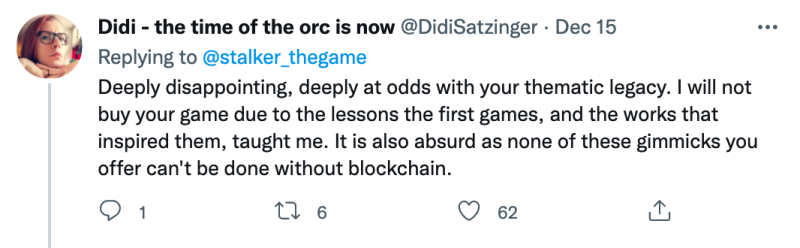
Within hours, fans took to Twitter to chastise GSC’s inclusion of NFTs, causing the small developer to pull NFTs from the game — suggesting that, while venture capitalists are still pouring funds into blockchain-based gaming endeavors, the general public isn’t so open to embracing the new technology application. 

In a statement emailed to The Block before GSC officially announced their inclusion of NFTs, GSC Game World CEO Evgeniy Grygorovych said: 

“Considering the global trends in gaming, we can do more than just offer an immersive game experience. Our players can get a deeper presence in the game, and we will give them this opportunity by presenting the first AAA game with a unique meta experience.” 

As described in the prior emailed statement, the NFTS would have been a part of the “S.T.A.L.K.E.R. Metaverse” launch. Users could have registered for in-game item drops starting in December, with the drop auction occurring in January. 

Included in the drop would be a new feature called “metahumans” in the game, or a non-player character that resembled the NFT’s owner would have been created by photogrammetry technology. A second drop of “high secretive genesis packs” would have occurred in February. A Los Angeles-based NFT trading platform called DMarket would have facilitated the NFT trades. 

GSC intended for the NFTs to be optional to players and offer no in-game benefits to those who didn’t want to purchase one. 

However, fans of the S.T.A.L.K.E.R. franchise did not like the game developers offering NFTs. Some of the responses to the official S.T.A.L.K.E.R. Metaverse post include: 


GSC clarified in a later post its intention with NFTs, but then deleted it soon after. 

GSC Game World’s now deleted reasoning for including NFTs, pulled from Twitter.

This is not the first time fan backlash caused project developers to scrap NFT inclusion. In October of 2021, five prominent young adult authors announced the creation of an NFT-based storytelling platform called Realm of Ruin, slated to launch on November 8. Users could create NFTs of their characters and write a backstory for them in what would have essentially been an MMORPG-esque story. However, intense backlash from fans caused the project developers to shut down the project altogether. 

And yet, the fan backlash begs the question: as blockchain-based gaming startups like Mythical Games and Forte raise millions of dollars, who will embrace these games? And how can blockchain-based gaming companies sell to potentially resistant players?

GSC decided that they will avoid using NFTs in its forthcoming game. 

GSC announcing on Twitter that it will not include NFTs in S.T.A.L.K.E.R. 2: Heart of Chernobyl.

When reached, GSC declined an interview request regarding the fan backlash toward NFTs.

© 2021 The Block Crypto, Inc. All Rights Reserved. This article is provided for informational purposes only. It is not offered or intended to be used as legal, tax, investment, financial, or other advice.

Go to Source
Author: MK Manoylov


Follow by Email
Facebook20
Pinterest20
fb-share-icon
LinkedIn20
Share